
Rishi Sunak and his family have all gone on holiday leaving England and the remainder of the United Kingdom in tatters. So it was no surprise that when the five Greenpeace ‘Stop Oil’ activists knocked on the door of Sunak’s country home in North Yorkshire and nobody opened the door, they felt free to climb onto the rooftop of the grade II-listed manor house and drape oil-black fabric over it before posing with their ‘Stop Oil’ Banner in front of the house – protesting against the government’s decision to expand North Sea oil drilling. There is – naturally – to be an inquiry – as to how and why the Prime Minister’s house was left so unattended. Surely there was some surveillance in place. But as Sunak has begun to show his real colors – under the tiniest bit of pressure on a radio program (listeners take note) we have seen his business management underbelly and once more our hopes – why do we even have them? – are dashed. What is Rishi doing looking to lift the 20 mph speed limits in some small residential neighborhoods while issuing new licenses for North Sea Oil drilling? I’m remembering – not that long ago – when the new King very pointedly invited the new Prime Minister to speak at a reception the King was giving for world leaders gathering before a conference on climate change. Rishi popped over to the conference in a private jet to smile and show up. But now he reminds us that ‘you can take a horse to water but you can’t make him drink’.
So it is with renewed respect we watch the Mayor of London Sadiq Khan, with his bushy eyebrows, sticking to his guns with the expansion of London’s low emission zone, saying tackling the climate emergency and air pollution are “bigger than party politics”. While those in parliament waffle and wave according to their party’s policies, Khan is staying true to his course. He is winning some and losing others. Hundreds of doctors have urged politicians to stand firm on initiatives to tackle air pollution, warning that they see its “devastating health consequences” in patients on a daily basis. Air pollution is the single largest environmental risk to public health, linked to between 28,000 and 36,000 UK deaths a year. Air pollution affects every one of us from before we are born into old age. I remember in 1966 looking into the chest of a young Mexican 16-year-old boy who had only been in the city for six weeks. His lungs were already pinpointed with black city pollution.
As I write, the Bibby Stockholm barge is receiving its first asylum seekers – refugees – today. There was a small stall – was this going to be a fire trap? But though Amnesty International calls the barge and its use a ‘Ministerial cruelty’, food will be served in the canteen tonight.
A combination of our 58th wedding anniversary, a small window of time, with the excuse to see a beloved old friend, and the long-anticipated search for Murches – dead more than alive – takes us to Devon and the northern end of Dartmoor.
The two-carriage train runs on old tracks – clickety clack, clickety clack – from Exeter-St. David to Okehampton, slowly rolling past the rows of not-yet-old oak trees marking the hedgerows separating pastures as some far-thinking farmers return to the old ways. The hedgerows are made of stone with some post and rail. There is little wire to be seen. The clouds are hanging low as if chasing the fields into the sea. There is no taxi stand at the Okehampton train station, but drivers swing in and out around train arrival times to see if they can hook a passenger and soon we are caught. But our man has only lived in these ‘ere parts for six years, “A second marriage,” he says, and driven for two which may explain the very long route that brought us through cow pastures – where he had to be reminded to close the gates – with a herd of fine healthy Devonshire cows, and the rubbish dumpster bins, to the back of the hotel for 27 pounds thank you very much. This one is not yet a local.
We are staying at the most elegant and expensive of hotels at Gidleigh Park which carries just the slightest breath of Fawlty Towers to remind us we are in England. After we check-in, there is time for a walk to the hamlet of Murchington. From the hotel, we dip into the woodlands of an ancient forest of Oak and Beech trees where the River Teign runs freely alongside of the path. This is the wilderness of fairies and Robin Hood. We leave the forest for the lanes that are as narrow as I remember them and the bracken is mid-summer high allowing the brambles to twine over and around the long fronds while wild white yarrow and pale orange columbine wave gently where they can. The couch grass remains stubbornly growing and uneaten by the cattle or sheep in the pastures. It’s a good climb up the hill before going down into the dale and finding the old sign of Murchington where Beatrice posed forty years ago. The few cars that pass are careful enough to let us squeeze into the bracken and it isn’t until we crest the hill – before the final dale – that we meet another traveler on the road. She is short and quite round, walking in country clothes with a fine leather hat, and two poles. She is moving slowly and when we first pass her taking a talking break with a motorist “Are we far from Murchington?” I ask, “Just down there. I live in Upper Murchington.” so we carry on. Murchington is now a hamlet having only a few houses with the church being decommissioned in 1975 and there is no central place of worship or community. Sometimes a hamlet is a small group of Kinsmen, no larger than an extended family or clan, though there are no Murches living in Murchington, nor could we find trace of any. On our return – there is not a lot to see in Murchington – our fellow traveler is now polling on the other side of the hill and we pause together. “I like your hat,” says Walter, and that is all it takes to learn about her two children, in Texas and Portugal, far away from this widowed mother who has just had double knee surgery and is walking alone along a country lane.
Back at the hotel and we change for dinner. To dine here is an event and joining us are my oldest friend from Nursing school 60 years ago, Sally, and her daughter Emma who is a leading conservationist with her Dartmoor’s Daughter tours of Dartmoor. There are screams of delight and so much laughter when we see each other and the tears of joy would fall but that we are both – even at 80 – mindful of mascara. When dinner is served it behooves us to pay attention for the care, flavor, and presentation is exquisite, though a far cry from the gnawing on bones by the forest fire that could have been here mere centuries ago.

The next day is for searching for those long-dead Murches that we are pretty sure are lying about in the Church graveyard. But first, there is morning coffee – at a small cafe where the local artists gather- in the town of Chagford. The four tables that have been put together for us take up almost half of the cafe space. We are late – Richard – our taxi driver – knows his way about, but then there are cattle and ponies on the road and hellos to be shared. Immediately when we arrive fresh coffee is served and we split up – the conversation rushes deeply into the arts at one end of the table and conservation and humanity at the other. It’s a wonderful way to spend a Saturday morning – with people who care – reinforcing each other – encouraging by just showing up – before we wave our goodbyes and slip away into the day.
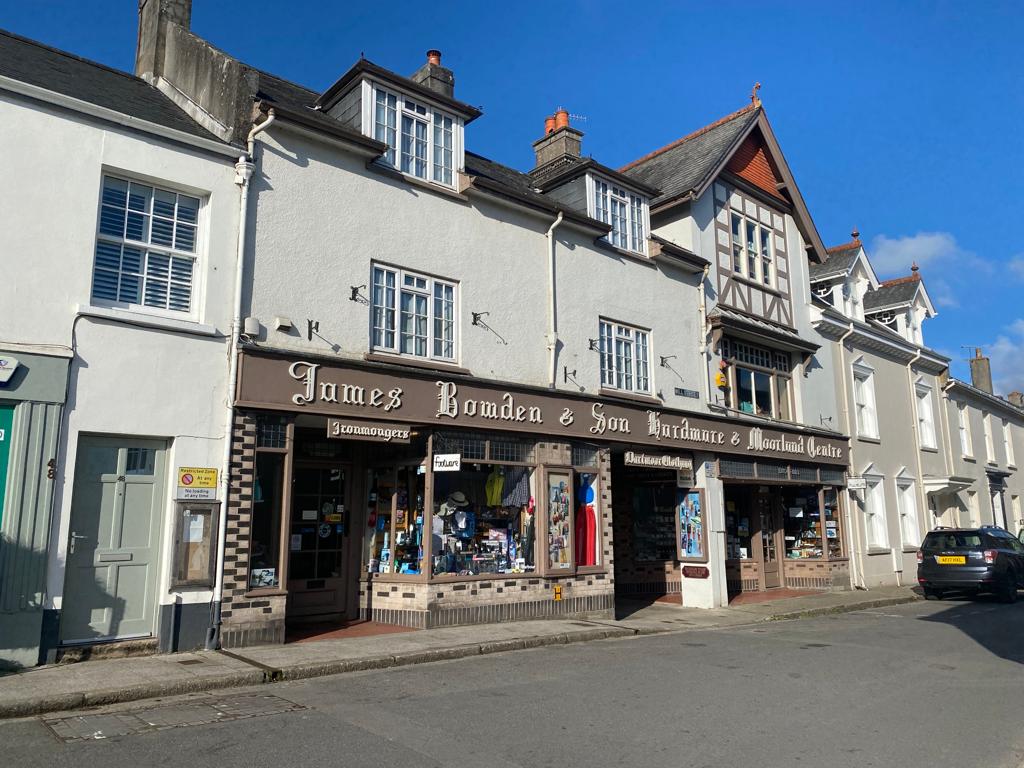
It is beginning to rain – a soft rain – as Sally guides us to the hardware shop that sells everything you need at home and more enticingly has a museum room in the back. It is here that we find the first evidence of George Murch, wheelwright, who sold this shop to James Bowden in 1862. The little room that sells the boots would have been his first shop room. It is comforting to know that we both come from working stock a wheelwright and Slater, such names carry the trades of our forefathers. And more than one Murch married into the Perryman family from Stancombe, giving me full license to go ahead with cider making. As the soft rain gets stronger Sally leaves us at the Chagford churchyard of St Michael the Archangel where someone did what we all mean to do with our boxes of old photographs – gone through the graveyard and mapped out as to whom is buried where – it doesn’t take any time at all to find one of George’s sons, William but not George. William’s gravestone is still upright but leaning a bit as most in the ‘old’ graveyard are. We stand in the rain and think about those lives. The ones that came before us – not so very long ago – was William the one who stayed behind so that James could leave? Or was James always restless – the one who would venture out no matter what? He never named a son of his after his father. These are stories we may not know but only imagine.
On Sunday morning there is a knock on the door and our morning tea, toast, and flaking-everywhere croissant arrives. We are rested and ready to leave with Emma at 8.15 a.m. for a 9.30 start on our guided Wool Walk. After picking up Sally and a friend, Emma sets off at a roaring pace along those single-lane roads and we are soon out on the moor which stretches before us with heart-holding beauty. The sheep are grazing and resting beside the road along with small herds of cows and ponies. Low patches of late gorse hold tightly to the beginning blooms of heather.
The walk is led by – I quote – qualified Hill and Moorland Leader, Emma Cunis aka Dartmoor’s Daughter, and Kristy Turner, Curator of the Dyeing on Dartmoor exhibition at the Museum of Dartmoor Life. Emma and Kristy give us a little introductory talk and we share our names and reasons for walking this Sunday morning. The walk is billed as ‘Easy’ and as we set off Emma acknowledges that we will be of different walking abilities: some fast, some in the middle, and some – a little slower. It doesn’t take long for me to realize I am among the latter- more than a little slower – and this sobers me as I miss the woman I used to be.

This morning Sally wrote “It came to me last night, we are a bit like ancient oak trees, a bit bent and gnarled, but the inner strength keeps us going. So from one Oak tree to another, take care of your roots and branches but wave your leaves merrily into the air whenever you get the chance.” This is friendship and sounds like good advice for us all.
This has been A Letter from A. Broad, written and read for you by Muriel Murch.
 Muriel Murch
Aggie, This one is especially lovely. Carry on, Mary
Mary Nisbet/California Orchidswww.californiaorchids.com
<
div dir=”ltr”>
<
blockquote type=”cite”>
LikeLiked by 1 person