Monday Nights at the Movies with Mark

Written and read for you by Muriel Murch with WSM by my side

It’s a Monday evening for goodness sake, with an early opening of 6.30 pm. People have to rush from work, and – this being a youngish crowd – they do. The British Film Institute is hosting its 92nd MK3D monthly – Monday night at the Movies with Mark  – Kermode that is – and the theatre is packed with a live audience of hundreds of film fanatics. Which is what they must be because Mark and his team never announce who his guests will be. For the past few months the BFI has been going through some serious renovations – we hear the new bar is not senior friendly – and this live event is the 4th to take place at the IMAX theatre in Waterloo – between the railway station and the bridge across the Thames River. Unless you really know where you are going it is very easy to get lost. Our driver had to be chased down by a runner, to turn around and take a dive under the river before we were led on foot through a labyrinth of latrine smelling tunnels. But we made it in time and were gathered up by Mark’s team of very efficient and kind women. And this may be one of the keys to his success. Mark surrounds himself with good people and because he is good, and passionate about cinema and its history good people want to be on his show, want to hear his show and want to work for him. This night Walter was to be one of the guests and as we all assembled in a discrete roped-off corner of the bar, gentle weavings of admiration stretched across the guests who gratefully sipped their beverages of choice but as elders, we were happy to refrain, before being locked into an auditorium. 

After Mark’s news he introduced his first guest, Robbie Ryan, the director of Photography on ‘Poor Things’. Robbie was followed by Rachael Ramsay co-director of the documentary ‘Copa 71’ on the very successful Women’s Football World Cup that was erased from sporting history – until now. Then came Johnny Burn the sound designer on ‘The Zone of Interest,’ before the senior fellow, Walter gave a shout-out for the 50-year release of ‘The Conversation’ and his latest film ‘Her Name Was Moviola’ directed by Howard Berry.

Mark Kermode, WSM and Robbie Burn photo by MAM

Mark is deft in drawing out the information he wants from his guests and dropping in, like sweet strawberries, clips from the films they are talking about, for after all it is film that Mark and his audience are here for. But like all good hosts he also turns the questions a little more inward onto the guests. On a Literature program I might have asked a guest ‘What book is beside your bedside? Rose Grey, owner and chef of the River Cafe, asks her guests on the Podcast ‘Ruthies’ Table 4’ ‘what is the comfort food of your life’?  Mark’s question is ‘What are the films that have influenced you?’ and then showed chosen clips.

Robbie Ryan picked ‘The Elephant Man’, and ‘Women in Love’. Rachael Ramsey a lesser-known work, ‘Bring It On’, Johnny Burn chose ‘Apocalypse Now’ and Walter picked the final scene of ‘2001’. The breadth of these films, the evolution of their styles and subjects left me – again – in awe of the art of Cinema. 

Burlington Arcade Beadles outfitted by Joshua Kane

On Saturday – when London is given over completely to tourists – I am making my way down to Piccadilly for the last-minute errands before a real vacation, and I hurry as best I can through the streets. From New Bond Street I weave my way into the Burlington Arcade, now almost completely overtaken by boutiques with the bling of today. I see two old shops that remain – their windows filled with diamond brooches and rings laid out on black velvet, looking like small spinsters trying not to seem bold. Two young Beadles were stationed – one at each end of the arcade – but neither was wearing their beautiful Joshua Kane outfits, merely a routine heavy black with white piping livery coat and top-hat. Coming to the Piccadilly end of the arcade I slip into a gentleman’s summer sports shop and – because it is French – I buy my husband an elegant, and very expense pair of shorts. He will be furious but look great – he has good legs – and I’m smiling because he will – eventually – wear them. 
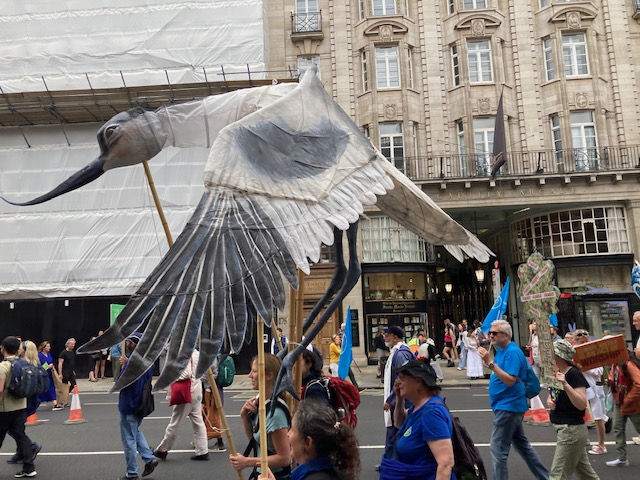
Earthday March with Bird on Piccadilly. Photo by MAM

On Piccadilly, a long march is going past and I think for a moment: it is for Palestine or Ukraine? But no, the colours are too soft and the energy too high. No one is silently angry, this is a peaceful Earth Day Summer Solstice parade march. There are human butterflies and bees and birds and placards and the spirits lifted. Their music makes me happy. I walk between them, all smiling and waving and slip into the last shops I need to go to.

For a moment I am able to forget the horrible wars that continue and the utter utter stupidity of the English Political General election that is happening next week. Now a row has erupted and – like a festering boil – causing swelling in all the body politic. Apparently a ‘few’, shall we say five, politicians have gone to the races – this being Ascot week after all – and as they say, ‘Put on a bob or two’ betting on the date and maybe the outcome of the General election. And in classic English fashion the security policeman who joined in this gamble has been arrested. The politicians have yet to have their knuckles rapped. This has taken over any talk about National Health patients waiting lists, education, or crime, or anything that the country really needs to think about.

I stick with the Earth Day marchers and pop into the teashop and the bookshop for more gifts and memories. Bookshops will do that.

A week earlier at a dinner party, Gabriel Garcia Marquez’s name had come up and Walter mentioned that when we had visited Cuba in 1989 and while strolling awhile after a long latin luncheon, Gabriel and I had made a connection. The dinner guests were eager to hear what that was and I quietly said that after we had spent some time together Gabriel had asked me to write to him.

“And did you?” was the breathless question. “Oh No. I was afraid of being collected.” and I could tell they were disappointed at the possibilities I had rejected.

Back at home as I pack up the gifts, I think again about Gabriel Marquez and all his books that I had not got around to reading. During one of those ’It’s 2 am and I’m still awake’ moments I find ‘One Hundred Years of Solitude’ on our study bookshelf and put it by my bedside. But it is at the local library that I find the one book I have read. ‘Love in the Time of Cholera’ published in 1985. An old friend and lover – of literature – and I had read it at the same time. Our friend died earlier this month and sitting under ancient olive trees overlooking hills and lakes of this corner of Italy this seems the right book, the right time to turn those pages and say farewell to over 60 years of friendship.
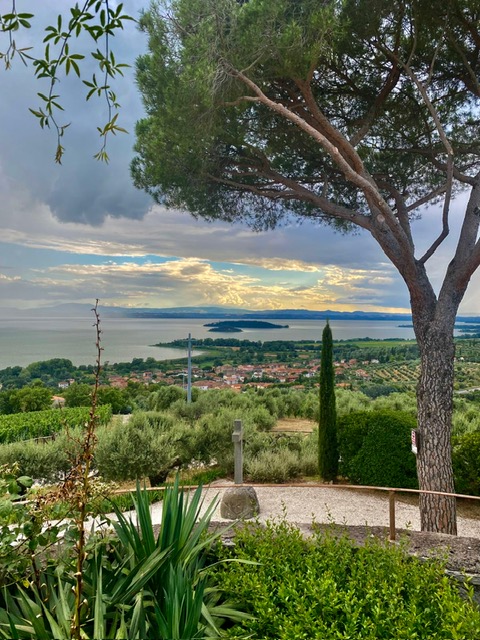
Overlooking the lake at evening time.

And always supported by Beatrice @ murchstudio.com
Somber June

Written and Produced for you by Muriel Murch with WSM by my side.

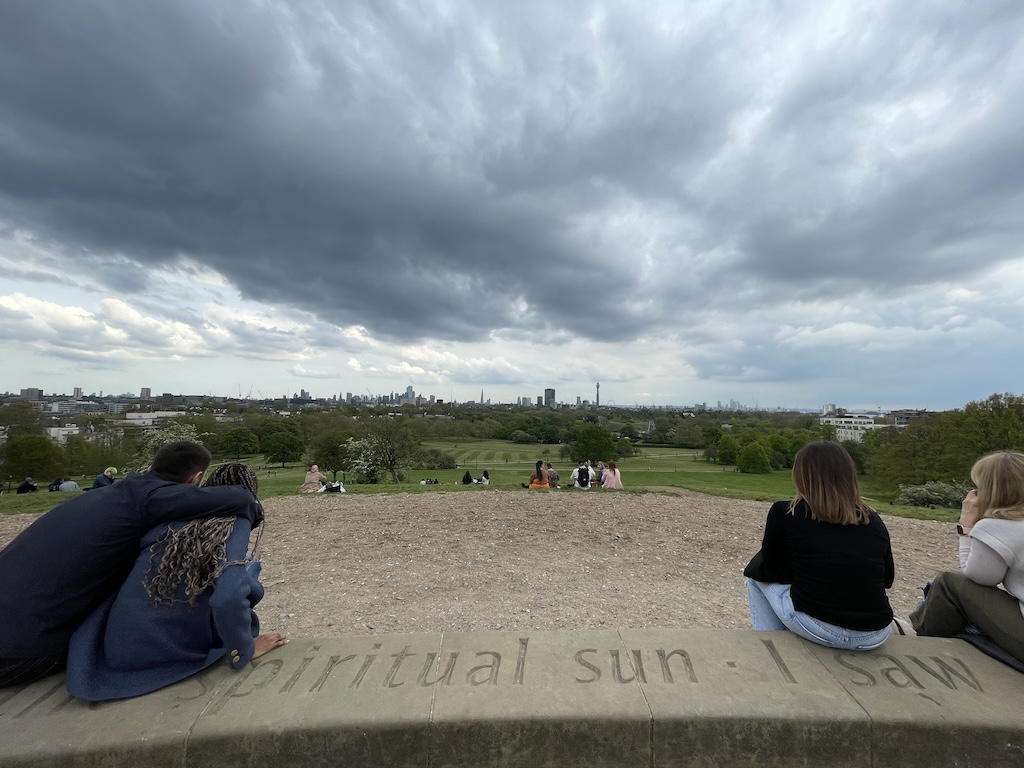
Grey skies and the London skyline over Primrose Hill by Beatrice Murch

The grey sky is pouting – there is no sun – just a half-hearted threat of rain. The London season is muted; the Chelsea Flower Show and Royal Ascot Race week do not shine as brightly in splashing colour across the weekly magazines. Even Queen Mary’s Rose garden in Regent’s Park – that in June is usually overwhelming with the attar of roses and a wild palette of colour – is subdued, while beds of favourite roses have been grubbed up and new adolescent bushes planted in their stead. On our little terrace the roses and geraniums that should be bursting with cheerful reds and yellows remain shy and closed, while the potted tomato plants stand nakedly to attention, seemingly condemned to a fruitless life. It is sobering. 

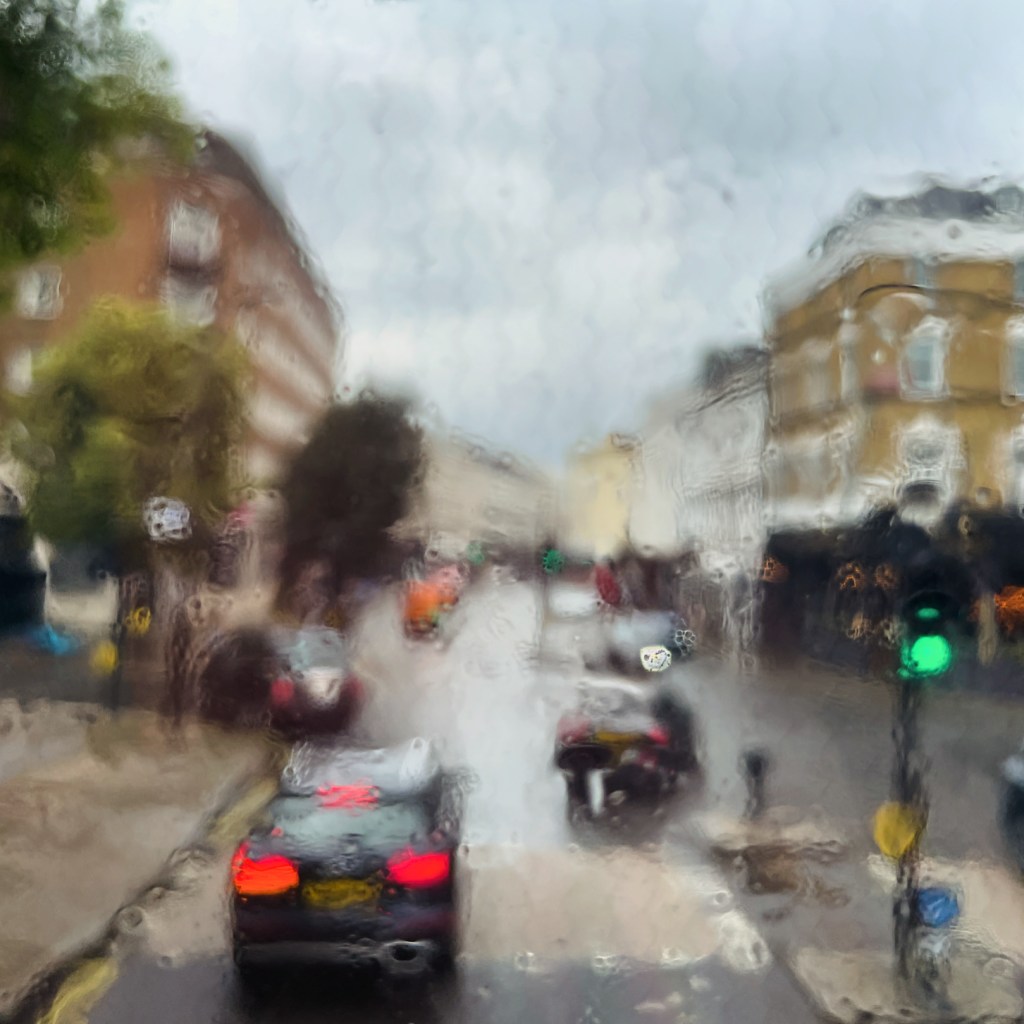
Rainy London from the top of a double decker red London bus by Beatrice Murch

At the bus stop on Thursday morning I join a small crowd waiting to catch the 31 that has gone missing from the Chalk Farm stop, “Not stopping here mate, you have to go back into Camden”. But I walked forward to Swiss Cottage – on past the road works overlooking the railway line that have been in progress for at least a year’s duration – and settled in to wait – looking as one does – for the big bright red bus to come around the corner. But it was hearing a sound I had not heard for years that had me turn my head. Sharp, fast hoofbeats and the King’s Household Cavalry came trotting smartly down the road from Primrose Hill on their way through North London to Hampstead. The traffic was stopped in all directions as the horses took over the streets – trotting in tandem, one rider with two horses. Keeping the Household Cavalry horses fit and quiet is only a part of the weeks of preparation that comes before next Saturday’s Trooping of the Colours which marks the Sovereign’s official birthday as it has for over 260 years. In April there was an ‘incident’ in London when a construction site’s sudden dumping of rubble down a roadside shaft spooked the horses and several bolted and soldiers were unceremoniously dumped on the road. It must have been quite a ruckus, as five horses  were injured along with three soldiers. Camera phones were clicking as the horses took off – galloping along the streets with blood streaming down their bodies. The incident was admirably ‘contained’ and progress information – first the horses and then the soldiers –  was metered out in the best British understated tradition.

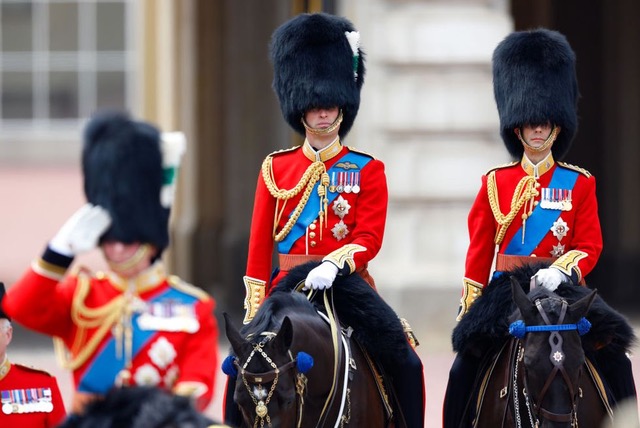
Prince William in procession photo by Getty

And so, on this upcoming Saturday the King will take the colours – not on horseback as he did last year – his first year as Monarch – but in a carriage befitting his health and doctor’s advice. And Princess Kate, the Duchess of Cornwall and the Colonel in Chief of the Irish Guards, whose honour it is this year to lead the trooping, was missing from this past week’s dress rehearsal. In a heartfelt letter to the regiment, she apologised and wished them all well and luck. As the nation does her. The silence around the princess’s illness is more sobering than the intermittent news of her father-in-law’s health, and underlines the rest of the news the country has to hear.

Not least is the snap election on July 4th called by Rishi Sunak. Standing at his podium outside of #10 Downing Street in a downpour of rain and unsuitable suit, the question of whether to raise an umbrella or not must have been a snap one, and as Sunak turned to retreat back inside – water dripping from his coat tail, he did truly look like a drowning rat, and one could not but help feeling just a little bit sorry for him. This week he was followed by the French President Emmanuel Macron dissolving the French parliament and calling for a snap election to be held within the next 30 days. The French president said the decision was a “serious and heavy” one, but that he could not resign himself to the fact that “far-right parties … are progressing everywhere on the continent”. He described it as “an act of confidence”, saying he had faith in France’s voters and “in the capacity of the French people to make the best choice for themselves and for future generations”. This is confusing to both the French people and the governing European bodies based in Brussels. How will it play out? Is it truly a bid for gathering up and solidifying a democracy that is crumbling over much of Europe and the world.

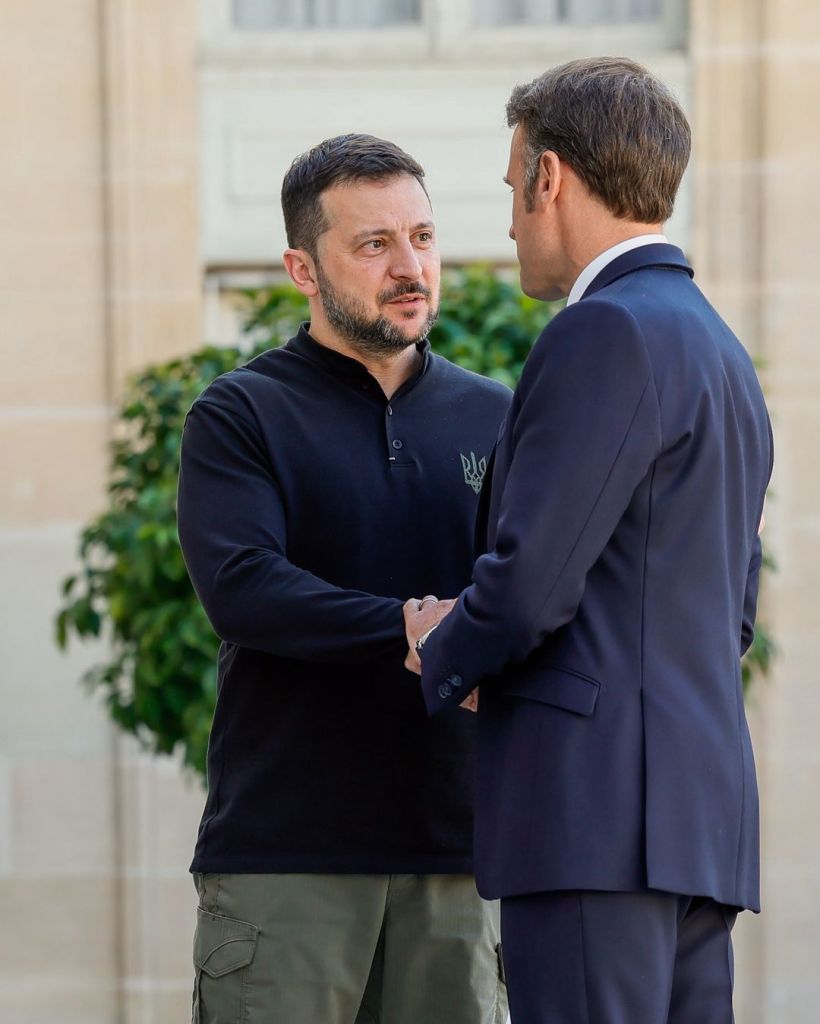
Presidents Zelensky & Macron in France June 2024 – photo courtesy of Macron Instagram

But before Macron called for his snap election – along with the leaders of the allied nations – among the Canadian, British and US, he attended the D-Day commemorations on Omaha Beach. This 80th remembrance brought together for maybe the last time, the mostly 100-year-old Veterans from all the Allied countries. A heavy dose of British royalties were also present to pay homage and show gratitude. This was also a time when the Ukrainian President Zelensky could say thank you while meeting and greeting and hopefully gathering more support for his country’s war. The Soviet Union lost more than 25 million lives in World War II and – though there have been Russian officials attending those ceremonies in the past – there were no invitations sent – or representatives present – in France this year. These wartime commemorations always bring a special pause in all countries – there are a lot of them and they do go on a bit, as they need to, because there is much that can happen there, in front of a camera or behind a closed door. President Zelensky has a lot of hustle to get through gathering the spoken, moral and physical support that he needs for Ukraine. Like chess pieces moved by an unseen magnet under the board, the world leaders who are present pick and choose which meetings and photo calls to attend. They circle each other, and the wars that they are fighting or funding. It is ironic that this commemoration, ending this war, is taking place as another war is embedded in the land that was to hold and heal the displaced people from 80 years ago. Each day – while Ukraine fights on – there is more news from the Middle East. After the carnage that killed 270 Palestinians to release four Israeli hostages, there is another US backed peace offering on the table endorsed by the UN security council – between Hamas and Israel. But there is little word of the others – refugees – otherwise known as Palestinians.

This has been A letter from A. Broad. written and read for you by Muriel Murch with support by WSM and as always overseen by – beatrice @ murchstudio.com 

Seeing Red

Written and produced by Muriel Murch

The sun is shining as we find our way into the  Queen Elizabeth Center on the South Bank of the River. The Uber drops us off and the driver waves vaguely in ‘that direction over there.’ Four men in yellow vests are lounging on a break and smile at our questioning faces. They point to a door set back in the wall and in we go. 

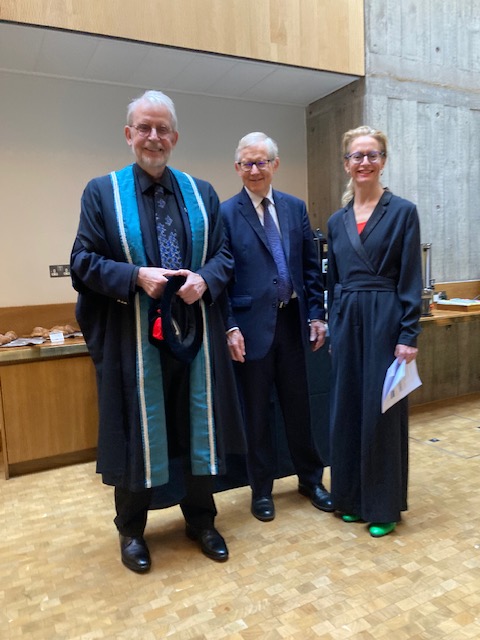
WSM about to be a Doctor of Philosophy of Film with a Governor and teacher of Ravenesbourne University.

Greeted with smiles of relief by the student staff that we got there in time, Walter is ushered away to be gowned. Beatrice and I head for the coffee while David eyes the pastries. One by one the professors emerge with gowns over their suits and mortarboards and velvet caps held sheepishly in hand to mill about and also eye the pastries. Each gown is different, signifying their graduating university. Walter and Robin Baker, OBE, RCA, FRSA will be wearing the turquoise of Ravensbourne and, because they are both to be made honorary Doctors, a soft velvet cap, with the appropriate colored tassel. The lovely student hostess takes Bea, David and I over to our reserved seating to wait. David takes out his drawing pencil and paper. The students come in clustered like bees – grouped in their disciplines – smiling and nervous while their families sit behind them, also smiling, proud and nervous. 

Ravensbourne is a small university that has made its way to London from the Ravensbourne river in Kent. Robin Baker is the man most responsible and it is his vision of the challenges – combining art and business that these young graduates face today. Finally we are asked to stand as the professors file in to take their places on the stage and turn to face those young eager faces solemnly looking back at them from the audience. There had been a moment of panic before entering the hall, Walter’s tassel was red – for journalism – instead of blue – for Education, Public works and Art – but it didn’t seem to stop this new Doctor of Philosophy in Film from accepting his diploma and saying a few words. And then David could leave.  As we watched the students enter the stage, accept their diplomas and return to their seat –  each in their own personal manner – we could see that 99% of these students are from Africa, India, and the Asian Continent all studying here in London, very much made possible by the quiet Robin Baker who had long ago understood that what the English have taken away we need to return.   

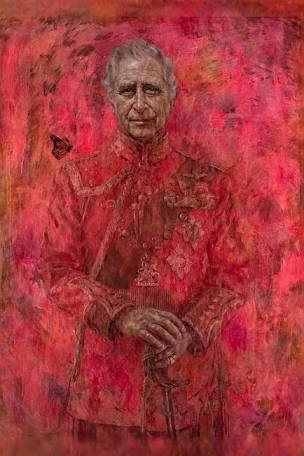
King Charles III painted by Johnathan Yeo

This week ever mindful of the English summer season beginning, the Kings first official Portrait was unveiled at Buckingham Palace by the King himself. Did he know it was so RED?  Painted by Jonathan Yeo it is, in fact, rather nice – if Red. Posters for sale on EBay are doing a brisk trade in print sales, for the picture is of a kindly king, handsome in an elder way. His face is sweet and only his hands show the physical work of weekends spend hedge-laying and hiking his beloved moors in all weathers. 

Meanwhile Europe is getting antsy. There are growing protests in Georgia. We must look at an atlas, Georgia, now where is that? Well it shares a boarder with Russia and from some Georgian towns it is possible to see smoke and gun-fire coming from the Russian army training grounds not a hundred miles away. If your border nestle beside Russia then you will either – like Belarus and President Lukashenko – welcome your mother or, like Ukraine, and its President Zelenskyy fight to protect your country as the Russian army invades with battles fought back and forth along the roadside coast-line or now like little Georgia get very nervous about laws being passed and seawalls to be protected. These are not little squabbles. While the Slovakian Prime Minister Robert Fido’s life is no longer in danger, feelings are high and divided between the peoples of Europe about the war in Ukraine and if their governments should support Ukraine or Russia. It has been over 20 years since a European politician was shot. This suspect was 71 – an age where one doesn’t have too much more to lose – a retired security guard and a poet.

Last Sunday there was an accident. Iran’s President Ebrahim Raisi along with the Foreign Minister  and six others were killed in a helicopter crash. There were no survivors. President Raisi was a hardline cleric close to Iran’s Supreme Leader, Ayatollah Khamenei. BBC Weather presenter Simon King – who used to brief RAF air crews ahead of missions in the Middle East says: “ … it seems it was clearly a disturbed weather day, forecasts suggest the cloud levels would be at a level that would have been covering the mountains, there would have been hill fog, so there would have been a lot of hazards to address.” Foggy weather can be a help or a hindrance – depending on your circumstances. 

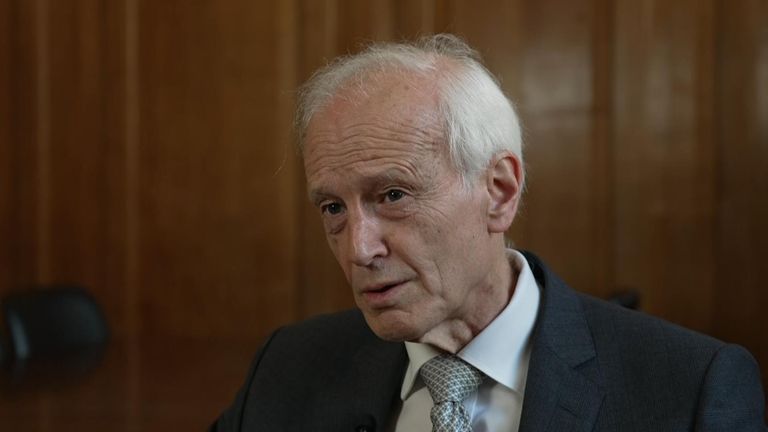
Sir Brian Langstaff Photo from Sky News

The old TV series, ‘Yes Minister” carries a longstanding political joke. One minister says, “There will be an inquiry”. The Prime Minister replies “Oh good. Then nothing will happen.” So it has always been. But finally one inquiry has come to a halt. Since the 1970’s when contaminated blood and blood products were given to patients through until the 1990’s, the Infected Blood Scandal has been pushed aside, shoved from one ministerial desk to another but not given up on. Finally, after Teresa May’s 2018 appointment of Brian Langstaff his report has landed in Parliament and is damming. Langstaff was not the protecting Safe Pair of Hands that May’s government had hoped. Hearing the testaments of patients and their families, seeing the look on the faces of politicians and whoever else he spoke with as they lied to him made for a 2000 page plus report that defamed them all.

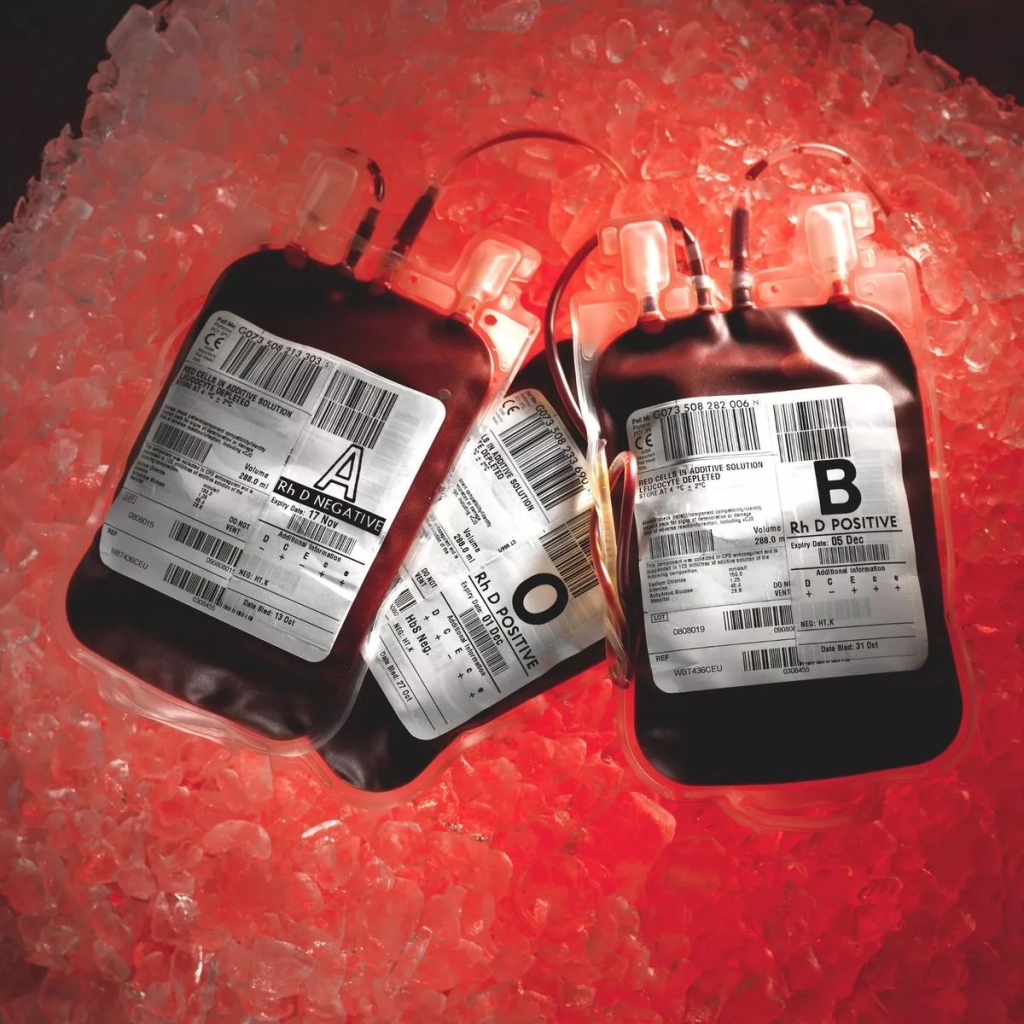
The Contaminated Blood Scandal

Through seven Prime Ministers and countless National Health executives and doctors, the truth was hidden. 30,000 people had been infected with HIV, Hepatitis C and B by tainted blood supples – bought from America – and at least 3,000 have died. On Monday morning the report came out and was handed to the victims and their families before going off to Parliament, giving Rishi Sunak the opportunity for his finest speech to date calling this: ‘A Day of Shame for the British State.’ He can think himself lucky that he is the apparent deliverer of ‘the truth’. He promised that this government will pay whatever it takes to the victims of this cover-up scandal. In such situations there are steps to be taken. Among the scandals of the last fifty years, the Contaminated Blood scandal sits at the head of the list, while the Grenfell Towers and Post Office scandals remain to be completed. 

“This must never happen again,” says our prime minister – as have others before him. Even as he says those words, in his deepest sincerity voice, another scandal has emerged. Smaller this time – possibly it can be swept into another sewage holding river,  as the South Devon Water Board ‘Invited customers to boil their water’. Luckily – in this instance – there have been no deaths, but severe ‘tummy problems’ caused by an itty, bitty parasite getting into the water supply. “There is no remedy for this,” says a very tidy looking Water Board spokeswoman. “The Tummy problems will go away after a couple of weeks.” But don’t worry, ‘there is going to be an inquiry and this must never be allowed to happen again.’

This has been A Letter from A. Broad. Written and read for you by Muriel Murch.

And always overseen by Beatrice @ murchstudio.com 

Eleanor Coppola

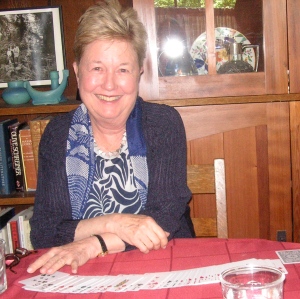
Eleanor readies the deck for Machiavelli, that she taught us all for those times of waiting. Photo by Janet Robbins or MAM – card players both.

In 2008 Eleanor Coppola published her book ‘Notes on a Life’. It did well, though was received with mixed reviews; some people were curious about the life of a Coppola, others about art and relationships, while others understood that a woman’s world is that – a woman’s world – and the challenges that women face, in all walks of life, have many overlapping similarities. As an artist as well as a wife and mother, Eleanor knew first-hand of the trials, the fears and the courage it takes to share your work and your voice with others.

At that time I was still producing ‘Living with Literature’, radio programs of conversations with writers, teachers and thinkers for radio broadcast on KWMR.org. Eleanor the artist, Ellie the friend, and I sat down for a conversation about her book, her life and her quiet observations, that become notes to be shared. 

Eleanor Coppola left us in April of 2024 but listening back to this conversation from 2008 it is wonderful hear the energy in her voice, the understanding in her mind and the compassion in her heart – for they remain with us.

Muriel – Aggie – Murch

And always overseen by – beatrice @ murchstudio.com

Solitude op 127 #2 is from Piano Music of Cécile Chaminade played by Peter Jacobs.  

The Sky is Crying

Written and Produced for you by Muriel Murch with WSM by my side.

“Look Granny, The sky is crying,” David says as he peeks out from underneath our umbrella. And we laugh because the rain is soft and light and warm and we know that it is just a little late May-time cry from the sky. And of course it is raining because the cottage windows have just been washed.

The park Elderflowers are bowed down with the rain

First I see his ladder, it wobbles as he perches it up against the study windowsill before ringing the door bell.

“ello Aggie – I saw you was back.”

“Perfect Chris – I have been thinking about you wondering when we would catch up. How have you been?”

“All right – middling you know.” And together we laugh as old friends do. Chris drives up from Sussex and parks his van somewhere in Camden. His tools are simpler now, an old wooden six-foot ladder that is wrapped in cloth and duct tape to protect the windows, a black plastic bucket, spray bottle of dish soap, window wiper, and cloth. He has a route of regulars through Camden, up Parkway and Regent’s Park Road before curling down through Primrose Hill until he has had enough for the day and can circle back to Camden, load up his van and drive home before the commute traffic gets too full. 

“You’re limping more,” I say to Chris, Such is our familiarity over close to 20 years that I can say such things. 

“it’s uh cyst on my muscle,” he replies. “Never heard of such a thing.” And he limps up and down the stairs. Chris is a London lad who, with his move to Sussex, has dipped his toes into semi-country living. He is old school and while he will go to the doctor he will not voluntarily step foot in a hospital. With Dickinsonian knowledge he knows well that you can die in there. As Chris does less for us – I pay him more. No longer able to hoist a big expandable ladder, nor not steady enough to carry our flimsy one upstairs, he no longer clears out the junk and leaves from our gutters. There was a time when he could reach the outside of the upstairs kitchen window and then help me replant out that lonely flower box. But no more. He can’t get up on the ladder and I can’t get onto the kitchen window ledge. About an hour in it is time to ask. 

“ Would you like a cup of tea now Chris?”

“Oh, wouldn’t mind at all.” And so I make the tea. Chris is close to finishing up but the tea must come as tea break – not the end of the job. With milk, no sugar, and two biscuits. Chris needs the break and I sit down beside him. It is time to talk over matters most serious. But before we start Walter comes up to say hello and goodbye.  Chris doesn’t quite stand up but returns Walter greeting.

“Morning Sir, you are keeping her well then I see.” While my husband chuckles his response I feel like an elderly dairy cow – still producing. But this again is our familiarity. Now it is time to get comfortable with our conversation.

Chris tells me of his sister in France – doing well with her family. And then it is on to politics. 

John Swinney is sworn in as First Minister of Scotland – Photo from Hollyrood

The Scottish National Party is doing the Highland Reel with their changing of the presidential guard – for a moment longer – the leading Scottish governmental party with the First Mister of Scotland, and have just chucked out their leader Humza Yousaf as First Minister. He seemed to go quietly – almost too quietly – some saying he fell on his own sword with his dismissal of a collaboration with the Green Party and then begging them back to no avail. Sir John Swinney steps up to the helm, saying he will continue Yousaf’s independence strategy. A brown man steps down for a white one – who – admittedly is apparently untarnished – unlike Nicola’s Sturgeon’s husband Peter Murrell or her mentor Alex Salmond, neither one as yet in jail for any financial slipping and sliding and who both look like 19th century Moreland farmers still eating beef in quantities over and above the necessary calories for sitting around in government houses. Stepping up to the microphone as the new first minister, Sir John Swinney is trimmer. At first this looks like a right old stitch up, but maybe he is a guiding tugboat bringing this limping ship of the Scottish National party into safe waters. It remains to be seen.

Prime Minister Boris Johnson with his dog Dilyn after voting at a polling station in London in 2022. (Photo: AP/Matt Dunham)

Meanwhile Chris and I continue, curling our lips in mock horror at the buffoonery of Boris Johnson showing up to vote in the English by-elections without any ID – a law brought in by his government under his watch – and his – “you’ve seen me with my terrier dog on a lead” – just does’t cut it. We shake our heads in mutual disdain. Now the tea is finished, and it is time for Chris to carry on along his rounds and we say goodbye until he comes knocking on our door again in a few month’s time. I will see him through the summer, with his little ladder propped up against the window of a rock and roll bar on Parkway.

As the by-election results come in we watch the Tory party begin to implode. Rishi Sunak holds a tight grin as he speaks and congratulates the few Tories who have held onto their seats. A photo-op occurs in an Indian Restaurant where he is filmed chopping carrots with such inefficiency that the by-standing chefs are biting their lips and holding a tight smile as if watching a child with a knife for the first time.  The Labour Party Leader, Sir Keir Starmer tries to look hard-working and casual as he goes about the country congratulating those who have worked hard on winning their labour seats. Poor man – someone should tell him that a white tee shirt under a jumper doesn’t suit every male figure. And all this hopping about the country for these by-elections puts the real business of government aside. The Conservatives are in the process of taking a whipping at the polls and government ministers are shuffling from one foot to another, not yet quite sure where to land and where to speak. 

But Foreign Secretary Sir David Cameron has stayed busy, and along with the French President Emmanuel Macron, committed money and arms to Ukraine while still trying to broker any kind of peace in the Middle East. Russia’s President Putin has plenty to say about that.

The student protests with Pro-Palestinian sympathies about the bombing of Gaza are growing around the world, each country’s universities going about their demonstrations in their own cultural way. On the campuses here in England, because so far there are no overt clashes between the students, the administration and police, they are not covered by the evening news. While the young students and some professors already know the cost of speaking out, they are prepared to do so. When asked by the Guardian columnist Nesrine Malik about the cost – of their education, their reputation – a student replied, “The students in Gaza don’t have schools to protest in; they don’t have medical care to be taken away from them. This is nothing compared to what they’re experiencing.” Could it be that this time it is the young of the world who can silence the guns of war.   

This has been A Letter from A. Broad. Written and produced for you by Muriel Murch

And always overseen by – beatrice @ murchstudio.com 

Fading Flags

Written and produced by Muriel Murch with WSM by my side.

Driving out along the lagoon, over the mountain, and down the twisting road through the Redwoods into another town, the large Ukrainian flags are faded and torn but still fluttering under the trees.

They look weary like the soldiers themselves must be. That war, between Russia and Ukraine, is into its second year and is now being jostled out of the headlines and overtaken by the three way shootout that is occurring between Gaza, Israel and Palestine. The weariness that is shown by the torn Ukrainian flags is but a reflection of the faces of both the Ukrainian and Russian soldiers. Satellite pictures of Russian graveyards show their expansion and a rough estimate is over 50,000 Russian and 31,000 Ukrainian troops killed from this war so far. Mothers do not like to hear such numbers and know that their sons are among the fallen.

Daily, more young, untrained Russian boys and old men are sent into battle to wear down the Ukrainian military. In 2022 the Russian Wagner leader Yevgeny Prigozhin began recruiting prisoners for his private army – until that all went pear shaped and ‘angry words were spoken’. Shortly after that Prigozhin was killed in a plane crash. But – to no one’s surprise – the Russian defense minister has continued with the same policy, containing the stipulation that enlisted prisoners must fight until they die or the war is over – whichever comes first. Prison recruits remain crucial to the success of the Meat Grinder… The modern term for Cannon Fodder.

Nobody really knows how many Russian and Ukrainian solders or civilians are dying. But all Russians steeped in their history know, from Tolstoy’s War and Peace to Maylis De Kerangal’s Eastbound, war in Russia is carried genetically through ancestral bloodlines. For the Ukraine it is not a lot different – maybe the war dead figures are more honest – it is hard to tell. President Zelensky is anxious and impatient calling for the military aid package just passed by the US Congress over the weekend to be delivered now – not in six months time.

Back in London, though there are no more welcome signs for refugees from any country, this war is still on the page. The prancing dance that is happening with Putin, the West, China and the East is keeping at least some journalists on their toes.

London welcomes me back into a land of brown people and I am grateful. There is kindness all around me. I push my trolly-load of luggage towards the parked taxi driver at the airport, who, when we reach the cottage, brings my suitcases inside and lifts them onto the spare bed.

But our UK Government remains as tight, shortsighted and corrupt as ever. Another Tory minister resigns here, mud is slung at Angela Rayner the labour Deputy Prime Minister there, and, goodness me, Peter Murrell, the husband of the last Scottish First Minister, Nicola Sturgeon, is under arrest again.  Released of course – the only polite thing to do – and to be investigated further – in due course. Well maybe. This is beyond sad, another betrayal as most people whatever they felt about an independent Scotland admired and even liked Nicola Sturgeon as she brought Scotland through the Covid crisis. Lifting its head slightly out from underneath these stained seats of government we find other unbelievable act of fly swatting. 

Through The European Commission president, Ursula von der Leyen, the EU have proposed free moment for young European Union citizens and Britons across the borders, allowing young people from the EU to stay in the UK to work or study for reciprocal periods of time. As Ursula said, this would have been where there could be “closer collaboration. The topic of youth mobility is in both our interests, because the more we have youth mobility being on both sides of the Channel, the more we increase the probability we will be on good terms because the next generation knows each other very well.” But Rishi doesn’t seem to want to get to know anyone outside of his home-county set and has rejected that, the government saying that ‘Brexit had ended free movement and it had no desire to reopen that conversation, even with strict conditions on length of stay.’ God help this country. 

As I began to write, the question of shipping undocumented immigrants to Rwanda was being batted back and forth across the aisles of Parliament for maybe the fourth time. There is no doubt that if the bill passes, those held in ‘safe housing’ will disappear into the urban ghettos of this country. Some will die, many will be extorted, while only a very few will reunite with their families or move on to make some kind of a life for themselves. Sunak will merely have transported the jungles of Calais to the cities of Liverpool and London. After a night of back and forth from the green seats of the Commons to the tattered red ones of the Lords the bill was passed – at the cost of 1.8 Million pounds per person – before it was time for an early morning cup of tea. It goes to the King on Tuesday evening and goodness knows how he is going to keep his mouth shut and sign it. 

A Getty Image of Rhishi trying.

It is hard to think about this as I sit on the sofa at dusk watching the evening light soften and glow, as if to say, ‘That was an ok day wasn’t it? The plants in my pots on my small terrace garden must have bloomed for our guests: volunteer Bluebells coming out of home-made compost, yellow Cowslips raised and bowed down. The geraniums and fuchsias are not quite ready to come out of hibernation while the unpruned rose buds are reaching for any weak spring sunshine. The pigeons and squirrels scurry around though the bird feeder needs replenishing and rehanging before the smaller birds will return. But it is dusk and Lucy the fox is back. Her coat is full and healthy while her udder glistens from the recent suckling of her kits. She too has sensed the movement behind the glass, the lights flickering on and off, and has come to check my egg supply. I go to the fridge and get one for her. Sliding open the terrace door I place it just inside the cottage. Tentatively, checking my smell and my seat on the sofa, she steps froward and takes the egg in her mouth, turns and neatly hops off between my pots to trot along the wall and disappear.

Lucy comes for her first egg of the evening Photo by WSM.

She returns ten minutes later for a second egg. How many kits does she have this year? A famous Italian designer has a trophy home just across the wall and with his garden unused for the winter months this could be where Lucy and her family live. The park – with its tall grasses and hedgerows – is just across the road and the canal with its river-rat filled verges is only a quarter of a mile away. Can Lucy and her family live peacefully in that garden or will they too be evicted out of their found safety to wander to find a new place to call home.

This has been A Letter From A. Broad. Written and Read for you by Muriel Murch.  

And always overseen by – beatrice @ murchstudio.com

Serving Safety

Written and Recorded by Muriel Murch with WSM by my side

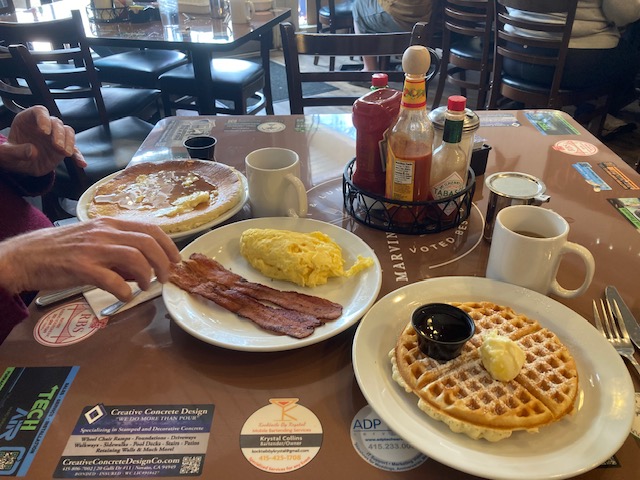
When you want a ‘good old American Breakfast’ you need a ‘good old American restaurant’ to go to. There are a couple still thriving on the main street of Novato, in California. We go to Marvin’s. The tables are crammed together, the outside dining that came in with Covid, remains – and for those new to Novato, with small fluffy dogs as accessories, those tables are fine. But for us, not locals but oldies, inside is better. The coffee comes quicker, the menu is there and you only get water if you ask for it. The restaurant is crammed and with a fluidity of a well-honed team the kitchen, and wait-staff dance between us all and even have time to smile and say hello. The clientele inside is mostly old, local, male and large. Which makes placing cardboard on the  floor of the tiny bathroom a more than sensible idea. So do the signs posted on the walls, ‘ For goodness sake clean up after yourself’, ‘Anything is possible if you have the courage to make it happen,’ ‘You never know what you have until it’s gone. Toilet paper for instance.’  Returning to our table, my second cup of coffee is ready for me and I am beginning to feel better. And that is the gift that a restaurant, worthy of the name, gives to its patrons.  

One of Marvin’s ‘All American’ breakfasts.

For over 50 years Cupertino-based Chefs of Compassion Cooking for a Cause has held an annual fundraiser dinner. A gala evening event of food, giving the attendees a feast fit for their dollars as they support the West Valley Community Services – serving those in need from the cratered and neglected pockets Santa Clara County. It is one of thousands of not-for-profit organizations throughout the country and the world that help those struggling with food, and to get by with things that many of us take for granted.

Steve Simmons with Chefs of Compassion

I stumbled across The Chefs of Compassion when reading of the sudden death of a beloved friend, Chef Steve Simmons. Steve and I first met when he was cajoled onto the board of Full Circle Programs. Barely out of apprenticeship he was far too young to enjoy sitting at meetings. He was busy claiming his place alongside other rising chefs in the Bay Area, such as Ogden Bradley. But he was game and eager to help with my first ever fund-raising event: a screening of The English Patient for the Full Circle Programs in 1997. I didn’t have a clue what I was doing but Steve had everything under control and – if I remember correctly – gracefully served up oysters and champagne. The event was a modest success and we made money for the program. Steve soon became a renowned and sought-after Bay Area Chef in his own right before opening his own success story, Bubbas’ Diner in San Anselmo. Bubba’s was perfect for meetings, family gatherings and just plain, ‘let me sit-down for a moment and gather myself before the next whatever hits me’. With constant affection, our lives crossed paths for over thirty years. Steve’s sudden death from a heart attack brings a personal sadness as it does to all his friends, colleagues and family. He leaves three children to still scramble through school. But Steve’s work carried a constant in that, as well as being a fine chef, his desire to help those less fortunate was a hallmark of his work and is seen so often in other chefs, serving from small roadside kitchens or in world-renowned restaurants. Serving and sharing food is a passion that reaches out from our own kitchen table, to our communities and beyond. 

Chef José Andrés and his carrots

Meet Jose Andrés Group

There are chefs who are known not only for their cooking, books, fame and fortunes but for their humanitarian work feeding the world. Such a chef is the Spanish American José Ramón Andrés who, with a matador’s flair naturally rose to the challenges ahead of him in the 1990’s when he arrived in New York. Success quickly followed success and took him to Washington DC where, dinning in his restaurants, meetings over a meal, discord could become accord. In 2010  Andrés founded the World Central Kitchen beginning by focusing on feeding communities hit with natural disasters but too quickly found itself operating – like Doctor’s without Borders – in areas of conflict – as wars marched side by side with climate change as the cause for famine and disease. While many chefs are artists in the kitchen and business men behind the till, Andrés is also a deeply caring man. Like an army General he quickly strode across the global stage with his humanitarian work.

Wherever war has brought hunger, the World Kitchen has been there, serving the food of the people to the people. The World Central Kitchen has grown to be enormous, serving food and people’s worldwide. Currently it is operating in Haiti, Ukraine, Poland, Israel and Gaza. In Ukraine, chefs and restauranteurs jockey with each other to feed the best borscht to their people, in the Middle East to honour Ramadan and other religions, and now the World Central Kitchen serves in Israel and Gaza, bringing the food of comfort to both Israelis and Palestinians. Though more at home behind a roaring grill or unloading the flatbed of a truck, Andrés fingers are now busy working the computer and phones as he looks to use any influence he has to halt the war in Gaza. Andrés is outspoken in his criticism of anyone who cannot see the need for humanitarian aid and his work is such that nobody wants to be seen not being compassionate. Both Republican and Democrat Senators are known to nod sagely when he speaks. Even in Israel, where the World Central Kitchen immediately gathered forces to feed those affected from the Hamas attack in October, Andrés can speak. But now – as that assault became a full blown war – and Netanyahu seized the excuse to attack Gaza, squeezing Palestinians into tighter corrals with less and less resources, things became personal for Andrés. A pier was built by the U.S. Military where food, water and relief could be unloaded safely and delivered to the Palestinians still trapped on the Gaza Strip. With the precision of a Military General Andrés already had supply workers lined up in a convoy. One, two and three, the vehicles were picked off by Israeli soldiers and all seven of the international volunteer workers were killed. Quickly Andrés took pen to paper and wrote op-ed pieces both in the New York Times and in Israel’s largest newspaper, plus tweets and all forms of media. He wrote “Israel is better than the way this war is being waged,” For the moment that supply route is closed. 

Andrés’ stride across the world stage is large like the Ukrainian president Volodymyr Zelenskyy, who is also untrained in the school of politics. Andrés’ schooling in the kitchen as Zelenskyy’s on the stage has given both men the skills of hustle, the art of seduction, both slicing and seasoning each connection to fit and join with another. Is it possible that it is these artists that can chip away at the gates of death, calm the storms of war, and bring a peace at the table. 

This has been A Letter from A. Broad. Written and read for you by Muriel Murch.

And always overseen by – beatrice @ murchstudio.com
March Winds

Written and recorded by Muriel Murch with WSM by my side

The manicure lasted two weeks which is a long time, but maybe in Beverly Hills they do know what they are doing, as their clientele often need care on a weekly basis. It was fun while it lasted and – as I walked to the orchard – sweet to glance at my hands holding the pail of chicken feed and smile. Back in Northern California the March winds are now in earnest – rushing and claiming the April showers – to bring forth May flowers. We were taught this rhyme as children, as it was repeated to us with smiles when we were bundled up against the sharp north-easterner wind blowing – even though the sun shone – and we were sent outside to play. But the wind is sharp, the air cold, and only in the stillest of sheltered moments, can one feel the beginning of spring.

Spring Irises on Commonweal. Photo WSM

It is the woodland flowers that tell us spring has come. The irises on the Commonweal Mesa are glistening pale mauve and sharp purple. Bill’s black cattle are fat, their coats sleek and shiny with good health as they graze hock-deep and with heads buried into the grass as lush as I have ever seen it.

An afternoon feeding for Evie

On this farm lambing has begun – often in the most difficult of nights, the early daffodils are fading, the chickens are laying more eggs than we can sell, and the swallows are back.

Maybe it is the birds that mark the seasons best. The swallows are now diving into the barn at the end of March. ‘Whew’ they seem to say, ‘Made it home safely’. But now there are two young barn kittens eagerly learning how to catch those on the fly. The bluebirds have returned too. She is resting in the climbing pink rose over the art shop as he has shown her a new housing option and she needs time to think about it, taking everything into consideration – as a woman does. The robins arrived with a loud fanfare and immediate squabbles, fights over sex and ownership of wives and real estate . 

King heading in the orchard 2014 when we were both ‘in our prime’.

It is past time to prune the orchard. Of course I am late and I move slower now. But Rudy has sharpened my pruners and they are shiny from his care. He still has the loppers – as there was something not quite right with a bolt and he must be sure I can manage it, such is his watchfulness of us all. As I reach each tree I apologize for my neglect over these last years. But like a hen-raised brood of chicks, some have survived, even thrived while others have stood still, rooted but not growing, waiting for that extra serving of water through the summer months or the loosening of soil around their root ball, enough to let air in but not the gophers. It often seems a futile effort and yet I keep on working. I look at all that we do – trying to keep the land nurtured and yet productive, a give and take between the soil and us and sometimes I feel defeated as if all my work is but a stop-gap between them – the .01% moving in on us – and us moving on into wherever we can go. 

The farm calls for focus and sends the world of wars further into the outskirts of my mind. Though the horrors that are occurring all the time – everywhere – still return to my consciousness when I try to rest from the chores that face me here. What is happening in Russia? Who is attacking whom and for why? This latest attack was claimed by an Islamic Terrorist organization maybe just to show that terrorism is another equal opportunity employer? But it matters, not just that – so far – 137 people were killed in the Crocus City Concert Hall attack – but – despite warnings from the US ‘services’ that this was going to happen – and like Netanyahu before him – Putin let it happen. For Israel’s Prime Minister the music festival attack last October was an opportunity to begin a war he wanted. For Putin it is the continuation of blindness that the Russian people matter and not understanding that somewhere in the months or years to come they will be able to say so. Or is Putin maybe looking to the blindness of other Western countries as they fail in taking a truthful way forward? Will Donald Trump find a way through his nine billion sale of something he probably doesn’t even own to stay out of jail and on the U.S. Presidential ballot? Will Julian Assange be shuttled from one secure house to another or is the possibility of honoring freedom of the press still alive? They – whoever they are – are playing a game that seemingly has no rules and we the people – of the West and of Russia, Ukraine, China ,and all continents – are tossed on the sea storms of their brewing.

This has been A Letter from A. Broad. Written and read for you by Muriel Murch.

And always overseen by – beatrice@blmurch

The Guilds

Written and read for you by Muriel Murch with WSM by my side

‘How do you manage it Mrs a-Murch?” ‘Manage what?” I asked looking down to the sweet young Indian film student in Pune?” “Holly wood” she replied using two words with her beautiful sing-song voice – speaking the English that has been imposed on her country. I laughed and said that I didn’t manage it – Hollywood – we had long ago escaped to Northern California. She breathed a sigh of wonderment rather than relief and the three – there were only three – female film students in the country’s film school over the next few days took me firmly under their wings as we exchanged the stories that women can share.

Good morning – every morning

But this last weekend I had to mange it – Hollywood – because it was ‘that time of year again’. Oscar was coming. But there is foreplay in the form of the British BAFTA awards appearing in London a month beforehand, like a butler announcing ‘Dinner is served.’ And then in Los Angeles the weekend before the Oscars, the Industry Guilds all give out their awards. It’s a busy time and Hollywood, Beverly Hills and the tentacles of Los Angeles are gratefully twitching and alive with business. But is it enough to reboot the industry after the screen-writers and actors strike that shut down the town for five months last year? Whether you fly, drive or take an Amtrak train into Los Angeles, it is the industry that envelops you. Like the coal mines of Yorkshire, or General Motors of Detroit, the unions here hold power over the industry bosses, which in the film business are the studio heads – whose heads roll with each change in profit margins. It’s a rough game.

The players are divided into teams – called guilds – and they – for better or worse are divided again – into above and below the line. That is – recognizable and exploitable names with star qualities above and those who keep the engines moving throughout production below. At this time of year our mail box is crammed full of glossy Hollywood extra magazines, all promoting this film, that craft, and for a while they are fun to read in the bath, as one would under the hair dryer in years gone by. But some carry dire warnings of another strike as more below-the-line guilds enter union negotiations to protect their health and pension benefits. The Screen Actors and Writers had known names walking the picket lines, but this strike, by the crews that keep the cameras rolling, the boom mic high enough out of the shots, the wardrobe departments sewing and ironing, the stylists and makeup artists gently applying their brushes, followed by the post-production teams of sound and picture editors pushing their faders, clicking their mice, tightening and kneading the films into its best self does not. The teamsters union boss, Lindsay Doughery says “We will strike if we have to”. These crews have been out of work for months as the industry ground to a halt in Hollywood. Actors and writers mostly have enough to get by but many below the line have been pinched and squeezed into bread lines over these last months.

Which maybe was why with the new – almost all improved – Oscar ceremony last Sunday the show opened with teamsters, truckers, caterers and drivers brought on stage for a round of applause. Was this a genuine gesture of appreciation, or a preemptive move to beg them not to strike and bring the industry to a halt again. 

But we were in Hollywood the week before Oscar to celebrate and honor a lifetime of editing work by Walter and the added joy of having the kids – all grown-ups now – along to celebrate their father. And to see them – the other life-time of work – each holding their own and living their lives in the fullness of their times. And young prodigies joined the ranks of old colleagues, those who have been in the trenches of each particular film; from THX 1138, American Graffiti, A Godfather here and there, The Conversation, Apocalypse Now, Return to OZ, Ghost, English Patient, Talented Mr Ripley, Particle Fever, Coup 53 and so many more. A full lifetime of work flashed across the screen turning the photo album pages too quickly – “Wait”, I wanted to say – “let me look a second longer”. And did it end with ‘Her Name was Moviola’? The machine woman who beguiled him away for those long hours, days, nights and all times in-between. She, for that machine is a she, is asleep now, resting in an old horse stall, hidden under a pile of boxes, not yet knowing she will never turn over her wheels again, never clunk down on a sprocket of film to cut. What happens to machine relics? How many get saved for a museum exhibit? Like pencil and paper, envelopes and books, the tools we use are changing, but not the emotion that cinema stirs in us. 

Saturday night before the Editors brunch, the Cinema Audio Society held their awards dinner celebration. This guild is only 60 years old, and is not as rich or as powerful as the editors or cinematographers Guilds. But while picture without sound can take over our senses, it is sound that sweetens our awareness of cinema. Voices, sound effects and music blended together are the cradle in which the film can rock. 

And it is before the cradle that sound comes to us. In 2004 the young voice echoed again, “How do you manage it Mrs ah Murch” when I found myself in Berlin for the Film Festival. Berlin, the first of the years big festivals, is cold, often there is snow, which looks pretty on arrival but soon becomes slushy and grey. I am at a loss, floundering around, and reached for the only tools I had with me: A microphone and tape recorder.

And so I began to record my fluctuating heart beat before moving the mic up over my chest to capture breathing, down my belly for the gurgles that occur with greater frequency when one is nervous. My husband is in the bath, so I kneel beside him, sliding the mic up over his carotid arteries, lub dub, lub dub, lub dub, he doesn’t seem so bothered by Berlin. I walk the hotel hallways where the world’ film makers are hurrying, from one place to another, excited to see the new work and each other.

WSM has taken my Mother’s Symphony and is using it to make a point about our hearing.

I take my recordings back to our room where one track leads into another – blends, fades in and out – but, as in the womb, from four and a half months of gestational life, there is always sound until after we are born – when there is the silence of a solitary crib in a room of one’s own.

Almost 20 years after my Mother’s Symphony was made, played, used in lectures and then put way, film maker Sam Green, found it and then me.  

“Could he buy it?” “Certainly not, he could have it.” And so he carefully lifted the symphony tracks from their radio format and slipped it into the opening of his film ’32 Sounds’ where it gently beckons us into the worlds of nature, of make believe and music. On that Hollywood evening, despite strong musical competition, 32 Sounds won for best documentary sound. As the audience rose to its feet It was as if we were all coming home. 

And then there was Chocolate

This has been A Letter from A. Broad. Written and read for you by Muriel Murch.

And always overseen by – beatrice@murchstudio.com
Navalny

Written and Produced for you by Muriel Murch with WSM by my side

The news of Alexei Navalny’s death is confirmed. First offered with a shrug from the Kremlin, for ‘what did you expect? That we would let him live forever?’

This single death takes over my consciousness as I think I can imagine it – while the multiple slaughters are that are occurring in Gaza and on the West Bank leaves me sifting through pictures of rubble, hospitals and carnage, not really knowing who or what I am looking for, or at. Navalny’s death has me remembering the South African Activist Steve Biko. While Wikipedia maintains that his Political Legacy remains ‘a matter of contention’ there is no doubt that he was a forceful presence against apartheid. Wikipedia also tells us that Biko was the twenty-first person to die in a South African prison in twelve months, and the forty-sixth political detainee to die during interrogation since in 1963 the South African government introduced laws permitting imprisonment without trial. Biko and Navalny were both men of their time and place, both political prisoners killed with the direction or approval of the state. It is not uncommon, this singling out of one man whose presence has become more than annoying, but is still only a potential threat to those currently in power.

The English Royal Courts of Justice are wrestling with another moral question ‘Which is the more serious crime: extrajudicial killings, routine torture of prisoners and illegal renditions carried out by a state. Or exposing those actions by publishing illegally leaked details of how, and where, and when and by whom they were committed?’ Now, after ten years, Julian Assange is having his day in court though he is not present. He is reportedly too unwell to even watch his appeal via a video link. Assange has been asking to be able to appeal against the decision to extradite him to the US to face trial under its Espionage Act for his publication of documents, via WikiLeaks. The documents – handed to him by the former US soldier Chelsea Manning – detailed illegal US actions in Afghanistan, Iraq, Guantanamo Bay and elsewhere. While still not having been convicted of any crime he is in his fifth year in high security in Belmash prison. The memory of Daniel Ellsberg who in 1973, was hauled into the legal system for exposing the US government and military activities in Vietnam hovers over this hearing. No-one knows yet what will happen  – except that you can bet someone is looking at film rights… 

Across the river, the Houses of Parliament are turned upside down with Sir Lindsay Hoyle the Speaker of the House of Commons loosing his cool and his gavel as he tries to control both sides of the aisle. The clamoring from the Labour, Conservative and all parties in between that they want a stop to the bombing and fighting  – turns into an uproar for two days – fussing over a breach in protocol that happened due to the rising threats of retaliations to Members of Parliament. It sounds silly – but – we remember the Labour MP, Jo Cox, killed by a Neo-Nazi supremacist in 2016 followed by the conservative MP, Sir David Amess, in 2021 by a Jihadist. Both of these instances occurred during Sir Lindsay’s time in government. Since 1812 only six members of parliament have been killed while in office but the pace of assassination seems to be stepping up in the 21st century. Maybe Sir Lindsay is being super-aware and damning the little rules and regulations – there could be an inquiry – but probability not. Apart from some tut-tutting over the tea cups this will blow over and the government will move onto more important issues as the UK tries again to be relevant and meaningful on the world stage.  

But can it? Will the United Kingdom ever accept that, since Brexit, and our disengagement from Europe, nobody is really listening. Last week Zelensky welcomed the leaders of Italy, Canada and Belgium along with the European Commission president Ursula von der Leyen who all stood beside him as he spoke at Kyiv. The US president Joe Biden tuned in by video. Boris Johnson popped over with a few delegates – of what I’m not sure – to wave his tattered flag and tell whoever he was speaking to – that he was sure that Ukraine could beat the Russian forces. But quietly – and maybe not so quietly – much of the rest of the world is not so sure. 

Meanwhile Sir David Cameron – how handy is that prefix of Sir – in his role of Foreign Secretary is being a little more serious on the world stage as he speaks up for a two state solution to the war in the Middle East. Just like the Jewish people displaced from Europe in the last two World Wars, he insists Palestinians must have a homeland to call their own. 

But Rishi Sunak flew into Wales, so sidestepping the rising concerns of racial bigotry brewing in London. He has hardly rapped Suella Braverman’s knuckles for her racially inflammatory writing and shrugs off Lee Anderson’s remarks about Sadiq Khan, the mayor of London, ‘giving London to his mates’. It’s getting scary – again. Instead Rishi is in Wales standing side-by-side with net zero and climate conspiracy groups of Welsh farmers as he tries to bolster his rural vote. The Welsh Labour government is proposing a new payment scheme in which farmers will have to prove 10% of their land is woodland and 10% of it is quality habitat for wildlife. That’s not so much and in Wales, so full of hills and dales where the sheep roam and get lost all the time.

Rishi Sunak speaking with farmers after he delivered a speech at the Welsh Conservatives conference 2024. Photograph by Peter Byrne

As I write, the home team of Pacific Slope Tree Company is working on my Gertrude Jekyll corner. Jekyll always wrote that we should leave a portion of our gardens to the wilderness and I have stayed true to that. Many years ago – in my naiveté – I planted at least 40 pine trees to provide a windshield and wilderness habitat. The trees grew tall providing a deep shade and soon brambles covering the forest floor. They did create a habitat while over the years the blue jays buried their oak acorns and forgot them. As the pines grew taller and weaker they were harvested for fire wood. Now some of the young oaks are straight and strong, others a little weaker but with more light and air they too could flourish. The last pines will come down now and let the young oaks emerge as a new wilderness.

This has been A Letter from A Broad written and read for you by Muriel Murch.

And always overseen by – beatrice@murchstudio.com