Old Reads and New Writing

Written and Read for you by Muriel Murch

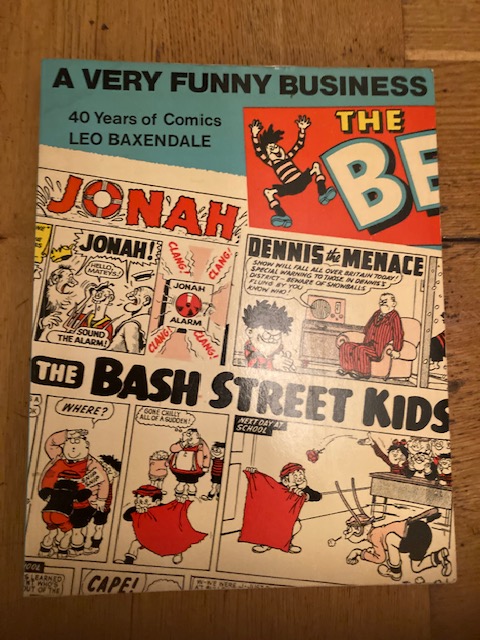
As dawn broke in years gone by, newspapers would be delivered by a bicycling schoolboy earning a few US dollars or English shillings. The papers  were carefully gathered to be opened at breakfast, pages turned with American coffee or English tea – and toast. The news, the gossip, the sports – in green – before finally the cartoons and crossword puzzles were found on the final pages. Now those youngsters are out of a job as television and social media bring everything to us with a click of a button or a swipe of a forefinger. With a nine-year old grandson, I am having a refresher moment of comic book education. It is a good primer for what is playing out on the large and small screens in our hands.

The Cover of Leo Baxendale’s ‘A Very Funny Business’

The story lines are remarkably similar; a bully struts into the Oval Office with all his pals lined up behind him. A new boy comes in – quickly mocked for failing to be dressed the same as the bully and his pals. The new boy sits quietly, tries to reason with the bully and holds his own before leaving abruptly, as if chased from the room, but in reality he has left on his own terms. A few weeks later, the bully picks on another visitor. He too held his own with calm dignity. Now, weeks later, both of these men have achieved their aims. President Zelensky has demolished a third of the Russian bombers that were set to attack the Ukraine while, as South African President Cyril Ramaphosa left the White House, his smile reinforced for both black and white South Africans that his diplomacy skills are a strength the whole country is grateful for.  This week the German Chancellor, Friedrich Merz, traveled to Washington DC to report back to the European Union. He too saw the symptoms of madness and stayed calm. As the rough-housing erupts in the White House we wait for the next installment to be drawn on the page. 

While the comic book gets put aside – I find a gift tucked into my email inbox. A note from Barbara Bos who runs the Woman Writers, Women’s Books website would like a piece on the background of Harvesting History, While Farming the Flats and how I came to write it. This exercise is perfectly timed to answer a question that I pushed aside before it even had a chance to form. Did I answer her question? I’m not sure but this is some of what I wrote about that time in 2014. 


Bees are busy in the Borage

It is midday. As many mornings as I can, I spend outside. Farm chores call out: ‘Over here, over here’ with raised wands of weeds, brambles and fences to care for. Fridays are sacrilegiously saved, even called ‘My Friday Farm days’. But I can only manage three morning hours before my body tells me to halt and I come back inside. Clean up, and enjoy a small snack before taking my place, sitting at the Bistro table, beside the French doors, in the main dining room. 

The Farm Dining room is quiet now

This is a quiet room, saved now for big occasions with family or friends, but in this solitary time I take it for my own. The stillness calls me and I welcome it putting my pen to the page bringing immediate and long-past memories together, taking time to talk to the page.

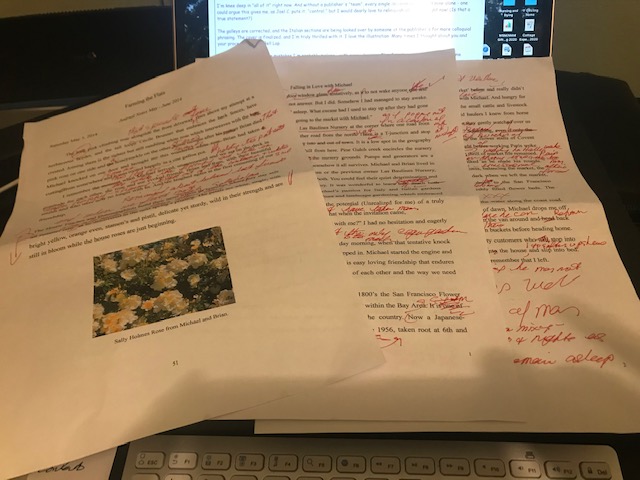
Journal books are on the table. The little blue one – whose innards I change each year – records the past day, the day today, and the things still to do. Lists abound in that book while very occasionally an Idea or Question is also captured. When the three pages of warm-up notes are completed like piano scales, the little blue book is put aside. Two bigger journals, also with soft covers, have big spaces and faint lines. I can only open these when I am alone, for the pen may find memories of its own, spilling its ink over the pages onto the table, and I am frightened that I cannot scoop them back again. My pens also are important. Somedays I pick and choose, wanting something different, possibly a useful pen, even a pencil, or a beautiful one with free flowing ink, gliding across the page like a superb dancing partner. I have a fountain pen, a gift we bought from Rome one Christmas for my mother and which she used for the rest of her life. Sometimes when I write with it, I feel my mother’s encouragement – now flowing more freely through that pen. Each entry begins as a letter to you, whoever and wherever you are, or even a chat, as if we were sitting side by side in a cafe.

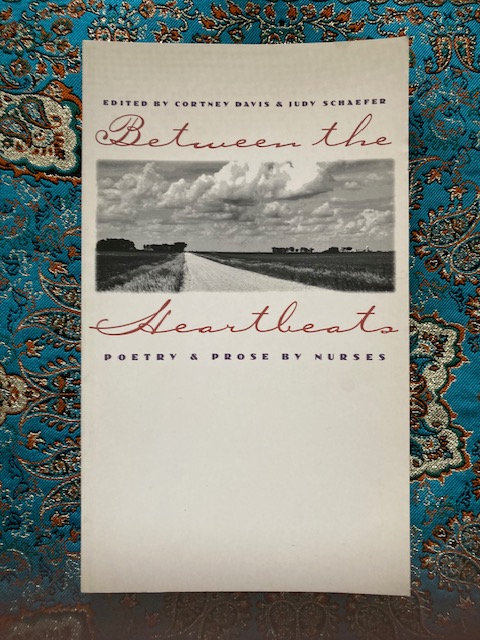
Between the Heartbeats. Poetry and Prose by Nurses, edited by Cortney Davis and Judy Schaffer

I start writing like this, knowing that much of it will not find its way into the final piece. I accept that scribbling is OK, good, it is the compost, heating up the heart, trusting the practice, the craft that hones thoughts into words until they become uniquely mine. There is no final version – until maybe it is published and given to you – a reader. Writing becomes us, as slowly, one gathers a body of work behind one. I remember the first time that I received a postcard back from a Submission, (with a capital S) It was for Mr Tims Morning and Cortney Davis wrote on a card, “Thank you for this excellent work.” She probably wrote that on cards for all the work she and Judy Shaffer collected for their first Anthology of Nurse writing Between the Heartbeats. I still have that note.

Now, two books later, it happened again, Steve Wax had read some of my essays published in ‘The West Marin Review’, then, in a huge cinematic reunion sought me out to say, “I read your essays and they are beautiful”.  And so the harvesting began again.

The isolation imposed by Covid and age, helped me turn inward in earnest as I carried those farm journals to London and old memories began to sit beside the farm memories from – well – memory. Only when the essays laid themselves alongside of each other, jostling back through the-time-before, like the loose and falling pages of old photo albums, which must – one day – all be digitized. But until that time I would write about – that – those – times, remembering them in words and stories. Sometimes the words rise like yeast-laden dough, as the memories crowded on the page become kneaded together with imagination. 

What does it take to do that? Perseverance, putting the words on the page, taking them up again, moving them around before pushing them back down. There is a reason why in bread recipes we are instructed to knead the dough for 10 minutes until it is soft and silky under our hands. That is how we want our words to be, soft and silky, gliding along the page and into your imagination.

This has been A Letter From A. Broad written and read for you by Muriel Murch

All Those Books

Libraries carry the past forward to the present and into the future. The knowledge and truth stored safely from the Library of Alexandria through to the likes of Wikipedia and The Internet Archive, and all libraries, are the creations of our minds and those looking to control the narratives of history are oft times fearful. It is not that long ago that the burning of books took over from the burning of witches. The concept of an open and accessible library is an ancient democratic idea, and for the destruction of democracy access to knowledge and art must be curtailed.

How much of a surprise was it then when on May 8th Carla Hayden received an email from the White House’s Presidential Personnel Office.

Carla Hayden as head of the Library of Congress

“Carla, On behalf of President Donald J. Trump, I am writing to inform you that your position as the Librarian of Congress is terminated effective immediately. Thank you for your service.” A spokesperson for the Library of Congress confirmed that the White House told Hayden she was dismissed. The reason given by the White House press secretary, Caroline Leavitt, was that Hayden ‘did not fit the needs of the American People’. Leavitt, a young and ambitious Republican, reminds me too much of Reese Witherspoon’s character in Alexander Payne’s 1999 film Election which follows Tracy Flick in her race for high school president in Omaha, Nebraska. Leavitt comes from New Hampshire and, like Tracy Flick, she too has learnt to use the media, adjusting her facts to suit a hoped-for narrative. Fact-checking at The Library of Congress is not likely to happen soon, for a culture war has begun and the Library of Congress, along with National Public Radio and other media are making fine early targets.

The Library of Congress was founded in 1800 and during the 1812 war burned by British troops. But precious documents had been saved and after the war ended, past-president Thomas Jefferson gave his own library to help restock all that was destroyed by the British on the condition that the library was to be free and accessible to all, sharing knowledge of the diversity and culture that already made up America. His library held copies of the Quran and Hebrew Bible which exposed Jefferson’s beliefs in the freedom of religions which was not then – as is not now – despite the pledge of allegiance – a universally-accepted truth in America. With the firing of Hayden this month we have a return to that history.

A lithograph of the Battle of New Orleans during the War of 1812.

At the moment there is a stand-off in which the Library Staff and their legal counsel have refused admittance to the President’s team without congressional approval. We hold our collective breath as the lasso circles around the Kennedy Center, National Public Radio, and libraries large and small.

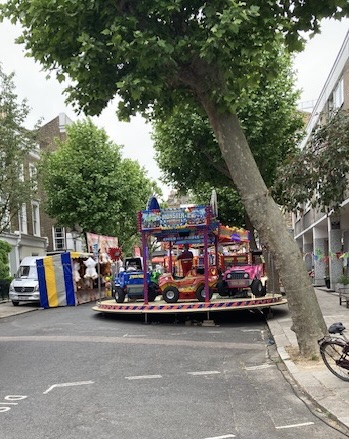
In spring and autumn, this little community of Primrose Hill holds a festival of self. The main street is closed off. Vans are parked and stalls pitched on both sides of the road. Food stalls bring ethnic foods from all corners of London, hand-made boutique gifts are laid out under twinkling light, bright colored clothes hang high, swaying in the sunny breeze. Big ferris wheels and spinning teacups twirl around, flinging children up into the air with screams of delighted fear.

Around and around they go.

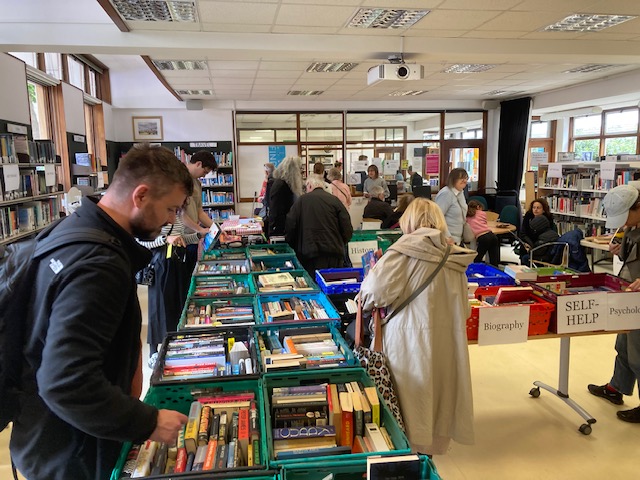
And after all that excitement almost everyone is in need of a bathroom, a cup of hot builder’s tea, cookies and a book. Then they pour into the library – which is strung with ancient bunting – which offers –  cheaper than anywhere else – all of the above in their biannual Cake and Book sale.  

For weeks leading up to this event, the library kitchen has been storing donated books. Like any community organization the kitchen becomes the store room – or the store room becomes the kitchen. We can hardly get in to haul out the books and begin sorting them into categories: history, fiction, non-fiction, biography, art, cookery, travel, children’s, philosophy, poetry and all else. Are there enough books to make plays and short stories a category? It’s a delightful dilemma. The days before the sale sees volunteers sorting, sifting books into crates with the aforementioned categories. On Saturday we admit partial failure, but on Sunday the full crates of books get hoisted onto the tables and, as the doors open and the first cups of tea are poured, we begin again in earnest. Every book is second-hand and priced at £1 except for the large and colorful cook-books, the only ones that are £2. They are interesting to wonder about. Which ones have been outgrown, or the families have developed other tastes. What is the story behind this almost perfect copy of ‘The Joy of  Cooking’? Was there an illness in the family, was it given as a wedding present by a very old-fashioned aunt or did a divorce tear the fabric of that relationship before the first casserole came out of the oven?

So very many books

Titles spring out, surprising, delighting and amazing us. A leather-bound copy of Mao’s Little Red Book, is tucked into self-help. There are two almost new copies of both Barack and Michelle Obama’s autobiographies. Obviously readable but a one-night stand and not save-able to take up so much space on the bookshelf.

People come in – in waves – and we watch who comes and what books they choose. An early-bird Muslim woman combs through the boxes. She picks out seven books, one on the destruction of Palestine and I slip out, “Oh good one” before offering to find her an old bag in the kitchen. I tote up her spendings, £1 a piece – that’s £7- “I want to make a donation to the library she says. “£3 to bring it to 10?” I ask. “No £50” she replies and I wonder at the price of, and gratitude for, kindness. Later another woman has ‘The Art of the Deal’ in her collection and I wonder out loud again (when will I learn to be quiet) “You’re buying that?” “I want to understand more.“ she replies. I pray for her compassion as I ask her if she has seen ‘The Apprentice’ film. ‘No’ she replies “But I will look for it after reading this.”

It’s a wonderful mixed crowd drawn from the community and beyond. A single gentleman spends at least an hour circling the crates before choosing one book. £1 changes hands and he disappears back into the crowd. But he just went to the cake stall for a cup of tea, a piece of cake and a sit-down at the round table. Half an hour later, refreshed, he is back and buys four more books. It is a good day for him. There are several single visitors, using this day, this time to be among other people – a kind of friendly cafe without any obligations – cozy and safe from the carnival atmosphere outside and the world beyond.

There are two lower tables filled with books for children, all within easy reach of little hands. Parents lean over too, choosing this or that book. A family comes bouncing in and the sisters pounce on two collections. “Daddy Please?” and their father is so happy that they want books he smiles his “Yes” to us all. Pregnant mothers sit down at the round communal table, sipping their hot tea resting for too-brief a moment, while their toddlers eat brownies and flit through the pages of their new-to-them purchase. Maureen and I take turns sweeping the floor.

This has been A Letter From A. Broad written and read for you by Muriel Murch with WSM by my side. Tech support by murchstudio.com

Half a Life-time Ago

Written and produced by Muriel Murch with WSM by my side

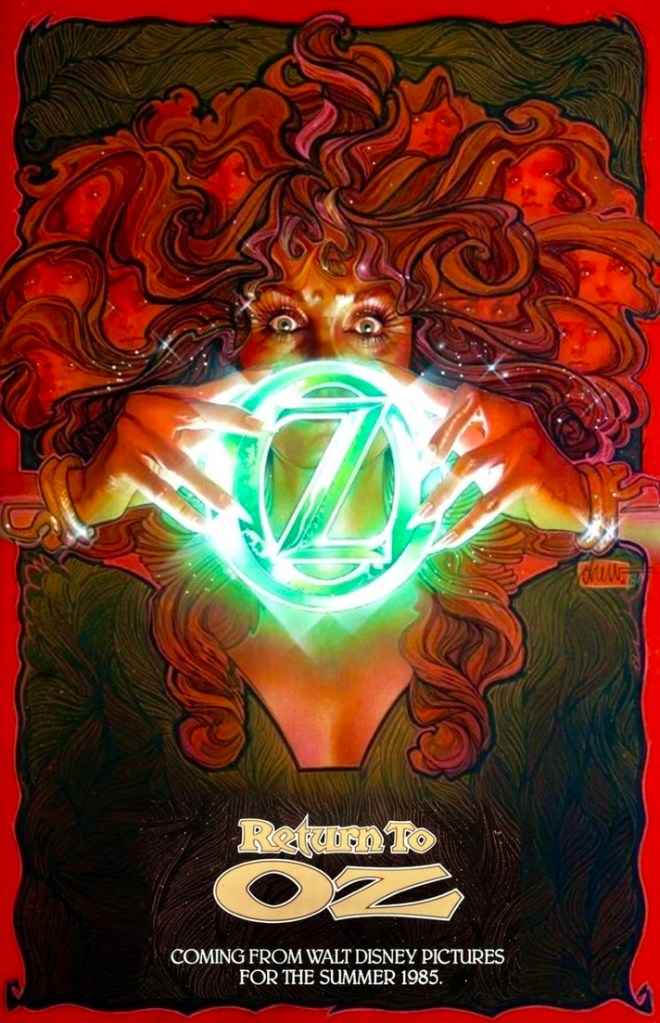
Forty-one years – half our life-time – ago we packed up our bags and the family and said goodbye to our home, leaving for two years in England to begin making ‘Return to Oz’ for Disney studios. In our inexperience and naiveté we didn’t know what was ahead for us or the film, and it was an intense two years full of more adventures than we had bargained for. We returned bruised but not broken though the film had a harder time of it. Abandoned by the studio whose revolving doors had spun executives in and out approximately every six months ‘Return to Oz’ was not given a good send-off as it was threaded up in cinemas around the country. Many years later Sydney Pollack, a film director, producer and friend, when battling the same issues with ‘The Talented Mr. Ripley’ said that “you can take an audience to hell and back, but you have to let them know where they are going.” Disney was not prepared to do that with Oz and neither was Paramount with Ripley. Both films felt the force of those non-decisions. But eventually both found their audiences and have a strong following to this day,

Return to Oz Poster by Drew Struzan that was never used.

On Saturday morning we were driven across London – never a smart thing to do on a Saturday morning – to the British Film Institute – on the South Bank of the Thames River. The driver dropped us off – as they do – somewhere in the back of the vast South Bank complex – and it took us awhile to find our way to the BFI entrance. We were late. ‘Return to Oz’ had already started, Dorothy had just found the key to Oz, showed it to Aunt Em and was about to be taken off to Dr. Worley’s. My friend Tansy as Toto was putting in a star performance. We were ushered to our seats in the back and as we slowly got used to the dark we saw that this large theatre was almost completely full of families and fans glued to the screen. They were laughing at the jokes, and following along, even staying silent and alert when the film froze as the projectionist missed the final breath-holding reel changeover. As the lights came up the audience of some film makers, film buffs. and children settling in for the Q and A. A young girl who had participated in the fun children’s hour hosted before the film asked Walter “Is Oz real?” and he answered, “Well that is the question isn’t it?” 

Thames in spring – photo by Beatrice Murch

Eventually we left the BFI, going out into the bright sunlight and joined the weekend folks along the South Bank of the river. The tide was in, the wind was up and the tourists were thick, walking and pausing to see the street artists with their puppets, music, youthful energy and hope. Strolling along we were bemused and touched that the work of 41 years ago still lives in the minds and hearts of these families. Crossing the Westminster Bridge I thought of the Nome King’s destruction by a plucky girl, her Army, the Gump, a squishy pumpkin, a chicken and an egg. For this afternoon moment we were relieved of thinking of the current Nome King who is destroying the Oz of Frank Baum’s world and dreams, the new age of invention as it was then in America and continued to be – until this time.

It’s pretty steady, each and every day a new decree is published from the Emperor who – although despite falling asleep while wearing a blue suit at the Popes Funeral – seems not to have any other clothes. He is moving on, already bored with the finer details of making a deal with Ukraine’s President Zelensky – gouging out huge mineral reserves in exchange for a paper-thin promise of more weapons, a cease-fire with Russia and some small print saying which countriy’s mayors, Russia or the Ukraine, gets to sit on which city council. President Zelensky has signed away half of his countries mineral wealth to this US President, betting that he won’t last his full term and hoping that eventually some calmer heads might prevail. For the moment the word from one of many Ukrainian women who have sheltered in Europe, finding work where they can is that ‘We are running out of men’.

It is as if the US president is no longer content with the swing of his golfing driver but has taken to fishing, wading in over his knees as he casts his rod and line out into the waters. He is moving on from the river bank of Gaza – leaving his pal Benjamin Netanyahu to finish mopping up the remains of that invasion. Hamas will burrow deeper into the sands of the desert that will indeed become deadly.  

photo by Faith Ninivaggi for Reuters

He is even more dangerous with a fishing rod, spinning it back and then out with too heavy a lure on the end. While we watch, Vice President Mike Pence received a Kennedy Medal of Honor and pause to take in the meaning of that award, for him and the country. 

Last week Public Broadcasting was threatened and ‘Films not made in America’ are on this week’s hit list as he called them a “security threat”, saying that “Other nations have stolen our Movie industry” The thought that art forms of any kind are like cats not owned by anyone but casting their lot with whoever gives them the best deal has not crossed the minds of the minions in the White House. Or maybe it has? Is the film industry to be reeled in with all the creators of all art to be marinated with the a new sauce before being tossed into the scorching barbecue pit of Great America. 

Spring has balked at heralding summer. The clouds are heavy with gun smoke as Israel attacks Yemen, Lebanon, Syria and Gaza all in one day. The blame lies elsewhere they say. And so far there are no children with a magical army of peace to stop this.

Here in Great Britain council seats were contested across the country splitting the United Kingdom into disarray. The Reform party led by Nigel Farage has taken a bold lead, sending the Conservatives tumbling to sit below the Lib Dems, whose leader, Ed Davey, MP for Kingston and Surbiton, is busy celebrating by playing village cricket and serving up just-out-of-the oven warm scones smothered in cream and strawberry jam at the tea break. Sir Keir Starmer looks rather shell-shocked and is almost pleading with the people to ‘give him more time.’ before he, too, dutifully served tea at the long table laid out along Downing Street for the 80th VE celebrations for the end of WW II.   

Princes George and William listen to a Veteran at Tea time in Buckingham Palace

Monday was the beginning of England’s week long celebrations. The Royal family were dutifully out on display, paying tribute to the soldiers, sea and airmen who fought then, and those who continue to serve. As in other countries that celebrate this day, there are fewer and fewer active service personal alive to be wheeled out and thanked, while each country continues to prepare for war.

This has been a letter from A Broad written and read for you by Muriel Murch. 

Supported by murch studio.com

Hove Actually.

Written and Read for you by Muriel Murch with WSM by my side.

Last week we took the train from London’s Victoria Station to Hove. Brighton and Hove that is, Hove tagging along beside its more famous big sister Brighton, never quite able to keep up. Which is why we were to spend the night in a cheaper seaside hotel in Hove rather than Brighton, and though the hotel boasted of a five-star breakfast, it remained Hove as the shingle beach stretches all along the Essex county coast line. It’s been a bitter marriage. Hove remains the smaller sister, its houses on the roads to the seaside crammed side by side with no breathing room between them. 

After the last war, every few houses became a boarding house, helping widows and poor relations hold onto their homes. Such was the lot of my Uncle Geoff and Aunt Gertrude, Geoff having retired as a Canadian Mountie and failed as a real estate developer returning from Canada. There was possibly not a lot of interest in development for the wilds of Alberta in the early 1950’s. I was sent to stay with Uncle Geoff and Aunt Gertrude in what I now see as an attempt to revert the family estate back to me, the only offspring of six children. I failed at that, but learnt to swim in the King Alfred seawater baths at Hove.  I also learnt about hunger for the first time in my life, Geoff and Gertrude’s Canadian life style didn’t include three meals a day. Another spinster aunt, Edith, lived close by, and her house was even more dismal than Geoff and Gertrude’s. Looking back I realize that my father was the only one of those six children to make it out of Canterbury and into a more successful life. No wonder Geoff and Gertrude were not going to hand back the small-as-it-was Slater Estate.

The Peace Statue that marks the entrance to Brighton

We taxied to the hotel, that looked no different from the houses along the road, and were greeted by a sweet young European woman who looked no different from all the European hotel staff who arrived at Victoria Station in the 1950’s, looking to better their lives and those of their families back home. The outline of the old house is still visible as we climbed the stairs to the top floor. All done over and with the necessary wifi connections. A quick change, back downstairs, to the next taxi and through the rush hour traffic along the coastal roadside, passing the Peace Statue into Brighton. A supper moment meeting the co-guests of this event, Victor and Wendy Armstrong – fellow film makers, English – who made their home and livelihood in Los Angeles. Victor being the world’s most prolific stunt double. His career is as legendary as Walter’s and this evening’s event is an interesting twinning of production action and post production manipulation of that action.

But supper has to be quick, we are on location with a gig after all and we walk our way from the restaurant to Horatio’s Bar and ‘The Space’ on Brighton Palace Pier. Dusk has arrived and day trippers were leaving the pier as film buffs are arriving, bustling in, ordering a drink or two and settling into the chairs arched around The Space. It is late by the time the last fans leave and we walk back along the pier, with the waves lapping underneath drowning out the sound of the cars heading back to ‘Hove Actually’.

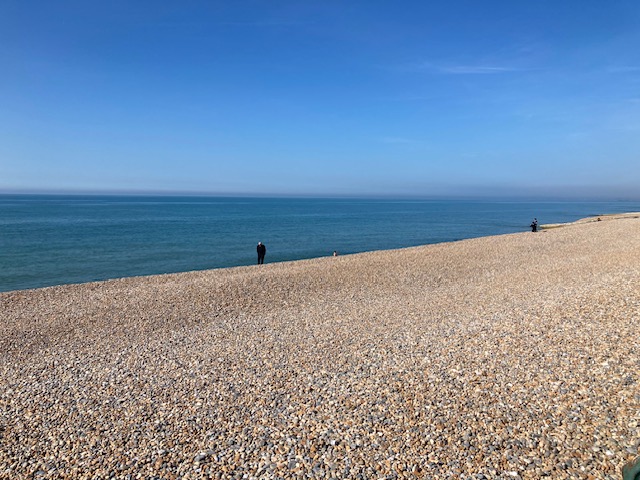
Shingles by the sea.

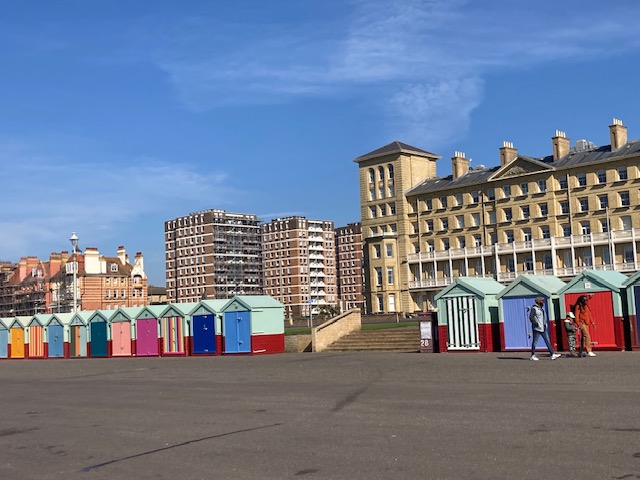
The morning gets us down to the 5 star breakfast which was probably the most appalling breakfast I have ever been faced with. And it must have been appalling for those poor European girls to prepare, never mind serve. Even the coffee – we won’t discuss the coffee. So we walked to the beach, the shingle stones as large and unforgiving as they were to my 10-year-old feet. The sun was shining, the beach huts all still closed up and only a few brave souls were at the water’s edge. The cold and the currents take no prisoners here in Sussex. 

We took the train back to London, where the cottage was waiting for us, and the pigeons were impatient for feeding. Fred, I think it is Fred, has been doing a dance, turning in circles in one of the flower pots to attract Freda, who is not that impressed with this swirling dervish courtier. The parrots are having better luck, a pair cozying up to the feeder together. They give us pleasure, these birds as we watch their antics in relief to those we see having in the United fractured States of America.  But are cracks slowly beginning to be visible as the axes of untrained gardeners slash into the undergrowth of Government? There are checks occurring, the latest being that while the Pope honored King Charles and Queen Camila with an audience, he guided JC Vance into the learned hands of Cardinal Pietro Parolin and the foreign minister, Archbishop Paul Gallagher. “There was an exchange of opinions on the international situation, especially regarding countries affected by war, political tensions and difficult humanitarian situations, with particular attention to migrants, refugees, and prisoners,” said the statement reported in The Guardian. Whereas the parameters of Islam follow the concentric expansion of interests that little by little extends to other persons and groups. The Christian one – as in this Easter Message – read for the Pope –

“I appeal to all those in positions of political responsibility in our world not to yield to the logic of fear which only leads to isolation from others, but rather to use the resources available to help the needy, to fight hunger and to encourage initiatives that promote development. These are the ‘weapons’ of peace: weapons that build the future, instead of sowing seeds of death!”

No matter which religion one follows, none include the concept of ‘Proizvol’ a Russian word that means the arbitrary abuse of power, the effect of which is a feeling that anything can happen to anyone at any time and that there is no accountability. Russia has this word for it, I wonder, do we?

Vance has to go to India, fast on the heels of China’s president Xi Jinping, who manages with a smile and charm to show Beijing having a steady hand on the tiller of commerce. But the Indian farmers, who outnumber any of those in North America, could rumble into Mumbai powering their concern and displeasure at Usha Vance bringing this American husband to her homeland. They are not convinced that he has come in the spirit of cooperation.

Vice President JD Vance has been tripping about and often tripping on unforeseen obstacles such as other countries opinions of his ‘America First’ Foreign Policy. It just doesn’t occur to him, or other members of this US government that going around the world shouting “America First” is – to put it politely – very rude. It’s also not polite to so brashly criticize your hosts defense spending or saying, while in Greenland, “We have to have Greenland.” Over this Easter Weekend it was touch and go if the ailing Pontiff would in fact grant Vance and audience, but finally – as it would – kindness and good manners prevailed and JD and his wife were allowed into the presence of the Pope. It was brief, Vance’s Motorcade idled in the Vatican grounds for a mere 17 minutes as JD nipped in and out it, appearing to listen, before patting the ailing Pope on the arm. They were give chocolate for the children and sent on their way.

As Vance boards his plane flying into India he will have heard of the Pope’s death. Will he, can he, reflect on his ‘America First’ attitude maybe being one more endurance that the Pope shouldered before putting down his burden ?  

This has been A letter from A. Broad, written and read for you by Muriel Murch.

As always supported by murchstudio.com
It’s the Trees

Written and read for you by Muriel Murch with WSM by my side.

The tail winds bring the plane into London fifteen minutes early and so we circle the city, sometimes dipping low over Windsor Great Park then rising over Queen Alexandra’s Palace before eventually fitting into our designated time slot – diving down and bump, bump, bumping to the runway. The afternoon sun is shining brightly by the time we pile into a taxi. 

“We have a lot of luggage.” “Sit yourselves down and I’ll pack it around you.” and with that instruction and in charge tone we are welcomed back. The traffic is light as between a waitress shift – after lunch and before dinner – as we head out around the roundabout onto the M4 Motorway which is still bordered by the scruffy fields holding a couple of caravans and the travelers piebald ponies half-hidden by the tall hawthorne hedgerows that are coming into leaf. The motorway dips to the city, passing the hat-tip of industry and settling onto the highly packed houses of Hounslow and Acton. The grass verges are left un-mowed, the dead daffodil blossoms are allowed to recede into the soil for next year. Dandelions take this opportunity to stand up and offer their yellow heads to the emerging bumble bees, and for a moment before the council can attack there is harmony in these narrow strips of roadside grass. This road into the city is deeply familiar and, bathed in the afternoon the sunlight, is welcoming. Turning the corner onto Prince Albert’s Terrace I see the newly worked hawthorne is sprouting as the bent branches form a hedge tough enough for sheep and cattle, and well able to hold the children climbing and swinging in the playground. Tired as we are the sight lifts our spirits. Sunlight can do that.

Sprouting Hedgerow on Primrose Hill

Our in-charge taxi driver sets about unloading all the luggage, knowing that small as our home is there will be a big tip. We are grateful for his help and unlocking the door we are even more grateful to enter our clean and welcoming cottage. It is small, and for now a safe haven from that world we have left.

We make it to the first evening, turning on the BBC news and to our dismay find that far from having left it, the American political scene is playing out on our screens. I have to remember that the same scene is being played out on news channels across the world in different languages – both verbal and body – as the news-casters try their utmost to report the news of American tariffs on their and other countries. Reeta Chakrabarti can hardly keep a straight face as she reports on the pending cutting down of the nearly 200 year old Magnolia Tree on the White House south lawn. It was planted by Andrew Jackson to honor the memory of his late wife, who died before he took office in 1829. The current US president said that wood from the tree, known as the Jackson Magnolia, will be used for “Other high and noble purposes”. He went on to say the tree was a safety concern and would be replaced by another ‘very beautiful tree’. I tend to worry when this US president uses the word ‘very’ – as in very beautiful, very nasty, very bad. And saddened that a tree, with such history is being killed on a whim.

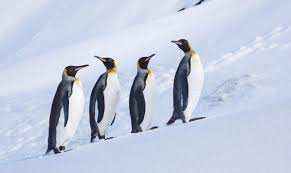
Penguins on Norfork Island are confused by Liberation Day. Photo from Dales Radio.

Reeta then took a deep breath as the news continued with the American President holding up boards with columns and numbers – this is, after all, a business meeting presentation, though his hair is too slicked down at the sides leaving the sparse top fluffing in the wind, showing where tariffs would be imposed when the scene suddenly cuts away – shifting from the President holding up his board to the Norfolk Island Penguins, who presumably have just seen it –  waddling along as fast as they can, no doubt worrying about the 10% tariffs being imposed on their guano that is carried out to sea. Heard Island and McDonald Islands, which form an external territory of Australia, are among the remotest places on Earth, accessible only via a two-week boat voyage from Perth in Australia. Anthony Albanese, the Australian Prime Minister, was as surprised as the penguins by the announcement saying “Nowhere on Earth is safe.” 

And I wonder about that. Even if everything was reversed, right now this minute, lives have been altered, some destroyed, there is more than one death that can be attributed to the maniacal behaviour coming from Washington D.C. 

Even here in this quiet corner of London we feel it, the head-shaking from our neighbors, the decisions not to visit America – the US president is on every newscast in this country and around most of the world and that is possibly a Very Important Thing for him.

We have been back almost a week and still every night the President is front and center of the newscasts. The protests that we know are happening all over the American coastlines get very little coverage. Each country is more concerned with this storm across the global markets and has little time or energy to think of the American people who voted for or against this President. The Universities, medical research, the arts and even in the heartland farmers will feel the swish of his scythe. 

The Israeli Prime Minister popped into to Washington for a visit. The two men sat at the head of a table, which holds a large model plane that looks to be waiting for one of them to pick it up and run around the room playing like a five-year-old, making whoosh plane noises as they dive bomb the nodding heads, sitting suited in uniform, turned to face their leaders. Maybe this is where the plane turns and lifts off, flying beyond America hovering over China, Europe and Iran, spoiling for a fight with real blood.

Poor Sir Keir Starmer looks out of his depth as he goes out to meet the people and leaders in UK industry. Yesterday he was at the Jaguar Land Rover factory, a heavyweight plant of Industry whose CEO, Adrian Mardell, has said they are pausing exports to the US for a month. He is giving Starmer time to do something but Sir Keir’s earnestness is not very convincing and Rachael Reeves is getting shrill – never a good sign.

On our first full day we walk up the Broadwalk in Regent’s Park, determined to see the cherry trees in bloom. The air is warm but the wind is strong and early falling petals carpet the road. People of all ages, colors and persuasions have come to admire and to take pictures of the young trees. We have watched them since their planting and now in their three-year-old adolescence they are giving us courage while bringing joy with their beauty. May it always be so.

Regent’s Park Cherry Trees in bloom

This has been A Letter from A. Broad. Written and read for you by Muriel Murch, and as always supported by murchstudio.com

Bees are Buzzing

Written and read for you by Muriel Murch with WSM by my side

The orange one and his grubby companions are causing horrendous chaos in Washington and the world, but one thing they cannot stop is this morning’s spring sunshine. Even in the worst of times, which for so many people in the world this is, the spring sunshine is bringing warmth and a moment of peace within the despair of their lives. How can it be otherwise when the world is churning upside down, as if a mammoth is rising up from the depth of the ocean and has begun a tidal wave of tsunami proportions? We do not know when this will be stopped for surely as America and the world come to their senses, the end of their road and rope will be reached. 

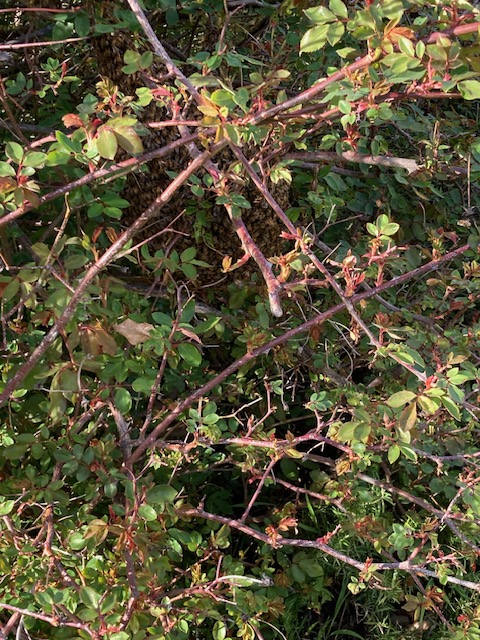
Last week an early swam of bees arrived. First they circled the redwood trees, then the wood pile below, before settling deep into the as yet unpruned Cécile Brunner rose. They presented a knotty problem, this is not really a safe place for them while being a very tricky spot for any bee keeper to reach. But these were the gentlest bees I can remember ever working with. They slid into the skip and were happily transferred to an already swept out and refreshed hive body waiting for them. It was a big swarm and has settled in nicely and I am a little bit gleeful, for we may – eventually – profit from their upgraded housing. You can live here – and we will harvest – tithing you – later in the year. Sounds a little like a mafia move to me. 

They are very hard to see but – trust me – they are there.

But then a little swarm returned to the rose bush, hiding, I suspect, a young and tender queen who was having none of it and could not be persuaded to move. A few days later I tried to add them to their sisters in the big hive but no – back to their rose bush they flew and by the following morning were clustered, a smidgen smaller, but still holding onto their rose bush branch. She, their young queen, and they know better than to trust me and, if they had time, could become strong enough to find ‘just the right’  log or tree, and they would move on again. But there isn’t time. We are wanting to host a small party in the back garden later this week and not everyone is comfortable with worker bees out and about. There could be panic among the humans, panic among the bees as the workers die off in the efforts to save their little queen, who may die before they find a suitable home and build up a colony that will survive and grow. I look at the bees, some acquiescing to our manipulation and others holding out for what they believe in. It feels a little like some of the behavior in North America right now. So this morning, while the dew was still on the ground, and the sun had not reached this cluster holding tight for warmth, I came to them again. Sweeping them softly into a box, closing it quickly and then taking it to a smaller hive that I had again prepared. This time they went in and by the time this letter is finished for you they will be busy setting up house and drawing out comb ready to take care of their community once more.

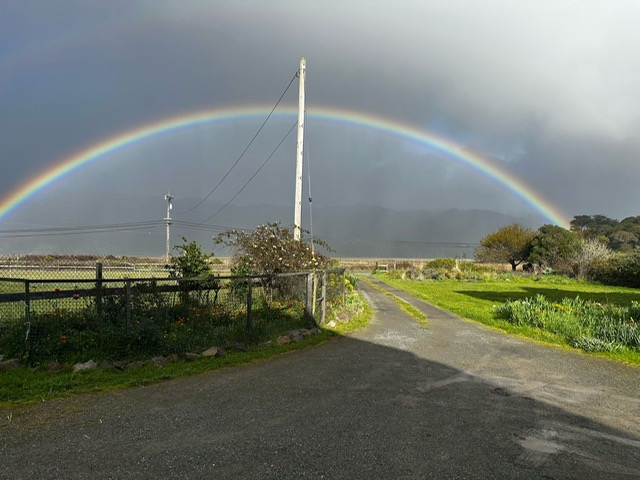
After the storm, a rainbow for the farm. Photo by Greg Watson.

This has been a Letter from A. Broad. Written and read for you by Muriel Murch.

Supported by https://www.murchstudio.com

The Limit

Written and read for you by Muriel Murch with WSM by my side.

When Winifred Forsyte’s husband, Montague Dartie, stole the pearl necklace that her father had given her for her wedding and then gave it to his mistress before setting sail to South America, she said to her brother: “It’s the limit!” And now, across the country, Americans reacting to the nine weeks of this new government administration, are reaching the same conclusion, with all the bombastic fireworks and scrawled penmanship erupting from the Oval Office at the same time. At first it was hard to see where to focus – which was the point of the mass display of bogus authority. As we each tried to settle on something that meant America to us: immigration, freedom from persecution, a land of opportunity, many people returned to The National Parks that display the majesty of all that this country can offer.

Protest at the Bear Valley Visitors Center in Pt Reyes, California

The Parks belong to the people of America and the people who work in them, coming from all walks and persuasions of life, work for the American people. The wild actions of the President and his puppeteer Elon Musk are enraging ordinary folks from the Rockies to the Mid-West plains and the rivers that join them. The limit may not yet have been reached but it is getting close. The forests and parks are the American Jewels, beloved by peoples of all parties, persuasions, income levels, rural and city dwellers alike. And they – we the people – are coming together, supporting where we can the rangers and Park personal dismissed out of hand by the playboys in Washington.   

What are they thinking, strutting around the corridors, cruising into conference and press rooms, wandering along halls leading to nowhere in particular? They are plucking what seems like easy pickings off of the laden fruit of America. Things that they don’t use. When was the last time Elon drove a Tesla into Yosemite National Park? Was there even a first time? It is more than doubtful. Up one aisle and down another he trolls with his shopping cart, as if in a giant supermarket of cheap value. The park service here, an unforgivable rudeness to another nation there, a Palestinian immigrant kidnapped. It is enough to shake up America to join together in saying ‘This is the limit’ But when and how will that be reached? The display of bad manners – the politest words I can find – shown in the Oval Office last week for President Zelensky’s visit was another limit reached.

And this one – that one – has left lasting damage to how North America, not Central or Southern America, is seen across the world. ‘No taxes to Kings’ was the battle cry of the first republic but now this America is being ravaged by a despot and his henchmen. 

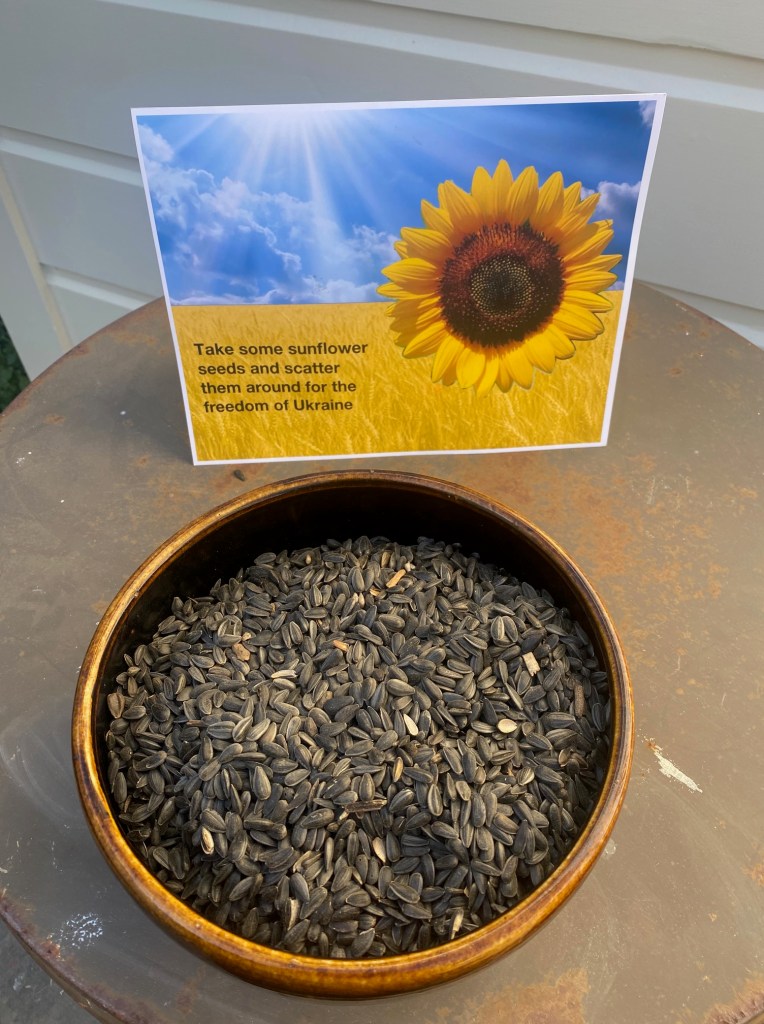
Sunflower Seeds at an event for guests to take and spread in support of the Ukraine.
Photo by WSM

Meanwhile across the Atlantic, on the boarders of Europe, a real King is welcoming President Zelensky as he should be welcomed, with good manners and concern for his well-being, reminding us all it’s not the title – it’s the person. King Charles III is joined by his Prime Minister and the leaders of a still free and Democratic Europe. Which is poised – understanding that the rise of fascism starts with a slow simmer before reaching a boil. And then it can boil over, like an unwatched  pot of soup to be mopped up – or not – by those left in the kitchen that is Europe. The Ukraine, sits boiling on the stove rising to a boil in the kitchen that is Europe, the heart-beat of any home. And America is a home to those who were here before the rest of us who arrived – in free will or slavery. For we all came as immigrants, some in fear, struggling from persecution, some in greed seeking opportunities and some with good heart looking for a better life without the need to hurt another. 

As we live, around the block, up the street, in the cul-de-sac or along the lonely highway that weaves from farm to farm our families grow together in community. We celebrate, mourn and disagree together. These times make us who we are. And when some outside force threatens the community – disease, natural disasters, governmental bureaucracy and corruption – then we put aside our differences and come together, clustering like bees to protect our queen, in this case the integrity and sanity of North America who is in danger. The people know that a killer wasp has entered the Bee hive and is threatening all that work there. 

It is beginning, the gathering of small groups leading to larger ones, coming together forming bigger and stronger communities and blessed Bernie Sanders out there stomping around in the midwest states. So far it has the smell of “We’re right behind you,” not too many daring to stand along side or step up to the lead. Sanders is a Truth Bomber. He has nothing to lose by speaking out. And as Rep. Alexandria Ocasio-Cortez, said of Sanders’ efforts. “You look around — who else is doing it? No one. My hope is that the dam will break in terms of Democrats going on the offense … We need to take the argument directly to the people.” “It’s not about whether Bernie should or shouldn’t be doing this. It’s about that we all should,” she said. “He is unique in this country, and so long as we are blessed to have that capacity on our side, I think we should be thankful for it.” Ocasio-Cortez said she will join him on the road in the coming weeks planning solo appearances in Republican-held congressional districts in Pennsylvania and New York — as now local House Republicans are reluctant to face the angry questions coming at them in their Town hall meetings. Rather than blame the chap sitting in the swirling chair in the Oval office they are turning on Elon Musk and that is a good start.

Found in NW1 London Photo by Steve Wax

At this time we feel the threats coming at us nationally and globally and cluster even closer. Each national park is holding rallies that are growing each week and beginning to unite in mass gatherings. Citizens march and protest outside of Tesla Dealerships. Decals are stuck on parked Telsas in America and Europe. They are saying no – and at some point that no could overflow into a protest that will rise from a simmer to boiling point giving this government the excuse to bring in the national guard, pitting Americans agains Americans. 

It is called Civil War.

This has been A Letter from A. Broad. Written and read for you by Muriel Murch.

And as always supported by https://www.murchstudio.com
Harvesting History

Written and read for you by Muriel Murch with WSM by my side

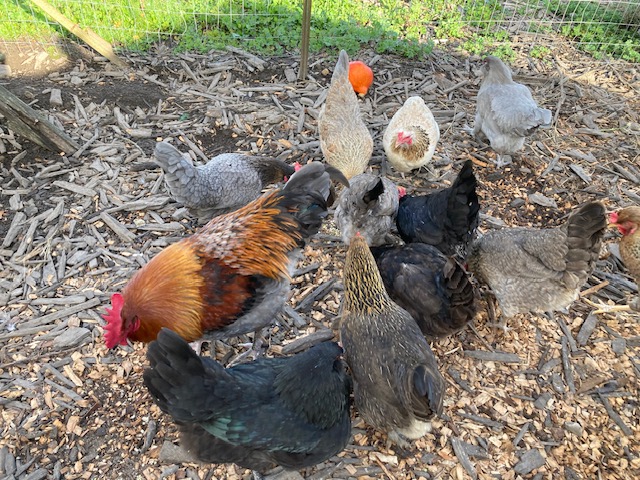
The sun was shining as I finished refreshing the chicken house. Blue, the rooster, led his ladies milling around, happy as they checked out the new straw and shavings. And then, out of the silent sky came the roar and rumble. Looking up, I saw nothing, but heard and felt it deep in my body. I know that sound, it was a fighter jet, flying low overhead and I thought – the war has begun. 

Breakfast in the safety of the Hen house

The news media bombards us and, like the chickens scratching in the orchard, we are half-primed for the pounce of a predator coming from the surrounding underbrush. For the moment, the chickens are safe from a resident bobcat on the hill as I will not let them into the orchard, but we may not be so lucky.

With each item of news about the shenanigans happening in the Happy House in Washington DC, everything we treasure about the Constitution is under attack and it takes more strength than I have not to be afraid of, and for, America. We can hardly glance at Gaza, the Sudan, and the world. But Europe, though teetering on waves of militant bravado has woken up. Germany has just elected a Conservative government – but the seemingly strong right-wing factor is licking its electoral wounds. Even Nigel Farage has toned down his bombastic spittle. A beloved friend in England who was beginning her new life in Scotland now thinks that her old home in the Australian Outback looks safer.

Thinking back into European and American History of less that a hundred years ago is like turning the pages on an old photo album. History, behaviour, and human nature mixes and re-emerges as a sea thrusting the waves of an ocean storm circling us again.

I’m thinking of young Vladimir Putin as a keen and dedicated KGB officer, committed to keeping all the surrounding principalities  herded into the USSR and then, under Putin’s watch, for it all to be upset by Mikhail Gorbachev giving back Ukraine and breaking up the Union of Russia so tightly bound by Stalin. An attempted coup – here is that word again – led to the dissolution of the Communist party in Russia and the USSR four months later. Heady and searing times for a young, ambitious KGB officer. At the same time another ambitious yet nervous young New York business want-to-be was struggling with paternal authority issues. Slipping into real estate with a million dollars, and the advice, “you’ve got to be a killer”, from his father Fred, he began. Among his successes were failures, both moral and financial but he kept playing the part until he became the business man he wanted to be.  But this smiling blustering crook took more than one serious tumble and that was captured and understood by an equally ruthless and ambitious, but more serious President across the continent of enemies. While Putin’s early bruising was from Gorbachev, and remembered for the rest of his life, the US President’s crushing bruising came later, in 2011 when an African-American president, Barak Obama, returned his fire at the White House Correspondents’ Dinner – these personal insults were never forgotten and maybe this was the night that redemption and revenge became the main drive of Donald Trump to rule the universe he knew.

Now these two men are playing on the world stage, ruthless killers and unrepentant deal makers. It is not a good combination for democracy.  Ukraine’s President Zelenskyy may be bold, clever, quick and right but crushing him and regaining Ukraine to Mother Russia remains an objective, with the candy cane of minerals and wheat for the taking. We who are older and watching what is playing out see a repeat cycle on the world stage and know that deep down all of this dog-fighting is personal. There are other young European leaders taking up the helm for Zelenskyy and Ukraine. Emmanuel Macron flies to Washington DC, sits at the right hand of the Emperor and gently laughs, humors and says ‘Ah but no no, it was like this’. The Emperor laps it up, enjoying the adulation of the younger man but will probably pay no heed to his words. Next will come the British Prime Minister, Chief Prosecutor for the Labour Party, Sir Keir Starmer, as devoid of humor and charm as Macron is full of it. He will play another hand, appearing to be ‘taking the President seriously’ while – maybe – we can never be sure with Sir Keir – again trying to guide the US president away from his deal making with Russia.

From The New Statesman

Zelenskyy, Macron, and Starmer are young men, hard working and dedicated to Democracy and a Free Europe but they may not be strong enough to turn the US President away from the skull crushing grasp of the Russian bear Vladimir Putin.

We watch the world stage from our rural corner of California, while looking at the effects of the games played by the boys in the Oval Office. What affects us close to home? What are the things we care about? Hard working families in fear of being torn apart, rangers from the National Parks fired, books banned from Libraries and Schools. 

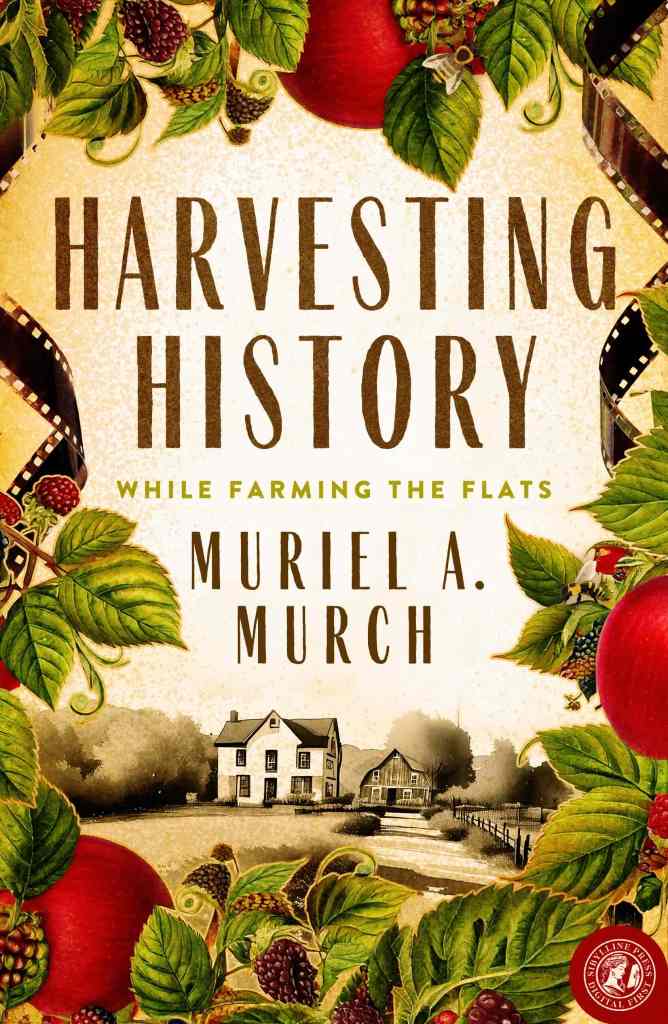
We are older and need to tidy up our lives. We are not cleaning out the cupboards and barn stalls as we should be, instead have been writing of our work, our lives and worlds together and apart. There are family stories to repeat, cinematic history and community evolution to record. And for some lucky reason both Walter and I are managing in our own ways to remember, to write and to share our lives. Walter’s new book ‘Suddenly Something Clicked’ from Faber & Faber will be on bookstore shelves and Amazon in the UK in May and the US in July. My ‘Harvesting History while Farming the Flats’ will be scrolling out in a digital format for your Kindle in March, followed with a print version a week later. And even an Audio – as soon as I can get to it. Here is a little glimpse in the prologue of our life stories as they moved separately through the decades of our existence together.


After my husband delivered a lecture to a group of Danish Film makers and students Philip calls out, “The last question please,” and a young man stands up.

“Mr. Murch, with your work schedule and the traveling, how do you manage a home life?” then he sits down. Suddenly there is a deeper quiet in the room. Philip nods and raises his eyebrows, which always look striking with his large, round, smooth bald head. He nods as if to say, “yes this is a good question” and looks over at Walter. Walter pauses, not rushing, as he can, to answer with overflowing ideas. Then he responded.

“Truth be told I don’t. I am often on a project for a year, maybe longer, sometimes eighteen months, even two years – and in that time I may not know where I will be six weeks ahead. You will have to ask Aggie that question.” He smiles and looks up briefly before Philip calls out, “Lunch. We will reconvene in an hour.”

‘Harvesting History while Farming the Flats’ is my answer.

Available March 7 2025
as an ebook ISBN 9781960573544
Print ISBN 9781960573698
www.sibyllinepress.com

This has been A Letter From A. Broad, written and read for you by Muriel Murch. 

As always supported by https://www.murchstudio.com

Morning Moments

Written and read for you by Muriel Murch with WSM by my side.

Across the high street from the general merchants, Wainwrights and Sons  – when general merchants sold everything from coal, lumber and rabbit food – was a small glass-fronted, with green trim, coffee and pastry shop. It was run by Madame Max and painted above the door, in curly blue writing ‘Mrs Max’s Café’. She must have been a refugee from the war and somehow had landed in our small town in Fleet in Hampshire. I like to think there may have been a story from a returning army officer giving her a helping hand to start her life once more. There are stories we never know. Lady Pechell was a daily customer, riding her bicycle from the two miles from the rhododendron shrouded Denorban Avenue into the village. Lady Pechell was older than the young mothers making do with their ration books, trading eggs and butter from small holdings for gin from goodness knows where. On shopping days during the week they came to Mrs Max’s Café, to be together for an hour. To commiserate about all and everything, trying to put their lives together as the war continued, while Lady Pechall quietly fed me lumps of sugar. She pocketed more lumps of sugar for her ponies. Though sugar was also rationed and because she was a little eccentric and her husband had fought in two world wars, nobody minded. A mystery surrounded her, her husband Sir Paul, that maybe included Madame Max and her café. 

Hampshire countryside then and now

I’m thinking of those times after reading Emma Beddington in the Guardian last week. Her article was about Starbucks, now getting people out of their U.S. coffee shops with a new “Coffeehouse Code of Conduct,” making people buy something or leave. Someone has been scratching their corporate head wondering how, in the words from ‘The Loved one’ “To get those stiffs off of my property.”

This attitude has caused quite a stir-up in the brew that makes up coffee house culture in the U.S. and Europe. It’s a big thing in all cultures and wouldn’t you know it it is America that can’t quite handle the slow soothing pace of sipping. There are all sorts of reasons, the economy being the main thrust driving Starbucks which, really isn’t failing but has always seemed to be on overdrive. I’m remembering European workmen, standing at coffee bars in Rome and Paris, taking an expresso hit before their day started and women pausing for a refresher mid-morning to get them through the day. I’m thinking of Bianca, who I met 30 years ago in the Piazza San Lorenzo, our dogs yapping at each other leading to a conversation, a visit with homemade raspberry sorbet and a postcard from Puccini. 

KHARKIV OBLAST, UKRAINE – NOVEMBER 20 2023.
(Photo by Diego Herrera Carcedo/Anadolu via Getty Images)

Soldiers stand about – taking their coffee before heading back out on patrol. How is it now for the Russian and Ukrainian solders in Northern Europe slogging on in February where the war between them has wearied both the soldiers, the politicans and those of us who are watching from thousands of miles away. They have no comfort, barely some companionship that may or may not be with them at the end of the day. February for foot soldiers in war is the month of mud, spring and relief seems far away. Russian troops are killing more Ukrainian war prisoners and The new US President is doing his ‘gimme gimme’ routine with Ukraine, asking for ‘Rare Earth’ in exchange for weapons. Rare Earth that would be better used for rebuilding a war torn country when all of that stops. 

And as for the old fella’s tariffs on Canada and Mexico, well they may have slid backwards or even backfired. The Mexican President Claudia Sheinbaum said she reached an agreement with the US president to pause tariffs for a month as Mexico sends 10,000 troops to the border to stop migrants crossing into the US and address drug smuggling. And after talks with the Canadian prime minister, Justin Trudeau, there is a month’s pause going north as well. Both these agreements were apparently all in place before they were ‘renegotiated’. But it is too late for the Kentucky Bourbon now being pulled off of the Canadian Liquor store shelves. Meanwhile China responds in its own way.

In Europe Sir Keir Starmer has been to Brussels and managed to say pretty much nothing as he walked the gymnastic balance beam in front of the whole European school. He made it to the end – without falling off – but only just. A journalist from the BBC no less – called out that surely these were not ordinary times in the political arena. That the Orange one is rather upsetting the apple cart. Standing beside Sir Keir Starmer in a joint conference, Mark Rutte the former prime minister of the Netherlands and now the Secretary General of NATO said that “I am absolutely convinced that we can deal with these issues, and there are always issues between allies, … sometimes bigger, sometimes smaller. But I’m absolutely convinced that will not get in the way of our collective determination to keep our deterrence strong.” They looked very alone standing in their joint conviction of collective peace in our time. 

Sir Keir Starmmer and Mark Rutte standing together in Brussels

Tariffs tossed out across borders, gutting of American government bodies is keeping the president busy and he will get hand cramp if he is not careful signing away the country in a Coup. This weekend sees BB Netanyahu sitting in DC having photos taken, and a chat about Gaza – or what to do with the rubble that is left of the state. It is doubtful that they will talk about the people. But there will be a statement about something ‘definitely happening’.  But as we doubt those ‘definitely happening’ statements we worry and need to share those thoughts; the effects of this new global bickering and power plays that is costing lives, along with worries about our communities as the trickle-down effect of this new reality takes hold, our friends getting older and our families. 

It is seriously raining outside but our need for companionship in another place, neither work nor home, calls us out. And so we come together, meeting in town for an hour to sit at Toby’s with our cups of coffee. Chris Giacomini is moving the chairs back into the feed barn so that we are dry. He understands more than most that the need for companionship – sharing our worries and the world’s troubles with a friend are served best – in that other place – slowly sipping a cup of coffee.

This has been A Letter From A. Broad. Written and read for you by Muriel Murch.

As always supported by murchstudio.com

Wolf Moon

Written and recorded by Muriel Murch with WSM by my side

Last week the Wolf Moon rose over the whole world. Shining brightly through clouds and fog, it blazed through the night and our windows while the coyotes howled for mates on the lowlands along with their wolf brethren deep in the forests. It’s a strong moon for the middle of winter that harbors renewal as seal and sea lion birth occurs on the seashores around us, but the ground is still cold and – tempting as the sun can be – it is too soon to start planting a garden.

Coyote looking about the farm. Photo by Walter out West

The predators that come through the farm change through the years and we would do well to take note. For the moment there are no raccoons or foxes tiptoeing up the stairs to our little terrace. They are deeper in the woods, also hiding from the coyotes and the bobcats that are also happy with the local takeaway of pet-fur as chicken feathers. The coyotes are hungry and so are the hawks. Both eye our chickens. From time to time they get lucky and there are raids that end in death cries and feathers to tell the tale. The predators know this small holding lies on the edge of farming country and that we are not always as vigilant as we could be. The hawks fly in silently and the coyote is quiet as he trots up the back driveway, looking here and there for an easy catch or any human activity that precludes it before carrying on through the barn and out, down the front driveway. He is scrawny, this coyote who comes through, hungry and skinny beyond just the needs of winter.

But there are others – in human form – who are searching, looking for some nurturing of the soul. He is young, dark with weathered skin and hair that covers his head and face as if he is risen from the sea, a messenger from Poseidon, and now finding himself on land, is not too sure what to do next. He wandered in, up the back driveway like the coyote, and stood behind the barn looking about him for a while. 

Ever the galant host, our son approached the stranger to ask if he is all right? Slowly coming to earth he responds, “This is so authentic man. Your jacket too. It looks like the real thing.” And covetously eyes it. Walter replies, “It is the real thing. I need it. You can’t have my jacket.” They stand in the driveway, as the stranger ponders his situation. He looks again at the farmer before he slowly backs away – like an animal who has stumbled into another bear’s territory. 

But the stranger was looking for something, and maybe found it in the grounded feel of this little farm that sits on the knotty edge of what used to be farming country and is now braced between National Park Land and a vacation paradise. It’s a tricky triangle, played out in this tiny corner of West Marin. But enlarge that geography and the mindsets that cherish agriculture, parkland and vacations, and a storm in a teacup doesn’t even begin to cover it. This week – things came to a head and we have seen and heard the outpouring of frustration and grief at the closure of the ranches within the Point Reyes Parks. It’s a pretty brutal execution and one that could have been so avoided a long time ago with bringing all parties to the table for counsel, consideration, and cooperation. In our local paper – the Point Reyes Light – January 16th issue – there are articles beyond articles of the damage these closures will cause to all the Parklands the environmentalists, the tourists, the ranchers, and the ranch workers whose family members also work in the communities.  Dewey Livingston added a column, “Point Reyes in Time” laying out the history of Point Reyes since ‘we’ took it over.  Sober and sad as it is, it is also a reminder that we are all a part of history. In ‘The Temper of our Time’ Eric Hoffer wrote “Every great cause begins as a movement, becomes a business, and eventually degenerates into a racket.” Putting some of the environmental and conservation organizations into that equation and you might find a good fit.

On the day that I write this letter another historical change is occurring in America. As one administration bows out another is striding in and the world is trembling in happy or fearful anticipation. In a preemptive move, not something the Democratic party do often, outgoing President Joe Biden has pardoned many public servants to prevent false prosecution by the incoming government. The list is too long for this writing but the democratic Chairman Bennie Thompson, and Republican Vice Chair Liz Cheney, leaders of the House Select January 6 committee said on behalf of the committee they were grateful for the pardons. I choke up thinking that Dr Fauci is in need of protection from such harassment. Immediately on taking office the incoming president puts his cards on the table – playing a full flush of pardons for 1,600 people associated with the January 6th riots storming the Capitol. He went on, signing this and signing that and the ‘to do’ list laid out for his administration –  the heads of whom – don’t seem to have yet learned how to lay the table – is long.

Meanwhile – after it is over – I study the news, culling from this publication and that TV station. European leaders, some past, some still sitting at their desks, and some not quite there yet I’m seeing a motley crew with their hair and hats and ties as they took their places behind the second generation American Tech leaders of the moment. 

Past Presidents Bill Clinton, George W. Bush and Barak Obama with Hilary Clinton and Laura Bush

Then I look particularly at the women who – like our late Queen – know the subtle messages of the clothes they wear and the actions they take. Michelle Obama is absent. Hillary Clinton standing beside her very trim husband is wearing a Peace on Earth broach.  Laura Bush has a single strand of good pearls over her dress as she accompanied her husband George.

A universal image probably from Getty or The Guardian.

Melania is wearing a hat – that fits – her mood, and possibly her need to be hidden as she walks back onto the world stage. And as she controls the gloved touches she exchanges with her husband, she does not let his flesh reach hers. Melania’s hide may not be as thick as she likes us to believe. Only time will tell if the oil of parenthood has softened her skin to embrace the world she comes from and is about to enter once more.

This has been A Letter from A. Broad. Written and read for you by Muriel Murch. 

As always supported by murchstudio.com