Mourning and Marmalade

Mourning and Marmalade

Written and read for you by Muriel Murch with WSM by my side
All Saints Church in Crondall, England by Andrew Smith

The year – that year – 2024 has ended and Past-President Jimmy Carter quietly left so as to watch the next chapter of American history unfold from afar. In a sign of respect – not accorded to every US President – the Union Jack at Buckingham Palace was flown at half mast on the days of, and after, his passing. For us the outgoing tides of 2024 carried out with them family and friend transitions that were close to our hearts. Later this week I will rise with the dawn to think about friends and family gathering in the Norman All Saints village church in Crondall that they have attended for over fifty years, as the patriarch of their family will be remembered and laid to rest in the grounds surrounding the church. This is the winter of our lives and the leaves of love and memory are falling.

The gifts – that is – of this time – are the memories that emerge out of our past – even the worst of them – are coated – if not soaked – with love – and often more than a little laughter. So the old year fades, taxes get paid and we look forward to whatever this year will bring.

The changing American administration will take place on January 20th, ironically falling on Martin Luther King day, whose dream seems to be once more deferred. This change is bringing apprehension to Americans and world leaders alike. Gears must be shifted, and wheels oiled. Ukraine’s President Zelensky has to figure out how to dance around the incoming American President who is in turn dancing to President Vladimir Putin’s music. It’s tricky for whatever happens with Zelensky and to Ukraine will ripple through the rest of Europe and beyond. Elon Musk is traveling in person and on X into London chatting with – and then dismissing – Nigel Farrage now saying “Reform needs a new leader.” Well there is egg or custard pie on Nigel’s face – again. Sir Keir Starmer has too many papers on his desk, The National Health System, housing, Nigel breathing down his neck, the conservatives straightening their skirt hems and now this Musk boy putting his finger in the icing of British Politics, not knowing that the cake inside has collapsed completely. Meanwhile Justin Trudeau is stepping down as Canada’s Prime Minister. Another good-looking chap falling under the wheels of Government failure and a touch of corruption. How do they make such silly mistakes swinging in and out of revolving doors? Maybe one needs to be a fly in the soup to understand that better.

# 24 bus From Pimlico to Camden

It is snowing in England. ’Makes you feel like a kid again’ says another wistful middle-aged man in a Yorkshire pub. And it does. However inconvenient, the snow is and it can be brutal for farmers and those living in small hamlets, throughout the country we are relieved to see this winter weather. Cold to ward away the concerns of global warming.

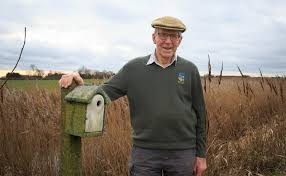
Nicolas Watts in Lincolnshire, is a farmer who farms among his crops, a fine line in organic bird seed. Nicolas sits down once a month to write a newsletter about his farm, the crops, the wildlife and the weather.

Credit: Tim Scrivener http://www.agriphoto.com

And every month I read it. He has his figures and facts all lined up and this month says “We only had one frost in December and it was far milder than usual, with a mean average of 7.2°C. … There are no fast moves in here, no rushing to embrace this fad or that. But what Nicholas is showing – on his farm and in his newsletters – are the effects of climate change on this small country – this farm – agriculture, and thus us all. He goes on – telling us about how the price of potatoes has gone up – but that is another story. This farmer is working the land and seeing what is happening to the soil and the Earth we live on.

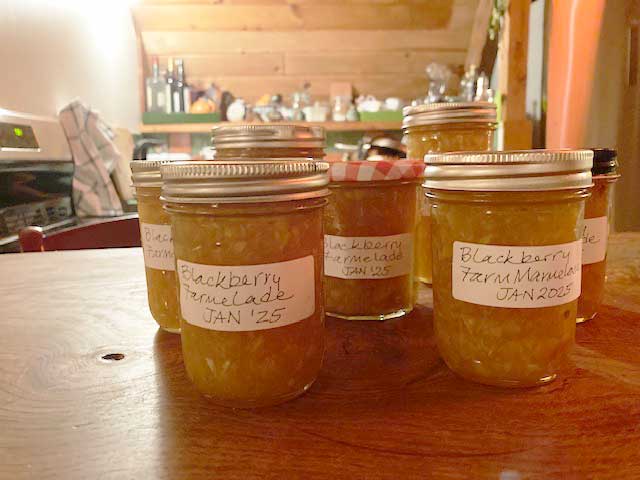
Meanwhile in January, many English women still make enough marmalade – for their family and friends – to last for the whole year. And those of us who do it are very particular about what we use. Each family has its own recipes and traditions, though now it is mostly us grandmothers who ‘have the time’ and care enough to make it. Oranges from Seville are key, and arrive from Spain to England just after Christmas. They are small, squishy, bitter and full of pips. In years gone by, when lemons were a luxury, the marmalade was made solely from these oranges. Lemons were saved for Lemon Curd. Rose’s brought in Lime Fine Cut Marmalade as an exotic and it remains popular today. I’m thinking those limes came from the Caribbean and that Rose’s got a good deal on them. Now marmalades are mixed, and exotic, with and without, whiskey added, but it is hard to find good old chunky cut marmalade. Marks and Spencers and Fortnum & Mason made a stab at it but both are still too refined. And what about those of us, outside of England for whom making marmalade remains as important as making mince pies? We are lucky in California that citrus and Meyer Lemons particularly grow abundantly. And on this farm we are also lucky. About twenty years ago one of our daughters gave me a Pacific Coast Orange tree. I was dubious and the tree felt my lack of confidence in it and so for years it sat, sulking, hardly growing at all but then maybe the nutrients from all the dead pets in the bury patch released into the soil and now the little shrub is a big tree, with bowed branches full of fruit. Truth be told they are the complete opposite of the oranges from Seville. There is as much pith as fruit in each orange and as for juice – to be kind – it is tart. But I go out into the garden, gather those oranges, a few Meyer lemons – that tree for some reason not as strong as the orange – and chop, mixing the fruit together. It gives me a chunky, tart marmalade that can stand ‘toast to toast’ with the old remembered Seville orange marmalade. This week I have my twelve plus and counting jars of marmalade, and I am happy once more. 

Farmalade January 2025

As I make my marmalade, I remember my mother making hers and the rows and rows of jars put away in the larder. I am thinking again of my friends in England. We are older now and knocked about by the snow and winter weather. The silent whiteness will only be beautiful if they can be safe walking to the church, laying this loved one into his grave, before returning with their memories to the safety of their homes.

This has been A Letter from A. Broad. Written and read for you by Muriel Murch. 

As always supported by https://www.murchstudio.com

666 Days and Counting

Written and Read for you by Muriel Murch with WSM by my side.
Stinson Beach from the Airplane, photo by WSM

Bump bump bump goes the United Airlines plane as we fly across the mid-west and over the Rockies, it is as if the plane is no longer sure what is United, and as for ‘flying the friendly skies’ that went the way of all bombers. We bumped until we didn’t – descending like a glider over the Point Reyes Peninsula, seeing our home stretch of California before heading back to land. 

As we were a week later than planned, there was no time to slowly unpack and settle in before the appointments all lined up. Day one, Doctor in the city, check. Day two, doctor in the country, check. Day three, The Department of Motor Vehicles, check, an Xray here, a medication pick up there and we are check, checked again – now hungry and exhausted. But it is barely late afternoon and as we are a little ways north we gratefully pull up at the Rancho Nicasio Bar and Restaurant which quietly stays open for those like us, coming home too tired and hungry to cook. It’s a small row, really all one building, and looking at it, it is always strange to think that this was going to be the center seat of Marin County. How would the county have emerged if that had happened instead of San Rafael? The bar restaurant is the biggest holding here, tucked beside it is the grocery store that was out of milk, and almost hidden by an overhanging oak tree in the corner is the post office. As we pull up and the boys walk towards the bar door, another car pulls in and smiling through her window is a dear friend that I haven’t seen for a year. She is here to get her mail – at the post office. And I too have letters to post. Another gentleman, whose name I can’t remember, also smiles hello to me, and I am reminded that this is what the postoffice does – weaving a vital thread through the community as folks come and go checking for their mail and on each other, even more than community libraries, they are places of and for community.

Our town, Bolinas – there, said it out-loud – has been without its post office for 666 days and counting. And we are counting, and marking it down, writing letters, going to meetings, in public and in private and hustling, trying to right this wrong. This town, and others around the country like us, little ones, with not too many people, may not be considered worth the time and effort needed to put things right. After all – how many votes are we? Though adding up a few thousand here and a few thousand there could make a difference. Meanwhile our long-suffering nearby neighbors make room for us at their post offices, where we take up space, make the queues longer at their counters, and mingle with their friends. 

The famous Bolinas 2 Miles road sign memorialised as an ornament.

As we drive home at dusk through the soft falling rain we can stop rushing. I can take in the twisted limbs, fallen trunks and greening pastures, the trees are shiny with their sparse autumnal beauty. The mud in these fields is not so dense and thick as that of small farms in England. The weather is not so raw, and the cattle are calving well on their own. The roads are glistening as streams cross them in a hurry, there are clusters of mushrooms sitting brazenly on the verges, tempting one to stop and venture into the woodlands. But we carry on home, grateful to have finished our day and be able to light a fire for warmth.

It is in the gratitude of sitting by the fireside that I think of those I have left behind in England for these months of relative comfort. The wars still being waged, erupting like bubbling volcanos, The Ukraine, Gaza – is there anything left of Gaza? and now the rock pulled away from the oppression by the Assad regime in Syria uncovering more cruelty than we know how to absorb. How can it go on? So many of us ‘of a certain age’ turn away in depressed horror and despair. A reader had asked Johnathan Freedland of the Guardian “How do we live in this terrible world?” and he tries – at quite a few column inches – to answer. But it is not easy – It is hard to put your faith in the goodness of our fellow human beings when we read of the horror of cruelty and the greed of those in power.

Catching up on old copies of ‘The Week’ I found a quote from President Barack Obama which seems to help. “At the end of the day, we’re part of a long running story. We just try to get our paragraph right.”

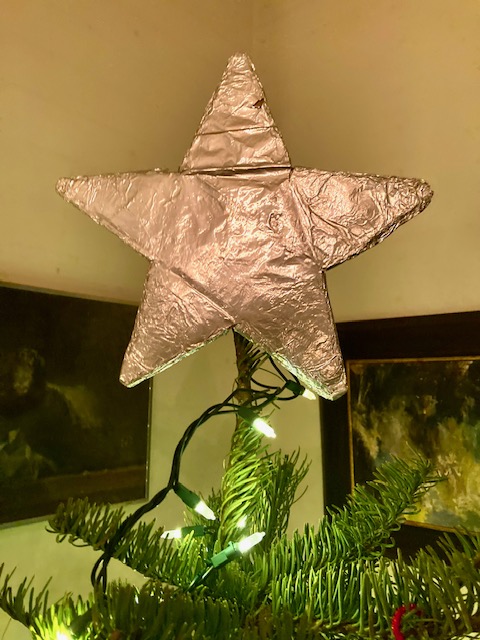
Our family Christmas tree star, going on 40+ years now

So with my paragraph I am sending out a prayer of gratitude for all the good people and things I know are here in our world.

Thank you for those who are trying to bring back our local post office. Thank you to those who are growing our food, caring for each other, those who are helping the sick, the family and friends who are suffering with illness and loss. Thank you to artist friends we know who  have risked so much to bring truth through story into our lives. Thank you.  

This has been A. Letter From A. Broad written and read for you by Muriel Murch

And supported by murchstudio.com

It’s All Theater

It’s all Theater,

Written and recorded by Muriel Murch with WSM by my side.

As we left London a vote of no confidence had dissolved the French parliament and Prime Minister Barnier resigned. President Macron vows to stay on and form a new parliament before this week. This will be France’s fourth Prime Minister in a year. A shooter took aim at the Health Insurance business and took out Brian Thomson, the CEO of United Healthcare, as he went to work in Manhattan. Fighters have captured Damascus and the Syrian president Bashar Al Assad has fled. Another coup has happened. Hafez al- Assad took power, with a coup of his own in 1971 and his son became president in 2000. Bashar Al Assad is believed to be receiving room-service with his family in Moscow.

As the plane descends to Washington we look down on the winter trees that stand close in a comfortable looking forrest, circling the small towns and villages that have been carved out of them. Arriving in DC, in America, at dusk is sobering and the temperature freezing. While our driver is prompt, efficient and friendly there is nothing else welcoming about the drive into the city as darkness falls. The huge streets coming off the freeway seem lost, reaching for the stone buildings, holding like prisons, places of power. I remember the Avenida 9 de Julio, roaring off the freeway ready to enter the chaos and confusion that is the living city of Buenos Aires.

I wanted to write about the beautiful things. The reopening of Notre Dame cathedral but then – there is the President-Elect of the United States – front and center at the cathedral’s opening ceremony. He sat smugly between President and Brigette Macron, while the current First Lady, Jill Biden, was tucked on the other side of Madame Macron. Over fifty world leaders representing as many countries fell in behind them. Ukrainian President Zelensky is tucked somewhere in there too. The shuffling on this world stage is being played out in the giant nave of this cathedral as politics come before God. Luckily the cathedral was to be reconsecrated and blessed the following day. There was time to brush the detritus of politics back into the river.

From left to right, Congo’s President Denis Sassou Nguesso and his wife Antoinette Sassou Nguesso, Ashley Biden, First Lady of the US Jill Biden, Brigitte Macron, US President-elect Donald Trump and French President Emmanuel Macron [Ludovic Marin/Pool via AFP]

We came to Washington for The Kennedy Center Honors weekend. Walter to introduce his old friend Francis Ford Coppola at the state department dinner. Singer and activist Bonnie Raitt, Cuban Trumpeter Arturo Sandoval, The Apollo Theatre, and the Grateful Dead are all to be honored this weekend.

Honorees for the Kennedy Center 2024. The Apollo Theater, The Grateful Dead, Arturo Sandoval, Frances Ford Coppola, Bonnie Raitt.

We arrive safely at the Salamander Hotel, rated at 4.6. out of 5 and it does very nicely thank you. Malvik wheels our luggage and shows us how our room works. He looks to have been here a long time, his thinning, oily, too long hair barely held back, is somehow comforting, leading me to believe that this hotel may care who it hires and holds onto. The staff, as with any big hotel, is heavily African-American and Latina but there are also Africans from Ethiopia carrying the strength of their own cultures and beliefs. One senses that working inside the hotel is a safe place.

On Saturday night, as supporting cast, we are guided onto the bus taking us to the State Department for dinner with The Secretary of State, Anthony Blinkin. The driver whips this bus along the avenues as if it is a chariot around the Roman colosseum before coming to a screeching halt on the street. Standing on the bus step he exclaimed loudly, ‘we must walk from here’ and – because it is not raining – we all laugh – understanding as we do that the whole evening is theater. Ball-gowned singers and actresses, black-tied, over-coated actors and musicians along with a few low-life politicians carefully climb down off the bus and we walk the last half block to the entrance for the first of the weekend’s security checks. A line here for photos, a line there for hand shaking with a little glimpse into a politician’s life and the world of Politics. Power, beauty, talent and money are all standing in line, (with our name cards to hand over for announcing) as we move though the rooms that are pretending to be older than their 70 years. It is hard to explain – it is as if the building itself is also aware that this is all theater. Hands are shaken and smiles are exchanged by which time I need to find the ladies lounge before sitting down for dinner. I try to sort out who here is carrying what gift. Mostly it is power: a retired Senator, an agricultural Lobbyist, a Board Chair and a bit of art. We look for our friends but we are all separated. This is a working weekend and we each have our parts to play. The schedule tries to be tight but 9.12 p.m. has come and gone before Bonnie Raitt, the first up, is given her honours. She is followed by Francis Coppola, Arturo Sandoval, The Apollo Theater and finally the Grateful Dead. Each artist is given their ribbon and chain and says thank you, speaking of how honored they are to be here. The surprise comes at the last when the Grateful Dead come to receive their colours. How could they get old? Us yes, but them? No way. It seems truly unfair.

Night One is over and we can relax. For tomorrow is show time. Sunday brunch gives us the time to catch up with friends. But like the Oscars in Hollywood one is dressed in a new ball gown – early. This bus driver is a lot more steady for as we approach the Kennedy Center the streets are lit up with rows of police cars flashing their blue and yellow lights as they shepherd the politicians of this fading administration, along with D.C.’s finest and the rest of us, to the Kennedy Center. As we filed through another security check and into the vastness of that building I wondered how the political factors and teams played out in this arena of theater. Are they brought together through music, cinema and opera? Can the arts help break through the animosity of power? The politicians we had sat with the night before were moving on to the deal opportunities that this evening could bring. We sit down early watching the theater fill up until someone tries to get everyone to their seats as ‘the show is about to start’ but it is tricky when the past Speaker of the House is now busy speaking in the isles. As the President arrives with the honorees behind him and the red uniformed marching band enters to the stage, we settle. The National anthem is played. Queen Latifah comes on stage to start the show, Bobby De Niro plays a bar of two on the grand piano, and the show begins – and then – four hours later – it ends. We look up and acknowledge the fading power of President Joe Biden, the lost dreams of Kamala Harris, and the enormous richness of art that the world provides. 

The evening ends

This has been A. Letter From A. Broad written and read for you by Muriel Murch

Supported by murchstudio.com 

Storm Bert

Written and read for you by Muriel Murch with WSM by my side

It took two weeks for the leaves on the elm tree that bows over the entrance to Kingstown Street to turn from khaki to golden then crimson before falling. Now the branches are bare, showing their stark beauty with the strength that comes from age. The grass below is now covered in a soft mulch of leaves from which will come the renewal of spring in the new year.  Across the street, though, the younger ornamental prunes is in a complete muddle. The first chill of autumn crushed the leaves but then a slight shift brought a warm spell and the buds began to swell. Now there are small pink blossoms peeking through dying yellow leaves. 

The second storm of the season – named Bert – pushed into London from Wales but still on Sunday a walk was called for and, wrapped up against the wind, I ventured out. Turning the corner onto Regent’s Park Road a blast of wind hit me and I buckled, tottering like the old lady I have become, before carefully crossing the road. Though it is the first time I have ever seen this, it is no surprise that there is a notice on the closed park gates: ‘The Park is closed today. All being well it will reopen on Monday. We apologize for any disappointment’. Who chose that word? Disappointment rather than the usual ‘sorry for any inconvenience.’ It almost sounds sincere, a touch of kindness and as I walked past the gate a young family came and paused and they were indeed, disappointed. Storm Bert is the second storm to hit these islands. The first was a snowstorm called Ashley while Conall has yet to arrive. Bert hit Wales, Devon and the South West coasts hard, moving into London and the news and, rough as it is, it is nothing compared to the deluge that overtook Valencia in Spain. It was in 1953 that the World Meteorological Organization in the US began giving women’s names to storms and hurricanes. It wasn’t until 1978 that they began to accept that many of the gods of the sea and winds were male and also lose their temper. In 2014 the UK Met Office began to do the same. So here we are at the tail end of Bert, who, like a flat-capped boozer, is weaving about, losing his way going home across the North Sea.

Storm Bert from The Independent

The budget has caused a stir. Well of course it has. Rachael Reeves is the first woman Chancellor of the Exchequer, presenting the first Labour budget in twelve years, and she has gone after the wealthy. Not so much of a problem but she has included the wealthy who do not pay inheritance tax. Through the years of history business men and women have become land owners choosing to pop their pennies into the soil, growing their wealth now along with too much monoculture and wheat, while avoiding their taxes. These are the farmers for whom the land is the investment. Occasionally they can be seen striding about in their Wellington boots pretending they don’t have a bean to rub together. For the small farmers things are different – making a living from mindful farming and husbandry remains as harsh here as in any country. I don’t understand it all and realize that neither I nor the small farmers are supposed to.

This week Kim Leadbeater, the Labour MP for Spen Valley, that follows the river Spen in the West Riding area of Yorkshire is presenting a bill on Assisted Dying. The arrival of Kim as the northern MP was a welcome and resounding relief after some years with Sarah Wood of Reform UK and Laura Evans  a Conservative before her. Kim has brought forward a new and improved bill on Assisted Dying for debate. There are activists and protesters on both sides of this issue, they are heartfelt and driven by strong emotions of fear and love – and yet – past Prime Minister Sir Gordon Brown is calling for a commission on end-of-life care. At four days of age, Gordon and Sarah’s baby girl had an immense brain hemorrhage and died a week later. In a recent article for the Guardian Gordon Brown wrote –     

Sarah and Gordon Brown after the death of their daughter. From the Daily Mail.

“But those days we spent with her remain among the most precious days of my and Sarah’s lives. The experience of sitting with a fatally ill baby girl did not convince me of the case for assisted dying; it convinced me of the value and imperative of good end-of-life care. We were reassured that she was not in pain.”

At this time, as the National Health Service still struggles from the residue effects of the Covid pandemic and twelve years of Tory government what this debate is showing more than ever there remains a huge difference in health care when defined by your post-code address –  once again playing wealth against poverty.

As autumn dons a winter cloak and storm Bert takes itself out into the North sea, these days have led us into musical adventures. I think of Herman Hesse’s short story, Old Music, where he ventures from his woodland cabin – first on foot, then by tram into the city center to hear a cathedral concert of Bach and what it means to him.

These last ten days have given us similar adventures but the music we have been led to is new to us, not familiar and yet all absorbing reaching me in a new way. This is exciting as with age I’m getting a little iffy I don’t hear music in the same way – and yet from the first concert – the last of the Rolex Arts Initiative series – with jazz vocalists Diana Reeves and Song Yi Jenn from South Korea and the New Dot drummers, my heart and body responded. A complete switch around took us to Abbey Road and a film screening of ‘Standing on the Shoulders of Kitties’ joyfully full of Rock and Roll and country music.

Ticket invitation to the screening 🙂

Gently the week ended at a Musical Salon and an Italian Armenian duet of Viols and Voice from Intesa sharing a musical journey through the stages of love. Each concert was so different yet as the drummers marched onto the stage at the Queen Elizabeth Hall they brought the universal dreams carrying the same searching to be heard and I marvel at the music that speaks to us across the world.

This has been A Letter From A. Broad – Written and Read for you by Muriel Murch 

And as always supported by murchstudio.com
A Week Ago

A week ago on Wednesday.

Written and produced by Muriel Murch with WSM by my side

There was a stillness in the air – The cloud-shielded sky was hiding its sorrow that the world it was covering could well now begin to die. Conversations at the corner cafe were subdued and somber. Nobody was smiling, not even in greetings. Our American friend and neighbor and I sat together nursing our long overdue coffee moment. As we took time to catch up, he spoke of waiting for his Lithuanian passport. What in the world has changed that he is looking forward to a Lithuanian passport? 

Image by Urszula from Pixabay

A lumbering beast has come into the room, lurching forward, knocking against the chessboard where a game is forever in progress. The King has been moved and there is a new guard surrounding him. As the board shudders to a halt, the pawns in the front row of defense are jostling about, each seeking a square of safety. But there is little to be found. Even those soldiers who surround the new King will be knocked off the board before this game is over. 

Prime ministers and presidents across the world pick up their phones and press numbers stored on speed-dial. Who will they phone first, the incoming King or the outgoing President? They will make more than one call, many to be denied later in the press, for there are many corners of the board to be covered. For those – like the Taliban – who don’t have phone access, they can always post a tweet on the public notice board marked X.  Photographic coverage of war leaders shows a smiling Netanyahu and a serious Zelensky. Putin can’t keep the sly smugness out of his eyes while communication with President Zelensky is paused as support is reconsidered. The UK’s chief of defense staff said approximately 1,500 Russian troops were being killed or injured every day, while the 10,000 soldiers sent from North Korea are already suffering casualties. Now the United Kingdom is looking at its options. Possibly how to honor its word with support while changing what that support could mean. A bribe perhaps? Money rather than weapons – but there is no time for funds to become weapons.

In Gaza there are collapsed corridors of rubble where streets and buildings once stood, leaving families to scrape with their bare hands to retrieve the bodies of their loved ones. While the ‘surrender or starve’ policy has been denied by Israel, earlier this week a military official told BBC reports it had “no intention” of allowing Palestinians to return to their homes in Northern Gaza. There will be no cease-fire in Gaza. Israel will continue with its annihilation of that country.

That was the week that was – or was not – depending on your frame of reference. The English news media continue writing and scurrying around words and projecting policies while the politicians, in England and all over Europe, are shifting their papers and policies as fast as they can. The moral high ground seems to be sinking. 

I spent Wednesday and Thursday gnawing on my nails, shredding them to jagged uneven tops. Turning to the drinks cupboard, it was an easy finish of the almost empty sherry, whiskey, and gin bottles. There was not much in them to start with, but upending all three bottles of their dregs was telling. We look around and can only console ourselves with caring for each other.

Neal’s Yard Cheese shop in London by Frank Fujimoto

While politics plays out on the world stage, England continues to play out a mix of lorry-like thievery and home-grown purity. The world famous cheese market of Neal’s Yard Dairy was cleanly relieved of 22 tons of cheese in 950 wheels of cheddar valued at £300,000. While the police seriously consider deliveries to Russia or the Middle East, chef Jamie Oliver was more down to earth tweeting, “There has been a great cheese robbery. Some of the best cheddar cheese in the world has been stolen,” and added “If anyone hears anything about posh cheese going for cheap, it’s probably some wrong’uns.” 

Ah yes, Some of those wrong’uns for sure. But then there are the 5 % good ‘uns such as Paul Horton, the owner of Apidae Honey in Lincolnshire. Paul sells ‘proper honey’. Not like 90% of the honey tested from retailers selling to supermarkets – all considered suspicious by the British branch of the Honey Authenticity Network.

King Charles III at the Remembrance day Service. The Princess Royal next to him.

This weekend is Remembrance Day Weekend. For the first time in a  week the sun is shining. Whenever the date falls, the weekend Friday brings a ‘Festival of Remembrance’ at the Royal Albert Hall with the senior royals all in attendance. The service, filled with traditional music, ends with the first of the two minute silences as paper poppy petals fall on the audience of armed forces and civilians all standing to attention. On Saturday morning the Family comes out once more, leading the nation in remembering those who fought and died in the continued wars we fight. While we follow this remembrance here in England, it is played out in all corners of the British Isles and in Europe.

Sir Keir Starmer joined President Emanuel Macron for the Armistice Day Remembrance in Paris

For the first time since 1944, when Churchill was in Paris, Sir Keir Starmer joined the French President Emanuel Macron for the Armistice Day Remembrance in Paris. They stood together, Sir Keir with his red poppies, Emmanuel with his Blue cornflowers, both symbols of their country’s losses during the wars beyond the first. And in summer, in the cornfields of France and England, those two flowers, the red poppy and blue cornflower grow together, side by side amidst the wheat which is cut down in the harvest of bread and blood. The two minute silence was repeated in at 2 minutes to 11 on the 11th day of the 11th month.

This has been a Letter from A. Broad. Written and Read for you by Muriel Murch 

And as always supported by murchstudio.com
I ain’t’ done nothink

Written and recorded by Muriel Murch with WSM by my side
Eurostar from Rotterdam Station – photo by Beatrice Murch

Though paused along the track, the Eurostar train to St. Pancras arrived on time and we disembark. It seems to have been a full long weekend away in Amsterdam for musicians and young families. We had joined the train at Rotterdam after our grandson David’s 9th birthday and the best Dutch birthday cake ever, homemade by David and his mother. On the platform, those of us who are older, the grand-parent tribe, and the wandering poets are quickly passed by the young musicians and even the families struggling with all their stuff to gather and bundle up. By the time we reach the last turn into the exit there is hardly anyone with us as we pass the four customs officers standing together. They seem to be hanging out, just chatting, but as I look at them – and they don’t meet my eyes – I realize they have been looking at us all. First I wonder what on earth do they think we are carrying, and then I realize they are also looking at whom we might be carrying.

Slavery – indentured servitude – is still alive and well in Britain and Europe. The German far right politician Jörg Dornau employs political prisoners from the uprising against Aleksandr Lukashenko’s political re election in 2020. Dornau owns an onion farm in Belarus where around 30 prisoners work, many of whom, like Nicole who told the story, had been jailed on political grounds and for “liking” old social media posts from 2021. The prisoners sorted onions for roughly £4 a day on what Nicole described as a strictly voluntary basis. And the onions tasted good. They are the lucky ones. But the customs officers waiting to see the passengers leave the Eurostar train were watching for those not so lucky.

Emerging into the station proper we pick up breakfast essentials before heading to the taxi rank. This evening the queue is not too long and we shuffle forward at a steady pace. Naturally everyone is tired, looking at their phones and not speaking. But suddenly there are quick soft running footsteps, and a child’s voice shouting “I ain’t’ done nothink.” More running footsteps, a longer stride and a uniformed youth catches up with the child, who is clutching a brown paper shopping bag and still yelling. “Let me go, I ain’t’ done nothing.” Faces lift from the phones and those in the taxi queue look as the young officer catches the barely clothed child wearing shorts and a very oversized t-shirt. Now there are more footsteps, heavier as in regulation police boots, and six uniformed security policemen, all under the age of thirty catch up with their young partner who is barely holding onto the child still crying out, “Let me go I ain’t done nothing.” Then suddenly the air goes silent and it is over. Taxis come to the curb, the line moves forward, and as we wait three patrol cars with lights flashing and sirens ringing come to a screeching halt beside us. I marvel at all the adrenaline rushing through at least nine men holding one child. And the silencing of the voice that echoes Oliver Twist in 1837 – led on by The Artful Dodger, used and abandoned by Fagin.  What really has changed in almost 200 years? Not so much. Hardship finds us along many paths.

Flying high over the carnival – photo by Beatrice Murch

On the autumn Sunday afternoon in Utrecht we visit a carnival. It has popped up outside of a Jumbo shopping center and is an easy distraction for small children, and some who are no longer so little. We’re cruising, grandson David passes the candy floss as he leads me to this fishing hall, that shooting range, all the time with his eye out for the bungee jumping trampoline that looks terrifying – to a Granny. Suddenly there is his best friend from down their street. The boys are thrilled to see each other, the bungee jump forgotten for the moment while the mothers chat together. The afternoon ends with a closing-time visit to the big public library which is institutional but welcoming and impressive. I am – as Grannies do – sitting, resting and waiting outside when the mother of David’s friend approaches me. Bea has sent her over.  “Mum’s a nurse, ask her.” “May I ask you something?” “Yes of course.”

She is from Ukraine and has three children, two boys and one girl. Her husband has left her and they are now divorcing. The afternoon carnival is a cheap distraction for them together. Her long hair is matted, her clothes look to have come off of the floor and her sneakers are – for want of a better word – inadequate. The children are hovering, watchful, a little distant, protecting her as best they can. They are nervous of her speaking with a strange woman, even from their friend’s family. The mother had a little accident on her bike and her thumb hurts. Is it broken? Should she go to the hospital? But that means a four hour wait in the emergency room and she has three small children. In her state the slightest upset blows into a potential disaster. Softly I ask if I can touch her hand and she nods. I take her hand in mine and begin to gently feel here and there, bend the hand and fingers this way and that. Quickly I know that it is not broken. There is a little warmth suggesting the thumb is strained. I continue to hold her hand, for with the act of touching and receiving her, she begins to calm. I tell her about arnica gel. Seeing their mother relaxing, the children creep closer to us as we retrace our steps to the pharmacy. Which is – naturally – at 5.30 on a Sunday afternoon – now closed. But the young mother is looking better, more purposeful and with a little smile. The children cluster closer still around her as we said goodbye. The eldest boy shakes my hand, the two little ones smile and wave. They are grateful that someone had listened and received their mother. This little Ukrainian family have been in the Netherlands since before the war began.  Maybe they knew what was coming or maybe they just got lucky. Now it makes no difference. They are adrift and broken in a foreign country. Hardship finds us along many paths.

The conflict – pick any red dot on the map – in the Middle East – has pushed the Ukrainian War off of the page and the screen. Cold mud and snipers are not as photogenic as nighttime rockets and buildings ablaze. Rubble and body bags are more prolific in any of the states at war in the Middle East than in the Ukrainian villages on fire. This war has a published start date of October 7 but that cannot have been the beginning. Israeli solders are schooled that attack is the best form of defense, but all of those red dots – in Gaza, in Lebanon and beyond – do not appear as the work of a country defending itself. Back, back we go into history, Europeans and their pens, pencils and rulers, drawing lines across the desert, pointing fingers and saying ‘That will do.’ 

This has been A Letter From A. Broad. Written and read for you by Muriel Murch  

And always supported by murchstudio.com

One Memory Leads to Another

Written and read for you with WSM by my side

A book to read – one I had hoped would be more satisfying. So at 2 AM I lie awake and fuss wondering what – if anything I can say to the author. And how to calm myself? In times of unease, poetry always helps. Michael Ondaatje’s ‘A Year of Lost Things’ is on my nightstand, poetry with just a page or two of prose remembrances slipped between the stanzas. It is enough and for the next few nights I am lulled to sleep with the beauty of his words. In one section of remembrances, he writes of a friend who becomes the muse for a brother in ‘Anil’s Ghost,’ first published in 2000 and – as one thing leads to another – I search for the book in our local community library. There it is, I take it home and turning the pages am taken back to our 2004 visit to Sri Lanka. 

Our visit had fallen easily into place after Walter’s teaching for ten days at the Indian Film School in Pune. Walter had long wanted to go Sri Lanka to visit the Green Memorial Hospital in Jaffna where his maternal Grandparents, Thomas Beckett Scott and Mary Elizabeth MacCallum Scott had, from 1893-1913, worked as medical missionaries.

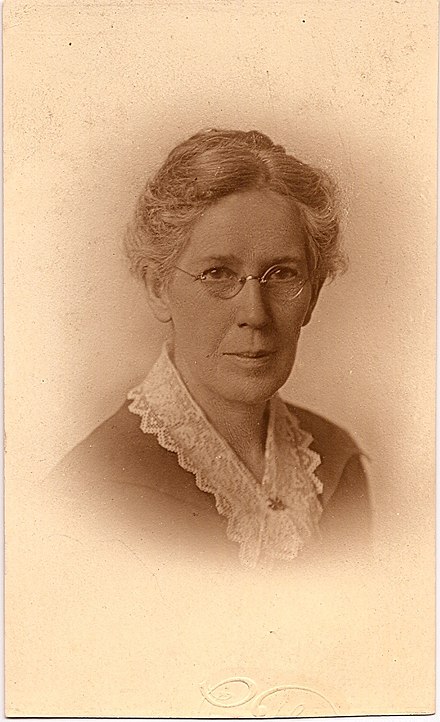
Mary Elizabeth MacCallum Scott

Mary Elizabeth was the first female doctor to work in Jaffna, while at the same time she birthed seven children and started the first nursing school in Manipay which is still in existence today. I wonder about her story, for Mary was the child of deeply Christian parents. She first trained as a teacher, then as a nurse before completing a medical degree in Kingston, Ontario, repeating exams at the Bellevue Hospital in New York. She was one of the first five women to receive a medical degree in America, but maybe getting a degree did not equal getting a job. Did that play a role in their decision to become medical missionaries? She reminds me of another exemplary woman physician, Dame Cicely Saunders, who founded the modern day Hospice movement. Dame Cicely also began her adult life as a nurse before becoming a social worker and then a physician.

Edwardo stops us for a snack of Water Buffalo yogurt and honey

But the Green Memorial Hospital is in the Northern province of Jaffna, a strong Tamil district and during out time the war was still active. Michael had guided us to the Kandalama Hotel, designed by his friend the architect Geoffrey Bawa and built into the hillside outside of Kandy. Edwardo drove us for five hours and that was as far as we got.

Everyone was very polite but clear, explaining as gently as they could that the troubles precluded them sending anyone with us to Jaffna and certainly not allowing us on the trains where murder was not uncommon. The Civil War that had begun in 1983 was ongoing and didn’t settle until 2009. We didn’t take it in – and in our ignorance remained enjoying the peace, the water, the birds, and the Buddhas, those hidden in caves, sitting or lying about – though never standing, and the Golden Buddha in Dambulla shining from the hillside across the lake. The Seven Kingdoms of Sri Lanka had been beaten almost into one, the two languages of Sinhala and Tamil remaining the tear in the Island’s fabric. The Portuguese arrived first, then the Dutch to harvest cinnamon and other spices before the British came trading Christianity for tea. It was all rather messy. This week, Sri Lanka welcomes Anura Kumar as their new Left of Center President. Namaste we say to you.  

Bell from Kandalama Hotel in Sri Lanka

But we didn’t know much about this then. We were immersed in a new culture and beyond grateful for the opportunities and understanding that this time had brought to us. It wasn’t until now, re-reading ‘Anil’s Ghost’ that I came to a glimmer of understanding about what was happening, never mind why and to whom in this country. In an interview, Hilary Mantel, when speaking about history said, “I think novelists are alert for everything historians can find and verify, but also for something different, and extra; history’s unconscious, if you like. You try to grasp an individual’s moment-by-moment experience, as the tides of the past and present wash through them.”

And maybe that is partly why I feel so lost looking about me now. The wars that we are shown remain in the present tense. In Ukraine it is the old women well into their 80’s being packed up to leave their village homes. What can they take with them? Not the last of the harvest from their cottage gardens, the chickens still raising a brood of chicks, but maybe a blanket, a change of clothes, a photograph or two. In Gaza, Israel, Lebanon and Palestine urban rubble with shards of clothes caught on rebar are all that some survivors can find. The Israeli and Hamas leaders, lunging forward like attack dogs straining and then retreating, have been unleashed and given over to the pure fury of warfare and this latest weapon, of first thousands of pagers and then the walkie-talkies blowing up in pockets and hands. There will be over 500 dead in Lebanon before this letter reaches you. These are the things that weigh the heart down. 

But meanwhile in our small country, the Annual Labour Party Conference is happening in Liverpool. The Prime Minister assured us last week that “I’m in Control.” We begin to wonder what exactly is he in control of? There is the matter of Sue Gray, his Chief of Staff having a higher salary than him. If she can keep everyone playing by an honour code of written and unwritten rules then good for her she has earned it. But can she? Digging for dirt the media finds that Sir Keir has a new box of tickets for the Arsenal Football season and a very nifty and expensive pair of glasses. The glasses follow his ‘I’m a serious fellow’ style but don’t look a whole lot better than my husband’s from the local pharmacy that cost £7.50. Then there are the clothes for the girls. Wife Victoria in a dress and Deputy Prime Minister Angela Rayner in a billowing too-bright green trouser-suit, both from the new up and coming English fashion house MEEM, look quite smart. But the women beside Sir Keir, Deputy Prime Minister Angela Rayner and Chancellor Rachael Reeves, also looking very smart, need to learn to say their lines without glaringly staring at the teleprompter, widening their mouths with animated articulation. They look like a python getting ready to swallow a sheep, and it could be that ‘we the workers’ are the sheep. They are pushing their vocals in a bid for political authority afraid that any other womanly tone will sound weak.   

In Fred Zinnemann’s 1966 film ‘A Man for All Seasons’, Paul Schofield who plays Sir Thomas More, converses with Richie Rich played by John Hurt. Earlier Richie had asked More for a place in Court. More declined, suggesting Richie become a teacher. But Richie gets his place and a golden Goblet. At the river’s edge, More sees the Goblet, looks up to Richie “For Wales Richie, For Wales?” Richie’s shame and humiliation are clear on his face. The cup is dropped into the river.

I don’t see football tickets being returned but maybe fewer parcels, with the compliments of …  will be accepted or signed for on the steps of number 10 Downing Street.

This has been A Letter From A. Broad. Written and read for you by Muriel Murch 

And always supported by https://www.murchstudio.com

Green is for Grenfell

Written and read for you by Muriel Murch with WSM by my side

One evening last week, four mid-sized yellow ambulances screeched to a halt in the little parking cul-de-sac which serves this side of the Auden Place Council housing apartment blocks. The ambulances were left with engines running and lights flashing as the paramedics carrying their bags, searched to find where they needed to go. They were gone a long time and when later I finally looked out of the window the parking lot was empty. There had been no blue lights flashing or blaring sirens signaling their departure. The next day I learnt that Sylvie had fallen downstairs and had not recovered. Those who knew her went about the day sobered and reflective.

Capitalism lives on in buttons

Last week the second volume of the Grenfell Inquiry report was finally published and made available to the survivors of the tragedy, and today’s government ministers. On the evening’s broadcast, the news-anchor standing in front of the Grenfell Tower, bathed in moonlight and cladding with its green heart wore a bright green coat as she spoke. Green-heart buttons are worn by Prime Minister Sir Keir Starmer and London’s Major Sadiq Khan seen standing on the right side of this event. 

Ministers leave the benches in a hurry

The daily Parliamentary schedule allows that after the morning’s Prime Minister’s questions there is a pause for those who have meetings to attend – to leave. On the morning when the report was to be presented the choking exodus of Members of Parliament was sobering to those who remained seated and disgusting to those survivors watching. Sir Keir turned to face the gallery as he gave his heartfelt apology, acknowledging that on every level – regulatory, council care, business and responsibility – the Government had let them down. The report left no doubt that the 72 deaths from the Grenfell fire of 2017 were avoidable.

The living community that had existed within that tower block, that exists in all housing estates and neighborhoods to a degree, has become one of bereavement for the Grenfell survivors while they remain physically misplaced in temporary housing. ’We want Justice’, read the banners at Grenfell but what is justice, what would it look like? Now the buck of blame is sliding from the place of government regulation, to counselors who did not listen to their citizen’s concerns and onto leaders in businesses. Tracking those responsibile is like following a river to its source, as a hidden stream emerging from the earth that may yet come to rest outside of the garden shed of the Prime Minister of the time, the Rt Hon Lord David Cameron who so eagerly started his ‘bonfires of red tape’ hoping to free businesses of unnecessary regulations. ‘For every new regulation cut three’, was the guideline while each and every one of the construction firms with government contracts took advantage of the burnt red tape. Once all 1,700 pages of the Inquiry documents have been read, surely there will be some firms will be highlighted and named. Sir Keir Starmer calls for the companies involved in the disaster be banned from receiving government contracts, and that the government would support the Metropolitan Police’s investigation into the fire, saying it was “imperative that there is full accountability, including through the criminal justice process, and that this happens as swiftly as possible”. But the Metropolitan Police are stalling, shuffling papers to be read in detail by lawyers – before proceeding with any prosecutions. It will be at least two years before charges are brought against anyone deemed at this time to be responsible.

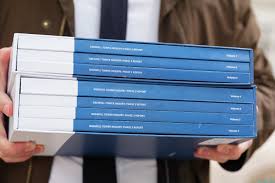
The report – all of it. Image: Ben Gingell via Dreamstime.com

While the inquiry has been bound together, distributed and read, the criminal courts have been unusually busy for August, as the far-right activists who erupted with violent anti-immigration protests in cities across the country a few weeks ago were rounded up and swiftly brought to trial. It was nasty. Sir Keir – again – expressed his determination to crack down hard on the rioters, and so the courts have been working overtime and in quick succession jail sentences have been handed out like military call-up papers. But there is another problem. England’s jails are reportedly ‘not fit for purpose’. Last week’s count showed only 500 places out of 88,000 were left, 400 being quickly taken up by the far-right rioters, leaving only 100 places, either to be given to more rioters or – possibly saved for those who took advantage of the Tory government’s bonfire of red tape. It is noted but not yet spoken how quickly some prosecutions can occur, while others linger in old manila folders. A jail-house solution is being acted on as I write. 1700 ‘low risk’ prisoners are being released across the country today. We are assured ‘High risk prisoners are not being released’. But that depends on your point of view, who is high risk or low risk, to whom? Prison staff are already struggling with this new check-list of red tape with things to be done to get those lads and lassies out of the prison gates. There is no time to wonder who will receive them, where they can go, who will support them, or will they just find it safer to return to lock-up. Will they leave enough room for the Right Honorable gentlemen and business leaders to maybe one day sit on benches beside them?

This afternoon the government just approved Chancellor Rachael Reeves’s bill to cut the fuel payment allowance given to pensioners last year. Not many people are saying the obvious – that the allowance was a double-hitting ‘take that’ act from the past Prime Minister, Rishi Sunak, first as a sop to mop up any old voters who might have put an x in his box on election day, and secondly to skewer the next government with less money in the kitty and an unpopular choice to make. But Sir Keir and the labour party still have some political support from raising pay for essential workers in the National Health Services and then to the train-drivers, thereby keeping that union at bay – for the moment.  

Sir Keir has not traveled far this summer. He’s been busy reading the manual and fixing the government’s old bike whose chain keeps falling off and brakes need new pads. In Ireland he met the Irish Prime Minister Simon Harris to ‘reset the UK’s relationship with Ireland’. There was also a visit to Paris renewing his friendship with France’s new Prime Minister Michel Barnier. Both are detail-oriented men, and keen to connect rather than disagree. French government being what it is at the moment, Emmanuel Macron’s appointment of Michel Barnier as the new Prime Minister makes England look relatively stable and calm.

And so for excitement – rather than war – we ready ourselves for the upcoming US presidential debate which will have happened by the time this letter airs. It is more nervous-making than any football match with the stakes high for the US and the world. Even those who are not counted will feel the waves of power as they settle in November. 

This has been A. Letter from A Broad. Written and read for you by Muriel Murch.

Supported by https://www.murchstudio.com

August Bank Holiday W/E

August Bank Holiday,

Written and read for you by Muriel Murch with WSM by my side.

‘Out of the Office’, automatic replies come bouncing in to anyone foolish enough to write a business letter in the month of August. Occasionally there is a head’s up – a note saying “I will be away on holiday until the ‘something’ in August. If this is urgent please contact – whoever the poor soul is who has been left to ward off intrusive calls.” Lawyers, bankers, publishers, doctors, stylists, and politicians all go away, usually taking a plane to Spain or even as far as Turkey, leaving delivery drivers and grocery clerks to carry on. Pete from the Primrose Hill market farm stand has taken his wife to visit her family in Croatia.  

Chugging along under Tower Bridge Photo by WSM

Over the weekend, the river is choppy as the wind battles with the sun to give the tourists a boat-ride to remember while cruising up and down the Thames to Greenwich where the Cutty Sark, along with the maritime museums and colleges waits patiently for them.

Returning to the city from their seafaring adventures the tourists pour into the street, across Westminster Bridge circling around the Palace of Westminster, the House of Parliament and Big Ben, now free of three years of scaffolding, and whose clock-face shines over the river.

But across the bridge from the Houses of Parliament is the wall that encircles St. Thomas’s Hospital and lines the walkway along the river.

Painting of St. Thomas’s Hospital at the Welcome Trust Museum

The Hospital was named after Saint Thomas Becket and first built in Southwark, possibly as early as 1173. The reformation of the monasteries caused its closure but in 1551- the young king – Edward VI – allowed the hospital to move up-river a bit while being rededicated to another Thomas – the Apostle. St. Thomas’s Hospital was first dedicated to serving the poor, the destitute and homeless and though it has become a world renowned teaching hospital it has remained open ever since. It is seeming and appropriate that the wall that cradles the hospital close to the Thames and faces the Houses of Parliament is still decorated with painted hearts and messages commemorating the thousands who died in the Covid epidemic that began in January of  2020. 

Within the Houses of Parliament, the green benches in the house of Commons and the red benches from the House of Lords are mostly bare. If Sir Keir Starmer, during his term as Prime Minister, finally has his way then those red benches, so bloated by gift peerages from previous governments – both Labour and Conservative – will become even more sparsely filled and those gifts of ermine robes in very short supply. Though most of the politicians have popped off on holiday the Prime Minister has cancelled his two weeks of family time in Europe and stayed at home. Sir Keir knows that there are things to attend to and if he is lucky he can get some serious work done – for he is a methodical and serious fellow – and have a look at the bookkeeping left by the previous government. What exactly is the state of the economy and the country and how much money is available in the kitty for all those reforms that he promised? Not a lot it seems. Like a new contractor coming in for your house repairs, there is some teeth sucking as he looks at the job before him. And like any English builder – there is fault to find with those who came before him. Instead of “They used the wrong paint love,” Sir Keir’s line is already “Things will get worse before they get better.” A version of Lord David Cameron’s “Hard times are ahead we are going to have to tighten our belts.” And we all remember how that went down. The £600 fuel allowance that was so freely given out last year has already been cut for the upcoming winter. There will hardly be a city and country household who will choose not to heat their entire house – however small it is.

Like many of us – not on holiday – in England – Sir Keir has been watching the wars as they continue to unfold. The Ukrainian army has popped a missile over into the Russian territory of Kursk, and captured a few Russian soldiers that it promptly swapped for 115 men of its own. Our screens light up with the flames from the Israeli and Hezbollah strikes at each other. Is it a game of fire and fury, a warning or wake up move? All is paused as each side ponders and watches the other.

Then there was the Democratic Convention held in Chicago last week, orchestrated into a fine piece of rousing theatre. Only the most cynical among us could not be flickered into a moment of hope that the homegrown terrorist among the American people could be held at bay. The concept of a  woman – a comfortable and pleasing shade of brown – with a steady coach beside her, may – with much luck and hard work – keep America safe for a few more years, is enough to make one giddy with hope. One could see this as a sea change of colour that comes with autumn, the maturing of the fruits of this season.

At the market the colours are changing too. Bright red berries are giving way to the blush of young apples, the green cream of pears and the dark purple of Victoria plums, while the deep black of hedgerow berries glisten with a shimmering autumnal hue.

With constant support by murchstudio.com

Remembering the First Time

Remembering the First Time

Written and produced for you by Muriel Murch with WSM by my side

It was 1948 and I was 5 years old when, with my mother and Brett, my nanny, I stood on the side of The Devil’s Punch Bowl. As each horse came to the crest of the gully, they paused, taking in the drop, collecting three strides down, before a leap over the solid tree-trunk above the deep ditch then galloping up the other side and away onto the rest of the course. As a big grey horse thundered past, my mother and Brett let out a cheer for the Swedish rider. Brett was from Sweden and this was the first Olympics after the Second World War. The equestrian events at the 1948 London Olympic Games were all held close to home at the Tweseldown Racecourse by Aldershot – a military town and at a very early age we were taught, “Never talk to the soldiers”. The American team won the eventing, the Swedish team placed second, with Mexico taking the Bronze medal. The changes in the political geography of countries can often be seen at the Olympics. In those days Mexico and Argentina sent successful equestrian teams all over the world. I never got over the thrill of seeming that grey horse leap into and over the Devils Punch Bowl.

Tweseldown Racecourse from Wikipedia

I was hooked and it would be less than ten years before Taffy and I were galloping through those same forests and over any obstacle I found in the secret freedoms that lay on those moorlands. 

We remember those first times, and now as this year’s Olympics play out in Paris we watch the athletes perform, many for the first time for their country.

Sir Keir is a serious man and treating his new premiership with appropriate gravitas, and while the Labour Government was seriously going about getting settled in, they too felt they could breathe gently and watch our athletes in Paris giving their very British best. But if he had hoped for a longer honeymoon period it was soon cut short as we watched the riots break out in a fire storm over the killing of three little girl children finishing a dance class in Southport. An unnamed seventeen year old boy – incorrectly rumored at first to be a Muslim refugee – is being held in custody. Rumours – spreading as fast as the wildfires of Canada and California, have sparked violence in cities across the country. Far-Right nationalists fuelled by the disinformation from social media, are following a pattern discernible in North America, Israel and Hungary, among other eruptions around the world. Gray headed grannies holding signs for ‘Nans not Nazis’ are in danger of being knocked to the ground by the boys in thier street that they may have helped raise.

Far right rioters attack asylum seeker hotels in Tamworth. Photo for Al Jazeera

From Southport in the north to Aldershot in the south, towns up and down the country that hold deep pockets of poverty and unemployment are fuelled with anger and rioting in an all-too-familiar manner. Sir Keir Starmer is facing his first time as Prime Minister with this storm battle and our country’s worst elements. Nigel Farage barely makes an effort to keep a neutral face while he sits in Parliament and no one can believe that he is not chalking one up for the far-right team. The Police have been given ‘extra powers’, more prosecuting lawyers have been called in, though from where and where to it is hard to tell.  ‘The rioters will feel the full force of the law,’ promises Sir Keir, but some of us wonder if those said rioters will care, and what the law stands for – for them and for us all. It just took one incident – no matter that misinformation was spread – lines are drawn across the streets of neighbors, with those leaving flowers for the children and their families, and those rioting for an England they never knew, each side is screaming to be heard.

Certainly other government leaders are not concerned about the internal laws of their own country or the international laws that loosely hold the global community together. The recent swap of Political prisoners, brokered by Germany, Norway, Slovenia, Poland, North America, and Russia that took place in Turkey was the largest game of checkers since the Cold War. 16 Russian dissidents, Germans and US prisoners were returned for 8 Russian undercover spies and agents. But there are still hundreds of political prisoners left behind in Russian prisons, and who knows how many Russian prisoners are also still in European and American jails. When the talks first started, Navalny’s name was among those put forward for release, ‘Sure, no problem,’ said Putin in the Russian political way. During the months that the final arrangements fell into place and the talks continued the ‘Sure no problem’ line was repeated, but Navalny died in prison on February 16th.  Bait and switch. Check mate. Putin never intended for Navalny to go free. 

It was 1992 when at KPFA Pacifica, I was handed ‘Time and Tide’ a new book by Edna O’Brien who was coming to California for an extensive book tour. This was to be my first book interview. As I picked up the book and turned it in my hand, the portrait of a sensual and defiant Edna stared out at me from the back cover. Edna was a woman who – if she took to your husband at a dinner party might – or might not – return him for breakfast. This I knew to be true. ‘Time and Tide’ was not an easy book, even if you were a follower of Edna’s writing. But I understood Nell, her heroine, even as I cringed at all the troubles that beset her through the pages. 

Edna O’Brien at that time. Photo from The New Yorker

Edna arrived at the radio station in a fuss. Her plane has been delayed and her luggage was lost. She was as tiny and Irish as I was tall and English but quickly I saw that we were both nervous. Edna upset at the loss of her luggage and the fact that her silver pendant had rubbed a stain on her white jumper. I was terrified of her intellect and sexuality. But as we sat down, locked together in the recording booth, and began to talk, she relaxed, answering my questions with eagerness and generosity and the conversation began to roam as she remarked “Well, Ulysses is difficult isn’t it?” Then we slipped into film as both of us had been knocked sideways with ‘Raise the Red Lantern.’ by Zhang Yimou. It was clear we shared a mutual concern for the plight of young women and that, as well as my thorough preparation, softened Edna and she recommend me for the publishers next author, Susan Sontag.  Now Edna has died at the age of 93 after a long illness and I wonder what was the illness that took her away from this world at the beginning of this late summer time. Edna was my first Author Interview and I will never forget her.

Apart from the riots and the Olympics there are the perennial editorial concerns about the decline of wildlife and insects. Our little terrace is less than 150 square feet and is now full of summertime beauty. We get excited when we see the honey, bumble and mason bees, and then a cabbage white butterfly, an orange tiger moth, and a blue dragonfly also come by. Their first arrivals let us know we are doing the right thing on our tiny patch of heaven.

A little London Terrace MAM

This has been a Letter from A. Broad. Written and read for you by Muriel Murch, and supported by murchstudio.com

A correction from the audio to the text. In the audio I say Stockport when it should be Southport.