Navalny

Written and Produced for you by Muriel Murch with WSM by my side

The news of Alexei Navalny’s death is confirmed. First offered with a shrug from the Kremlin, for ‘what did you expect? That we would let him live forever?’

This single death takes over my consciousness as I think I can imagine it – while the multiple slaughters are that are occurring in Gaza and on the West Bank leaves me sifting through pictures of rubble, hospitals and carnage, not really knowing who or what I am looking for, or at. Navalny’s death has me remembering the South African Activist Steve Biko. While Wikipedia maintains that his Political Legacy remains ‘a matter of contention’ there is no doubt that he was a forceful presence against apartheid. Wikipedia also tells us that Biko was the twenty-first person to die in a South African prison in twelve months, and the forty-sixth political detainee to die during interrogation since in 1963 the South African government introduced laws permitting imprisonment without trial. Biko and Navalny were both men of their time and place, both political prisoners killed with the direction or approval of the state. It is not uncommon, this singling out of one man whose presence has become more than annoying, but is still only a potential threat to those currently in power.

The English Royal Courts of Justice are wrestling with another moral question ‘Which is the more serious crime: extrajudicial killings, routine torture of prisoners and illegal renditions carried out by a state. Or exposing those actions by publishing illegally leaked details of how, and where, and when and by whom they were committed?’ Now, after ten years, Julian Assange is having his day in court though he is not present. He is reportedly too unwell to even watch his appeal via a video link. Assange has been asking to be able to appeal against the decision to extradite him to the US to face trial under its Espionage Act for his publication of documents, via WikiLeaks. The documents – handed to him by the former US soldier Chelsea Manning – detailed illegal US actions in Afghanistan, Iraq, Guantanamo Bay and elsewhere. While still not having been convicted of any crime he is in his fifth year in high security in Belmash prison. The memory of Daniel Ellsberg who in 1973, was hauled into the legal system for exposing the US government and military activities in Vietnam hovers over this hearing. No-one knows yet what will happen  – except that you can bet someone is looking at film rights… 

Across the river, the Houses of Parliament are turned upside down with Sir Lindsay Hoyle the Speaker of the House of Commons loosing his cool and his gavel as he tries to control both sides of the aisle. The clamoring from the Labour, Conservative and all parties in between that they want a stop to the bombing and fighting  – turns into an uproar for two days – fussing over a breach in protocol that happened due to the rising threats of retaliations to Members of Parliament. It sounds silly – but – we remember the Labour MP, Jo Cox, killed by a Neo-Nazi supremacist in 2016 followed by the conservative MP, Sir David Amess, in 2021 by a Jihadist. Both of these instances occurred during Sir Lindsay’s time in government. Since 1812 only six members of parliament have been killed while in office but the pace of assassination seems to be stepping up in the 21st century. Maybe Sir Lindsay is being super-aware and damning the little rules and regulations – there could be an inquiry – but probability not. Apart from some tut-tutting over the tea cups this will blow over and the government will move onto more important issues as the UK tries again to be relevant and meaningful on the world stage.  

But can it? Will the United Kingdom ever accept that, since Brexit, and our disengagement from Europe, nobody is really listening. Last week Zelensky welcomed the leaders of Italy, Canada and Belgium along with the European Commission president Ursula von der Leyen who all stood beside him as he spoke at Kyiv. The US president Joe Biden tuned in by video. Boris Johnson popped over with a few delegates – of what I’m not sure – to wave his tattered flag and tell whoever he was speaking to – that he was sure that Ukraine could beat the Russian forces. But quietly – and maybe not so quietly – much of the rest of the world is not so sure. 

Meanwhile Sir David Cameron – how handy is that prefix of Sir – in his role of Foreign Secretary is being a little more serious on the world stage as he speaks up for a two state solution to the war in the Middle East. Just like the Jewish people displaced from Europe in the last two World Wars, he insists Palestinians must have a homeland to call their own. 

But Rishi Sunak flew into Wales, so sidestepping the rising concerns of racial bigotry brewing in London. He has hardly rapped Suella Braverman’s knuckles for her racially inflammatory writing and shrugs off Lee Anderson’s remarks about Sadiq Khan, the mayor of London, ‘giving London to his mates’. It’s getting scary – again. Instead Rishi is in Wales standing side-by-side with net zero and climate conspiracy groups of Welsh farmers as he tries to bolster his rural vote. The Welsh Labour government is proposing a new payment scheme in which farmers will have to prove 10% of their land is woodland and 10% of it is quality habitat for wildlife. That’s not so much and in Wales, so full of hills and dales where the sheep roam and get lost all the time.

Rishi Sunak speaking with farmers after he delivered a speech at the Welsh Conservatives conference 2024. Photograph by Peter Byrne

As I write, the home team of Pacific Slope Tree Company is working on my Gertrude Jekyll corner. Jekyll always wrote that we should leave a portion of our gardens to the wilderness and I have stayed true to that. Many years ago – in my naiveté – I planted at least 40 pine trees to provide a windshield and wilderness habitat. The trees grew tall providing a deep shade and soon brambles covering the forest floor. They did create a habitat while over the years the blue jays buried their oak acorns and forgot them. As the pines grew taller and weaker they were harvested for fire wood. Now some of the young oaks are straight and strong, others a little weaker but with more light and air they too could flourish. The last pines will come down now and let the young oaks emerge as a new wilderness.

This has been A Letter from A Broad written and read for you by Muriel Murch.

And always overseen by – beatrice@murchstudio.com

Remembering Oscar

Written and Produced for you with WSM by my side.

In 1978 the film Julia was nominated for 10 Academy Awards. Directed by Fred Zinnemann, the film starred Vanessa Redgrave, Jane Fonda, Jason Robards, and – Meryl Streep in her first film. Walter was among the nominees for the editing. Of the ten, Julia won in three categories; Jason for Best Supporting Actor, Vanessa for Best Supporting Actress, and Alvin Sargent for Adapted Screenplay. A few weeks earlier, the BAFTA awards in London had yielded a slightly different crop of awards from its ten nominations with Jane Fonda winning for Best Actress, Dougie Slocombe for Cinematography, Joan Bridge for Costume Design, and Producer Richard Roth for Best Picture. My mother and her pals, whom we had invited to the BAFTA awards dinner with us that year, also scored. With postwar frugality, she and her friends refused to leave opened bottles of wine on the table and so – to my total embarrassment – six bottles were deftly pocketed into Gabardine macintoshes and mink coats.

Hraybould, via Wikimedia Commons

My mother had decided we were being far too serious about the whole awards business and wanted to liven the evening up a bit. “Why it’s just like a school prize giving”. And – as she often was – she was right. But looking back that year on Julia, spent in England having all four children with us, was for me the best of those film adventures that we shared. And when Julia came to an end and was received with critical and box office approval, we kept Fred company going to a few of those awards dinners, bolstering him in the disappointments and learning a thing or two about how the awards machines are oiled and work. At the Directors Guild Awards dinner, Fred quietly whispered why he believed he would not win, while we could see that he did ‘oh so want to’ – just one more time. Woody Allen won for Anne Hall, beating out George Lucas for Star Wars, Steven Spielberg for Close Encounters of the Third Kind, Herbert Ross for The Turning Point, and Fred with Julia. I’m sure I wore the same outfit – a long pale green dress with no particular flair, more discreet than outstanding, but a dress I felt safe in. By Oscar night, because there had been so much political publicity, we were all nervous. Fred nervous from his long-standing knowledge of Hollywood and its people had a saying, “I met him in 1938.” Meaning I know that type and that style. Our nervousness was because we didn’t know our way around this particular Hollywood. Vanessa Redgrave’s nomination for Best Supporting Actress was already causing a stir but she didn’t show any nervousness. The Jewish Defense League had openly objected to her nomination and were picketing that year’s Oscar Ceremony. Vanessa had narrated a film, ‘The Palestinian’ which was critical of Israel’s role in the conflict between Palestine and Israel – then – in 1977. Vanessa’s acceptance speech did not disappoint. There were boos among the applause and Vanessa never returned to work in Hollywood again.

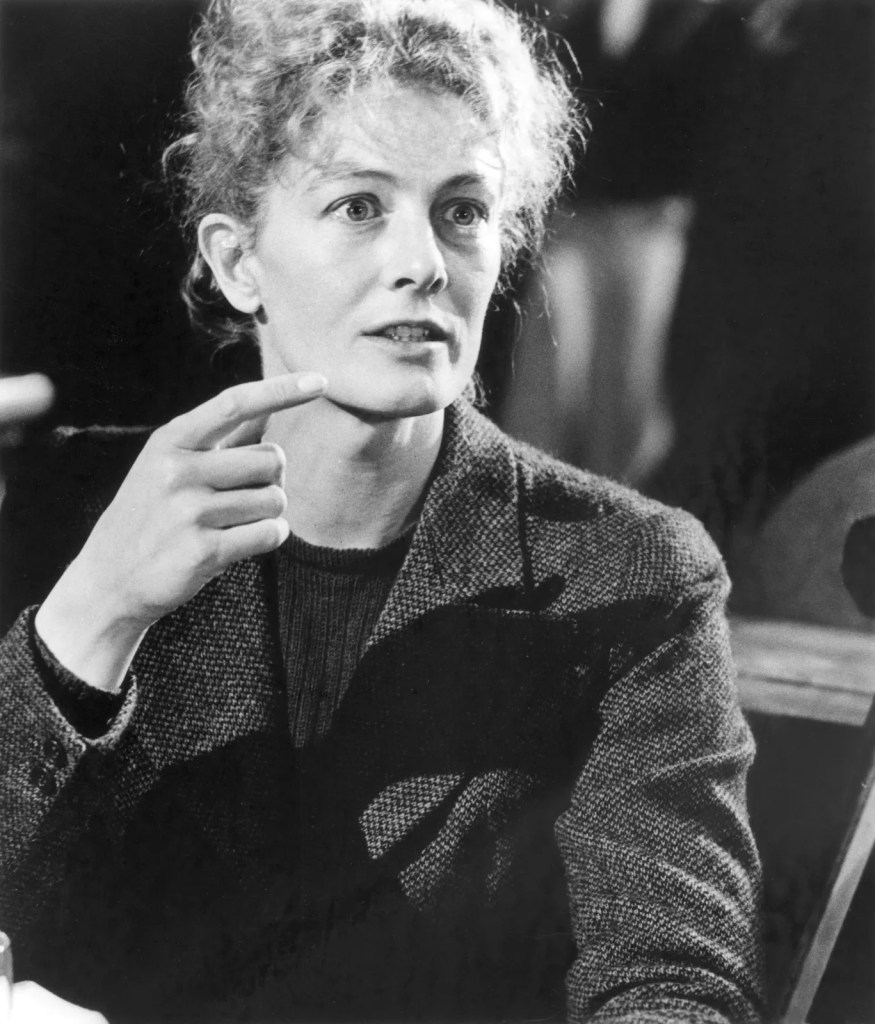
Vanessa Redgrave as Julia in the film of the same name. Directed by Fred Zinnemann 1977

Looking back on that year, and the politics that were uppermost in so many minds, it is hard to accept where we are now. Everything seems more – nothing seems less – and it is frightening for all of those paying attention. 86-year-old Vanessa, and others who have hit that 80-year date, still struggle and sometimes succeed to put the political and artistic work in a perspective that encourages those who follow. Looking back at that seemingly innocent time – but that was not – we are grateful for the work opportunities we had, and the friendships that grew and formed from mutual respect and bound us together. The friendship between Fred and Walter lasted up to and through Fred’s death. On an April spring afternoon in his office, Fred said, “I’m feeling a little tired. I will rest on the sofa.” On his own terms, it was a wonderfully discreet way to leave.

It seems like it has been raining on and off for weeks. Huge clusters of ladybugs have come inside in record numbers, finding their own warm spots, close to light bulbs and on my desk. The farm is saturated to sogginess. Overflowing water scurries down from the Mesa and bounces out from shallow ditches to collect in the fields, puddling in the low spots until it finds its way to another ditch flowing back to the road and beyond. It is as if the farm cradles the water, rocking it from one roadside to the other. The small roadside streams along the road into town are thick with mud pulled from the hillsides and I can’t even see the watercress that was just beginning to be ready for harvest. Now the Wolf Moon has arrived – gentle and mild while as bright and strong as the headlights from the harvesting trucks crossing the fields at three in the morning. The trucks bounce along, with their headlights shining into the hayloft waking me to watch them. I think of them, the drivers and the pickers, rolling out of bed at 2 am to gather the harvest and drive it to its destination by lunchtime. 

Jan 2024 Wolf Moon over Marin by Clint Graves

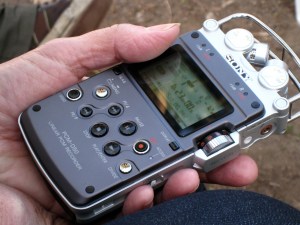
“Aggie’s breeding frogs.” says one friend to another when we meet in Point Reyes. His friend smiles, and she is not too sure what we are talking about. It is the night-time chorus from our hopelessly disused pond. Somehow – for all of my neglect, water gathers and holds within the reeds, rushes, and Irises and the little green and red-legged frogs settle down to call out to each other. It is at a particular moment in the rainstorms – as if the moonlight on water truly beckons them to sing and mate. There are more, bigger bodies of water up on the Mesa of our town, and for those living close by, the chorus is deafening. Recorder in hand we walk quietly along the driveway but still they hear us. Slowly, then suddenly, all is quiet again as they wait us out. We must leave before they start their singing again. 

Even as we slosh about in our boots outside in the dark this song of the frogs brings a smile to all our faces, begging relief from the horror of the wars’ continuum. Here in a failing pond, is a place of renewal and a sign of hope. 

This has been A Letter From A. Broad. Written and read for you by Muriel Murch 

January – The New Year

Wrtten and read for you by Muriel Murch with WSM by my side.

January and the New Year is here, scuttling along at a pace that seems to quicken each year we get older. But what is our new? Resolutions: lose ten pounds and only gain back five? Follow the wars? Or maybe we just get to keep the old ones? Ukraine, Belarus, Israel, Gaza and Palestine seem to be all I can carry, though God knows there are more states of anguish all over the world. And these holiday months seem to be a time where ‘things’ can get slipped through Government, like jokes and laws passed.

Did you hear the one about Belarus’s President Alexander Lukashenko signing a new law giving him life-time immunity from criminal prosecution – from what crimes is he thinking about, one wonders? Were Lukashenko to leave power, that is, resign “he cannot be held accountable for actions committed in connection with exercising his presidential powers. And also – just for safety’s sake –  the law stops opposition leaders in exile returning to Belarus and running as a candidate for president against him. The last leader of the opposition, who fled to Lithuania in 2020, said the new law was Lukashenko’s response to his “fear of an inevitable future”. He’s been on the job – as president of Belarus – for 30 years, and maybe he’s getting a little weary and wants some kind of a state pension.

Alexander Lukashenko, 69, has ruled Belarus for almost 30 years. Mikhail Svetlov/Getty Images

Lukashenko is not the only politician to be seen juggling a little law here and another one under the table, there. The UK’s Prime Minister Rishi Sunak has his hands full with Junior Doctors walking out for a full six-day strike, and the Royal College of Nursing still in formal discussions over nurses’s pay. Someone somewhere is calculating how many extra lives have been lost beyond Covid due to the stand-offs between the NHS and the government. Despite this and the increase in cancellations of routine surgeries – a friend’s gall-bladder surgery has been repeatedly canceled – and the lack of diagnostic screenings for heart disease and cancer, the public remains mostly supportive of the NHS blaming the government for this impasse once again. It is a gamble for this Tory government. If they keep the disputes brewing until after a general election, and win that election, then the blame falls squarely back on their shoulders. If the Tories lose to Labour then Sir Keir Starmer has to rise to the challenge. Will he raise taxes and have the public pay for these services we still hold dear? Rishi is looking for lollypops to hand out and may have found one in the Post Office Scandal that left hundreds of workers wrongly accused of fraud when it turned out to be a faulty computer program. The heartache, broken lives and even deaths of postal workers, and their families, have saddened the country. But Rishi is ready with photo opportunities and sound bites. “People should know we are on it and want to make it right for all those affected.” A new government minister is in charge and getting the right compensation to the right people could earn Rishi some much needed brownie points. But England, like other countries, continues to have miscarriages of justice that remain mis-carried, left lying in government boxes and portfolios like stickie-notes to be eventually scrunched up and tossed away.

‘The breaking point of the NHS, so long predicted, seems very nearly upon us.’ Junior doctors in London, 4 January. Photograph: Andy Rain/EPA

Sir Keir also has a stickie note on his desk. On New Year’s Eve, 16-year-old Harry Pitman came to Primrose Hill with his chums, joining the crowds watching the New Year’s fireworks light up the city of London. Maybe it was a scuffle, a push, or a taunting word which left him stabbed to death. Always a popular destination, Primrose Hill took on new significance during the Covid lockdown as the only Royal Park that remained open and illuminated after dark. Groups, friends, dealers and small gangs came from all over London changing the tenor of the park from safe, friendly and joyful, to edgy, loud, mercenary and dangerous. We were all frightened that something like this would eventually happen, and as community groups tried to tone down and stop the changes they became inevitable as, like rats crowded in a cage, groups of friends become crowds of strangers and quickly fearful of each other. This deep sadness is felt as a community loss, and failure for Primrose Hill, which is within Sir Keir Starmer’s constituency. We look to see if he could show some leadership in this ‘small’ matter and pony up, installing the park gates that have been requested for years and putting the police presence in the park and on the streets on the weekend evening shifts, rather than having them stroll down the High street on a mid-week afternoon. 

Harry Pitman was in Primrose Hill to watch the New Year fireworks. Photograph: Family/PA

Sometimes, when I can see the maps, I get it. It is harder from this distance, the ‘other’ side of North America, and many people are better than I in understanding the European and Middle Eastern conflicts. Those who have a knowledge of history, and apply that memory can see further forward than most of us. Reading Archie Bland in the Guardian trying to grapple with, and present, the number of Palestinian deaths, displacements, and destruction coming out of Gaza remains beyond me. It is when I look at the maps, alongside the photographs, and see the flattened buildings and communities, that I begin to grasp the seeming purpose behind such destruction. Simon Tisdall, also for the Guardian, writes chillingly of the similarities of the behaviors of Putin and Netanyahu. I get the scale of it all – I think I do – but it is with the stories that hold the slimmest degrees of separation that I carry. We have friends who are housing Israeli refugees in Paris; another young woman who fled Russia and now lives with her mother as refugees in Tel Aviv; a Palestinian artist who has been silent since reaching out in the beginning of October. Our 8-year-old grandson’s best friend is from Ukraine, living with his grandmother in The Netherlands. These are the stories I can hold in my heart. 

Drawing of war by David Borrazás Murch aged seven

This has been a Letter from A. Broad. Written and read for you by Muriel Murch

A Dog’s Dinner

Written and Produced by Muriel Murch with WSM by my side

The dictionary defines A Dog’s Dinner as ‘A situation, event, or piece of work that is chaotic, badly organized, or very untidy.’ Such as when an unschooled dog gallops into the scullery for his bowl of specially formulated dog food moistened with a little water. It is gulped down in a flash, the bowl knocked about noisily until it hits a wall. But then there is a pause as his tummy swells. A burp is followed by a belch before up comes dinner again, now glistening and sticky with saliva and the first tentacles of stomach acid. The dog looks puzzled wondering what happened but then he spies the food, all over the floor and with excited tail wagging, eats it all up again. Only a mop and a big dose of disinfectant can clear the damage away. 

This is the image that comes to mind after Suella Braverman’s published remarks that homelessness was a lifestyle choice. As Rishi Sunak sent her back to her kennel he had to reshuffle his cabinet once more. Even the newspapers had to print charts with pictures of who has come and gone and where to. We watched – soon to be Lord – David Cameron stride back into Downing Street, knock on the door of number 10 with his tail wagging as he tucks into the mess of Brexit that he created. It looks to be a dog’s dinner all over again.  

On November 14th King Charles celebrated his 75th birthday by popping into a food bank between holding a couple of tea parties for people and organizations that also turned 75 this year. A tea dance was held in Dumfries House and then more tea was served at Highgrove with members of the Caribbean Windrush generation, nurses and midwives from the NHS. This week, The Big Issue, a weekly magazine sold on the streets by homeless vendors, has The King on the cover highlighting his Coronation Food Project, launched on his birthday. The King is quoted – saying that “Food need is as real and urgent a problem as food waste,” …. “If a way could be found to bridge the gap between them, then it would address two problems in one.” It seems to take a football player like young Marcus Rashford of Manchester United and a King like Charles the Third to steer this ship into a clearer lake of fresh water. 

On Tuesday, we left for Poland and the Camerimage International Film Festival in Torun. It takes a full day of travel getting to the festival and we were only traveling from London. Cinematographers, manufacturers, filmmakers from other disciplines with films come from around the world. It is a  jumble of festival and trade faire, a little glamor and a lot of graft for the craft of cinematography. We gather at breakfast, the same as on a film set, such is the comradery of international filmmakers.

The plane landed in Warsaw and the afternoon light stayed for the first hour of the two-and-a-half hours it takes to drive to Torun. Leaving the city there are single-gauge railway tracks that emerge and disappear in and out of the paved road. They are old, disused but along with the tree-covered mounds of larch, silver birch, and pine that cover the detritus of an ancient war, a chilling reminder of the wars past and present. The city names of old wars are now joined with new place markers that move traveling east into Russia and Ukraine, and then south with the eruptions in Jerusalem, Gaza, and Palestine. 

The city disappears giving way to bare winter fields. There is very little green left to harvest, only tall dried-out corn to be cut for livestock. As we pick up speed, the farmhouses appear small, even tiny, most look old and decrepit. There are no lights shining to welcome a farmer home from the plow. As we drive north a storm is crossing Europe and for those moments that we are on the open barrier-less road, the raw wind beats across the motorway making this all-electric German limousine slip and tremble and the windshield wipers pick up speed.

We settle into the hotel with memories that slowly come back to us. Beyond the window the river flows fast, the current pushing and pulling fallen trees into the mud. There is no shipping. The countryside is bleak this far north in November. Even though it maybe earlier in the year than our previous visit winter feels like it is coming sooner. 

Here is Copernicus

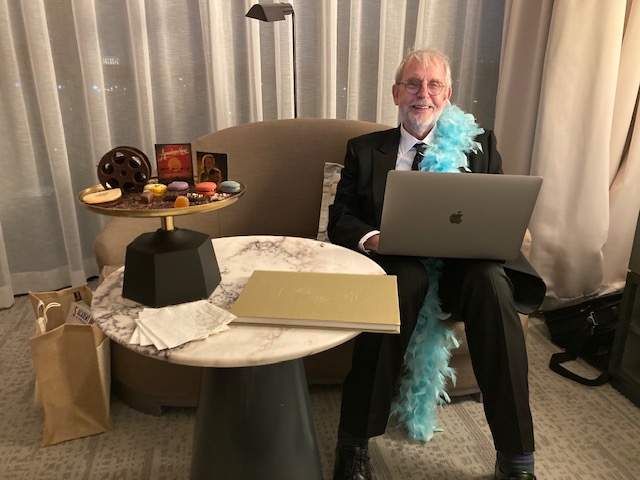
Walking into the old medieval town we pay homage to the statue of Copernicus. Torun is not a big city but as Copernicus’s birthplace it is rich in history and over two million people come to visit each year. Some come for astronomy, Copernicus, science, and some for this festival. Walter is here to join Professor of Astronomy, Leszek Blaszkiewicz in a moderated discussion on ‘Copernicus, Dreamers, Inspiration and Science.’ Held in the beautiful old Camerimage Cinema, the audience is primed and happy to hear, think, and discuss such things. After the talk is over they linger and some have already brought with them the beautiful Golden Book on Walter’s Golden Ratio exploration that the festival produced. The days are busy although we don’t get to see one film. 

Mateusz Józefowicz moderates Walter Murch and Leszek Blaszkiewicz in conversation on Art, Inspiration, Science, and Dreams.

On Saturday as we walk over to the main building for the closing ceremony and awards event, dusk has already busied herself with night and the street lights proclaim it is winter. The big theatre has filled up early and fast. The ceremony begins and is almost all in Polish though there are head-sets for translations and it all goes along easily and quickly. The Golden Frog is the symbol for this festival, with tadpoles for the rising stars of cinematography. Each film festival has its symbol, Berlin has the bear, Locarno a Leopard, Venice a Lion, and of course, it’s Oscar for Hollywood. While the Torun festival celebrates the art of Cinematography it is also a huge trade faire. It is overwhelming to see the equipment. The festival also acknowledges the other disciplines and those who – within their fields – carry a particular understanding and integration of cinematography and their own discipline. Walter brought his frog home in 2015 and it sits sweetly and discreetly on a bookcase shelf here in London.

The last award is given and the festival director returned to the stage for his closing remarks before beckoning a line of assistants to file in behind him, and then another line and another, and – as we rose to our feet – he has assembled everyone who made the festival happen on stage. It is the first time we have seen such an acknowledgment from a festival and it seems fitting that it should occur here where the emphasis has always been on the heavy lifting that it takes to be a cinematographer and to make movies. The yellow-vested stage hands arrive carrying three sofas and the recipients of this year’s gold frogs and tadpoles come to sit alongside those who have made this year’s festival possible and still the full audience is on its feet acknowledging that just as Copernicus wrote in his revolutions, we are all like the stars in the heavens and the universe beyond,  elliptically revolving around each other.

Brava and thank you to everyone who made this 31st Camerimage possible.

As we walk back to the hotel we can see our breath and the sky prepares to scatter the first flurries of snow. The final party is going strong but we are too old for that and even in flat shoes my back hurts. At the bar, we sit among those who would rather drink and talk than stand and shout, enjoying a glass of wine and a bowl of Polish soup. The next morning camp is broken and the lobby is full of puffer jackets, wheeled cases, and fond goodbyes. We have barely left the city when a huge owl swoops down across the car, just three feet in front of us, and with wings unfurled for balance, he nails his meal of young bunny on the snow-covered grass beside the road. We drive on past the mistletoe-encrusted trees, the wind turbines emerging from the fog where acres of bare apple and pear fruit trees, red and black currant bushes are already dormant, preparing for the winter ahead. We quietly understand that life in this corner of the world is not easy for those who live here.

This has been A Letter from A. Broad written and read for you by Muriel Murch

An Inquiry

Written and produced for you by Muriel Murch with WSM by my side.

‘Yes Minister’ first aired on The BBC television in 1980 until it ended in 1988, possibly due to the fact that it was becoming harder to distinguish the comedy series from the nightly newscasts that followed. Among the many quotes attributed to the Cabinet Secretary Sir Humphrey is “Minister there is going to be an Inquiry” to which the reply from The Prime Minister Jim Hacker is “Oh good, then nothing will happen.” Well yes and here we are again – 

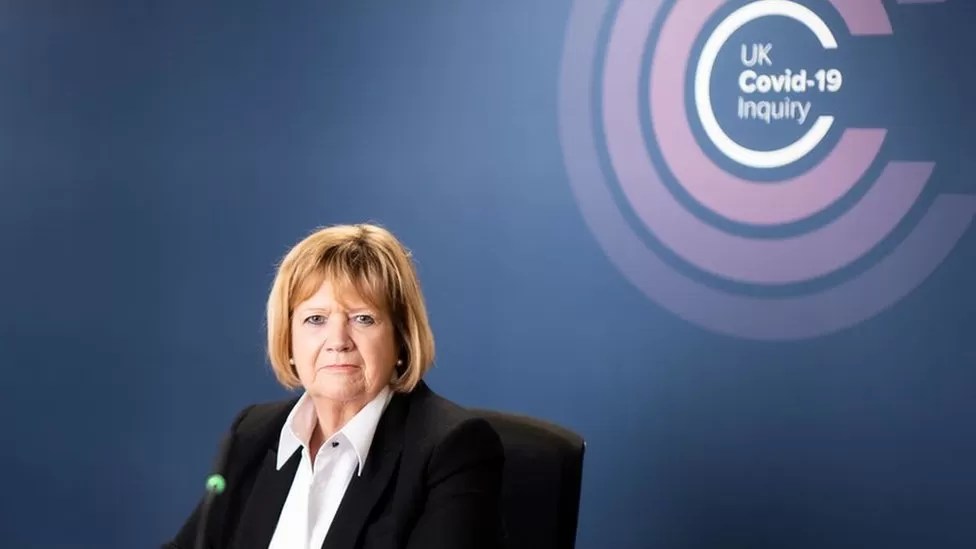
Baroness Hallett promises the inquiry would be ‘thorough and fair’. Photo from Piranha Photography.

Last week saw the beginning of “Britain’s Public Inquiry” to understand the Conservative Government’s responses and handling of the Covid pandemic. But for the life of me, I can’t find out who is in charge of “Britiain’s Public Inquiry” and what – after the facts have hopefully been gathered – will happen? Will lessons have been learnt? Will those deemed responsible be held responsible? Will there be any retribution? Will anyone be called before a court of law or those pages of documents produced be filed away rather than read. Last week when Dominic Cummings gave his testimony he asked that the inquiry also focus on the broader failures of the system. Reading – for I can’t listen to them talking – it is clear that as blame is shuffled about like pearls under walnuts, the prize goes to the then Prime Minister Boris Johnson. Dominic Cummings likened working with Boris Johnson to driving a shopping cart with a wonky wheel. 

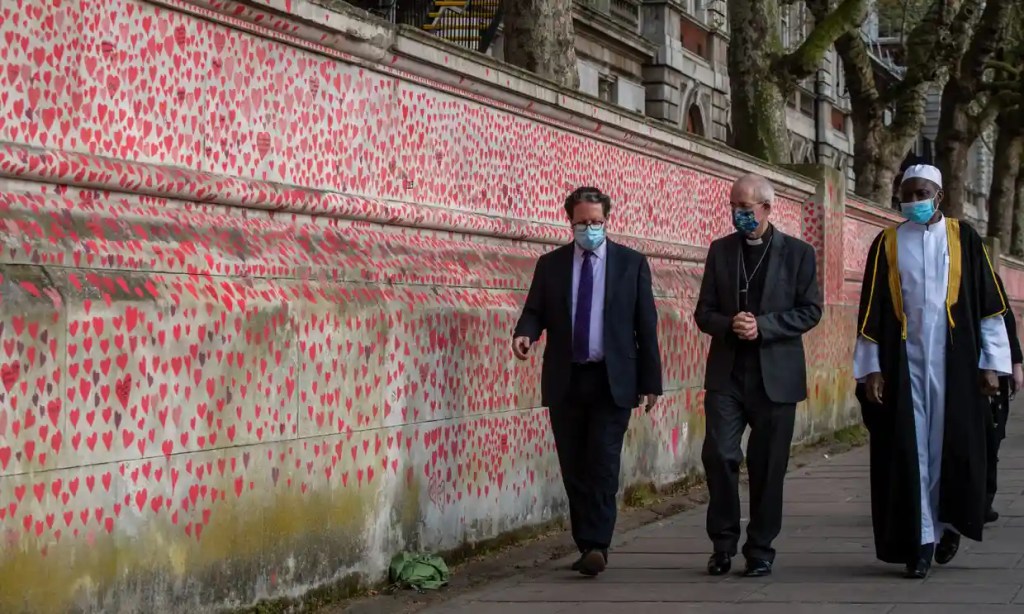
It is not without irony that the inquiry is taking place at Whitehall just across the river from the Covid Memorial Wall that was created and painted in 2021by people who had lost loved ones, or worked in the NHS, coming together with the good guidance of the group ‘Led By Donkeys’. Over 240,000 painted hearts cover more than a third of a mile alongside the Thames River outside of St. Thomas’s Hospital. During this time the public were afraid and looked in vain for leaders in the government where all the common sense had been bred and educated out of almost anyone in Westminster not yet of pensionable age. It was like putting drones in charge of the beehive to collect pollen and care for their queen, when all they could think about was kingship and sexual obsession. 

From left: Rabbi Daniel Epstein, the archbishop of Canterbury, Justin Welby, and Imam Kareem Farai visiting the wall in April. Photograph: Chris J Ratcliffe For Covid-19 Bereaved Families For Justice/Getty Images

People are booking their theater seats. We follow the inquiry like a serialized Charles Dickens story in the magazines of the day. Up to testify next are the past Prime Minister Boris Johnson, his hovering henchman Matt Hancock, and the holder of the chair at the moment, Rishi Sunak. But it is the failings of one particular individual, Boris Johnson, who was ultimately responsible for directing the government, which will continue to be scrutinized in the months ahead. Johnson’s successor-but-one as prime minister, Rishi Sunak — who was U.K. Chancellor during the pandemic — also has questions to answer. All three men — Johnson, Sunak, and Hancock — are to appear before the inquiry in the same week at the end of November. 

Photo Credit to Art Center Wikipedia

Sunak has thrown his dead cat into the ring – by hosting an international AI conference on safety issues that was held at Bletchley Park. The conference produced some back-patting for, and from, the UK, US, and European leaders who attended while getting a nod of approval from the United Nations. Elon Musk arrived to give a speech and chat with Rishi at Downing Street. Both men in their uniforms, Elon remains rumpled and a little unshaved while Rishi rolls up his pristine white shirt sleeves possibly looking for his next job opportunity after this gig is over. So will anything happen from this inquiry apart from “Lessons have been learnt”? The Infected Blood Inquiry – the Stephen Lawrence Inquiry – and the Greenfield Tower Inquiry – have each chipped away at this UK government, but not a lot has changed. Could this inquiry be the one showing that Britain’s democracy has really gone up in flames? I’m writing on Guy Fawkes night – our night of fireworks – celebrating the failure of the 1605 attempt to blow up the Houses of Parliament. We may be holding our breath and will it happen this time? I cannot watch the inquiries – it is too painful – so instead I read.

in an interview, the American thinking and writer, James Baldwin, said “You must realize that if I am starving you are in danger”. And in this simple truth, buried deeply, lies some of the reasons the wars are being fought all around us. Johnathan Freelander writes eloquently and with great heart in this weekend’s Guardian Newspaper, that no side of the Israeli, Gaza, and Jordan triangle conflict are searching for a peaceful conclusion – at this time. In Pulse “Stories from the Heart of Medicine,” I read a translated account from Hadar Sadeh, an Israeli youth psychiatrist working at a Medical Center, about twenty-five miles from the Gaza Strip. Then I open an email from our Palestinian friend and filmmaker, Annemarie Jacir. Each woman weeps at the death of children and physical destruction that they see around them. Each letter could have been written the other.

And see how the war in Ukraine gets roughly pushed to one side even as we know it continues? Old statesmen take planes from one capital city for talks then board another, exchanging their suit jackets for a flack vest as they land in a war zone to encourage young men to face death bravely for their country. Ukrainian President Zelensky rightly worries that this other war is distracting from support to his war – defending Ukraine from Russia’s invasion. How much can we carry in our hearts? And tucked away even further is the news that Russia’s President Putin’s arch-opponent Alexei Navalny’s three lawyers have been detailed. They are facing trial for participating in the so-called extremist group, Navalny’s Anti-Corruption Foundation. If they end up in jail then all contact to the outside world will be lost for Navalny. Each of these eruptions is bleeding like an aspirin-fed wound and all the pressure that is applied will not staunch or stop it any time soon.  

This has been A Letter From A. Broad written and read for you by Muriel Murch.

The Rain in Spain

The Rain in Spain

Written and produced by Muriel Murch with WSM by my side
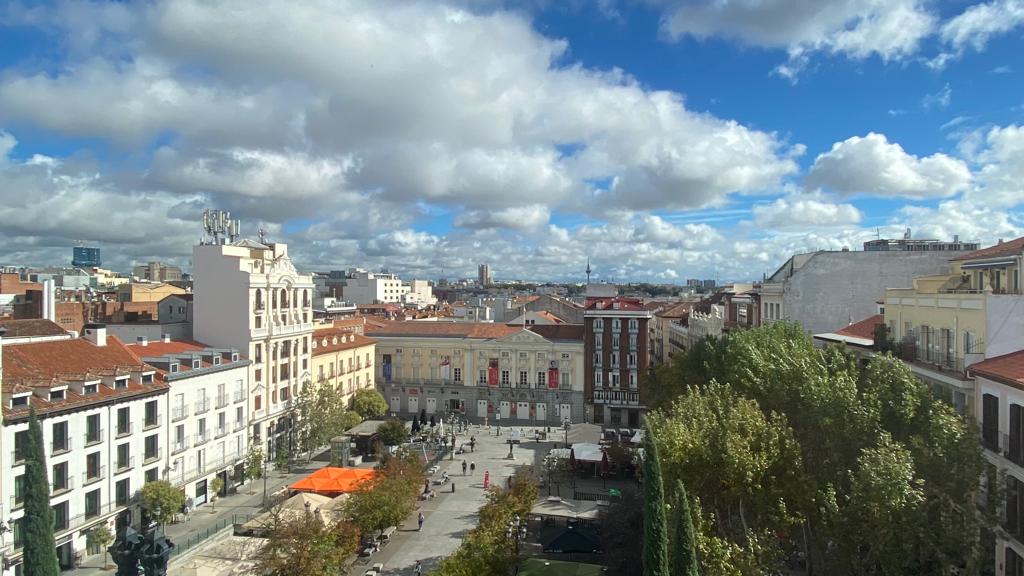
View from the Victoria Hotel over the Santa Ana Square in Madrid by WSM

Falls mainly in the plain. And we saw that as we sat in the plane, in the rain, for three hours at the Madrid airport waiting for it to ease off enough that a Spanish pilot – who must be used to such things – was cleared for take off. It was a bumpy ride but we got from A – Madrid to B – London and home. Only three days earlier – as we drove to the city center we passed the dry dusty outskirts, the soil a pail ochre yellow that looked like sand and made one wonder how anything could grow there. But it does. Between the houses – jostling for a patch – olive trees claim their space clinging and begging to be allowed to stay, offering their untended fruit as payment for the soil. As the motorways slice through the land the trees give way to factories and then block housing before entering the old city center.  

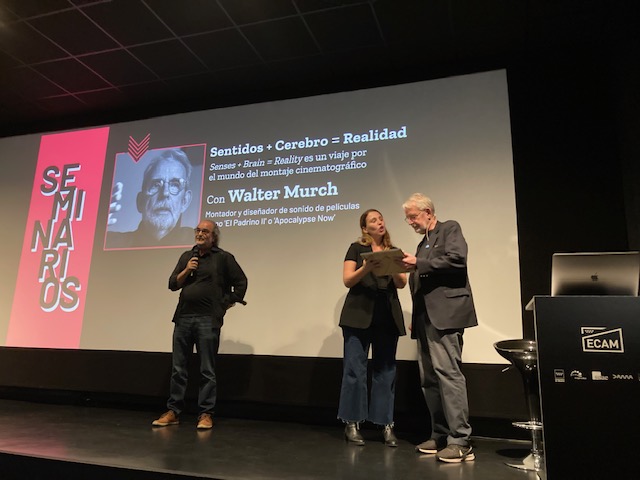
It has been six years since we were last in Madrid and at this film school. Beloved faculty who were young men then are – like us – just a little bit older while our young minders all seemed very much younger. It was a fully packed two days as Walter gave four lectures on Senses + Brain = Reality, as seen in the editing of Motion Pictures. A bit of a mouthful for a title but the four talks were all swallowed, hungrily by most – and cautiously by a few – in the full-house audience for both days as the students and old professionals bravely went along with him. Such is their affection for and trust in the man. These talks are where Walter can give encouragement to them and try out new ways or show what is right in front of – and in our faces – or noses – on this occasion taking a very deep dive into the concept of the Golden Ratio as it applies to the human face.

WSM is made an honorary professor of the University. Photo by MAM

We arrived in the middle of the third week in October and as the wars slide from one continent to another, the new war of the season is well underway. The conflict in the Sudan never reaches the papers, the Ukrainian war remains but is now a side column as the bombing, threats of more bombing, retaliations, and death on all sides of this Middle Eastern mess unravel before us. Hostages had been taken and at that time none released. Politicians began lining up their positions while planning out their strategies, looking for who are their friends, who owns what, and what trades and compromises are available. Each day the war moves forward and it is not a pretty picture. Walter speaks of this at the beginning of both talks reminding us that this is the world we live in, and we are fortunate to be speaking and thinking about art and ideas for this short period of time. 

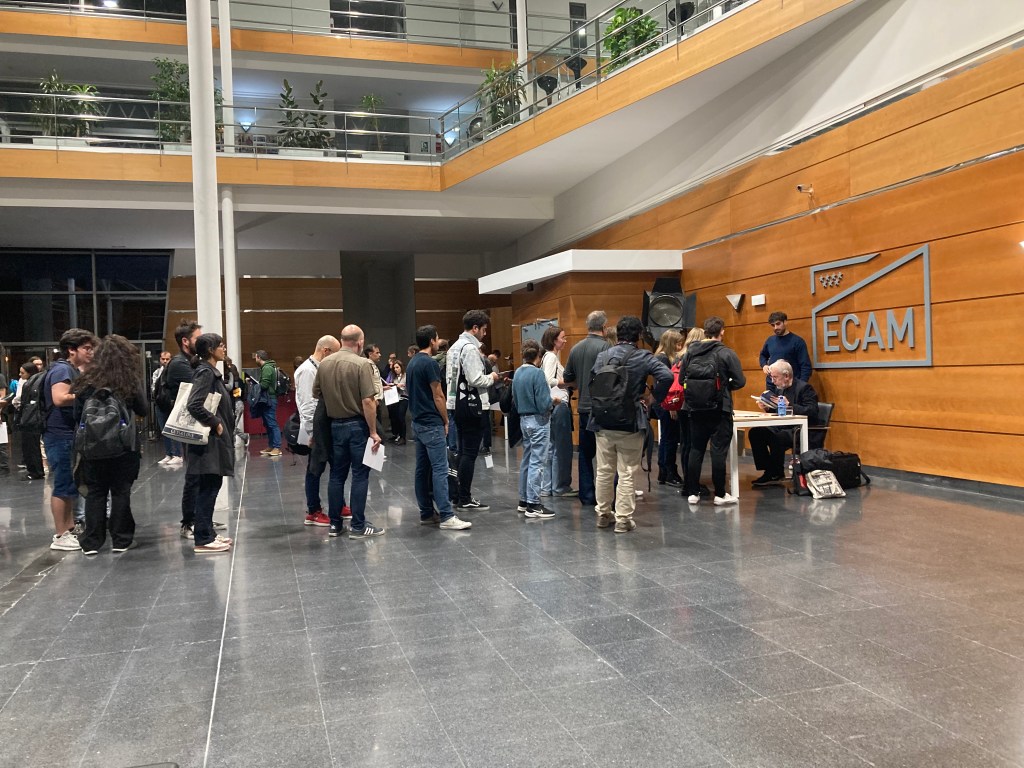
A new translation of ‘Blink’ in Spanish needs signing. Photo by MAM

While waiting and watching Walter sign a new edition of his old ‘Blink’ book I am gently surrounded by the young people who are there for us. They hover like bees finding a new flower but instead, it is I who take from them, as each has a story, and war, government policies, and economic hardships feature in everyone. 

The purple-haired bright-smiling young assistant from the film school is from Puerto Rico. While her family are scattered and separated in California, she has turned East and has found her way to Madrid, and this film school. Deeply conscious of the neglect of the various North American government administrations, her dream is to return to Puerto Rico and help the country with the film and radio skills she is learning. 

Peter, the photographer, was born in Ukraine. He is young, with a mop of blond hair, and is slipping from gangly youth into adulthood. His parents – maybe seeing the future with fear – emigrated to Spain while they could. Peter speaks modest English though better Spanish and now his mother forbids the family to speak Russian – their native tongue – in their home. He doesn’t talk much about Ukraine but his mother worries. Peter’s grandmother is still there, not in the thick of the war zone but close enough, choosing to stay in her home and her mind until she dies. 

Argentines Queuing to Vote in the Hague. Photo by Agustina Izurieta

Cecelia, our main minder, is a young and beautiful Argentine. As Argentina crumbles and falls – with the Argentine peso now at 1000 to 1 US dollar and rising – she too has left her home searching for a new life, a safer place to live and has come to Spain. This weekend our son-in-law took the train from Utrecht to the Hague to vote in Argentina’s first round of elections. Throughout Europe, the lines around the Argentine Embassies were hours long as those who had fled rallied to send the crazed Javier Milei out of the ballot box. 

Coming home we reach out to Lika, another young friend who last year managed to leave Russia for Israel and then bring her mother with her. 

She writes from her point of view in Tel Aviv, “Me and mom are ok. We have a bomb-shelter in the apartment and it’s the best you can get in this situation. North doesn’t get as many rockets as in the South up to Tel Aviv, but from day 1 we have constant shootings from Lebanon and even Syria. I have a panoramic view of the whole bay and I already saw and heard explosions, rockets being caught by the iron shield, and sirens from the border areas. It’s intense. To be honest I still can’t fully comprehend that it’s the second war in my life and at the same moment. We’re very much invested in the war in Ukraine and now this. And the ugliest thing is that the terrorists here are all in one bed – Russia, Hamas, Iran… and Israel and Ukraine have one thing left – to defend themselves. We have many Ukrainian friends here who were evacuated from the bombs and they are incredible to watch – very brave.”

The wars are pushing Britain’s local government squabbles off the front pages. Slipping the two conservative safe seats bi-elections – that they lost – well out of the spotlight. The wars, in the Ukraine, and now in Gaza and Israel are rolling over our consciousness like the winter storms hurtling through forests and along rivers in eastern Scotland. Yet they are not random acts of nature but preplanned with maps and political strategies that are embraced with little thought nor care for the collateral destruction and deaths that follow. It is as if a giant combine harvester is scraping the fields of our planet Earth, leaving stubble where there was wheat, stones, and dust where there used to be rich soil. We cry out but can do little more than weep.  

This has been a Letter from A. Broad. Written and read for you by Muriel Murch. Note an error correction – in the recording I say the pesos to dollar is 350 to 1. It is 1000 to 1 and falling.

Sunshine and Storms

Written and Read for you by Muriel Murch with WSM by my side.

This Letter was written last weekend just as the storms were breaking in Israel, Gaza and Palestine. Since then events are unfolding at a fearful pace and I have not gone back to update this blog. There are better places to find out what is happening as we try to keep all people in our hearts. This program is always first aired on KWMR.org on ‘The Lowdown show’. KWMR.ORG is in the middle of its fall Pledge drive. If you feel you can support the little station that could and can and does make a difference, we are all grateful – especially in these difficult times. Thank you. https://kwmr.org

On this bright Saturday October morning, The Primrose Hill Farmer’s Market is bustling. The stalls are overflowing and there seem to be more shoppers, children and dogs than I have seen all year long. Like squirrels, we are stocking up for the winter ahead. I buy olive oil and artichoke hearts from the Olive Bar, then see Ron, who now walks with a cane, with his Horizon collection of honey and I choose a jar of freshly harvested heather honey. From Pete, of Brambletyne Farm, I gather eggs, small windfall apples, some of the last Negro Kale and fresh mushrooms. Spelt bread from Olivers and the French baker who always gives me a sweet grin and his ‘best’ loaf. Alex of Five-Way Fruit is doing a brisk trade with perfect pears and the last of his berries grown in plastic greenhouses. Here is lovely Angelina, who comes at harvest time with their family wine and olive oil from Italy. Onto the back of the market and Varley and Crouch for Parmesan and a slice of three-month-old sheep cheese plus 100 grams of Parma ham for tonight’s supper, with Matthew’s Eden Farm Organics baked potatoes. Mathew also has the last of the fresh carrots – they are getting large, but with their tops on, are still fresh. I remember to buy unpasteurized milk and butter from Steve Hooks’ farm stall. But no meat today, either from Hooks or Picks or even one of Rafik’s chickens. I pass by fresh pasta, smoked salmon, empanadas, fresh broth and tempting macaroons. On my way out I take a loop through Ted’s Veg and there is the prize of the morning. Bert, of Ted’s Veg, has a basket of fresh walnuts. They are still moist, and the shells green with damp mould. They lie cool in my hand as if they have been plucked from a woodland floor. I scoop two handfuls into a bag and hope that Bert will have more next week. Only when I get home do I realize I have forgotten onions and garlic. The day is full: a noon-time haircut followed by a Film Festival screening. When finally we come home, I am exhausted. Flat out on the sofa, rehydrated with Russet apple juice, I can face the small plate that Walter prepares for me. One of Alex’s moist pears, sliced alongside of thin cuts of the sheep cheese and now those precious walnuts are crushed, the meat glistening and as fragrant as an evening fog-laden autumn walk. Like the squirrels on the hill, I have come home with gifts of the forest.

The walnuts are fresh and moist.

Away from home, wars join natural disasters to fill our newspapers and TV screens. The war in Ukraine remains in the news as much for the war as for the political ramifications, and manoeuvres that are played out on the world stage. Zelensky still strides about in Army fatigues but now they are pressed and clean for he is as often at conferences as he is on the ground with his troops as they enter their third winter in the fields of battle. This is getting messy and does not look to end any time soon. The stakes are too high for both sides.

Nature skips her stones across the deserts and into the lake scolding us for our unwanted cheap behaviour. Storm Daniel flooded and crushed the dams around the city of Derna and swept villages away in Libya, while earthquakes shook villages free from the hillsides of Morocco and Afghanistan.

Coming home from the market, and thinking about what to write for this weekend letter – focusing on the Labour and Conservative Party Conferences that take place in September and October – but while I was plucking carrots, choosing cheese and walnuts – another war exploded. Israel was attacked from The Gaza Strip by Hamas in the biggest attack for fifty years. Among the targets was a music festival held close to the border between the two territories. Israel’s Zika rescue service have so far removed 260 bodies. Images of the festival audience running for their cars also showed the Israeli hostages taken. Many are young, beautiful in their youth, as well as children and grandparents. This was a family day out. There is no pause now, with the Israeli Prime Minister saying the country is embarking on a “long and difficult war”. Hamas claims to have struck Israeli cities while Israel clamps a siege on Gaza. Iran’s officials say “not me gov” and the politicians here are sobered, clambering to position themselves to the right or the left of their own moral consciousness. 

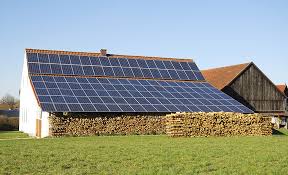
Solar Panels from GreenBiz

The politicians have returned to work beginning with the Conservative and Labour Party conferences. The Conservative party held theirs at the end of September in Manchester, rudely giving the High-speed rail 2 – leading from London to Manchester – the chop. Despite the fact that this was probably not planned out well by their conservative cronies all those years ago – let’s change things for change’s sake – such as the rail tracks width so that no trains running on it could actually link up with other trains across the country or – hold it – going on into Europe. And taking additional slices of the country pie by cutting back on solar panels incentives for farmers. There are a lot of big Conservative farmers who don’t like this new form of harvest, seeing solar panels in their fields as a blight on ‘this green and pleasant land’ preferring their huge combines to scoop out the earth’s resources rather than receive the sun’s bounty.

Now in October, it is the turn of the Labour Party – and even though this brand new war has caused a moment of reflection – the Labour leader Sir Keir Starmer is doing his thing and so is the Shadow Deputy Prime Minister Angela Rayner, she of flaming red hair and a true Council-house background. Now she is ready to roll and she does. Can she and Sir Keir deliver on housing, the cost of living, the NHS backlog, interest rates, immigration and God knows whatever else. There are some serious messes to clean up. They are an unlikely team but that in itself may help to make them work in harness. During these months and years ‘in opposition’ they have learnt ‘when to hold ‘em and when to fold them’ with each other’s style. If they can both keep focused on the country and not themselves, then there is a chance for The United Kingdom to righten the ship of state.

A little Glitter for Sir Keir at the Labour Party Conference

An interesting development is the addition to the Labour team of Marina Wheeler KC – ex-wife of ex-Prime Minister Boris Johnson as Labour’s new “whistleblowing tsar”, offering advice on proposed protections for women against workplace harassment, helping the party strengthen the employment rights of women. After the mandatory six-month break between roles, Sue Grey the former Civil Servant, whose report on the parties at Downing Street during the Covid lock-down helped bring the aforementioned Boris and his boys to the dudgeon – is now Labour’s Chief of Staff. Sir Keir Starmer has more than welcomed these women – formally from the Conservative party – to join him, he has plucked the cream of the crop.

Volunteering at our Community Library has its perks beyond meeting and greeting people from our community. There are books to be borrowed and relished and – tempted by politics – and the writers I do. However the inner truth of ‘Johnson at 10’, by Anthony Seldon and Raymond Newell – documenting the chaos and downfall of the Johnson premiership – is too unbearable to read. But I dive into the muddled waters of ‘Politics on the Edge: A Memoir from Within’ by Rory Stewart with the heartbreaking truths of its pages showing me a Conservative party system rotten to the core and it makes me deeply afraid as I face my naiveté.

This has been a Letter from A. Broad written and read for you by Muriel Murch.

Bobbies on the Beat

Written and produced by Muriel Murch with WSM by

It is a sunny autumn morning when I sit outside of Le Tea Cosy cafe, sipping a flat white and chatting with a friend when first two, then three, followed by two more police men and women saunter by. I laugh to them, “Seven of you”. And the slightly older – but still so young – as policemen have been for years – smiles back “Yes, young recruits on training exercises.” He could have been talking about trotting out young cavalry horses in Hyde Park, but no, this is rookies on the beat walking around Primrose Hill and into the village on a sunny mid-week midday, and is a very different scene from what they could encounter on a Saturday night down by the locks in Camden Town. Their young faces look sweet, both hopeful and nervous of what lies ahead for them all.

Chris Kaba – photo courtesy of his family

For by now they know that the news is full of the charge of murder by an armed police officer with a single gunshot to the head of Chris Kaba last September in South East London. Chris was a construction worker and a rapper under the name of Madix with the group called 67. Reportedly he was not a man without flaws but with his impending fatherhood that could have been about to change.

The firearm officer charged with Chris’s murder is only named as NX121. Rallies led by Chris’ mother and family were held asking for an investigation. Here we go again and we hope that Steven Lawrence’s parents are helping her. Home Secretary Minister Suella Braverman – she of the floating barges and Rwanda deportation plans for immigrants – assures the police that they have her full backing. But what does that mean? Now – for a moment – there is a pause. Close to one hundred bobbies-on-the-beat, a little older than those rookies walking the pavements of Primly Hill, are handing in their guns. Reflecting on what they think ‘could have happened on that street in Streatham Hill’ and want no part of it. They don’t trust Suella Braverman to have their backs and maybe – for a solitary moment – they don’t trust themselves and want no part of killing another man – when – on a Saturday night off they might be dancing to the music of 67. Further assurances are made by Braverman, and the Met Police force floats the idea of bringing in the army to do a Policeman’s work, leaving these young officers churning again in confusion and mistrust.

Chris’s family, along with the police, are not alone in their mistrust of the government. This next weekend the Conservatives are holding their Annual Party Conference in Manchester. Which is a bit rude – to put it mildly – where the main item on the agenda is the closing down of the continued construction of the High-speed Rail link that travels from London to Birmingham and is scheduled to go on to Manchester. The South/North divide is strong in England, and Andy Burnham the major of Greater Manchester sees this move for what it is. Like a true northerner he is able to speak his mind.

Andy Burnham Getty Images

Come to think of it that maybe the most characteristic difference between the north and south in England. Northerners don’t mess around, calling a spade a spade while southerners can relish moving words and phrases around as if playing the ‘follow the ace’ card game again and again. For Sunak, to make the decision to scrap this link is pretty abrasive. Grant Shapps who was transport secretary until last month and who moves through Cabinet secretary positions with the lighting speed of those fast trains he wants to halt, says it would be “crazy” not to reassess whether the full HS2 rail project remains viable. One of the far reaching goals for High Speed rail – such as exists in Europe and Japan – let’s not speak of Europe – was that it would enable business men and women from the north to travel to London or even – steady on – to Paris, Brussels and Amsterdam – for face-to-face meetings thereby giving the North of England a better shot of doing business within Europe. But ministers in Westminster are determined to keep the power close to the south and this train vasectomy would do that. With a change of government this little snip could be reversed but that is no certainty. 

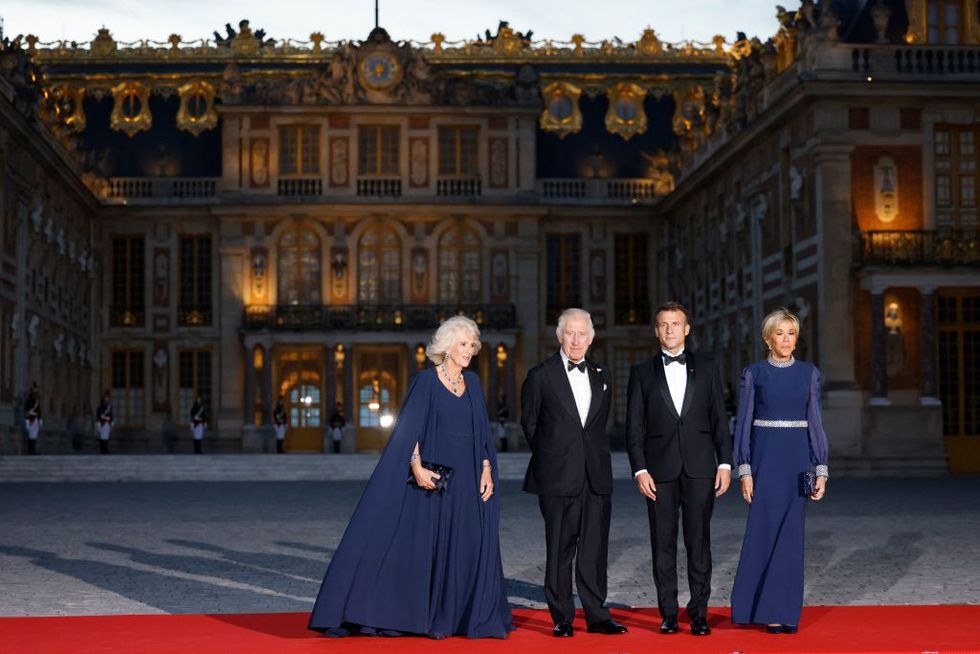
Meanwhile – thinking forward in fellowship – King Charles and Queen Camilla were invited to Paris for a three-day state visit complete with dinner for 150 guests in the Hall of Mirrors at the Palace of Versailles. When invited to dinner some people bring wine, flowers or chocolate. But the King and Queen brought Sir Mick Jagger and England’s still favorite handsome man, Hugh Grant. The guest list was drawn from French and English men and women who continually contribute to good relations between the two countries, so often found easily within the arts and sports. The fact that both French and English cheeses were on the menu says a great deal for the warmth that was brought to the table. One wonders who sat next to whom and we can only hope that everyone remembered their table manners and used their silverware from the outside in. Fellowship was ever present and as the wind ushered their entrance to the palace Mme Macron helped the Queen with her cloak. Of course there were speeches – the President and the King both speaking in each other’s language. During the three-day visit there was the obligatory tree planting, remembrances of past Royal visits to Paris, then the wives played a little table tennis at a sports center, both showing their need for more practice and a first – as King Charles spoke in French to the French senate. It was a good visit with gentle words and gracious kindness on both sides. 

Queen Camila, King Charles, President and Madam Marcon before dinner

As the equinox came and went the evenings were closing in. The green tomatoes were harvested from the library garden and our little terrace and there was just enough to make the starter layer of chutney. I look to see what we have and what should I add? In the local greengrocers there are fresh onions and the first Bramley apples, while on the counter is a box of no longer sellable fruit. Ladies of a certain age know not to waste and so half a dozen soft and wrinkly, old lady peaches went into my bag and then the chutney. Delia Smith has two recipes in her book but chutney is not for recipes, it is for bountiful harvests, leftovers and sweetness so I jumble the recipes up – remembering a little of this instead of that works – and there it cooked happily on the stove. Now it is in jars to wait – if it can – for the flavors to lie together and emerge anew.

Labeled and Photgraphed by WSM:)

This has been A Letter From A Broad Written and read for you by Muriel Murch 

Summer’s End

Written and recorded by Muriel Murch with WSM by my side.

The summer blasted out with a heatwave that left those of us of a certain age floating in a sea of lethargic sweat. This morning there is a lift in the breeze as brown leaves fall and swirl, crackling underfoot, telling us that autumn has arrived. Children are returning to school, politicians to their chambers, and nobody really knows what is happening in Ukraine. The huge earthquake and toll of over 2,500 deaths in Morocco has blasted the Ukrainian war off the front pages but not completely out of the news. 

Widowed 26-year-old Margo sits at her desk inside a small brick mortuary close to the front line in Donetsk. Unknown soldiers are brought for her to check and record what she can about each body. And where she says – she speaks to the dead. “It may sound weird… but I’m the one who wants to apologize for their deaths. I want to thank them somehow. It’s as if they can hear, but they can’t respond.” Ukraine gives no numbers of its war dead – but Margo knows the losses are huge. US officials, quoted by the New York Times, recently put the number at 70,000 dead and as many as 120,000 injured. This from an armed force estimated at only half a million strong.

A mother looks for her son

Crime Watch Live was a BBC weekly program in which the public were asked to help the police solve a crime that has been reported yet remains unsolved. Britain loves this work, it plays into the ancient forest hunter. In Crime Watch the police would put up a situation, giving as much detail as they could and a phone number to call. And sometimes it worked, while the show was still going on ‘a suspect was apprehended and brought in for questioning’. The TV public loved it and so the escape of the ex-army soldier and terror suspect Daniel Khalifa from Wandsworth Prison on Wednesday brought the public out hunting again alongside the police. Daniel is only 21 years old, with an Asian name and light coffee coloring. Dressed as a chef he managed to escape the prison strapped onto the undercarriage of a food delivery truck as it left the prison. I was not the only person with a smile on my face. An ex-prisoner interviewed by the BBC, could not stop grinning as he said. “He’s off out of here now.” But it was not to be. 75 hours after dangling under the truck out of Wandsworth Prison he was pushed off of his bike by an undercover police officer while cycling the towpath by the Union Canal in Chiswick. While Daniel faces the law on Monday it is time to point a finger of blame at someone. The finger circulates around and comes to rest on the conservative government as the country pays the price for another slice of the Austerity measures put in place by George Osbourne and David Cameron. On BBC radio, Secretary of State for Foreign and Commonwealth affairs James Cleverly, previously secretary for Education – so it’s not clear how much he really knows – claimed there was no evidence that cuts imposed by his government were to blame because, “the number of escapes had decreased dramatically, while “4,000 extra prison officers” had been recruited. To which the Prison Officers Association national chair, Mark Fairhurst, rebutted that the Prison Service was “now unable to retain the staff we recruit. That tells you everything about the working conditions in our prisons.” And blamed the escape on “The link goes back to 2010, when the Tory government came into power and hit us all with austerity measures.” 

But this little bit of amusement is only one part of the austerity chickens coming home to roost.

As children put on their uniforms, several schools will be closed due to those chickens roosting. Construction codes were loosened in the 1980s and 90s and buildings built during those years are now crumbling apart from the light-weight, porous, cheaper, easier concrete. Classrooms are getting soaked through in the rains and even clumps of ceilings are falling down in classrooms. The hold-your-breath not-said-yet page-turner are those other buildings – hospitals, apartment blocks, offices – built during that boom – and is going to be a very big problem once someone puts the question to the government. Which is maybe why the Prime Minster nipped off to India for the G20 summit. Better to be shunned and dissed by world leaders than hounded in parliament. It’s tricky for Rishi and he really has no way out. There is no one else to blame for the state of the nation but the Conservative government and everybody knows it. And Rishi will have to show up in parliament soon. 

The King and Queen must also come down from the highlands and back to London. The King managed a few weeks away in his beloved Scotland, to take the time to honour his mother and reflect on the first year of his reign as he moves forward. Where now can he now shine a careful light without poking his finger into politics? It is rumored that his first big personal project is a national initiative to tackle food waste. The Evening Standard newspaper – which reports a surprising amount of truth – writes that 2.9 million tons of good-to-eat farm produce, enough to provide the equivalent of seven billion meals, is being dumped in landfills each year. And you can be sure that more than one someone is making a profit from that.

This caption quote is from ‘Left Foot Forward’
The campaign to hand out EU flags at the Last Night of the Proms was spearheaded by the Thank EU for the Music group, which said that “tens of thousands of music lovers have taken our free European flags into the Royal Albert Hall for each Last Night of the Proms in solidarity with musicians who feel (like countless others) the destructive impact of Britain’s recent isolation from Europe.”
The group also posted a letter it had sent to the BBC’s Director General Tim Davie on its Facebook Page, where it added: “Our flags represent the hope that the Last Night of the Proms musically celebrates “Britannia ruling the airwaves”, hopefully transforming the problematic post-colonial anthems into something more, shall we say, enlightened and collaborative?”

The Promenade Concerts from the Royal Albert Hall ended this weekend. The last night of the Proms usually concludes with a roar of British national fever but this year it was pitched a little differently and though ending with the usual Rule Britannia – sounding a little tired – the National Anthem – God Save the King and For Auld Lang Syne while people stood swaying together singing along in harmony. But there were as many European Union flags and berets in the audience as there were Union Jacks. Members of the Government are asking for another investigation by the BBC but it could be – that just like the late Queen before them – with her clear message hat, the people are speaking calling for a greater self than just this treasured Isle.

`The Late Queen at the opening of Parliament 2017

September 8th marks a year since the late Queen died. An evening program set out the timeline of the day leading up to her death. Little nooks and crannies of tit-bit information came to light as we watched and remembered that day and our Queen. While the Queen’s condition became more grave, the then Prince of Wales took himself off for a solitary walk in the forest as he began to prepare himself for what lay ahead. This program was a moment for the nation to reflect on the passing of a beloved monarch and mother, a person who affected all of our lives, like remembrance prayers for all of our dearly departed. Years ago coming to All Hallows Eve, St.Michaelmas – of the daisy and the dead – an old friend wrote to ask if I would like my mother’s name included in the prayers for the dead at St. Paul’s Cathedral. It was an unexpected act of kindness and a remembrance of all things past. And we do remember them, those we knew, those we loved, and those who taught us life lessons. We will remember them until we become among those who are remembered. 

This has been A Letter from A. Broad.

Written and read for you by Muriel Murch

Poaching in the Park

Written and Produced by Muriel Murch with WSM by my side.
Blackberry-bramble Harvest 2023

August slipped into autumn not bothering to wait for September while most of London went on holiday, leaving the city almost as subdued as Paris. Along the canal, three teenage ducklings are swimming alone as if their parents have regretted their final feathered fling in the water and are just too tired to raise one more brood this year. The ducklings look lost, paddling from one clump of weeds to another in the mindless way of adolescence. It is blackberry season and we are late for our semi-annual ‘Poaching in the Park’ moment. We go in the middle of the week – with less chance of being caught – though this little corner of Regent’s Park is now sorely neglected. There used to be a thriving small sports school here, a place to practice your tennis, golf, or cricket. But now the cricket practice nets have moved close to a central concrete hub with a cafe, overlooking the big open pitches that serve both cricket and football in often overlapping seasons. There is a small tennis club close to Queen Mary’s Rose Garden but the golf nets were removed altogether. Now the wilderness has taken over – as it should – and the blackberry brambles climb the Hawthorne shrubs and surround the adolescent oak trees. The King is in Scotland striding out on the moors for a good bit of fresh air, while the Prime Minister is back home in Yorkshire, maybe looking to see if the Green Peace ‘Stop Oil’ Delegation have left him any more notes on how to run the country. So we can pick and gather our bramble harvest which quickly became eight pots of jam. Six are stored away. One goes straight into our fridge and the other to Howard who – in years gone by – was one of the tennis coaches on the courts now covered with brambles. Howard lives close by and while closing into the other side of his eighties we often stop and chat. Howard is fond of the written word and from time to time pops a poem through our letter box. 

This week’s poem from Howard

The nightly news can barely be bothered with the wars that do not stop in the Sudan and Yemen. The Human Rights Watch write that Saudi border guards have been reported killing hundreds of Ethiopians trying to cross into Saudi Arabia from Yemen. And the war in Ukraine is not ending soon. The maps showing – in red, purple, and white – whose troops hold which cities and coastlines in Ukraine – are confusing and seem at odds with the reporting. If all that land – in red – is occupied by the Russians, how is Ukraine ‘making ground’? We see villages and cities bombed – and the long, low trenches slicing through fields and countryside appear no different than those dug for World War One – where Ukrainian soldiers crouch and fire, fire and smoke, and slog on. Summertime is wearing for soldiers and politicians alike. But there is a useful police mess-up from Manchester and a horrific tale of infanticide to keep us distracted from the wars and the Government debortle with the Biddy Stockholm barge. A few asylum seekers were being marched onto the barge two by two – when it was discovered – at least a week before reporting – and the marching on – that the barge water supply contained traces of the legionella disease bacteria long known to cause severe pneumonia and death. Time to pack their bags and march those foot-weary seekers of asylum and hope off again. 

The 168 bus leaving Chalk Farm.

Sometimes I miss the small thud when the paper lady pops the Camden New Journal through the letterbox every Thursday morning. I glance through it, knowing there will not be not much I care to read but that sometimes, something will catch my eye. Last week – another August moment – there was no home delivery – so this week I made sure to read it. And there it was: a small column slipped into the side of a page. ‘RIP 168 – the bus stops here’. This route will be closed in September. ‘Oh No.’ How could they – who the heck is ‘they’ – let it happen. ‘They’ turns out to be Transport For London (TFL for short) and to whom we pay our bus and rail fares. They did a survey – even reporting that of three hundred respondents, only 18 agreed with the scheme to scrap the 168 bus route. And still, they went ahead. It is this kind of lock-jaw response that drives us all crazy. The government does it with their ‘there will be an inquiry’. It is – to put it mildly – upsetting.

Upsetting and inconvenient for people like me perhaps but downright devastating for people like Jim. Jim and I have been friends for twenty years and know much – and yet little – about each other. Jim is Jamaican, his wife was German and I often wondered what brought them together – if in those early years of their courtship, they both felt the chill of English disapproval. Jim was a Camden Garbage truck driver until he retired. His route brought the truck onto our street and he lives just two blocks away in a council flat. He had a Yorkshire Terrier dog, small, black and brown, and always keen, pulling Jim along as she raced up our street galloping towards the hill. Even at 17 – a serious senior for a little terrier – she was always ahead of Jim – until she wasn’t – and one day Jim quietly took her to the vet to say goodbye. Now he is alone, and as he gets older doesn’t go out and about so much. But we meet from time to time. ‘Ello darlin’ He calls to me, having long forgotten my name and it being too old a friendship to ask to be reminded. And we chat, about this, that, the other, and loneliness. A kiss is always welcome. The last time I saw Jim he was walking slowly with his cane, going to the bus stop for the aforementioned 168 bus on his way to The Royal Free Hospital in South End Green where the bus stops right outside of the hospital – in both directions. What will happen to Jim and so many others if TFL takes this moment of independence away? Each little cost-saving denial from them leads to a retreat and loss for us all. 

This has been A Letter From A. Broad written and read for you by Muriel Murch.