For over 24 years, passion and inquiry has been AIRWAVES’ backbone. From across the globe, host Raul Gallyot has invited authors, cooks, medical professionals, directors, performers, actors, politicians and winemakers to visit AIRWAVES while sharing their particular perspectives. Unrehearsed and informative, broadcast-interview conversations flow back and forth as professionals present unedited thoughts, past stories and recent findings.
The studio 1 Board at KWMR.org
Raul Galllot
And this was certainly unrehearsed. Raul has been a programmer host on KWMR.org for almost 25 years and throughout that time has brought us guests who make us think, laugh and ponder in sorrow. When he asked me to join him on air I had no hesitation on saying ‘Yes’ trusting he would challange me and make me – the guest – think outloud. The result is a bit of a ramble through my mind, my life and work.
We talked of a flutest playing over the lake at dusk in Sri Lanka. But there was also a bell, rung at dawn and dusk and at times of danger.
Raul’s Airwaves can be found in the archives of KWMR.org and on the Internet Archive. Thank you for listening.
Written and read for you by Muriel Murch with WSM by my side.
Across the high street from the general merchants, Wainwrights and Sons – when general merchants sold everything from coal, lumber and rabbit food – was a small glass-fronted, with green trim, coffee and pastry shop. It was run by Madame Max and painted above the door, in curly blue writing ‘Mrs Max’s Café’. She must have been a refugee from the war and somehow had landed in our small town in Fleet in Hampshire. I like to think there may have been a story from a returning army officer giving her a helping hand to start her life once more. There are stories we never know. Lady Pechell was a daily customer, riding her bicycle from the two miles from the rhododendron shrouded Denorban Avenue into the village. Lady Pechell was older than the young mothers making do with their ration books, trading eggs and butter from small holdings for gin from goodness knows where. On shopping days during the week they came to Mrs Max’s Café, to be together for an hour. To commiserate about all and everything, trying to put their lives together as the war continued, while Lady Pechall quietly fed me lumps of sugar. She pocketed more lumps of sugar for her ponies. Though sugar was also rationed and because she was a little eccentric and her husband had fought in two world wars, nobody minded. A mystery surrounded her, her husband Sir Paul, that maybe included Madame Max and her café.
Hampshire countryside then and now
I’m thinking of those times after reading Emma Beddington in the Guardian last week. Her article was about Starbucks, now getting people out of their U.S. coffee shops with a new “Coffeehouse Code of Conduct,” making people buy something or leave. Someone has been scratching their corporate head wondering how, in the words from ‘The Loved one’ “To get those stiffs off of my property.”
Robert Morley and Robert Morse in The Loved One 1965
This attitude has caused quite a stir-up in the brew that makes up coffee house culture in the U.S. and Europe. It’s a big thing in all cultures and wouldn’t you know it it is America that can’t quite handle the slow soothing pace of sipping. There are all sorts of reasons, the economy being the main thrust driving Starbucks which, really isn’t failing but has always seemed to be on overdrive. I’m remembering European workmen, standing at coffee bars in Rome and Paris, taking an expresso hit before their day started and women pausing for a refresher mid-morning to get them through the day. I’m thinking of Bianca, who I met 30 years ago in the Piazza San Lorenzo, our dogs yapping at each other leading to a conversation, a visit with homemade raspberry sorbet and a postcard from Puccini.
KHARKIV OBLAST, UKRAINE – NOVEMBER 20 2023. (Photo by Diego Herrera Carcedo/Anadolu via Getty Images)
Soldiers stand about – taking their coffee before heading back out on patrol. How is it now for the Russian and Ukrainian solders in Northern Europe slogging on in February where the war between them has wearied both the soldiers, the politicans and those of us who are watching from thousands of miles away. They have no comfort, barely some companionship that may or may not be with them at the end of the day. February for foot soldiers in war is the month of mud, spring and relief seems far away. Russian troops are killing more Ukrainian war prisoners and The new US President is doing his ‘gimme gimme’ routine with Ukraine, asking for ‘Rare Earth’ in exchange for weapons. Rare Earth that would be better used for rebuilding a war torn country when all of that stops.
And as for the old fella’s tariffs on Canada and Mexico, well they may have slid backwards or even backfired. The Mexican President Claudia Sheinbaum said she reached an agreement with the US president to pause tariffs for a month as Mexico sends 10,000 troops to the border to stop migrants crossing into the US and address drug smuggling. And after talks with the Canadian prime minister, Justin Trudeau, there is a month’s pause going north as well. Both these agreements were apparently all in place before they were ‘renegotiated’. But it is too late for the Kentucky Bourbon now being pulled off of the Canadian Liquor store shelves. Meanwhile China responds in its own way.
In Europe Sir Keir Starmer has been to Brussels and managed to say pretty much nothing as he walked the gymnastic balance beam in front of the whole European school. He made it to the end – without falling off – but only just. A journalist from the BBC no less – called out that surely these were not ordinary times in the political arena. That the Orange one is rather upsetting the apple cart. Standing beside Sir Keir Starmer in a joint conference, Mark Rutte the former prime minister of the Netherlands and now the Secretary General of NATO said that “I am absolutely convinced that we can deal with these issues, and there are always issues between allies, … sometimes bigger, sometimes smaller. But I’m absolutely convinced that will not get in the way of our collective determination to keep our deterrence strong.” They looked very alone standing in their joint conviction of collective peace in our time.
Sir Keir Starmmer and Mark Rutte standing together in Brussels
Tariffs tossed out across borders, gutting of American government bodies is keeping the president busy and he will get hand cramp if he is not careful signing away the country in a Coup. This weekend sees BB Netanyahu sitting in DC having photos taken, and a chat about Gaza – or what to do with the rubble that is left of the state. It is doubtful that they will talk about the people. But there will be a statement about something ‘definitely happening’. But as we doubt those ‘definitely happening’ statements we worry and need to share those thoughts; the effects of this new global bickering and power plays that is costing lives, along with worries about our communities as the trickle-down effect of this new reality takes hold, our friends getting older and our families.
It is seriously raining outside but our need for companionship in another place, neither work nor home, calls us out. And so we come together, meeting in town for an hour to sit at Toby’s with our cups of coffee. Chris Giacomini is moving the chairs back into the feed barn so that we are dry. He understands more than most that the need for companionship – sharing our worries and the world’s troubles with a friend are served best – in that other place – slowly sipping a cup of coffee.
This has been A Letter From A. Broad. Written and read for you by Muriel Murch.
Written and recorded by Muriel Murch with WSM by my side
Last week the Wolf Moon rose over the whole world. Shining brightly through clouds and fog, it blazed through the night and our windows while the coyotes howled for mates on the lowlands along with their wolf brethren deep in the forests. It’s a strong moon for the middle of winter that harbors renewal as seal and sea lion birth occurs on the seashores around us, but the ground is still cold and – tempting as the sun can be – it is too soon to start planting a garden.
Coyote looking about the farm. Photo by Walter out West
The predators that come through the farm change through the years and we would do well to take note. For the moment there are no raccoons or foxes tiptoeing up the stairs to our little terrace. They are deeper in the woods, also hiding from the coyotes and the bobcats that are also happy with the local takeaway of pet-fur as chicken feathers. The coyotes are hungry and so are the hawks. Both eye our chickens. From time to time they get lucky and there are raids that end in death cries and feathers to tell the tale. The predators know this small holding lies on the edge of farming country and that we are not always as vigilant as we could be. The hawks fly in silently and the coyote is quiet as he trots up the back driveway, looking here and there for an easy catch or any human activity that precludes it before carrying on through the barn and out, down the front driveway. He is scrawny, this coyote who comes through, hungry and skinny beyond just the needs of winter.
But there are others – in human form – who are searching, looking for some nurturing of the soul. He is young, dark with weathered skin and hair that covers his head and face as if he is risen from the sea, a messenger from Poseidon, and now finding himself on land, is not too sure what to do next. He wandered in, up the back driveway like the coyote, and stood behind the barn looking about him for a while.
Ever the galant host, our son approached the stranger to ask if he is all right? Slowly coming to earth he responds, “This is so authentic man. Your jacket too. It looks like the real thing.” And covetously eyes it. Walter replies, “It is the real thing. I need it. You can’t have my jacket.” They stand in the driveway, as the stranger ponders his situation. He looks again at the farmer before he slowly backs away – like an animal who has stumbled into another bear’s territory.
But the stranger was looking for something, and maybe found it in the grounded feel of this little farm that sits on the knotty edge of what used to be farming country and is now braced between National Park Land and a vacation paradise. It’s a tricky triangle, played out in this tiny corner of West Marin. But enlarge that geography and the mindsets that cherish agriculture, parkland and vacations, and a storm in a teacup doesn’t even begin to cover it. This week – things came to a head and we have seen and heard the outpouring of frustration and grief at the closure of the ranches within the Point Reyes Parks. It’s a pretty brutal execution and one that could have been so avoided a long time ago with bringing all parties to the table for counsel, consideration, and cooperation. In our local paper – the Point Reyes Light – January 16th issue – there are articles beyond articles of the damage these closures will cause to all the Parklands the environmentalists, the tourists, the ranchers, and the ranch workers whose family members also work in the communities. Dewey Livingston added a column, “Point Reyes in Time” laying out the history of Point Reyes since ‘we’ took it over. Sober and sad as it is, it is also a reminder that we are all a part of history. In ‘The Temper of our Time’ Eric Hoffer wrote “Every great cause begins as a movement, becomes a business, and eventually degenerates into a racket.” Putting some of the environmental and conservation organizations into that equation and you might find a good fit.
On the day that I write this letter another historical change is occurring in America. As one administration bows out another is striding in and the world is trembling in happy or fearful anticipation. In a preemptive move, not something the Democratic party do often, outgoing President Joe Biden has pardoned many public servants to prevent false prosecution by the incoming government. The list is too long for this writing but the democratic Chairman Bennie Thompson, and Republican Vice Chair Liz Cheney, leaders of the House Select January 6 committee said on behalf of the committee they were grateful for the pardons. I choke up thinking that Dr Fauci is in need of protection from such harassment. Immediately on taking office the incoming president puts his cards on the table – playing a full flush of pardons for 1,600 people associated with the January 6th riots storming the Capitol. He went on, signing this and signing that and the ‘to do’ list laid out for his administration – the heads of whom – don’t seem to have yet learned how to lay the table – is long.
Meanwhile – after it is over – I study the news, culling from this publication and that TV station. European leaders, some past, some still sitting at their desks, and some not quite there yet I’m seeing a motley crew with their hair and hats and ties as they took their places behind the second generation American Tech leaders of the moment.
Past Presidents Bill Clinton, George W. Bush and Barak Obama with Hilary Clinton and Laura Bush
Then I look particularly at the women who – like our late Queen – know the subtle messages of the clothes they wear and the actions they take. Michelle Obama is absent. Hillary Clinton standing beside her very trim husband is wearing a Peace on Earth broach. Laura Bush has a single strand of good pearls over her dress as she accompanied her husband George.
A universal image probably from Getty or The Guardian.
Melania is wearing a hat – that fits – her mood, and possibly her need to be hidden as she walks back onto the world stage. And as she controls the gloved touches she exchanges with her husband, she does not let his flesh reach hers. Melania’s hide may not be as thick as she likes us to believe. Only time will tell if the oil of parenthood has softened her skin to embrace the world she comes from and is about to enter once more.
This has been A Letter from A. Broad. Written and read for you by Muriel Murch.
The year – that year – 2024 has ended and Past-President Jimmy Carter quietly left so as to watch the next chapter of American history unfold from afar. In a sign of respect – not accorded to every US President – the Union Jack at Buckingham Palace was flown at half mast on the days of, and after, his passing. For us the outgoing tides of 2024 carried out with them family and friend transitions that were close to our hearts. Later this week I will rise with the dawn to think about friends and family gathering in the Norman All Saints village church in Crondall that they have attended for over fifty years, as the patriarch of their family will be remembered and laid to rest in the grounds surrounding the church. This is the winter of our lives and the leaves of love and memory are falling.
The gifts – that is – of this time – are the memories that emerge out of our past – even the worst of them – are coated – if not soaked – with love – and often more than a little laughter. So the old year fades, taxes get paid and we look forward to whatever this year will bring.
The changing American administration will take place on January 20th, ironically falling on Martin Luther King day, whose dream seems to be once more deferred. This change is bringing apprehension to Americans and world leaders alike. Gears must be shifted, and wheels oiled. Ukraine’s President Zelensky has to figure out how to dance around the incoming American President who is in turn dancing to President Vladimir Putin’s music. It’s tricky for whatever happens with Zelensky and to Ukraine will ripple through the rest of Europe and beyond. Elon Musk is traveling in person and on X into London chatting with – and then dismissing – Nigel Farrage now saying “Reform needs a new leader.” Well there is egg or custard pie on Nigel’s face – again. Sir Keir Starmer has too many papers on his desk, The National Health System, housing, Nigel breathing down his neck, the conservatives straightening their skirt hems and now this Musk boy putting his finger in the icing of British Politics, not knowing that the cake inside has collapsed completely. Meanwhile Justin Trudeau is stepping down as Canada’s Prime Minister. Another good-looking chap falling under the wheels of Government failure and a touch of corruption. How do they make such silly mistakes swinging in and out of revolving doors? Maybe one needs to be a fly in the soup to understand that better.
# 24 bus From Pimlico to Camden
It is snowing in England. ’Makes you feel like a kid again’ says another wistful middle-aged man in a Yorkshire pub. And it does. However inconvenient, the snow is and it can be brutal for farmers and those living in small hamlets, throughout the country we are relieved to see this winter weather. Cold to ward away the concerns of global warming.
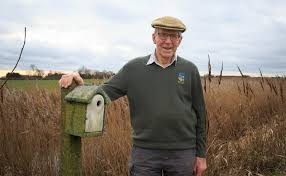
Nicolas Watts in Lincolnshire, is a farmer who farms among his crops, a fine line in organic bird seed. Nicolas sits down once a month to write a newsletter about his farm, the crops, the wildlife and the weather.
And every month I read it. He has his figures and facts all lined up and this month says “We only had one frost in December and it was far milder than usual, with a mean average of 7.2°C. … There are no fast moves in here, no rushing to embrace this fad or that. But what Nicholas is showing – on his farm and in his newsletters – are the effects of climate change on this small country – this farm – agriculture, and thus us all. He goes on – telling us about how the price of potatoes has gone up – but that is another story. This farmer is working the land and seeing what is happening to the soil and the Earth we live on.
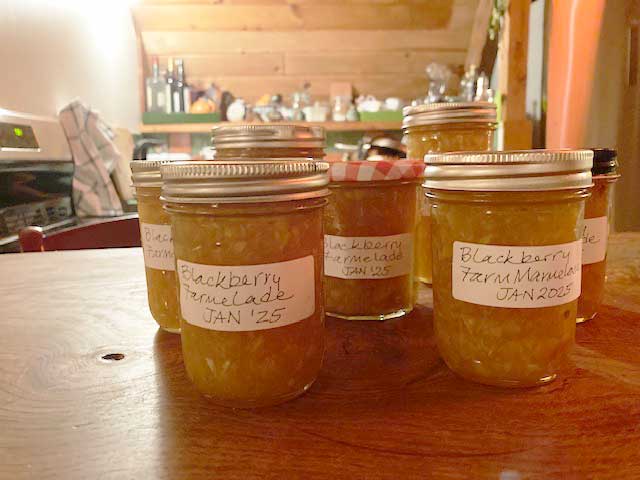
Meanwhile in January, many English women still make enough marmalade – for their family and friends – to last for the whole year. And those of us who do it are very particular about what we use. Each family has its own recipes and traditions, though now it is mostly us grandmothers who ‘have the time’ and care enough to make it. Oranges from Seville are key, and arrive from Spain to England just after Christmas. They are small, squishy, bitter and full of pips. In years gone by, when lemons were a luxury, the marmalade was made solely from these oranges. Lemons were saved for Lemon Curd. Rose’s brought in Lime Fine Cut Marmalade as an exotic and it remains popular today. I’m thinking those limes came from the Caribbean and that Rose’s got a good deal on them. Now marmalades are mixed, and exotic, with and without, whiskey added, but it is hard to find good old chunky cut marmalade. Marks and Spencers and Fortnum & Mason made a stab at it but both are still too refined. And what about those of us, outside of England for whom making marmalade remains as important as making mince pies? We are lucky in California that citrus and Meyer Lemons particularly grow abundantly. And on this farm we are also lucky. About twenty years ago one of our daughters gave me a Pacific Coast Orange tree. I was dubious and the tree felt my lack of confidence in it and so for years it sat, sulking, hardly growing at all but then maybe the nutrients from all the dead pets in the bury patch released into the soil and now the little shrub is a big tree, with bowed branches full of fruit. Truth be told they are the complete opposite of the oranges from Seville. There is as much pith as fruit in each orange and as for juice – to be kind – it is tart. But I go out into the garden, gather those oranges, a few Meyer lemons – that tree for some reason not as strong as the orange – and chop, mixing the fruit together. It gives me a chunky, tart marmalade that can stand ‘toast to toast’ with the old remembered Seville orange marmalade. This week I have my twelve plus and counting jars of marmalade, and I am happy once more.
Farmalade January 2025
As I make my marmalade, I remember my mother making hers and the rows and rows of jars put away in the larder. I am thinking again of my friends in England. We are older now and knocked about by the snow and winter weather. The silent whiteness will only be beautiful if they can be safe walking to the church, laying this loved one into his grave, before returning with their memories to the safety of their homes.
This has been A Letter from A. Broad. Written and read for you by Muriel Murch.
Written and Read for you by Muriel Murch with WSM by my side.
Stinson Beach from the Airplane, photo by WSM
Bump bump bump goes the United Airlines plane as we fly across the mid-west and over the Rockies, it is as if the plane is no longer sure what is United, and as for ‘flying the friendly skies’ that went the way of all bombers. We bumped until we didn’t – descending like a glider over the Point Reyes Peninsula, seeing our home stretch of California before heading back to land.
As we were a week later than planned, there was no time to slowly unpack and settle in before the appointments all lined up. Day one, Doctor in the city, check. Day two, doctor in the country, check. Day three, The Department of Motor Vehicles, check, an Xray here, a medication pick up there and we are check, checked again – now hungry and exhausted. But it is barely late afternoon and as we are a little ways north we gratefully pull up at the Rancho Nicasio Bar and Restaurant which quietly stays open for those like us, coming home too tired and hungry to cook. It’s a small row, really all one building, and looking at it, it is always strange to think that this was going to be the center seat of Marin County. How would the county have emerged if that had happened instead of San Rafael? The bar restaurant is the biggest holding here, tucked beside it is the grocery store that was out of milk, and almost hidden by an overhanging oak tree in the corner is the post office. As we pull up and the boys walk towards the bar door, another car pulls in and smiling through her window is a dear friend that I haven’t seen for a year. She is here to get her mail – at the post office. And I too have letters to post. Another gentleman, whose name I can’t remember, also smiles hello to me, and I am reminded that this is what the postoffice does – weaving a vital thread through the community as folks come and go checking for their mail and on each other, even more than community libraries, they are places of and for community.
Our town, Bolinas – there, said it out-loud – has been without its post office for 666 days and counting. And we are counting, and marking it down, writing letters, going to meetings, in public and in private and hustling, trying to right this wrong. This town, and others around the country like us, little ones, with not too many people, may not be considered worth the time and effort needed to put things right. After all – how many votes are we? Though adding up a few thousand here and a few thousand there could make a difference. Meanwhile our long-suffering nearby neighbors make room for us at their post offices, where we take up space, make the queues longer at their counters, and mingle with their friends.
The famous Bolinas 2 Miles road sign memorialised as an ornament.
As we drive home at dusk through the soft falling rain we can stop rushing. I can take in the twisted limbs, fallen trunks and greening pastures, the trees are shiny with their sparse autumnal beauty. The mud in these fields is not so dense and thick as that of small farms in England. The weather is not so raw, and the cattle are calving well on their own. The roads are glistening as streams cross them in a hurry, there are clusters of mushrooms sitting brazenly on the verges, tempting one to stop and venture into the woodlands. But we carry on home, grateful to have finished our day and be able to light a fire for warmth.
It is in the gratitude of sitting by the fireside that I think of those I have left behind in England for these months of relative comfort. The wars still being waged, erupting like bubbling volcanos, The Ukraine, Gaza – is there anything left of Gaza? and now the rock pulled away from the oppression by the Assad regime in Syria uncovering more cruelty than we know how to absorb. How can it go on? So many of us ‘of a certain age’ turn away in depressed horror and despair. A reader had asked Johnathan Freedland of the Guardian “How do we live in this terrible world?” and he tries – at quite a few column inches – to answer. But it is not easy – It is hard to put your faith in the goodness of our fellow human beings when we read of the horror of cruelty and the greed of those in power.
Catching up on old copies of ‘The Week’ I found a quote from President Barack Obama which seems to help. “At the end of the day, we’re part of a long running story. We just try to get our paragraph right.”
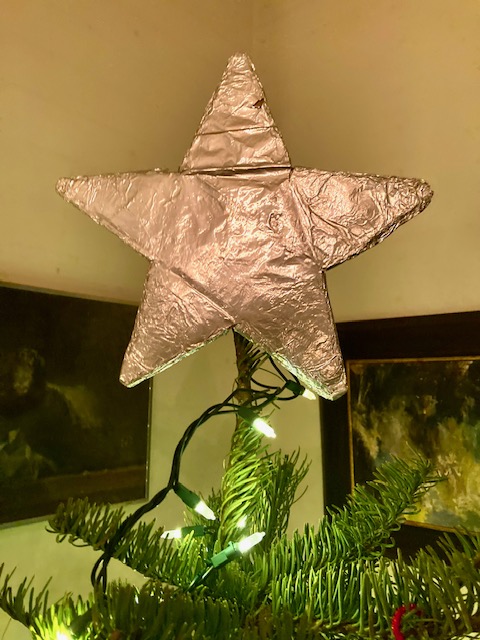
Our family Christmas tree star, going on 40+ years now
So with my paragraph I am sending out a prayer of gratitude for all the good people and things I know are here in our world.
Thank you for those who are trying to bring back our local post office. Thank you to those who are growing our food, caring for each other, those who are helping the sick, the family and friends who are suffering with illness and loss. Thank you to artist friends we know who have risked so much to bring truth through story into our lives. Thank you.
This has been A. Letter From A. Broad written and read for you by Muriel Murch
Written and recorded by Muriel Murch with WSM by my side.
As we left London a vote of no confidence had dissolved the French parliament and Prime Minister Barnier resigned. President Macron vows to stay on and form a new parliament before this week. This will be France’s fourth Prime Minister in a year. A shooter took aim at the Health Insurance business and took out Brian Thomson, the CEO of United Healthcare, as he went to work in Manhattan. Fighters have captured Damascus and the Syrian president Bashar Al Assad has fled. Another coup has happened. Hafez al- Assad took power, with a coup of his own in 1971 and his son became president in 2000. Bashar Al Assad is believed to be receiving room-service with his family in Moscow.
As the plane descends to Washington we look down on the winter trees that stand close in a comfortable looking forrest, circling the small towns and villages that have been carved out of them. Arriving in DC, in America, at dusk is sobering and the temperature freezing. While our driver is prompt, efficient and friendly there is nothing else welcoming about the drive into the city as darkness falls. The huge streets coming off the freeway seem lost, reaching for the stone buildings, holding like prisons, places of power. I remember the Avenida 9 de Julio, roaring off the freeway ready to enter the chaos and confusion that is the living city of Buenos Aires.
I wanted to write about the beautiful things. The reopening of Notre Dame cathedral but then – there is the President-Elect of the United States – front and center at the cathedral’s opening ceremony. He sat smugly between President and Brigette Macron, while the current First Lady, Jill Biden, was tucked on the other side of Madame Macron. Over fifty world leaders representing as many countries fell in behind them. Ukrainian President Zelensky is tucked somewhere in there too. The shuffling on this world stage is being played out in the giant nave of this cathedral as politics come before God. Luckily the cathedral was to be reconsecrated and blessed the following day. There was time to brush the detritus of politics back into the river.
From left to right, Congo’s President Denis Sassou Nguesso and his wife Antoinette Sassou Nguesso, Ashley Biden, First Lady of the US Jill Biden, Brigitte Macron, US President-elect Donald Trump and French President Emmanuel Macron [Ludovic Marin/Pool via AFP]
We came to Washington for The Kennedy Center Honors weekend. Walter to introduce his old friend Francis Ford Coppola at the state department dinner. Singer and activist Bonnie Raitt, Cuban Trumpeter Arturo Sandoval, The Apollo Theatre, and the Grateful Dead are all to be honored this weekend.
Honorees for the Kennedy Center 2024. The Apollo Theater, The Grateful Dead, Arturo Sandoval, Frances Ford Coppola, Bonnie Raitt.
We arrive safely at the Salamander Hotel, rated at 4.6. out of 5 and it does very nicely thank you. Malvik wheels our luggage and shows us how our room works. He looks to have been here a long time, his thinning, oily, too long hair barely held back, is somehow comforting, leading me to believe that this hotel may care who it hires and holds onto. The staff, as with any big hotel, is heavily African-American and Latina but there are also Africans from Ethiopia carrying the strength of their own cultures and beliefs. One senses that working inside the hotel is a safe place.
On Saturday night, as supporting cast, we are guided onto the bus taking us to the State Department for dinner with The Secretary of State, Anthony Blinkin. The driver whips this bus along the avenues as if it is a chariot around the Roman colosseum before coming to a screeching halt on the street. Standing on the bus step he exclaimed loudly, ‘we must walk from here’ and – because it is not raining – we all laugh – understanding as we do that the whole evening is theater. Ball-gowned singers and actresses, black-tied, over-coated actors and musicians along with a few low-life politicians carefully climb down off the bus and we walk the last half block to the entrance for the first of the weekend’s security checks. A line here for photos, a line there for hand shaking with a little glimpse into a politician’s life and the world of Politics. Power, beauty, talent and money are all standing in line, (with our name cards to hand over for announcing) as we move though the rooms that are pretending to be older than their 70 years. It is hard to explain – it is as if the building itself is also aware that this is all theater. Hands are shaken and smiles are exchanged by which time I need to find the ladies lounge before sitting down for dinner. I try to sort out who here is carrying what gift. Mostly it is power: a retired Senator, an agricultural Lobbyist, a Board Chair and a bit of art. We look for our friends but we are all separated. This is a working weekend and we each have our parts to play. The schedule tries to be tight but 9.12 p.m. has come and gone before Bonnie Raitt, the first up, is given her honours. She is followed by Francis Coppola, Arturo Sandoval, The Apollo Theater and finally the Grateful Dead. Each artist is given their ribbon and chain and says thank you, speaking of how honored they are to be here. The surprise comes at the last when the Grateful Dead come to receive their colours. How could they get old? Us yes, but them? No way. It seems truly unfair.
Night One is over and we can relax. For tomorrow is show time. Sunday brunch gives us the time to catch up with friends. But like the Oscars in Hollywood one is dressed in a new ball gown – early. This bus driver is a lot more steady for as we approach the Kennedy Center the streets are lit up with rows of police cars flashing their blue and yellow lights as they shepherd the politicians of this fading administration, along with D.C.’s finest and the rest of us, to the Kennedy Center. As we filed through another security check and into the vastness of that building I wondered how the political factors and teams played out in this arena of theater. Are they brought together through music, cinema and opera? Can the arts help break through the animosity of power? The politicians we had sat with the night before were moving on to the deal opportunities that this evening could bring. We sit down early watching the theater fill up until someone tries to get everyone to their seats as ‘the show is about to start’ but it is tricky when the past Speaker of the House is now busy speaking in the isles. As the President arrives with the honorees behind him and the red uniformed marching band enters to the stage, we settle. The National anthem is played. Queen Latifah comes on stage to start the show, Bobby De Niro plays a bar of two on the grand piano, and the show begins – and then – four hours later – it ends. We look up and acknowledge the fading power of President Joe Biden, the lost dreams of Kamala Harris, and the enormous richness of art that the world provides.
The evening ends
This has been A. Letter From A. Broad written and read for you by Muriel Murch
Written and read for you by Muriel Murch with WSM by my side
It took two weeks for the leaves on the elm tree that bows over the entrance to Kingstown Street to turn from khaki to golden then crimson before falling. Now the branches are bare, showing their stark beauty with the strength that comes from age. The grass below is now covered in a soft mulch of leaves from which will come the renewal of spring in the new year. Across the street, though, the younger ornamental prunes is in a complete muddle. The first chill of autumn crushed the leaves but then a slight shift brought a warm spell and the buds began to swell. Now there are small pink blossoms peeking through dying yellow leaves.
The second storm of the season – named Bert – pushed into London from Wales but still on Sunday a walk was called for and, wrapped up against the wind, I ventured out. Turning the corner onto Regent’s Park Road a blast of wind hit me and I buckled, tottering like the old lady I have become, before carefully crossing the road. Though it is the first time I have ever seen this, it is no surprise that there is a notice on the closed park gates: ‘The Park is closed today. All being well it will reopen on Monday. We apologize for any disappointment’. Who chose that word? Disappointment rather than the usual ‘sorry for any inconvenience.’ It almost sounds sincere, a touch of kindness and as I walked past the gate a young family came and paused and they were indeed, disappointed. Storm Bert is the second storm to hit these islands. The first was a snowstorm called Ashley while Conall has yet to arrive. Bert hit Wales, Devon and the South West coasts hard, moving into London and the news and, rough as it is, it is nothing compared to the deluge that overtook Valencia in Spain. It was in 1953 that the World Meteorological Organization in the US began giving women’s names to storms and hurricanes. It wasn’t until 1978 that they began to accept that many of the gods of the sea and winds were male and also lose their temper. In 2014 the UK Met Office began to do the same. So here we are at the tail end of Bert, who, like a flat-capped boozer, is weaving about, losing his way going home across the North Sea.
Storm Bert from The Independent
The budget has caused a stir. Well of course it has. Rachael Reeves is the first woman Chancellor of the Exchequer, presenting the first Labour budget in twelve years, and she has gone after the wealthy. Not so much of a problem but she has included the wealthy who do not pay inheritance tax. Through the years of history business men and women have become land owners choosing to pop their pennies into the soil, growing their wealth now along with too much monoculture and wheat, while avoiding their taxes. These are the farmers for whom the land is the investment. Occasionally they can be seen striding about in their Wellington boots pretending they don’t have a bean to rub together. For the small farmers things are different – making a living from mindful farming and husbandry remains as harsh here as in any country. I don’t understand it all and realize that neither I nor the small farmers are supposed to.
This week Kim Leadbeater, the Labour MP for Spen Valley, that follows the river Spen in the West Riding area of Yorkshire is presenting a bill on Assisted Dying. The arrival of Kim as the northern MP was a welcome and resounding relief after some years with Sarah Wood of Reform UK and Laura Evans a Conservative before her. Kim has brought forward a new and improved bill on Assisted Dying for debate. There are activists and protesters on both sides of this issue, they are heartfelt and driven by strong emotions of fear and love – and yet – past Prime Minister Sir Gordon Brown is calling for a commission on end-of-life care. At four days of age, Gordon and Sarah’s baby girl had an immense brain hemorrhage and died a week later. In a recent article for the Guardian Gordon Brown wrote –
Sarah and Gordon Brown after the death of their daughter. From the Daily Mail.
“But those days we spent with her remain among the most precious days of my and Sarah’s lives. The experience of sitting with a fatally ill baby girl did not convince me of the case for assisted dying; it convinced me of the value and imperative of good end-of-life care. We were reassured that she was not in pain.”
At this time, as the National Health Service still struggles from the residue effects of the Covid pandemic and twelve years of Tory government what this debate is showing more than ever there remains a huge difference in health care when defined by your post-code address – once again playing wealth against poverty.
As autumn dons a winter cloak and storm Bert takes itself out into the North sea, these days have led us into musical adventures. I think of Herman Hesse’s short story, Old Music, where he ventures from his woodland cabin – first on foot, then by tram into the city center to hear a cathedral concert of Bach and what it means to him.
These last ten days have given us similar adventures but the music we have been led to is new to us, not familiar and yet all absorbing reaching me in a new way. This is exciting as with age I’m getting a little iffy I don’t hear music in the same way – and yet from the first concert – the last of the Rolex Arts Initiative series – with jazz vocalists Diana Reeves and Song Yi Jenn from South Korea and the New Dot drummers, my heart and body responded. A complete switch around took us to Abbey Road and a film screening of ‘Standing on the Shoulders of Kitties’ joyfully full of Rock and Roll and country music.
Ticket invitation to the screening 🙂
Gently the week ended at a Musical Salon and an Italian Armenian duet of Viols and Voice from Intesa sharing a musical journey through the stages of love. Each concert was so different yet as the drummers marched onto the stage at the Queen Elizabeth Hall they brought the universal dreams carrying the same searching to be heard and I marvel at the music that speaks to us across the world.
This has been A Letter From A. Broad – Written and Read for you by Muriel Murch
Written and produced by Muriel Murch with WSM by my side
There was a stillness in the air – The cloud-shielded sky was hiding its sorrow that the world it was covering could well now begin to die. Conversations at the corner cafe were subdued and somber. Nobody was smiling, not even in greetings. Our American friend and neighbor and I sat together nursing our long overdue coffee moment. As we took time to catch up, he spoke of waiting for his Lithuanian passport. What in the world has changed that he is looking forward to a Lithuanian passport?
A lumbering beast has come into the room, lurching forward, knocking against the chessboard where a game is forever in progress. The King has been moved and there is a new guard surrounding him. As the board shudders to a halt, the pawns in the front row of defense are jostling about, each seeking a square of safety. But there is little to be found. Even those soldiers who surround the new King will be knocked off the board before this game is over.
Prime ministers and presidents across the world pick up their phones and press numbers stored on speed-dial. Who will they phone first, the incoming King or the outgoing President? They will make more than one call, many to be denied later in the press, for there are many corners of the board to be covered. For those – like the Taliban – who don’t have phone access, they can always post a tweet on the public notice board marked X. Photographic coverage of war leaders shows a smiling Netanyahu and a serious Zelensky. Putin can’t keep the sly smugness out of his eyes while communication with President Zelensky is paused as support is reconsidered. The UK’s chief of defense staff said approximately 1,500 Russian troops were being killed or injured every day, while the 10,000 soldiers sent from North Korea are already suffering casualties. Now the United Kingdom is looking at its options. Possibly how to honor its word with support while changing what that support could mean. A bribe perhaps? Money rather than weapons – but there is no time for funds to become weapons.
In Gaza there are collapsed corridors of rubble where streets and buildings once stood, leaving families to scrape with their bare hands to retrieve the bodies of their loved ones. While the ‘surrender or starve’ policy has been denied by Israel, earlier this week a military official told BBC reports it had “no intention” of allowing Palestinians to return to their homes in Northern Gaza. There will be no cease-fire in Gaza. Israel will continue with its annihilation of that country.
That was the week that was – or was not – depending on your frame of reference. The English news media continue writing and scurrying around words and projecting policies while the politicians, in England and all over Europe, are shifting their papers and policies as fast as they can. The moral high ground seems to be sinking.
I spent Wednesday and Thursday gnawing on my nails, shredding them to jagged uneven tops. Turning to the drinks cupboard, it was an easy finish of the almost empty sherry, whiskey, and gin bottles. There was not much in them to start with, but upending all three bottles of their dregs was telling. We look around and can only console ourselves with caring for each other.
While politics plays out on the world stage, England continues to play out a mix of lorry-like thievery and home-grown purity. The world famous cheese market of Neal’s Yard Dairy was cleanly relieved of 22 tons of cheese in 950 wheels of cheddar valued at £300,000. While the police seriously consider deliveries to Russia or the Middle East, chef Jamie Oliver was more down to earth tweeting, “There has been a great cheese robbery. Some of the best cheddar cheese in the world has been stolen,” and added “If anyone hears anything about posh cheese going for cheap, it’s probably some wrong’uns.”
Ah yes, Some of those wrong’uns for sure. But then there are the 5 % good ‘uns such as Paul Horton, the owner of Apidae Honey in Lincolnshire. Paul sells ‘proper honey’. Not like 90% of the honey tested from retailers selling to supermarkets – all considered suspicious by the British branch of the Honey Authenticity Network.
King Charles III at the Remembrance day Service. The Princess Royal next to him.
This weekend is Remembrance Day Weekend. For the first time in a week the sun is shining. Whenever the date falls, the weekend Friday brings a ‘Festival of Remembrance’ at the Royal Albert Hall with the senior royals all in attendance. The service, filled with traditional music, ends with the first of the two minute silences as paper poppy petals fall on the audience of armed forces and civilians all standing to attention. On Saturday morning the Family comes out once more, leading the nation in remembering those who fought and died in the continued wars we fight. While we follow this remembrance here in England, it is played out in all corners of the British Isles and in Europe.
Sir Keir Starmer joined President Emanuel Macron for the Armistice Day Remembrance in Paris
For the first time since 1944, when Churchill was in Paris, Sir Keir Starmer joined the French President Emanuel Macron for the Armistice Day Remembrance in Paris. They stood together, Sir Keir with his red poppies, Emmanuel with his Blue cornflowers, both symbols of their country’s losses during the wars beyond the first. And in summer, in the cornfields of France and England, those two flowers, the red poppy and blue cornflower grow together, side by side amidst the wheat which is cut down in the harvest of bread and blood. The two minute silence was repeated in at 2 minutes to 11 on the 11th day of the 11th month.
This has been a Letter from A. Broad. Written and Read for you by Muriel Murch
Written and recorded by Muriel Murch with WSM by my side
Eurostar from Rotterdam Station – photo by Beatrice Murch
Though paused along the track, the Eurostar train to St. Pancras arrived on time and we disembark. It seems to have been a full long weekend away in Amsterdam for musicians and young families. We had joined the train at Rotterdam after our grandson David’s 9th birthday and the best Dutch birthday cake ever, homemade by David and his mother. On the platform, those of us who are older, the grand-parent tribe, and the wandering poets are quickly passed by the young musicians and even the families struggling with all their stuff to gather and bundle up. By the time we reach the last turn into the exit there is hardly anyone with us as we pass the four customs officers standing together. They seem to be hanging out, just chatting, but as I look at them – and they don’t meet my eyes – I realize they have been looking at us all. First I wonder what on earth do they think we are carrying, and then I realize they are also looking at whom we might be carrying.
Slavery – indentured servitude – is still alive and well in Britain and Europe. The German far right politician Jörg Dornau employs political prisoners from the uprising against Aleksandr Lukashenko’s political re election in 2020. Dornau owns an onion farm in Belarus where around 30 prisoners work, many of whom, like Nicole who told the story, had been jailed on political grounds and for “liking” old social media posts from 2021. The prisoners sorted onions for roughly £4 a day on what Nicole described as a strictly voluntary basis. And the onions tasted good. They are the lucky ones. But the customs officers waiting to see the passengers leave the Eurostar train were watching for those not so lucky.
Emerging into the station proper we pick up breakfast essentials before heading to the taxi rank. This evening the queue is not too long and we shuffle forward at a steady pace. Naturally everyone is tired, looking at their phones and not speaking. But suddenly there are quick soft running footsteps, and a child’s voice shouting “I ain’t’ done nothink.” More running footsteps, a longer stride and a uniformed youth catches up with the child, who is clutching a brown paper shopping bag and still yelling. “Let me go, I ain’t’ done nothing.” Faces lift from the phones and those in the taxi queue look as the young officer catches the barely clothed child wearing shorts and a very oversized t-shirt. Now there are more footsteps, heavier as in regulation police boots, and six uniformed security policemen, all under the age of thirty catch up with their young partner who is barely holding onto the child still crying out, “Let me go I ain’t done nothing.” Then suddenly the air goes silent and it is over. Taxis come to the curb, the line moves forward, and as we wait three patrol cars with lights flashing and sirens ringing come to a screeching halt beside us. I marvel at all the adrenaline rushing through at least nine men holding one child. And the silencing of the voice that echoes Oliver Twist in 1837 – led on by The Artful Dodger, used and abandoned by Fagin. What really has changed in almost 200 years? Not so much. Hardship finds us along many paths.
Flying high over the carnival – photo by Beatrice Murch
On the autumn Sunday afternoon in Utrecht we visit a carnival. It has popped up outside of a Jumbo shopping center and is an easy distraction for small children, and some who are no longer so little. We’re cruising, grandson David passes the candy floss as he leads me to this fishing hall, that shooting range, all the time with his eye out for the bungee jumping trampoline that looks terrifying – to a Granny. Suddenly there is his best friend from down their street. The boys are thrilled to see each other, the bungee jump forgotten for the moment while the mothers chat together. The afternoon ends with a closing-time visit to the big public library which is institutional but welcoming and impressive. I am – as Grannies do – sitting, resting and waiting outside when the mother of David’s friend approaches me. Bea has sent her over. “Mum’s a nurse, ask her.” “May I ask you something?” “Yes of course.”
She is from Ukraine and has three children, two boys and one girl. Her husband has left her and they are now divorcing. The afternoon carnival is a cheap distraction for them together. Her long hair is matted, her clothes look to have come off of the floor and her sneakers are – for want of a better word – inadequate. The children are hovering, watchful, a little distant, protecting her as best they can. They are nervous of her speaking with a strange woman, even from their friend’s family. The mother had a little accident on her bike and her thumb hurts. Is it broken? Should she go to the hospital? But that means a four hour wait in the emergency room and she has three small children. In her state the slightest upset blows into a potential disaster. Softly I ask if I can touch her hand and she nods. I take her hand in mine and begin to gently feel here and there, bend the hand and fingers this way and that. Quickly I know that it is not broken. There is a little warmth suggesting the thumb is strained. I continue to hold her hand, for with the act of touching and receiving her, she begins to calm. I tell her about arnica gel. Seeing their mother relaxing, the children creep closer to us as we retrace our steps to the pharmacy. Which is – naturally – at 5.30 on a Sunday afternoon – now closed. But the young mother is looking better, more purposeful and with a little smile. The children cluster closer still around her as we said goodbye. The eldest boy shakes my hand, the two little ones smile and wave. They are grateful that someone had listened and received their mother. This little Ukrainian family have been in the Netherlands since before the war began. Maybe they knew what was coming or maybe they just got lucky. Now it makes no difference. They are adrift and broken in a foreign country. Hardship finds us along many paths.
The conflict – pick any red dot on the map – in the Middle East – has pushed the Ukrainian War off of the page and the screen. Cold mud and snipers are not as photogenic as nighttime rockets and buildings ablaze. Rubble and body bags are more prolific in any of the states at war in the Middle East than in the Ukrainian villages on fire. This war has a published start date of October 7 but that cannot have been the beginning. Israeli solders are schooled that attack is the best form of defense, but all of those red dots – in Gaza, in Lebanon and beyond – do not appear as the work of a country defending itself. Back, back we go into history, Europeans and their pens, pencils and rulers, drawing lines across the desert, pointing fingers and saying ‘That will do.’
This has been A Letter From A. Broad. Written and read for you by Muriel Murch
A book to read – one I had hoped would be more satisfying. So at 2 AM I lie awake and fuss wondering what – if anything I can say to the author. And how to calm myself? In times of unease, poetry always helps. Michael Ondaatje’s ‘A Year of Lost Things’ is on my nightstand, poetry with just a page or two of prose remembrances slipped between the stanzas. It is enough and for the next few nights I am lulled to sleep with the beauty of his words. In one section of remembrances, he writes of a friend who becomes the muse for a brother in ‘Anil’s Ghost,’ first published in 2000 and – as one thing leads to another – I search for the book in our local community library. There it is, I take it home and turning the pages am taken back to our 2004 visit to Sri Lanka.
Our visit had fallen easily into place after Walter’s teaching for ten days at the Indian Film School in Pune. Walter had long wanted to go Sri Lanka to visit the Green Memorial Hospital in Jaffna where his maternal Grandparents, Thomas Beckett Scott and Mary Elizabeth MacCallum Scott had, from 1893-1913, worked as medical missionaries.
Mary Elizabeth MacCallum Scott
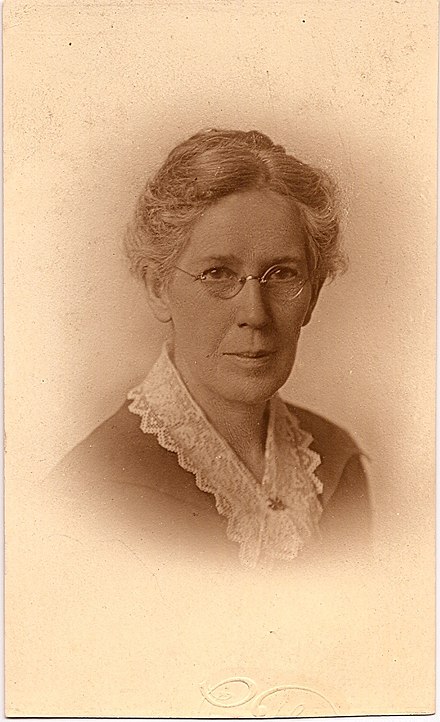
Mary Elizabeth was the first female doctor to work in Jaffna, while at the same time she birthed seven children and started the first nursing school in Manipay which is still in existence today. I wonder about her story, for Mary was the child of deeply Christian parents. She first trained as a teacher, then as a nurse before completing a medical degree in Kingston, Ontario, repeating exams at the Bellevue Hospital in New York. She was one of the first five women to receive a medical degree in America, but maybe getting a degree did not equal getting a job. Did that play a role in their decision to become medical missionaries? She reminds me of another exemplary woman physician, Dame Cicely Saunders, who founded the modern day Hospice movement. Dame Cicely also began her adult life as a nurse before becoming a social worker and then a physician.
Edwardo stops us for a snack of Water Buffalo yogurt and honey
But the Green Memorial Hospital is in the Northern province of Jaffna, a strong Tamil district and during out time the war was still active. Michael had guided us to the Kandalama Hotel, designed by his friend the architect Geoffrey Bawa and built into the hillside outside of Kandy. Edwardo drove us for five hours and that was as far as we got.
Everyone was very polite but clear, explaining as gently as they could that the troubles precluded them sending anyone with us to Jaffna and certainly not allowing us on the trains where murder was not uncommon. The Civil War that had begun in 1983 was ongoing and didn’t settle until 2009. We didn’t take it in – and in our ignorance remained enjoying the peace, the water, the birds, and the Buddhas, those hidden in caves, sitting or lying about – though never standing, and the Golden Buddha in Dambulla shining from the hillside across the lake. The Seven Kingdoms of Sri Lanka had been beaten almost into one, the two languages of Sinhala and Tamil remaining the tear in the Island’s fabric. The Portuguese arrived first, then the Dutch to harvest cinnamon and other spices before the British came trading Christianity for tea. It was all rather messy. This week, Sri Lanka welcomes Anura Kumar as their new Left of Center President. Namaste we say to you.
Bell from Kandalama Hotel in Sri Lanka
But we didn’t know much about this then. We were immersed in a new culture and beyond grateful for the opportunities and understanding that this time had brought to us. It wasn’t until now, re-reading ‘Anil’s Ghost’ that I came to a glimmer of understanding about what was happening, never mind why and to whom in this country. In an interview, Hilary Mantel, when speaking about history said, “I think novelists are alert for everything historians can find and verify, but also for something different, and extra; history’s unconscious, if you like. You try to grasp an individual’s moment-by-moment experience, as the tides of the past and present wash through them.”
And maybe that is partly why I feel so lost looking about me now. The wars that we are shown remain in the present tense. In Ukraine it is the old women well into their 80’s being packed up to leave their village homes. What can they take with them? Not the last of the harvest from their cottage gardens, the chickens still raising a brood of chicks, but maybe a blanket, a change of clothes, a photograph or two. In Gaza, Israel, Lebanon and Palestine urban rubble with shards of clothes caught on rebar are all that some survivors can find. The Israeli and Hamas leaders, lunging forward like attack dogs straining and then retreating, have been unleashed and given over to the pure fury of warfare and this latest weapon, of first thousands of pagers and then the walkie-talkies blowing up in pockets and hands. There will be over 500 dead in Lebanon before this letter reaches you. These are the things that weigh the heart down.
But meanwhile in our small country, the Annual Labour Party Conference is happening in Liverpool. The Prime Minister assured us last week that “I’m in Control.” We begin to wonder what exactly is he in control of? There is the matter of Sue Gray, his Chief of Staff having a higher salary than him. If she can keep everyone playing by an honour code of written and unwritten rules then good for her she has earned it. But can she? Digging for dirt the media finds that Sir Keir has a new box of tickets for the Arsenal Football season and a very nifty and expensive pair of glasses. The glasses follow his ‘I’m a serious fellow’ style but don’t look a whole lot better than my husband’s from the local pharmacy that cost £7.50. Then there are the clothes for the girls. Wife Victoria in a dress and Deputy Prime Minister Angela Rayner in a billowing too-bright green trouser-suit, both from the new up and coming English fashion house MEEM, look quite smart. But the women beside Sir Keir, Deputy Prime Minister Angela Rayner and Chancellor Rachael Reeves, also looking very smart, need to learn to say their lines without glaringly staring at the teleprompter, widening their mouths with animated articulation. They look like a python getting ready to swallow a sheep, and it could be that ‘we the workers’ are the sheep. They are pushing their vocals in a bid for political authority afraid that any other womanly tone will sound weak.
In Fred Zinnemann’s 1966 film ‘A Man for All Seasons’, Paul Schofield who plays Sir Thomas More, converses with Richie Rich played by John Hurt. Earlier Richie had asked More for a place in Court. More declined, suggesting Richie become a teacher. But Richie gets his place and a golden Goblet. At the river’s edge, More sees the Goblet, looks up to Richie “For Wales Richie, For Wales?” Richie’s shame and humiliation are clear on his face. The cup is dropped into the river.
I don’t see football tickets being returned but maybe fewer parcels, with the compliments of … will be accepted or signed for on the steps of number 10 Downing Street.
This has been A Letter From A. Broad. Written and read for you by Muriel Murch
















 Muriel Murch
