Sunshine and Storms

Written and Read for you by Muriel Murch with WSM by my side.

This Letter was written last weekend just as the storms were breaking in Israel, Gaza and Palestine. Since then events are unfolding at a fearful pace and I have not gone back to update this blog. There are better places to find out what is happening as we try to keep all people in our hearts. This program is always first aired on KWMR.org on ‘The Lowdown show’. KWMR.ORG is in the middle of its fall Pledge drive. If you feel you can support the little station that could and can and does make a difference, we are all grateful – especially in these difficult times. Thank you. https://kwmr.org

On this bright Saturday October morning, The Primrose Hill Farmer’s Market is bustling. The stalls are overflowing and there seem to be more shoppers, children and dogs than I have seen all year long. Like squirrels, we are stocking up for the winter ahead. I buy olive oil and artichoke hearts from the Olive Bar, then see Ron, who now walks with a cane, with his Horizon collection of honey and I choose a jar of freshly harvested heather honey. From Pete, of Brambletyne Farm, I gather eggs, small windfall apples, some of the last Negro Kale and fresh mushrooms. Spelt bread from Olivers and the French baker who always gives me a sweet grin and his ‘best’ loaf. Alex of Five-Way Fruit is doing a brisk trade with perfect pears and the last of his berries grown in plastic greenhouses. Here is lovely Angelina, who comes at harvest time with their family wine and olive oil from Italy. Onto the back of the market and Varley and Crouch for Parmesan and a slice of three-month-old sheep cheese plus 100 grams of Parma ham for tonight’s supper, with Matthew’s Eden Farm Organics baked potatoes. Mathew also has the last of the fresh carrots – they are getting large, but with their tops on, are still fresh. I remember to buy unpasteurized milk and butter from Steve Hooks’ farm stall. But no meat today, either from Hooks or Picks or even one of Rafik’s chickens. I pass by fresh pasta, smoked salmon, empanadas, fresh broth and tempting macaroons. On my way out I take a loop through Ted’s Veg and there is the prize of the morning. Bert, of Ted’s Veg, has a basket of fresh walnuts. They are still moist, and the shells green with damp mould. They lie cool in my hand as if they have been plucked from a woodland floor. I scoop two handfuls into a bag and hope that Bert will have more next week. Only when I get home do I realize I have forgotten onions and garlic. The day is full: a noon-time haircut followed by a Film Festival screening. When finally we come home, I am exhausted. Flat out on the sofa, rehydrated with Russet apple juice, I can face the small plate that Walter prepares for me. One of Alex’s moist pears, sliced alongside of thin cuts of the sheep cheese and now those precious walnuts are crushed, the meat glistening and as fragrant as an evening fog-laden autumn walk. Like the squirrels on the hill, I have come home with gifts of the forest.

The walnuts are fresh and moist.

Away from home, wars join natural disasters to fill our newspapers and TV screens. The war in Ukraine remains in the news as much for the war as for the political ramifications, and manoeuvres that are played out on the world stage. Zelensky still strides about in Army fatigues but now they are pressed and clean for he is as often at conferences as he is on the ground with his troops as they enter their third winter in the fields of battle. This is getting messy and does not look to end any time soon. The stakes are too high for both sides.

Nature skips her stones across the deserts and into the lake scolding us for our unwanted cheap behaviour. Storm Daniel flooded and crushed the dams around the city of Derna and swept villages away in Libya, while earthquakes shook villages free from the hillsides of Morocco and Afghanistan.

Coming home from the market, and thinking about what to write for this weekend letter – focusing on the Labour and Conservative Party Conferences that take place in September and October – but while I was plucking carrots, choosing cheese and walnuts – another war exploded. Israel was attacked from The Gaza Strip by Hamas in the biggest attack for fifty years. Among the targets was a music festival held close to the border between the two territories. Israel’s Zika rescue service have so far removed 260 bodies. Images of the festival audience running for their cars also showed the Israeli hostages taken. Many are young, beautiful in their youth, as well as children and grandparents. This was a family day out. There is no pause now, with the Israeli Prime Minister saying the country is embarking on a “long and difficult war”. Hamas claims to have struck Israeli cities while Israel clamps a siege on Gaza. Iran’s officials say “not me gov” and the politicians here are sobered, clambering to position themselves to the right or the left of their own moral consciousness. 
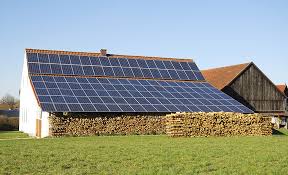
Solar Panels from GreenBiz

The politicians have returned to work beginning with the Conservative and Labour Party conferences. The Conservative party held theirs at the end of September in Manchester, rudely giving the High-speed rail 2 – leading from London to Manchester – the chop. Despite the fact that this was probably not planned out well by their conservative cronies all those years ago – let’s change things for change’s sake – such as the rail tracks width so that no trains running on it could actually link up with other trains across the country or – hold it – going on into Europe. And taking additional slices of the country pie by cutting back on solar panels incentives for farmers. There are a lot of big Conservative farmers who don’t like this new form of harvest, seeing solar panels in their fields as a blight on ‘this green and pleasant land’ preferring their huge combines to scoop out the earth’s resources rather than receive the sun’s bounty.

Now in October, it is the turn of the Labour Party – and even though this brand new war has caused a moment of reflection – the Labour leader Sir Keir Starmer is doing his thing and so is the Shadow Deputy Prime Minister Angela Rayner, she of flaming red hair and a true Council-house background. Now she is ready to roll and she does. Can she and Sir Keir deliver on housing, the cost of living, the NHS backlog, interest rates, immigration and God knows whatever else. There are some serious messes to clean up. They are an unlikely team but that in itself may help to make them work in harness. During these months and years ‘in opposition’ they have learnt ‘when to hold ‘em and when to fold them’ with each other’s style. If they can both keep focused on the country and not themselves, then there is a chance for The United Kingdom to righten the ship of state.

A little Glitter for Sir Keir at the Labour Party Conference

An interesting development is the addition to the Labour team of Marina Wheeler KC – ex-wife of ex-Prime Minister Boris Johnson as Labour’s new “whistleblowing tsar”, offering advice on proposed protections for women against workplace harassment, helping the party strengthen the employment rights of women. After the mandatory six-month break between roles, Sue Grey the former Civil Servant, whose report on the parties at Downing Street during the Covid lock-down helped bring the aforementioned Boris and his boys to the dudgeon – is now Labour’s Chief of Staff. Sir Keir Starmer has more than welcomed these women – formally from the Conservative party – to join him, he has plucked the cream of the crop.

Volunteering at our Community Library has its perks beyond meeting and greeting people from our community. There are books to be borrowed and relished and – tempted by politics – and the writers I do. However the inner truth of ‘Johnson at 10’, by Anthony Seldon and Raymond Newell – documenting the chaos and downfall of the Johnson premiership – is too unbearable to read. But I dive into the muddled waters of ‘Politics on the Edge: A Memoir from Within’ by Rory Stewart with the heartbreaking truths of its pages showing me a Conservative party system rotten to the core and it makes me deeply afraid as I face my naiveté.

This has been a Letter from A. Broad written and read for you by Muriel Murch.

Bobbies on the Beat

Written and produced by Muriel Murch with WSM by

It is a sunny autumn morning when I sit outside of Le Tea Cosy cafe, sipping a flat white and chatting with a friend when first two, then three, followed by two more police men and women saunter by. I laugh to them, “Seven of you”. And the slightly older – but still so young – as policemen have been for years – smiles back “Yes, young recruits on training exercises.” He could have been talking about trotting out young cavalry horses in Hyde Park, but no, this is rookies on the beat walking around Primrose Hill and into the village on a sunny mid-week midday, and is a very different scene from what they could encounter on a Saturday night down by the locks in Camden Town. Their young faces look sweet, both hopeful and nervous of what lies ahead for them all.

Chris Kaba – photo courtesy of his family

For by now they know that the news is full of the charge of murder by an armed police officer with a single gunshot to the head of Chris Kaba last September in South East London. Chris was a construction worker and a rapper under the name of Madix with the group called 67. Reportedly he was not a man without flaws but with his impending fatherhood that could have been about to change.

The firearm officer charged with Chris’s murder is only named as NX121. Rallies led by Chris’ mother and family were held asking for an investigation. Here we go again and we hope that Steven Lawrence’s parents are helping her. Home Secretary Minister Suella Braverman – she of the floating barges and Rwanda deportation plans for immigrants – assures the police that they have her full backing. But what does that mean? Now – for a moment – there is a pause. Close to one hundred bobbies-on-the-beat, a little older than those rookies walking the pavements of Primly Hill, are handing in their guns. Reflecting on what they think ‘could have happened on that street in Streatham Hill’ and want no part of it. They don’t trust Suella Braverman to have their backs and maybe – for a solitary moment – they don’t trust themselves and want no part of killing another man – when – on a Saturday night off they might be dancing to the music of 67. Further assurances are made by Braverman, and the Met Police force floats the idea of bringing in the army to do a Policeman’s work, leaving these young officers churning again in confusion and mistrust.

Chris’s family, along with the police, are not alone in their mistrust of the government. This next weekend the Conservatives are holding their Annual Party Conference in Manchester. Which is a bit rude – to put it mildly – where the main item on the agenda is the closing down of the continued construction of the High-speed Rail link that travels from London to Birmingham and is scheduled to go on to Manchester. The South/North divide is strong in England, and Andy Burnham the major of Greater Manchester sees this move for what it is. Like a true northerner he is able to speak his mind.

Andy Burnham Getty Images

Come to think of it that maybe the most characteristic difference between the north and south in England. Northerners don’t mess around, calling a spade a spade while southerners can relish moving words and phrases around as if playing the ‘follow the ace’ card game again and again. For Sunak, to make the decision to scrap this link is pretty abrasive. Grant Shapps who was transport secretary until last month and who moves through Cabinet secretary positions with the lighting speed of those fast trains he wants to halt, says it would be “crazy” not to reassess whether the full HS2 rail project remains viable. One of the far reaching goals for High Speed rail – such as exists in Europe and Japan – let’s not speak of Europe – was that it would enable business men and women from the north to travel to London or even – steady on – to Paris, Brussels and Amsterdam – for face-to-face meetings thereby giving the North of England a better shot of doing business within Europe. But ministers in Westminster are determined to keep the power close to the south and this train vasectomy would do that. With a change of government this little snip could be reversed but that is no certainty. 

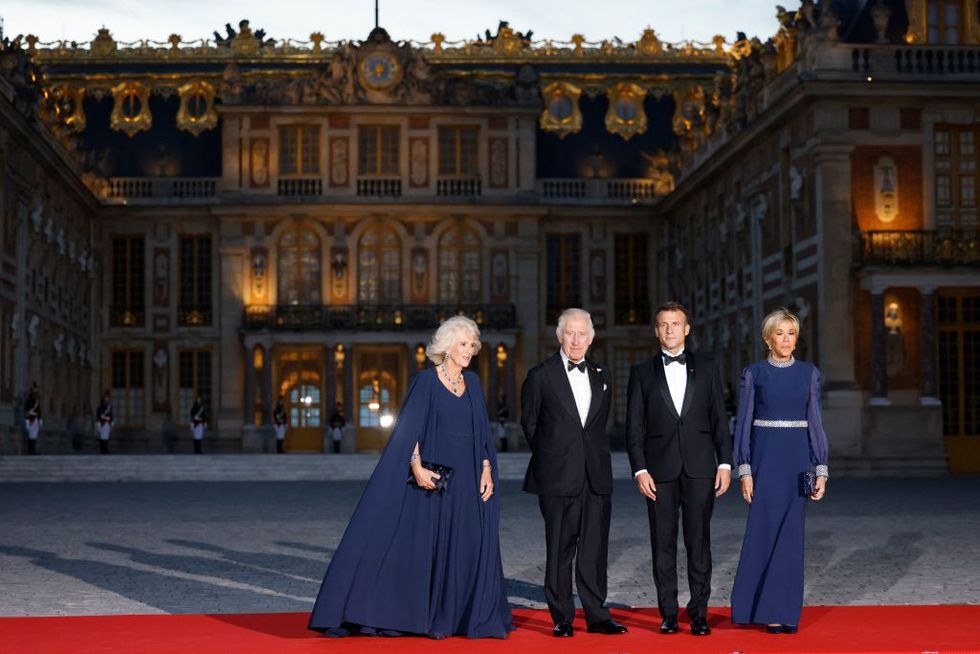
Meanwhile – thinking forward in fellowship – King Charles and Queen Camilla were invited to Paris for a three-day state visit complete with dinner for 150 guests in the Hall of Mirrors at the Palace of Versailles. When invited to dinner some people bring wine, flowers or chocolate. But the King and Queen brought Sir Mick Jagger and England’s still favorite handsome man, Hugh Grant. The guest list was drawn from French and English men and women who continually contribute to good relations between the two countries, so often found easily within the arts and sports. The fact that both French and English cheeses were on the menu says a great deal for the warmth that was brought to the table. One wonders who sat next to whom and we can only hope that everyone remembered their table manners and used their silverware from the outside in. Fellowship was ever present and as the wind ushered their entrance to the palace Mme Macron helped the Queen with her cloak. Of course there were speeches – the President and the King both speaking in each other’s language. During the three-day visit there was the obligatory tree planting, remembrances of past Royal visits to Paris, then the wives played a little table tennis at a sports center, both showing their need for more practice and a first – as King Charles spoke in French to the French senate. It was a good visit with gentle words and gracious kindness on both sides. 

Queen Camila, King Charles, President and Madam Marcon before dinner

As the equinox came and went the evenings were closing in. The green tomatoes were harvested from the library garden and our little terrace and there was just enough to make the starter layer of chutney. I look to see what we have and what should I add? In the local greengrocers there are fresh onions and the first Bramley apples, while on the counter is a box of no longer sellable fruit. Ladies of a certain age know not to waste and so half a dozen soft and wrinkly, old lady peaches went into my bag and then the chutney. Delia Smith has two recipes in her book but chutney is not for recipes, it is for bountiful harvests, leftovers and sweetness so I jumble the recipes up – remembering a little of this instead of that works – and there it cooked happily on the stove. Now it is in jars to wait – if it can – for the flavors to lie together and emerge anew.

Labeled and Photgraphed by WSM:)

This has been A Letter From A Broad Written and read for you by Muriel Murch 

Summer’s End

Written and recorded by Muriel Murch with WSM by my side.

The summer blasted out with a heatwave that left those of us of a certain age floating in a sea of lethargic sweat. This morning there is a lift in the breeze as brown leaves fall and swirl, crackling underfoot, telling us that autumn has arrived. Children are returning to school, politicians to their chambers, and nobody really knows what is happening in Ukraine. The huge earthquake and toll of over 2,500 deaths in Morocco has blasted the Ukrainian war off the front pages but not completely out of the news. 

Widowed 26-year-old Margo sits at her desk inside a small brick mortuary close to the front line in Donetsk. Unknown soldiers are brought for her to check and record what she can about each body. And where she says – she speaks to the dead. “It may sound weird… but I’m the one who wants to apologize for their deaths. I want to thank them somehow. It’s as if they can hear, but they can’t respond.” Ukraine gives no numbers of its war dead – but Margo knows the losses are huge. US officials, quoted by the New York Times, recently put the number at 70,000 dead and as many as 120,000 injured. This from an armed force estimated at only half a million strong.

A mother looks for her son

Crime Watch Live was a BBC weekly program in which the public were asked to help the police solve a crime that has been reported yet remains unsolved. Britain loves this work, it plays into the ancient forest hunter. In Crime Watch the police would put up a situation, giving as much detail as they could and a phone number to call. And sometimes it worked, while the show was still going on ‘a suspect was apprehended and brought in for questioning’. The TV public loved it and so the escape of the ex-army soldier and terror suspect Daniel Khalifa from Wandsworth Prison on Wednesday brought the public out hunting again alongside the police. Daniel is only 21 years old, with an Asian name and light coffee coloring. Dressed as a chef he managed to escape the prison strapped onto the undercarriage of a food delivery truck as it left the prison. I was not the only person with a smile on my face. An ex-prisoner interviewed by the BBC, could not stop grinning as he said. “He’s off out of here now.” But it was not to be. 75 hours after dangling under the truck out of Wandsworth Prison he was pushed off of his bike by an undercover police officer while cycling the towpath by the Union Canal in Chiswick. While Daniel faces the law on Monday it is time to point a finger of blame at someone. The finger circulates around and comes to rest on the conservative government as the country pays the price for another slice of the Austerity measures put in place by George Osbourne and David Cameron. On BBC radio, Secretary of State for Foreign and Commonwealth affairs James Cleverly, previously secretary for Education – so it’s not clear how much he really knows – claimed there was no evidence that cuts imposed by his government were to blame because, “the number of escapes had decreased dramatically, while “4,000 extra prison officers” had been recruited. To which the Prison Officers Association national chair, Mark Fairhurst, rebutted that the Prison Service was “now unable to retain the staff we recruit. That tells you everything about the working conditions in our prisons.” And blamed the escape on “The link goes back to 2010, when the Tory government came into power and hit us all with austerity measures.” 

But this little bit of amusement is only one part of the austerity chickens coming home to roost.

As children put on their uniforms, several schools will be closed due to those chickens roosting. Construction codes were loosened in the 1980s and 90s and buildings built during those years are now crumbling apart from the light-weight, porous, cheaper, easier concrete. Classrooms are getting soaked through in the rains and even clumps of ceilings are falling down in classrooms. The hold-your-breath not-said-yet page-turner are those other buildings – hospitals, apartment blocks, offices – built during that boom – and is going to be a very big problem once someone puts the question to the government. Which is maybe why the Prime Minster nipped off to India for the G20 summit. Better to be shunned and dissed by world leaders than hounded in parliament. It’s tricky for Rishi and he really has no way out. There is no one else to blame for the state of the nation but the Conservative government and everybody knows it. And Rishi will have to show up in parliament soon. 

The King and Queen must also come down from the highlands and back to London. The King managed a few weeks away in his beloved Scotland, to take the time to honour his mother and reflect on the first year of his reign as he moves forward. Where now can he now shine a careful light without poking his finger into politics? It is rumored that his first big personal project is a national initiative to tackle food waste. The Evening Standard newspaper – which reports a surprising amount of truth – writes that 2.9 million tons of good-to-eat farm produce, enough to provide the equivalent of seven billion meals, is being dumped in landfills each year. And you can be sure that more than one someone is making a profit from that.

This caption quote is from ‘Left Foot Forward’
The campaign to hand out EU flags at the Last Night of the Proms was spearheaded by the Thank EU for the Music group, which said that “tens of thousands of music lovers have taken our free European flags into the Royal Albert Hall for each Last Night of the Proms in solidarity with musicians who feel (like countless others) the destructive impact of Britain’s recent isolation from Europe.”
The group also posted a letter it had sent to the BBC’s Director General Tim Davie on its Facebook Page, where it added: “Our flags represent the hope that the Last Night of the Proms musically celebrates “Britannia ruling the airwaves”, hopefully transforming the problematic post-colonial anthems into something more, shall we say, enlightened and collaborative?”

The Promenade Concerts from the Royal Albert Hall ended this weekend. The last night of the Proms usually concludes with a roar of British national fever but this year it was pitched a little differently and though ending with the usual Rule Britannia – sounding a little tired – the National Anthem – God Save the King and For Auld Lang Syne while people stood swaying together singing along in harmony. But there were as many European Union flags and berets in the audience as there were Union Jacks. Members of the Government are asking for another investigation by the BBC but it could be – that just like the late Queen before them – with her clear message hat, the people are speaking calling for a greater self than just this treasured Isle.

`The Late Queen at the opening of Parliament 2017

September 8th marks a year since the late Queen died. An evening program set out the timeline of the day leading up to her death. Little nooks and crannies of tit-bit information came to light as we watched and remembered that day and our Queen. While the Queen’s condition became more grave, the then Prince of Wales took himself off for a solitary walk in the forest as he began to prepare himself for what lay ahead. This program was a moment for the nation to reflect on the passing of a beloved monarch and mother, a person who affected all of our lives, like remembrance prayers for all of our dearly departed. Years ago coming to All Hallows Eve, St.Michaelmas – of the daisy and the dead – an old friend wrote to ask if I would like my mother’s name included in the prayers for the dead at St. Paul’s Cathedral. It was an unexpected act of kindness and a remembrance of all things past. And we do remember them, those we knew, those we loved, and those who taught us life lessons. We will remember them until we become among those who are remembered. 

This has been A Letter from A. Broad.

Written and read for you by Muriel Murch

Poaching in the Park

Written and Produced by Muriel Murch with WSM by my side.
Blackberry-bramble Harvest 2023

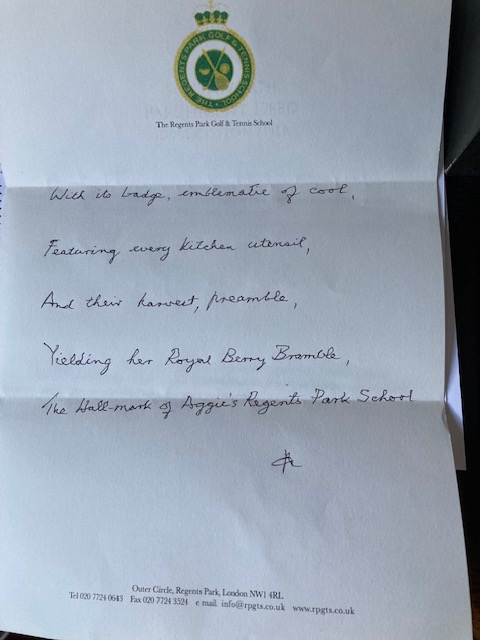
August slipped into autumn not bothering to wait for September while most of London went on holiday, leaving the city almost as subdued as Paris. Along the canal, three teenage ducklings are swimming alone as if their parents have regretted their final feathered fling in the water and are just too tired to raise one more brood this year. The ducklings look lost, paddling from one clump of weeds to another in the mindless way of adolescence. It is blackberry season and we are late for our semi-annual ‘Poaching in the Park’ moment. We go in the middle of the week – with less chance of being caught – though this little corner of Regent’s Park is now sorely neglected. There used to be a thriving small sports school here, a place to practice your tennis, golf, or cricket. But now the cricket practice nets have moved close to a central concrete hub with a cafe, overlooking the big open pitches that serve both cricket and football in often overlapping seasons. There is a small tennis club close to Queen Mary’s Rose Garden but the golf nets were removed altogether. Now the wilderness has taken over – as it should – and the blackberry brambles climb the Hawthorne shrubs and surround the adolescent oak trees. The King is in Scotland striding out on the moors for a good bit of fresh air, while the Prime Minister is back home in Yorkshire, maybe looking to see if the Green Peace ‘Stop Oil’ Delegation have left him any more notes on how to run the country. So we can pick and gather our bramble harvest which quickly became eight pots of jam. Six are stored away. One goes straight into our fridge and the other to Howard who – in years gone by – was one of the tennis coaches on the courts now covered with brambles. Howard lives close by and while closing into the other side of his eighties we often stop and chat. Howard is fond of the written word and from time to time pops a poem through our letter box. 

This week’s poem from Howard

The nightly news can barely be bothered with the wars that do not stop in the Sudan and Yemen. The Human Rights Watch write that Saudi border guards have been reported killing hundreds of Ethiopians trying to cross into Saudi Arabia from Yemen. And the war in Ukraine is not ending soon. The maps showing – in red, purple, and white – whose troops hold which cities and coastlines in Ukraine – are confusing and seem at odds with the reporting. If all that land – in red – is occupied by the Russians, how is Ukraine ‘making ground’? We see villages and cities bombed – and the long, low trenches slicing through fields and countryside appear no different than those dug for World War One – where Ukrainian soldiers crouch and fire, fire and smoke, and slog on. Summertime is wearing for soldiers and politicians alike. But there is a useful police mess-up from Manchester and a horrific tale of infanticide to keep us distracted from the wars and the Government debortle with the Biddy Stockholm barge. A few asylum seekers were being marched onto the barge two by two – when it was discovered – at least a week before reporting – and the marching on – that the barge water supply contained traces of the legionella disease bacteria long known to cause severe pneumonia and death. Time to pack their bags and march those foot-weary seekers of asylum and hope off again. 

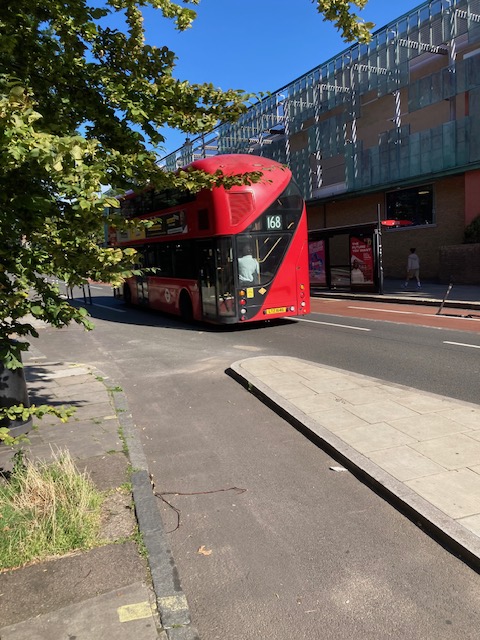
The 168 bus leaving Chalk Farm.

Sometimes I miss the small thud when the paper lady pops the Camden New Journal through the letterbox every Thursday morning. I glance through it, knowing there will not be not much I care to read but that sometimes, something will catch my eye. Last week – another August moment – there was no home delivery – so this week I made sure to read it. And there it was: a small column slipped into the side of a page. ‘RIP 168 – the bus stops here’. This route will be closed in September. ‘Oh No.’ How could they – who the heck is ‘they’ – let it happen. ‘They’ turns out to be Transport For London (TFL for short) and to whom we pay our bus and rail fares. They did a survey – even reporting that of three hundred respondents, only 18 agreed with the scheme to scrap the 168 bus route. And still, they went ahead. It is this kind of lock-jaw response that drives us all crazy. The government does it with their ‘there will be an inquiry’. It is – to put it mildly – upsetting.

Upsetting and inconvenient for people like me perhaps but downright devastating for people like Jim. Jim and I have been friends for twenty years and know much – and yet little – about each other. Jim is Jamaican, his wife was German and I often wondered what brought them together – if in those early years of their courtship, they both felt the chill of English disapproval. Jim was a Camden Garbage truck driver until he retired. His route brought the truck onto our street and he lives just two blocks away in a council flat. He had a Yorkshire Terrier dog, small, black and brown, and always keen, pulling Jim along as she raced up our street galloping towards the hill. Even at 17 – a serious senior for a little terrier – she was always ahead of Jim – until she wasn’t – and one day Jim quietly took her to the vet to say goodbye. Now he is alone, and as he gets older doesn’t go out and about so much. But we meet from time to time. ‘Ello darlin’ He calls to me, having long forgotten my name and it being too old a friendship to ask to be reminded. And we chat, about this, that, the other, and loneliness. A kiss is always welcome. The last time I saw Jim he was walking slowly with his cane, going to the bus stop for the aforementioned 168 bus on his way to The Royal Free Hospital in South End Green where the bus stops right outside of the hospital – in both directions. What will happen to Jim and so many others if TFL takes this moment of independence away? Each little cost-saving denial from them leads to a retreat and loss for us all. 

This has been A Letter From A. Broad written and read for you by Muriel Murch.

On the Moor

Written and produced by Muriel Murch with WSM by my side
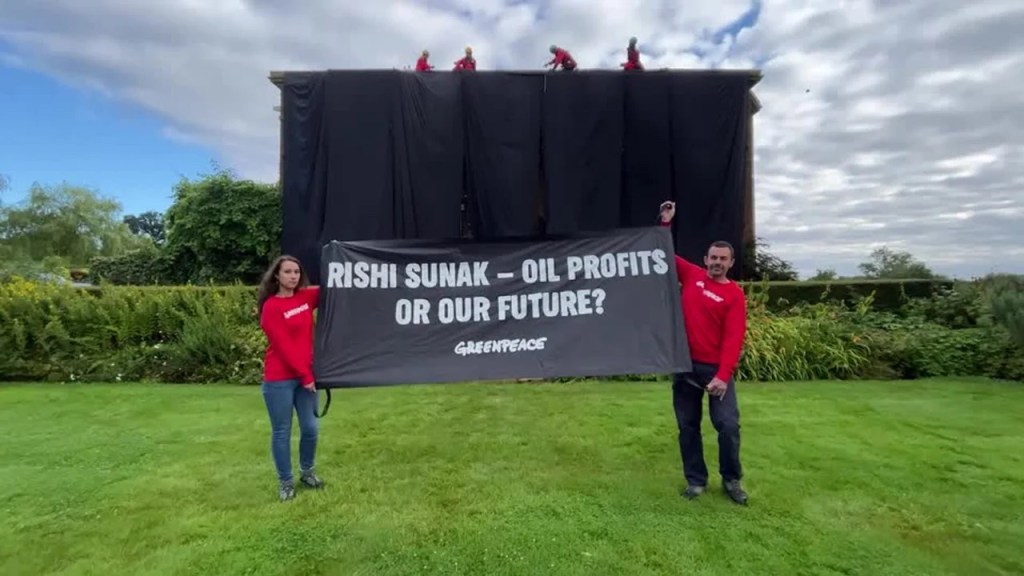
Pictures posted online by Greenpeace UK on Thursday showed the protesters on top of the property while a banner read “RISHI SUNAK – OIL PROFITS OR OUR FUTURE?”

Rishi Sunak and his family have all gone on holiday leaving England and the remainder of the United Kingdom in tatters. So it was no surprise that when the five Greenpeace ‘Stop Oil’ activists knocked on the door of Sunak’s country home in North Yorkshire and nobody opened the door, they felt free to climb onto the rooftop of the grade II-listed manor house and drape oil-black fabric over it before posing with their ‘Stop Oil’ Banner in front of the house – protesting against the government’s decision to expand North Sea oil drilling. There is – naturally – to be an inquiry – as to how and why the Prime Minister’s house was left so unattended. Surely there was some surveillance in place. But as Sunak has begun to show his real colors – under the tiniest bit of pressure on a radio program (listeners take note) we have seen his business management underbelly and once more our hopes – why do we even have them? – are dashed. What is Rishi doing looking to lift the 20 mph speed limits in some small residential neighborhoods while issuing new licenses for North Sea Oil drilling? I’m remembering – not that long ago – when the new King very pointedly invited the new Prime Minister to speak at a reception the King was giving for world leaders gathering before a conference on climate change. Rishi popped over to the conference in a private jet to smile and show up. But now he reminds us that ‘you can take a horse to water but you can’t make him drink’. 

So it is with renewed respect we watch the Mayor of London Sadiq Khan, with his bushy eyebrows, sticking to his guns with the expansion of London’s low emission zone, saying tackling the climate emergency and air pollution are “bigger than party politics”. While those in parliament waffle and wave according to their party’s policies, Khan is staying true to his course. He is winning some and losing others. Hundreds of doctors have urged politicians to stand firm on initiatives to tackle air pollution, warning that they see its “devastating health consequences” in patients on a daily basis. Air pollution is the single largest environmental risk to public health, linked to between 28,000 and 36,000 UK deaths a year. Air pollution affects every one of us from before we are born into old age. I remember in 1966 looking into the chest of a young Mexican 16-year-old boy who had only been in the city for six weeks. His lungs were already pinpointed with black city pollution.

As I write, the Bibby Stockholm barge is receiving its first asylum seekers – refugees – today. There was a small stall – was this going to be a fire trap? But though Amnesty International calls the barge and its use a ‘Ministerial cruelty’, food will be served in the canteen tonight.

A combination of our 58th wedding anniversary, a small window of time, with the excuse to see a beloved old friend, and the long-anticipated search for Murches – dead more than alive – takes us to Devon and the northern end of Dartmoor.

The two-carriage train runs on old tracks – clickety clack, clickety clack – from Exeter-St. David to Okehampton, slowly rolling past the rows of not-yet-old oak trees marking the hedgerows separating pastures as some far-thinking farmers return to the old ways. The hedgerows are made of stone with some post and rail. There is little wire to be seen. The clouds are hanging low as if chasing the fields into the sea. There is no taxi stand at the Okehampton train station, but drivers swing in and out around train arrival times to see if they can hook a passenger and soon we are caught. But our man has only lived in these ‘ere parts for six years, “A second marriage,” he says, and driven for two which may explain the very long route that brought us through cow pastures – where he had to be reminded to close the gates – with a herd of fine healthy Devonshire cows, and the rubbish dumpster bins, to the back of the hotel for 27 pounds thank you very much. This one is not yet a local.

We are staying at the most elegant and expensive of hotels at Gidleigh Park which carries just the slightest breath of Fawlty Towers to remind us we are in England. After we check-in, there is time for a walk to the hamlet of Murchington. From the hotel, we dip into the woodlands of an ancient forest of Oak and Beech trees where the River Teign runs freely alongside of the path. This is the wilderness of fairies and Robin Hood.  We leave the forest for the lanes that are as narrow as I remember them and the bracken is mid-summer high allowing the brambles to twine over and around the long fronds while wild white yarrow and pale orange columbine wave gently where they can. The couch grass remains stubbornly growing and uneaten by the cattle or sheep in the pastures. It’s a good climb up the hill before going down into the dale and finding the old sign of Murchington where Beatrice posed forty years ago. The few cars that pass are careful enough to let us squeeze into the bracken and it isn’t until we crest the hill – before the final dale – that we meet another traveler on the road. She is short and quite round, walking in country clothes with a fine leather hat, and two poles. She is moving slowly and when we first pass her taking a talking break with a motorist  “Are we far from Murchington?” I ask, “Just down there. I live in Upper Murchington.” so we carry on. Murchington is now a hamlet having only a few houses with the church being decommissioned in 1975 and there is no central place of worship or community. Sometimes a hamlet is a small group of Kinsmen, no larger than an extended family or clan, though there are no Murches living in Murchington, nor could we find trace of any. On our return – there is not a lot to see in Murchington – our fellow traveler is now polling on the other side of the hill and we pause together. “I like your hat,” says Walter, and that is all it takes to learn about her two children, in Texas and Portugal, far away from this widowed mother who has just had double knee surgery and is walking alone along a country lane. 

Back at the hotel and we change for dinner. To dine here is an event and joining us are my oldest friend from Nursing school 60 years ago, Sally, and her daughter Emma who is a leading conservationist with her Dartmoor’s Daughter tours of Dartmoor. There are screams of delight and so much laughter when we see each other and the tears of joy would fall but that we are both – even at 80 – mindful of mascara. When dinner is served it behooves us to pay attention for the care, flavor, and presentation is exquisite, though a far cry from the gnawing on bones by the forest fire that could have been here mere centuries ago. 

Hand-tinted postcard of Murchington, c. 1910 showing Woodlands Farm and the Anglican chapel (with railings)

The next day is for searching for those long-dead Murches that we are pretty sure are lying about in the Church graveyard. But first, there is morning coffee – at a small cafe where the local artists gather- in the town of Chagford. The four tables that have been put together for us take up almost half of the cafe space. We are late – Richard – our taxi driver – knows his way about, but then there are cattle and ponies on the road and hellos to be shared. Immediately when we arrive fresh coffee is served and we split up – the conversation rushes deeply into the arts at one end of the table and conservation and humanity at the other. It’s a wonderful way to spend a Saturday morning – with people who care – reinforcing each other – encouraging by just showing up – before we wave our goodbyes and slip away into the day.

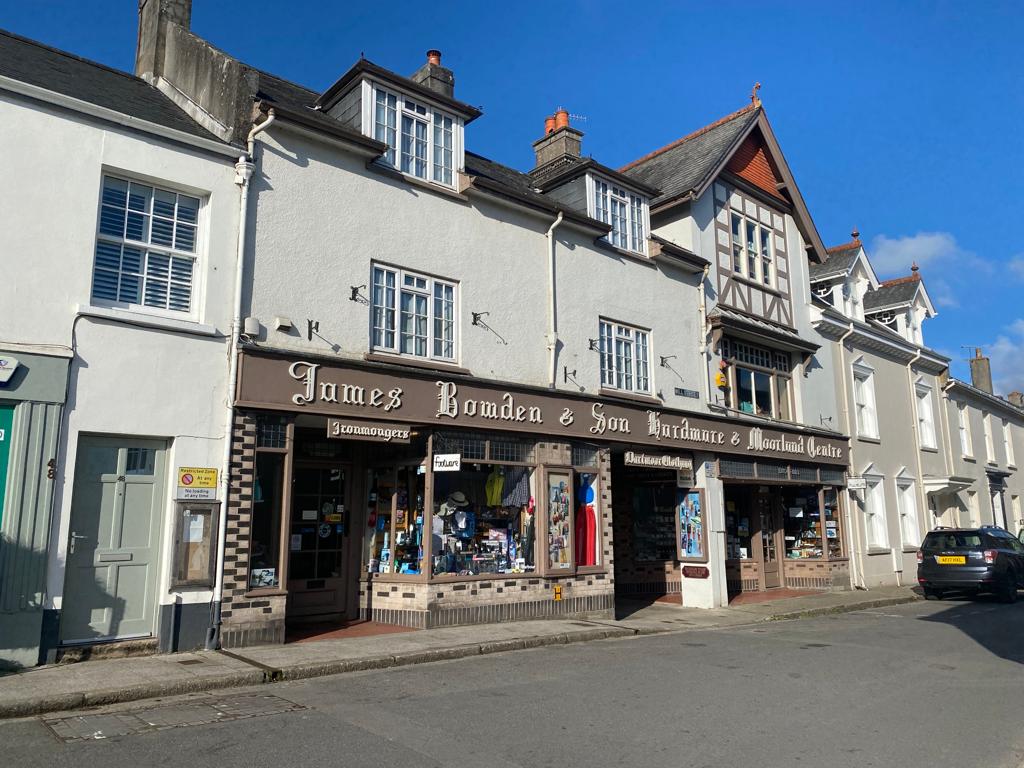
James Bowden & Son Hardware & Moorland Centre

It is beginning to rain – a soft rain – as Sally guides us to the hardware shop that sells everything you need at home and more enticingly has a museum room in the back. It is here that we find the first evidence of George Murch, wheelwright, who sold this shop to James Bowden in 1862. The little room that sells the boots would have been his first shop room. It is comforting to know that we both come from working stock a wheelwright and Slater, such names carry the trades of our forefathers. And more than one Murch married into the Perryman family from Stancombe, giving me full license to go ahead with cider making. As the soft rain gets stronger Sally leaves us at the Chagford churchyard of St Michael the Archangel where someone did what we all mean to do with our boxes of old photographs – gone through the graveyard and mapped out as to whom is buried where – it doesn’t take any time at all to find one of George’s sons, William but not George. William’s gravestone is still upright but leaning a bit as most in the ‘old’ graveyard are. We stand in the rain and think about those lives. The ones that came before us – not so very long ago – was William the one who stayed behind so that James could leave? Or was James always restless – the one who would venture out no matter what? He never named a son of his after his father. These are stories we may not know but only imagine.

On Sunday morning there is a knock on the door and our morning tea, toast, and flaking-everywhere croissant arrives. We are rested and ready to leave with Emma at 8.15 a.m. for a 9.30 start on our guided Wool Walk. After picking up Sally and a friend, Emma sets off at a roaring pace along those single-lane roads and we are soon out on the moor which stretches before us with heart-holding beauty. The sheep are grazing and resting beside the road along with small herds of cows and ponies. Low patches of late gorse hold tightly to the beginning blooms of heather. 

The walk is led by – I quote – qualified Hill and Moorland Leader, Emma Cunis aka Dartmoor’s Daughter, and Kristy Turner, Curator of the Dyeing on Dartmoor exhibition at the Museum of Dartmoor Life. Emma and Kristy give us a little introductory talk and we share our names and reasons for walking this Sunday morning. The walk is billed as ‘Easy’ and as we set off Emma acknowledges that we will be of different walking abilities: some fast, some in the middle, and some – a little slower. It doesn’t take long for me to realize I am among the latter- more than a little slower – and this sobers me as I miss the woman I used to be.

Old Friends and old Oaks photo by WSM

This morning Sally wrote “It came to me last night, we are a bit like ancient oak trees, a bit bent and gnarled, but the inner strength keeps us going. So from one Oak tree to another, take care of your roots and branches but wave your leaves merrily into the air whenever you get the chance.” This is friendship and sounds like good advice for us all.

This has been A Letter from A. Broad, written and read for you by Muriel Murch. 
Divas and Dingies

Divas and Dingies Recorded and produced by Muriel Murch with WSM by my side

The writer Milan Kundera has died at the age of 94. It is noted with a passing sentence or two in the papers, a mention on the evening news and a few more paragraphs in obituaries in England and Europe. Salman Rushdie took a quote from ‘The Book of Laughter and Forgetting’  “The struggle of man against power is the struggle of memory against forgetting.” And this is why there are novels, poems, songs and biographies of work and of people written – to hold onto what we know as true for as long as possible remembering the stepping stones that were laid down for our work and we provide for those that follow.

And as that came to mind, a seventeen-year-old granddaughter stepped through the cottage doors for a visit with her now ‘over 80’ grandparents and we had things to do. Two bus rides took us to the Victoria and Albert Museum and the exhibit of Divas. Headphones in place we were ushered down the darkened steps to Gallery 40, first into the world of opera with the costumes and cracked voice of Maria Callas. Moving from window to window for the first time I look on these early opera singers as brave and courageous women paving their own pathways for independence for singers and actresses to follow. Billie Holliday is shown in a photographic negative of her only performance at the Albert Hall in 1954. Between the flickering pictures of Theda Bara playing the first Cleopatra on film in 1917, we pass display cases showing those who were destroyed by the systems they tried to conquer: Marilyn Monroe, and Judy Garland are seen smiling bravely. Then comes Elizabeth Taylor playing the same queen Cleopatra in 1963 as she commands Mark Anthony to kneel before her. It’s beautiful stuff and when I emerge from the darkness – the exhibit continues upstairs – there are the brilliant costumes of Prince, Cher, Elton John and countless others. I can make it around the exhibit once before I get dizzy with all this courage displayed before me. As the granddaughter goes around and around I sit and think of these divas – of female and male inclinations – all pushing the boundaries of their times. Within this exhibit are the milestones that bring us from Marie Callas to Marian Anderson performing at the Lincoln Memorial in 1939, to the civil rights movement, through Cher, Elton John to the Beyoncé of today.

Theda Bara as Cleopatra in 1917 from the Diva Exhibit

We find our way to the old tea rooms with their tiled walls, porcelain columns and stained glass windows. There are far too many pastries and not enough small plates of good-for-you food but we slide a pot of tea and scones onto a tray and manage a tea-time moment to sit down and take in what we have seen and look about us – at old and young England with some European and Asian families who are also taking this moment to pause and refresh. I am caught seeing a young Japanese family sitting at a table close by, parents with a slightly older daughter and the younger brother who is having trouble with his broccoli. His father helps him out – spooning some strands of vegetable back into the boy’s mouth and scraping some away to his own plate. But it is the mother who is striking. She sits calmly, casually watchful as a lioness teaching her young cubs to eat for themselves. Her face is long and strictly angular, half of her black hair is pulled back and held roughly high on her head with a band. The angle of her jaw, the rise of her hair are ancient and familiar both.

Popen o Fuku Musume (“Young woman blowing a poppen glass”), which appears under both series titles of c. 1792–93

Since childhood, I have seen her on the pages of books of paintings of Japanese art and culture but here she is in the 21st century – utterly beautiful in her casual modern clothes. I wonder at this Japanese family so seemingly on vacation in England, visiting the week that the Oppenheimer film opens to worldwide audiences. What history are they reliving as they come here? 

Meanwhile, summer’s slow tides are ebbing and flowing with little wavelets rippling through our political history. Because of the obtuse behaviour on the one hand and downright disgraceful on another, three conservative members of Parliament have had to resign their seats in government and go back to oiling their lawnmowers in the countryside. Three countywide elections were held in one night. Uxbridge and South Ruislip did bring home another conservative with Steve Tuckwell. Keir Mather took a Labour seat in Selby and Ainsty while Somerset and Frome chose a woman, Sarah Dyke, for the Liberal Democrats, nice little wins for the Labour and Liberal Democratic parties each. It is small potatoes given what is going on in England and the world but they are potatoes. Desks will be shuffled, phones re-arranged, email accounts set up along with new websites – all promising to right what is wrong with this country – at the moment. And though those promises will hardly be fulfilled they could indeed change the way forward just enough to tack this listing boat of a country onto a kinder course.

And we so need this with the sight of the Bibby Stockholm barge anchored off of Portland Harbour in Dorset – though registered at Bridgetown Barbados. It is now refurbished to hold 506 single men who arrived in Kent seeking UK Asylum. The men are called asylum seekers – not refugees – and it is a reminder of when we were called registered aliens rather than immigrants, and that language is important. As well as the 506 asylum seekers there are 18 – trained to Military standards (whatever that means) security guards along with cooks and cleaners to a total staff of 60. It is a  floating prison for want of a better word – a ship to discourage sea-faring migrants from crossing to this small Island.

The Bibby Stockholm docked in the Portland Harbour awaiting 506 asylum seekers.

Whatever they say about it – and they try to say a lot – the idea of putting 506 young men in a boat with only 60 more to lend a helping hand providing essentials, may not have the same outcome as the owl and the pussycat who sailed out to sea – in a beautiful pea-green boat.

This has been A Letter From A. Broad. Written and read for you by Muriel Murch.

We Seek him Here … and then There

Written and Produced by Muriel Murch
Snack time at The Cottage

We seek him here we seek him there and the whereabouts of the Russian General Prigozhin who took a group of mercenary fighters towards Moscow and then back again, is reminiscent of Humpty Dumpty who took a big fall – as I remember – and all the king’s horses and all the king’s men couldn’t put Humpty together again. Prigozhin and his men may or may not be in Belarus. Only five days after the aborted march on Moscow, Prigozhin met with Putin at the Kremlin, and now the location of the mercenary soldiers has got a little murky. Alexander Lukashenko shrugs as he responds to a direct question about Prigozhin during a conversation with a few invited journalists – that reportedly lasted for four hours. “I’ve no idea where General Prigozhin is.” And when asked further about the mercenary soldiers he responded “Every country has them.” Though he may be lying on the first count he is probably right on the second. The newsreels from Belarus show farmland fields filled with rows of army tents flapping gently in the sunshine. Soldiers camping – I remember them on summer exercises in the fields when I was growing up five miles from Aldershot, a military town. But over twenty years ago I also remember crossing a mountain gravel road in Idaho where grown men were taking the lads out “camping” – with bows and arrows and rifles – almost hidden in a mountain-pass meadow. It is so easy – when you feel under threat – to believe you must defend yourself.

While searching for Prigozhin we also look about for Rishi Sunak who does not pop up on the telly quite as often as his two predecessors, Boris Johnson and Lizzy Truss. While the 75th birthday of our pride and joy, the National Health Service, is celebrated with cup-cakes for the working staff, the accompanying discussions on what to do about Britain’s Health care – “charge patients more and pay staff less” seem to be the Government’s only mantra. This is a greasy pole Sunak may fall from. If he isn’t careful and Keir Starmer is careful there could be a change of government in the not-too-distant future. But can such a steady hand with Starmer’s hectoring voice fix all that has been destroyed in the last 12 years? It’s a tall order.

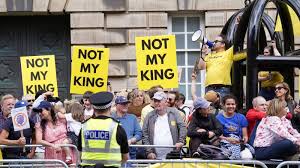
Not my King

The sun shone as King Charles drove along the Royal Mile from Holyrood House to St. Giles’ Cathedral with his queen and the Prince and Princess of Wales beside him. The crowds came out along the mile, mostly to welcome, wave and shout ‘God Save the King’ but some to show – with large yellow placards – that for them he is ‘Not my King’.

King Charles Touches the Scottish Crown

As a historic rule, Scotland does not care for kings though it’s a little more sympathetic to queens. The King kept it short and accepted the crown with a touch but not wearing it, along with a new sword, and the scepter. The ceremony ended with the familiar fly-pass of the Red Arrow fighter jets – always a crowd-pleaser. For the moment the Royal couple can go on holiday at Berkhall and Balmoral – the homes that his grandmother and mother loved the most. There they can rest a little as they reflect on the legacy he has been given and the job at hand. They may even manage a barbecue in the forests but that might be pushing history and memory a little bit too far. It’s a tough transition. King Charles knows he is a bridge slung between an old Great Britain and a floundering England and not everybody’s King. 

We are in the midst of the summer season with the Wimbledon Lawn Tennis World Championships fortnight. 2018 was the last year that England had any showing at all on the last week of competition. England’s men, Andy Murray, Cameron Norrie, and Liam Broady, and the single woman, Katie Boulter have been knocked out already and the country is embarrassed but maybe not enough. Somehow the play at Wimbledon symbolizes – for me – England’s place – not quite good enough to match the rest of the world. The fixture is of such importance and now with roof lighting – the show must go on – until 11 p.m. The  BBC ten o’clock news is at times pushed aside and the quick brush war between Israel and Palestine barely got two evenings. The Israeli forces did a quick in-and-out three-day attack, killing ten Palestinians in the Jenin refugee camp – job done from the Israeli point of view while the Palestine forces gather once again, vowing not to rest until they have reclaimed their land taken in 1948.

Somewhere in the world a battle is raging, people are being killed while others are trying to escape. Boatloads – some carrying unaccompanied children – are sent off and with luck arrive alive at the English shores in Kent. They are housed in detention centers where Robert Jenrick the Minister of Immigration has ordered the reception area pictures of Micky Mouse and Baloo from The Jungle Book to be painted over, to show something less welcoming. We know by now that we are less welcoming than Germany, Italy, and other European countries but is the painting over of Micky Mouse really helpful? 

Micky waves Hello in Kent

Naturally, the shadow immigration minister, Stephen Kinnock, condemned Mr. Jenrick’s order, saying it was a sign of a “chaotic government in crisis. Labour had a plan to end the dangerous crossings, defeat the criminal smuggler gangs, and end hotel use by clearing the asylum backlog.” Well, good luck with that.

Just as things seem quieter and we prepare to enjoy a week of family celebration, The Headlines of Murdock’s Sun Newspaper breaks another serious scandal coming directly from The BBC. Allegations made against an as yet unnamed TV presenter of – at the least – sexual improprieties are now being reported by the BBC as the mostly women presenters carefully chose their words. We watch to see who is not bringing you the ten o’clock news and like a game of Wordle, fill in the blanks by elimination. The country is hushed with a communal sense of betrayal. Though this week the mood beckons consideration of some serious falling-on-your-sword action by whoever ends up at the bottom row of this puzzle.

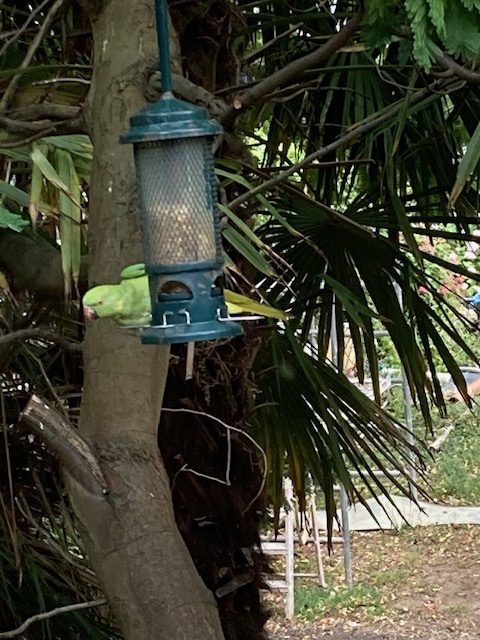
We refill the bird feeder that hangs from the Acacia tree over our little terrace. Along with the familiar families of birds – a small flock of Indian Ring Neck Parrots have found the feeder and have figured out how to work their way through the entire tube of food in a morning. It looks as if they aim to stay with us for a while.

This has been A Letter from A. Broad. Written and read for you by Muriel Murch.

Old Music

Old Music.

Recorded and Produced by Muriel Murch with WSM by my side.

The Government party-gate reports are in, and the votes on ‘did Boris Johnson break the rules the government set for us all?’ were cast. 354 ministers said yes, 7 puffed no while a few slippery ones went missing. It is too much all too foolish and for this moment I am closing my eyes and ears. 

Where can we retreat to? In May a visit to The Hague in the Netherlands took us to meet the Dutch artist Theo Jansen who in the 1990’s began – using PVC, bits of nylon robe and old cloth sails – to make creatures – huge toys collectively known as Strandbeests that when caught by the winds run along the beaches, sometimes galloping into the surf if Theo is not quick enough to catch them. Luckily the afternoon was very windy – as well as cold. Watching the play between Theo and our grandson David – the silent wonder of the boy child and the magician’s twinkle in Theo’s eyes it is clear that magic and bewitching sorcery remain a reality.

A Strandbeest takes off with David and Theo following. Photo by WSM

Our artist friend Carey Young has an exhibit in Oxford at the Modern Art Museum entitled Appearance. Carey has a steady and persistent eye on women and the law and the Modern Art Museum – built in a repurposed brewery – is where her show has been for over three months and I really want to see it. The Sunday train was full of students returning to university from a weekend in London. I look at those in our carriage and – catching them at this mid-point of leaving late adolescence and entering adulthood – I’m a little chilled. Are there world leaders, scientists, artists or teachers among them? They are young and we are old and so far I see absorption, self-interest and timidity. A girl sits on her case in the middle of the aisle and nobody can – or even tries to – get past her. She seems supremely unconcerned but maybe holding herself steady with a steel will. I wonder again why Boris Johnson bought his castle – the one with only three-quarters of a moat – here in the outskirts of Oxford.

All three of Young’s videos focus on women’s lives. The first – ‘The Vision Machine’ follows the preparation of lenses for the Sigma corporation in Japan. Though Young wants us to imagine a factory run and maybe owned by women – the grey black and white tones took my thoughts in the other direction. That the women were subservient to whomever owned the factory – and could never be free. Then Carey brings us fifteen British female judges who come to sit and look into the camera for minutes at a time. Where are they looking? At us, beyond? Do they become as reflective in front of the camera as we become to the screen? These images make me deeply conscious of the weight of appearances, on each of these robed women etched into beauty by their lives and work. It is a sobering piece of film that follows on her 2017 Palais de Justice, a key-hole look at Belgium female judges at work. I ponder their power and then their ordinariness. Surely they too go home to cook and care for families.

Two days later as dusk was claimed by night we arrived back at Victoria Station on the almost longest day of the year. Walking along the platform, we were still surrounded by those who have pilgrimaged to Lewes in Sussex and surrendered to the music of L’Elisir d’Amore at Glyndebourne. In Herman Hesse’s short story ‘Old Music’ 

I – Herman Hesse – left my desk, blew out the candle and closed the cottage door behind me. I walked through the woods to the edge of the forrest and caught a tram that took me to the heart of the city. Another short walk to the cathedral where Master Bach raised up his voice to God. And when it was over I returned back through the city to the forrest and home. 

Did Hesse then pick up his pen for the short story ‘Old Music’. Spurned on by the urge to escape the political clamor and noise of the city – our journey was in reverse. 

Glyndebourne Festival Opera began in 1934 only closing for the war years of 1941-1945. The festival is a fixture of the English summer season and for the first time we are going. Glyndebourne House sits in the countryside of East Sussex and those of us traveling by train watch the fading elderflowers give way to the blackberry bushes brimming with white blossoms pass by – heralding a fine harvest – if one can reach the vines. At Lewes Station the train is met by huge double-decker coaches that packs us and our picnics inside like well laid out sardines and swish us through the village. The villagers may grumble but are proud that their country estate has turned to art while providing jobs close to home.

The whole planning and preparation are new to us. My husband declines his old tuxedo opting for his black and brown assembly. But like all the women I opt for a gown – with bling. A friend has gathered six of us together and we lay our picnic contributions on the table for the English way of outdoor dining when the time is right. And the beginning of summer is right. Strawberries are blushing and the peaches softening. The traditional English picnic will find smoked salmon alongside of a bottle of good champagne in almost every hamper. There are other old favorites and a sausage roll or two can be seen. Our table is laid with the smoked salmon, bread and butter, a vegetarian quiche and a giant salad to be followed by fresh strawberries, a fruit salad and cream – with a touch more – there must have been a second bottle of Champagne – all of which disappears during the long interval. The gardens lead to an orchard, the lawns to the lake, meadows and farmland beyond. They are deeply Edwardian and remind my heart of my childhood home.

Tonights performance is of L’Elisir d’Amore by Gaetano Donizetti. ‘Composed in a hurry’ says a note. Well Donizetti composed everything in a hurry, knocking out over 70 operas plus other works before succumbing to the lover’s disease at the age of 51. L’Elisir d’Amore is that old story of love yearned for – thwarted and then after many plot twists and turns – requited – and we loved it.

L’Elisir d’Amore Cast – a moment

On Monday the government has gone to ground hiding behind a heart-wrenching headline accident, the cricket match and the shock- horror – of interest rates being raised – again. 

But our King is working. A book of portraits celebrating the arrival of the first of the Windrush generation in June of 1948 was quietly celebrated at Buckingham Palace. In the forward the King writes, “Thank you. … It is, I believe, crucially important that we should truly see and hear these pioneers who stepped off the Empire Windrush at Tilbury in June 1948” Many of their daughters became nurses and my bedside sisters where they remain forever in my heart. 

The Celebration of Windrush: Portraits of a Pioneering Generation.

This has been A Letter from A. Broad. Written and read for you by Muriel Murch.

Below the Fold

Written and Produced for you by Muriel Murch with WSM by my side

It came on Saturday – effectively immediately – Boris Johnson resigned from his parliamentary seat of Uxbridge and South Ruislip, a Greater London constituency inside of the M25 motorway for those who need to know. It was on the front page of the Financial Times Weekend Supplement but – below the fold. Michael Heseltine, the former deputy Prime Minister under Margaret Thatcher (keep your friends close but your enemies even closer) described the move as “a brilliant coup de théâtre – and – it is … totally unprincipled and dishonest.” It is worth remembering that in 2019 just before Johnson became Prime Minister, Max Hastings, Johnson’s former editor at the Daily Telegraph, reportedly said: “There is room for debate about whether he is a scoundrel or a mere rogue, but not much about his moral bankruptcy, rooted in a contempt for truth.”

While his counterpart in America – across the increasingly bigger pond – struts out on stage once more – our home-blown blond – who has handed Kelly Jo Dodge, his hairdresser, an MBE, has had enough for the moment. In a dance of betrayal about not getting popped upstairs to the Ermine chamber of which I have quite lost the plot, two further Conservative MPs have also resigned their seats: Nadine Dorries from Mid Bedfordshire, and Nigel Adams from North Yorkshire. So geographically, the Conservative holes to be plugged are fairly evenly spread in England’s ‘green and pleasant land.’

UK Prime Minister Rishi Sunak and US President Jo Biden had a nice chat

When Rishi Sunak arrived back from his spin around Washington with Uncle Jo Biden, the political and geothermal heat had risen. Politically he now has three seats to fill in by-elections. Luckily the arrest on Sunday of the past First Minister of Scotland, Nicola Sturgeon – pulled in for questioning on financial misconduct by the Scottish National Party – proved a timely diversion. Whether one is in favour of Scottish independence or not – and though I can see their point I’m rather fond of Scotland – Sturgeon proved herself a first-class politician, even as she saw her party’s cause chipped away beyond her grasp. Looking back at Scotland’s history, Sturgeon joins Gordon Brown and the late John Smith as ministers that carried some visible moral backbone.

During the week that was, Prince Harry’s got himself in a right pickle – showing up a day late and leaving a day early for his court case against the Mail newspaper – not making the judge a happy fellow – and though Prince Harry has a point about journalists seeking him out for fodder, he is out of his minor royal depth as to how to fix it. He has returned to California and journalists are all busy taking a good bite of the political backside of the British Parliament. And for that, we can be grateful. 

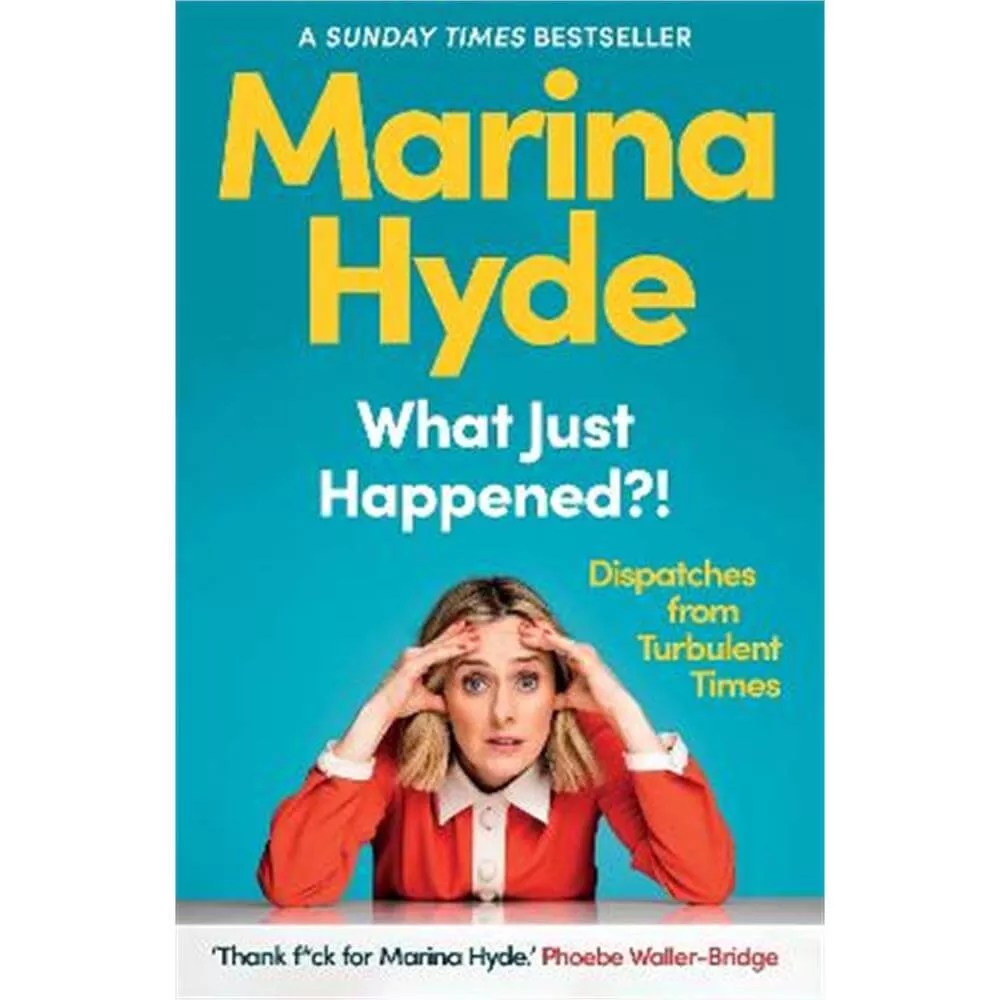
At the beginning of this month, there was an event on the other side of town. Cadogan Hall looks like an old church and is tucked away just off Sloane Square. It is where the Royal Philharmonic Orchestra calls home. Two high-profile journalists for The Guardian Newspaper, Marina Hyde and Jonathan Freedland, would be in conversation to celebrate Hyde’s book launch of ‘What Just Happened!?’ Walter had bought the book and tickets. He was determined to see them in person and to ask his question. The book is a big one – and sits prominently on our table. It is easy to dip in and out of with its short article-sized chapters.

Book Cover for What Just Happened by Marina Hyde

Marina Hyde now holds the lead position as “a thinking man’s crumpet”, an English expression first used in the 1960s to describe Joan Bakewell when she appeared on the BBC2 late-night discussion programs. There have been other crumpets of course, smart as well as beautiful actresses, news and semi-smart presenters, the chef, and author Nigella Lawson, Nicola Sturgeon could even be considered as such. The oldest crumpet of the moment is Kirsty Wark with – thank goodness – her own quirky style and smart mind – she still holds our attention as the senior co-hostess of Newsnight. But for now, Marina Hyde takes the pretty position with her political journalism and she definitely has my husband’s attention. He is not alone and on entering the bar to the hall we see many more left-leaning types – mostly of a certain age. There are young men out on a date, “Would you like to come and hear Marina Hyde – I’ve got tickets?” But I’m not sure Marina is really the come-on that they hope she will be. She could be just too intimidating. Us oldies look at her and remember – we too have been a bit of crumpet in our day and now just smile, seeing husbands getting frisky. The conversation on stage was good – Marina seemed a bit nervous which was comforting and when it ended Jonathan opened up to questions from the audience along with some on his iPad. My husband’s hand popped up and down until he was called and could ask his Brexit question. “ With the referendum being so important why was it not a super majority vote?” There was applause for the question but sadly no real new answer. Walter has met his third Russian as in “When three Russians tell you you are drunk you might want to lie down.” The sickening truth is that the then Prime Minister, David Cameron, was so confident of winning he saw no reason to make the vote more than a simple majority. His arrogance began the spin that has taken this country into a downward spiral of decay. 

The war in Ukraine goes on, and both the Ukrainians and Russians know and are admitting this is not going to end easily. God is apparently on both sides. We see Putin holding up his latest Icon in gold, while Volodymyr Zelinskiy posts videos of captured Ukrainian soldiers being swapped home. Nope, this is not going well – God may be just too busy with wars all over the world along with global warming and the terrible mess we are creating on our planet.

This evening I pass a young Asian man and an older English lady trying to move a crippled gentleman down the last steps of his house and into a wheelchair on the street. It is dusk. I don’t know where they are going but they look a bit unbalanced – the man’s feet are caught up and twisted together. I stop, put down my basket and rest my thigh against the wheelchair. From behind I lean over the man and say “This old nurse is going to put her arms under yours and bring you back into the chair” and lift him safely into his seat. Our heads are close and a sweet smile breaks over his uncleaned teeth. He turns closer to me. ‘Thank you” he says and our eyes smile a secret together. I pick up my basket and don’t look back as I walk on home. 

While I write, a small storm flicked a little lightning and a thunderclap, caressing us with the sweet smell of summer rain across our deck. It was not enough to soak the potted plants – only for the leaves to cup and drink. 

At the age of 86 the past Prime Minister of Italy, Silvio Berlusconi has died. His life set out the playboy playbook that so many politicians read. It will take more than a little light rain to wash away the pages of his legacy found amidst the dry crevasses of corruption and decay in Westminster today.

This has been A Letter From A. Broad. Written and read for you by Muriel Murch.

Back to Work

Written and read for you by MAM with WSM by my side

The coronation is over, the King and Queen have had their little rest and are now back working; the King shaking hands with ministers and world leaders, and reading those dispatch papers that keep him informed as to who is doing what- and where – while the Queen goes out and about visiting and spreading good cheer as she continues to learn who is doing what in this country. The flags are still flying over the London streets teasing the tourists out to take another picture or two.

King Charles III. Photo by Victoria Jones /PA

The roses are only just beginning to bloom and have not yet pushed spring into summer. The bluebells are fading and the air in London is rich with the attar of cowslips growing in the hedges around the parks and along the canals and rivers. Last week while, walking up alongside of Primrose Hill I saw two vans parked on the same side of the street – back to back with their boot hatches open facing one another. The two men – from street-savvy habit – look up, always conscious of who might be watching, and we catch each other’s eyes. I’m smiling at them and – like fourteen-year-old boys caught smoking at school – they sheepishly grin back. There is an exchange going on. The slightly younger man is holding a plastic fitting, something that could be used in plumbing or electrical works. He seems to have at least a box of them and is proudly showing them to the slightly older man. Both are in their forties and when they were babes such things would appear on the lot of the film studio at Elstree, ‘It fell off of a lorry’ was the phrase for such items. Here in town, lorries are too conspicuous in the city streets and an unmarked white van can disappear quickly into the traffic. The men know that I know – and that I remember such mischief – and am too old to do anything but go on my way. And with another grin exchanged that is what I do.

The newspapers are quieter, looking as they can for other news. Well, there are always wars, and though we have a hard time keeping up with the Ukrainian president as he moves from the front lines of his country’s war to diplomatic meetings and back again, he does keep visible and keep the world informed. Is he luckier – in a sickening sense of that phrase – than the people of Syria with their multi-sided civil war or the Sudan where civilians are killed on a daily basis. Wars continue in what could be called the B column. In the C column, news of the treatments of refugees from Somalia and Ethiopia by the Greek authorities are not even reaching the English papers. The refugees fleeing these wars have made their way from Turkey to Greece only to be captured – by whom – and pushed into vans – driven to launches – taken out to sea and transferred to the Greek coast guard vessels before being set adrift in rubber dinghies. Is this bounty hunting as in ‘I’ll give you so much for an adult, so much for a child’? We are horrified and sickened as we catch glimpses of such cruelty – and yet – it is hard to think of a time or place in ‘civilized history’ where and when this has not been true. 

But at home – in England – the Prime Minister is missing. Rishi Sunak and his wife have gone to Japan for the G7 conference where everyone has a chat and so politely says ’After you’ as in ‘if you give Ukraine bombers we will too. If you shake China’s hand – we will too’. All are consumed with the war in Ukraine. Well, almost all, India and the Arab States are keeping a distance from that chat while Volodymyr Zelensky strides about this world stage, clad in his army fatigues moving and talking to anyone and everyone he can. What deals can he cut? A little pilot training here, a couple of fighter jets there. It may not be much but he wouldn’t get any of it without showing up and giving a photo opportunity for the supposed great and good.

While Rishi is away, the little problem of Suella Braverman’s speeding ticket has blown up across the papers. It is almost good for a laugh. Those pesky cameras are everywhere and even with the warnings, ‘speed camera ahead’ one can get careless, and click, click there is your license plate picture in a civil service office and the next thing you know a paper notice comes through the letter box. Then what do you do? Well if you are the Archbishop of Canterbury and you get nicked popping in and out of London you may try to resolve it out of court but accept that, “No your worship – you was speeding – a hot 25 in a 20 mph zone.” He may have muttered some words about the press getting ahold of this one but paid up and accepted the points on his license. But a politician is different and good – not so old – Suella Braverman tried to wiggle out of taking her speeding awareness course within a class. The media spotlight swung quickly onto her – again – and she looks more and more like the most recent hole in the Tory bucket shining light into the murky interior of her political party.

And with Rishi still in Japan, Boris popped back into the news announcing that he and Carrie are expecting another child, bringing this family up to three children trotting along beside the other known five he has begat. What a lovely old word begat is.

But some words are not so lovely – they are hard to pronounce and to say. Nigel and Farage are two such words heard again as he showed up on the news once more to finally admit – ‘Brexit is not working.’  He goes on – that of course it is not Brexit’s fault, but the bureaucratic administration that has got it all wrong. The communist party said the same thing but no one remembers that. What is so terribly sad is how this country cannot yet see itself as a minor player on the world stage, and behave accordingly. Europe has no need of England, but England has great need of Europe and European business, industry, and people.

On Monday evening our plane touched down in Athens Airport, 59 years after we left – not knowing if we would ever see each other again. The drive to the city dips in and out of old memories. Small towns and old olive groves spread out in age, showing dreams made, broken, and reset as the trees are realigned to the country’s fortunes. The scattered sage and scrub are muted in the decaying dusk before we enter the city center where there is not a refugee to be seen. The limousine pulls up beside the hotel, and we are welcomed to Athena. For 24 hours we can disappear into an old marble suite, deep hot baths, and room service before reemerging to work in the world once more.

Yorgos Mavropsaridis and Walter Murch in conversation with Orestis Andreadakis at the Astor Cinema for the Rolex Arts Festival. Photo Credit – in Greek!

This has been A Letter From A. Broad. written and produced for you by Muriel Murch.