The Rain in Spain
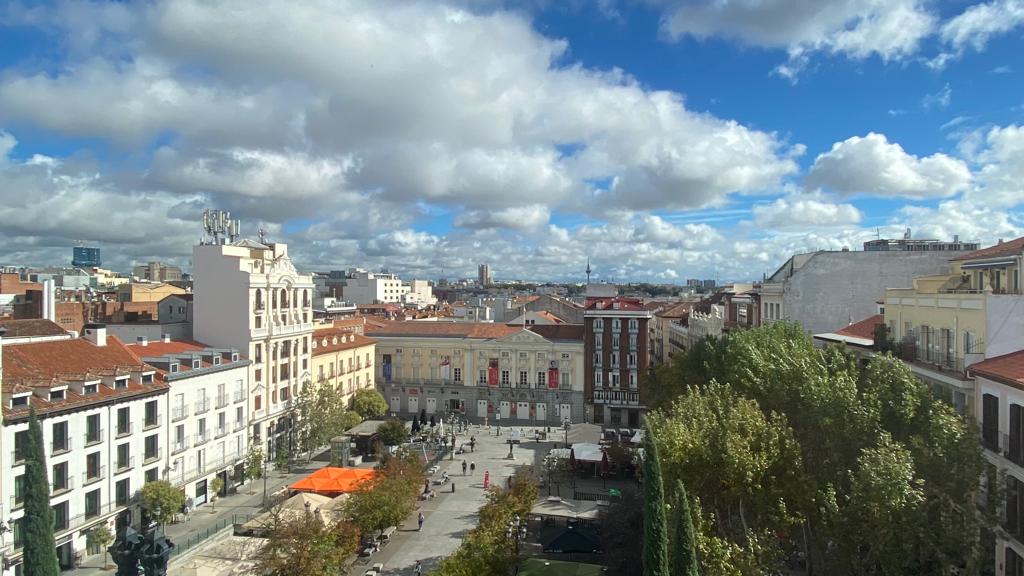
Falls mainly in the plain. And we saw that as we sat in the plane, in the rain, for three hours at the Madrid airport waiting for it to ease off enough that a Spanish pilot – who must be used to such things – was cleared for take off. It was a bumpy ride but we got from A – Madrid to B – London and home. Only three days earlier – as we drove to the city center we passed the dry dusty outskirts, the soil a pail ochre yellow that looked like sand and made one wonder how anything could grow there. But it does. Between the houses – jostling for a patch – olive trees claim their space clinging and begging to be allowed to stay, offering their untended fruit as payment for the soil. As the motorways slice through the land the trees give way to factories and then block housing before entering the old city center.
It has been six years since we were last in Madrid and at this film school. Beloved faculty who were young men then are – like us – just a little bit older while our young minders all seemed very much younger. It was a fully packed two days as Walter gave four lectures on Senses + Brain = Reality, as seen in the editing of Motion Pictures. A bit of a mouthful for a title but the four talks were all swallowed, hungrily by most – and cautiously by a few – in the full-house audience for both days as the students and old professionals bravely went along with him. Such is their affection for and trust in the man. These talks are where Walter can give encouragement to them and try out new ways or show what is right in front of – and in our faces – or noses – on this occasion taking a very deep dive into the concept of the Golden Ratio as it applies to the human face.
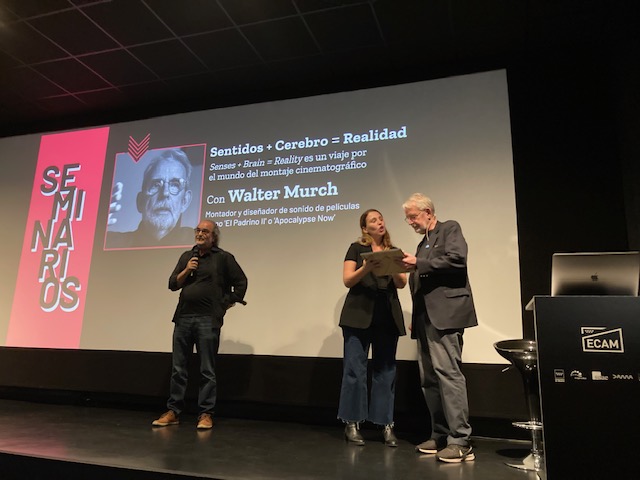
We arrived in the middle of the third week in October and as the wars slide from one continent to another, the new war of the season is well underway. The conflict in the Sudan never reaches the papers, the Ukrainian war remains but is now a side column as the bombing, threats of more bombing, retaliations, and death on all sides of this Middle Eastern mess unravel before us. Hostages had been taken and at that time none released. Politicians began lining up their positions while planning out their strategies, looking for who are their friends, who owns what, and what trades and compromises are available. Each day the war moves forward and it is not a pretty picture. Walter speaks of this at the beginning of both talks reminding us that this is the world we live in, and we are fortunate to be speaking and thinking about art and ideas for this short period of time.
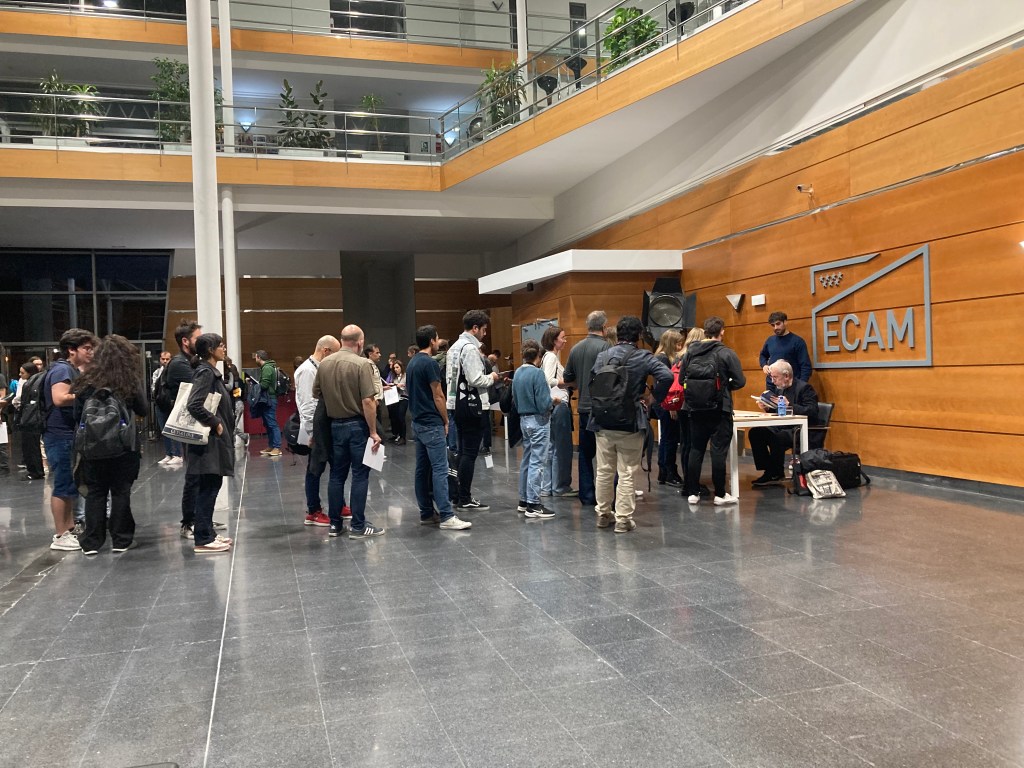
While waiting and watching Walter sign a new edition of his old ‘Blink’ book I am gently surrounded by the young people who are there for us. They hover like bees finding a new flower but instead, it is I who take from them, as each has a story, and war, government policies, and economic hardships feature in everyone.
The purple-haired bright-smiling young assistant from the film school is from Puerto Rico. While her family are scattered and separated in California, she has turned East and has found her way to Madrid, and this film school. Deeply conscious of the neglect of the various North American government administrations, her dream is to return to Puerto Rico and help the country with the film and radio skills she is learning.
Peter, the photographer, was born in Ukraine. He is young, with a mop of blond hair, and is slipping from gangly youth into adulthood. His parents – maybe seeing the future with fear – emigrated to Spain while they could. Peter speaks modest English though better Spanish and now his mother forbids the family to speak Russian – their native tongue – in their home. He doesn’t talk much about Ukraine but his mother worries. Peter’s grandmother is still there, not in the thick of the war zone but close enough, choosing to stay in her home and her mind until she dies.

Cecelia, our main minder, is a young and beautiful Argentine. As Argentina crumbles and falls – with the Argentine peso now at 1000 to 1 US dollar and rising – she too has left her home searching for a new life, a safer place to live and has come to Spain. This weekend our son-in-law took the train from Utrecht to the Hague to vote in Argentina’s first round of elections. Throughout Europe, the lines around the Argentine Embassies were hours long as those who had fled rallied to send the crazed Javier Milei out of the ballot box.
Coming home we reach out to Lika, another young friend who last year managed to leave Russia for Israel and then bring her mother with her.
She writes from her point of view in Tel Aviv, “Me and mom are ok. We have a bomb-shelter in the apartment and it’s the best you can get in this situation. North doesn’t get as many rockets as in the South up to Tel Aviv, but from day 1 we have constant shootings from Lebanon and even Syria. I have a panoramic view of the whole bay and I already saw and heard explosions, rockets being caught by the iron shield, and sirens from the border areas. It’s intense. To be honest I still can’t fully comprehend that it’s the second war in my life and at the same moment. We’re very much invested in the war in Ukraine and now this. And the ugliest thing is that the terrorists here are all in one bed – Russia, Hamas, Iran… and Israel and Ukraine have one thing left – to defend themselves. We have many Ukrainian friends here who were evacuated from the bombs and they are incredible to watch – very brave.”
The wars are pushing Britain’s local government squabbles off the front pages. Slipping the two conservative safe seats bi-elections – that they lost – well out of the spotlight. The wars, in the Ukraine, and now in Gaza and Israel are rolling over our consciousness like the winter storms hurtling through forests and along rivers in eastern Scotland. Yet they are not random acts of nature but preplanned with maps and political strategies that are embraced with little thought nor care for the collateral destruction and deaths that follow. It is as if a giant combine harvester is scraping the fields of our planet Earth, leaving stubble where there was wheat, stones, and dust where there used to be rich soil. We cry out but can do little more than weep.
This has been a Letter from A. Broad. Written and read for you by Muriel Murch. Note an error correction – in the recording I say the pesos to dollar is 350 to 1. It is 1000 to 1 and falling.
 Muriel Murch