Autumnal Harvest

Written and recorded by Muriel Murch with WSM by my side.

‘So you did it twice,” said a very young Beatrice when she was reckoning up the presence of herself and her brother and checking her new information of where babies came from. I kept a pretty straight face as I replied, “Yes. We did. Twice.” This was not the time to elaborate, as I was driving the thirteen turns stretch of Highway One on our way home and, again, we were late for something. “Yes we did it twice.”

Another thing that we have done twice is Walter directing me in a production reading. Many years ago I booked an evening studio session at KPFA Pacifica for the recording of Herman Hesse’s story “Old Music”. I was somehow committed and compelled to read this story. In hind-sight it was more suited to a male voice, but I so loved the story of Hesse’s journey from his cottage in the forest to the cathedral in the city that I was determined to do it and, for the first time, asked Walter to guide me thought the reading. I was nervous, hoping that we did not dissolve into an altercation in public. I need not have worried, Walter was professional and kind, gentle but firm and I relaxed as he led me through the story. We added some Bach, such as Hesse might have heard in the cathedral to the end of it and – even if I say so myself – it aired well. 
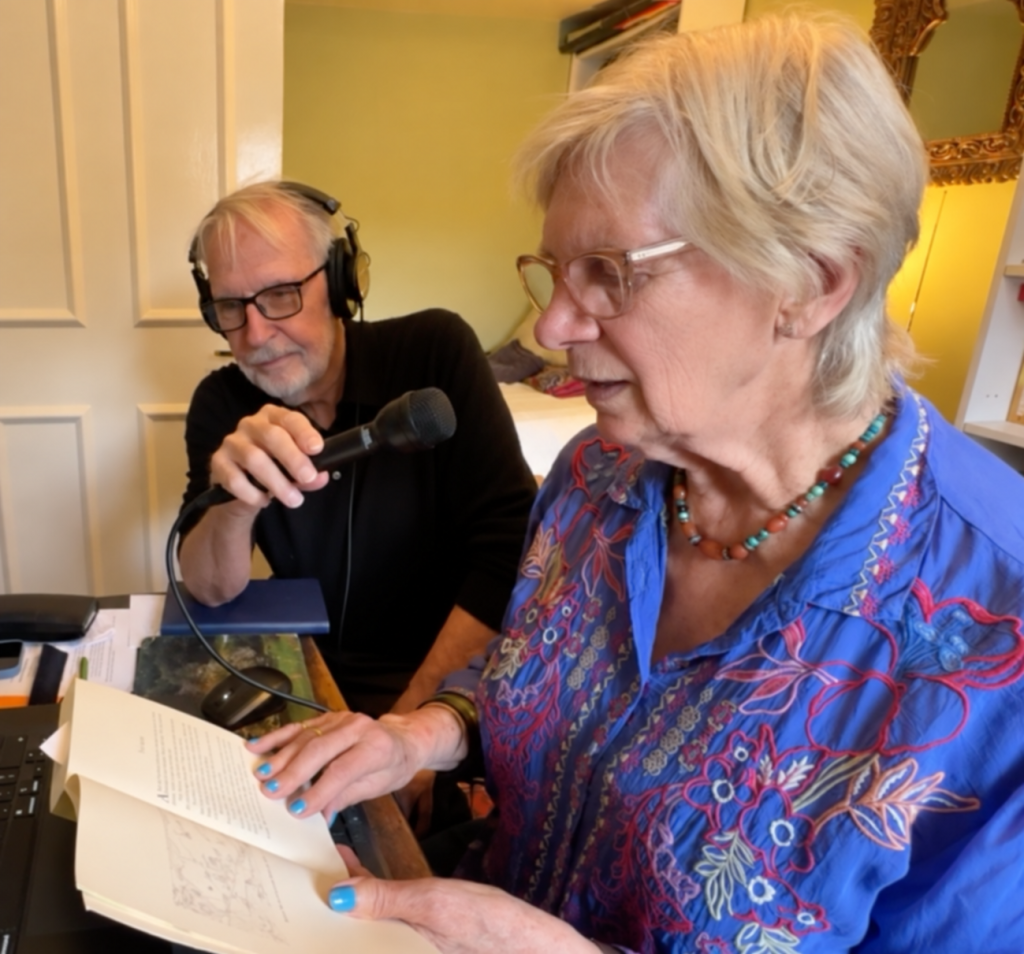
A tidier picture of team Murch at work. Photo by Taghi Amirani

This summer we did it again. Mostly here in London, as Walter held my less-than-best microphone while correcting my still hopeless dyslexic stumbles over long words and names. My voice and I are old, and with no true acting training we worked in short bursts. Granny Smith apples or big juicy grapes are said to help with such sessions but for me it was to be hard apple cider and honey which got me through, and was more than appropriate given that we were recording my book ‘Harvesting History While Farming the Flats.’  I took two editorial passes though each chapter before handing the tracks over to beloved Jim Mckee who cleaned me up some more. The result is a 9 hour and 6 minute book on audible.com. There is a little teaser – in the video.

The video clip on my website is a little taste tease. 

After my husband delivered a lecture to a group of Danish Film makers and students Philip calls out, “The last question please,” and a young man stands up.

“Mr. Murch, with your work schedule and the traveling how do you manage a home life?” then he sits down. Suddenly there is a deeper quiet in the room. Philip nods and raises his eyebrows, which always look striking with his large, round, smooth bald head. He nods as if to say, “yes this is a good question” and looks over at Walter. Walter paused, not rushing, as he can, to answer with overflowing ideas. Then he responded.

“Truth be told I don’t. I am often on a project for a year, maybe longer, sometimes eighteen months, even two years – and in that time I may not know where I will be six weeks ahead. You will have to ask Aggie that question.” He smiles and looks up briefly before Philip calls out,  “Lunch. We will reconvene in an hour.” 

This book is my answer 

Through some digital magic you can also switch between reading on your Kindle and listening to the audio. Pretty cool for an old lady.

The summer is fading now, the harvests are in. The Gods in Heaven have swept up three American jewels who spread good news, and good trouble across this good earth. We who are left are saddened by their passing. I think of them, Dolly Parton, Wendell Berry and Gloria Steinem who have no need to linger – their work well done and their torchlight handed on to those of us who are finishing what we can of our work in the world. 

And it is time to make chutney again. We harvested six green tomatoes from the one plant that survived the heatwaves of this summer. Our neighbor props a sign, ‘Free but don’t take them all’ on a box of Bramley Apples she brought from her home in the country. Tony at the market – he of the best and sweetest small strawberries – hands over a punnet of Victoria and Damson plums, Pete’s onions are small but good and into the big pot with all sorts of secrets they go. A day later there are nine jars filled with dark rich savory fruit sitting on the counter. 
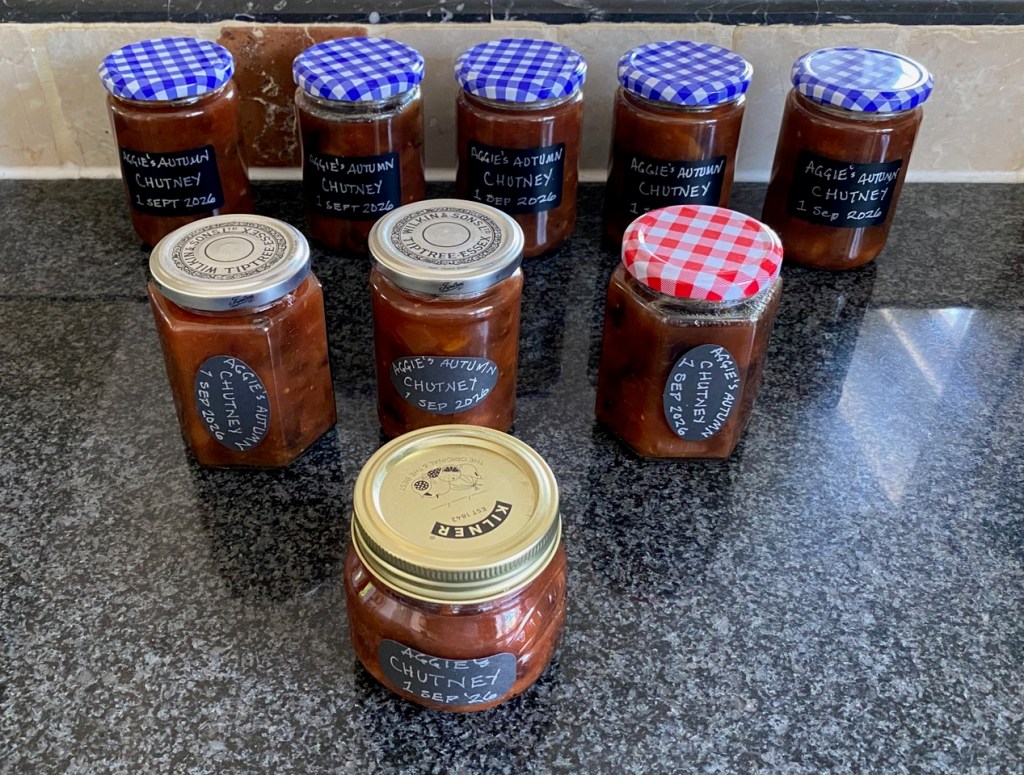
Nine jars of Chutney cooling on the counter.

I look at the jars and think of the words that Wendell Berry let me share in Harvesting History, and hope that even in this autumnal urban time of our lives we can remember that

The soil is the great connector of lives, the source and destination of all. It is the healer and restorer and resurrector, by which disease passes into health, age into youth, death into life. Without proper care for it we can have no community, because without proper care for it we can have no life. – Quote from Wendell Berry with kind permission from Wendell Berry

This has been A Letter From. A Broad Written and read for you by Muriel Murch with WSM by my side and as always supported by Beatrice from MurchStudio. And the video? Taken by Taghi Amarani and then tucked up together by WSM

It’s Raining Again

Recorded and Knit together by WSM

Being in England it seems only polite to speak of the weather. Now autumn has arrived with its mixture of rain and sunshine. The leaves on the Plane trees in the park are bright yellow and glistening with the steady rain that has fallen. These leaves will not fade to brown but drop with the next wind, leaving a carpet of yellow on the grass which itself is shining a brilliant, verdant green.

On Sunday we crossed town in an Uber. The rain fell steadily. The city is quiet and some roads were blocked off as the London Marathon was run by the chosen elite runners in the city. Around the country and the world, runners clocked in and up their twenty-six plus miles while raising money for their chosen charities. Looking out of the car window, we saw a city on hold. As if in a doctor’s office, nervously waiting for a diagnosis. Will the city live or die? What is its life expectancy and how will it need to adjust to the next new reality?

London street in the rain. Photo by Anjana Menon

Mindful of the rule of six we are celebrating old friendships as the youngest of us passes her ’77 Sunset Strip’ birthday. We laugh about it, with a toast of wine this Sunday lunch time. We are grateful that we are still a foursome and we don’t – at the table – discuss most of the ways that our bodies are beginning to show their limitations. The restaurant, Lorne in SW1, is small, modern and delightfully European. The food is elegant, the wait-staff all family and there is no bread on the menu or table. But there is wine and we drink with a fair amount of abandon and not a lot of caution. Sunday luncheon is a lingering meal and we are not alone in the lingering.

Three of the four birthday bites. Photo by WSM

Eventually the meal winds down into spearmint tea served in the tiniest of tea pots, and more of the owner’s family arrive for their meal. They bring the youngest member of the family, a little toddler girl. Already she is gently pulling things out of her mother’s bag and looking at ladies items. There is a zip closure, which will only take a few days more to master. Missing our own grandchildren, we beam at this little one and she looks up at us as we leave. Some of her family are still masked, we are putting our masks back on, and suddenly I’m trying to understand what this third of her life in masks could look like to a toddler. It is only our eyes that can shine love and laughter to her. But she gets it and smiles back, still clutching her mother’s unopened case.

This has been a welcome break from the confinement we continue to observe, and the news which spins through our minds as it unfurls.

The stand-off in Belarus continues. On Saturday, Belarus withdrew the accreditation of all foreign correspondents. The internet went down on Sunday. Aljazeera news is the only outlet still able to report. On Sunday, water cannons were used against the protestors marching towards the detention centers where at least 77 political prisoners are being held.

But on Friday, the United States and the European Union hit Belarus with sanctions for rigging the vote and orchestrating the crackdown on protesters, targeting key officials – but not Lukashenko himself. Russia has backed its long-standing ally Lukashenko, offering financial backing and promising military support if events turn against him. Unless you are paying minute attention it is hard to tell what is happening where.

On Sunday we saw again how the U.K. government’s knee rests on the BBC’s neck as Prime minister Boris Johnson deigned to be interviewed by Andrew Marr on Marr’s Sunday morning political program.

Public Health England has admitted a cock-up. In one week 15,841 positive Covid cases were not included in reports at the time, and not passed on to the contact tracing system. On Monday Health Minister Matt Hancock took the fall in Parliament blaming a computer malfunction, sort of like – the dog ate my homework.

Johnson warns that the UK faced “a very tough winter” with the virus. Truthfully, though, most governments are struggling, each searching for the right approach for their country. But watching this program every Sunday morning is wearing and I need a seriously good cup of tea to get through it. At first it seemed there was a restraint on Marr with his questions about the missing 16,000 cases, and then, as sometimes happens, the Scot in him rose to the fore. It takes a half squint of my eyes to see him strip off his Sunday suit, toss his shawl over his shoulder, twirl in his green plaid kilt and brandish his sword – at Boris.

When a patient leaves a hospital on their own volition it becomes ‘an incident’. There are nursing notes to be written, forms to be filled out and passed up the chain of responsibility until it reaches the top. But who is that person in the Walter Reed Memorial hospital? It may well be the commander in chief, who took the insane joy ride to wave to his people.

I could not take in the news when I first hear it.
“He’s mad.” I say.
“And scared.” Came the reply. And this may well be the truth. A memory of Saddam Hussain, stripped of his uniforms and ready for execution now twins with that of a masked man in a black armored car, waving before he takes his final ride home.

This has been A Letter from A. Broad.

Written and read for you by Muriel Murch

Week Seven in Belarus

Recorded and Knit together by WSM

Autumn has blown in and plonked her grab bag of swirling leaves down on every street and alley-way in London. Thoughts of letting tomatoes linger on the vine to ripen are swept away. We would be wise to pick what remains and be grateful for onions, windfall apples and green tomato chutney.

The cooler air is over Europe too and though the weather has turned in the seven weeks since the Belarusian elections that declared Lukashenko president the protests have continued. Svetlana Tikhanovskaya, who, in place of her detained husband, was on the ballot against Lukashenko, and Veronika Tsepkalo are in exile while Maria Kolesnikova remains in custody. Tikhanovskaya speaks in a video made for the New York Times about the situation in Belarus as the protest movement is left almost rudderless.

Anyone who steps into that leadership role is putting their life in danger and they know it. The news shows a young organizer using his phone to coordinate protesters while his wife phones every fifteen minutes to check that he is safe. Many of the Belarusian men protesting are often sturdy, thick-set, of truck driving ilk, alongside the student, intellectual types. The O.M.O.H. Police special forces remain fully masked under their helmets and are also stocky but one suspects younger and not so street savvy. Often they need four officers to capture one man. It is easier picking up the women, two officers can grab them off the streets, toss them into vans and drive to police stations. The photographs and reports of beatings and other tortures from released prisoners seeking medical aide are chilling. Tikhanovskaya knows she is no politician, “I am just a teacher. I will preside for six months to oversee fair and democratic elections. I am a wife and a mother and just want my husband back.” It is clear that though some protesters may be released, others may not, and some may never return.

Nina Baginskia and her flag. Photographer unknown

It is now illegal to carry the old State Belarusian flag but the streets are filled with the strong red and white fluttering flags waving among the signs carried by the protestors. Nina, a 73 year old great grandmother, is especially fond of hers. Though momentarily detained she is back on the street with the protesters and Nina may be the one force that brings the O.M.O.H. to a halt. Childhood religious respect for an elder does give the masked police pause, while Nina does half-apologize for kicking a police officer when he takes her flag away from her, “That was not very good behavior, I know, but when someone takes something of yours you don’t just say ‘Thank you.’” But not everyone approves, “You follow an old babushka,” Shouted a old-Lukashenko supporter.

Yes, they do. One of the privileges of reaching a certain age is the grounding of your collective wisdom and the ability to commit to what you know is right. Among the younger generations, Nina’s grey hair is a beacon, shining like that of the Abuelas de Plaza de Mayo, as she marches. At last the United Nations have stated it is time these allegations are investigated. This week the French president, Emmanual Marcon, said that Lukashenko must step aside. Several other European countries, including Britain, have stated they don’t recognize Mr. Lukashenko as the legitimate president of Belarus. Even the U.S. agrees, though, as the U.S. is prone to do, they may change their statement later in the year. Poised as the U.S. is for the November’s presidential elections these events in tiny Belarus are being watched in detail by those who hold the White House at this time.

Changing statements is what some governments do best. Balancing the effects of the COVID-19 Pandemic and salvaging the economy is proving a difficult business. The rigidity of the Lukashenko’s and Putin’s of the world can be contrasted with the melting iron of Johnson and other European leaders, who are struggling with this gordian knot. World wide COVID-19 cases are reported at over thirty-three million and today’s death toll has crested one million people.

France, German, Spain, Portugal and Italy are among the countries we heard about, each country trying to balance their economy with their country’s safety. Germany has already said they are putting the economy first and so other countries will be watching. Even with the governments’ ever changing statements it seems that being sensible as we go about our restricted lives with our smaller groupings of family and friends is the right thing to do. Medical personnel and hospitals are rearranging their priorities once more. Pubs and restaurants opened and last orders are called by 9 p.m. for 10 p.m. closure. I find this charming but I expect it has to do with my age. I remember those nice little drink, a nice little snack and then a nice little – not too tired, not too drunk – ‘Shall I walk you home moments’.

Primary schools have reopened and students are returning. The hardest hit are the new and returning students to University. Though all of the universities have worked really hard, there are bound to be cases of infections and illness. The numbers are just too high, the spaces just too small and the students, just as exuberant as they should be at this time in their lives.

So tonight’s headline from the Evening Standard newspaper “London Lockdown Moves a step closer” has us pause again. Though we will go out for supper tonight, it maybe the last time we can do so for a while. We will mask up to walk along the two streets and dine in the company of a few strangers trying to feel a little more connected to each other and the world.

This has been A Letter from A. Broad,
written and read for you by Muriel Murch