Feet in the Fridge

Writtten and read for you by Muriel Murch with WSM by my side.

Sally came back from across the street, “Granny Turriff has pulled up a chair and has her feet in the fridge.” 

“Well that seems sensible. It is hot today.” replied her mother summing up the family consensus from their kitchen on the small street in the village where I grew up. The temperature must have reached the mid 70s at that time in the early 1950s. Granny Turriff was not my Granny, but she was one of the grannies who lived all around, in the house, or across the street at a time when families stayed close and watched out for each other. There was no air-conditioning then – maybe a breeze from an open back door would rise – stirring the still air – and putting your feet in the fridge was a pretty reasonable way for an elderly lady living alone to stay cool.

London Temperatures for Saturday June 28th

This last week with the heat wave now official – three days of temperatures above 30 degrees celsius, the mid-80s Fahrenheit – I’m remembering Granny Turriff  as I open our fridge door to reach for the freshly made jug of iced tea and the cool air swirls out towards me. The temperature rests in the mid 80s and is 10 degrees hotter that when Granny Turriff put her feet in the fridge. Low level fridges are long gone so no one will see this piece of eccentricity – when practical might be considered just beyond sensible – and such actions could be judged as inappropriate behavior. There are warnings of the ‘extra’ deaths that this heatwave will bring to the vulnerable; the very young, the elderly and the infirm. The news details the pressures this will put on the already stressed health service and we, the very young, the elderly and the infirm, are advised to stay at home, rest and drink plenty of water. It is almost our duty to do so. We will keep the curtains and blinds drawn down to keep out the sun. We will water our plants in the evening time and we will rest. 

The heat wave crosses Europe and given these times an almost manageable concern – what is it that puts global warming into manageable while Palestinian families are bombed, Ukraine battles on struggling to reclaim land stolen by Russia and now the mad man in American makes Dr. Strangelove look sane? 

War, once again there is war. War for The United States of America is almost as big an industry as the entire US agricultural section. With these blasts, like aggressive bowel evacuations, of another attack on a sovereign country – whether one likes the regime or not – I look around searching for a place of reason. There are the “No Kings” demonstrations around the United States and even in Europe and other countries. The leaders of Canada, Mark Carney and Mexico, Claudia Sheinbaum cradle us in hope while the American Democratic party sits about pinging their phones and deleting emails. The American barrel of sanity looks pretty empty.

But this week, in a small organization, I found a firm steadfast remembrance of the horror of war. 

Nurses, old, ofttimes retired are joined by young ones as they group together, state by state to form Nurses Honor Guards. The NHG now has over 300 chapters in all 50 states and continues to grow. Jeanie Bryner is a nurse, a friend, a poet and a power-house member of the Nurses Honor Guard of Eastern Ohio. When asked, the honor guards gathers to perform Nightingale Tribute services for nurses. Like in the military, it consists of the Final Call to Duty. The Nightingale Lamp is lit in the nurse’s honor and when a triangle is rung the nurse’s name is called out three times as a request to report to duty. With the last silence, after her name is called, the nurse is announced as retired and the lamp’s flame is extinguished. She is relieved from Duty. 

Relieved from Duty Display from an Honor Guard.

Last week three chapters of the Nurses Honor Guard from Ohio took buses to Washington D.C. where they had been invited to place a wreath on the Tomb of the Unknown Soldier. And that makes some kind of sense. The little I know, but something, from the strength of the grass-rooted down to earth poetry of Jeanie Bryner – the poetry of rural people, the patients, the nurses who care for them from the heartland of America – these are people who know the loss of war. It is probable that at least half of those women nurses have suffered some deep loss from the wars fought within their lifetimes – never mind their fathers before them. I found the video of the wreath laying ceremony on line – of course I did – and like so many at that ceremony there were tears in my eyes watching these nurses, there for their fellow fallen sisters and brothers, lovers and fathers.

Ohio Chapter of the Nurses Honor Guard at Arlington Washington D.C.

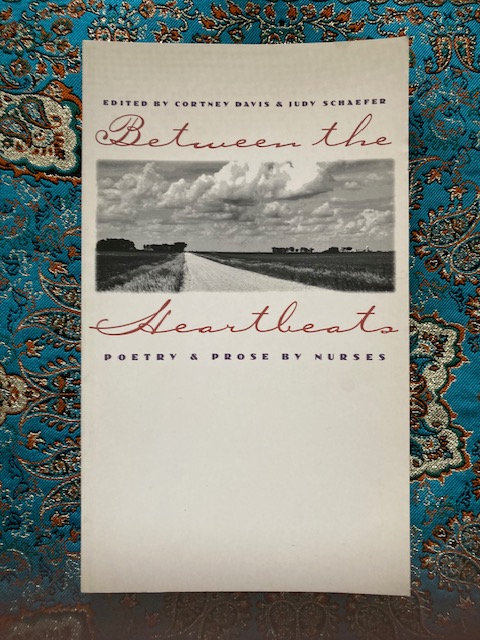
In 1995 Ohio State University published the first of a series of Anthologies on Nursing. ‘Between the Heartbeats Poetry and Prose by Nurses’ was edited by Judy Schaefer and Cortney Davis. As many of us as could traveled to Washington DC. where The American Nurses association was holding its annual meeting. But the ANA refused us permission to present or read at the convention. Instead we found a bookstore that took us in. I don’t remember how many other people came to that reading but we were an enthusiastic and proud group of nurse writers. As we gathered after the reading, mostly meeting each other for the first time, there was one nurse I particularly remember. Above her slacks she wore a brown, checked, gingham, short sleeved shirt. She had read her poem about Vietnam. We asked her if she had visited the new Vietnam Memorial wall. “Oh no.” She replied. “It is too soon.” In our silence we understood we would never know the horror she had witnessed. While the Ohio nurses gathered at the tomb of the unknown solder we all hold the world closer, praying for peace and the seeming unceasing wars to end.

This has been A Letter from A. Broad. written and read for you by Muriel Murch.

Always supported by https://murchstudio.com
Old Reads and New Writing

Written and Read for you by Muriel Murch

As dawn broke in years gone by, newspapers would be delivered by a bicycling schoolboy earning a few US dollars or English shillings. The papers  were carefully gathered to be opened at breakfast, pages turned with American coffee or English tea – and toast. The news, the gossip, the sports – in green – before finally the cartoons and crossword puzzles were found on the final pages. Now those youngsters are out of a job as television and social media bring everything to us with a click of a button or a swipe of a forefinger. With a nine-year old grandson, I am having a refresher moment of comic book education. It is a good primer for what is playing out on the large and small screens in our hands.

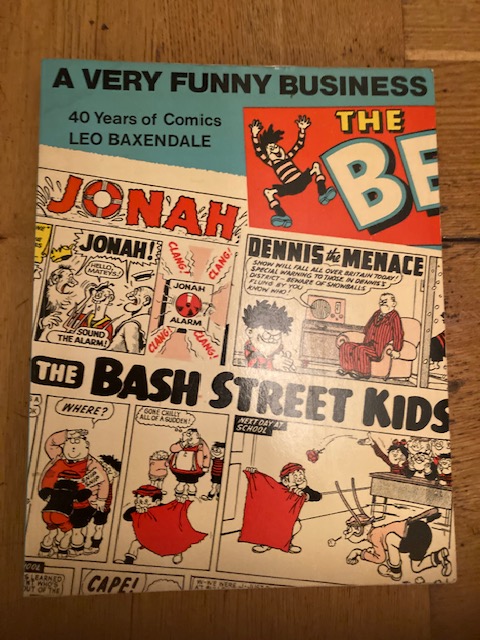
The Cover of Leo Baxendale’s ‘A Very Funny Business’

The story lines are remarkably similar; a bully struts into the Oval Office with all his pals lined up behind him. A new boy comes in – quickly mocked for failing to be dressed the same as the bully and his pals. The new boy sits quietly, tries to reason with the bully and holds his own before leaving abruptly, as if chased from the room, but in reality he has left on his own terms. A few weeks later, the bully picks on another visitor. He too held his own with calm dignity. Now, weeks later, both of these men have achieved their aims. President Zelensky has demolished a third of the Russian bombers that were set to attack the Ukraine while, as South African President Cyril Ramaphosa left the White House, his smile reinforced for both black and white South Africans that his diplomacy skills are a strength the whole country is grateful for.  This week the German Chancellor, Friedrich Merz, traveled to Washington DC to report back to the European Union. He too saw the symptoms of madness and stayed calm. As the rough-housing erupts in the White House we wait for the next installment to be drawn on the page. 

While the comic book gets put aside – I find a gift tucked into my email inbox. A note from Barbara Bos who runs the Woman Writers, Women’s Books website would like a piece on the background of Harvesting History, While Farming the Flats and how I came to write it. This exercise is perfectly timed to answer a question that I pushed aside before it even had a chance to form. Did I answer her question? I’m not sure but this is some of what I wrote about that time in 2014. 


Bees are busy in the Borage

It is midday. As many mornings as I can, I spend outside. Farm chores call out: ‘Over here, over here’ with raised wands of weeds, brambles and fences to care for. Fridays are sacrilegiously saved, even called ‘My Friday Farm days’. But I can only manage three morning hours before my body tells me to halt and I come back inside. Clean up, and enjoy a small snack before taking my place, sitting at the Bistro table, beside the French doors, in the main dining room. 

The Farm Dining room is quiet now

This is a quiet room, saved now for big occasions with family or friends, but in this solitary time I take it for my own. The stillness calls me and I welcome it putting my pen to the page bringing immediate and long-past memories together, taking time to talk to the page.

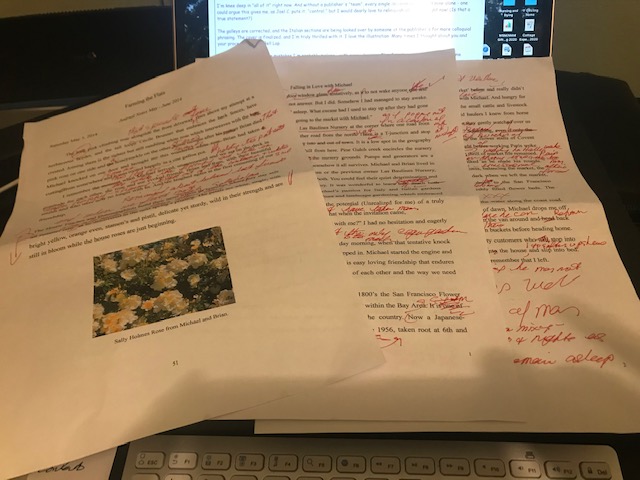
Journal books are on the table. The little blue one – whose innards I change each year – records the past day, the day today, and the things still to do. Lists abound in that book while very occasionally an Idea or Question is also captured. When the three pages of warm-up notes are completed like piano scales, the little blue book is put aside. Two bigger journals, also with soft covers, have big spaces and faint lines. I can only open these when I am alone, for the pen may find memories of its own, spilling its ink over the pages onto the table, and I am frightened that I cannot scoop them back again. My pens also are important. Somedays I pick and choose, wanting something different, possibly a useful pen, even a pencil, or a beautiful one with free flowing ink, gliding across the page like a superb dancing partner. I have a fountain pen, a gift we bought from Rome one Christmas for my mother and which she used for the rest of her life. Sometimes when I write with it, I feel my mother’s encouragement – now flowing more freely through that pen. Each entry begins as a letter to you, whoever and wherever you are, or even a chat, as if we were sitting side by side in a cafe.

Between the Heartbeats. Poetry and Prose by Nurses, edited by Cortney Davis and Judy Schaffer

I start writing like this, knowing that much of it will not find its way into the final piece. I accept that scribbling is OK, good, it is the compost, heating up the heart, trusting the practice, the craft that hones thoughts into words until they become uniquely mine. There is no final version – until maybe it is published and given to you – a reader. Writing becomes us, as slowly, one gathers a body of work behind one. I remember the first time that I received a postcard back from a Submission, (with a capital S) It was for Mr Tims Morning and Cortney Davis wrote on a card, “Thank you for this excellent work.” She probably wrote that on cards for all the work she and Judy Shaffer collected for their first Anthology of Nurse writing Between the Heartbeats. I still have that note.

Now, two books later, it happened again, Steve Wax had read some of my essays published in ‘The West Marin Review’, then, in a huge cinematic reunion sought me out to say, “I read your essays and they are beautiful”.  And so the harvesting began again.

The isolation imposed by Covid and age, helped me turn inward in earnest as I carried those farm journals to London and old memories began to sit beside the farm memories from – well – memory. Only when the essays laid themselves alongside of each other, jostling back through the-time-before, like the loose and falling pages of old photo albums, which must – one day – all be digitized. But until that time I would write about – that – those – times, remembering them in words and stories. Sometimes the words rise like yeast-laden dough, as the memories crowded on the page become kneaded together with imagination. 

What does it take to do that? Perseverance, putting the words on the page, taking them up again, moving them around before pushing them back down. There is a reason why in bread recipes we are instructed to knead the dough for 10 minutes until it is soft and silky under our hands. That is how we want our words to be, soft and silky, gliding along the page and into your imagination.

This has been A Letter From A. Broad written and read for you by Muriel Murch