Poaching in the Park

Written and Produced by Muriel Murch with WSM by my side.
Blackberry-bramble Harvest 2023

August slipped into autumn not bothering to wait for September while most of London went on holiday, leaving the city almost as subdued as Paris. Along the canal, three teenage ducklings are swimming alone as if their parents have regretted their final feathered fling in the water and are just too tired to raise one more brood this year. The ducklings look lost, paddling from one clump of weeds to another in the mindless way of adolescence. It is blackberry season and we are late for our semi-annual ‘Poaching in the Park’ moment. We go in the middle of the week – with less chance of being caught – though this little corner of Regent’s Park is now sorely neglected. There used to be a thriving small sports school here, a place to practice your tennis, golf, or cricket. But now the cricket practice nets have moved close to a central concrete hub with a cafe, overlooking the big open pitches that serve both cricket and football in often overlapping seasons. There is a small tennis club close to Queen Mary’s Rose Garden but the golf nets were removed altogether. Now the wilderness has taken over – as it should – and the blackberry brambles climb the Hawthorne shrubs and surround the adolescent oak trees. The King is in Scotland striding out on the moors for a good bit of fresh air, while the Prime Minister is back home in Yorkshire, maybe looking to see if the Green Peace ‘Stop Oil’ Delegation have left him any more notes on how to run the country. So we can pick and gather our bramble harvest which quickly became eight pots of jam. Six are stored away. One goes straight into our fridge and the other to Howard who – in years gone by – was one of the tennis coaches on the courts now covered with brambles. Howard lives close by and while closing into the other side of his eighties we often stop and chat. Howard is fond of the written word and from time to time pops a poem through our letter box. 
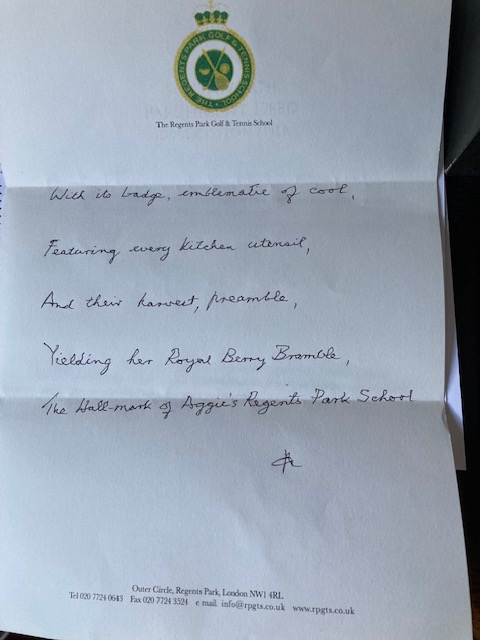
This week’s poem from Howard

The nightly news can barely be bothered with the wars that do not stop in the Sudan and Yemen. The Human Rights Watch write that Saudi border guards have been reported killing hundreds of Ethiopians trying to cross into Saudi Arabia from Yemen. And the war in Ukraine is not ending soon. The maps showing – in red, purple, and white – whose troops hold which cities and coastlines in Ukraine – are confusing and seem at odds with the reporting. If all that land – in red – is occupied by the Russians, how is Ukraine ‘making ground’? We see villages and cities bombed – and the long, low trenches slicing through fields and countryside appear no different than those dug for World War One – where Ukrainian soldiers crouch and fire, fire and smoke, and slog on. Summertime is wearing for soldiers and politicians alike. But there is a useful police mess-up from Manchester and a horrific tale of infanticide to keep us distracted from the wars and the Government debortle with the Biddy Stockholm barge. A few asylum seekers were being marched onto the barge two by two – when it was discovered – at least a week before reporting – and the marching on – that the barge water supply contained traces of the legionella disease bacteria long known to cause severe pneumonia and death. Time to pack their bags and march those foot-weary seekers of asylum and hope off again. 
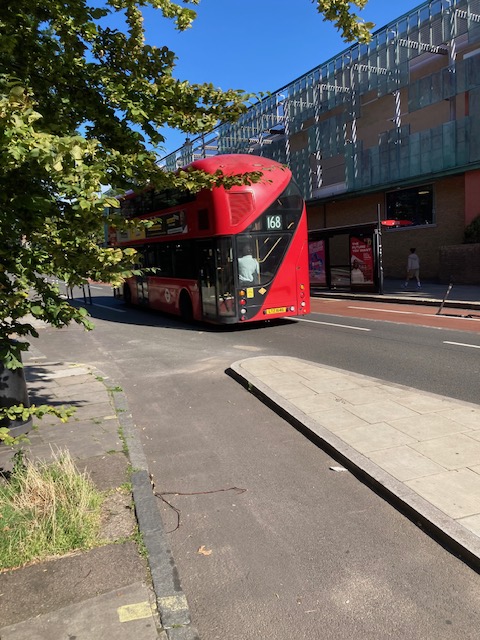
The 168 bus leaving Chalk Farm.

Sometimes I miss the small thud when the paper lady pops the Camden New Journal through the letterbox every Thursday morning. I glance through it, knowing there will not be not much I care to read but that sometimes, something will catch my eye. Last week – another August moment – there was no home delivery – so this week I made sure to read it. And there it was: a small column slipped into the side of a page. ‘RIP 168 – the bus stops here’. This route will be closed in September. ‘Oh No.’ How could they – who the heck is ‘they’ – let it happen. ‘They’ turns out to be Transport For London (TFL for short) and to whom we pay our bus and rail fares. They did a survey – even reporting that of three hundred respondents, only 18 agreed with the scheme to scrap the 168 bus route. And still, they went ahead. It is this kind of lock-jaw response that drives us all crazy. The government does it with their ‘there will be an inquiry’. It is – to put it mildly – upsetting.

Upsetting and inconvenient for people like me perhaps but downright devastating for people like Jim. Jim and I have been friends for twenty years and know much – and yet little – about each other. Jim is Jamaican, his wife was German and I often wondered what brought them together – if in those early years of their courtship, they both felt the chill of English disapproval. Jim was a Camden Garbage truck driver until he retired. His route brought the truck onto our street and he lives just two blocks away in a council flat. He had a Yorkshire Terrier dog, small, black and brown, and always keen, pulling Jim along as she raced up our street galloping towards the hill. Even at 17 – a serious senior for a little terrier – she was always ahead of Jim – until she wasn’t – and one day Jim quietly took her to the vet to say goodbye. Now he is alone, and as he gets older doesn’t go out and about so much. But we meet from time to time. ‘Ello darlin’ He calls to me, having long forgotten my name and it being too old a friendship to ask to be reminded. And we chat, about this, that, the other, and loneliness. A kiss is always welcome. The last time I saw Jim he was walking slowly with his cane, going to the bus stop for the aforementioned 168 bus on his way to The Royal Free Hospital in South End Green where the bus stops right outside of the hospital – in both directions. What will happen to Jim and so many others if TFL takes this moment of independence away? Each little cost-saving denial from them leads to a retreat and loss for us all. 

This has been A Letter From A. Broad written and read for you by Muriel Murch.

On the Moor

Written and produced by Muriel Murch with WSM by my side
Pictures posted online by Greenpeace UK on Thursday showed the protesters on top of the property while a banner read “RISHI SUNAK – OIL PROFITS OR OUR FUTURE?”

Rishi Sunak and his family have all gone on holiday leaving England and the remainder of the United Kingdom in tatters. So it was no surprise that when the five Greenpeace ‘Stop Oil’ activists knocked on the door of Sunak’s country home in North Yorkshire and nobody opened the door, they felt free to climb onto the rooftop of the grade II-listed manor house and drape oil-black fabric over it before posing with their ‘Stop Oil’ Banner in front of the house – protesting against the government’s decision to expand North Sea oil drilling. There is – naturally – to be an inquiry – as to how and why the Prime Minister’s house was left so unattended. Surely there was some surveillance in place. But as Sunak has begun to show his real colors – under the tiniest bit of pressure on a radio program (listeners take note) we have seen his business management underbelly and once more our hopes – why do we even have them? – are dashed. What is Rishi doing looking to lift the 20 mph speed limits in some small residential neighborhoods while issuing new licenses for North Sea Oil drilling? I’m remembering – not that long ago – when the new King very pointedly invited the new Prime Minister to speak at a reception the King was giving for world leaders gathering before a conference on climate change. Rishi popped over to the conference in a private jet to smile and show up. But now he reminds us that ‘you can take a horse to water but you can’t make him drink’. 

So it is with renewed respect we watch the Mayor of London Sadiq Khan, with his bushy eyebrows, sticking to his guns with the expansion of London’s low emission zone, saying tackling the climate emergency and air pollution are “bigger than party politics”. While those in parliament waffle and wave according to their party’s policies, Khan is staying true to his course. He is winning some and losing others. Hundreds of doctors have urged politicians to stand firm on initiatives to tackle air pollution, warning that they see its “devastating health consequences” in patients on a daily basis. Air pollution is the single largest environmental risk to public health, linked to between 28,000 and 36,000 UK deaths a year. Air pollution affects every one of us from before we are born into old age. I remember in 1966 looking into the chest of a young Mexican 16-year-old boy who had only been in the city for six weeks. His lungs were already pinpointed with black city pollution.

As I write, the Bibby Stockholm barge is receiving its first asylum seekers – refugees – today. There was a small stall – was this going to be a fire trap? But though Amnesty International calls the barge and its use a ‘Ministerial cruelty’, food will be served in the canteen tonight.

A combination of our 58th wedding anniversary, a small window of time, with the excuse to see a beloved old friend, and the long-anticipated search for Murches – dead more than alive – takes us to Devon and the northern end of Dartmoor.

The two-carriage train runs on old tracks – clickety clack, clickety clack – from Exeter-St. David to Okehampton, slowly rolling past the rows of not-yet-old oak trees marking the hedgerows separating pastures as some far-thinking farmers return to the old ways. The hedgerows are made of stone with some post and rail. There is little wire to be seen. The clouds are hanging low as if chasing the fields into the sea. There is no taxi stand at the Okehampton train station, but drivers swing in and out around train arrival times to see if they can hook a passenger and soon we are caught. But our man has only lived in these ‘ere parts for six years, “A second marriage,” he says, and driven for two which may explain the very long route that brought us through cow pastures – where he had to be reminded to close the gates – with a herd of fine healthy Devonshire cows, and the rubbish dumpster bins, to the back of the hotel for 27 pounds thank you very much. This one is not yet a local.

We are staying at the most elegant and expensive of hotels at Gidleigh Park which carries just the slightest breath of Fawlty Towers to remind us we are in England. After we check-in, there is time for a walk to the hamlet of Murchington. From the hotel, we dip into the woodlands of an ancient forest of Oak and Beech trees where the River Teign runs freely alongside of the path. This is the wilderness of fairies and Robin Hood.  We leave the forest for the lanes that are as narrow as I remember them and the bracken is mid-summer high allowing the brambles to twine over and around the long fronds while wild white yarrow and pale orange columbine wave gently where they can. The couch grass remains stubbornly growing and uneaten by the cattle or sheep in the pastures. It’s a good climb up the hill before going down into the dale and finding the old sign of Murchington where Beatrice posed forty years ago. The few cars that pass are careful enough to let us squeeze into the bracken and it isn’t until we crest the hill – before the final dale – that we meet another traveler on the road. She is short and quite round, walking in country clothes with a fine leather hat, and two poles. She is moving slowly and when we first pass her taking a talking break with a motorist  “Are we far from Murchington?” I ask, “Just down there. I live in Upper Murchington.” so we carry on. Murchington is now a hamlet having only a few houses with the church being decommissioned in 1975 and there is no central place of worship or community. Sometimes a hamlet is a small group of Kinsmen, no larger than an extended family or clan, though there are no Murches living in Murchington, nor could we find trace of any. On our return – there is not a lot to see in Murchington – our fellow traveler is now polling on the other side of the hill and we pause together. “I like your hat,” says Walter, and that is all it takes to learn about her two children, in Texas and Portugal, far away from this widowed mother who has just had double knee surgery and is walking alone along a country lane. 

Back at the hotel and we change for dinner. To dine here is an event and joining us are my oldest friend from Nursing school 60 years ago, Sally, and her daughter Emma who is a leading conservationist with her Dartmoor’s Daughter tours of Dartmoor. There are screams of delight and so much laughter when we see each other and the tears of joy would fall but that we are both – even at 80 – mindful of mascara. When dinner is served it behooves us to pay attention for the care, flavor, and presentation is exquisite, though a far cry from the gnawing on bones by the forest fire that could have been here mere centuries ago. 

Hand-tinted postcard of Murchington, c. 1910 showing Woodlands Farm and the Anglican chapel (with railings)

The next day is for searching for those long-dead Murches that we are pretty sure are lying about in the Church graveyard. But first, there is morning coffee – at a small cafe where the local artists gather- in the town of Chagford. The four tables that have been put together for us take up almost half of the cafe space. We are late – Richard – our taxi driver – knows his way about, but then there are cattle and ponies on the road and hellos to be shared. Immediately when we arrive fresh coffee is served and we split up – the conversation rushes deeply into the arts at one end of the table and conservation and humanity at the other. It’s a wonderful way to spend a Saturday morning – with people who care – reinforcing each other – encouraging by just showing up – before we wave our goodbyes and slip away into the day.

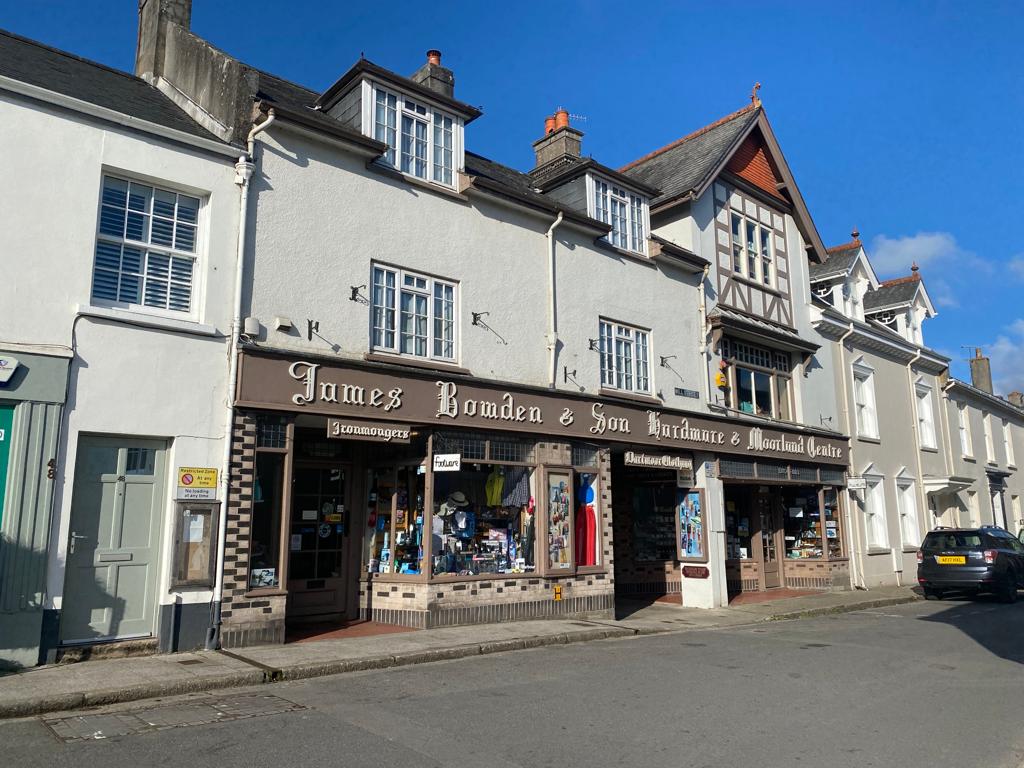
James Bowden & Son Hardware & Moorland Centre

It is beginning to rain – a soft rain – as Sally guides us to the hardware shop that sells everything you need at home and more enticingly has a museum room in the back. It is here that we find the first evidence of George Murch, wheelwright, who sold this shop to James Bowden in 1862. The little room that sells the boots would have been his first shop room. It is comforting to know that we both come from working stock a wheelwright and Slater, such names carry the trades of our forefathers. And more than one Murch married into the Perryman family from Stancombe, giving me full license to go ahead with cider making. As the soft rain gets stronger Sally leaves us at the Chagford churchyard of St Michael the Archangel where someone did what we all mean to do with our boxes of old photographs – gone through the graveyard and mapped out as to whom is buried where – it doesn’t take any time at all to find one of George’s sons, William but not George. William’s gravestone is still upright but leaning a bit as most in the ‘old’ graveyard are. We stand in the rain and think about those lives. The ones that came before us – not so very long ago – was William the one who stayed behind so that James could leave? Or was James always restless – the one who would venture out no matter what? He never named a son of his after his father. These are stories we may not know but only imagine.

On Sunday morning there is a knock on the door and our morning tea, toast, and flaking-everywhere croissant arrives. We are rested and ready to leave with Emma at 8.15 a.m. for a 9.30 start on our guided Wool Walk. After picking up Sally and a friend, Emma sets off at a roaring pace along those single-lane roads and we are soon out on the moor which stretches before us with heart-holding beauty. The sheep are grazing and resting beside the road along with small herds of cows and ponies. Low patches of late gorse hold tightly to the beginning blooms of heather. 

The walk is led by – I quote – qualified Hill and Moorland Leader, Emma Cunis aka Dartmoor’s Daughter, and Kristy Turner, Curator of the Dyeing on Dartmoor exhibition at the Museum of Dartmoor Life. Emma and Kristy give us a little introductory talk and we share our names and reasons for walking this Sunday morning. The walk is billed as ‘Easy’ and as we set off Emma acknowledges that we will be of different walking abilities: some fast, some in the middle, and some – a little slower. It doesn’t take long for me to realize I am among the latter- more than a little slower – and this sobers me as I miss the woman I used to be.

Old Friends and old Oaks photo by WSM

This morning Sally wrote “It came to me last night, we are a bit like ancient oak trees, a bit bent and gnarled, but the inner strength keeps us going. So from one Oak tree to another, take care of your roots and branches but wave your leaves merrily into the air whenever you get the chance.” This is friendship and sounds like good advice for us all.

This has been A Letter from A. Broad, written and read for you by Muriel Murch. 

Divas and Dingies

Divas and Dingies Recorded and produced by Muriel Murch with WSM by my side

The writer Milan Kundera has died at the age of 94. It is noted with a passing sentence or two in the papers, a mention on the evening news and a few more paragraphs in obituaries in England and Europe. Salman Rushdie took a quote from ‘The Book of Laughter and Forgetting’  “The struggle of man against power is the struggle of memory against forgetting.” And this is why there are novels, poems, songs and biographies of work and of people written – to hold onto what we know as true for as long as possible remembering the stepping stones that were laid down for our work and we provide for those that follow.

And as that came to mind, a seventeen-year-old granddaughter stepped through the cottage doors for a visit with her now ‘over 80’ grandparents and we had things to do. Two bus rides took us to the Victoria and Albert Museum and the exhibit of Divas. Headphones in place we were ushered down the darkened steps to Gallery 40, first into the world of opera with the costumes and cracked voice of Maria Callas. Moving from window to window for the first time I look on these early opera singers as brave and courageous women paving their own pathways for independence for singers and actresses to follow. Billie Holliday is shown in a photographic negative of her only performance at the Albert Hall in 1954. Between the flickering pictures of Theda Bara playing the first Cleopatra on film in 1917, we pass display cases showing those who were destroyed by the systems they tried to conquer: Marilyn Monroe, and Judy Garland are seen smiling bravely. Then comes Elizabeth Taylor playing the same queen Cleopatra in 1963 as she commands Mark Anthony to kneel before her. It’s beautiful stuff and when I emerge from the darkness – the exhibit continues upstairs – there are the brilliant costumes of Prince, Cher, Elton John and countless others. I can make it around the exhibit once before I get dizzy with all this courage displayed before me. As the granddaughter goes around and around I sit and think of these divas – of female and male inclinations – all pushing the boundaries of their times. Within this exhibit are the milestones that bring us from Marie Callas to Marian Anderson performing at the Lincoln Memorial in 1939, to the civil rights movement, through Cher, Elton John to the Beyoncé of today.

Theda Bara as Cleopatra in 1917 from the Diva Exhibit

We find our way to the old tea rooms with their tiled walls, porcelain columns and stained glass windows. There are far too many pastries and not enough small plates of good-for-you food but we slide a pot of tea and scones onto a tray and manage a tea-time moment to sit down and take in what we have seen and look about us – at old and young England with some European and Asian families who are also taking this moment to pause and refresh. I am caught seeing a young Japanese family sitting at a table close by, parents with a slightly older daughter and the younger brother who is having trouble with his broccoli. His father helps him out – spooning some strands of vegetable back into the boy’s mouth and scraping some away to his own plate. But it is the mother who is striking. She sits calmly, casually watchful as a lioness teaching her young cubs to eat for themselves. Her face is long and strictly angular, half of her black hair is pulled back and held roughly high on her head with a band. The angle of her jaw, the rise of her hair are ancient and familiar both.

Popen o Fuku Musume (“Young woman blowing a poppen glass”), which appears under both series titles of c. 1792–93

Since childhood, I have seen her on the pages of books of paintings of Japanese art and culture but here she is in the 21st century – utterly beautiful in her casual modern clothes. I wonder at this Japanese family so seemingly on vacation in England, visiting the week that the Oppenheimer film opens to worldwide audiences. What history are they reliving as they come here? 

Meanwhile, summer’s slow tides are ebbing and flowing with little wavelets rippling through our political history. Because of the obtuse behaviour on the one hand and downright disgraceful on another, three conservative members of Parliament have had to resign their seats in government and go back to oiling their lawnmowers in the countryside. Three countywide elections were held in one night. Uxbridge and South Ruislip did bring home another conservative with Steve Tuckwell. Keir Mather took a Labour seat in Selby and Ainsty while Somerset and Frome chose a woman, Sarah Dyke, for the Liberal Democrats, nice little wins for the Labour and Liberal Democratic parties each. It is small potatoes given what is going on in England and the world but they are potatoes. Desks will be shuffled, phones re-arranged, email accounts set up along with new websites – all promising to right what is wrong with this country – at the moment. And though those promises will hardly be fulfilled they could indeed change the way forward just enough to tack this listing boat of a country onto a kinder course.

And we so need this with the sight of the Bibby Stockholm barge anchored off of Portland Harbour in Dorset – though registered at Bridgetown Barbados. It is now refurbished to hold 506 single men who arrived in Kent seeking UK Asylum. The men are called asylum seekers – not refugees – and it is a reminder of when we were called registered aliens rather than immigrants, and that language is important. As well as the 506 asylum seekers there are 18 – trained to Military standards (whatever that means) security guards along with cooks and cleaners to a total staff of 60. It is a  floating prison for want of a better word – a ship to discourage sea-faring migrants from crossing to this small Island.

The Bibby Stockholm docked in the Portland Harbour awaiting 506 asylum seekers.

Whatever they say about it – and they try to say a lot – the idea of putting 506 young men in a boat with only 60 more to lend a helping hand providing essentials, may not have the same outcome as the owl and the pussycat who sailed out to sea – in a beautiful pea-green boat.

This has been A Letter From A. Broad. Written and read for you by Muriel Murch.