Following Florence

Recorded and knit together by WSM
First aired on KWMR.org May 13 2020

In this new reality, a phrase that crosses my lips at least once a week is “Incandescent with Rage.” Usually by the time I come to write I have calmed down. But the feeling bubbles up and like waves rolling into the shore, heralds a possible storm at sea. This week it began – again – at Matt Hancock. A concise question from the Labour MP for Tooting, DR. Rosena Allin-Khan, about the continuing shortage of Personal Protective Equipment that was supposedly shipping from Turkey led him to respond that she should “Mind her Tone”.

And so it is UK people and businesses who step forward. On Princess Street there is a small sewing shop now closed. Walking past in the mid-afternoons we could see young children enjoying their after-school sewing programs. But the owner, Roz Davies, has gathered her staff together and, with a small army of off-site volunteers, been busy making gowns, scrubs and bags for the staff of The Royal Free Hospital. Nurses can put their scrubs in the bags for laundry and thus not contaminate their homes. This enterprising spirit has been repeated up and down the country by such shops as ‘Sew Much Fun’ and larger companies like Burberry. But wait a minute! This is the National Health Service. National, as in: owned and paid for by the UK government with our taxes. Would that not presume that the government would pay for and provide all the Personal Protective Equipment that the staff need? Ah well you see – that brings up an incandescent moment.

The testing for ‘essential workers’ has been abysmal failure. To find out if you are considered essential and how to get tested – you need a computer – where you can try to access a self-referral portal and fill out the 35 page form. Alternatively, try to book an appointment at one of the supposedly 50 testing sites open throughout the country. The nearest can be several miles away. And who is running them?

God Bless the Army. Newsreel footage now shows young soldiers with flapping blue plastic aprons over their army fatigues, standing, masked and gloved while waving cars forward. Then, while clutching papers and test tubes, they lean into car windows and poke swabs into open breathing mouths. No figures have yet been published as to how many of these young, partially trained, men and women have succumbed to the virus.

Throughout the week it was announced that The Prime Minister would outline his road map for going forward on Sunday evening. (Thereby cleverly missing a dissection by Andrew Marr on his Sunday Morning political broadcast.) We turned on the Television at 7 p.m. to see Boris in Blue. A navy suit, pale blue shirt and discrete tie. His hair, for those who like to note such things, was combed into a semblance of flattened style. Sitting at an old-fashioned desk with the door open behind him so we could see the elegant chairs and chandler in the room beyond. Did he give the broadcast live on Sunday? No he did not. It was prerecorded. Why was that? I still don’t know. And what did he say? Well a lot of us still don’t know that either. The three other United Kingdom Countries, Scotland, Wales, and Northern Ireland all rejected his new message of ‘Stay Alert’ and are continuing with ‘Stay Home and Save Lives’. This could be a moment to reflect that: “When Three Russians tell you that you’re drunk, you might want to lie down.”

But the general message seemed to be, “You‘ve all done a good job and now it is time to go back to work tomorrow. (Later that was corrected to Wednesday as tomorrow was Monday, a bank holiday.) If you can work from home, keep doing that. But if you do have to travel, try not to take public transport but “get on yer bike”.

And there must be a way to keep the natives happy and the country divided. (I’m sorry to sound so politically incorrect but here it is). Essential workers, and some businesses were to reopen, such as – wait for it – garden centers. How does that work? By keeping the home counties happy. They can shop for and work in their gardens and feel that Boris is taking care of them – as they will for him come election time. He must be careful as the warmth of the fire’s dampened faggots are beginning to smolder underneath him.

May 12th is Florence Nightingale’s 200th birthday. A day celebrated throughout the world with maybe even with a Google Doodle. This spring five Nightingale hospitals were built in London, Birmingham, Manchester, Harrogate and Bristol. Similar facilities have been set up in Cardiff, Glasgow and Belfast.

Frequent hand washing by nurses was an early directive of Nightingale’s and remains one of the most important health messages in this coronavirus pandemic. The new hospitals share many similarities to those that Florence Nightingale designed after returning to England from the Crimean war in 1856. But the main component was nurses. And the lack of nurses, as well as the situation just staying manageable, is what has kept these new pop-up hospitals almost empty. Nightingale also understood “politicians have short attention spans”. She was a quiet woman who would never have shown my emotion. I can’t but feel she might have given me a tight lipped smile of understanding.

This has been a Letter from A. Broad.
Written and read for you by Muriel Murch

From the Florence Nightingale Museum

Easter Weekend 2020

Easter Weekend in London brings news and time for reflection.

Some days swirl by in a non-specific haze, leading to a confusion of thought, and a seeming inability to get anything done, so that the by day’s end one wonders what did actually happen. Like older relatives and parents who cut out articles from the newspapers and mailed them to us, we now swap internet links and stories. “I thought you might be interested in …” and we often are.

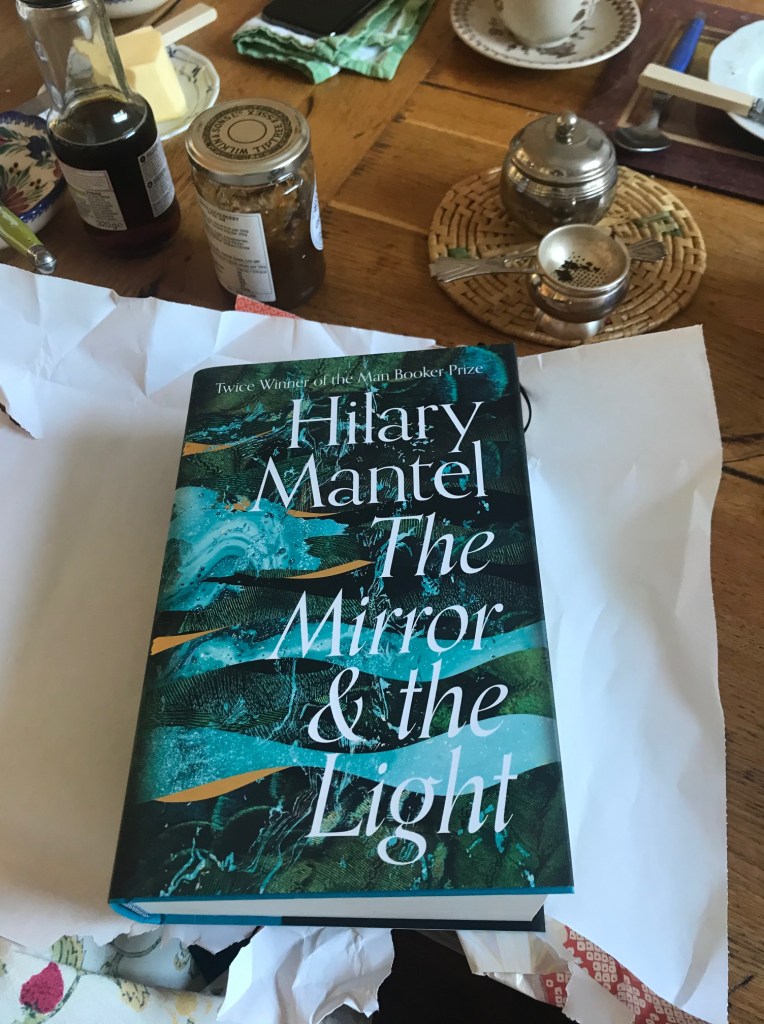
Thomas arrived for my birthday. He had been hinted at, noted, ordered from our local book shop and was wrapped up to serve beside a pot of coffee for breakfast.

Thomas at Breakfast

Hilary Mantel’s “The Mirror and the Light” brings Thomas Cromwell’s life to an end. For three days and nights I managed to resist him, continuing to read an evening chapter from “Jock of the Bushveld” an old favorite book of my mother’s.

But before even a week was over, I had picked up the hefty tome of 880 pages. I said (to myself) “I’ll just take a peek”, as if “I’ll just go for a drink with him. It’s nothing. I can get up and leave whenever I want.” But now Jock is laid aside, and Thomas has my heart and mind. I love him, more than a little bit, and am infinitely in awe of and grateful to Hilary Mantel. I am not alone. Others I know read him in this gifted time of solitude. We will go with him to his end and close the book with sadness.

When Susan Sontag published ‘The Volcano Lover’ in 1992, she went on her book tour. I was fascinated with the history and had lots of questions prepared for speaking with her at KPFA, Pacifica. But as the conversation relaxed and drew to a close, I asked about living alone in New York City. “Are you ever lonely?” “How could I be,” she responded. “I have two thousand years of history in my library.”

Here in London we both have small libraries crammed full of books that we cherish. We are both re-readers, I returning to history while he explores science. Though I’m a one-at-a-time gal there are at least seven books piled behind “The Mirror and the Light”.

My father would have been in his 70’s when I was first old enough to become conscious of his reading habit. And for him, too, this age was a time of re-reading books that he welcomed back into his life as long lost friends.

Saturday morning began in the new quiet, but by noon a helicopter began to circle overhead. There is no Prince traveling from one palace to another, and the air ambulance is hardly needed now that the London streets are almost empty of traffic. This is the police, boys with their toys, circling Primrose Hill and Regent’s Park looking for those, oh no, sunbathers and loiterers. Later, when we take our walk a police patrol car is cruising The Broad Walk. They are not walking to give a face to their presence, nor even on horseback when I might get lucky with a bag full of droppings for the compost pile.

The evening news program brings the government representatives out to the podiums with their daily bulletins. Mathew Hancock, Minister for Health, speaks his coverup nonsense “Maybe the NHS are hoarding gowns and masks which is why there is a shortage.” Priti Patel, the Home Secretary says, as one does when knowing there is a need for an apology but not ready to give ground, “I’m sorry the situation makes you feel that way.” As of this writing 8 national health doctors – all of them UK immigrants – have died. The number of nurses to have died is unknown. Today at over 11,000 deaths, England is set to overtake Italy in the number of Covid-19 deaths.

On Easter Sunday morning, the Prime Minister Boris Johnson was discharged from St. Thomas’s Hospital and driven to Chequers, the country seat of the current Prime Minister. Whatever one feels about this Prime Minister we are grateful that one more life has been saved. And so is he, giving public thanks to the nurses who cared for him; particularly Ward Sister Jenny McGee, from New Zealand and Staff Nurse Luis Pitarma from Portugal – again – immigrants.

Easter Sunday is when some look for a miracle. Not necessarily the one of a life returned, but possibly of the recognition in this moment of gratitude by the Prime Minister, for the nurses, doctors and all staff working in the health service. Doctors may cure but it is the nurses and hospital staff that keep us alive.

Old into New – again

A strange part of all of this is trying to accept that my job is to be out of the way, not on the ‘front line’ – not helping. But what to do? what is next? The table napkins are next, the first one already torn and sewn to make a face mask. I take up a needle and mother’s cotton threads while listening to history unfold itself again.

I bow my head over the work as a gentlewoman would in the Tudor time of King Henry and his Lord Privy Seal, Sir Thomas Cromwell.

This has been A Letter from A. Broad. Written and read for you by Muriel Murch.

Keeping Calm in London Town

“You ol’ rite?”
“Yes, thank you.”
“Not coughin’?”
“No Maddy, not coughing.”
And Maddy gives me a thumbs-up sign before she scurries away to catch an overland train to Battersea and visit her ailing mother.

Thank you Zine

“Do you need anything? Can I shop for you?”
“Thank you Sinder. We are ok at the moment.”
A note is slipped through the letterbox from Zine our neighbor at # 37. “… I would be most happy to help”.
“Aggie, Aggie.” Mr. Habto has returned from his early morning taxi run and is standing by his cab. 

“Anything we can do to help. Please let us know. Knock on the door or leave a note.”
Maddy is probably London born and bred, Sinder is Hindu, Zine is from Eastern Europe, and Mr. Habto a Coptic Christian from Africa. This is the mix of the little community at the bottom of our street. They all have families to care for and yet are finding moments to be watchful over us. We have become the “old folks” on the street. Thus neighbour cares for neighbour in our little corner of London. And we are grateful.

It is Sunday afternoon. The sun will not come out again today. The wind is blowing and the raindrops seem hesitant and unsure where to fall. Families are walking home from their ‘fresh air and exercise’ moment in the park. Football games are still scrubbing along in the mud. White shorts are streaked with brown, hair is windblown and there is quiet laughter coming across the pitches from the players. Out there – the city, London, – is very quiet.

Boris Johnson and his lieutenants appear very old school serious as they stride to the podiums set up in the State dining room at Number 10 Downing Street, while trying to cover up the fact that Number 19 Coronavirus may be beyond their abilities. This may be the first time in his life that Johnson gets really serious, and not everyone is convinced he knows how to do that. We can only hope that he might in fact be growing into the role of Prime Minister and treating this with all with the gravitas it deserves. One does suspect that upsetting the populace is as an important part of the equation as is protecting the insurance companies. Another supposition is that this is seen, by Johnson at least, as his Churchill moment. One can be grateful though that he has these two lieutenants: England’s Chief Scientific Advisor, Sir Patrick Vallance, and the chief medical officer, Professor Chris Whitty by his side. Whitty, or is it Vallance, produced graphs on a large board and pointed away so that the journalists in the room, sitting as close together as ever, could understand what was trying to be accomplished and then relay that information to us, the presumably less well-educated public. Vallance and Whitty are both, in their English way, considerably more competent than the school-yard gang that surrounds Donald across the water.

Daily updates from the government will now come from Number 10 Downing Street as the situation changes every twelve hours with more confirmed cases and deaths. Johnson and his team are putting some guidelines in place while they wait to come down with a heavy hand. It’s a gamble for sure. Health Secretary, Matthew Hancock, sputtered and muttered on the Andrew Marr Sunday morning show about ‘Doing everything we can and self-isolation’. Manufacturers have an opportunity to make millions of Pounds Stirling and ventilators. “Other countries in the world will be needing them too.” Mostly though it is businesses, sports centers, and banks (!) that are leading the way, encouraging working from home, canceling big matches (though not the Cheltenham Race meet last week), and encouraging self-isolation.

And now, on Monday morning, there are more shutters coming down. Museums have already closed, special openings have been postponed, and the British Film Institute team all work from home, strategizing what this means for the film industry in England. We withdraw too, canceling lunch dates with friends and family. Being well over a certain age, 70, we are all ‘vulnerable.’ and many of us have at least one strike hitting our general health. We are being encouraged to self-isolate. What will happen then to the organizations run primarily by older volunteers who serve their communities? As I write an email comes through from one such trusted leader: ‘The Library is closed for the foreseeable future’. What will happen to those books? Sitting on their shelves so lonely and unread. Theatres, cinemas, concert halls, hotels, and restaurants are all growing dark as their lights dim. Today all religious leaders united in asking their followers to pray at home.

Hand sanitizers are out and visible – where they are available. Otherwise, it is serious and constant hand washing – by those who do that sort of thing. Shop-keepers and checkout folks wear rubber gloves to handle the £ coming in. And £s are rolling into supermarkets as folks panic buy and buy. That may have begun to calm down now with ‘assurances’ that the stores have enough of what we need stock-piled somewhere. This morning the pharmacy was full even as folks tried to stay apart from each other. The doctor’s office is closed with a notice on the door saying that appointments will be by phone for the near future! The local Deli and other coffee shops on the street are almost empty. Can they hold on for those over-70s for whom a little sandwich at the coffee shop is their main meal?

Daffodils from Taghi A’s Morning walk

We are grateful for the Hill and Regent’s Park where we can walk in isolation. Wild primroses rise from the soil to shine close to the ground. The daffodils are reaching their peak, staying upright through the foul weather of the last weeks. But the plum and pear trees lining the street are beginning to loosen their soft blooms and whisper in the breeze for us to keep heart. Our Robin Red Breast hops down to check my worm count as I work in the little garden. She too tells me to let the warming soil soothe my soul.

Primrose in St. Mark’s Church garden Wall. Photo WSM

‘Our’ Robin checking my work