The Piazza Santissima Annunziata is almost empty with only a few tourists bearing the late afternoon summer heat while seeking refuge in the churches and museums. Idanna drives straight into the empty Piazza and parks the car. We get out and look around. In the center sits The Grand Duke Ferdinand (from 1608) astride his horse. The horse is facing the little telescope alleyway that leads directly to the Duomo, but the Duke’s eyes, if you look carefully, seem to glance up to two windows, three stories high, on a red building. The shutters remain open so that through the centuries he can look to, and be seen by, his mistress behind them. His arm is raised in salutation to the Pope of the day, or to her – it is left to the onlooker to imagine. On another side is the hospital of the Innocents, an orphanage and museum still run by the nuns from the Sisters di Maria. A small grilled window sits facing the square where – at night time – a mother could – between 1660 and 1875 – raise the grill and lay her new-born babe on the rota where friars, on their night-time shift, sat waiting for a delivery, not as midwives for a wanted child, but as caretakers receiving the fruits of enslaved and then abandoned love. These are the buildings and stories we take in as we make our way to the side door of the Church of Santissima Annunziata, for our friends, Idanna Pucci and Terence Ward have something to show us.

“It is a surprise,” says Idanna after we had stopped at the Palazzo Pucci to pick up the ancient key that would have weighted heavy on the twisted cord belt of a monk’s cassock. Again, her face lights with that impossible grin she has when holding a happy secret. The door is thickly double paneled, over eight meters tall, and the strong wood is sun-cracked. Terry takes the key from his pocket and places it in the single lock.
In the bright late afternoon sunlight the key is reluctant to turn and it takes several wiggles before it catches and the door is opened. We enter the tall cool space of this chapel dedicated to St. Sebastian and now lovingly restored by Giannozzo and Idanna Pucci with the help of World Wide Friends of Florence.

Terry gathers the three red velvet chairs placed in the chancel for musicians together and we gather around as Idanna tells the story. Her lilting voice takes us back to 1082 when a little house of prayer was dedicated to St. Sebastian, then leads us down the path of history through the Middle Ages, the building of this church of the most Holy Annunciation and this chapel, to the paintings commissioned, sold (by one of the unscrupulous relatives) and now lovingly replicated through the guiding hand of her brother Giannozzo. Her voice sings with the joy of the story, coming to when the chapel was reopened and rededicated in May of this year. Idanna is grinning with the happiness of sharing their gift to the city with us. They then lead us around the three major paintings of Saint Sebastian hanging above the alter sanctuary while underneath there are sculpted reliefs of Pucci ancestors, the good and the maybe not so good. Finally we look up at the breathtaking cupola. As we lingered in the beautiful sanctuary a guide from the main church brought in two more visitors to see this sidebar of history. Taking our leave, we walk over the moveable stones that cover the crypt holding Puccis and maybe even a Medici or two. “Have you been down there?” I ask Terry, and he firmly shakes his head. “I have looked. It is a jumble of bones all tossed about, from the flood’. In 1966 the Arno river flooded and swamped Florence ravaging much of the art and bibliotic heritage of the city. The Pucci crypt would be one among many holding places of the dead to be tumbled into confusion and dust. Leaving, Terry turns the key once more in the lock. Walking to the car in the still almost-empty Piazza, I silently said goodbye to the orphanage museum, the Convent of the Sorelle di Maria and the old Duke with his arm raised in salutation.

With our time in Italy we missed the final run up to the UK general election and returned only in time to watch Ukrainian Prime Minister General Zelensky meet his Hungarian counter part, Victor Orbán. Orban, who for six months more is head of the European Union, then went on to chat with his pal Vladimir Putin.

The countries that make up the EU cried ‘Foul, He is not speaking for us,’ but Orbán merely shrugged, figuratively speaking, saying he was just going to listen and hear what each side has to say. He may be dreaming to broker a peace deal – always a good thing to have noted – but his hand is more eager to grasp Putins’ than Zelensky’s. As each Eastern European leader swims across the tides of history pulling and pushing the boundaries of their country it is within our memory to recall Hungarian refugees arriving in England while fleeing their own county’s oppression.
As July 4th – the UK polling day ended – TV screens lit up like a game show as presenters pointed out which constituencies were turning from blue to red with touches of amber for the Liberal Democrats and green for – well – the Green party. But it is the red of a Labour takeover of the country that has prevailed. As Dishy Rishi drove off to hand his resignation to the King, the movers were quickly packing up the Sunaks’ plates and cutlery, curtains and bed linens to take out of the back door. An hour – or is it two – later, steady Sir Keir Starmer was off to Buck House, asking the King’s permission to form another government. The handover has to be quick so the country is not left to its own devices. The moving vans are as quick in and out which is rather lovely, for #10 Downing Street is just an old run-down city house in constant need of repair. The inconvenience of any refurbishments only heightens the impermanence of the position, as power comes and goes and hopefully, while you have it, you can do more than change the curtains.
Sir Keir Starmer has not been idle. The smell of Pledge furniture polish was barely cleared from the cabinet room before he gathered his new team around the oval table and gave them each their work orders for the weekend. There was not an old Etonian among them and there would be no potting shed moments. For some, their bags were already packed to fly out, meet and greet, and start work. The weekend saw Keir begin his trip around the British Isles meeting the other UK government leaders. While with the First Minister of Scotland, Sir John Prescott, the chants from protest marchers could be heard through the ministerial walls before Sir Keir was whisked away past the waving Pro-Palestinian flags to meet the First Ministers of Wales and Northern Ireland. On Monday, he arrived in Washington DC, attending the two day Nato conference, filling his movable dance card with more meetings of world leaders, some who are uncertain about their political future. As Sir Keir enters the stage, others are exiting, stage left or right or hovering in the center holding an unenviable heavy portfolio. While Zelensky can be assured of continued support from the UK, the State of Israel, Gaza and the Palestinians remains out of balance. The elections in France have handed Macron a mixed plate but there is relief that, for the moment, the Far Right parties of Farage in England and La Pen in France, though now more visible than ever, have been contained – but only just.
When thirteen of us gathered together at a Palestinian restaurant on the Marylebone Road, for a Coup 53 reunion and an early celebration of Walter’s 81st Birthday, I looked around the table counting our birth-countries: Sweden, The Caribbean, Finland, Iran, North America, Ireland, and England, and am grateful to break bread in a place of such multiplicity.
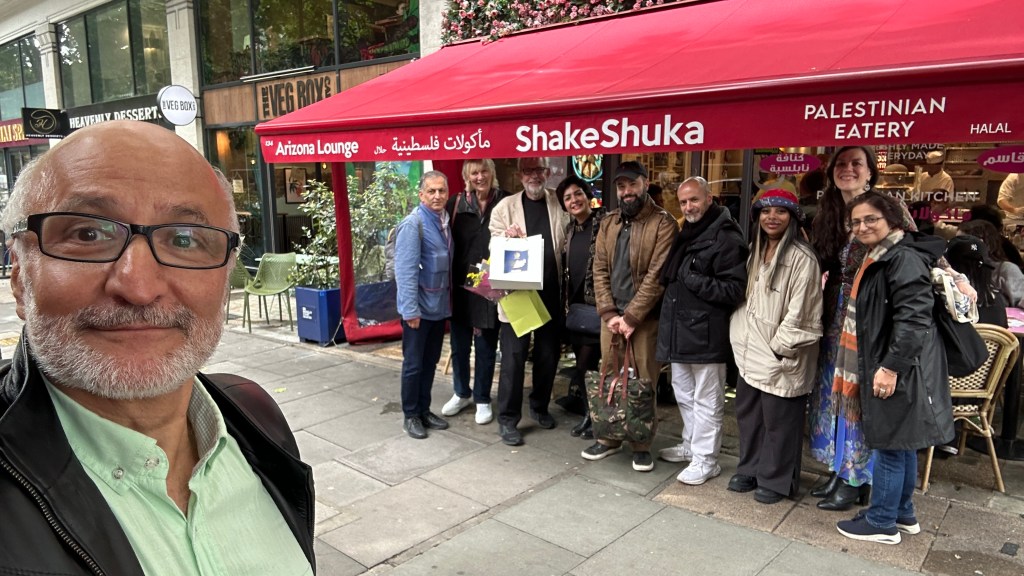
By the closed door of the ladies, I stood with a tall, young, beautiful Palestinian woman just back from the day’s march. “How was it?” “Really good, we were over 100,000 strong.” Smiling together we know that however dissimilar we appear our women’s hearts beat in one accord.
And always supported by Beatrice @ murchstudio.com




 Muriel Murch