Mother Russia amidst Covid19

Recorded and Knit together by WSM

While America turns the ignition key for political movement and change, Russia yanks its hand brake hard bringing dissension to at least a temporary halt.

If Alexei Navalny is to carry on his work, he needs to return to Russia. The price would be high and he knew the Kremlin would come for him. As Vladimir Putin’s strongest critic, in print and on the streets, Navalny has been a thorn in Putin’s side for a long ten years. The Kremlin tried to corral him to silence him, sending out their best guard-dogs to nip at his heels. They herded him into courts, penned him in house-arrests and jail, before finally, in exasperation, tried a botched poisoning attempt by the Federal Security Office, the FSO, that was rebirthed from the old KGB. 

Whenever Navalny decided to return from Germany to Russia he knew the world’s journalists would be following him. Booking tickets on the same plane, they crowded in on Alexei’s last hours with his wife Yulia who must have accepted that this is the price they needed to pay.

What did Alexei and Yulia discuss, that they haven’t already? How far ahead can they look into the lives of their children, the family, his work, and how much can be continued if he were to be silenced forever? They must have known that Moscow’s police service had orders to immediately detain him for parole violations. The question of how long to detain him, where and for what, is a thorny political decision for Vladimir Putin as the world watches. And the world is watching, or rather glancing, for at the moment, there are other players in the world stage this week.

Police officers speaking with Alexei Navalny before leading him away at Sheremetyevo airport on Sunday. Photograph: Reuters

On Wednesday, as this program airs on KWMR the United States is inaugurating Joe Biden as their 46th president and with that act completed the United States and the world stages will change and a new act begins. While Putin may shrug off concerns for world opinion the question still remains for him, ‘What to do with this constant festering thorn in his side’.

Arrested again, Navalny is held and now jailed for a month pending his three-year prison sentence. He was last seen speaking from a holding area surrounded by masked police, and urging his supporters to take to the streets. Though the temperature is 20º below freezing, the sun is shining and his supporters are gathering and protesting for him. But the fear of the Covid virus and Covid restrictions may be enough to dampen support, and Alexei Navalny can be quietly herded into the past tense.

Text messages ping through within minutes of each other on both of our phones. “You have been invited to book for your local First COVID-19 (Astrazeneca/Oxford) vaccine this weekend”  There are instructions, ‘attend alone unless you need a carer, don’t come at all and rebook if you are feeling unwell,’ and more. This is the true excitement highlight of this week. The Belsize Priory Health Center in Kilburn is on the number 31 bus line, but are we up for getting on the number 31 bus? Not yet. Just as we step outside, Mr. Habtu returns home from a client. I tell him we are off to get our vaccines.

There is no hesitancy,

“I will take you.” ‘No no.’ “Yes I will take you. Let me get a clean mask.” and he disappears up to his flat and returns to park his Addison Lee SUV at our doorstep. It is in the kindness of such gestures that we are reminded how much people need to give as well as receive. He is more than happy and we are more than grateful to be driven to and back from the Belsize Priory Health Center in Kilburn.

It is raining. Not hard slogging-down rain but neither is it just a soft rain. The queue stretches out and winds around the cold utilitarian buildings that look older than their years. Belsize and Kilburn all look worn down and even their tiny community garden is hiding in the rain. Umbrellas are needed as we move along from under the overhanging walkway, across the small courtyard, and into the first building. Traffic flow has still to be worked out, as there are check-ins to be done here, questions to answer there, and then another walk – winding around to the clinic building offices. Here we are firmly told where to stand. Nobody is going to get sick on this volunteer’s beat. How many of the staff are volunteers, medical staff from the clinic, or retried doctors and nurses recruited for this effort, it is hard to say. But everyone, before noon on Saturday, is still upbeat and kind. Across the country, health centers, pharmacies, and even cathedrals are rearranging the furniture to become vaccination centers.

The health scares of smallpox and polio with their vaccination programs for children that followed in the 1950s are strong memories from our childhood. Now those children, including ourselves, are the vulnerable seniors, once again waiting our turn and grateful for science to save us. From self-isolation at home, Health Secretary Matt Hancock announces that vaccinations are now available for those 70 years and older and that as of today over four million people have had their first vaccination in the United Kingdom. Though the UK death toll from COVID-19 is still rising, the number of new infections in London is down 30% and there is a glimmer of light at the end of this tunnel. 

People queue outside Salisbury Cathedral, Wiltshire, to recieve an injection of the Pfizer coronavirus vaccine.

This has been a Letter from A. Broad. 

Written and read for you by Muriel Murch 

First aired on Swimming Upstream – KWMR.org

Web support by murchstudio.com

Classroom Chaos to Lockdown

Recorded and Knit together by WSM

Classed as a vulnerable senior, I was muddled as to where and when I could shop. But all that is clear now. A total lockdown has been announced across the United Kingdom lasting through to March. Thanks in part to pressure from the Teachers’ Unions that weighed in alongside the scientific community and made the government sit down and listen. As another, even more, virulent strain of the COVID-19 virus arrived from South Africa, the health minister Matt Hancock said ‘things are about to get harsh and complicated.’ and I’m almost feeling sorry for him. The view of the bumpy road has now become seriously clear. There are potholes of bankruptcy, illness, and death ahead.

Along with the national lockdown comes the news of the first Astra Zeneca vaccine being administered in Oxford. This, added to the Pfizer vaccine, is being delivered to care-homes, hospitals and doctor’s offices. Now it needs to get out to the public quickly. There is a tier system set in place and the beginning of a plan to administer the vaccine that could see the United Kingdom relatively safe, for the moment.

It was clear, as the Prime Minister began the New Year on Andrew Marr’s Sunday political program, each jousting with the other, that the Prime Minister had not done his homework of reading the June report that all of this – mutations of the virus strain, rising cases, and death tolls – was bound to happen this winter. Figures seem to be difficult for Boris and the absence of preparedness, one suspects, a life-long trait. That darn dog is always eating his homework. The BBC has to be a bit careful, so Andrew had to mind a P and a Q. But the director of the show has, I believe, a strong impulse to buck his traces and more than once showed a full-shot rear-view image of Boris at the round table. For a moment we were spared the frontal head of hair but now we see the look goes from top to tail and there are bare legs under rumpled sagging socks. It is a look that when Boris utters the words, “Believe me,” my response is immediately: ‘No’.

This week also brings up the case of the extradition of Julian Assange to the US. To avoid being sent to Sweden for sexual assault charges, always meaty fodder for the British tabloids, Assange fled to the Ecuadorian Embassy in London in 2012. Sweden eventually dropped their charges but the US still wants him for WikiLeaks’s publication of leaked documents about the Afghanistan and Iraq wars in 2010 and 2011. Assange has been in British custody since April 2019. His lawyers argued that to send Assange to the US would rewrite the rules of what was permissible to publish in Britain.

“Overnight, it would chill free and open debate about abuses by our own government and by many foreign ones, too.” The judge ruled that the risk of ‘suicide’ should Assange be extradited to the US was high and that he should remain a guest of Her Majesty’s Government.

Which is of interest to journalists and filmmakers alike. Early on this program, you will have heard from Taghi Amirani and Walter Murch about the relaunch of the documentary Coup 53, the story of the overthrow of Prime Minister Mohammad Mosaddegh in Iran in 1953. Because of Covid, the film was released in 118 cinemas and digitally in August of 2020. There was – to put it politely – a huge outcry from the makers of Granada Television’s ‘End of Empire’ series which aired in the 1980s. Huge. To their immense credit, the Coup 53 team battled on fighting every false mud-sling that was thrown over the film. And good people have stood up beside them which is always reassuring and has made a serious difference to the film’s outcome. 

Which of course then takes us to Donald Trump and Georgia. Where to start with this one? It was unbelievable, that word again, when on the Ten o’clock BBC news we listened to the tape of Trump speaking with the Georgian Secretary of State. 

Seville Oranges, waiting

So where do we go for lighter news, sunshine and comfort? Why to Spain. As every English housewife knows, the only oranges to use for making marmalade are from Seville in Spain. With their rough skins, bounty of pits and high pectin content, they are the only oranges to use. Making marmalade in January is an ancient tradition and ‘older people’ (the youngsters a mere 75) write into the newspapers to say how much they have made this year. My mother made marmalade and now I do too. It is, though I should not say it, the best marmalade I know and, naturally, requires two piece of toast at breakfast rather than just one. 

In June of this year, Isambard Wilkinson reported for The Times on a delicate task that recently fell to the head gardener at the Alcázar royal palace in the southern Spanish city of Seville: Manuel Hurtado, a senior official from the palace confirmed that this was the first year of reintroducing this ancient custom of choosing the oranges for the Queen’s marmalade. This gift, is harvested from the Poets’ Garden and the Marqués de la Vega’s garden, whose trees bear the most and best oranges.”

From The Times. The Alcázar royal Palace and the Marqués de la Vega.

But now what will happen with Brexit? Well, that small little rock of Gibraltar is coming in very handy now. An ‘agreement’ has been reached whereby Spain and England can have congress in Gibraltar, and with that, Parma Ham and Seville Oranges may reach our shores once more.

This has been a Letter from A. Broad.

Written and read for you by Muriel Murch 

First aired on Swimming Upstream –KWMR.org. Web support by murchstudio.com

Mutant in Tier Four

Recorded and Knit together by WSM

On our Sunday walk through the park, people were in groups of families and friends, mostly unmasked as if to say, like Scarlett O’Hara, “I’ll think about that tomorrow.” And then in the depth of mid-winter, Monday’s Solstice came, with the dawning of understanding that England is now closed well into the New Year. The clouds are rain-filled and hang low in the sky, dripping like a slipping tap. And there is no way we can see the great conjunction of the planets, Jupiter with his train of moons and Saturn with her large rings.

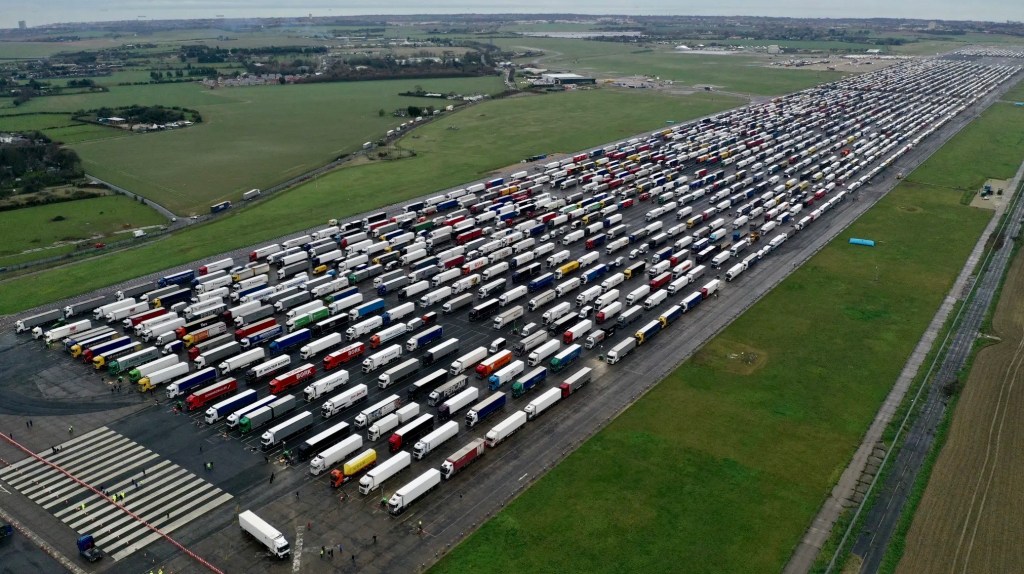
Trucks in Waiting in Kent

Between Brexit and the new mutant strain of COVID-19, the rest of Europe is firmly closing its doors on trade and travel with England. Albeit ‘closing the barn door after the horse has bolted’. The mutant strain of COVID-19 is now found in six countries while 40 countries more have banned travel to and from England. The blinding vision that Boris Johnson, and all who sail with him, carry – that England would become a hub of commerce – have not just faded but imploded. Great Britain, in the eyes of the world, is now Little England. Who is being served here? Certainly not the European, Scottish and English fishermen, nor the lorry firms’ haulers or container-freight drivers from Europe or the UK. A six-hour queue on the motorways in Kent is now the norm, and the book of Brexit is not yet closed. News broadcasts announce that ‘there will be gaps on the supermarket shelves within days. A shortage of lettuce,’ they say. But who on Earth is choosing a salad over hot winter vegetable soup in these dark, wet, days. But we will join the rest of the country stocking up as best we can for our non-existent Christmas and into the Bleak Midwinter New Year. We go to our familiars: the supermarkets that are close to our feet and bank accounts, and we have now become the old people, moving slowly, peering at this and picking up that. Six crumpets at 30 pence a packet are still the best and cheapest comfort food on the shelf. And the wine, well we could always do with a bottle or two more.

Much of England’s dismay is the understanding that – once again – the UK government has not been telling, ‘The truth, the whole truth and nothing but the truth.’ The mutant strain of the COVID-19 virus was first discovered in Kent in September. Sir Patrick Vallance, the government Chief Scientific Adviser, spoke of it in October, and still, in November the government announced a five-day break of isolation over Christmas. Last week there was a “Oh, sorry about that, our whoopsie,” before a rushed reversal, clamping down to a one day Christmas holiday with no more than six people and no granny or grandpa visits.

In Tom Chivers’ December 21 article in UnHerd, ‘How dangerous is the Covid mutation?’ he writes of his family’s efforts to do the right thing before – thank you – explaining about mutations in a very readable way.

While Health Secretary Matt Hancock repeats: 

“It’s all very difficult.” But is it? Hie Min, the dance choreographer from Taiwan writes that life there is now almost normal. What did they, and other nations like China, Japan, New Zealand, and Vietnam, do? Apart from mask–wearing, social-distancing, super-hygiene, and testing, they closed their borders and contained themselves. And they thought of the collective good over their personal wants and needs.

Murch Mince Pies

Despite the lock-down I cannot help getting twitchy in the kitchen (as an American friend says about his Swiss wife) at this time of year. And so I buy dried fruit, mince-meat, more flour, eggs and butter, and bake for hours. But I’m not the cook I was and one burnt Dundee cake found its way to the compost pile where it will become soil for next spring. There is a little COVID-free cluster in this cul-de-sac bringing neighbors together as we all look out for each other. My husband watches with some concern as another plate of Mince Pies or Biscotti goes out the door into grateful hands and brings a smile to another drawn face. But there are always the crumble bits – which long ago Uncle Harold taught us have no calories.

There are more knocks on the door, as gifts and secrets (can you wrap this for us?) arrive from family and friends. This morning there is the mail from America, our letters from abroad. I open it eagerly, for among the  constant bills, is always a note from our son. This one says that the old Christmas Lights from eons ago are hung on the windows and a wreath of welcome hangs on the door. The gratitude that we feel when Dan the postman knocks on the door and, with a smile, hands us our letters, makes me wonder if this is how it felt to receive mail packages from the ships in past centuries, when families were taking great leaps into far-away countries, and letters from home were a reminder of what they had left behind: their families, the good, and the terrible times. Those leaps are still being taken by families from over the world. News may not come in letters, but phone calls – even emails – will still contain the same messages: of hope, of longing, some truths, some not-quite truths, some requests, some reassurances and news, good or not. 

As of this weekend it was not known if the Queen had written or recorded her Christmas message to the nation and commonwealth. It is hard to imagine what she must be thinking about this government. A good hearty wield of the ceremonial sword would not go amiss in these times. Her unprecedented message in the middle of the first lock-down helped us all see this through but now there is a deeper malaise, a sadder push and pull to us all in the country. We will listen to her carefully-chosen words on Friday, and hope that she can give us all the strength and courage to Carry On.

This has been a Letter from A. Broad. 

Written and read for you by Muriel Murch 

First aired on Swimming Upstream – KWMR.org. Web support by murchstudio.com

Losing

Recorded and Knit together by WSM


Late afternoon becomes early evening with the December drizzle falling softly as I turn from Marylebone High Street onto George Street on Saturday afternoon. Sitting and rocking on the ground outside of the metal railings surrounding St. James’ Roman Catholic Church, sits a woman. I have seen her here before. Reaching into my pocket I check, that yes I do have some coins ready and waiting. As I bend to give into her old paper coffee-cup she beams up at me with such an engaging, albeit tooth-shy, smile that we talk.

“Do you have somewhere to sleep?”
“Ooh yes they are very good to me, I am so grateful. But I do have to buy my own food.” We talk some more about accommodation at this time and then I ask her,
“Where are you from?” and have to ask her to repeat herself.
“Russia. I am from Russia, then I spent several years in Switzerland but they let me come back here and I am (she repeats) so grateful.”

She is smiling all the time, and rocking from side to side and I wonder at her story. So many Eastern European women came to Great Britain, and America, looking for a refuge, a better life an escape from what? I wondered. They were all working women in one way or another. Some got lucky, were successful if you like, such as Melania Trump who started life as Melanija Knavs of Yugoslavia, then Slovenia, and finally, at the moment, the United States of America. While some, like this smiling lady sitting on the pavement outside of a Catholic church in the soft rain and evening light, were not. But she looks like she will make it through the winter, though you never know.

It was only sixteen months ago that David Cornwall, John le Carré, was sitting beside me at the theater for a friends and family screening of Coup 53. It was wonderful that he came to see the film, understood so clearly the behavior and involvement of MI6 and the CIA in the take-down of Mohammad Mosaddegh. His understanding and wholehearted approval of the film led to him giving the team his total support and some wry comments of what to watch out for: “You have no idea how deep they will go.” In the subsequent months his remarks proving remarkably true. But as well as government coups, we talked of grand-children and the new best next love affairs in our lives. The news of his death on Sunday came like the news of a friends death and in the outpouring of tributes to him, so many said the same. His joy in writing was evident on every page. His literary skills were honed like a fine musician playing his instrument: piano, saxophone, violin or words on paper.

Photograph: Rob Judges/Rex/Shutterstock

On Sunday, over a dinner of scallops and turbot, discussions between Boris Johnson and Ursula von der Leyen took place in Brussels. They were described as ‘lively and frank’ in one paper and Johnson as unbelievably arrogant in another report found on Twitter, that did not make it to the papers. But Ursula held her ground against Boris and after his incredible outburst of rudeness the turbot was dispatched quietly and quickly. It doesn’t sound as if desert was on the menu. There were ten minutes of discussion after supper, some separate statements were sent out, “Very large gaps” are said to remain between the two sides, according to a No 10 source. Von der Leyen said the two sides’ positions “remain far apart” and that their teams will reconvene to try to resolve issues: and then it was away and back to their rooms. Was it Saturday that Boris suggested bringing in the Royal navy to patrol the UK Waters, and Ursula had spoken with a subdued but visible smile of the UK’s wish for “Sovereignty, if you like’ and by Sunday, when the discussions were supposed to stop, both sides had agreed to carry on.

Johnson was not happy when blocked from talking with Angela Merkel and Emanuel Macron, as he tried to weasel his way around from meeting with Ursula. Ursula, as head of the European commission, has done a fine job of herding cats, as in twenty-seven nations, to one agreement. After the Sunday phone call exchange, “I’ll call you,” the EU and UK have promised to go the extra mile. Johnson seems at a loss with this strong and immaculately turned-out attractive woman. It is hard to separate the personal man from the political and when he did put forward sending the navy out to protect British waters, the public embarrassment crosses generations and classes. In past interviews Le Carré has spoken of his time as a teacher at Eton School.

“What you have to understand about the Etonian is that he is not taught to govern, he is is taught to win.” And as Malaparte has said, “Everyone would like to win but not everyone is capable of losing.”

Meanwhile the COVID-19 vaccines are beginning to be given in England. The few pictures of seniors in wheelchairs may be cheerful but are not yet reassuring. London and large parts of the North of England are heading back into the Tier 3 restrictions this week and it looks like there are rough waters ahead. Health Secretary Matt Hancock asks for caution when doing what we have all been promised we can do, travel to visit family. Winnie the Pooh’s bouncing Tiger has turned to a sad Eeyore and understandably so.

This has been a Letter from A. Broad.
Written and read for you by Muriel Murch.

First aired on Swimming Upstream – KWMR.org. Web support by murchstudio.com

Arrival

Recorded and Knit together by WSM

As I write, the first of the vaccines for the COVID-19 virus are being administered in 70 hospitals throughout the United Kingdom. Margaret Keenan, who will be 91 next week, received the first of the 800,000 doses that have arrived. 40 million doses of the Pfizer/bioNtech vaccine are on order to be delivered to the United Kingdom in the coming weeks.

The vaccines were made by the husband and wife team of Professors Sahin and Özlem Türeci at their German firm BioNTech. Professor Türeci’s father had come to Germany as a refugee from Turkey and found work as a mechanic at the Ford factory. When Sahin was four years old the family followed and the immigrant refugee family settled in Germany.

Last week England came out of lockdown from the Coronavirus while this week much of California enters it. So the virus wings about through the world. The World Health Organization is scrambling to keep the regional information current. Each country and region looks for different ways to combat the virus and it is clear that countries led by women leaders have fared best thus far in their handling of the COVID-19 outbreak. One could argue that those are ‘small countries with manageable numbers’ or one could say ‘those are women who know how to think of more than one thing at a time.’ Other women, in government, or opposition, are also organizing their worlds, fighting back against right-wing oppressive governments. And mostly they do it in tandem or groups: Marta Lempart, a co-founder of Polish Women Strike has been battling the latest anti-abortion laws in her country laid out by the government and the Catholic Church.

Martha Lempart picture from the Financial Times

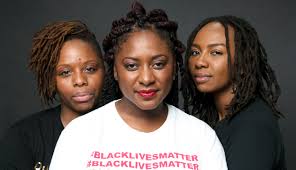
The team of three Belarusian ladies work together even as they are physically far apart. Patrisse Cullors a co-founder of Black Lives Matter says the obvious, “No movement has one leader. It never did and it never will.” Maybe this is something women understand clearer than men.

Patrisse Cullors

Due as much to science, and the infection numbers coming down as to the Christmas retail needs, London is buzzing again. Shoppers are out in such force in the West End and Knightsbridge that over the weekend four arrests were made outside of the Harrod’s department store, while the crowds of mostly young people, struggled to shop ’til they drop. And some sadly will. Even in our little corner of town, people are shopping, clustering at coffee shops and spending money. I am too, being careful and almost guilt-free in my efforts to support the local economy. But the empty shop windows in the high streets strip the phrase ‘shutting up shop’ of its humor as workers lose their jobs. What is the key to shops staying alive? Beyond getting savvy with the new online way of buying and selling it has to be related to those who own the real estate underneath the buildings. If the rents and taxes can be managed then the shop has a chance to make it through.

Boris Johnson and Rishi Sunak know all this of course and must look to whose bread is to be buttered.

So again I ask, why are the UK and European fishing rights so important when all the seafaring European countries have been dipping their oars and nets into everyone’s waters for centuries, and who, for goodness sake owns all the boats and fleets? It really is a medieval moment, without the costumes. There is a news outlet ‘Unearthed’ that digs into this to the point of making you despair at anyone with a net and a trawler not being a pirate.

As Boris rushed from congratulating 81 year old Lyn Wheeler for getting her vaccine jab at Guy’s Hospital onto his next stop, Brussels, one had to wonder about the UK’s group of small and wealthy elite. Maybe understanding their concerns is the beginning of the answer to defending ‘Our sovereign rights’ as opposed to ‘workers rights’. It is hard to find anyone writing or talking about Off-Shore banking. Those little Islands close by, of Man, Jersey and Guernsey and further afield like Bermuda, that hold the banks that are happy to take your funds and ignore reports for UK taxes. Even as I pay my UK taxes to Her Majesty’s Government I then pay the tax ladies’ bill into their bank in Guernsey! The small and wealthy elite are rushing to come out of the European Union before those EU rules and regulations come snooping into the Islands.

An Obituary in the weekly local Camden Newspaper said of a lady who had died at 103, ‘She used to be a fine cook in her prime.’ It made me pause and wonder what and when is ‘prime’? Cooking is a part of who I am, it is a joy and often an adventure. Someone else wrote, ‘My Kitchen and I work in harmony’ and I know that, as one ingredient or dish of left-overs leads into an old favorite or a new creation to place on the table. Grandma Murch would cook her oatmeal cookies whenever someone came to visit at her home in 1 Vermont Avenue in Toronto. Those cookies, from the old Quaker oatmeal recipe, are the ones I made for our children and now at least one daughter makes them for hers.

Four generations of Quaker Oatmeal Cookies

The Christmas lights are on and the birds have gone to roost. Maybe it is time to pull out that oatmeal cookie recipe once more and put the kettle on as the light fades before tea-time and all is dark outside.

This has been A letter from A. Broad.
Written and read for you by Muriel Murch First aired on Swimming Upstream – KWMR.org. Web support by murchstudio.com


Shutting up Shop

Recorded and Knit together by WSM

Factory workers and university students have now joined the rota of protests in Belarus now working in daily shifts, slowing the country’s economy down hour by hour, adding their voices to the opposition of President Lukashenko.

In Poland too, the women have had enough. The latest change in the abortion laws – stating that even when the fetus is diagnosed with a serious and irreversible defect – abortion is now illegal, is seen as the last tightening knot against democracy, and there is a growing anger at the Church’s complicity in this ruling. The strikes are led by women in the work force, housewives will no longer keep house, and more women than are counted have ‘Shut up Shop’ – completely. 

While Belarus and Poland protest, France mourns and prays as the attacks by ISIS extremists continue. With night-time curfews in France, Spain and Italy no-one knows when to have dinner.

Most of Europe now recognizes that each country’s initial ‘me-first’ reaction to COVID-19 didn’t help countries individually or Europe collectively. Belgium, Germany, France, Italy and Spain are now opening their borders for any needed treatments of COVID-19 patients. While England goes into Lockdown for four weeks. There is an old adage in medicine, “Timing and Dosage” which applies to everything we try to do. Everyone is struggling and, unlike Asia, no European country has succeed thus far in controlling the virus.

Here on Thursday all non-essential businesses will close for another month. Shutting up Shop has never felt so poignant. We tend to look inward and not venture too far afield. While the first wave of COVID caused a lot of closures and adjustments there were also new beginnings. Now there are six pubs within less than five minutes of our front door: The Pembroke, The Queen’s, The Lansdowne, The Princess, The Engineer, and finally The Albert which has reopened after four years. The opening of The Albert took place on Friday. A handful of locals gathered outside and Andrew Marr, of political inclination, declared The Albert open and joked that this was the most important thing he had done all year.  Cheering and clapping on the corner of the street, but it too will close again on Thursday. 

The Albert is ‘Declared Open’ by Andrew Marr. Walter Murch, Phil Cowan, Line Copper are among others present. Photo credit unknown. Thank you.

While walking through the modern complex of shops and high-rise apartments at the Tower complex I thought of our friends Hwai-Min LIN and Hsun CHIANG who had been gifted an apartment there for this summer. They arrived in February, and left in March. “The English are crazy, no masks no distance.” They very sensibly fled to the safety of home in Taiwan.

We had been nervous of going to a theater in these COVID Times. And maybe that is what these times will be known as – These COVID Times. But I snagged the last two seats available for a Saturday afternoon matinee at The Bridge Theatre. We were to see a one hour monologue of David Hare’s “Beat the Devil” performed by Ralph Fiennes.

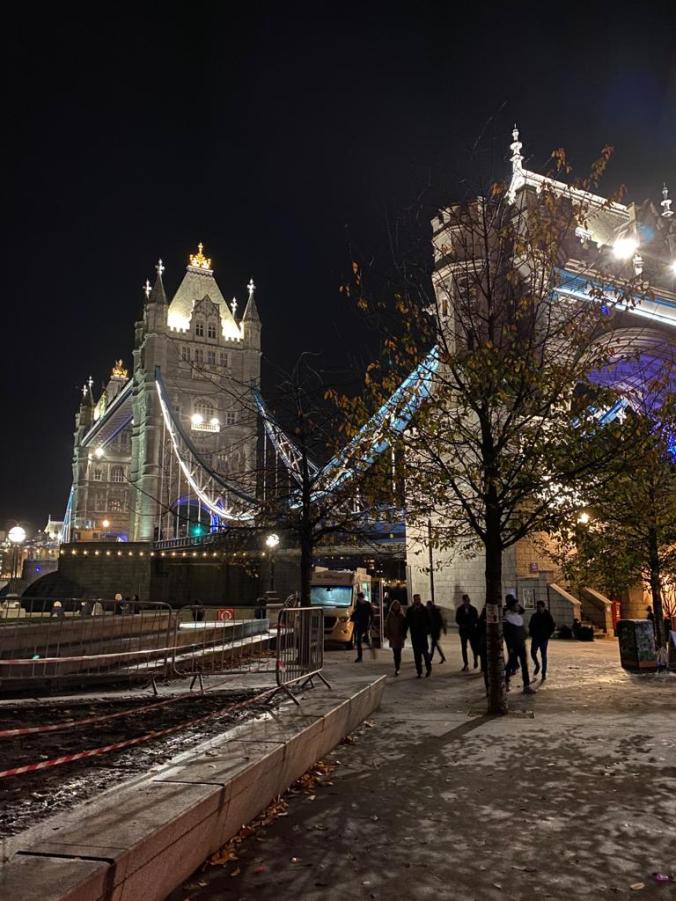
Tower Bridge. Photo by WSM

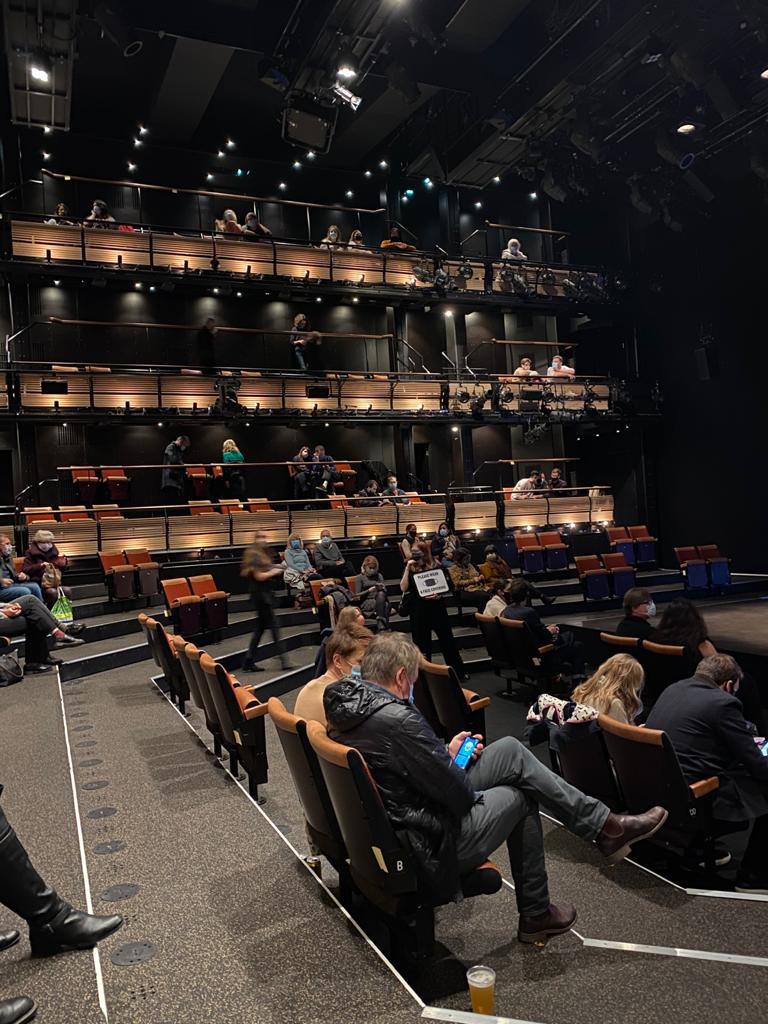
How wonderful it was. And how brave. The Bridge Theater shines as a beacon by the Thames River and is looked down on by Tower Bridge. Across the river stands The Tower of London. Old and New London within a cricket ball toss of each other. The entrance doors of the theater are open, we have a window of time within which to arrive. Masked attendants guide us through the temperature check, check our tickets and show us where to go. The loos are easily accessible. The theater seating looks as if it has been prepared for an orchestra, so many seats are missing and spaced apart.

Getting Settled at the Theatre. Photo by WSM

More staff come by for bar orders, another holds a glowing “Please wear a mask” sign and – if someone leaves their mask down for a chat beyond a sip – gently goes to remind them of their collective responsibility. The mask notice supplanting the ‘please turn off your cell phones’ message. At first I wonder, what on earth is it like to perform to such a sparse house? Does it feel provincial, like stepping out on the boards for the first time, trying to make your way in a flea-bag pit. But this is not that and soon after our ginger-beer drinks arrive the audience buzz begins. It is the same hum of excitement the same music of expectation, as if the audience is indeed in the orchestra pit and tuning up as musicians do. The hum grows, but then – the lights dim – and a hush comes over us all. 

Ralph strides onto the stage and loudly places his props on the table, claiming the table and the props as a supporting cast. He is the magician who will hold us in David Hare’s mind with his fears of the disease, his anger at the government’s handling of it all, and his heart’s rage at the treatment of the NHS nurses. He longs for a gentle ‘Platonic disease’ while later realizes that “The Virus is always with me now.” The septuagenarian is there, twisted in Ralph’s body now sinewy as a maturing cockerel.

Under the London Bridge Photo by WSM

When the play was over, the applause was wondrous and we left the theater uplifted as art moves us, brings us closer to each other. As the audience goes their separate ways, we share that communion and feeling of belonging within this city.

Under the night lights we walk along the river finding our way back to the little enclave of Primrose Hill. It is time to try out the newly opened Albert pub for a half pint of cider and an elegant Ploughman’s supper bowl. It has been too long since I’ve crunched a pickled onion. 

This has been A letter From A. Broad.

Written and read for you by Muriel Murch

A Few Good Men

Recorded and Knit together by WSM

As the wind whips up the autumn leaves along the bottom of the hill children are tossing them over each other as if they are snowballs. Their father stands patiently by the stroller, smiling as he allows his family to cover him with the yellow leaves. The clocks went back, the temperature is dropping, and blue skies struggle to be seen between the grey rain clouds. I reach the bus stop just as the number 274 comes along. I have an appointment with Nick. Following Covid guidelines, the salon remains quiet and his clients come in one by one. Soon a petite, sparrow-sexy lady of beyond my years enters. Socially separated, she settles in beside me for her biweekly shampoo and blow dry. I watch these two old friends sharing the news of the past weeks as best they can through their blue masks. Nick works steadily, caring for her and she relaxes under his touch.

Returning home the weather is squally. Walk, bus and walk again, along an alleyway between Mornington Cresent and Delancy Street, where an old man walks slowly towards me. Politely he stops to give me some distance on the pavement but in truth he has to pause. He is short of breath and is not sure in which pocket he will find his house keys. Then a lithe tabby cat crosses ‘his’ road – slowly – with ownership. At the pavement he leaps lightly to the railing that protects the house, and the stairwell to the basement flat, from the street. A window faces him. He calls – twice – loudly. The lace curtain flutters, the window-sash is raised and he bounds inside and out of the rain. The window closes behind him.

I hurry home to make supper. ‘My Kitchen and I are in good harmony’ wrote a chef, and I understand. One meal leads to another in a simpler way than the frantic cooking of early lock-down. Now there is just a weekly foray into the unknown. Chicken Pot Pie is the challenge for tonight.

Chicken Pot Pie for supper.

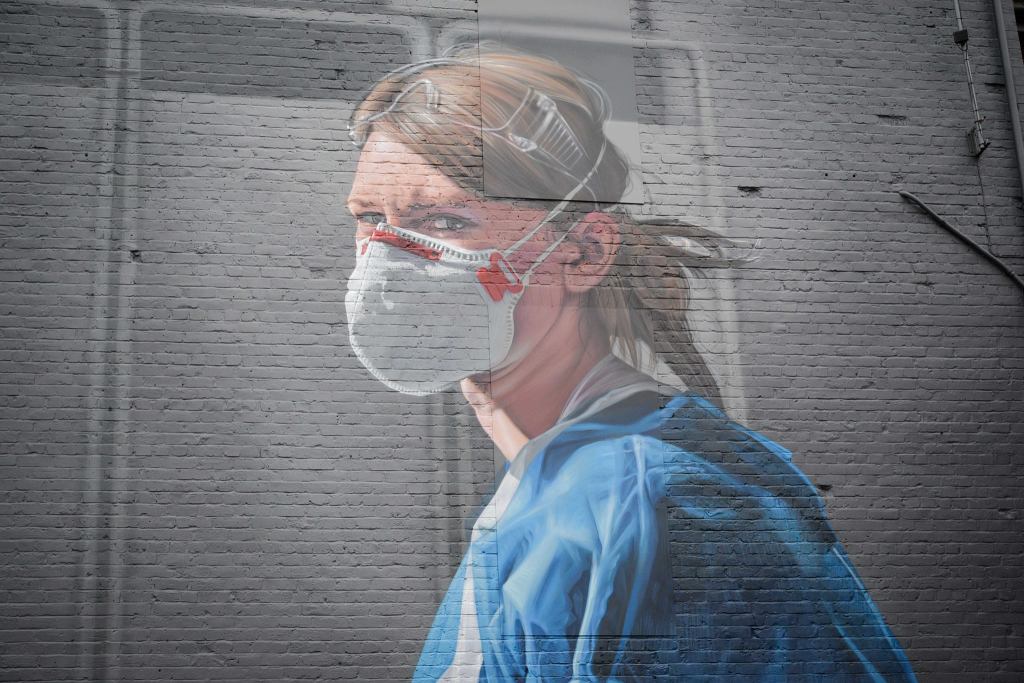
Nightly we watch the steep lift in the graph curve of the COVID-19 infection numbers in Little England. Throughout the country hospital staff are still feeling bruised as no-one seems to have caught their breath from the first wave of this disease. This summer the Duchess of Cambridge called for photographs taken during lockdown. Now 100 chosen photos are on display at the ‘Hold Still’ exhibit at the National Portrait Gallery. ’Melanie March 2020’ was photographed by her colleague, Johannah Churchill, and now mural artist, Pete Barber, has painted her for the High Street in Manchester. The picture depicts what no one wants to return to.

Image from any of the many sources

Each corner of the country is metered out a different set of government rulings. People are confused, angry and frightened and not always sure of what or at whom. The rulings leave poor people struggling more than before while big businesses find lucrative loopholes.

Half-term has begun which means that school children are home for two weeks. Marcus Rashford, the 22 year-old English Football player, (who may yet have me watching football) petitioned the UK government to continue providing school meals to children whose families are in need over the holidays. The government rejected the petition. But all over the country, local restaurants, big and small businesses are supporting Rashford in providing lunch-meals through this half-term holiday. Speaking to BBC Newsnight, Rashford explained: “Growing up we didn’t have a lot, but we’ve always had the safety net of the community. That community was my family.” For those of us who live in communities we get it. News flashes show Marcus doing the heavy lifting with crates of food and Boris, softer-spoken today, holding a loaf of sliced bread. For now, and long haul, I have my money on Marcus. At least we know he is playing for Manchester and England.

Marcus Rashford helping out.

Meanwhile those restauranteurs looking for help have found a ‘Working Lunch’ loop-hole in the regulations for the Tier Two restriction areas, which includes London. One paper wrote ‘You can meet colleagues and people from other firms but you cannot take your mother to lunch. This is a conscious choice by the government to save jobs and livelihoods.’ The following tweets are full of British humor.

Somewhere, buried in this school meals and business lunch storm the Brexit discussions are still taking place. We don’t hear much about them. Fishing rights, like the Irish borders, remains a close-fisted problem of long standing. The French fishermen have fished in the waters of La Manche for centuries and the French government says nothing should change. The UK government is adamant that things will change. This game of chicken could end in a messy chicken salad sandwich.

And then comes Sunday. I confess to be ‘busy in the kitchen’ for some of Andrew Marr’s Political program. The strident tones of host and guest are upsetting and not good for digesting breakfast. But then I hear a calm voice. Andrew too is calmer. It is Dr. Fauci answering questions on the Corona Virus, and, politely sidestepping political jabs, he guides Andrew out of the gutter where he tends to slip speaking with the English politicians at his disposal. There is even a ‘I don’t know the answer to that.’ Politeness, calmness in the face of such needless suffering and death and a gentleman holding his own. Tears come to my eyes at the sight and sound of him. Surely a few good men is not too much to ask for.

This has been A Letter from A. Broad, written and read for you by Muriel Murch.

Better to Give

Recorded and Knit together by WSM


It is crisp cold on Saturday morning for our hill climb to the Farmers Market. Mushrooms are laid out in small cardboard boxes at one stall while the last of the tomatoes at another. Large Mozzarella balls are two for a tenner. The Italians know that the season of Tomato, Mozzarella and Basil salads is ending. Rutabagas and Swedes are piled in crates looming over bags of potatoes. Winter is coming.

On Sunday we walked through the Italian gardens which every autumn, holds the outdoor Frieze Sculpture exhibit. This year there are more people than ever crowding the sculptures, reflecting a collective hunger for art. In this time of Covid restrictions people remain wary of indoor galleries and museums. Every year, I find one piece that speaks to me. This year, it is Kalliopi Lemos’s ‘The Plait’ A very tall braid of wire signifying a chopped-off braid of hair.

The Plait by Kalliopi Lemos Photo by WSM

And I am remembering my friend Heather and a sunny morning after a sleep-over. Her family had left Kenya abruptly and my mother had found them a place to live by Hawley Lake. There was no electricity and water was carried from the lake. My mother got Heather enrolled in St. Nicholas School and must have ferried us both back and forth to school. There were sleep-overs by kerosene lanterns and adventures by the little stream that ran past their cottage from the lake. But at our home we woke up one morning wanting to play barber. My thick hair was down to my waist but the plaits were kept knotted at night. Mornings were spent in tears with the rushed, brushing, pulling and replaiting that happened.

“I’ll be the barber” said Heather and I happily knelt in front of her.

Somehow she found scissors, maybe old paper scissors from my father’s study, as, when my plaits finally fell away, there was a clear unevenness in the line. Knowing that whatever trouble we got into I would not be spending morning in tears left me elated. All this passed through my mind as I stood looking at the giant wire braid in the park. Lemos explains “an act of disobedience and emancipation of thinking … a liberation’.

Kalliopi Lemos Artist photo by WSM

Looking at all the different people walking through the park broad-walk I am thinking of war and all the countries they came from. Now journalists have been expelled from Belarus and it is hard to image what is going on behind those iron doors.

Earlier this year, when the demonstrations began in Hong Kong at the Chinese government’s take-over laws, Dominic Raab, then Foreign Secretary for the UK government, announced: “We will take in three million residents from Hong Kong who want to come.” There must have been hurried discussions behind closed doors for there is no ‘Welcome to Britain’ flag waving at the airports.

But Nathan Law, a 27 year old activist, made it. When agreeing to give an interview to Samuel Fishwick from the Evening Standard, he chose a bench in Regent’s Park which looked to be along the broad-walk where we were walking. Law was imprisoned, assaulted, forced to leave his home and family and lives low in London. Though he fears for his life, he knows someone has to speak out.

“The Hong Kong we knew has gone”.
“Will your family know how you are?”
“If you write about me they will find it.” But unspoken is the knowledge that so will others. Can Britain give this young man the safe haven he needs?

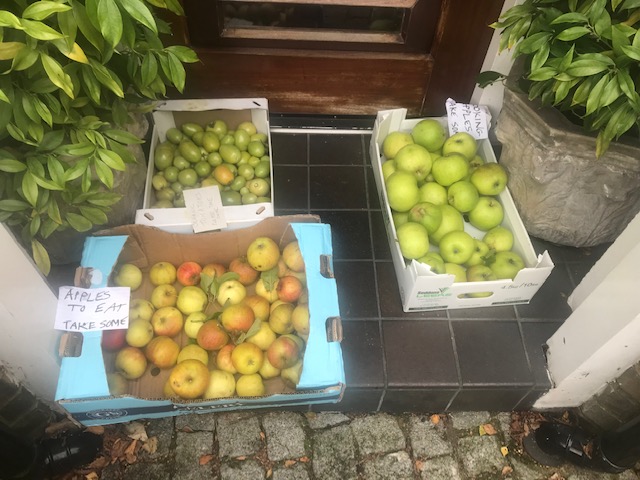
Autumn is a time of overflowing bounty. A neighbor on our street brings the harvest of her Oxford garden to London. Boxes of Bramley cooking apples, Cox’s Pippins for eating, and those pesky green tomatoes that refuse to ripen are on her doorstep for anyone to take. I gather them as from orchard grass and now can bake to pass along to other neighbors.

Doorstep bounty

We continue to do what we can for each other as this next round of COVID-19 circles us. Daily 12,500 new cases are reported and tonight brought another set of government rules to learn and abide by.

I imagine our Queen as she follows the news and watches her people doing what they can for their country. Maybe she keeps a note-pad on which to jot down names and pass them on to her Prime Minister of the day for The Birthday Honours list usually in June, when the Queen celebrates her official birthday. This year it was delayed so that COVID-19 front-line workers and volunteers could be honored. She may leave much of the choices to her Prime Minister but with this one she could have more to say.

Orders of the British Empire seem old-fashioned considering that there is no empire but these special recognitions by the Queen mean a lot to everyone. Sir David Attenborough gets a boost upstairs with a hurried make-over of the badge for the Knight Grand Cross. The young footballer Marcus Rashford becomes an MBE. With quiet dignity and persistence, he got the government to do a U-turn, successfully campaigning to extend free school meals over the summer.

“It is never the child’s fault that they are hungry.” This is a young man to watch.

I have a smiling satisfaction at actor David Suchet, most known as Poirot in the re-running Agatha Christie series, becoming a Sir. Dabirul Islam Choudhury, who turns 101 in January, takes home an OBE for walking almost 1,000 laps of his garden, raising money for charity, while fasting for Ramadan. Between him and the better-known Captain Tom, centenarians are showing they remain full of the Right Stuff.

This has been A Letter From A. Board.
written and read for you by Muriel Murch

Week Seven in Belarus

Recorded and Knit together by WSM

Autumn has blown in and plonked her grab bag of swirling leaves down on every street and alley-way in London. Thoughts of letting tomatoes linger on the vine to ripen are swept away. We would be wise to pick what remains and be grateful for onions, windfall apples and green tomato chutney.

The cooler air is over Europe too and though the weather has turned in the seven weeks since the Belarusian elections that declared Lukashenko president the protests have continued. Svetlana Tikhanovskaya, who, in place of her detained husband, was on the ballot against Lukashenko, and Veronika Tsepkalo are in exile while Maria Kolesnikova remains in custody. Tikhanovskaya speaks in a video made for the New York Times about the situation in Belarus as the protest movement is left almost rudderless.

Anyone who steps into that leadership role is putting their life in danger and they know it. The news shows a young organizer using his phone to coordinate protesters while his wife phones every fifteen minutes to check that he is safe. Many of the Belarusian men protesting are often sturdy, thick-set, of truck driving ilk, alongside the student, intellectual types. The O.M.O.H. Police special forces remain fully masked under their helmets and are also stocky but one suspects younger and not so street savvy. Often they need four officers to capture one man. It is easier picking up the women, two officers can grab them off the streets, toss them into vans and drive to police stations. The photographs and reports of beatings and other tortures from released prisoners seeking medical aide are chilling. Tikhanovskaya knows she is no politician, “I am just a teacher. I will preside for six months to oversee fair and democratic elections. I am a wife and a mother and just want my husband back.” It is clear that though some protesters may be released, others may not, and some may never return.

Nina Baginskia and her flag. Photographer unknown

It is now illegal to carry the old State Belarusian flag but the streets are filled with the strong red and white fluttering flags waving among the signs carried by the protestors. Nina, a 73 year old great grandmother, is especially fond of hers. Though momentarily detained she is back on the street with the protesters and Nina may be the one force that brings the O.M.O.H. to a halt. Childhood religious respect for an elder does give the masked police pause, while Nina does half-apologize for kicking a police officer when he takes her flag away from her, “That was not very good behavior, I know, but when someone takes something of yours you don’t just say ‘Thank you.’” But not everyone approves, “You follow an old babushka,” Shouted a old-Lukashenko supporter.

Yes, they do. One of the privileges of reaching a certain age is the grounding of your collective wisdom and the ability to commit to what you know is right. Among the younger generations, Nina’s grey hair is a beacon, shining like that of the Abuelas de Plaza de Mayo, as she marches. At last the United Nations have stated it is time these allegations are investigated. This week the French president, Emmanual Marcon, said that Lukashenko must step aside. Several other European countries, including Britain, have stated they don’t recognize Mr. Lukashenko as the legitimate president of Belarus. Even the U.S. agrees, though, as the U.S. is prone to do, they may change their statement later in the year. Poised as the U.S. is for the November’s presidential elections these events in tiny Belarus are being watched in detail by those who hold the White House at this time.

Changing statements is what some governments do best. Balancing the effects of the COVID-19 Pandemic and salvaging the economy is proving a difficult business. The rigidity of the Lukashenko’s and Putin’s of the world can be contrasted with the melting iron of Johnson and other European leaders, who are struggling with this gordian knot. World wide COVID-19 cases are reported at over thirty-three million and today’s death toll has crested one million people.

France, German, Spain, Portugal and Italy are among the countries we heard about, each country trying to balance their economy with their country’s safety. Germany has already said they are putting the economy first and so other countries will be watching. Even with the governments’ ever changing statements it seems that being sensible as we go about our restricted lives with our smaller groupings of family and friends is the right thing to do. Medical personnel and hospitals are rearranging their priorities once more. Pubs and restaurants opened and last orders are called by 9 p.m. for 10 p.m. closure. I find this charming but I expect it has to do with my age. I remember those nice little drink, a nice little snack and then a nice little – not too tired, not too drunk – ‘Shall I walk you home moments’.

Primary schools have reopened and students are returning. The hardest hit are the new and returning students to University. Though all of the universities have worked really hard, there are bound to be cases of infections and illness. The numbers are just too high, the spaces just too small and the students, just as exuberant as they should be at this time in their lives.

So tonight’s headline from the Evening Standard newspaper “London Lockdown Moves a step closer” has us pause again. Though we will go out for supper tonight, it maybe the last time we can do so for a while. We will mask up to walk along the two streets and dine in the company of a few strangers trying to feel a little more connected to each other and the world.

This has been A Letter from A. Broad,
written and read for you by Muriel Murch

Rule of Six

Recorded and Knit together by WSM

Six months into this strange lockdown year many of us are still struggling to find our old normal life patterns or create and accept new ones. Families, communities, and countries are so ripped apart by war, disease and fires, that this may never happen again in their life times. The natural world is in deep fury and sorrow and has serious indigestion from humanity’s greedy excesses. For support or solace some people return to their religions, some look to science, hardly anyone looks to their politicians. In this house there are books and charts from the I–Ching, Runes and Astrology.

Anne Ortelee sends out biweekly astrology posts. I read them yet I can’t begin to fathom all the planetary positions in the heavens that she explains. Planets are joining up, and flying back to whence they came. When she reflects back into history, I always learn something new. It’s been more than 500 years since the last time that Jupiter, Saturn, and Pluto all met together in Capricorn; in the autumn of 1517, just a couple of weeks after Martin Luther nailed his theses to the church door and set off the Protestant Reformation.

But at this point in time it looks like trouble for America and much of the world all tumbling on into political and natural chaos.

The people of Belarus are not giving up. Another big protest rally in Minsk showed Lukashenko’s riot police, now almost completely encased in armor that makes them look like rolling armadillos, attacking protesters and bundling those they think are the remaining opposition leaders into vans and taking them away. The country’s interior minister says 774 people had been detained on Sunday.

On Monday, Lukashenko flew to Sochi to meet with Putin at Putin’s Black Sea resort home. This is Lukashenko’s first trip outside the country since the protests began after the August elections. Russian news agencies report that Russia will send paratroopers to Belarus for 10 days of military exercises entitled “Slavic brotherhood”. It is yet to be seen what else Putin will do to help the old warrior who has now interrupted Putin’s holiday break – or will Lukashenko fall ill, and not make it back home to Belarus. Such things do happen.

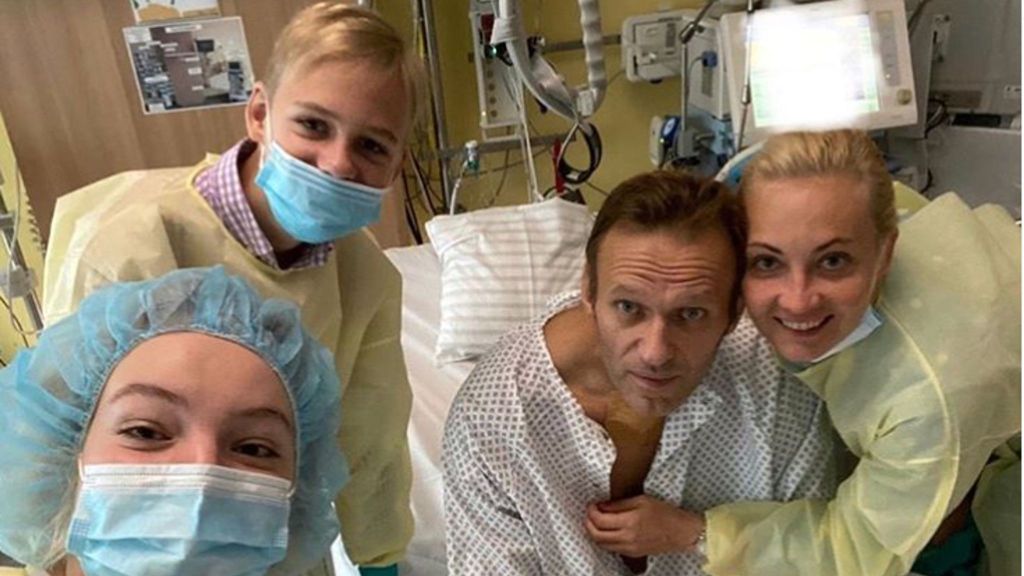
Alexei Navalny is up and conscious and anxious to return to Russia. Two German laboratories have independently confirmed that he was poisoned with the nerve agent Novichok. Suspicions remain strong that the poison was probably in a cup of tea he drank at Omsk airport before boarding a flight to Moscow last week. His team lost no time in blaming Russia’s president, Vladimir Putin. The Kremlin spokesperson, remains completely dismissive of such suggestions.

Alexei Navalny with his wife and daughters in Berlin. Photo from Sky News

Following the English government rules for the COVID-19 situation is like playing a game of hop-scotch on a chalked-out pavement that has been twisted and blurred by the rain. Back and forth until this week Boris, Matt – and maybe deeply hidden behind a scientific puppet, Dominic – have come up with the Rule of Six, nicked one can be sure from a catchy-sounding chapter heading in a book on film lying about in Dom’s editing suite. What is right for film and the arts is completely useless for this epidemic situation. Professors Carl Heneghan and Tom Jefferson write in the Spectator, “Our leaders amount to little more than a Dad’s Army of highly paid individuals with little or no experience of the job at hand.” Their long article reads like a doomsday book of despair and the writers barely touch on the failures of Matt Hancock’s Track and Trace schemes.

Moving from one debortle to another, Boris last week announced that he was going to flout, that is break, an agreement with the European Union on the Trade Deal that he made, and celebrated as a victory, just nine months ago. Suddenly this has given past Prime Ministers something to get excited about, join in unity around, and enjoy a new photo opportunity. John Major and Tony Blair are seen smiling and looking sweetly neat walking together across the Peace Bridge. Both probably chuckling at this dig to Johnson. David Cameron has cautiously joined the chorus but did not see fit to walk the plank with Major and Blair. He is a young man and may still have hopes of a political life before him. But he did say that “Passing an act of Parliament and then going on to break an international treaty obligation is the very, very last thing you should contemplate. It should be an absolute final resort. So, I do have misgivings about what’s being proposed.”

“See Thomas, See how you have angered me so!” Henry VIII roars, on a supposedly surprise visit, to Sir Thomas More in Robert Bolt’s’ “A Man for All Seasons.” It seems that it is this wrath that politicians fear, but what I can’t yet figure out: who is playing Henry?

So much politics to think and write about. All pushing back the desperately important thoughts and ideas needed in this time of Global Warming and the eruption of this pandemic experience. Last year we looked in amazed horror when the Australian bush went up in flames. This year California is following the fire season’s pattern of Australia, with ‘some fires in 2019’ becoming the whole of the western states of America in 2020. In both continents the fire season is barely beginning.

Meanwhile Lebanon, Yemen, Syria and Lesvos continue to burn and drown with no helping hands in sight.

This has been A Letter from A. Broad.
Written and read for you by Muriel Murch.