Thank you Jesus

Written and recorded by Muriel Murch with WSM by my side

‘Use a Wheelchair’ enough friends and family said that, that it became another ‘if three Russians tell you you are drunk you might want to lie down’ moments. And so, feeling immensely foolish and embarrassed, I did. And each wheelchair led to another brief encounter of sweetness. First up there was Chris at EuroStar. “It’s your lucky day, I’m with you all the way.” And he was – and he easily took on more than just us. Chris was watchful and would spot others who seemed lost and as if they needed more help and guidance. For them too he would quickly point out their way forward.

Feeling foolish in Amsterdam. Photo by BL Murch

It took only a few hours before we were safely tucked into our daughter’s home in Utrecht. The little overnight case holding Beano comics and Cheddar cheese along with the toothbrush was unpacked and we settled into the now ritual Sushi takeout supper the family orders for our first night with them. The Dutch, along with the rest of Europe and the world, do not celebrate the American Thanksgiving holiday, though a different form of Thanksgiving from America may eventually come to pass. A Thanksgiving to be free of the yanked choke-hold that is oozing out of the United States. As I write, motions are being written and presented to the senate that American citizens may not hold more than one passport and visitors to the United States should show five years of email correspondence and social media activity. There goes the United States airline industry for a start.

This little family holds all its traditions dear, those from Argentina and those from America. Assados and barbecues, soccer and football alike and so that weekend the Thanksgiving meal was a lunch on Saturday. Swedish friends with their two children and an American couple who had just recently moved from Ireland to the Netherlands gathered around the table. My Granny jobs had me thinking back to Mudda, my oldest friend’s grandmother, sitting at her daughter’s kitchen table, slicing beans. She would slip me half-a-crown with instructions to bicycle down to the tuck shop at the end of the road and pick up a packet of Craven A cigarettes for her. There would be sixpence left over which she would slip back in my pocket to buy sweets for us later. During those childhood years Mudda fed me my first cigarette. As I took my Granny place with the beans I felt quite virtuous, knowing I had only given David comics. It felt good to sit at the table topping and tailing green beans before peeling the potatoes. 

Saturday’s meal was fabulous as was the company. Beatrice has mastered mashed potatoes like I never could. The beans were served with a shallot and balsamic dressing and the turkey – well of course it was perfect – and then there were pies.

Pumpkin Pecan and Apple Pie. Thank you Beatrice.

The conversations flowed over and across Kim’s Game – another Thanksgiving tradition Bea had brought forward from her childhood when we joined friends in Inverness. Animated talks continued until someone picked up the brochure that had been mailed to every household in the Netherlands that weekend. The cover was eye-catching purple and the cartoon figures stood out in relief, as through the pages they showed what to do in case of a drone attack. No enemy was mentioned but the recent Russian drones flying into the airspace of the Netherlands, Poland, Germany, Estonia, Sweden, as well as Ukraine leaves the whole of Europe nervous and jittery – which is just the fun of it for the Russian President. As winter sets in to Northern Europe another country’s president, too far out of reach for those drones, tosses off instructions and memos to President Zelensky. While Ukraine’s President repeats that he will not cede any territories to Russia the infantry troops must hold the ever-increasingly dangerous line while under such constant attacks.   

On Sunday our bags were packed in the car and we left Amsterdam for an overnight in Dublin before flying back to California. Both the Irish attendants, for those in need of assistance, in and out of Dublin Airport, were so young and had perfect capped white and even teeth – and I wondered – why. I couldn’t help thinking that once – like young race horses – they had been promising young boxers and that maybe injury had set them aside to languish and grow bald working for Air Dublin at the airport. The tips could be good and it is almost healthy work with all the walking and maybe a better life than working in construction or the restaurant trades. 

Flying our bodies 6000 miles across land, sea and any remaining snow-capped mountains leaves them shaking and in turmoil. For the first few nights back in the Hayloft there is a strong full moon over the lagoon and farm. Dawn has barely broken as I lie awake and look out of the glass doors to the fields beyond. The tall eucalyptus trees are only just outlined against the sky. A faint light flickers up and down as a small converted golf cart is driven slowly along the rows of vegetables growing in the fields beyond. The light bobs and then pauses for some minutes before carrying on along the row. The cart is idled and I imagine the Jesuses and Josés of the world wearing thick jackets and pulled-down caps over stained jeans climbing down, knives in hand as they each pull an empty crate from the back of the golf cart before bending down and harvesting from another row of chard. The work and rhythm is repeated as the dawn lightens until the cart is full and they return to the office and waiting truck ready to accept these gifts. For this harvest, working though it is, is a gift to us all. I watch the bobbing light, the dawn rising and even with some early morning kisses I do not fall back to sleep. I must honor the work of Jesus and José with my words –  and I do.
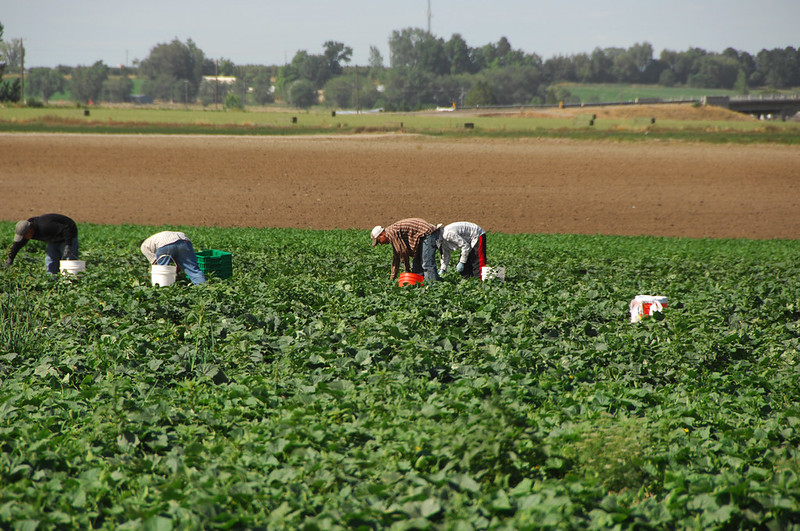
Workers mannually harvest ripe produce on Rick and Robyn Purdum’s farm. Fruitland, Idaho. 7/20/2012 Photo by Kirsten Strough via USDA

This has been A Letter From. A Broad Written and read for you by Muriel Murch with WSM by my side and as always supported by Beatrice from MurchStudio

I ain’t’ done nothink

Written and recorded by Muriel Murch with WSM by my side
Eurostar from Rotterdam Station – photo by Beatrice Murch

Though paused along the track, the Eurostar train to St. Pancras arrived on time and we disembark. It seems to have been a full long weekend away in Amsterdam for musicians and young families. We had joined the train at Rotterdam after our grandson David’s 9th birthday and the best Dutch birthday cake ever, homemade by David and his mother. On the platform, those of us who are older, the grand-parent tribe, and the wandering poets are quickly passed by the young musicians and even the families struggling with all their stuff to gather and bundle up. By the time we reach the last turn into the exit there is hardly anyone with us as we pass the four customs officers standing together. They seem to be hanging out, just chatting, but as I look at them – and they don’t meet my eyes – I realize they have been looking at us all. First I wonder what on earth do they think we are carrying, and then I realize they are also looking at whom we might be carrying.

Slavery – indentured servitude – is still alive and well in Britain and Europe. The German far right politician Jörg Dornau employs political prisoners from the uprising against Aleksandr Lukashenko’s political re election in 2020. Dornau owns an onion farm in Belarus where around 30 prisoners work, many of whom, like Nicole who told the story, had been jailed on political grounds and for “liking” old social media posts from 2021. The prisoners sorted onions for roughly £4 a day on what Nicole described as a strictly voluntary basis. And the onions tasted good. They are the lucky ones. But the customs officers waiting to see the passengers leave the Eurostar train were watching for those not so lucky.

Emerging into the station proper we pick up breakfast essentials before heading to the taxi rank. This evening the queue is not too long and we shuffle forward at a steady pace. Naturally everyone is tired, looking at their phones and not speaking. But suddenly there are quick soft running footsteps, and a child’s voice shouting “I ain’t’ done nothink.” More running footsteps, a longer stride and a uniformed youth catches up with the child, who is clutching a brown paper shopping bag and still yelling. “Let me go, I ain’t’ done nothing.” Faces lift from the phones and those in the taxi queue look as the young officer catches the barely clothed child wearing shorts and a very oversized t-shirt. Now there are more footsteps, heavier as in regulation police boots, and six uniformed security policemen, all under the age of thirty catch up with their young partner who is barely holding onto the child still crying out, “Let me go I ain’t done nothing.” Then suddenly the air goes silent and it is over. Taxis come to the curb, the line moves forward, and as we wait three patrol cars with lights flashing and sirens ringing come to a screeching halt beside us. I marvel at all the adrenaline rushing through at least nine men holding one child. And the silencing of the voice that echoes Oliver Twist in 1837 – led on by The Artful Dodger, used and abandoned by Fagin.  What really has changed in almost 200 years? Not so much. Hardship finds us along many paths.

Flying high over the carnival – photo by Beatrice Murch

On the autumn Sunday afternoon in Utrecht we visit a carnival. It has popped up outside of a Jumbo shopping center and is an easy distraction for small children, and some who are no longer so little. We’re cruising, grandson David passes the candy floss as he leads me to this fishing hall, that shooting range, all the time with his eye out for the bungee jumping trampoline that looks terrifying – to a Granny. Suddenly there is his best friend from down their street. The boys are thrilled to see each other, the bungee jump forgotten for the moment while the mothers chat together. The afternoon ends with a closing-time visit to the big public library which is institutional but welcoming and impressive. I am – as Grannies do – sitting, resting and waiting outside when the mother of David’s friend approaches me. Bea has sent her over.  “Mum’s a nurse, ask her.” “May I ask you something?” “Yes of course.”

She is from Ukraine and has three children, two boys and one girl. Her husband has left her and they are now divorcing. The afternoon carnival is a cheap distraction for them together. Her long hair is matted, her clothes look to have come off of the floor and her sneakers are – for want of a better word – inadequate. The children are hovering, watchful, a little distant, protecting her as best they can. They are nervous of her speaking with a strange woman, even from their friend’s family. The mother had a little accident on her bike and her thumb hurts. Is it broken? Should she go to the hospital? But that means a four hour wait in the emergency room and she has three small children. In her state the slightest upset blows into a potential disaster. Softly I ask if I can touch her hand and she nods. I take her hand in mine and begin to gently feel here and there, bend the hand and fingers this way and that. Quickly I know that it is not broken. There is a little warmth suggesting the thumb is strained. I continue to hold her hand, for with the act of touching and receiving her, she begins to calm. I tell her about arnica gel. Seeing their mother relaxing, the children creep closer to us as we retrace our steps to the pharmacy. Which is – naturally – at 5.30 on a Sunday afternoon – now closed. But the young mother is looking better, more purposeful and with a little smile. The children cluster closer still around her as we said goodbye. The eldest boy shakes my hand, the two little ones smile and wave. They are grateful that someone had listened and received their mother. This little Ukrainian family have been in the Netherlands since before the war began.  Maybe they knew what was coming or maybe they just got lucky. Now it makes no difference. They are adrift and broken in a foreign country. Hardship finds us along many paths.

The conflict – pick any red dot on the map – in the Middle East – has pushed the Ukrainian War off of the page and the screen. Cold mud and snipers are not as photogenic as nighttime rockets and buildings ablaze. Rubble and body bags are more prolific in any of the states at war in the Middle East than in the Ukrainian villages on fire. This war has a published start date of October 7 but that cannot have been the beginning. Israeli solders are schooled that attack is the best form of defense, but all of those red dots – in Gaza, in Lebanon and beyond – do not appear as the work of a country defending itself. Back, back we go into history, Europeans and their pens, pencils and rulers, drawing lines across the desert, pointing fingers and saying ‘That will do.’ 

This has been A Letter From A. Broad. Written and read for you by Muriel Murch  

And always supported by murchstudio.com