Autumnal Harvest

Written and recorded by Muriel Murch with WSM by my side.

‘So you did it twice,” said a very young Beatrice when she was reckoning up the presence of herself and her brother and checking her new information of where babies came from. I kept a pretty straight face as I replied, “Yes. We did. Twice.” This was not the time to elaborate, as I was driving the thirteen turns stretch of Highway One on our way home and, again, we were late for something. “Yes we did it twice.”

Another thing that we have done twice is Walter directing me in a production reading. Many years ago I booked an evening studio session at KPFA Pacifica for the recording of Herman Hesse’s story “Old Music”. I was somehow committed and compelled to read this story. In hind-sight it was more suited to a male voice, but I so loved the story of Hesse’s journey from his cottage in the forest to the cathedral in the city that I was determined to do it and, for the first time, asked Walter to guide me thought the reading. I was nervous, hoping that we did not dissolve into an altercation in public. I need not have worried, Walter was professional and kind, gentle but firm and I relaxed as he led me through the story. We added some Bach, such as Hesse might have heard in the cathedral to the end of it and – even if I say so myself – it aired well. 
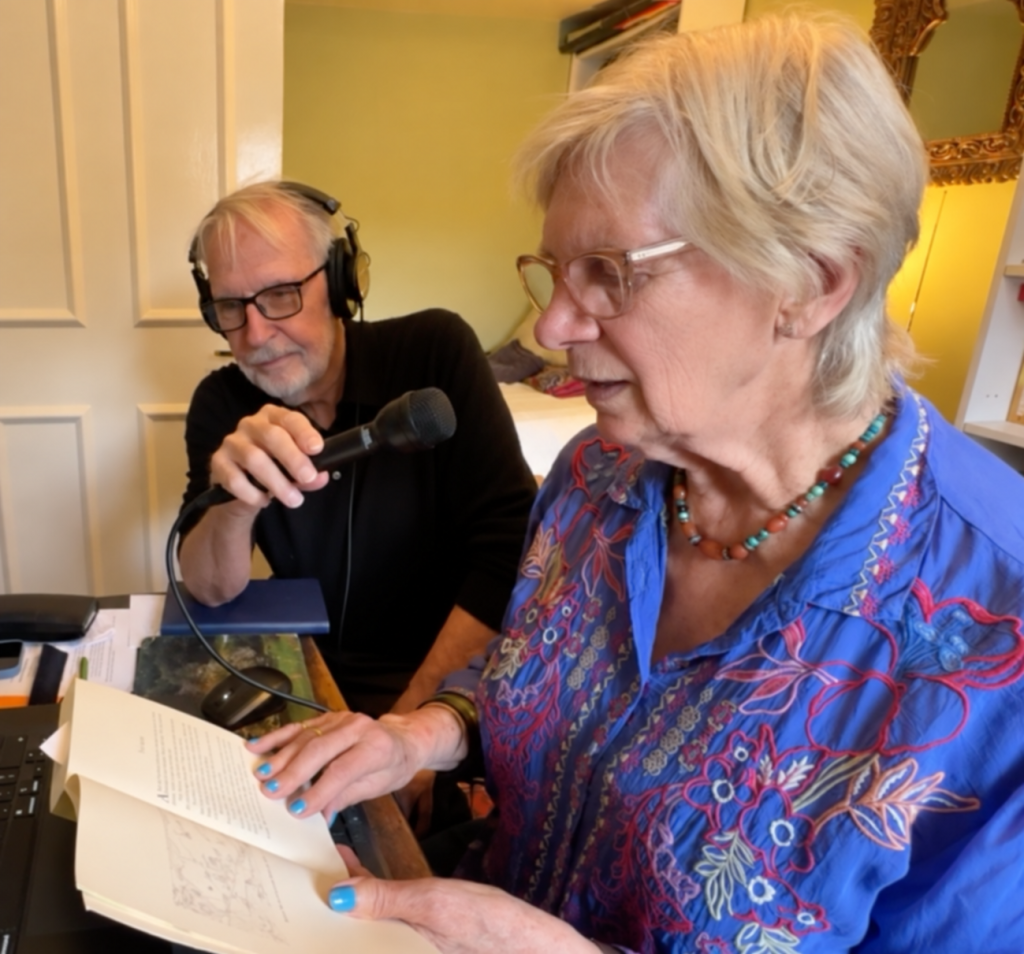
A tidier picture of team Murch at work. Photo by Taghi Amirani

This summer we did it again. Mostly here in London, as Walter held my less-than-best microphone while correcting my still hopeless dyslexic stumbles over long words and names. My voice and I are old, and with no true acting training we worked in short bursts. Granny Smith apples or big juicy grapes are said to help with such sessions but for me it was to be hard apple cider and honey which got me through, and was more than appropriate given that we were recording my book ‘Harvesting History While Farming the Flats.’  I took two editorial passes though each chapter before handing the tracks over to beloved Jim Mckee who cleaned me up some more. The result is a 9 hour and 6 minute book on audible.com. There is a little teaser – in the video.

The video clip on my website is a little taste tease. 

After my husband delivered a lecture to a group of Danish Film makers and students Philip calls out, “The last question please,” and a young man stands up.

“Mr. Murch, with your work schedule and the traveling how do you manage a home life?” then he sits down. Suddenly there is a deeper quiet in the room. Philip nods and raises his eyebrows, which always look striking with his large, round, smooth bald head. He nods as if to say, “yes this is a good question” and looks over at Walter. Walter paused, not rushing, as he can, to answer with overflowing ideas. Then he responded.

“Truth be told I don’t. I am often on a project for a year, maybe longer, sometimes eighteen months, even two years – and in that time I may not know where I will be six weeks ahead. You will have to ask Aggie that question.” He smiles and looks up briefly before Philip calls out,  “Lunch. We will reconvene in an hour.” 

This book is my answer 

Through some digital magic you can also switch between reading on your Kindle and listening to the audio. Pretty cool for an old lady.

The summer is fading now, the harvests are in. The Gods in Heaven have swept up three American jewels who spread good news, and good trouble across this good earth. We who are left are saddened by their passing. I think of them, Dolly Parton, Wendell Berry and Gloria Steinem who have no need to linger – their work well done and their torchlight handed on to those of us who are finishing what we can of our work in the world. 

And it is time to make chutney again. We harvested six green tomatoes from the one plant that survived the heatwaves of this summer. Our neighbor props a sign, ‘Free but don’t take them all’ on a box of Bramley Apples she brought from her home in the country. Tony at the market – he of the best and sweetest small strawberries – hands over a punnet of Victoria and Damson plums, Pete’s onions are small but good and into the big pot with all sorts of secrets they go. A day later there are nine jars filled with dark rich savory fruit sitting on the counter. 
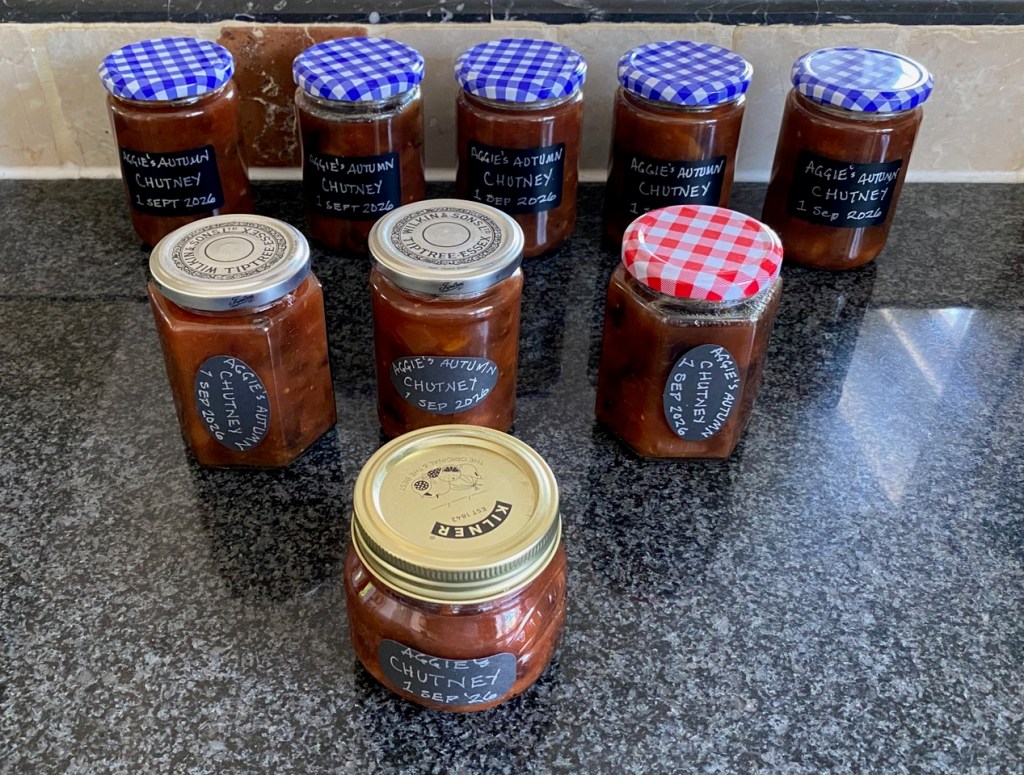
Nine jars of Chutney cooling on the counter.

I look at the jars and think of the words that Wendell Berry let me share in Harvesting History, and hope that even in this autumnal urban time of our lives we can remember that

The soil is the great connector of lives, the source and destination of all. It is the healer and restorer and resurrector, by which disease passes into health, age into youth, death into life. Without proper care for it we can have no community, because without proper care for it we can have no life. – Quote from Wendell Berry with kind permission from Wendell Berry

This has been A Letter From. A Broad Written and read for you by Muriel Murch with WSM by my side and as always supported by Beatrice from MurchStudio. And the video? Taken by Taghi Amarani and then tucked up together by WSM
Keeping Calm in London Town

“You ol’ rite?”
“Yes, thank you.”
“Not coughin’?”
“No Maddy, not coughing.”
And Maddy gives me a thumbs-up sign before she scurries away to catch an overland train to Battersea and visit her ailing mother.

Thank you Zine

“Do you need anything? Can I shop for you?”
“Thank you Sinder. We are ok at the moment.”
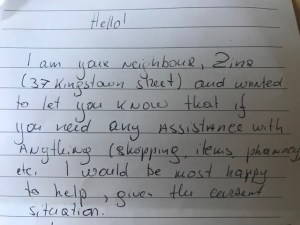
A note is slipped through the letterbox from Zine our neighbor at # 37. “… I would be most happy to help”.
“Aggie, Aggie.” Mr. Habto has returned from his early morning taxi run and is standing by his cab. 

“Anything we can do to help. Please let us know. Knock on the door or leave a note.”
Maddy is probably London born and bred, Sinder is Hindu, Zine is from Eastern Europe, and Mr. Habto a Coptic Christian from Africa. This is the mix of the little community at the bottom of our street. They all have families to care for and yet are finding moments to be watchful over us. We have become the “old folks” on the street. Thus neighbour cares for neighbour in our little corner of London. And we are grateful.

It is Sunday afternoon. The sun will not come out again today. The wind is blowing and the raindrops seem hesitant and unsure where to fall. Families are walking home from their ‘fresh air and exercise’ moment in the park. Football games are still scrubbing along in the mud. White shorts are streaked with brown, hair is windblown and there is quiet laughter coming across the pitches from the players. Out there – the city, London, – is very quiet.

Boris Johnson and his lieutenants appear very old school serious as they stride to the podiums set up in the State dining room at Number 10 Downing Street, while trying to cover up the fact that Number 19 Coronavirus may be beyond their abilities. This may be the first time in his life that Johnson gets really serious, and not everyone is convinced he knows how to do that. We can only hope that he might in fact be growing into the role of Prime Minister and treating this with all with the gravitas it deserves. One does suspect that upsetting the populace is as an important part of the equation as is protecting the insurance companies. Another supposition is that this is seen, by Johnson at least, as his Churchill moment. One can be grateful though that he has these two lieutenants: England’s Chief Scientific Advisor, Sir Patrick Vallance, and the chief medical officer, Professor Chris Whitty by his side. Whitty, or is it Vallance, produced graphs on a large board and pointed away so that the journalists in the room, sitting as close together as ever, could understand what was trying to be accomplished and then relay that information to us, the presumably less well-educated public. Vallance and Whitty are both, in their English way, considerably more competent than the school-yard gang that surrounds Donald across the water.

Daily updates from the government will now come from Number 10 Downing Street as the situation changes every twelve hours with more confirmed cases and deaths. Johnson and his team are putting some guidelines in place while they wait to come down with a heavy hand. It’s a gamble for sure. Health Secretary, Matthew Hancock, sputtered and muttered on the Andrew Marr Sunday morning show about ‘Doing everything we can and self-isolation’. Manufacturers have an opportunity to make millions of Pounds Stirling and ventilators. “Other countries in the world will be needing them too.” Mostly though it is businesses, sports centers, and banks (!) that are leading the way, encouraging working from home, canceling big matches (though not the Cheltenham Race meet last week), and encouraging self-isolation.

And now, on Monday morning, there are more shutters coming down. Museums have already closed, special openings have been postponed, and the British Film Institute team all work from home, strategizing what this means for the film industry in England. We withdraw too, canceling lunch dates with friends and family. Being well over a certain age, 70, we are all ‘vulnerable.’ and many of us have at least one strike hitting our general health. We are being encouraged to self-isolate. What will happen then to the organizations run primarily by older volunteers who serve their communities? As I write an email comes through from one such trusted leader: ‘The Library is closed for the foreseeable future’. What will happen to those books? Sitting on their shelves so lonely and unread. Theatres, cinemas, concert halls, hotels, and restaurants are all growing dark as their lights dim. Today all religious leaders united in asking their followers to pray at home.

Hand sanitizers are out and visible – where they are available. Otherwise, it is serious and constant hand washing – by those who do that sort of thing. Shop-keepers and checkout folks wear rubber gloves to handle the £ coming in. And £s are rolling into supermarkets as folks panic buy and buy. That may have begun to calm down now with ‘assurances’ that the stores have enough of what we need stock-piled somewhere. This morning the pharmacy was full even as folks tried to stay apart from each other. The doctor’s office is closed with a notice on the door saying that appointments will be by phone for the near future! The local Deli and other coffee shops on the street are almost empty. Can they hold on for those over-70s for whom a little sandwich at the coffee shop is their main meal?

Daffodils from Taghi A’s Morning walk

We are grateful for the Hill and Regent’s Park where we can walk in isolation. Wild primroses rise from the soil to shine close to the ground. The daffodils are reaching their peak, staying upright through the foul weather of the last weeks. But the plum and pear trees lining the street are beginning to loosen their soft blooms and whisper in the breeze for us to keep heart. Our Robin Red Breast hops down to check my worm count as I work in the little garden. She too tells me to let the warming soil soothe my soul.

Primrose in St. Mark’s Church garden Wall. Photo WSM

‘Our’ Robin checking my work

Grieve, Unite, Act.

We Still Have Each Other

We Still Have Each Other

As we leave our West Marin Hamlet we pass two signs sitting side by side on the fence. The first one went up immediately following the November election results and is written in English ‘We Still Have Each Other’. It was quickly followed by the Spanish version, ‘Aun Tenemos Uno a Otro’.

Returning from a village slightly further north is another sign stuck into the hillside,

‘Grieve, Unite, Act’.

We were not the only family to be struck by post election sickness. Apparently there was a wave of illness throughout the country. It could be attributed to the cold winter months, waves of colds, flu or pneumonia – or maybe to the sudden change in America’s fortunes, her perceived place in the world and all manner of personal and global changes that will effect every one of us. As we nursed our loved ones and held our families and friends closer we grieved, united and wondered how to act. The younger generations recovered faster that we did. They shook off the despair that we felt and began to act though one of the manifestations of this activity actually came from a Grandmother in Hawaii. The Woman’s March on Washington. Problems and obstacles have been put in their way and surmounted. The march is going ahead with thousands of women heading to Washington DC. Though the focus and purpose of the march has been knocked this way and that, primarily one could say they are marching to protest the agenda of the new government administration on Inauguration Day.

In our community, as in almost every community around the country, women come together in groups. Some are involved with fundraising for local needs – maybe a school project, or a book group. I belong to a knitting group. The Witty Knitters have been going strong for a good 18 years, I am a relatively new member of maybe of 4 or 5 years standing. We meet once a month at a member’s home. We knit, share news of communities and families, and, of course, gossip while our hostess prepares a meal of nourishing comfort. At last December’s gathering the conversation naturally turned to the recent political events and, as we went around the table, each one of us told of how we are ‘stepping up’ and adding one more thing to our already busy agendas. One spoke of engaging with Planned Parenthood (Love their tote bags), another of joining a local political group, Main Street Moms. I am working more with the United Religions Initiative. We are all beginning to see what we can do.

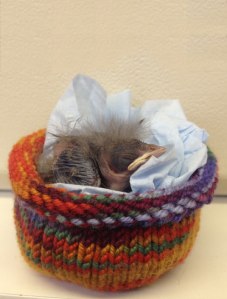
Baby Starling in knitted nest

Baby Starling in knitted nest

Usually in January we make a point of knitting for others. Carol Block shares her project of knitting little hats for Preemie babies which she then gathers up and takes to Oakland Hospital. Laurel Wroten has had us making baby birds nests.

We love to do this. But this year our January hostess, Susan Allan, has added another project. We are knitting hats for the women marching in the Woman’s March on Washington on January 21st. After she sent out the website, we all started rummaging through our wool stash searching out every ball of pink and red wool we have.

‘Grieve, Unite, Act’.

Beginnings

Beginnings

And finally, those of us who cannot get to a march, those of us who love to ‘do’ something, can. We’re knitting.

In the Christian tradition ,this weekend is the feast of the Epiphany, the day of the visitation of the Three Kings to the Christ child. The word Epiphany came to mean ‘a sudden, intuitive perception into the essential meaning of something, usually initiated by some simple experience’ – Such as knitting.

Over halfway done

Over halfway done

And in England during the fifteenth century the Monday after Epiphany became Plough Monday marking the start of the agricultural year. This tradition lingers on as the time when work is taken up once more and schools reopen after the Christmas and other festivities of late December. Plough Monday occurs this Monday, and when we meet on Wednesday we will be back at work again – knitting –


Doctor Patel Comes to Tea

DrPatelPoster_draft2This Saturday evening, April 9th, there will be a staged reading of “Doctor Patel Comes to Tea” from the book The Bell Lap  at the Bolinas Community Center. Doors open at 6.30 p.m. refreshments will be served beforehand and Davia Nelson of The Kitchen Sisters will talk with Muriel Murch afterwards. This evening also honors Erik Bauersfeld who, aged 93, moved onto other airwaves on April 3rd. Bauersfeld was mentor to many Bay Area radio and film sound professionals and a very early supporter of KWMR.org. Please join us for a very special evening.