Thank you Jesus

Written and recorded by Muriel Murch with WSM by my side

‘Use a Wheelchair’ enough friends and family said that, that it became another ‘if three Russians tell you you are drunk you might want to lie down’ moments. And so, feeling immensely foolish and embarrassed, I did. And each wheelchair led to another brief encounter of sweetness. First up there was Chris at EuroStar. “It’s your lucky day, I’m with you all the way.” And he was – and he easily took on more than just us. Chris was watchful and would spot others who seemed lost and as if they needed more help and guidance. For them too he would quickly point out their way forward.

Feeling foolish in Amsterdam. Photo by BL Murch

It took only a few hours before we were safely tucked into our daughter’s home in Utrecht. The little overnight case holding Beano comics and Cheddar cheese along with the toothbrush was unpacked and we settled into the now ritual Sushi takeout supper the family orders for our first night with them. The Dutch, along with the rest of Europe and the world, do not celebrate the American Thanksgiving holiday, though a different form of Thanksgiving from America may eventually come to pass. A Thanksgiving to be free of the yanked choke-hold that is oozing out of the United States. As I write, motions are being written and presented to the senate that American citizens may not hold more than one passport and visitors to the United States should show five years of email correspondence and social media activity. There goes the United States airline industry for a start.

This little family holds all its traditions dear, those from Argentina and those from America. Assados and barbecues, soccer and football alike and so that weekend the Thanksgiving meal was a lunch on Saturday. Swedish friends with their two children and an American couple who had just recently moved from Ireland to the Netherlands gathered around the table. My Granny jobs had me thinking back to Mudda, my oldest friend’s grandmother, sitting at her daughter’s kitchen table, slicing beans. She would slip me half-a-crown with instructions to bicycle down to the tuck shop at the end of the road and pick up a packet of Craven A cigarettes for her. There would be sixpence left over which she would slip back in my pocket to buy sweets for us later. During those childhood years Mudda fed me my first cigarette. As I took my Granny place with the beans I felt quite virtuous, knowing I had only given David comics. It felt good to sit at the table topping and tailing green beans before peeling the potatoes. 

Saturday’s meal was fabulous as was the company. Beatrice has mastered mashed potatoes like I never could. The beans were served with a shallot and balsamic dressing and the turkey – well of course it was perfect – and then there were pies.

Pumpkin Pecan and Apple Pie. Thank you Beatrice.

The conversations flowed over and across Kim’s Game – another Thanksgiving tradition Bea had brought forward from her childhood when we joined friends in Inverness. Animated talks continued until someone picked up the brochure that had been mailed to every household in the Netherlands that weekend. The cover was eye-catching purple and the cartoon figures stood out in relief, as through the pages they showed what to do in case of a drone attack. No enemy was mentioned but the recent Russian drones flying into the airspace of the Netherlands, Poland, Germany, Estonia, Sweden, as well as Ukraine leaves the whole of Europe nervous and jittery – which is just the fun of it for the Russian President. As winter sets in to Northern Europe another country’s president, too far out of reach for those drones, tosses off instructions and memos to President Zelensky. While Ukraine’s President repeats that he will not cede any territories to Russia the infantry troops must hold the ever-increasingly dangerous line while under such constant attacks.   

On Sunday our bags were packed in the car and we left Amsterdam for an overnight in Dublin before flying back to California. Both the Irish attendants, for those in need of assistance, in and out of Dublin Airport, were so young and had perfect capped white and even teeth – and I wondered – why. I couldn’t help thinking that once – like young race horses – they had been promising young boxers and that maybe injury had set them aside to languish and grow bald working for Air Dublin at the airport. The tips could be good and it is almost healthy work with all the walking and maybe a better life than working in construction or the restaurant trades. 

Flying our bodies 6000 miles across land, sea and any remaining snow-capped mountains leaves them shaking and in turmoil. For the first few nights back in the Hayloft there is a strong full moon over the lagoon and farm. Dawn has barely broken as I lie awake and look out of the glass doors to the fields beyond. The tall eucalyptus trees are only just outlined against the sky. A faint light flickers up and down as a small converted golf cart is driven slowly along the rows of vegetables growing in the fields beyond. The light bobs and then pauses for some minutes before carrying on along the row. The cart is idled and I imagine the Jesuses and Josés of the world wearing thick jackets and pulled-down caps over stained jeans climbing down, knives in hand as they each pull an empty crate from the back of the golf cart before bending down and harvesting from another row of chard. The work and rhythm is repeated as the dawn lightens until the cart is full and they return to the office and waiting truck ready to accept these gifts. For this harvest, working though it is, is a gift to us all. I watch the bobbing light, the dawn rising and even with some early morning kisses I do not fall back to sleep. I must honor the work of Jesus and José with my words –  and I do.
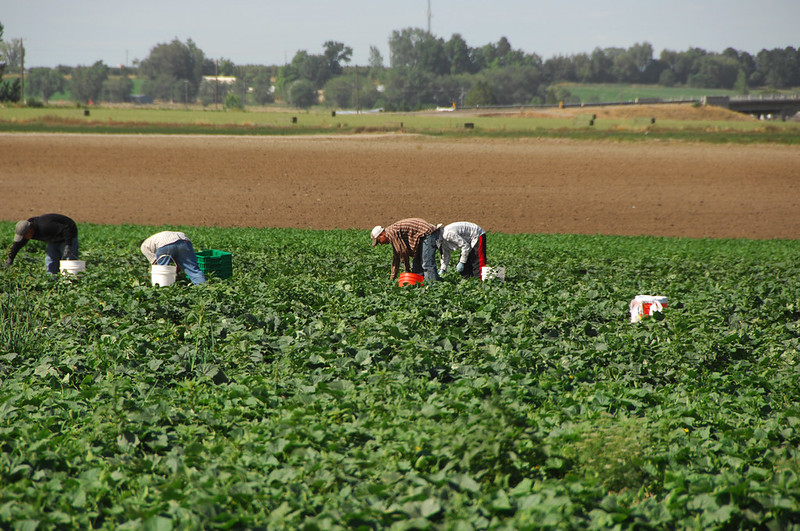
Workers mannually harvest ripe produce on Rick and Robyn Purdum’s farm. Fruitland, Idaho. 7/20/2012 Photo by Kirsten Strough via USDA

This has been A Letter From. A Broad Written and read for you by Muriel Murch with WSM by my side and as always supported by Beatrice from MurchStudio

Week One of London Lockdown

March 29th 2020 (Updated on April 1 2020) — Week One of Lock Down in London

A week ago on Friday, when my husband walked into Camden for some printer ink and returned with 5 Kilos of rice, I smiled. But now more than a week later I’m grateful to have that not so little bag of rice tucked away behind a chair in the living room. In the United Kingdom the death toll is over over 2200 and in London will be 700 plus by the time this reaches you. We are all finding different ways of being prepared for this new reality and the challenges and solutions of city living are different from life in the country.

Government Alert sent to ‘almost’ everyone

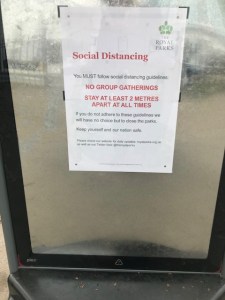
Being of a certain age we have been told – in no uncertain terms – to stay indoors except for one daily exercise adventure. This could be going to the grocery store, the pharmacy or, if really necessary, the doctor or hospital. In an effort to keep one’s sanity, the dog happy, blood circulating and bowels open we are all encouraged to take a daily constitutional in whatever way suits our fancy. There are signs posted in Regent’s Park reminding us to keep our social distance from each other.

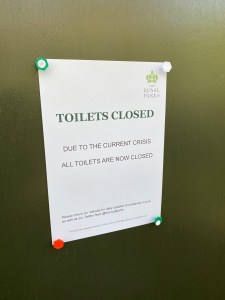
We walk carefully, mindful of others on the pathway, staying at that social distance from each other with a grateful nod of thanks. And it is spring and we can all be grateful for that. But I can’t help wondering if someone were to fall, or become ill on the path would anyone stop to help them? Some areas are closed. Understandably the Zoo is closed. But then, also understandably, are the public toilets. The notice, posted by the label for the ‘Golden Showers’ Roses reads ‘Due to the present day crisis these facilities are closed.’ Which, due to the present moment crisis, could provide another critical moment.

A serious crisis moment

But we are taking it all seriously and are tremendously grateful for our neighbors with their offers to help and the shops with delivery services that are working to full capacity. On Monday Vinnie, our milkman, said that he ran out of cheese. At first I thought he had just forgotten the order and put it down to typical milkman behavior. But then my little carrier had only one slab of cheese besides the two pints of milk so maybe his supplies are getting low.

Necdet from Parkway Greens has been busy beyond belief sending out daily delivery vans with boxes of fruit and vegetables. Delivery is free for house-bound seniors giving us another reason to be grateful.

Our little corner of London is quiet. Occasionally we see a neighbor and wave from a scarfed or masked distance while still asking “Are you OK? Do you need anything?” Every weekday morning Bob from Manley Street strides out of his cottage early, not for a walk but off to work. I wonder what is essential about his job and my imagination leads me to him working for MI5 in one of the discreet building along the 274 bus route.

From 8 a.m onwards throughout the day solitary delivery trucks come up and down the street. Masked young men bang on doors to drop off a package and then flee the doorsteps, behaving, though not yet looking, like one of Santa’s elves. No one stops for a signature any more. I’m grateful when our tea order from Fortnum and Mason’s arrives and smile at my last extravagance. If we do get sick at least we can still be drinking good tea.

Another van drops off builders next door. Essential work ? Well that depends who you are asking. It’s a balancing act between abandoning or completing a job, leaving a client in disarray and – or the workmen left with no income.

No longer able to walk to the Camden Bakery I turn to my old farm recipes and begin to bake. But it seems that the whole country is baking and the shortage of flour on the shop shelves this week made news headlines. I suspect this is more than a necessity for food, it is a need for the giving and receiving of comfort within our families and for each other.

First loaves I learnt to bake in 1969?

And who would have thought it possible that the English could garden even more than they do. But on the kitchen windowsill my chard seeds have sprouted and already have four leaves. Soon they will be ready to go out into the little garden patch that I work. But not today because March is going out like a lion. The wind is blowing and we wrap warmly up to take our walk. The door blows shut as we turn to face the empty street and the tiny snow flakes falling on our faces. 

First aired on KWMR.org Swimming Upstream with host Amanda Eichstaedt – April 1 2020

Lassie, Monkey and Memories

Banner and Bea

Bea’s banner goes up at the Botanical Gardens

Each morning at 7.30 a.m. David runs across the terrace, knocks on, and then opens the door and calls out, “Granny”! For there is book reading to be done or green play-dough dinosaurs (dinosaurs are green at the moment) to be made before breakfast. But today David came early only to help Granny with her morning yoga and then left. He took his Mama off to Palermo, to his music class and then for Bea to hang the banner for her show that opens on Saturday at the Botanical Gardens by Plaza Italia.

So I’ve not felt this morning stillness since arriving in Buenos Aires two and half weeks ago. The early delivery of food crates for the restaurant down below have been stacked and we won’t hear more until later this afternoon when it is time to chop vegetables for the evening meals.

Lassie and Monkey

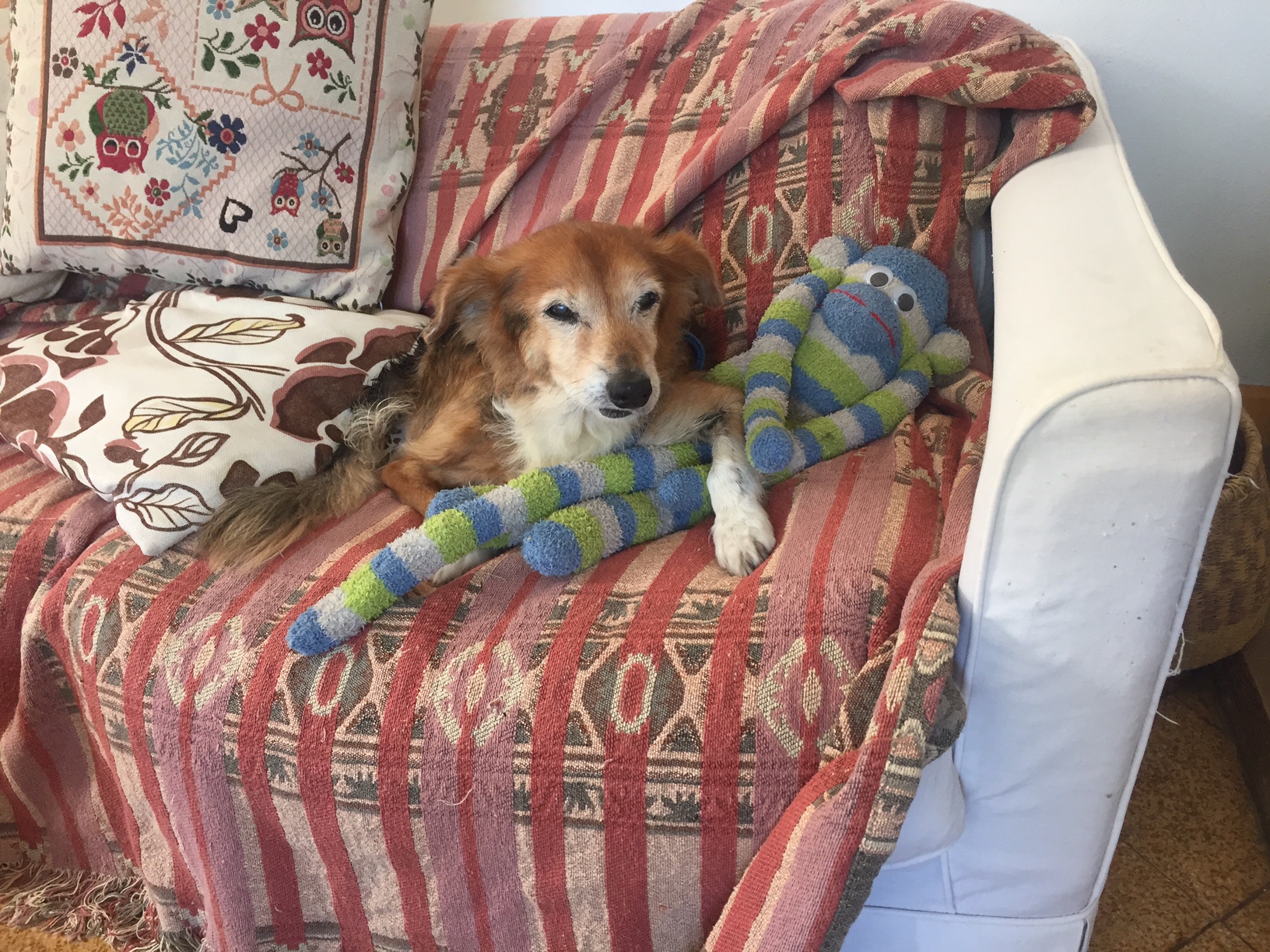
My Monkey – and sofa too

Lassie has come to join me as he (yes he) does everyday now. The ‘Abuela Dome’, as we have named the little studio, is a quiet place where he can rest his tired old body on the sofa, paws wrapped firmly around monkey.

This morning after laying my breakfast carefully out on the little table, I looked at every piece of china and food and saw memories alongside of breakfast.

Breakfast

Breakfast for one in the Abuela Dome

There is honey from our bees in Bolinas, and homemade strawberry jam made by Bea. The stewed apple are in one of two Johnson Bros, Indie bowls that I found at the street market at Plaza Dorrego one Sunday.

We got the money honey.

“It is an antique.” No, I first had that set in London thirty-five years ago. Does that make an ‘antique’? The petal-pink teapot came from the San Telmo Market when we first knew we would make a little home here. On it is the tea cosy I knit for the tea pot in the work kitchen of Tetro when the film crew were based in San Telmo in 2008. The bright and cheery butter dish was bought as a souvenir from our overnight visit to Uruguay last year. A surprise storm kept us there where we were lucky to be able to return to our hotel and ‘if’ we could find cash, still get a good deal.

The French Jacques Cout un Jandin …en plus milk jug came from a small village shop in Corsica. We went to visit old friends for the weekend and stayed on in their villa for ten days after their return to Paris, celebrating our 25th wedding anniversary. One afternoon a big thunder storm came across the bay and we stood naked, watching from the tall glass veranda doors, mesmerized as the darkening clouds and rain came closer and closer to finally wash over us and leave a calming stillness in its wake.

The Heirloom Royal Albert tea cup and plate belonged to my mother-in-law Katharine. I remember her at the end of a long day in New York City, sipping her tea while often smoking a cigarette. If my husband’s memory is correct this tea-set would have been from her mother, Mary Elizabeth Scott and probably sent as a wedding present from England to Mary Elizabeth MacCallum on her marriage to Thomas Beckett Scott in Canada. The tea-set was soon packed up carefully and taken to Ceylon in 1893 where she and her husband worked as medical missionaries, directing the Green Memorial Hospital and starting a nursing school. In 1913 Mary and Thomas retired and returned to the States where, until 1925, they ran the Walker Missionary Home at Auburndale, Mass, caring for the children left behind from other missionary workers.

Tea time, on another continent, with another generation

How much of the set made it back from Ceylon, now Sri Lanka? Did Mary Elizabeth sit at the end of her day and draw comfort from the delicate china as well as the tea, as did her daughter Katharine? After Mary died in 1941 was the tea-set divided up between her four daughters? Who got the tea pot, milk jug and sugar bowl?

This day began with old memories and ends with new. Lassie has returned to the sofa to hug his monkey. Beatrice joins me in our quiet catch-up ritual, sipping our late afternoon tea in San Telmo, Buenos Aires.

The little tea-set has traveled many miles over many years, bringing comfort along with tea to four generations of women. We have been blessed and are grateful.

The Bell Lap event in New York City

INVITE to The Bell Lap at the NACOn Wednesday May 25, Roz Chast author of “Can’t We Talk About Something More Pleasant,” will join me in discussion, talking about “The Bell Lap,” and some of the moments in-between. We will be in the Sculpture Court at The National Arts Club from 6:30 p.m. – 8 p.m. If you are in New York and interested in joining us, please RSVP to: murielmurch@gmail.com

Abuela Grannys and Apps

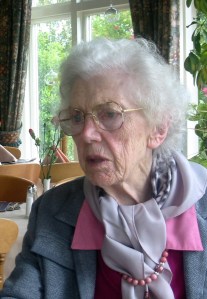
The grandmothers I remember came in three main flavors which would slide into each other like Neapolitan ice cream going soft on a summer afternoon: stern, formidable, ancient and kind; eccentric to down-right dotty yet ancient and kind; and those who were just ancient and kind.

Granny Slater

Granny Slater

Lady Pechell was formidable and kind. Each weekday morning she cycled into the village with one or two of her Pekinese dogs riding shotgun in her bicycle basket. She must have been twenty years, a war at least, older than the ladies she joined for coffee at Mrs. Max’s cafe. I never heard their conversation. I was too busy hovering, like one of her dogs, waiting for the treats she would magically produce. In a never secret whisper she would lean towards me, “Here, these are for you.” And three sugar lumps would be slipped into my hand. One for me to suck and other two for the milk cart-horse I rode at the end of the morning from our drive-way to the home-farm. Lady Pechell’s dogs eventually succumbed to sugar induced heart attacks.

Granny T was of the dottie variety. She lived in a small cottage across the road from her family and no longer strayed into the village but was content puttering in her small garden. When she came indoors she would cool her hot, tired feet by moving a kitchen chair up to the refrigerator, pulling off her stockings, opening the refrigerator door and sticking her feet onto the bottom shelf. Instead of tea she sipped a cool Pink Gin while she recovered. She was happy, and safe.

Then there was the ultimate Grandmother. Mudder became a constant in my childhood and was just ancient and kind. Bicycling to my friend’s house I would find her sitting in their kitchen. An old-fashioned apron was wrapped around her soft frame. Her grey hair rolled and unrolled about her softly aged face. Her bright eyes were soft and gentle in their seeing. She twinkled out a welcome as she sat shelling peas, snapping beans or scrubbing potatoes. My friend had never finished her chores before I arrived and so I would always have to wait – in the kitchen with Mudder. This was her chance. When we were alone she would pull out a florin, a ‘two bob bit’ and send me off to The Tuck Shop on the corner of Avondale Road. Here I was to purchase a packet of Craven A cigarettes. I think they cost about 1/6. “Go on, you can have it.” The sixpence was mine and the tuck shop my treasure trove. Mudder taught me that an apron was a part of the Granny Uniform, kindness and shared sweet secrets were the currency slipped in and out of its pockets.

One of the last gifts my mother gave me was the patience to pick up her knitting needles and relearn the ancient art that had keep her sober and filled her lonely hours with purpose. As she lay in bed in the evenings we took apart the last erratic sweater she had made for her grandson. Under her tutelage it took shape again. The result was a marginal improvement that was eventually returned to its rightful owner. Soon it became time for me to venture out shopping for wool and a pattern. I chose a light weight cardigan which was simple in design and happily knit away to have it finished in time for my mother’s spring birthday. It wasn’t until I was proudly sewing the seams closed and adding pearly buttons that I realized, with horror, that she would hate it. The sleeves were three-quarter length, the style only worn by fast woman. On the day of Granny’s birthday, as she unwrapped the cardigan and held it up before trying it on, I could see her lips compress in disapproval. And sure enough, once it was on she began to tug at the sleeves in an effort to pull them down along her arms. But she didn’t say anything. Over those last few months of her life she wore the cardigan almost daily, begrudgingly at first and then with a reluctant pride that seemed to have to been earned by the cardigan itself.

The Granny cardigan

The Granny cardigan

In that mind-numbing time of sorting through her belongings I reclaimed the cardigan. I couldn’t bring myself to let it go. As much for Granny as for myself. It lay folded away for months. At my mother’s memorial gathering one daughter said sadly, “Now we are Granny-less.” But in less than a year she was pregnant with the first of our grandchildren. “Now we will have a Granny again.”
As each of our daughters have entered their confinement and birthed, I have been blessed to be a part of that process. Older mummies all, with new ways and expectations, each daughter has wanted and needed different things from Farm Granny. When the new family leave the safety of the hospital, when the obstetrician, the midwife, the nurses and the lactation specialist are no longer at first hand and they return home, panic and fear can slip through the door with them, looking to stay awhile.

David and his Abuela at breakfast

David and his Abuela at breakfast

The mobile phone with its outside connections to the world is never far from the modern older first time mummy’s reach. There is no app for Abuelas but there is one for new mothers breast feeding. It shines from the phone with bright orange hearts and labels, right and left breast. Once the baby has latched on, you press go, and a timer begins. The seconds fly into minutes timing how long the baby nurses on the right and then the left, followed by the left and then the right breast. There are instructions and guides to follow which, although necessary and helpful, can also be intimidating to the new parents. The phone app can produce panic instead of measuring success while mother and babe struggle to adjust to the nursing process. The baby sucks for four minutes and then needs a breather. Does that count as time nursing or should one press pause? The app makes no allowances for tender nipples and full breasts. There are tears. The app is put aside, (the phone lucky not to be thrown across the room). And now an Abuela Granny can help. Somehow she knows how to soothe baby before putting him to the breast. She remembers positions that give the most comfort to a nursing mother and baby. She knows how to calm and encourage them all, and she does. Soon the parents are feeding, changing and bathing their baby as if they too have been doing it all their lives. As each confinement has come to pass I have added to my Granny uniform an apron with pockets and the old worn cardigan that brings with it the smells and texture of the Granny who came before me. Now they will be put away, until it is time to visit again.