Fading Flags

Written and produced by Muriel Murch with WSM by my side.

Driving out along the lagoon, over the mountain, and down the twisting road through the Redwoods into another town, the large Ukrainian flags are faded and torn but still fluttering under the trees.
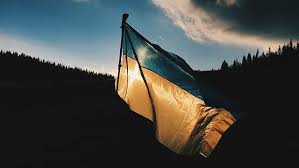
They look weary like the soldiers themselves must be. That war, between Russia and Ukraine, is into its second year and is now being jostled out of the headlines and overtaken by the three way shootout that is occurring between Gaza, Israel and Palestine. The weariness that is shown by the torn Ukrainian flags is but a reflection of the faces of both the Ukrainian and Russian soldiers. Satellite pictures of Russian graveyards show their expansion and a rough estimate is over 50,000 Russian and 31,000 Ukrainian troops killed from this war so far. Mothers do not like to hear such numbers and know that their sons are among the fallen.

Daily, more young, untrained Russian boys and old men are sent into battle to wear down the Ukrainian military. In 2022 the Russian Wagner leader Yevgeny Prigozhin began recruiting prisoners for his private army – until that all went pear shaped and ‘angry words were spoken’. Shortly after that Prigozhin was killed in a plane crash. But – to no one’s surprise – the Russian defense minister has continued with the same policy, containing the stipulation that enlisted prisoners must fight until they die or the war is over – whichever comes first. Prison recruits remain crucial to the success of the Meat Grinder… The modern term for Cannon Fodder.

Nobody really knows how many Russian and Ukrainian solders or civilians are dying. But all Russians steeped in their history know, from Tolstoy’s War and Peace to Maylis De Kerangal’s Eastbound, war in Russia is carried genetically through ancestral bloodlines. For the Ukraine it is not a lot different – maybe the war dead figures are more honest – it is hard to tell. President Zelensky is anxious and impatient calling for the military aid package just passed by the US Congress over the weekend to be delivered now – not in six months time.

Back in London, though there are no more welcome signs for refugees from any country, this war is still on the page. The prancing dance that is happening with Putin, the West, China and the East is keeping at least some journalists on their toes.

London welcomes me back into a land of brown people and I am grateful. There is kindness all around me. I push my trolly-load of luggage towards the parked taxi driver at the airport, who, when we reach the cottage, brings my suitcases inside and lifts them onto the spare bed.

But our UK Government remains as tight, shortsighted and corrupt as ever. Another Tory minister resigns here, mud is slung at Angela Rayner the labour Deputy Prime Minister there, and, goodness me, Peter Murrell, the husband of the last Scottish First Minister, Nicola Sturgeon, is under arrest again.  Released of course – the only polite thing to do – and to be investigated further – in due course. Well maybe. This is beyond sad, another betrayal as most people whatever they felt about an independent Scotland admired and even liked Nicola Sturgeon as she brought Scotland through the Covid crisis. Lifting its head slightly out from underneath these stained seats of government we find other unbelievable act of fly swatting. 

Through The European Commission president, Ursula von der Leyen, the EU have proposed free moment for young European Union citizens and Britons across the borders, allowing young people from the EU to stay in the UK to work or study for reciprocal periods of time. As Ursula said, this would have been where there could be “closer collaboration. The topic of youth mobility is in both our interests, because the more we have youth mobility being on both sides of the Channel, the more we increase the probability we will be on good terms because the next generation knows each other very well.” But Rishi doesn’t seem to want to get to know anyone outside of his home-county set and has rejected that, the government saying that ‘Brexit had ended free movement and it had no desire to reopen that conversation, even with strict conditions on length of stay.’ God help this country. 

As I began to write, the question of shipping undocumented immigrants to Rwanda was being batted back and forth across the aisles of Parliament for maybe the fourth time. There is no doubt that if the bill passes, those held in ‘safe housing’ will disappear into the urban ghettos of this country. Some will die, many will be extorted, while only a very few will reunite with their families or move on to make some kind of a life for themselves. Sunak will merely have transported the jungles of Calais to the cities of Liverpool and London. After a night of back and forth from the green seats of the Commons to the tattered red ones of the Lords the bill was passed – at the cost of 1.8 Million pounds per person – before it was time for an early morning cup of tea. It goes to the King on Tuesday evening and goodness knows how he is going to keep his mouth shut and sign it. 

A Getty Image of Rhishi trying.

It is hard to think about this as I sit on the sofa at dusk watching the evening light soften and glow, as if to say, ‘That was an ok day wasn’t it? The plants in my pots on my small terrace garden must have bloomed for our guests: volunteer Bluebells coming out of home-made compost, yellow Cowslips raised and bowed down. The geraniums and fuchsias are not quite ready to come out of hibernation while the unpruned rose buds are reaching for any weak spring sunshine. The pigeons and squirrels scurry around though the bird feeder needs replenishing and rehanging before the smaller birds will return. But it is dusk and Lucy the fox is back. Her coat is full and healthy while her udder glistens from the recent suckling of her kits. She too has sensed the movement behind the glass, the lights flickering on and off, and has come to check my egg supply. I go to the fridge and get one for her. Sliding open the terrace door I place it just inside the cottage. Tentatively, checking my smell and my seat on the sofa, she steps froward and takes the egg in her mouth, turns and neatly hops off between my pots to trot along the wall and disappear.

Lucy comes for her first egg of the evening Photo by WSM.

She returns ten minutes later for a second egg. How many kits does she have this year? A famous Italian designer has a trophy home just across the wall and with his garden unused for the winter months this could be where Lucy and her family live. The park – with its tall grasses and hedgerows – is just across the road and the canal with its river-rat filled verges is only a quarter of a mile away. Can Lucy and her family live peacefully in that garden or will they too be evicted out of their found safety to wander to find a new place to call home.

This has been A Letter From A. Broad. Written and Read for you by Muriel Murch.  

And always overseen by – beatrice @ murchstudio.com
Serving Safety

Written and Recorded by Muriel Murch with WSM by my side

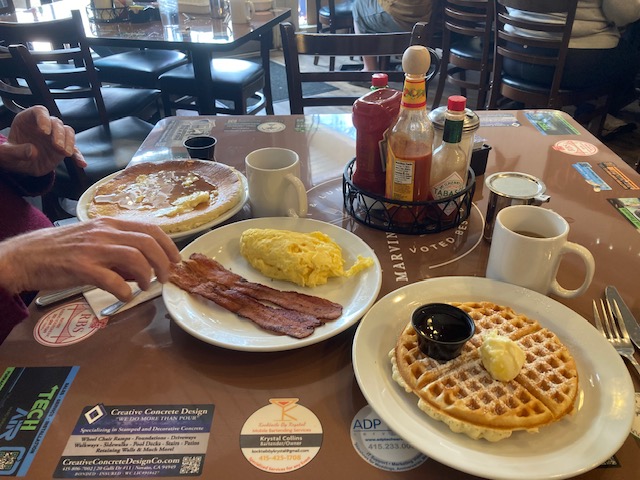
When you want a ‘good old American Breakfast’ you need a ‘good old American restaurant’ to go to. There are a couple still thriving on the main street of Novato, in California. We go to Marvin’s. The tables are crammed together, the outside dining that came in with Covid, remains – and for those new to Novato, with small fluffy dogs as accessories, those tables are fine. But for us, not locals but oldies, inside is better. The coffee comes quicker, the menu is there and you only get water if you ask for it. The restaurant is crammed and with a fluidity of a well-honed team the kitchen, and wait-staff dance between us all and even have time to smile and say hello. The clientele inside is mostly old, local, male and large. Which makes placing cardboard on the  floor of the tiny bathroom a more than sensible idea. So do the signs posted on the walls, ‘ For goodness sake clean up after yourself’, ‘Anything is possible if you have the courage to make it happen,’ ‘You never know what you have until it’s gone. Toilet paper for instance.’  Returning to our table, my second cup of coffee is ready for me and I am beginning to feel better. And that is the gift that a restaurant, worthy of the name, gives to its patrons.  

One of Marvin’s ‘All American’ breakfasts.

For over 50 years Cupertino-based Chefs of Compassion Cooking for a Cause has held an annual fundraiser dinner. A gala evening event of food, giving the attendees a feast fit for their dollars as they support the West Valley Community Services – serving those in need from the cratered and neglected pockets Santa Clara County. It is one of thousands of not-for-profit organizations throughout the country and the world that help those struggling with food, and to get by with things that many of us take for granted.

Steve Simmons with Chefs of Compassion

I stumbled across The Chefs of Compassion when reading of the sudden death of a beloved friend, Chef Steve Simmons. Steve and I first met when he was cajoled onto the board of Full Circle Programs. Barely out of apprenticeship he was far too young to enjoy sitting at meetings. He was busy claiming his place alongside other rising chefs in the Bay Area, such as Ogden Bradley. But he was game and eager to help with my first ever fund-raising event: a screening of The English Patient for the Full Circle Programs in 1997. I didn’t have a clue what I was doing but Steve had everything under control and – if I remember correctly – gracefully served up oysters and champagne. The event was a modest success and we made money for the program. Steve soon became a renowned and sought-after Bay Area Chef in his own right before opening his own success story, Bubbas’ Diner in San Anselmo. Bubba’s was perfect for meetings, family gatherings and just plain, ‘let me sit-down for a moment and gather myself before the next whatever hits me’. With constant affection, our lives crossed paths for over thirty years. Steve’s sudden death from a heart attack brings a personal sadness as it does to all his friends, colleagues and family. He leaves three children to still scramble through school. But Steve’s work carried a constant in that, as well as being a fine chef, his desire to help those less fortunate was a hallmark of his work and is seen so often in other chefs, serving from small roadside kitchens or in world-renowned restaurants. Serving and sharing food is a passion that reaches out from our own kitchen table, to our communities and beyond. 

Chef José Andrés and his carrots

Meet Jose Andrés Group

There are chefs who are known not only for their cooking, books, fame and fortunes but for their humanitarian work feeding the world. Such a chef is the Spanish American José Ramón Andrés who, with a matador’s flair naturally rose to the challenges ahead of him in the 1990’s when he arrived in New York. Success quickly followed success and took him to Washington DC where, dinning in his restaurants, meetings over a meal, discord could become accord. In 2010  Andrés founded the World Central Kitchen beginning by focusing on feeding communities hit with natural disasters but too quickly found itself operating – like Doctor’s without Borders – in areas of conflict – as wars marched side by side with climate change as the cause for famine and disease. While many chefs are artists in the kitchen and business men behind the till, Andrés is also a deeply caring man. Like an army General he quickly strode across the global stage with his humanitarian work.

Wherever war has brought hunger, the World Kitchen has been there, serving the food of the people to the people. The World Central Kitchen has grown to be enormous, serving food and people’s worldwide. Currently it is operating in Haiti, Ukraine, Poland, Israel and Gaza. In Ukraine, chefs and restauranteurs jockey with each other to feed the best borscht to their people, in the Middle East to honour Ramadan and other religions, and now the World Central Kitchen serves in Israel and Gaza, bringing the food of comfort to both Israelis and Palestinians. Though more at home behind a roaring grill or unloading the flatbed of a truck, Andrés fingers are now busy working the computer and phones as he looks to use any influence he has to halt the war in Gaza. Andrés is outspoken in his criticism of anyone who cannot see the need for humanitarian aid and his work is such that nobody wants to be seen not being compassionate. Both Republican and Democrat Senators are known to nod sagely when he speaks. Even in Israel, where the World Central Kitchen immediately gathered forces to feed those affected from the Hamas attack in October, Andrés can speak. But now – as that assault became a full blown war – and Netanyahu seized the excuse to attack Gaza, squeezing Palestinians into tighter corrals with less and less resources, things became personal for Andrés. A pier was built by the U.S. Military where food, water and relief could be unloaded safely and delivered to the Palestinians still trapped on the Gaza Strip. With the precision of a Military General Andrés already had supply workers lined up in a convoy. One, two and three, the vehicles were picked off by Israeli soldiers and all seven of the international volunteer workers were killed. Quickly Andrés took pen to paper and wrote op-ed pieces both in the New York Times and in Israel’s largest newspaper, plus tweets and all forms of media. He wrote “Israel is better than the way this war is being waged,” For the moment that supply route is closed. 

Andrés’ stride across the world stage is large like the Ukrainian president Volodymyr Zelenskyy, who is also untrained in the school of politics. Andrés’ schooling in the kitchen as Zelenskyy’s on the stage has given both men the skills of hustle, the art of seduction, both slicing and seasoning each connection to fit and join with another. Is it possible that it is these artists that can chip away at the gates of death, calm the storms of war, and bring a peace at the table. 

This has been A Letter from A. Broad. Written and read for you by Muriel Murch.

And always overseen by – beatrice @ murchstudio.com

A Dog’s Dinner

Written and Produced by Muriel Murch with WSM by my side

The dictionary defines A Dog’s Dinner as ‘A situation, event, or piece of work that is chaotic, badly organized, or very untidy.’ Such as when an unschooled dog gallops into the scullery for his bowl of specially formulated dog food moistened with a little water. It is gulped down in a flash, the bowl knocked about noisily until it hits a wall. But then there is a pause as his tummy swells. A burp is followed by a belch before up comes dinner again, now glistening and sticky with saliva and the first tentacles of stomach acid. The dog looks puzzled wondering what happened but then he spies the food, all over the floor and with excited tail wagging, eats it all up again. Only a mop and a big dose of disinfectant can clear the damage away. 

This is the image that comes to mind after Suella Braverman’s published remarks that homelessness was a lifestyle choice. As Rishi Sunak sent her back to her kennel he had to reshuffle his cabinet once more. Even the newspapers had to print charts with pictures of who has come and gone and where to. We watched – soon to be Lord – David Cameron stride back into Downing Street, knock on the door of number 10 with his tail wagging as he tucks into the mess of Brexit that he created. It looks to be a dog’s dinner all over again.  

On November 14th King Charles celebrated his 75th birthday by popping into a food bank between holding a couple of tea parties for people and organizations that also turned 75 this year. A tea dance was held in Dumfries House and then more tea was served at Highgrove with members of the Caribbean Windrush generation, nurses and midwives from the NHS. This week, The Big Issue, a weekly magazine sold on the streets by homeless vendors, has The King on the cover highlighting his Coronation Food Project, launched on his birthday. The King is quoted – saying that “Food need is as real and urgent a problem as food waste,” …. “If a way could be found to bridge the gap between them, then it would address two problems in one.” It seems to take a football player like young Marcus Rashford of Manchester United and a King like Charles the Third to steer this ship into a clearer lake of fresh water. 

On Tuesday, we left for Poland and the Camerimage International Film Festival in Torun. It takes a full day of travel getting to the festival and we were only traveling from London. Cinematographers, manufacturers, filmmakers from other disciplines with films come from around the world. It is a  jumble of festival and trade faire, a little glamor and a lot of graft for the craft of cinematography. We gather at breakfast, the same as on a film set, such is the comradery of international filmmakers.

The plane landed in Warsaw and the afternoon light stayed for the first hour of the two-and-a-half hours it takes to drive to Torun. Leaving the city there are single-gauge railway tracks that emerge and disappear in and out of the paved road. They are old, disused but along with the tree-covered mounds of larch, silver birch, and pine that cover the detritus of an ancient war, a chilling reminder of the wars past and present. The city names of old wars are now joined with new place markers that move traveling east into Russia and Ukraine, and then south with the eruptions in Jerusalem, Gaza, and Palestine. 

The city disappears giving way to bare winter fields. There is very little green left to harvest, only tall dried-out corn to be cut for livestock. As we pick up speed, the farmhouses appear small, even tiny, most look old and decrepit. There are no lights shining to welcome a farmer home from the plow. As we drive north a storm is crossing Europe and for those moments that we are on the open barrier-less road, the raw wind beats across the motorway making this all-electric German limousine slip and tremble and the windshield wipers pick up speed.

We settle into the hotel with memories that slowly come back to us. Beyond the window the river flows fast, the current pushing and pulling fallen trees into the mud. There is no shipping. The countryside is bleak this far north in November. Even though it maybe earlier in the year than our previous visit winter feels like it is coming sooner. 

Here is Copernicus

Walking into the old medieval town we pay homage to the statue of Copernicus. Torun is not a big city but as Copernicus’s birthplace it is rich in history and over two million people come to visit each year. Some come for astronomy, Copernicus, science, and some for this festival. Walter is here to join Professor of Astronomy, Leszek Blaszkiewicz in a moderated discussion on ‘Copernicus, Dreamers, Inspiration and Science.’ Held in the beautiful old Camerimage Cinema, the audience is primed and happy to hear, think, and discuss such things. After the talk is over they linger and some have already brought with them the beautiful Golden Book on Walter’s Golden Ratio exploration that the festival produced. The days are busy although we don’t get to see one film. 

Mateusz Józefowicz moderates Walter Murch and Leszek Blaszkiewicz in conversation on Art, Inspiration, Science, and Dreams.

On Saturday as we walk over to the main building for the closing ceremony and awards event, dusk has already busied herself with night and the street lights proclaim it is winter. The big theatre has filled up early and fast. The ceremony begins and is almost all in Polish though there are head-sets for translations and it all goes along easily and quickly. The Golden Frog is the symbol for this festival, with tadpoles for the rising stars of cinematography. Each film festival has its symbol, Berlin has the bear, Locarno a Leopard, Venice a Lion, and of course, it’s Oscar for Hollywood. While the Torun festival celebrates the art of Cinematography it is also a huge trade faire. It is overwhelming to see the equipment. The festival also acknowledges the other disciplines and those who – within their fields – carry a particular understanding and integration of cinematography and their own discipline. Walter brought his frog home in 2015 and it sits sweetly and discreetly on a bookcase shelf here in London.

The last award is given and the festival director returned to the stage for his closing remarks before beckoning a line of assistants to file in behind him, and then another line and another, and – as we rose to our feet – he has assembled everyone who made the festival happen on stage. It is the first time we have seen such an acknowledgment from a festival and it seems fitting that it should occur here where the emphasis has always been on the heavy lifting that it takes to be a cinematographer and to make movies. The yellow-vested stage hands arrive carrying three sofas and the recipients of this year’s gold frogs and tadpoles come to sit alongside those who have made this year’s festival possible and still the full audience is on its feet acknowledging that just as Copernicus wrote in his revolutions, we are all like the stars in the heavens and the universe beyond,  elliptically revolving around each other.

Brava and thank you to everyone who made this 31st Camerimage possible.

As we walk back to the hotel we can see our breath and the sky prepares to scatter the first flurries of snow. The final party is going strong but we are too old for that and even in flat shoes my back hurts. At the bar, we sit among those who would rather drink and talk than stand and shout, enjoying a glass of wine and a bowl of Polish soup. The next morning camp is broken and the lobby is full of puffer jackets, wheeled cases, and fond goodbyes. We have barely left the city when a huge owl swoops down across the car, just three feet in front of us, and with wings unfurled for balance, he nails his meal of young bunny on the snow-covered grass beside the road. We drive on past the mistletoe-encrusted trees, the wind turbines emerging from the fog where acres of bare apple and pear fruit trees, red and black currant bushes are already dormant, preparing for the winter ahead. We quietly understand that life in this corner of the world is not easy for those who live here.

This has been A Letter from A. Broad written and read for you by Muriel Murch

The Rain in Spain

The Rain in Spain

Written and produced by Muriel Murch with WSM by my side
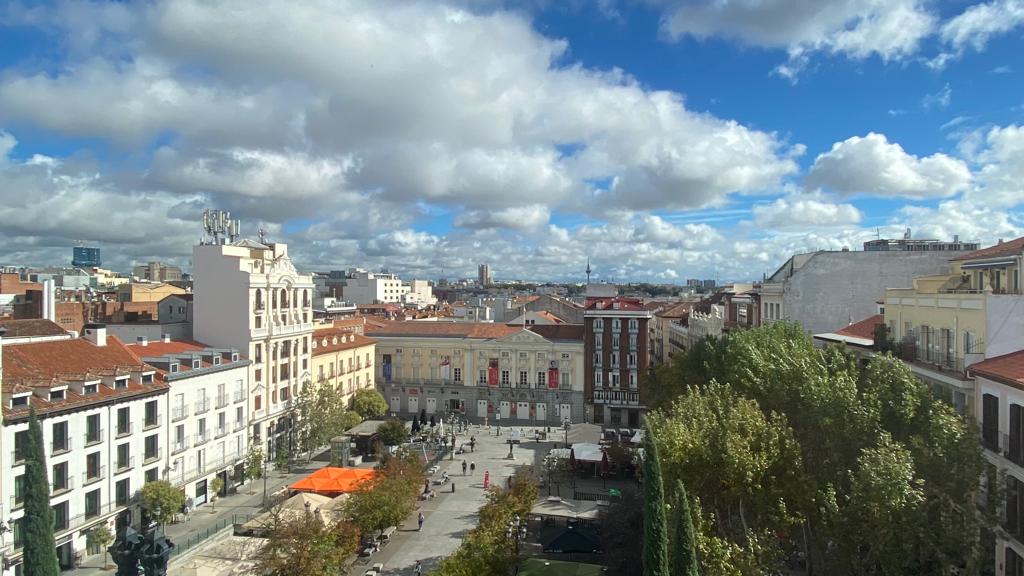
View from the Victoria Hotel over the Santa Ana Square in Madrid by WSM

Falls mainly in the plain. And we saw that as we sat in the plane, in the rain, for three hours at the Madrid airport waiting for it to ease off enough that a Spanish pilot – who must be used to such things – was cleared for take off. It was a bumpy ride but we got from A – Madrid to B – London and home. Only three days earlier – as we drove to the city center we passed the dry dusty outskirts, the soil a pail ochre yellow that looked like sand and made one wonder how anything could grow there. But it does. Between the houses – jostling for a patch – olive trees claim their space clinging and begging to be allowed to stay, offering their untended fruit as payment for the soil. As the motorways slice through the land the trees give way to factories and then block housing before entering the old city center.  

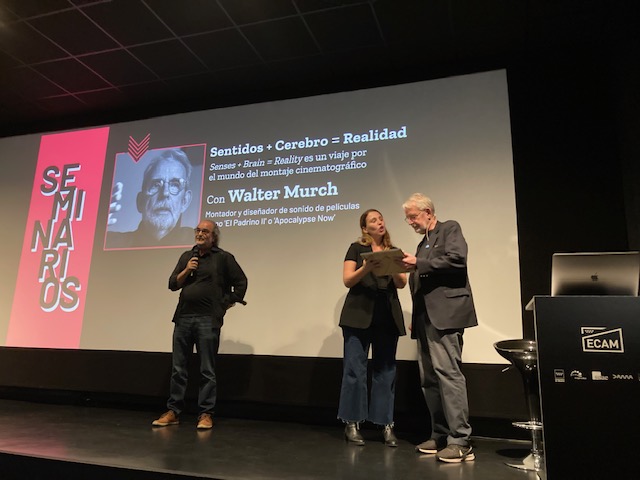
It has been six years since we were last in Madrid and at this film school. Beloved faculty who were young men then are – like us – just a little bit older while our young minders all seemed very much younger. It was a fully packed two days as Walter gave four lectures on Senses + Brain = Reality, as seen in the editing of Motion Pictures. A bit of a mouthful for a title but the four talks were all swallowed, hungrily by most – and cautiously by a few – in the full-house audience for both days as the students and old professionals bravely went along with him. Such is their affection for and trust in the man. These talks are where Walter can give encouragement to them and try out new ways or show what is right in front of – and in our faces – or noses – on this occasion taking a very deep dive into the concept of the Golden Ratio as it applies to the human face.

WSM is made an honorary professor of the University. Photo by MAM

We arrived in the middle of the third week in October and as the wars slide from one continent to another, the new war of the season is well underway. The conflict in the Sudan never reaches the papers, the Ukrainian war remains but is now a side column as the bombing, threats of more bombing, retaliations, and death on all sides of this Middle Eastern mess unravel before us. Hostages had been taken and at that time none released. Politicians began lining up their positions while planning out their strategies, looking for who are their friends, who owns what, and what trades and compromises are available. Each day the war moves forward and it is not a pretty picture. Walter speaks of this at the beginning of both talks reminding us that this is the world we live in, and we are fortunate to be speaking and thinking about art and ideas for this short period of time. 

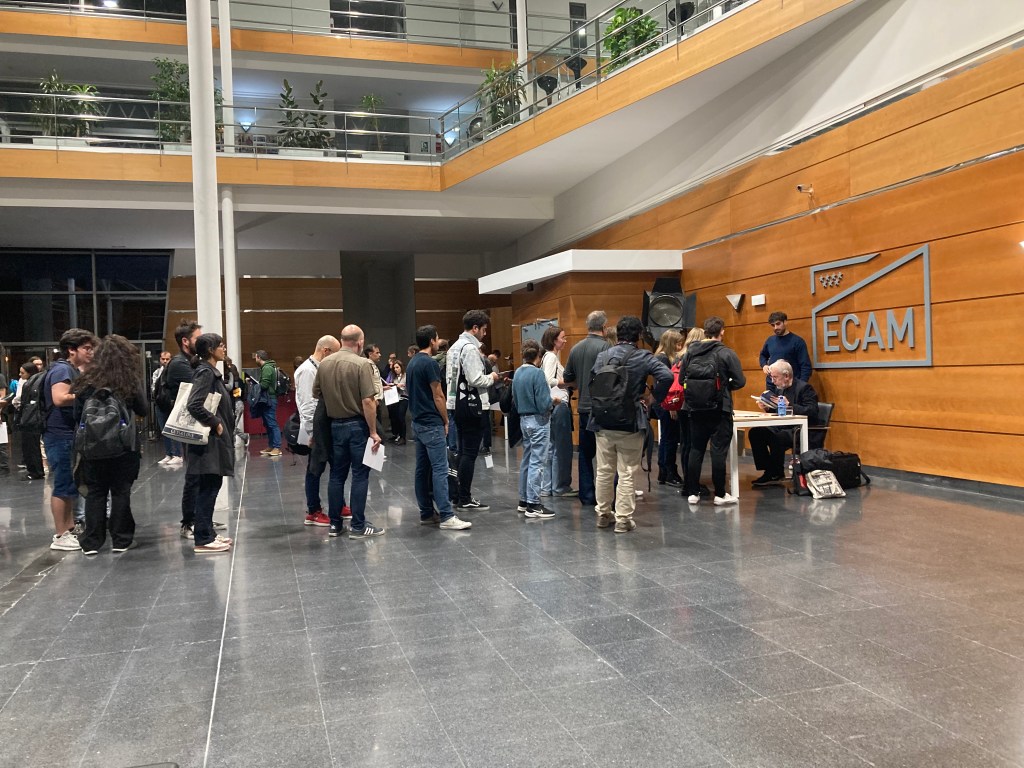
A new translation of ‘Blink’ in Spanish needs signing. Photo by MAM

While waiting and watching Walter sign a new edition of his old ‘Blink’ book I am gently surrounded by the young people who are there for us. They hover like bees finding a new flower but instead, it is I who take from them, as each has a story, and war, government policies, and economic hardships feature in everyone. 

The purple-haired bright-smiling young assistant from the film school is from Puerto Rico. While her family are scattered and separated in California, she has turned East and has found her way to Madrid, and this film school. Deeply conscious of the neglect of the various North American government administrations, her dream is to return to Puerto Rico and help the country with the film and radio skills she is learning. 

Peter, the photographer, was born in Ukraine. He is young, with a mop of blond hair, and is slipping from gangly youth into adulthood. His parents – maybe seeing the future with fear – emigrated to Spain while they could. Peter speaks modest English though better Spanish and now his mother forbids the family to speak Russian – their native tongue – in their home. He doesn’t talk much about Ukraine but his mother worries. Peter’s grandmother is still there, not in the thick of the war zone but close enough, choosing to stay in her home and her mind until she dies. 

Argentines Queuing to Vote in the Hague. Photo by Agustina Izurieta

Cecelia, our main minder, is a young and beautiful Argentine. As Argentina crumbles and falls – with the Argentine peso now at 1000 to 1 US dollar and rising – she too has left her home searching for a new life, a safer place to live and has come to Spain. This weekend our son-in-law took the train from Utrecht to the Hague to vote in Argentina’s first round of elections. Throughout Europe, the lines around the Argentine Embassies were hours long as those who had fled rallied to send the crazed Javier Milei out of the ballot box. 

Coming home we reach out to Lika, another young friend who last year managed to leave Russia for Israel and then bring her mother with her. 

She writes from her point of view in Tel Aviv, “Me and mom are ok. We have a bomb-shelter in the apartment and it’s the best you can get in this situation. North doesn’t get as many rockets as in the South up to Tel Aviv, but from day 1 we have constant shootings from Lebanon and even Syria. I have a panoramic view of the whole bay and I already saw and heard explosions, rockets being caught by the iron shield, and sirens from the border areas. It’s intense. To be honest I still can’t fully comprehend that it’s the second war in my life and at the same moment. We’re very much invested in the war in Ukraine and now this. And the ugliest thing is that the terrorists here are all in one bed – Russia, Hamas, Iran… and Israel and Ukraine have one thing left – to defend themselves. We have many Ukrainian friends here who were evacuated from the bombs and they are incredible to watch – very brave.”

The wars are pushing Britain’s local government squabbles off the front pages. Slipping the two conservative safe seats bi-elections – that they lost – well out of the spotlight. The wars, in the Ukraine, and now in Gaza and Israel are rolling over our consciousness like the winter storms hurtling through forests and along rivers in eastern Scotland. Yet they are not random acts of nature but preplanned with maps and political strategies that are embraced with little thought nor care for the collateral destruction and deaths that follow. It is as if a giant combine harvester is scraping the fields of our planet Earth, leaving stubble where there was wheat, stones, and dust where there used to be rich soil. We cry out but can do little more than weep.  

This has been a Letter from A. Broad. Written and read for you by Muriel Murch. Note an error correction – in the recording I say the pesos to dollar is 350 to 1. It is 1000 to 1 and falling.

Rain Stops Play

Recorded and Knit together by WSM

The third week in May – and it is still raining steadily. Umbrella in hand, it was time to take the 274 bus into town. The bus was already half full, so I sat upstairs to look down over the London streets and see a group of young Asian men, carrying their hefty bags full of cricket gear on their way to the park. One is already dressed in his Cricket whites. Do they dream of one day playing in the holy of holies, Lord’s Cricket Grounds close by in St. John’s Wood? Founded in 1788 by Thomas Lord, the grounds were moved at least three times before settling into this corner of Marylebone. Noted historical progressions through the years included that in 1864 the purchase of a lawn mower removed the need to keep sheep. Those young men I saw from my bus would have been in the grounds where my father was a member for all of his adult life.   

I arrived at the edge of the city to where, even with the soft rain falling, the pubs’ and restaurants’ outdoor tables are full. Most shops have been opened again on the Marylebone High Street, but with some noticeable gaps where high-end English brands used to sit proudly on their corner lots. They were always just out of my price range and I am not as sympathetic as I could be. 

On Monday, more lockdown restrictions were eased but we are going slowly, being sensible, as the health Minister Matt Hancock urges us all to be. But maybe there will be some lightening of the infection load that will bring this, and other countries, safely out of hibernation.

Every country is looking at what their government could have done better, safer, faster to save more lives. Doors, gateways, air pathways and sea-channels have been opened and closed with speeds that relate to the economy as much as infection rates. All governments have behaved badly to various degrees. There have been profiteers and deals of equipment, and devious deals of no equipment. Last week the head of a pharmaceutical firm in India fled to London after failing to provide more affordable vaccines to his own country. The blame? Already shifted to Narendra Modi, India’s Prime Minister for not booking ahead and placing his order. The high numbers of infection rates and still low numbers of vaccines are struggling to meet on a world-wide level. 

Over this year and half, the COVID-19 virus has been named and shamed as the Chinese, the Kent and now the Indian variant and – as it was named – so it fled to greener pastures. It must have been obvious to any epidemiologist that the Virus would change and mutate as the opportunity arose. That’s what viruses do. They are as opportunistic as all living beings. The Times newspaper estimated that at least 20,000 passengers from India were allowed to enter the UK because there was a trade deal in the works and a little hop to India would have got Boris out of his wallpaper dilemma . The Daily Mirror called Boris Johnson’s delay on closing travel from India another unforgivable ‘Own Goal’. 

Covid Memorial wall in London

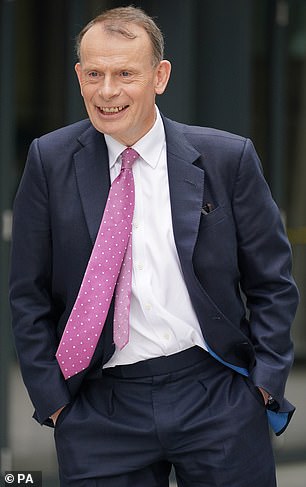
Another news item broke this week, one that many of us have been looking for. Andrew Marr, the BBC political broadcaster, whom we regularly watch with a Sunday Sofa breakfast, said he may leave the corporation so he can share his true views on politics. Speaking in Glasgow with the Scottish journalist Ruth Wishart, he said, ‘At some point, I want to get out and use my own voice again. How and when, I have no idea …. There are many privileges of working at the BBC, including the size of the audience and all of that, but the biggest single frustration by far is losing your own voice, not being able to speak in your own voice.’ Constraints such as this are a knife edge that all paid journalists must traverse, admitting the constraints is another.

Andrew Marr – smiling

For eight days and counting we have watched Israeli airstrikes and Hamas rocket barrages that have killed over 200 hundred people, the vast majority of them Palestinian women and children. Hospital buildings, schools and media centers have been bombed to rubble with Palestinians running, searching for their dead children. The heavy metal disparities are impossible to ignore. Prime Minister Benjamin Netanyahu gave no justification for targeting the 12-story press building in Gaza, though later claimed that Hamas had an intelligence unit inside. No news organization using the building had seen evidence of Hamas presence. He went on, “Israel’s military operation against Palestinian Hamas militants in Gaza will continue with full force. We are acting now, for as long as necessary, to restore calm… It will take time,” Mr Netanyahu warned. Time, to right which wrong?

Vanessa Redgrave in Julia

1978 was the awards season for the film Julia, directed by Fred Zinneman and staring Vanessa Redgrave, Jane Fonda and Jason Robards. Julia was up for eight nominations including for best editor and so we were there that night. Sitting aways away, (Walter’s chances of winning were not considered high) Vanessa looked very young, and alone as she scampered up onto the stage to be greeted by an even bouncier John Travolta. Graciously she accepted her Oscar and then spoke: quietly, politely but with great purpose, her memorable speech denounced what she saw as the Zionist disturbers of that time. That speech cost her a full blown career in Hollywood, thus allowing all of the richness of her work in the cinematic and theatre arts to flow through different channels. Listening again to that speech from 1978 while looking to the now scant news screens, tragically darkened by this new wave of Israeli and Palestinian bombing of the land that is Gaza and Holy – I wonder when will the world be able to bow our heads in prayer – together again.

This has been a Letter from A. Broad. 
Written and read for you by Muriel Murch 
First aired on Swimming Upstream – KWMR.org.
Web support by murchstudio.com