Rebooked for Tomorrow

You are rebooked for Tomorrow.

Recorded and Knit together by WSM

Whoops, the paper work, so checked and double checked still missed page one, which holds a QR code – something that those of us of a certain age are still unclear of its importance. But it only takes one whoops-e-daisy to learn pretty quickly. And so here we are back at number 19 Rue de l’Église, Gravelines, on the north coast of France for one more night.

Once more unto the breach dear friends …

We are staying in an old converted fisherman’s cottage, one of many such cottages along this street. The old fishermen are retired but some sons continue to take their boats, nets and hopes into the channel. The Granny wives stay sitting on a chair out in the street, catching the morning sun before tending their wind-protected gardens at the back. At onetime Gravelines was a thriving fishing town and much of the ‘old’ business is still in fish. Through the day the coastline is dotted with small fishing craft, a car ferry or two chugging back and forth between Dover and Dunkirk, and then a container ship looming, as they do, showing us the strength of our destruction. Now the town is mainly known for having the largest nuclear power plant in Europe. The size of the plant is sobering. Covid has made a good excuse for it not to have visitors – for the time being.
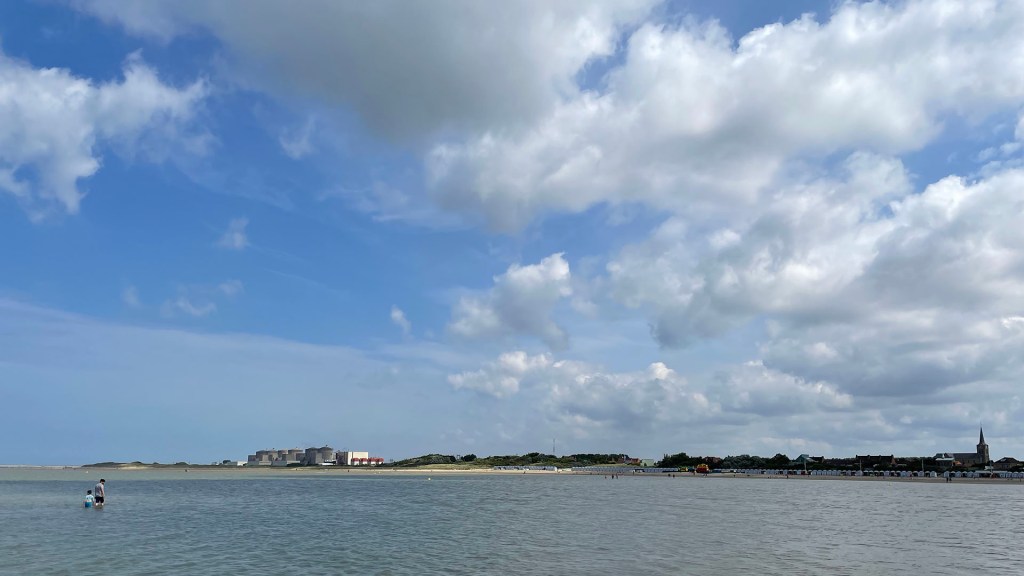
Gravelines beach with nuclear plant on the left and “our church” on the right. (photo by Beatrice Murch)
Saying hello to each other and the sea (photo by Beatrice Murch)

On our first day of meeting up, we are so excited to see each other again after 18 months apart from the little family in the Netherlands. We walked to the beach, and on the beach. The tide is strong, the beach low, the river pours in and is pushed back twice a day as with anywhere on this Earth that the Moon has residence. But the water is shallow. We have to walk a long, long way out to reach a depth that is swimmable. Clams live under the sand, jellyfish float back and forth in the small wavelets and, according to the restaurant menus, fish and the European spiny spider crab, are plentiful. But while at the beach, leading, and being led, into the waves by an ecstatic grandson, I look back along the long stretch of sand to see the dream-ghosts of solders waiting to leave. Queuing, all quietly, some in terror, and some with bravery. Gravelines was also a stronghold for the evacuation of Dunkirk in the Second World War.

We had been fortunate, our paperwork was all in order to make it into France and enjoyed the relaxation that only comes when someone else is in charge and a grandson is there to demand attention and shower us with love. And we thought all was in order to return today. But no – our age-related knowledge of the aforementioned QR code left us sitting at the station taking a deep breath with a good strong coffee for the return trip from Lille to Gravelines. Tired, dispirited, and in need of a deep glass of red wine to accompany Santi’s barbecued supper, the truth is we are only ‘inconvenienced’ in time and money as we sit outside on the patio for one more night with the little family.

Inconvenienced. It’s nothing. These last two weeks much of the world has been watching the Tokyo Olympics, athletes from 205 countries across the world giving their bes,t whatever their countries politics are. They have traveled with coaches, equipment, horses and often without loved ones. And some have come in fear. Fear of their health, their performance, and their governments, asking of each of them a different kind of courage: Simone Biles knowing her mind is not in tune with her body and retires, Harry Charles knew he was not in rhythm with Romeo 88 for the final showjumping event and retired. Personal losses both, as well as for their countries, but maybe nothing as sobering in consideration as the decision made by the Belarusian sprinter Kristsina Tsimanouskaya who appealed for, and received, political asylum from Poland. All three of these athletes are among many I haven’t registered who, often alone, have had to make such difficult and high-profile decisions. They all put our minor QR code ignorance and inconvenience properly in its place.

Driving along the A25 back to Gravelines from Lille. (photo by Beatrice Murch)

Driving back from Lille we enter Gravelines along roads that are becoming familiar. On the edge of town I look out at one nearly ripe wheat-field from where five young men have emerged. The farmer will be cross when he sees where they have walked in hiding. They are a rag-tag bunch, a couple have staffs, a couple more bags over their shoulders. They are very black, very young and very brave, as they slip away into the woods. They still have a ways to go before crossing the sea they are heading for and their tomorrow maybe a long time coming.

Leading the way to buy breakfast.

Tonight, as the church bells signal the end of evensong we will go to sleep for one more night in this little cottage. Tomorrow morning David will lead his granny back to the pastry shop across the town square and practice his 6 year old french, 

“Bonjour madame, comment allez-vous ? Deux pains au chocolat, croissants et deux baguettes s’il vous plait. Merci beaucoup. Au revoir.”

And then we will walk home and have breakfast together just one more time.

This has been A letter from A. Broad

Written and read for you by Muriel Murch

First Aired on Swimming Upstream KWMR.org

Web support by murchstudio.com

Sports Day

While America celebrates its independence on July 4th, here, this year, the not so Great Britain held a day of Thanksgiving to the National Health Service that turns 73 years old this week. And so for the first five years of my life all forms of medical care were paid for out of pockets that were mostly empty after the war. Being a country doctor could have made the difference between the doctor’s family eating well or not. Creating the National Health Service was one of the best things this country every did and for a long time it worked very well. But as science began to overtake the art of medicine, the economic equation became crunched and now the NHS looks like a proverbial cow-pony that has been ‘rode hard and put away wet.’ After these long months of COVID crisis, that are not over yet, many of the medical staff are exhausted and early retirement numbers are high. Johnson’s government will be hard pressed to patch the holes in this beaten war ship. The Queen awarded the King George’s Cross to the entire organization, done so with a handwritten letter, on Windsor Castle note paper, a gesture that is genuinely heartfelt. However a July 4th ‘buns and bangers barbecue’ with Boris in the garden of number 10 for some regional health administrators is an ill-fitting band-aide and will not make up for the 1% pay rise on offer for the staff who remain constantly underpaid and overworked.

The Base Line (Photo by WSM)

The school year here ends in July with sports and speech days and the summer sports season is on us. For a few brief weeks England will not care so much about what happens in the rest of the world but will look instead to the global sport stars. England may no longer have a contender at the Wimbledon World Tennis Championships it hosts, but the international players are thrilling to watch. So when the email came through ‘would we like to go to Wimbledon for a day?’ the answer was quick, ‘Yes Please’. 

As Sam, our driver, talked us through central London on a Monday morning it seems as if the city is slowly, cautiously returning. The Mayor has been busy making bike lanes much to the frustration of our driver. Sam tells me that there is now a shortage of truck drivers, those men who would slide through the tunnels from Europe to the UK and back again have gone home, and produce from the farms of Europe and England are in trouble.

But not the English Strawberries. For it is strawberry season and before the afternoon matches our hosts have a luncheon prepared. There remains a strict COVID protocol in place to follow that we have managed, and are given our COVID certificate wrist bands. This is an interesting table group for us, we are the only members of the arts’ arm of the very large Rolex family. There is a Harry Charles a young showjumper who, with his pal is enjoying a day away from the barn, but on whose shoulders rests England’s Equestrian showjumping dreams. The other men are older, all still at the top of their games. We are in heady company which finishes with the traditional strawberries and cream and good coffee. As we leave the salon we are handed new hats, seat cushions and water and as always, a lovely young masked Rolex guide shows us the way.

Center Court 1/4 finals on Manic Monday (Photo by WSM)

Seated, under cover but in the fresh air, I find that while I am surrounded by Gucci and Botox and more than a handful of Rolex wrists, there is kindness and laugher all waiting for the first match of Manic Monday. As we settle, the ball boys and girls run in and kneel in their navy shorts, line men and women march in, hanging their jackets up and bending over their knees closer to the line, now the umpire sits alone high up on their perch watching, listening and calling as the game begins. The number one player, Novak Djokvic against the Chilean Cristian Garin. The ladies played next with young Coco Gauff from the US putting in a good game with German Angelique Kerber. Then it is time for the Swiss Roger Federer came out with Italian Lorenzo Sonego. The ages of the players, the young pushing on the old add a grip to the excitement. The games unfold quickly and we watched seeing the mistakes that we all have made fast out-numbered by the brilliance we never achieved. Skill, experience, age, temperament and the weather all play their part and I wondered if this would the moment that the old would fall to the young. Thankfully they have held, for at least another year. For tennis is very gladiatorial.

In the summer of 1964 somewhere in Spain we went to a bullfight. It was not a big town, nor a famous fight, the tickets were cheap and we went knowing we might never see this again. It was as fascinating and heartbreaking as I had feared. Six bulls came to fight in the evening’s match. There is protocol, there is blood and death and also in a hard to understand way, honour. The afternoon gave way to the evening, the sunlight gave way to cloud-covered skies and then the rain poured down. The spectators groaned and roared at the skies and then, as quickly as they had come, left the stands but the bulls, the matadors and picadors all remained, and so did we. It seemed the least we could do, to stay, watch and honour the bravery however needlessly it had been shared and spilled.

This has been A letter from A. Broad

Written and read for you by Muriel Murch

First Aired on Swimming Upstream KWMR.org

Web support by murchstudio.com