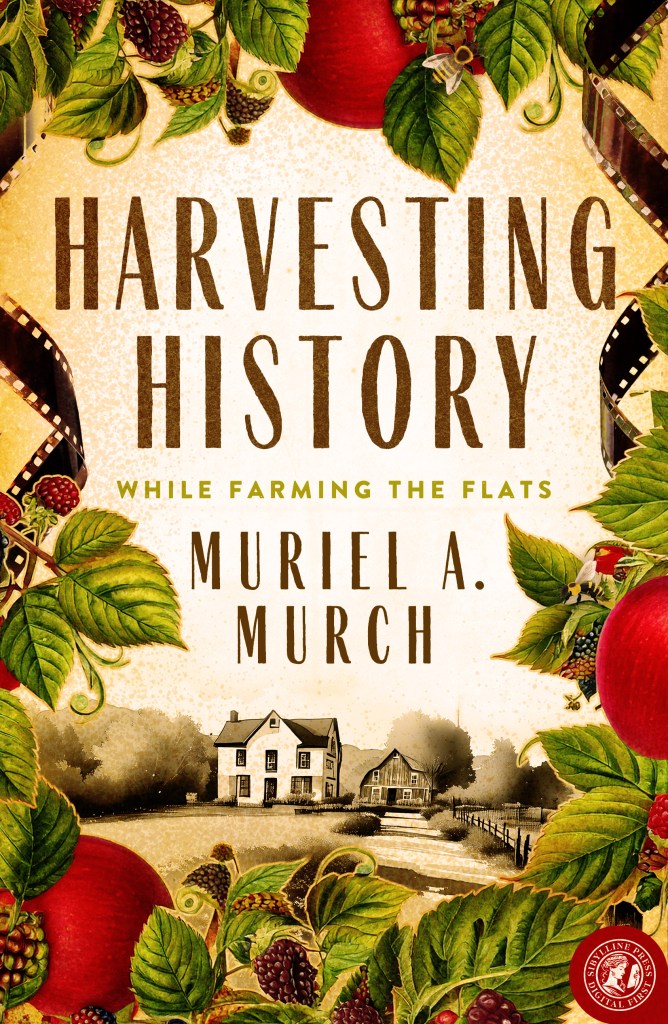
INTERVIEW by Leslie Lindsay: Muriel A Murch, Author of Harvesting History While Farming the Flats
Today, while perusing the riverwalk art festival in my town, I wandered into an artist’s booth filled with pieces inspired by nature. Barns and fields. Dirt roads, orchards. The artist was a self-taught electrician who decided he needed something ‘more,’ something other than being a nameless employee. He had a handful of business cards, each contained a glossy image of one of his many works. I was drawn to the one of a farmhouse and barn, a pastoral scene. Maybe that’s because I live outside Chicago, in a town that has grown into a burgeoning suburbia, but is dotted with the occasional farmhouse and barn. I regret I didn’t purchase his art, but my walls are full.
This is something I think Muriel A. Murch would appreciate, the merging of art with nature, complex with simple. Just because it’s ‘simple,’ though, does not mean it’s ‘easy.’ Weaving together Hollywood and agriculture, her upbringing in England, she chronicles food, family, farming, and friendship in such a way that feels not just full of life, but artful and poetic.
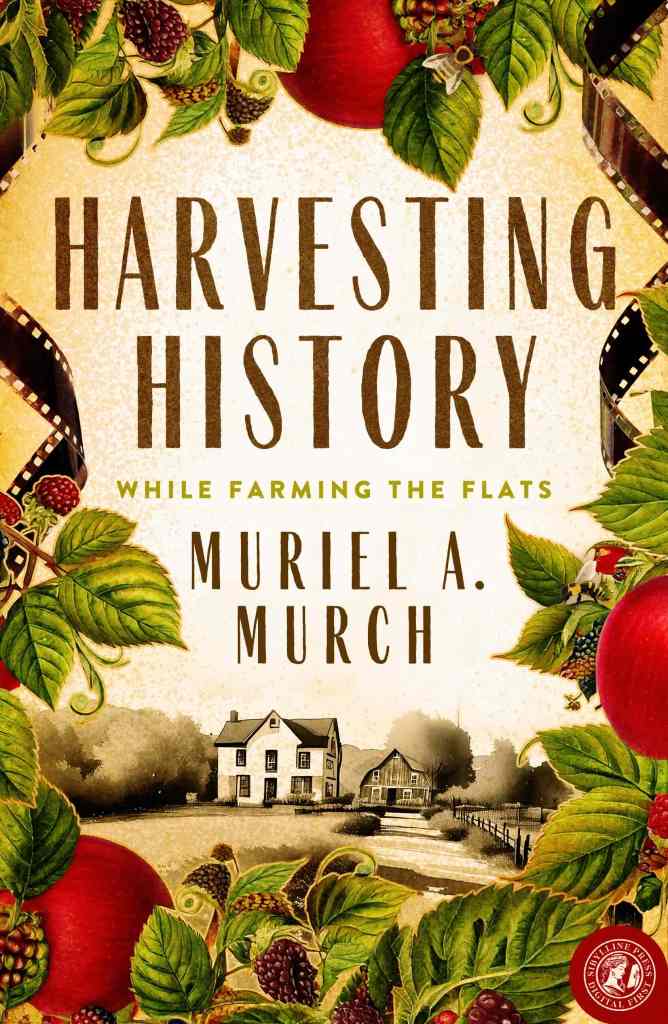
Organized in thirteen chapters with subheadings, plus a robust photo section at the end of the book, Harvesting History While Farming the Flats (Sybilline Digital First; March 2025), is a gorgeous, thoughtful book inside and out. A former nurse-midwife, Murch writes about her love of land, community, organic farming, the independent film scene, and so much more, it’s all juxtaposed by the sometimes troubling movement of urban development and Hollywood, which is anything but uncomplicated.
As I reach back to my own ancestral roots, I was so moved by Murch’s opening lines:
“Migration, moving away from one home to another, is sometimes voluntary, and sometimes forced. Quite often, we don’t know where home is until we are there.”
This was something I identified with. My ancestral family hails from the rolling hills of Kentucky, where they’ve farmed for well over two-hundred years. I feel a deep connection to the land, but also: beauty, hard work, and simplicity.
Hippocampus Magazine
Is an online publication set out to entertain, educate and engage writers and readers of creative nonfiction. It also has a books division and brings our mission to life with an online and in-person events.
Written and read for you by Muriel Murch with WSM by my side
August is a hard month for California. The sun sears down on the land that slides out from underneath the mountain ranges towards the sea. Only the water cascading down from the mountains and channeled into the fertile fields below brings relief and wealth, and the sense that all is as it should be. But looking closely, cracks are beginning to emerge. The eruptions of wealth, from early settler gold diggers in the Northern Hills, to the tech innovators in Silicon Valley playing their chips, surge and wane while those other essential and lucrative industries of agriculture and cinematic art are holding on, even as they feel the the claws of federal predators stretch and contract, preparing to strike at this strength and wealth while waiting until other, bigger fish for the moment, are fried.
The plane from London touches down at LA International. Not sure what to expect we are amazed at the ease of facing a camera before the gates are opened into the United States. Collecting our bags, we too are collected by our driver. We are exhausted but Bruno, an Angeleno, born and bred, with his own faded dreams has a lot to tell us and we listen as best we can. Depending on the time of day and day of the week each driver has their preferred route. Today we are driven to Beverly Hills on Sepulveda Avenue. The Avenue is large, even by old Los Angeles standards, dusty, dry and worn, laid down before the freeways had been dug out and around snaking through this city ever hungry for more traffic with seven lanes each way, at times barely able to contain the flow of cars.
Best burger at The Apple Pan
Entering The Four Seasons Hotel, the bright lights of the chandeliers beam down on the vast urns of gladioli denying the suffering outside. The following night we leave for the Apple Pan – open from 11 to 11 – on West Pico Boulevard, serving the same menu since 1947. It’s interesting to see Uber drivers from different cities, how they adapt to their city, get a job a gig and somehow make it all work – for a while. For we are all aware, both passengers and drivers how precarious is the American world today. We have paid homage to The Apple Pan since the 1960s, growing older along with Manny on the left wing, and Gordi on the right, of the big horseshoe-shaped counter that surrounds the deep friers and fronts the cavernous kitchen behind. Manny and Gordi began as young counter-boys about the time we first motorcycled into Los Angeles in 1965. They have both retired, but we continue to come, showing our children this tradition whenever we are in Los Angles together. Three kinds of burgers and four sandwiches make up the main menu with a generous helping of french fries. Flipping the menu over to deserts, only the Fresh Apple and Pecan pies are not cream pies – the rest are cholesterol heaven. You want Ice Cream? That will be double Dutch Vanilla.
Entering The Apple Pan is like entering a cave. For awhile, the beat and heat of the outside world is left behind. Even if your truck-driving is more limousine laden than diesel loaded, this is trucker heaven. We come to decompress, to speak and be spoken to kindly, it is almost holy. In years gone by West Pico was bright with shining mall lights, the intersection humming with life but now the outside street is dark and bare. Swaths of real estate have been shuttered, the lights turned off, only the blinking of a few cars and hissing busses pass by. It has taken me two days to find the right word for this Los Angles – it is – desolate. America does not seem so great again.
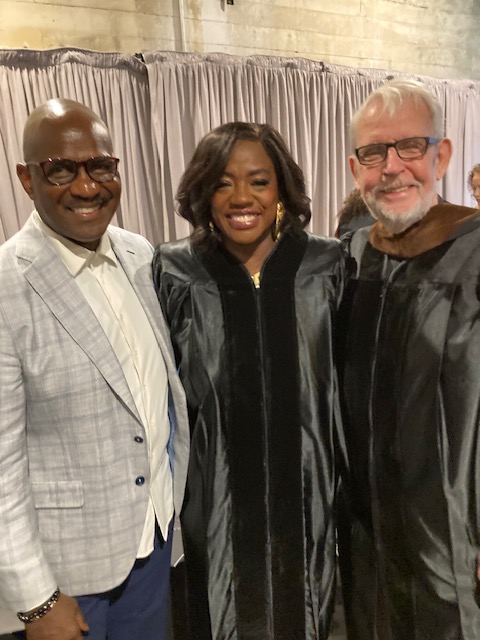
Julius Tennon, Viola Davis, Walter Murch
The week ahead holds a busy schedule. Along with Viola Davis, Walter received an Honorary Doctorate from the American Film Institute. Each of them, a power-house within their spheres, spoke passionately from within their disciplines and I wonder what the graduates made of them both.
For a morning, because it is a graduation with new beginnings for young artists, there is hope and relief in the air. And laughter as when we stop in at the post-event brunch and the faculty head of editorial asked me,
“Are you?”
“Yes.”
and laughter
“You’re famous in Hollywood. You must have the patience of a saint.”
And there is more laughter.
A little nervous beside Marylin
We connect with the friends that we can. There are friends too sick to visit, there are friends who have put their homes back together after the Palasades fires, and friends who are only just beginning. These are the precious moments.
And then the work. ‘Suddenly Something Clicked’is clicking along. The buzz around its publication is moving quickly through the Los Angles Post Production community and at the same time ‘Harvesting History’ is having its own quieter moment.
Randal Kleiser and WSM are listening – along with a standing room only audience.
Randal Kleiser led us both through our books at Chevalier’s Book Store in Larchmont before Lawrence Weschler puppeteered Murch at The Hammer Museum and the following night Murch just carried on determined to expose as many minds as possible – in another packed house at the Pasadena College of Art and Design – to his exploration of the Golden Ratio of the human face and its relation to cinema. He’s almost come up with an answer, but an absolute answer that might hold truth in logic would perhaps disperse the magic. And what is the magic of these days for these film makers? Maybe the fact that someone is thinking about and able to articulate what they hardly know goes on in their own minds. “Oh that is what I am doing, that is what is happening.” There is hope and validation and even a good dose of courage to be gained by listening.
We are lacking the stamina that is needed for such a full adventure and were felled with summer colds that descended like thick fog and hovered on the brink of bronchitis. Walter was downed early, checked out and prescribed a broad antibiotic by the brisk 60 year young hotel house doctor. I fall at the end, somehow packing and flying until we reach the safety of our London cottage. I wail that I want Doctor Joe, with his gentle chuckling care and beloved Mo with her Chicken soup.
The saving grace of illness is that it was two nights before we are able to manage the world news, Gazas rubble and carnage taking third billing to the immigration rows and the slow bizarre meeting of The American President with Vladimir Putin in Alaska followed by the European Leaders ‘Coalition of the Willing’ in Washington DC. There is the news, and the the body language, and maybe some fake AI unfurling as this madness of the about turns of this play out in unreal time. Sifting through the lies and the truths, the temptings and concessions, the breath-holding is reminiscent of a mother feeding a toddler with a buzzing airplane spoonful of spinach maybe to be spat out in a rage or grasped and swallowed looking for the prize of peace.
This has been A Letter From A. Broad written and read for you by Muriel Murch
Written and read for you by Muriel Murch with WSM by my side
I was nervous that he wouldn’t like it – and might get grumpy at the thought of going to Veeraswamy’s Restaurant on Swallow Street, the site of our first date 61 and 1/2 years ago. Veeraswarmy’s has been tucked into this little street, changing ever so slightly but ever so cleverly in style and food for its 99 years and remains the leader in Haute cuisine of Indian food. I need not have worried: he was happy and relaxed as we sipped their modern day cocktails, a Wimbledon Pimms for him, and Kir Royal for me while we enjoyed reading the menu.
“We sat over there,” we remembered, smiling while looking at the little table tucked in a corner while thinking back on that time. And that we had returned for Walter’s 60th birthday party. Now is is just us again, and he is 82.
Though we were dining early, the restaurant was filling up. A younger couple was seated beside us and as we smiled at each other I blurted out – because that is what I do – that we had our first date here 61 years ago and we were here for my husband’s Birthday. “Us too” the woman replied. We were both dressed specially for this evening out for our menfolk. She wore a black fitting maxi dress with an assortment of gold necklaces. Her diamonds were expensive and this evening was her treat to him. After our meals were eaten both tables were served with the obligatory delicious chocolate birthday deserts. We smiled again.
“How old are you?” I asked,
“40” He replied and I looked at him again.
“Where are you from?”
“From Florida. She’s on a work trip.” (Not ‘my wife’ but ‘she’.) And again because I truly can’t help it – I laughed and said:
“Florida, I could never go to Florida, the alligators frighten me.” And then even before I had finished speaking, my awareness shifted and my prejudices immediately leapt into my imagination – they are from ‘that’ Florida and ‘She’ is on a reconnaissance trip for the American invasion that is about to happen this summer. I felt my heart freeze. The birthday gentlemen finished their chocolate cake with just the smallest help from the wives. As the last forkful was finished she learnt over to me and said,
“Can I ask you?” Of course, “We have a two-year old at home and apart from Paddington Bear what else could I bring her?” Ah, now I was on home Granny ground and launched into the thrills of “Ant and Bee,” showing her the books on her phone. And even as I explained:
“They are different, but friends, you see.” I wondered if that idea would sit comfortably with her – different but friends. The conversation quickly went to families, they are both from large families with lots of siblings, and were worried about raising an only child. She was hungry for any knowledge she could gleam from this obviously comfortable English Granny – who was also wearing the appropriate amount of bling. I told her which bookshops she could go to and even brought up.
They were staying in Mayfair which helped confirm my imagination of them here to prepare for the American political invasion that is coming to England this summer.
The American President starts his trip in Scotland where security will try to preclude the Mexican marching band that greeted him on his golf course a few years ago.
Paddy Power descended on Glasgow Prestwick Airport (? 2016) to greet US presidential hopeful and golfing entrepreneur Donald Trump with a live performance by a Mexican mariachi band, “Juan Direction”, armed with a wheelbarrow full of bricks
Meanwhile ‘Me too Me too’ cries JD Vance who does’t want to be left at home to take care of America and has taken a holiday home in Chipping Norton for his family and a month long summer break. But who is minding the shop, if DT is in Scotland before spending two nights at Windsor Castle -a stiff nightcap whiskey or two will be needed that weekend – and JD is in the Cotswolds? Security is going to be tight, there will be grumbling down at the pub and it is quite possible that more than one antique Ford Major tractor will trundle along spitting manure off of their tire tracks in front of the large black SUV’s that will incur scratches if they are not careful on those narrow country lanes. This is not going to be a happy time. What of the hidden politicians who take refuge in the Cotswolds? Will David Cameron have JD over for drinks, even Nigel Farrage? Will Boris lumber up from Oxford bringing his brood with him? It doesn’t look good. The country lanes are not the only pathways going to be blocked.
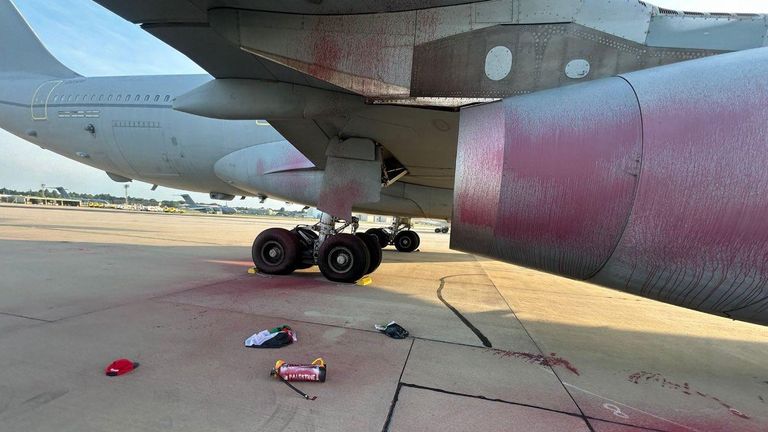
Just a small paint job
All this on top of June’s embarrassment when a handful of pro-Palestinian activists popped through a preexisting hole in the chain-link fence surrounding the Oxfordshire airbase and sprayed two RAF military planes with red paint. The Prime Minister, Sir Keir Starmer, said it was “disgraceful” and an “act of vandalism”.
Well of course it was. But whose grace was disrespected while the planes remained in working order? Not Palestine’s. Quickly a law was written and passed that support of the Palestine Action organization was now an act of terrorism.
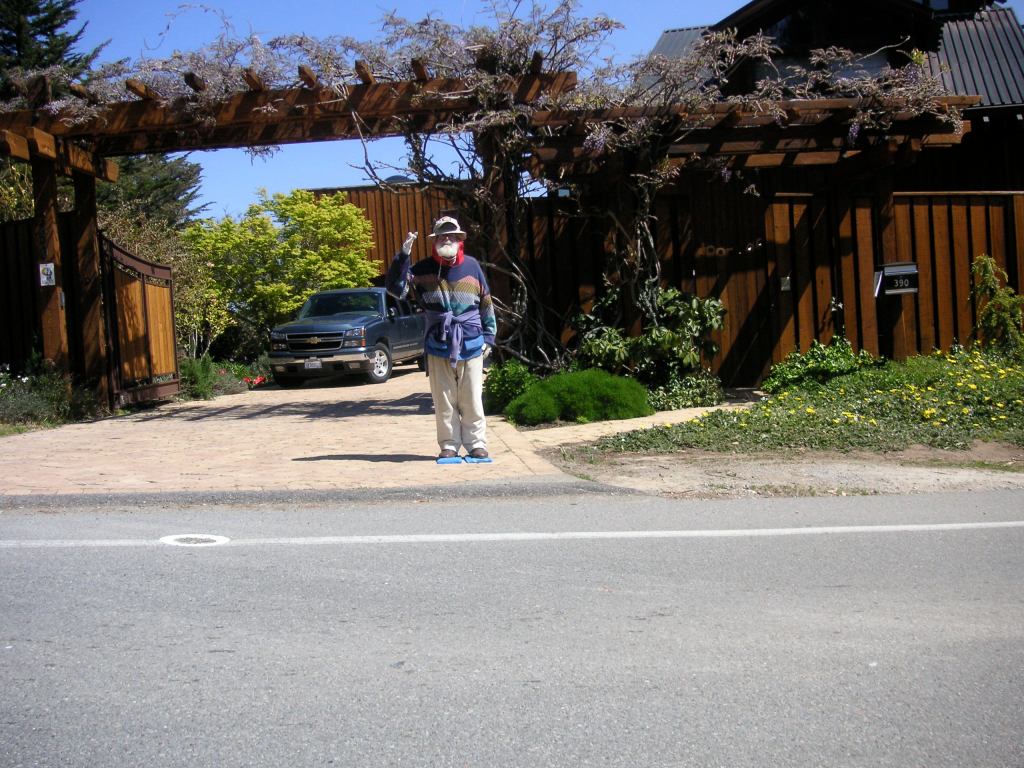
So where does that leave someone like Mill Valley’s John the Waving Man from 2008, and now England’s 83-year-old Reverend Sue Parfitt, and Laura Murton.
John the Waving man to stop war. Mountain Road Mill Valley 2008Police remove 83-year-old Reverend Sue Parfitt from the protest in London.
Nightly we see pale gruel, with a few floating vegetables scooped from big metal vats into small plastic containers held by old men, women and children while sacks of flour are hoisted onto the backs of young men just still strong enough to carry them as they scurry away zig zagging trying to avoid the bullets fired in panicked fear by young Israeli boy soldiers.
‘Please,’ begs one minister in Parliament ‘Can we acknowledge a Palestinian state while there is still a state to acknowledge?’ Last month, Emmanuel Macron addressed the English Parliament saying again that a two state solution was the only way to build stability in the region. It is unbelievable and heartbreaking that resistance still comes from the British government, though cracks are beginning in the less-united labour party. The UK foreign secretary, David Lammy, told the BBC that he felt appalled and sickened by the scenes of starving Palestinians being shot as they sought food.
“We said we wanted to be part of a process. But we have had no process. What we have had is mayhem and conflict. There has been no process to attach that recognition to.” The Newsnight numbers of dead are now given twofold: those killed by the shootings, and those dying of starvation.
This morning ants are coming into the kitchen through the open window. They have finished their meal of nasturtium-clinging aphids and are searching for fresh compost for dessert. A stray buddlia plant is blooming in the parking lot and a dozen or more butterflies are enjoying its nectar while the bees harvest from our fuchsia blossoms. As I prepare a breakfast of applesauce made with early windfalls from a friend’s country garden, I bow my head in gratitude and sorrow understanding that no windfall is falling yet on Palestine and its people.
This has been A Letter from A. Broad written and Read for you by Muriel Murch.
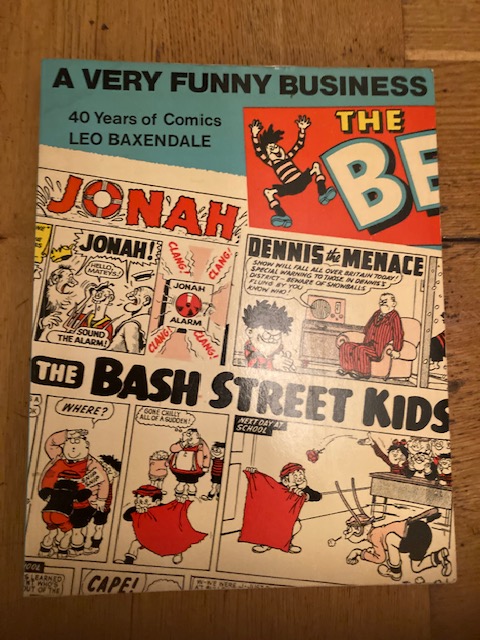
As dawn broke in years gone by, newspapers would be delivered by a bicycling schoolboy earning a few US dollars or English shillings. The papers were carefully gathered to be opened at breakfast, pages turned with American coffee or English tea – and toast. The news, the gossip, the sports – in green – before finally the cartoons and crossword puzzles were found on the final pages. Now those youngsters are out of a job as television and social media bring everything to us with a click of a button or a swipe of a forefinger. With a nine-year old grandson, I am having a refresher moment of comic book education. It is a good primer for what is playing out on the large and small screens in our hands.
The Cover of Leo Baxendale’s ‘A Very Funny Business’
The story lines are remarkably similar; a bully struts into the Oval Office with all his pals lined up behind him. A new boy comes in – quickly mocked for failing to be dressed the same as the bully and his pals. The new boy sits quietly, tries to reason with the bully and holds his own before leaving abruptly, as if chased from the room, but in reality he has left on his own terms. A few weeks later, the bully picks on another visitor. He too held his own with calm dignity. Now, weeks later, both of these men have achieved their aims. President Zelensky has demolished a third of the Russian bombers that were set to attack the Ukraine while, as South African President Cyril Ramaphosa left the White House, his smile reinforced for both black and white South Africans that his diplomacy skills are a strength the whole country is grateful for. This week the German Chancellor, Friedrich Merz, traveled to Washington DC to report back to the European Union. He too saw the symptoms of madness and stayed calm. As the rough-housing erupts in the White House we wait for the next installment to be drawn on the page.
While the comic book gets put aside – I find a gift tucked into my email inbox. A note from Barbara Bos who runs the Woman Writers, Women’s Books website would like a piece on the background of Harvesting History, While Farming the Flats and how I came to write it. This exercise is perfectly timed to answer a question that I pushed aside before it even had a chance to form. Did I answer her question? I’m not sure but this is some of what I wrote about that time in 2014.
Bees are busy in the Borage
It is midday. As many mornings as I can, I spend outside. Farm chores call out: ‘Over here, over here’ with raised wands of weeds, brambles and fences to care for. Fridays are sacrilegiously saved, even called ‘My Friday Farm days’. But I can only manage three morning hours before my body tells me to halt and I come back inside. Clean up, and enjoy a small snack before taking my place, sitting at the Bistro table, beside the French doors, in the main dining room.
The Farm Dining room is quiet now
This is a quiet room, saved now for big occasions with family or friends, but in this solitary time I take it for my own. The stillness calls me and I welcome it putting my pen to the page bringing immediate and long-past memories together, taking time to talk to the page.
Journal books are on the table. The little blue one – whose innards I change each year – records the past day, the day today, and the things still to do. Lists abound in that book while very occasionally an Idea or Question is also captured. When the three pages of warm-up notes are completed like piano scales, the little blue book is put aside. Two bigger journals, also with soft covers, have big spaces and faint lines. I can only open these when I am alone, for the pen may find memories of its own, spilling its ink over the pages onto the table, and I am frightened that I cannot scoop them back again. My pens also are important. Somedays I pick and choose, wanting something different, possibly a useful pen, even a pencil, or a beautiful one with free flowing ink, gliding across the page like a superb dancing partner. I have a fountain pen, a gift we bought from Rome one Christmas for my mother and which she used for the rest of her life. Sometimes when I write with it, I feel my mother’s encouragement – now flowing more freely through that pen. Each entry begins as a letter to you, whoever and wherever you are, or even a chat, as if we were sitting side by side in a cafe.
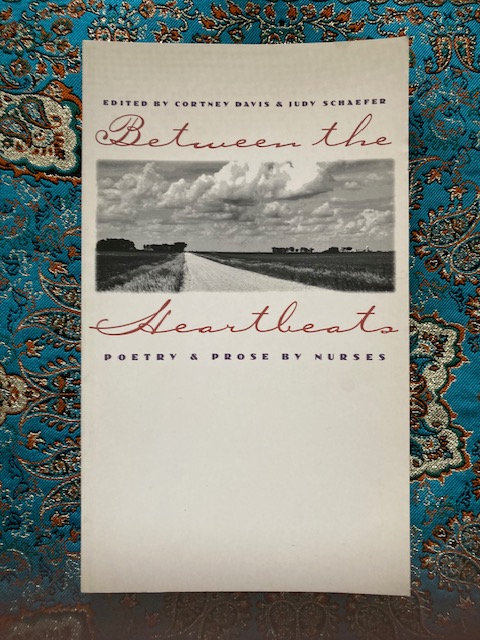
Between the Heartbeats. Poetry and Prose by Nurses, edited by Cortney Davis and Judy Schaffer
I start writing like this, knowing that much of it will not find its way into the final piece. I accept that scribbling is OK, good, it is the compost, heating up the heart, trusting the practice, the craft that hones thoughts into words until they become uniquely mine. There is no final version – until maybe it is published and given to you – a reader. Writing becomes us, as slowly, one gathers a body of work behind one. I remember the first time that I received a postcard back from a Submission, (with a capital S) It was for Mr Tims Morning and Cortney Davis wrote on a card, “Thank you for this excellent work.” She probably wrote that on cards for all the work she and Judy Shaffer collected for their first Anthology of Nurse writing Between the Heartbeats. I still have that note.
Now, two books later, it happened again, Steve Wax had read some of my essays published in ‘The West Marin Review’, then, in a huge cinematic reunion sought me out to say, “I read your essays and they are beautiful”. And so the harvesting began again.
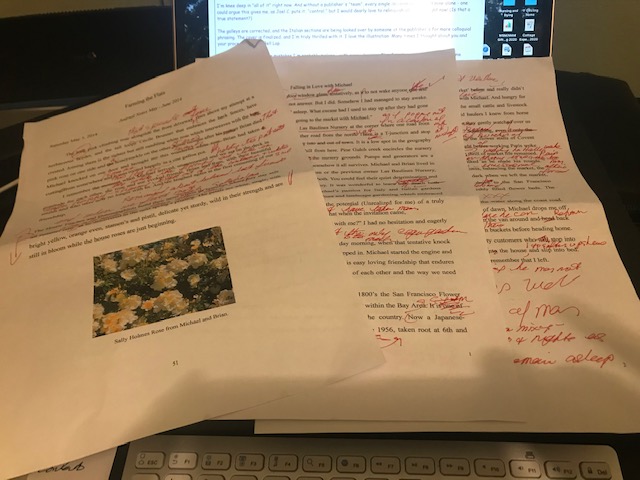
The isolation imposed by Covid and age, helped me turn inward in earnest as I carried those farm journals to London and old memories began to sit beside the farm memories from – well – memory. Only when the essays laid themselves alongside of each other, jostling back through the-time-before, like the loose and falling pages of old photo albums, which must – one day – all be digitized. But until that time I would write about – that – those – times, remembering them in words and stories. Sometimes the words rise like yeast-laden dough, as the memories crowded on the page become kneaded together with imagination.
What does it take to do that? Perseverance, putting the words on the page, taking them up again, moving them around before pushing them back down. There is a reason why in bread recipes we are instructed to knead the dough for 10 minutes until it is soft and silky under our hands. That is how we want our words to be, soft and silky, gliding along the page and into your imagination.
This has been A Letter From A. Broad written and read for you by Muriel Murch
Recorded at KWMR.org March 7 2025. Host Muriel Murch
It’s the writers, it’s the publishers, and it’s the bookstore owners that come together to give us the books we read. Over the years publishers and publishing, both in big and small houses, has grown and changed how a book gets into our hands and our hearts. It is not often that one gets to sit down with a working publisher who is willing to talk about the ups and downs of the publishing business today.
Harvesting History Book launch at Bolinas Museum March 8th. Muriel Murch with publisher Vicki DeArmon by her side
But at the beginning of March, Vicki DeArmon, the publisher of Sibylline Press, along with Christine Walker, one of Sibylline’s authors joined me at KWMR.org radio in Point Reyes Station. We had a grand conversation, learning about Vicki’s experiences in the dynamic publishing and bookselling worlds in the heyday of small presses in the 1980s and 1990s in San Francisco, when Bay Area presses and book stores each relied on the other for their livelihood, while harvesting authors for their successes. Vicki talks about the history of the Bay Area’s publishing houses, sharing information as to how they work and helpful information about how to get your book published. Christine talks about writing memoir, where memories come, from and the importance of all art in the creation of story and books. So sit back maybe with a glass of “Mortal Zin” (another title from Sibylline) and enjoy.
Foghorn by Vicki DeArmon
Christine Walker’s Tap Dancing at the Bluebird taps its way onto a new Kindle
Written and read for you by Muriel Murch with WSM by my side
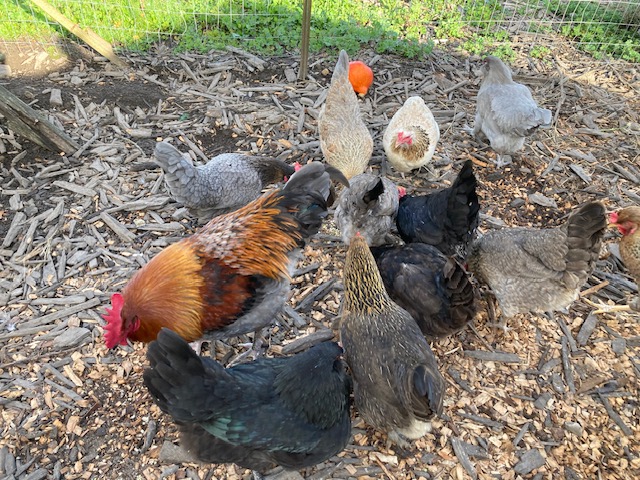
The sun was shining as I finished refreshing the chicken house. Blue, the rooster, led his ladies milling around, happy as they checked out the new straw and shavings. And then, out of the silent sky came the roar and rumble. Looking up, I saw nothing, but heard and felt it deep in my body. I know that sound, it was a fighter jet, flying low overhead and I thought – the war has begun.
Breakfast in the safety of the Hen house
The news media bombards us and, like the chickens scratching in the orchard, we are half-primed for the pounce of a predator coming from the surrounding underbrush. For the moment, the chickens are safe from a resident bobcat on the hill as I will not let them into the orchard, but we may not be so lucky.
With each item of news about the shenanigans happening in the Happy House in Washington DC, everything we treasure about the Constitution is under attack and it takes more strength than I have not to be afraid of, and for, America. We can hardly glance at Gaza, the Sudan, and the world. But Europe, though teetering on waves of militant bravado has woken up. Germany has just elected a Conservative government – but the seemingly strong right-wing factor is licking its electoral wounds. Even Nigel Farage has toned down his bombastic spittle. A beloved friend in England who was beginning her new life in Scotland now thinks that her old home in the Australian Outback looks safer.
Thinking back into European and American History of less that a hundred years ago is like turning the pages on an old photo album. History, behaviour, and human nature mixes and re-emerges as a sea thrusting the waves of an ocean storm circling us again.
I’m thinking of young Vladimir Putin as a keen and dedicated KGB officer, committed to keeping all the surrounding principalities herded into the USSR and then, under Putin’s watch, for it all to be upset by Mikhail Gorbachev giving back Ukraine and breaking up the Union of Russia so tightly bound by Stalin. An attempted coup – here is that word again – led to the dissolution of the Communist party in Russia and the USSR four months later. Heady and searing times for a young, ambitious KGB officer. At the same time another ambitious yet nervous young New York business want-to-be was struggling with paternal authority issues. Slipping into real estate with a million dollars, and the advice, “you’ve got to be a killer”, from his father Fred, he began. Among his successes were failures, both moral and financial but he kept playing the part until he became the business man he wanted to be. But this smiling blustering crook took more than one serious tumble and that was captured and understood by an equally ruthless and ambitious, but more serious President across the continent of enemies. While Putin’s early bruising was from Gorbachev, and remembered for the rest of his life, the US President’s crushing bruising came later, in 2011 when an African-American president, Barak Obama, returned his fire at the White House Correspondents’ Dinner – these personal insults were never forgotten and maybe this was the night that redemption and revenge became the main drive of Donald Trump to rule the universe he knew.
Now these two men are playing on the world stage, ruthless killers and unrepentant deal makers. It is not a good combination for democracy. Ukraine’s President Zelenskyy may be bold, clever, quick and right but crushing him and regaining Ukraine to Mother Russia remains an objective, with the candy cane of minerals and wheat for the taking. We who are older and watching what is playing out see a repeat cycle on the world stage and know that deep down all of this dog-fighting is personal. There are other young European leaders taking up the helm for Zelenskyy and Ukraine. Emmanuel Macron flies to Washington DC, sits at the right hand of the Emperor and gently laughs, humors and says ‘Ah but no no, it was like this’. The Emperor laps it up, enjoying the adulation of the younger man but will probably pay no heed to his words. Next will come the British Prime Minister, Chief Prosecutor for the Labour Party, Sir Keir Starmer, as devoid of humor and charm as Macron is full of it. He will play another hand, appearing to be ‘taking the President seriously’ while – maybe – we can never be sure with Sir Keir – again trying to guide the US president away from his deal making with Russia.
From The New Statesman
Zelenskyy, Macron, and Starmer are young men, hard working and dedicated to Democracy and a Free Europe but they may not be strong enough to turn the US President away from the skull crushing grasp of the Russian bear Vladimir Putin.
We watch the world stage from our rural corner of California, while looking at the effects of the games played by the boys in the Oval Office. What affects us close to home? What are the things we care about? Hard working families in fear of being torn apart, rangers from the National Parks fired, books banned from Libraries and Schools.
We are older and need to tidy up our lives. We are not cleaning out the cupboards and barn stalls as we should be, instead have been writing of our work, our lives and worlds together and apart. There are family stories to repeat, cinematic history and community evolution to record. And for some lucky reason both Walter and I are managing in our own ways to remember, to write and to share our lives. Walter’s new book ‘Suddenly Something Clicked’ from Faber & Faber will be on bookstore shelves and Amazon in the UK in May and the US in July. My ‘Harvesting History while Farming the Flats’ will be scrolling out in a digital format for your Kindle in March, followed with a print version a week later. And even an Audio – as soon as I can get to it. Here is a little glimpse in the prologue of our life stories as they moved separately through the decades of our existence together.
After my husband delivered a lecture to a group of Danish Film makers and students Philip calls out, “The last question please,” and a young man stands up.
“Mr. Murch, with your work schedule and the traveling, how do you manage a home life?” then he sits down. Suddenly there is a deeper quiet in the room. Philip nods and raises his eyebrows, which always look striking with his large, round, smooth bald head. He nods as if to say, “yes this is a good question” and looks over at Walter. Walter pauses, not rushing, as he can, to answer with overflowing ideas. Then he responded.
“Truth be told I don’t. I am often on a project for a year, maybe longer, sometimes eighteen months, even two years – and in that time I may not know where I will be six weeks ahead. You will have to ask Aggie that question.” He smiles and looks up briefly before Philip calls out, “Lunch. We will reconvene in an hour.”














 Muriel Murch