An Inquiry

Written and produced for you by Muriel Murch with WSM by my side.

‘Yes Minister’ first aired on The BBC television in 1980 until it ended in 1988, possibly due to the fact that it was becoming harder to distinguish the comedy series from the nightly newscasts that followed. Among the many quotes attributed to the Cabinet Secretary Sir Humphrey is “Minister there is going to be an Inquiry” to which the reply from The Prime Minister Jim Hacker is “Oh good, then nothing will happen.” Well yes and here we are again – 
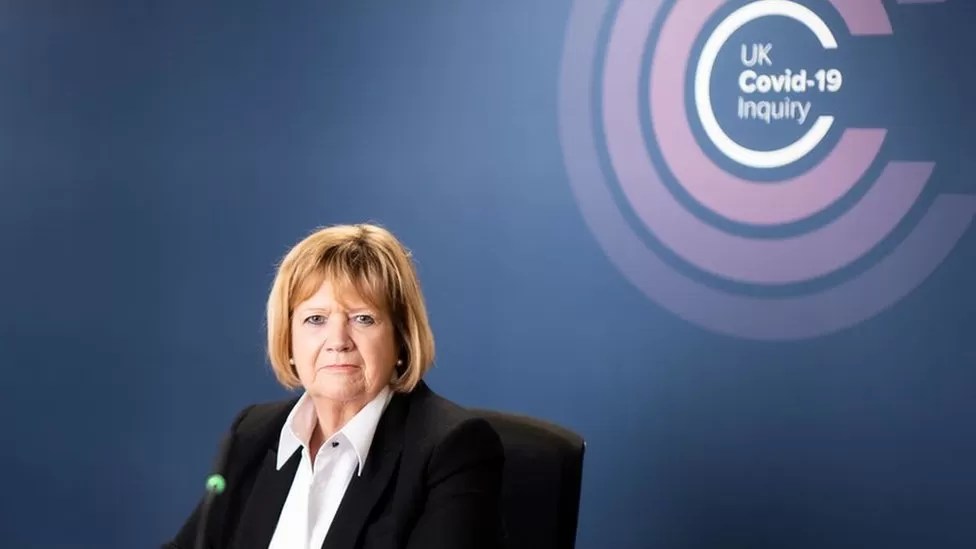
Baroness Hallett promises the inquiry would be ‘thorough and fair’. Photo from Piranha Photography.

Last week saw the beginning of “Britain’s Public Inquiry” to understand the Conservative Government’s responses and handling of the Covid pandemic. But for the life of me, I can’t find out who is in charge of “Britiain’s Public Inquiry” and what – after the facts have hopefully been gathered – will happen? Will lessons have been learnt? Will those deemed responsible be held responsible? Will there be any retribution? Will anyone be called before a court of law or those pages of documents produced be filed away rather than read. Last week when Dominic Cummings gave his testimony he asked that the inquiry also focus on the broader failures of the system. Reading – for I can’t listen to them talking – it is clear that as blame is shuffled about like pearls under walnuts, the prize goes to the then Prime Minister Boris Johnson. Dominic Cummings likened working with Boris Johnson to driving a shopping cart with a wonky wheel. 

It is not without irony that the inquiry is taking place at Whitehall just across the river from the Covid Memorial Wall that was created and painted in 2021by people who had lost loved ones, or worked in the NHS, coming together with the good guidance of the group ‘Led By Donkeys’. Over 240,000 painted hearts cover more than a third of a mile alongside the Thames River outside of St. Thomas’s Hospital. During this time the public were afraid and looked in vain for leaders in the government where all the common sense had been bred and educated out of almost anyone in Westminster not yet of pensionable age. It was like putting drones in charge of the beehive to collect pollen and care for their queen, when all they could think about was kingship and sexual obsession. 
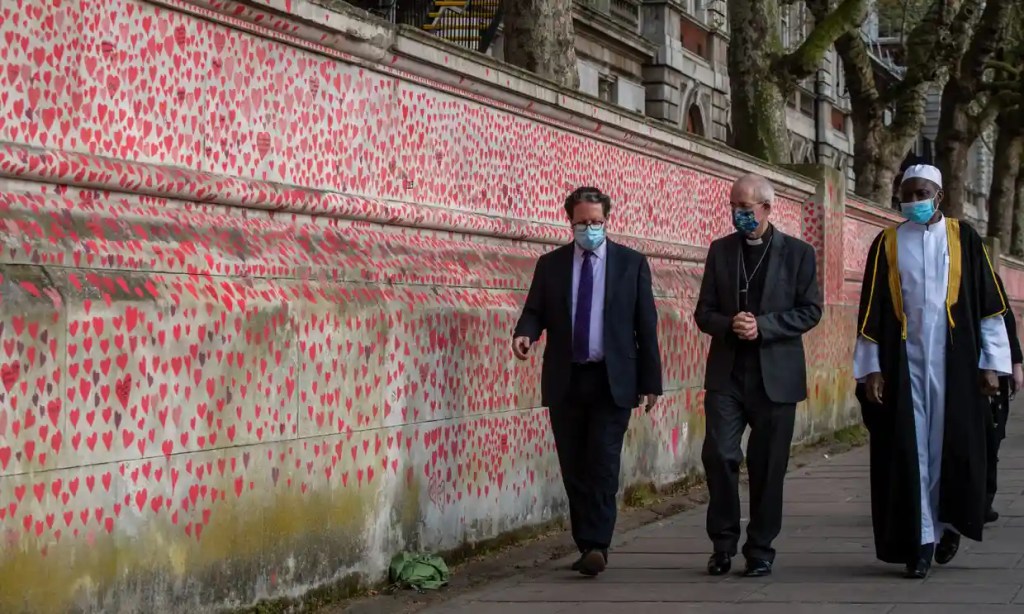
From left: Rabbi Daniel Epstein, the archbishop of Canterbury, Justin Welby, and Imam Kareem Farai visiting the wall in April. Photograph: Chris J Ratcliffe For Covid-19 Bereaved Families For Justice/Getty Images

People are booking their theater seats. We follow the inquiry like a serialized Charles Dickens story in the magazines of the day. Up to testify next are the past Prime Minister Boris Johnson, his hovering henchman Matt Hancock, and the holder of the chair at the moment, Rishi Sunak. But it is the failings of one particular individual, Boris Johnson, who was ultimately responsible for directing the government, which will continue to be scrutinized in the months ahead. Johnson’s successor-but-one as prime minister, Rishi Sunak — who was U.K. Chancellor during the pandemic — also has questions to answer. All three men — Johnson, Sunak, and Hancock — are to appear before the inquiry in the same week at the end of November. 

Photo Credit to Art Center Wikipedia

Sunak has thrown his dead cat into the ring – by hosting an international AI conference on safety issues that was held at Bletchley Park. The conference produced some back-patting for, and from, the UK, US, and European leaders who attended while getting a nod of approval from the United Nations. Elon Musk arrived to give a speech and chat with Rishi at Downing Street. Both men in their uniforms, Elon remains rumpled and a little unshaved while Rishi rolls up his pristine white shirt sleeves possibly looking for his next job opportunity after this gig is over. So will anything happen from this inquiry apart from “Lessons have been learnt”? The Infected Blood Inquiry – the Stephen Lawrence Inquiry – and the Greenfield Tower Inquiry – have each chipped away at this UK government, but not a lot has changed. Could this inquiry be the one showing that Britain’s democracy has really gone up in flames? I’m writing on Guy Fawkes night – our night of fireworks – celebrating the failure of the 1605 attempt to blow up the Houses of Parliament. We may be holding our breath and will it happen this time? I cannot watch the inquiries – it is too painful – so instead I read.

in an interview, the American thinking and writer, James Baldwin, said “You must realize that if I am starving you are in danger”. And in this simple truth, buried deeply, lies some of the reasons the wars are being fought all around us. Johnathan Freelander writes eloquently and with great heart in this weekend’s Guardian Newspaper, that no side of the Israeli, Gaza, and Jordan triangle conflict are searching for a peaceful conclusion – at this time. In Pulse “Stories from the Heart of Medicine,” I read a translated account from Hadar Sadeh, an Israeli youth psychiatrist working at a Medical Center, about twenty-five miles from the Gaza Strip. Then I open an email from our Palestinian friend and filmmaker, Annemarie Jacir. Each woman weeps at the death of children and physical destruction that they see around them. Each letter could have been written the other.

And see how the war in Ukraine gets roughly pushed to one side even as we know it continues? Old statesmen take planes from one capital city for talks then board another, exchanging their suit jackets for a flack vest as they land in a war zone to encourage young men to face death bravely for their country. Ukrainian President Zelensky rightly worries that this other war is distracting from support to his war – defending Ukraine from Russia’s invasion. How much can we carry in our hearts? And tucked away even further is the news that Russia’s President Putin’s arch-opponent Alexei Navalny’s three lawyers have been detailed. They are facing trial for participating in the so-called extremist group, Navalny’s Anti-Corruption Foundation. If they end up in jail then all contact to the outside world will be lost for Navalny. Each of these eruptions is bleeding like an aspirin-fed wound and all the pressure that is applied will not staunch or stop it any time soon.  

This has been A Letter From A. Broad written and read for you by Muriel Murch.
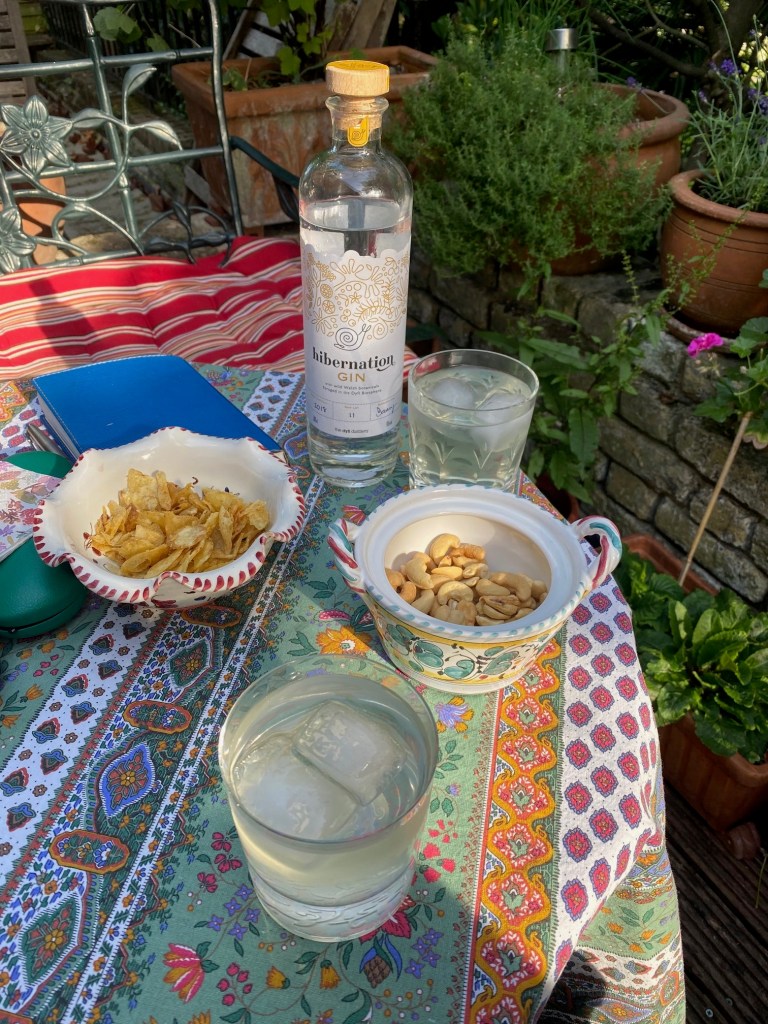
Hibernation Gin

Recorded and knit together by WSM. Aired on KWMR.org June 24 2020

The Summer Solstice has brought bright sunshine. But there are no trips to Stonehenge to divine what the sun’s rising foretold today’s Druids. The longest day turns us to face the oncoming months of summer and review the fruition of the last few months of solitude. We are lucky and blessed, each with work that can be done sitting in a dressing gown on the sofa or – as some of us prefer – dressed for reclining out on the terrace.

We are also surrounded by a wonderful mix of neighbors gently watching out for us all. Tentative new friendships have begun between those of us who have been aware of each other for a mere twenty years. I now know that Leslie likes to read historical fiction, ‘I’ve got bookcases full of ‘em. You are welcome to borrow anything, come over any time.” She now knows that many of the flowers she enjoys when looking out of her window come from my mother’s garden.

Pressure on the government by ministers, businesses and the economy is growing. Non-essential shops have begun to open, though I’m not too sure what separates essential and non-essential, and for whom. One of my essential shops remain unable to get to their Piccadilly warehouse for what I require.

“The Prime Minister will share his outlines for reopening the economy on Tuesday.” The Government hands out information like school homework assignments and I’m not getting too excited about what Tuesday might bring. There will still be queues outside of the shops, there will still be people mindful of how they walk, and others uncaring as they pass you. And this new reality does not bear looking into too far ahead. Whatever Tuesday’s briefing may bring, I know that ‘we will never get back to normal, how things were.’ Intellectually I understand that, I really do. But emotionally I am a little worn down.

A friend and I had a socially-distanced wine bar meeting in the Library Garden. But as she steadies me down off of the ladder, where I have climbed for a little pruning, I longed to take her hand. Another friend is coming for tea in the Square’s garden on Wednesday. Will we be able to hug each other then?

Touch is the glue that holds us together. The skin is our biggest organ, it covers, protects and feeds us all at one time. Again we are lucky, there are two of us living side by side and touch is as much a part of our lives as is ‘time for a cup of tea then?’

The moments of solitude and intense personal work can also be a time to pause and look inward. It is James Baldwin’s clarity of thought and literary articulation in his essay ‘Faulkner and Desegregation’ that helps me delve into the minutiae of my mind and think of the prejudices that I carry.

“Just because they speak the same language, remember, they are still foreigners.” Said my mother in 1964 as I sat on her bed late one evening before leaving for America. I was appalled, as I often was, at ‘the things my mother says.’ I left for America determined to pay no attention to her words. It took a month, six weeks at most, for our cluster of three Irish and one English nurses to start squawking at how the Americans we met, patients, doctors and fellow nurses, behaved. Where was their stiff upper-lip? Did everything need to be written out before we got a patient out of bed? What, in other words, was the matter with these people? Our little gang of gals grumbled our way through winter into spring. New York and all across America was in racial turmoil during those months and on throughout the summer.

My mother arrived in July for my marriage (to an American!) in August. She came bearing gifts, lists and more scoldings on what I still had to get done in the remaining two weeks and also with an openness that put me to shame. For her ‘They are different’ translated into a sincere effort to understand the differences she encountered in the Americans she met. Naturally, she found more similarities than differences, and absorbed them all.

After the Friday morning wedding and lunch time snack we left, heading out for a six week motorcycle Odyssey to California. My mother stayed with her new relatives for the weekend. I can only image that after we had left, and the guests slowly finished up the sandwiches, champagne and tea, and also departed, my new in-laws, the grandmother and uncle who had flown down from Toronto and my mother had all sat down together with some relief. Conversation would have relaxed as they sipped something soothing and maybe smoked a little before dinner.

On Sunday our mothers went to hear Martin Luther King speak at Riverside Church. For my mother whose knowledge of Africans was from Africa this must have been an extraordinary event giving her another glimmer of understanding. And a glimmer is maybe all that most of us can hope for however hard we try.

Hibernation on the Terrace Photo by WSM


Fifty-five years later I look back, and see how far we have not come, how much work there is still to do and how the tap and tide of human kindness does not always seem to be turning clockwise. On our little terrace I try not to be discouraged as I add Hibernation Gin to the Elderflower cordial and listen to the blackbirds calling to their fledglings. But I can smile and give thanks for all the young people we have raised who are finding those glimmers of understanding and a light to shine for us all.

This has been A Letter from A. Broad
Written and read for you by Muriel Murch

Covid, Cummings and Crying with Clive

Recorded and knit together by WSM. Aired on KWMR.org

Tear it all up and start again, as every night gives a new twist and the morning brings another reality. Thus this letter too may arrive as if receiving the papers on board ship and reading three-month-old news.

A notebook behind my desk opens to a page, ‘Nobody Talks to the Cleaners.’ A friend returning from her hospital stay remarked how she always made a point of saying ‘Hello, how are you?’ to the lady who came to clean the ward. When cleaning and other auxiliary hospital needs were contracted out – separated from the National Health Service – little fissures had a place to enter a smooth team of personnel. This essay was still waiting to be written, when Clive Myrie beat me to it and I am grateful.

Clive Myrie Somewhere.

Born to Jamaican parents Clive is a Lancashire lad. He graduated from The University of Sussex with a Law Degree at the age of twenty. But he chose to enter a BBC graduate program, thus beginning his journalist career. Traveling to over 80 countries, covering far too many war zones, he is now a regular news reporter for the BBC.

I always like to see Clive. Each news reporter has a different persona and how we respond to them may affect how we take in the news they are sharing. Even in his prime John Simmons was always too ‘old school’ for me. Jamaican born Sir Trevor McDonald barely hid his bite and made many folks sit up a bit straighter. Beloved, comfortable Welsh Huw Edwards has an aura of stability that sometimes also carries just the tiniest edge. And the women, well bless Emily Maitlis and her clarity last week. Though she was curbed she was not arrested. But I see compassion in Clive Myrie’s eyes. Scrolling through photographs I am held by one where he is standing with a guard at Guantanamo Bay prison with his fingers on his mouth. What was he thinking? What could he say?

Last week Myrie produced a special assignment closer to home. With permissions from patients, their families, and the staff, Myrie and his team spent a week in the Royal London Hospital of Whitechapel, recording the care, successes and sorrows of the hospital’s Covid virus wards. He sought out and talked with those beyond the front-line student nurses, religious leaders of all faiths, owners of funeral homes and morgues filled to overflowing with the dead of Asian and African communities hit the hardest by the virus, and the cleaners. “We clean to reduce the infection. If I don’t come the infection is going to spread more.”

In his report Myrie said ‘So many of the nurses and doctors and consultants as well as cleaners, the helping hands guiding us through this storm, are Black, Asian and Minority ethnic. Somewhere deep down, my heart skipped a little entering the Royal London’s Corona Wards. Because studies suggest that those from these communities are being affected by the virus disproportionately and almost twice as likely to die from the infection than those who are white.’

Meanwhile up the road in number 10 Downing Street ‘The Dominic Cummings incident’ is being fast swept under the not-so-magic carpet as the bitter pill of betrayal still lies un-swallowed in the mouths of many in this country. The goal of keeping the death rate at under 20,000 is long lost and the number of UK deaths will reach over 40,000 by the end of this week.

In America too those effected by the Corona Virus are disproportionally African-American and working class. Like England, security guards and workers on public transport are at the highest risk for severe infection and death.

The news from the United States brings tears of frustration, anger and deep sadness. For now – again – the senseless death – at police hands of George Floyd. I’m remembering Rodney King, I’m remembering and not calling to mind those who have been killed in the same way before and since that time. Watching the US police forces I think back to when the old ‘cop cars’ were replaced by military SUV’s returning from Iraq. Weapons came with them, bigger and more powerful guns, man-toys. Esquire writer Charles Pierce reminds us “that since 9-11, the federal government has equipped local police with $4.3 billion in military gear and prepared them for an all-out war on terrorists.” And some useful combat techniques. Jim Cessford, who has spent 47 years in law enforcement, says ‘knee to neck’ is not a tactic. “Neck restraints are totally unacceptable and they’re not an approved policy by police.” But on Twitter, the Palestinian Solidarity working group wrote: “US cops train in Israel with Israeli troops on duty in Palestine. The police violence happening in Minneapolis is straight out of the IDF playbook.”

There is anger, tears and despair aplenty among the images across the all the news media formats. There are scenes of peaceful protesters, rioters, more looters, now that the American unemployment rate is 14.7%, alongside groups cleaning up and feeding their communities. New York police wearing ‘I can breathe’ face masks, countered by other New York Police and politicians and even National Guards kneeling with, and reaching out to, protesters. Thus is the divide of the United States of America made visible to the world.

George the Poet, on Newsnight explaining a little about Racisism in the UK

Last weekend in capital cities throughout Europe groups gathered in peaceful protest of this ‘fresh’ killing. In London, marchers gathered in Trafalgar Square and the US fortress Embassy in Wandsworth. Though Social Distancing was out the window, most of the young marchers wore masks. There were only 23 arrests and the London coppers, without a mask between them, clutching only their water bottles in the heat, walked calmly side by side, with the marchers. George the Poet came to Newsnight and spoke in a gentlemanly manner trying to explain to Emily Maitlis the chilling similarities of black men and women killed by Police tactics in the UK and the U.S.

When Martin Luther King was assassinated, The King Assassination Riots, known as The Holy Week Uprising took place in 125 cities across America. America is again bubbling like a cauldron brewed and spread from the swamps of its underbelly. If the ‘Me too Movement’ which Maitlis referred to, was able to bring down Harvey Wienstien is it too much to ask that ‘Black Lives Matter’ maybe the Trump card America needs today.

So I return, retreat maybe, to James Baldwin, watching again his 1965 debate with William Buckley at Cambridge University.
“Has the American Dream been achieved at the expense of the American Negro?”
One could now add, “Among others.”
At night I reach for Baldwin’s ‘Collected Essays’, seeking clarity but not comfort.
In the background Nina Simone is banging on the piano and singing
Mississippi Goddamn – over and over again.

This has been a Letter from A. Broad.
Written and read for you by Muriel Murch.