The Salon Season is here.
Storm Amy came and went, whipping the wind high and hard through London bringing down the first autumn leaves, but walking our mile canal loop the water was dark, clear, the overhanging trees holding their gold and russet leaves hidden for a little while longer. But other great trees have fallen. The quiet passing of Jane Goodall while still working was as if she left on a broomstick, while telling us to get on with it. Jillie Copper, an author known as the queen of the bonk-buster, gathered up her skirts as she swirled out the door. Diane Keaton quickly followed after them. These women, so dissimilar in work, all shared their passionate love of dogs. Surely a light example to find that which unites us.

Another woman has been called forward. Sarah Mullally has been voted as the new Archbishop of Canterbury in a church that still is allowed to teach that men should have authority over women. It has been six months since the Right Reverend Justin Welby resigned over not paying due-diligence to the problems of the church. Due-diligence to problems; something that all heads of church, state, and police struggle to maintain. But Sarah Mullally is also a nurse, and as she moved to further embrace her faith, taking up the role of priest, then bishop, she is mindful of the division her appointment as Archbishop of Canterbury and head the World Anglican Church will bring. As devout a feminist as she is a Christian, Bishop Mullally has a hard row to hoe and many priests and bishops under her care will resist her as she struggles to unite this wide-bodied church, weaving a bobbin through its warp, joining the threads of communication. Maybe between a woman like Bishop Mullally and the Venezuelan María Corina Machado, the winner of this year’s Nobel Peace Prize, some world shift can occur towards peace in our time.
This past weekend the Israeli attacks on Gaza have halted but there is no end to the dying. While trucks have begun to roll into the bombed streets, cleared only enough to allow them through, they move slowly, allowing the near starving to seize whatever sacks they can off the flat beds. Stalls are set up and, even in this mayhem, sellers are trading to those with money while those that don’t must resort to theft. Medical supplies and nowhere close to sufficient.
Driven in Toyota trucks, 20 living Israeli hostages were returned to Tel Aviv while 2000 Palestinian captives were bussed from Israel into and released in Gaza. While the Israeli hostages mostly had families and homes to return to the Palestinians returned to bombed homes and decimated families. Their return must be soaked in deep grief pouring into anger.

The American President flew into Tel Aviv to address the Israeli parliament. He was greeted with a standing ovation which guaranteed to feed his hunger for a while. At the peace summit held in Egypt with his counterparts lined up behind him he declared “The prayers of millions have finally been answered. At long last, we have peace in the Middle East.”
At the photo shoot a back drop of European and Arab leaders stood behind him. Sir Keir Starmer looked puzzled, Emanuel Macron stoic, and the Italian Prime Minister, Giorgia Meloni, completely bemused. Later that day, perched on a suitably serious chair in a ‘for the press’ moment, the King of Jordan blinked furiously and frantically into the hot lights as he tried to be diplomatic, positive, and truthful with his thoughts and concerns for future peace in the Middle East. It was not easy. Can the American President stay focused enough to go through with meetings to implement the 20 point Peace plan?
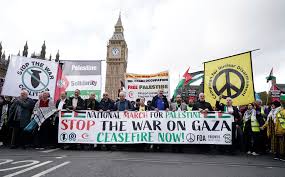
During these last two years of this conflict, peaceful rallies for Palestine to be recognized as a sovereign State have been held throughout Europe and the Western world. Beyond thousands have gathered in the major capitals of Italy, France, Spain, The Netherlands and more. And here in the United Kingdom, London, Manchester and other big cities have been holding huge gatherings of silent, peaceful protests for the freedom of Palestine. But in the United Kingdom is it considered a crime, the government having designated the Palestine Action organization a terrorist organization. Last week in Manchester a single terrorist attacked a Jewish Synagogue. Amidst a mess of gunfire three people are dead and Manchester is wounded. Despite the Prime ministers pleas – never a good sound bite – for the weekend Pro-Palestinian demonstration at Parliament Square in London to stop – it didn’t – and the police moved steadily through arresting nearly 500 silent protesters aged between 18 and 89. England seems too small, in geography and spirit to allow its people to protest in peace for peace.
As Michaelmas passes and the autumn evenings shorten and lower its lights, the London salon season begins. Friends gather together for evenings of art and friendship. A dear friend, a Chinese artist, who has lived and performed her life and work mostly in England and Europe hosts the first: a music and poetry Salon at her home tucked away at the top of the Heath. We are in London but not – at this moment – of it. There are no tall ceilings with giant chandeliers hovering over us, nor gilt-edged velvet chairs as in a castle. But there is soft lighting, a comfortable sofa, mixed chairs and the floor to sit on. The rooms fold away from each other, one behind the grand piano and the others concertinaing back into the warmth of the kitchen. Old and new friends come together – catching up on the year past – no time for future dreams before the poetry and music about to be shared. Everyone is nervous. The friends she has gathered are for the most part just that – friends – most are artists with a small a. As the evening unfolds, poetry mingles with music. The grand piano gets its longed-for work out, Tang poems from the 1700s are read in Mandarin, Cantonese, Russian, Latin, Japanese, French, German, Esperanto, Polish, Italian, Danish and Spanish. A poem translated from its original Italian prose into English poetry captures a brief moment in China. All are blended between theatre, mime and the music.
Poetry read by Walter Murch
The evening lifts us and for a few hours we are gathered together in the womb of art and beauty that sustain us, giving us strength to walk back into the dark night and return to the world.


This has been A Letter From A. Broad. Written and read for you by Muriel Murch
As always supported by https://www.murchstudio.com
Extracts of Xi’an of Eight Rivers written by Curzo Malaparte and read by Walter Murch. Music from Keith Hammond and Katrine M. Lehmann
Correction in the audio. Tang poetry is from the 700s not 1700s.

 Muriel Murch