The Salon Season

Written and Read for you by Muriel Murch with WSM by my side

The Salon Season is here.

Storm Amy came and went, whipping the wind high and hard through London bringing down the first autumn leaves, but walking our mile canal loop the water was dark, clear, the overhanging trees holding their gold and russet leaves hidden for a little while longer. But other great trees have fallen. The quiet passing of Jane Goodall while still working was as if she left on a broomstick, while telling us to get on with it. Jillie Copper, an author known as the queen of the bonk-buster, gathered up her skirts as she swirled out the door. Diane Keaton quickly followed after them. These women, so dissimilar in work, all shared their passionate love of dogs. Surely a light example to find that which unites us.

Sarah Mullally photo from Wikipedia

Another woman has been called forward. Sarah Mullally has been voted as the new Archbishop of Canterbury in a church that still is allowed to teach that men should have authority over women. It has been six months since the Right Reverend Justin Welby resigned over not paying due-diligence to the problems of the church. Due-diligence to problems; something that all heads of church, state, and police struggle to maintain. But Sarah Mullally is also a nurse, and as she moved to further embrace her faith, taking up the role of priest, then bishop, she is mindful of the division her appointment as Archbishop of Canterbury and head the World Anglican Church will bring. As devout a feminist as she is a Christian, Bishop Mullally has a hard row to hoe and many priests and bishops under her care will resist her as she struggles to unite this wide-bodied church, weaving a bobbin through its warp, joining  the threads of communication. Maybe between a woman like Bishop Mullally and the Venezuelan María Corina Machado, the winner of this year’s Nobel Peace Prize, some world shift can occur towards peace in our time. 

This past weekend the Israeli attacks on Gaza have halted but there is no end to the dying. While trucks have begun to roll into the bombed streets, cleared only enough to allow them through, they move slowly, allowing the near starving to seize whatever sacks they can off the flat beds. Stalls are set up and, even in this mayhem, sellers are trading to those with money while those that don’t must resort to theft. Medical supplies and nowhere close to sufficient. 

Driven in Toyota trucks, 20 living Israeli hostages were returned to Tel Aviv while 2000 Palestinian captives were bussed from Israel into and released in Gaza. While the Israeli hostages mostly had families and homes to return to the Palestinians returned to bombed homes and decimated families. Their return must be soaked in deep grief pouring into anger. 

Omar Al-Qattaa AFP Via Getty Images

The American President flew into Tel Aviv to address the Israeli parliament. He was greeted with a standing ovation which guaranteed to feed his hunger for a while. At the peace summit held in Egypt with his counterparts lined up behind him he declared “The prayers of millions have finally been answered. At long last, we have peace in the Middle East.”

At the photo shoot a back drop of European and Arab leaders stood behind him. Sir Keir Starmer looked puzzled, Emanuel Macron stoic, and the Italian Prime Minister, Giorgia Meloni, completely bemused. Later that day, perched on a suitably serious chair in a ‘for the press’ moment, the King of Jordan blinked furiously and frantically into the hot lights as he tried to be diplomatic, positive, and truthful with his thoughts and concerns for future peace in the Middle East. It was not easy. Can the American President stay focused enough to go through with meetings to implement the 20 point Peace plan?
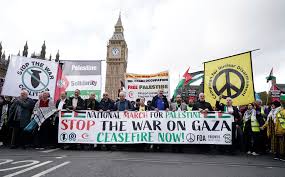
Peaceful protests in London

During these last two years of this conflict, peaceful rallies for Palestine to be recognized as a sovereign State have been held throughout Europe and the Western world. Beyond thousands have gathered in the major capitals of Italy, France, Spain, The Netherlands and more. And here in the United Kingdom, London, Manchester and other big cities have been holding huge gatherings of silent, peaceful protests for the freedom of Palestine. But in the United Kingdom is it considered a crime, the government having designated the Palestine Action organization a terrorist organization. Last week in Manchester a single terrorist attacked a Jewish Synagogue. Amidst a mess of gunfire three people are dead and Manchester is wounded. Despite the Prime ministers pleas – never a good sound bite – for the weekend Pro-Palestinian demonstration at Parliament Square in London to stop – it didn’t – and the police moved steadily through arresting nearly 500 silent protesters aged between 18 and 89. England seems too small, in geography and spirit to allow its people to protest in peace for peace.

As Michaelmas passes and the autumn evenings shorten and lower its lights, the London salon season begins. Friends gather together for evenings of art and friendship. A dear friend, a Chinese artist, who has lived and performed her life and work mostly in England and Europe hosts the first: a music and poetry Salon at her home tucked away at the top of the Heath. We are in London but not – at this moment – of it. There are no tall ceilings with giant chandeliers hovering over us, nor gilt-edged velvet chairs as in a castle. But there is soft lighting, a comfortable sofa, mixed chairs and the floor to sit on. The rooms fold away from each other, one behind the grand piano and the others concertinaing back into the warmth of the kitchen. Old and new friends come together – catching up on the year past – no time for future dreams before the poetry and music about to be shared. Everyone is nervous. The friends she has gathered are for the most part just that – friends – most are artists with a small a. As the evening unfolds, poetry mingles with music. The grand piano gets its longed-for work out, Tang poems from the 1700s are read in Mandarin, Cantonese, Russian, Latin, Japanese, French, German, Esperanto, Polish, Italian, Danish and Spanish. A poem translated from its original Italian prose into English poetry captures a brief moment in China. All are blended between theatre, mime and the music.

Poetry read by Walter Murch

The evening lifts us and for a few hours we are gathered together in the womb of art and beauty that sustain us, giving us strength to walk back into the dark night and return to the world.

This has been A Letter From A. Broad. Written and read for you by Muriel Murch 

As always supported by https://www.murchstudio.com

Extracts of Xi’an of Eight Rivers written by Curzo Malaparte and read by Walter Murch. Music from Keith Hammond and Katrine M. Lehmann

Correction in the audio. Tang poetry is from the 700s not 1700s.
An Inquiry

Written and produced for you by Muriel Murch with WSM by my side.

‘Yes Minister’ first aired on The BBC television in 1980 until it ended in 1988, possibly due to the fact that it was becoming harder to distinguish the comedy series from the nightly newscasts that followed. Among the many quotes attributed to the Cabinet Secretary Sir Humphrey is “Minister there is going to be an Inquiry” to which the reply from The Prime Minister Jim Hacker is “Oh good, then nothing will happen.” Well yes and here we are again – 

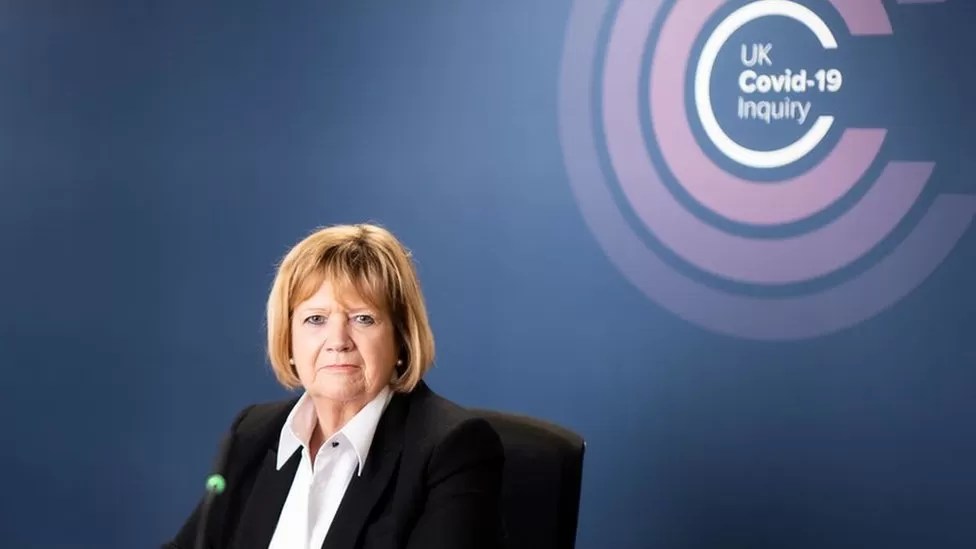
Baroness Hallett promises the inquiry would be ‘thorough and fair’. Photo from Piranha Photography.

Last week saw the beginning of “Britain’s Public Inquiry” to understand the Conservative Government’s responses and handling of the Covid pandemic. But for the life of me, I can’t find out who is in charge of “Britiain’s Public Inquiry” and what – after the facts have hopefully been gathered – will happen? Will lessons have been learnt? Will those deemed responsible be held responsible? Will there be any retribution? Will anyone be called before a court of law or those pages of documents produced be filed away rather than read. Last week when Dominic Cummings gave his testimony he asked that the inquiry also focus on the broader failures of the system. Reading – for I can’t listen to them talking – it is clear that as blame is shuffled about like pearls under walnuts, the prize goes to the then Prime Minister Boris Johnson. Dominic Cummings likened working with Boris Johnson to driving a shopping cart with a wonky wheel. 

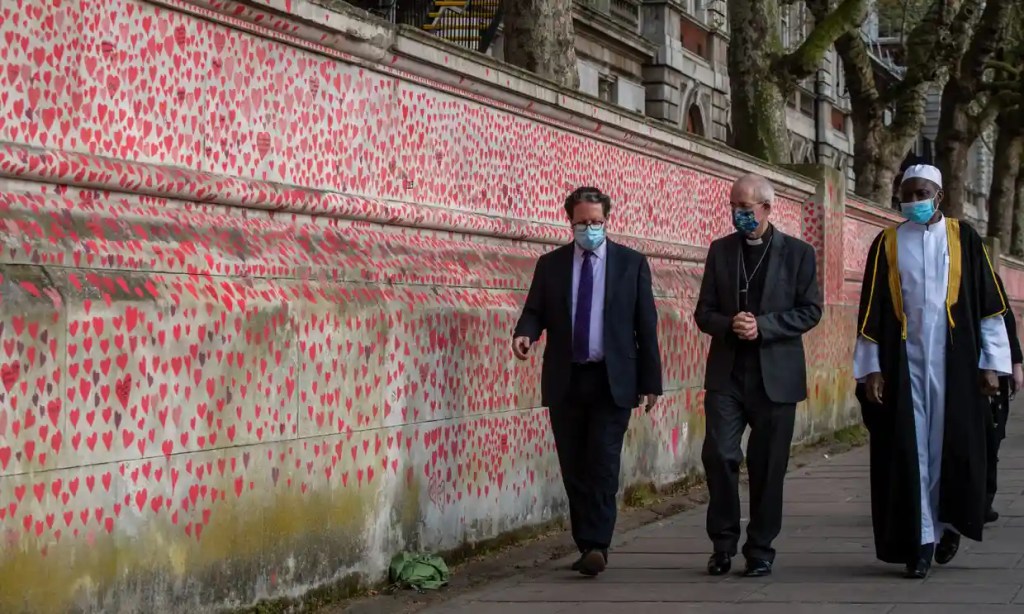
It is not without irony that the inquiry is taking place at Whitehall just across the river from the Covid Memorial Wall that was created and painted in 2021by people who had lost loved ones, or worked in the NHS, coming together with the good guidance of the group ‘Led By Donkeys’. Over 240,000 painted hearts cover more than a third of a mile alongside the Thames River outside of St. Thomas’s Hospital. During this time the public were afraid and looked in vain for leaders in the government where all the common sense had been bred and educated out of almost anyone in Westminster not yet of pensionable age. It was like putting drones in charge of the beehive to collect pollen and care for their queen, when all they could think about was kingship and sexual obsession. 

From left: Rabbi Daniel Epstein, the archbishop of Canterbury, Justin Welby, and Imam Kareem Farai visiting the wall in April. Photograph: Chris J Ratcliffe For Covid-19 Bereaved Families For Justice/Getty Images

People are booking their theater seats. We follow the inquiry like a serialized Charles Dickens story in the magazines of the day. Up to testify next are the past Prime Minister Boris Johnson, his hovering henchman Matt Hancock, and the holder of the chair at the moment, Rishi Sunak. But it is the failings of one particular individual, Boris Johnson, who was ultimately responsible for directing the government, which will continue to be scrutinized in the months ahead. Johnson’s successor-but-one as prime minister, Rishi Sunak — who was U.K. Chancellor during the pandemic — also has questions to answer. All three men — Johnson, Sunak, and Hancock — are to appear before the inquiry in the same week at the end of November. 

Photo Credit to Art Center Wikipedia

Sunak has thrown his dead cat into the ring – by hosting an international AI conference on safety issues that was held at Bletchley Park. The conference produced some back-patting for, and from, the UK, US, and European leaders who attended while getting a nod of approval from the United Nations. Elon Musk arrived to give a speech and chat with Rishi at Downing Street. Both men in their uniforms, Elon remains rumpled and a little unshaved while Rishi rolls up his pristine white shirt sleeves possibly looking for his next job opportunity after this gig is over. So will anything happen from this inquiry apart from “Lessons have been learnt”? The Infected Blood Inquiry – the Stephen Lawrence Inquiry – and the Greenfield Tower Inquiry – have each chipped away at this UK government, but not a lot has changed. Could this inquiry be the one showing that Britain’s democracy has really gone up in flames? I’m writing on Guy Fawkes night – our night of fireworks – celebrating the failure of the 1605 attempt to blow up the Houses of Parliament. We may be holding our breath and will it happen this time? I cannot watch the inquiries – it is too painful – so instead I read.

in an interview, the American thinking and writer, James Baldwin, said “You must realize that if I am starving you are in danger”. And in this simple truth, buried deeply, lies some of the reasons the wars are being fought all around us. Johnathan Freelander writes eloquently and with great heart in this weekend’s Guardian Newspaper, that no side of the Israeli, Gaza, and Jordan triangle conflict are searching for a peaceful conclusion – at this time. In Pulse “Stories from the Heart of Medicine,” I read a translated account from Hadar Sadeh, an Israeli youth psychiatrist working at a Medical Center, about twenty-five miles from the Gaza Strip. Then I open an email from our Palestinian friend and filmmaker, Annemarie Jacir. Each woman weeps at the death of children and physical destruction that they see around them. Each letter could have been written the other.

And see how the war in Ukraine gets roughly pushed to one side even as we know it continues? Old statesmen take planes from one capital city for talks then board another, exchanging their suit jackets for a flack vest as they land in a war zone to encourage young men to face death bravely for their country. Ukrainian President Zelensky rightly worries that this other war is distracting from support to his war – defending Ukraine from Russia’s invasion. How much can we carry in our hearts? And tucked away even further is the news that Russia’s President Putin’s arch-opponent Alexei Navalny’s three lawyers have been detailed. They are facing trial for participating in the so-called extremist group, Navalny’s Anti-Corruption Foundation. If they end up in jail then all contact to the outside world will be lost for Navalny. Each of these eruptions is bleeding like an aspirin-fed wound and all the pressure that is applied will not staunch or stop it any time soon.  

This has been A Letter From A. Broad written and read for you by Muriel Murch.

The Queen

Recorded by WSM Written, read and knit together by MAM
Waiting for the next Prime Minister photo by Jane Barlow

It has barely been three weeks since September 6th, when a rumpled Prime Minister Johnson arrived at the Balmoral Castle gates to hand in his card at 11 a.m. In quick succession, he was followed by the tight-skirted Truss. It was a long morning for our Queen, and for those watching with concern – seeing the Queen holding onto a stick with one hand while smiling and extending the other used and bruised hand, to Liz Truss. The Queen’s head looking large on her diminished frame, her nose pinched – straining for air – while no amount of lipstick covered the cyanosis of her lips. Tuesday was a brave day. Barely 48 hours later the Queen died as she had lived, in service to her nation. The heavens opened, pouring down their tears and we are still grieving.

Accompanied by The Princess Royal and her husband Admiral Sir Tim Laurence, the Queen’s coffin slowly made its way south to London to lie in state at Westminster Hall where over two hundred and fifty thousand people from all walks of life filed past to pay their respects and say ‘Thank you Ma’am for your service’. Did she cover all the bases? One could, if one chose, fault her for some family issues, but not on duty to her country as she saw it; honoring and hosting state and national moments or those small engagements around the country. The late Queen Mary was paraphrased as saying ‘We are the Royal Family and we love Infrastructure.’ We all feel a little stronger and stand a little straighter, when someone else shows interest and gratitude for what we do.

Her Majesty The Queen opens Parliament 2017 wearing – a hat –

The Saturday after the Queen’s death I wove my way behind Piccadilly through the lines of police vans parked all around St. James’ Square, then down the stairs behind that Palace to enter The Mall that felt like the nave of a giant cathedral. There was a quietness in this crowd, many carrying flowers and leading children, that was to last for days all across the country. People walked along the pavements to Buckingham Palace, sometimes with a pause as King Charles III and the Queen Consort were driven in and out of those palaces, Buckingham and St. James’. They were back and forth all afternoon and one hoped that they got at least 15 minutes for a sit-down cup of tea. The Autumn skies tossed grey and white clouds over the park trees, but the rain stayed hidden behind them.

What does it mean for a young girl to take a vow to follow a life that was chosen for her rather than she chose? It happens in all walks of life, people are lucky if they get to live their dreams. It takes an effort and strong will to turn your given path into your chosen one. The Queen embraced her role until she could relish it and turn it to her desiring. 

There are fewer of us alive now who remember Queen Elizabeth’s coronation than who will remember her death and funeral. John Galsworthy wrote in the Forsythe Saga at the death of Queen Victoria. “We shan’t see the like of her again”. But now we have this Elizabeth was our Queen for 70 years. Even in death, the Queen managed something that the government could not – as the Transport Unions and the Royal Mail held off their strikes until next month. 

At the announcement of the Queen’s death, all the television stations began airing their programs that they had been building for this moment. Planning for the Queen’s funeral had begun when she turned 79. All the news Broadcasters wore black. Huw Edwards, the senior news anchor man at the BBC – and he a Welshman – allowed himself to show some emotion. Those who wished to see the films, the footage, forever repeated could do so. It was like a huge family album of our family, our Queen, for as she vowed to give her life, be it long or short, to our service, she did – and we claimed her and the family as our own, rejoicing in the good times and fussing at the bad. The television stations played ten full days of coverage, back and forth with all the joys and the horrors replayed over and over again, probing into a life lived in the spotlight of her public, her people. The new King’s state and public greetings and meetings were followed in flashy detail. The pageantry and processions built like gentle love-making to the climax as the coffin was carried from Westminster Hall to Westminster Abbey. Giving his address from the pulpit of the Abbey – Justin Welby, the Archbishop of Canterbury – looked down across the nave at the congregation seated below. He spoke of our collective grief, the Queen’s abiding Christian faith, and service to duty, and then let out his zinger: “People of loving service are rare in any walk of life. Leaders of loving service are still rarer.” 

The service over, it was on to Wellington Arch where the coffin was transferred to the royal Hearse then driven slowly on through Hyde Park to join the A 30 road to Windsor. Just as she had begun her journey from Balmoral through the countryside of Scotland now she returned to the farms and lanes of Berkshire.

The Queen’s Corgi Dogs return from Balmoral Castle

The flags at all the royal residences flew at half-mast until the day after the State Funeral when the official period of public mourning ended. The Royal family and some of us will continue as long as we need.

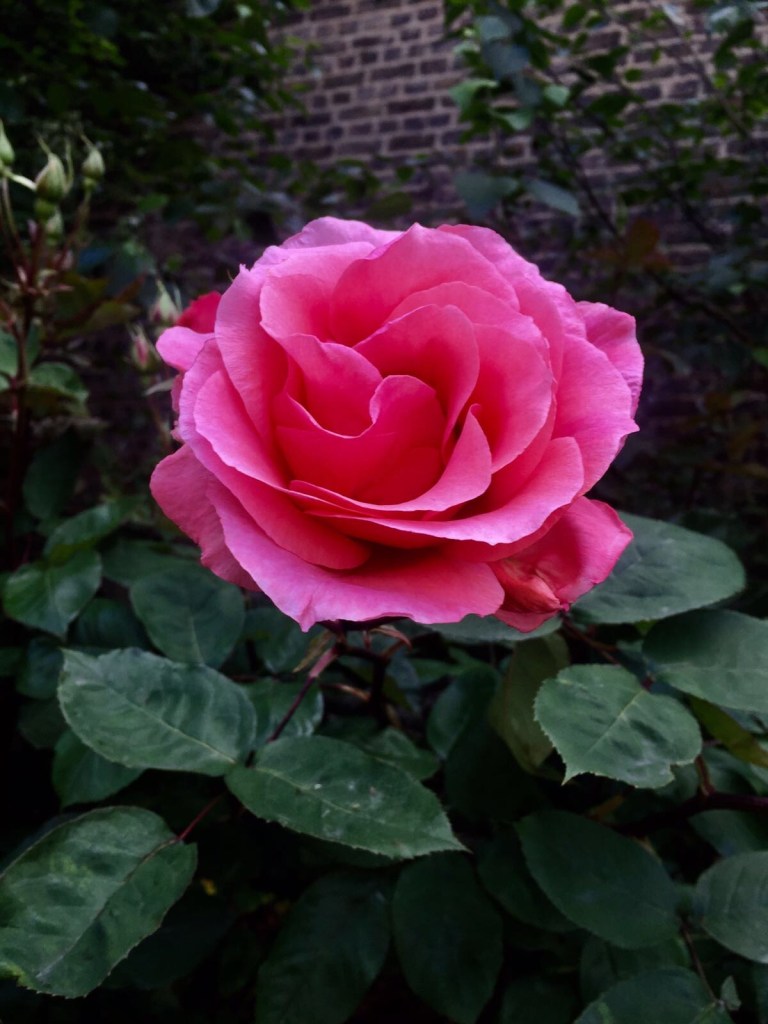
In our little London garden is a David Austin Queen Elizabeth rose – still blooming in autumn. My mother bought it after my father died when she had to start a new life in her new home. Now it is with us. The same rose was among the flowers on the Queen’s coffin – in remembrance of things past but not forgotten.

Queen Elizabeth Rose by David Austin.

This has been A Letter from A. Broad, written and read for you by Muriel Murch.