Bobbies on the Beat

Written and produced by Muriel Murch with WSM by

It is a sunny autumn morning when I sit outside of Le Tea Cosy cafe, sipping a flat white and chatting with a friend when first two, then three, followed by two more police men and women saunter by. I laugh to them, “Seven of you”. And the slightly older – but still so young – as policemen have been for years – smiles back “Yes, young recruits on training exercises.” He could have been talking about trotting out young cavalry horses in Hyde Park, but no, this is rookies on the beat walking around Primrose Hill and into the village on a sunny mid-week midday, and is a very different scene from what they could encounter on a Saturday night down by the locks in Camden Town. Their young faces look sweet, both hopeful and nervous of what lies ahead for them all.

Chris Kaba – photo courtesy of his family

For by now they know that the news is full of the charge of murder by an armed police officer with a single gunshot to the head of Chris Kaba last September in South East London. Chris was a construction worker and a rapper under the name of Madix with the group called 67. Reportedly he was not a man without flaws but with his impending fatherhood that could have been about to change.

The firearm officer charged with Chris’s murder is only named as NX121. Rallies led by Chris’ mother and family were held asking for an investigation. Here we go again and we hope that Steven Lawrence’s parents are helping her. Home Secretary Minister Suella Braverman – she of the floating barges and Rwanda deportation plans for immigrants – assures the police that they have her full backing. But what does that mean? Now – for a moment – there is a pause. Close to one hundred bobbies-on-the-beat, a little older than those rookies walking the pavements of Primly Hill, are handing in their guns. Reflecting on what they think ‘could have happened on that street in Streatham Hill’ and want no part of it. They don’t trust Suella Braverman to have their backs and maybe – for a solitary moment – they don’t trust themselves and want no part of killing another man – when – on a Saturday night off they might be dancing to the music of 67. Further assurances are made by Braverman, and the Met Police force floats the idea of bringing in the army to do a Policeman’s work, leaving these young officers churning again in confusion and mistrust.

Chris’s family, along with the police, are not alone in their mistrust of the government. This next weekend the Conservatives are holding their Annual Party Conference in Manchester. Which is a bit rude – to put it mildly – where the main item on the agenda is the closing down of the continued construction of the High-speed Rail link that travels from London to Birmingham and is scheduled to go on to Manchester. The South/North divide is strong in England, and Andy Burnham the major of Greater Manchester sees this move for what it is. Like a true northerner he is able to speak his mind.

Andy Burnham Getty Images

Come to think of it that maybe the most characteristic difference between the north and south in England. Northerners don’t mess around, calling a spade a spade while southerners can relish moving words and phrases around as if playing the ‘follow the ace’ card game again and again. For Sunak, to make the decision to scrap this link is pretty abrasive. Grant Shapps who was transport secretary until last month and who moves through Cabinet secretary positions with the lighting speed of those fast trains he wants to halt, says it would be “crazy” not to reassess whether the full HS2 rail project remains viable. One of the far reaching goals for High Speed rail – such as exists in Europe and Japan – let’s not speak of Europe – was that it would enable business men and women from the north to travel to London or even – steady on – to Paris, Brussels and Amsterdam – for face-to-face meetings thereby giving the North of England a better shot of doing business within Europe. But ministers in Westminster are determined to keep the power close to the south and this train vasectomy would do that. With a change of government this little snip could be reversed but that is no certainty. 

Meanwhile – thinking forward in fellowship – King Charles and Queen Camilla were invited to Paris for a three-day state visit complete with dinner for 150 guests in the Hall of Mirrors at the Palace of Versailles. When invited to dinner some people bring wine, flowers or chocolate. But the King and Queen brought Sir Mick Jagger and England’s still favorite handsome man, Hugh Grant. The guest list was drawn from French and English men and women who continually contribute to good relations between the two countries, so often found easily within the arts and sports. The fact that both French and English cheeses were on the menu says a great deal for the warmth that was brought to the table. One wonders who sat next to whom and we can only hope that everyone remembered their table manners and used their silverware from the outside in. Fellowship was ever present and as the wind ushered their entrance to the palace Mme Macron helped the Queen with her cloak. Of course there were speeches – the President and the King both speaking in each other’s language. During the three-day visit there was the obligatory tree planting, remembrances of past Royal visits to Paris, then the wives played a little table tennis at a sports center, both showing their need for more practice and a first – as King Charles spoke in French to the French senate. It was a good visit with gentle words and gracious kindness on both sides. 
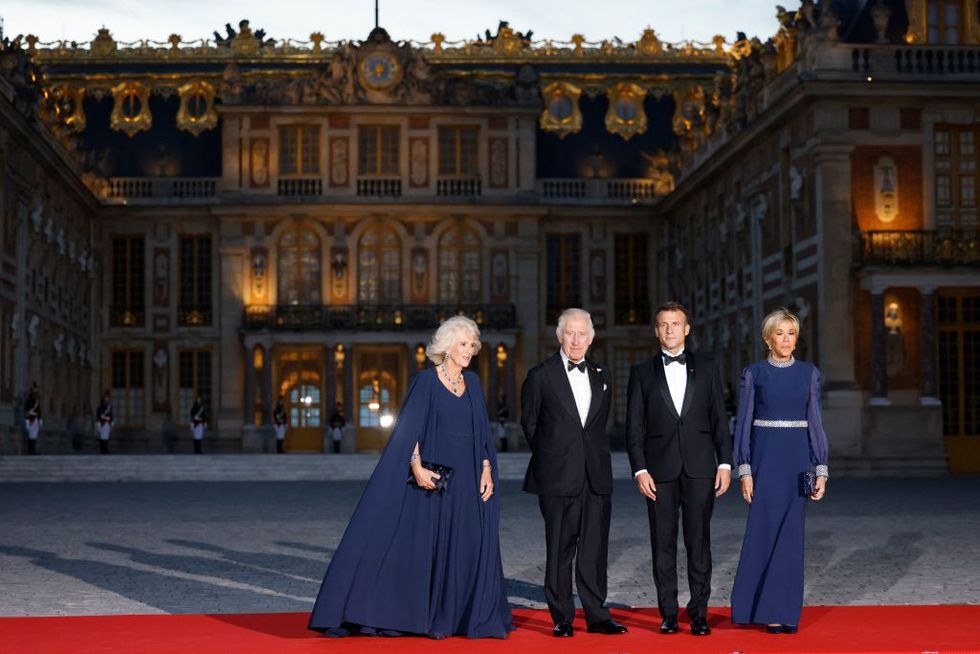
Queen Camila, King Charles, President and Madam Marcon before dinner

As the equinox came and went the evenings were closing in. The green tomatoes were harvested from the library garden and our little terrace and there was just enough to make the starter layer of chutney. I look to see what we have and what should I add? In the local greengrocers there are fresh onions and the first Bramley apples, while on the counter is a box of no longer sellable fruit. Ladies of a certain age know not to waste and so half a dozen soft and wrinkly, old lady peaches went into my bag and then the chutney. Delia Smith has two recipes in her book but chutney is not for recipes, it is for bountiful harvests, leftovers and sweetness so I jumble the recipes up – remembering a little of this instead of that works – and there it cooked happily on the stove. Now it is in jars to wait – if it can – for the flavors to lie together and emerge anew.

Labeled and Photgraphed by WSM:)

This has been A Letter From A Broad Written and read for you by Muriel Murch 

Poaching in the Park

Written and Produced by Muriel Murch with WSM by my side.
Blackberry-bramble Harvest 2023

August slipped into autumn not bothering to wait for September while most of London went on holiday, leaving the city almost as subdued as Paris. Along the canal, three teenage ducklings are swimming alone as if their parents have regretted their final feathered fling in the water and are just too tired to raise one more brood this year. The ducklings look lost, paddling from one clump of weeds to another in the mindless way of adolescence. It is blackberry season and we are late for our semi-annual ‘Poaching in the Park’ moment. We go in the middle of the week – with less chance of being caught – though this little corner of Regent’s Park is now sorely neglected. There used to be a thriving small sports school here, a place to practice your tennis, golf, or cricket. But now the cricket practice nets have moved close to a central concrete hub with a cafe, overlooking the big open pitches that serve both cricket and football in often overlapping seasons. There is a small tennis club close to Queen Mary’s Rose Garden but the golf nets were removed altogether. Now the wilderness has taken over – as it should – and the blackberry brambles climb the Hawthorne shrubs and surround the adolescent oak trees. The King is in Scotland striding out on the moors for a good bit of fresh air, while the Prime Minister is back home in Yorkshire, maybe looking to see if the Green Peace ‘Stop Oil’ Delegation have left him any more notes on how to run the country. So we can pick and gather our bramble harvest which quickly became eight pots of jam. Six are stored away. One goes straight into our fridge and the other to Howard who – in years gone by – was one of the tennis coaches on the courts now covered with brambles. Howard lives close by and while closing into the other side of his eighties we often stop and chat. Howard is fond of the written word and from time to time pops a poem through our letter box. 

This week’s poem from Howard

The nightly news can barely be bothered with the wars that do not stop in the Sudan and Yemen. The Human Rights Watch write that Saudi border guards have been reported killing hundreds of Ethiopians trying to cross into Saudi Arabia from Yemen. And the war in Ukraine is not ending soon. The maps showing – in red, purple, and white – whose troops hold which cities and coastlines in Ukraine – are confusing and seem at odds with the reporting. If all that land – in red – is occupied by the Russians, how is Ukraine ‘making ground’? We see villages and cities bombed – and the long, low trenches slicing through fields and countryside appear no different than those dug for World War One – where Ukrainian soldiers crouch and fire, fire and smoke, and slog on. Summertime is wearing for soldiers and politicians alike. But there is a useful police mess-up from Manchester and a horrific tale of infanticide to keep us distracted from the wars and the Government debortle with the Biddy Stockholm barge. A few asylum seekers were being marched onto the barge two by two – when it was discovered – at least a week before reporting – and the marching on – that the barge water supply contained traces of the legionella disease bacteria long known to cause severe pneumonia and death. Time to pack their bags and march those foot-weary seekers of asylum and hope off again. 

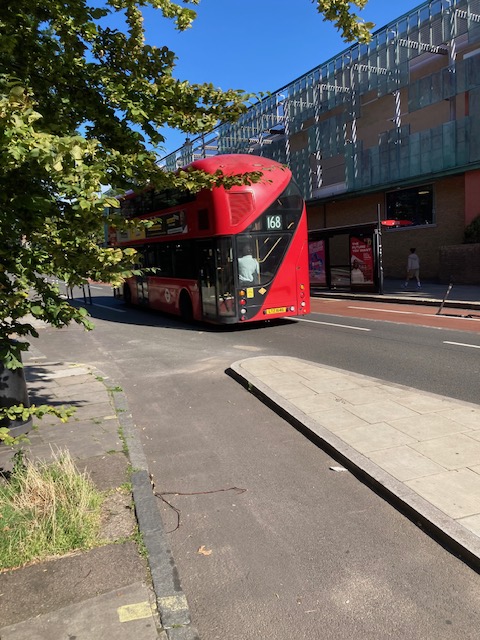
The 168 bus leaving Chalk Farm.

Sometimes I miss the small thud when the paper lady pops the Camden New Journal through the letterbox every Thursday morning. I glance through it, knowing there will not be not much I care to read but that sometimes, something will catch my eye. Last week – another August moment – there was no home delivery – so this week I made sure to read it. And there it was: a small column slipped into the side of a page. ‘RIP 168 – the bus stops here’. This route will be closed in September. ‘Oh No.’ How could they – who the heck is ‘they’ – let it happen. ‘They’ turns out to be Transport For London (TFL for short) and to whom we pay our bus and rail fares. They did a survey – even reporting that of three hundred respondents, only 18 agreed with the scheme to scrap the 168 bus route. And still, they went ahead. It is this kind of lock-jaw response that drives us all crazy. The government does it with their ‘there will be an inquiry’. It is – to put it mildly – upsetting.

Upsetting and inconvenient for people like me perhaps but downright devastating for people like Jim. Jim and I have been friends for twenty years and know much – and yet little – about each other. Jim is Jamaican, his wife was German and I often wondered what brought them together – if in those early years of their courtship, they both felt the chill of English disapproval. Jim was a Camden Garbage truck driver until he retired. His route brought the truck onto our street and he lives just two blocks away in a council flat. He had a Yorkshire Terrier dog, small, black and brown, and always keen, pulling Jim along as she raced up our street galloping towards the hill. Even at 17 – a serious senior for a little terrier – she was always ahead of Jim – until she wasn’t – and one day Jim quietly took her to the vet to say goodbye. Now he is alone, and as he gets older doesn’t go out and about so much. But we meet from time to time. ‘Ello darlin’ He calls to me, having long forgotten my name and it being too old a friendship to ask to be reminded. And we chat, about this, that, the other, and loneliness. A kiss is always welcome. The last time I saw Jim he was walking slowly with his cane, going to the bus stop for the aforementioned 168 bus on his way to The Royal Free Hospital in South End Green where the bus stops right outside of the hospital – in both directions. What will happen to Jim and so many others if TFL takes this moment of independence away? Each little cost-saving denial from them leads to a retreat and loss for us all. 

This has been A Letter From A. Broad written and read for you by Muriel Murch.

Old Music

Old Music.

Recorded and Produced by Muriel Murch with WSM by my side.

The Government party-gate reports are in, and the votes on ‘did Boris Johnson break the rules the government set for us all?’ were cast. 354 ministers said yes, 7 puffed no while a few slippery ones went missing. It is too much all too foolish and for this moment I am closing my eyes and ears. 

Where can we retreat to? In May a visit to The Hague in the Netherlands took us to meet the Dutch artist Theo Jansen who in the 1990’s began – using PVC, bits of nylon robe and old cloth sails – to make creatures – huge toys collectively known as Strandbeests that when caught by the winds run along the beaches, sometimes galloping into the surf if Theo is not quick enough to catch them. Luckily the afternoon was very windy – as well as cold. Watching the play between Theo and our grandson David – the silent wonder of the boy child and the magician’s twinkle in Theo’s eyes it is clear that magic and bewitching sorcery remain a reality.

A Strandbeest takes off with David and Theo following. Photo by WSM

Our artist friend Carey Young has an exhibit in Oxford at the Modern Art Museum entitled Appearance. Carey has a steady and persistent eye on women and the law and the Modern Art Museum – built in a repurposed brewery – is where her show has been for over three months and I really want to see it. The Sunday train was full of students returning to university from a weekend in London. I look at those in our carriage and – catching them at this mid-point of leaving late adolescence and entering adulthood – I’m a little chilled. Are there world leaders, scientists, artists or teachers among them? They are young and we are old and so far I see absorption, self-interest and timidity. A girl sits on her case in the middle of the aisle and nobody can – or even tries to – get past her. She seems supremely unconcerned but maybe holding herself steady with a steel will. I wonder again why Boris Johnson bought his castle – the one with only three-quarters of a moat – here in the outskirts of Oxford.

All three of Young’s videos focus on women’s lives. The first – ‘The Vision Machine’ follows the preparation of lenses for the Sigma corporation in Japan. Though Young wants us to imagine a factory run and maybe owned by women – the grey black and white tones took my thoughts in the other direction. That the women were subservient to whomever owned the factory – and could never be free. Then Carey brings us fifteen British female judges who come to sit and look into the camera for minutes at a time. Where are they looking? At us, beyond? Do they become as reflective in front of the camera as we become to the screen? These images make me deeply conscious of the weight of appearances, on each of these robed women etched into beauty by their lives and work. It is a sobering piece of film that follows on her 2017 Palais de Justice, a key-hole look at Belgium female judges at work. I ponder their power and then their ordinariness. Surely they too go home to cook and care for families.

Two days later as dusk was claimed by night we arrived back at Victoria Station on the almost longest day of the year. Walking along the platform, we were still surrounded by those who have pilgrimaged to Lewes in Sussex and surrendered to the music of L’Elisir d’Amore at Glyndebourne. In Herman Hesse’s short story ‘Old Music’ 

I – Herman Hesse – left my desk, blew out the candle and closed the cottage door behind me. I walked through the woods to the edge of the forrest and caught a tram that took me to the heart of the city. Another short walk to the cathedral where Master Bach raised up his voice to God. And when it was over I returned back through the city to the forrest and home. 

Did Hesse then pick up his pen for the short story ‘Old Music’. Spurned on by the urge to escape the political clamor and noise of the city – our journey was in reverse. 

Glyndebourne Festival Opera began in 1934 only closing for the war years of 1941-1945. The festival is a fixture of the English summer season and for the first time we are going. Glyndebourne House sits in the countryside of East Sussex and those of us traveling by train watch the fading elderflowers give way to the blackberry bushes brimming with white blossoms pass by – heralding a fine harvest – if one can reach the vines. At Lewes Station the train is met by huge double-decker coaches that packs us and our picnics inside like well laid out sardines and swish us through the village. The villagers may grumble but are proud that their country estate has turned to art while providing jobs close to home.

The whole planning and preparation are new to us. My husband declines his old tuxedo opting for his black and brown assembly. But like all the women I opt for a gown – with bling. A friend has gathered six of us together and we lay our picnic contributions on the table for the English way of outdoor dining when the time is right. And the beginning of summer is right. Strawberries are blushing and the peaches softening. The traditional English picnic will find smoked salmon alongside of a bottle of good champagne in almost every hamper. There are other old favorites and a sausage roll or two can be seen. Our table is laid with the smoked salmon, bread and butter, a vegetarian quiche and a giant salad to be followed by fresh strawberries, a fruit salad and cream – with a touch more – there must have been a second bottle of Champagne – all of which disappears during the long interval. The gardens lead to an orchard, the lawns to the lake, meadows and farmland beyond. They are deeply Edwardian and remind my heart of my childhood home.

Tonights performance is of L’Elisir d’Amore by Gaetano Donizetti. ‘Composed in a hurry’ says a note. Well Donizetti composed everything in a hurry, knocking out over 70 operas plus other works before succumbing to the lover’s disease at the age of 51. L’Elisir d’Amore is that old story of love yearned for – thwarted and then after many plot twists and turns – requited – and we loved it.

L’Elisir d’Amore Cast – a moment

On Monday the government has gone to ground hiding behind a heart-wrenching headline accident, the cricket match and the shock- horror – of interest rates being raised – again. 

But our King is working. A book of portraits celebrating the arrival of the first of the Windrush generation in June of 1948 was quietly celebrated at Buckingham Palace. In the forward the King writes, “Thank you. … It is, I believe, crucially important that we should truly see and hear these pioneers who stepped off the Empire Windrush at Tilbury in June 1948” Many of their daughters became nurses and my bedside sisters where they remain forever in my heart. 

The Celebration of Windrush: Portraits of a Pioneering Generation.

This has been A Letter from A. Broad. Written and read for you by Muriel Murch.