Mourning and Marmalade

Mourning and Marmalade

Written and read for you by Muriel Murch with WSM by my side
All Saints Church in Crondall, England by Andrew Smith

The year – that year – 2024 has ended and Past-President Jimmy Carter quietly left so as to watch the next chapter of American history unfold from afar. In a sign of respect – not accorded to every US President – the Union Jack at Buckingham Palace was flown at half mast on the days of, and after, his passing. For us the outgoing tides of 2024 carried out with them family and friend transitions that were close to our hearts. Later this week I will rise with the dawn to think about friends and family gathering in the Norman All Saints village church in Crondall that they have attended for over fifty years, as the patriarch of their family will be remembered and laid to rest in the grounds surrounding the church. This is the winter of our lives and the leaves of love and memory are falling.

The gifts – that is – of this time – are the memories that emerge out of our past – even the worst of them – are coated – if not soaked – with love – and often more than a little laughter. So the old year fades, taxes get paid and we look forward to whatever this year will bring.

The changing American administration will take place on January 20th, ironically falling on Martin Luther King day, whose dream seems to be once more deferred. This change is bringing apprehension to Americans and world leaders alike. Gears must be shifted, and wheels oiled. Ukraine’s President Zelensky has to figure out how to dance around the incoming American President who is in turn dancing to President Vladimir Putin’s music. It’s tricky for whatever happens with Zelensky and to Ukraine will ripple through the rest of Europe and beyond. Elon Musk is traveling in person and on X into London chatting with – and then dismissing – Nigel Farrage now saying “Reform needs a new leader.” Well there is egg or custard pie on Nigel’s face – again. Sir Keir Starmer has too many papers on his desk, The National Health System, housing, Nigel breathing down his neck, the conservatives straightening their skirt hems and now this Musk boy putting his finger in the icing of British Politics, not knowing that the cake inside has collapsed completely. Meanwhile Justin Trudeau is stepping down as Canada’s Prime Minister. Another good-looking chap falling under the wheels of Government failure and a touch of corruption. How do they make such silly mistakes swinging in and out of revolving doors? Maybe one needs to be a fly in the soup to understand that better.

# 24 bus From Pimlico to Camden

It is snowing in England. ’Makes you feel like a kid again’ says another wistful middle-aged man in a Yorkshire pub. And it does. However inconvenient, the snow is and it can be brutal for farmers and those living in small hamlets, throughout the country we are relieved to see this winter weather. Cold to ward away the concerns of global warming.

Nicolas Watts in Lincolnshire, is a farmer who farms among his crops, a fine line in organic bird seed. Nicolas sits down once a month to write a newsletter about his farm, the crops, the wildlife and the weather.
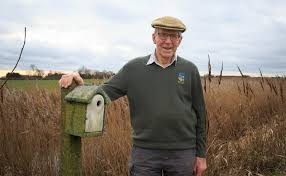
Credit: Tim Scrivener http://www.agriphoto.com

And every month I read it. He has his figures and facts all lined up and this month says “We only had one frost in December and it was far milder than usual, with a mean average of 7.2°C. … There are no fast moves in here, no rushing to embrace this fad or that. But what Nicholas is showing – on his farm and in his newsletters – are the effects of climate change on this small country – this farm – agriculture, and thus us all. He goes on – telling us about how the price of potatoes has gone up – but that is another story. This farmer is working the land and seeing what is happening to the soil and the Earth we live on.

Meanwhile in January, many English women still make enough marmalade – for their family and friends – to last for the whole year. And those of us who do it are very particular about what we use. Each family has its own recipes and traditions, though now it is mostly us grandmothers who ‘have the time’ and care enough to make it. Oranges from Seville are key, and arrive from Spain to England just after Christmas. They are small, squishy, bitter and full of pips. In years gone by, when lemons were a luxury, the marmalade was made solely from these oranges. Lemons were saved for Lemon Curd. Rose’s brought in Lime Fine Cut Marmalade as an exotic and it remains popular today. I’m thinking those limes came from the Caribbean and that Rose’s got a good deal on them. Now marmalades are mixed, and exotic, with and without, whiskey added, but it is hard to find good old chunky cut marmalade. Marks and Spencers and Fortnum & Mason made a stab at it but both are still too refined. And what about those of us, outside of England for whom making marmalade remains as important as making mince pies? We are lucky in California that citrus and Meyer Lemons particularly grow abundantly. And on this farm we are also lucky. About twenty years ago one of our daughters gave me a Pacific Coast Orange tree. I was dubious and the tree felt my lack of confidence in it and so for years it sat, sulking, hardly growing at all but then maybe the nutrients from all the dead pets in the bury patch released into the soil and now the little shrub is a big tree, with bowed branches full of fruit. Truth be told they are the complete opposite of the oranges from Seville. There is as much pith as fruit in each orange and as for juice – to be kind – it is tart. But I go out into the garden, gather those oranges, a few Meyer lemons – that tree for some reason not as strong as the orange – and chop, mixing the fruit together. It gives me a chunky, tart marmalade that can stand ‘toast to toast’ with the old remembered Seville orange marmalade. This week I have my twelve plus and counting jars of marmalade, and I am happy once more. 
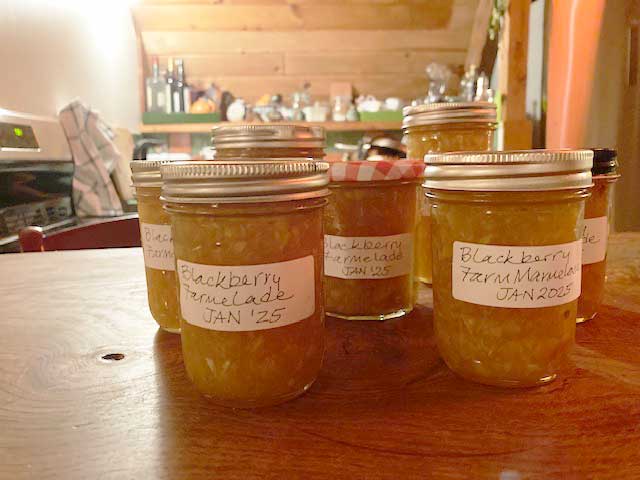
Farmalade January 2025

As I make my marmalade, I remember my mother making hers and the rows and rows of jars put away in the larder. I am thinking again of my friends in England. We are older now and knocked about by the snow and winter weather. The silent whiteness will only be beautiful if they can be safe walking to the church, laying this loved one into his grave, before returning with their memories to the safety of their homes.

This has been A Letter from A. Broad. Written and read for you by Muriel Murch. 

As always supported by https://www.murchstudio.com
Storms Here and There

Recorded by WSM KNit together by MAM

Storms Here and There.

The big storms in California and the Pacific North West have moved on and the cold snaps – also considered a weather abnormality – that settled in England and Europe are melting as they subside.

Along the roads around the lagoon and in our hamlets that we travel, the eucalyptus trees fell with a post-coital groan before crashing into the receptive embrace of the ground below. It is no ‘little death’ but a dance of death as the trees pull the soil and hillsides down, exposing their mud-bound roots. Cypress and Fir gave way also, only the native Redwood groves stood tall and strong. The sign for us all that something is – and will – change. 

This weekend, as we drove from North to South on route 101, along the California Coast and then inland, the rivers were only just subsiding, exposing more shifted mud and broken tree limbs trapping the shredded blue tarpaulins of destroyed tent hamlets. My headlights caught a mud-covered man struggling to lift a rusted-out old Radio Flyer red wagon across the freeway barrier. The next day, we passed fields of black plastic-covered strawberries and seedlings, glistening in the breeze and morning sunlight. Then it was on to the freeways of Southern California, to be caught in miles of car traffic, moving too fast and too far to heal the earth. We are the cause of this catastrophe.

Tucked away – as we were – in a musician’s cave carved out of the hillsides of Malibu, I reached for a huge tome of Beatles memorabilia and look back at the time when Paul, George, Ringo, and John were young and – at times – not afraid of taking the mick of the police amidst the crush of teenage fans where everyone was smiling and enjoying the madness of it all. Those were the days when young policemen could be found waiting at rural train stations to greet the last train home, checking to see if any inebriated gentlemen – not sure of where their car was in the parking lot – were sober enough to drive home. More than once, one of those policemen would be at the station exit and, pushing his bicycle alongside of us, walk me home. Maybe he was older than me but not much. He never asked for anything in return for his gentlemanly service. The bus drivers in the town where we trained were a little different – but a smile, a wave, maybe even a light peck on the cheek would be enough to have them drive on with a happy chuckle. 

Now, amidst the cold in England, another chill has descended. One that this UK government is unwilling and unable to address. For generations – with few interruptions – our Prime Ministers have come from the elitist of schools in England: Eton, Harrow, and Winchester. ‘On Forsyte Change’ written in 1930, coming up for 100 years ago, Galsworthy noted these three schools in his vignette ‘A Sad Affair’ which took place in 1866. England’s recent two Prime ministers, David Cameron and Boris Johnson were from Eton. Rishi Sunak is from Winchester.

Jonathan Freedland writing for the Guardian strongly urges that the whole Metropolitan police force be disbanded and reassembled.  There is some cross-party support for this as the current Conservative government is clearly chasing its tail. From the Steven Lawrence murder and debortle of a corrupt investigation in 1993, only tokens within the police force, in attitude or behavior, have changed in thirty years. This year’s uproar is of Officer David Carrick who pursued at least 12 women with rape and sexual assault. He was reported at least eight times, by whoever was brave enough, and has so far kept his uniform, his badge, and his gun, and the Met Office did the only thing they could, in 2009 they promoted him to a special armed unit. Films have been made by the dozen of American cops, notable is Crash written and directed by Paul Haggis in 2004. Efforts have been made to depict plentiful corruption in the English Police force but they still do not dent the iron-clad door of the Met Office.

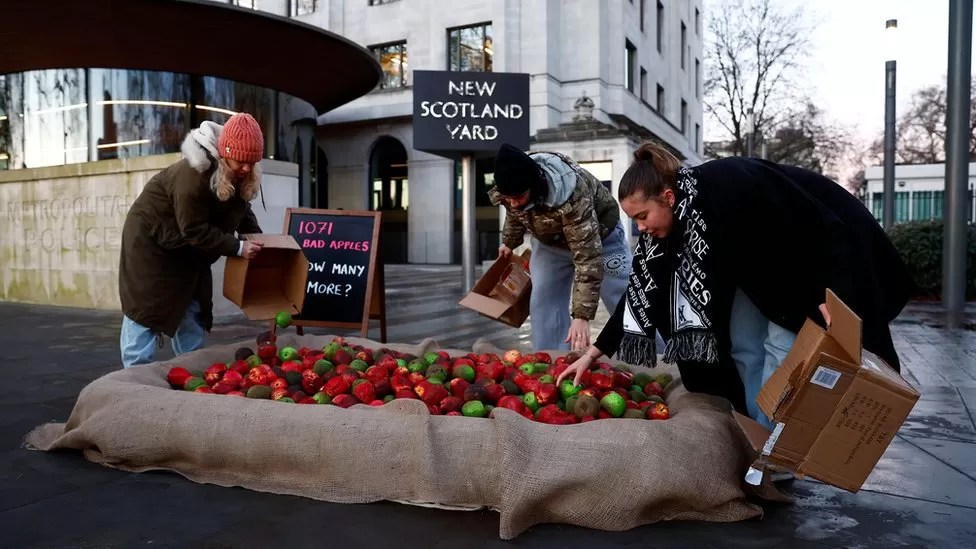
As the flurry of this last scandal broke, a government minister – whose name is not worth looking up – suggested that if anyone feels intimidated by a police officer they should ‘Wave down a bus’. It is clear that this government, like those before it, are as afraid of the police as are the general public. It is not surprising that this week a crate of 1071 rotten bad apples was left outside of New Scotland Yard in London, enough to ruin every batch of hard cider coming out of Somerset.

1071 plastic rotten apples for New Scotland Yard.

The New Met Chief, Mark Rowley, has more than one crate of officers to throw out on some compost heap where maybe they can rot into new earth. Rowley looks almost old enough to have walked a young nurse home from the train station. Maybe he can be the honest cop the whole country needs. But he is one man and the Met Police Force is made up of thousands, some police perpetrators, some intimidated officers, often women and officers of colour, rookies of every kind. 

The targeting of women, men and women of colour, is getting worse and it is hard for women, mothers, teachers, nurses, even policewomen, and women in government. It is a sad moment but no surprise to read of Jacinda Ardern announcing her resignation as Prime Minister of New Zealand. She did what she could, when she could, and now will be home for her daughter.           

Jacinda Ardern announcing her resignation in
Napier, New Zealand yesterday. Photograph: Kerry Marshall/Getty Images

January is also the month of marmalade making for English housewives at home and sometimes abroad. Winnie Carter knew it, and Ben Aiken wrote about it.  But here is a switch. Here on the coast in California, I’ve made my marmalade from our own oranges and lemons. This is something different and delicious. 

This has been A Letter from A. Broad

written and read for you by Muriel Murch

Classroom Chaos to Lockdown

Recorded and Knit together by WSM

Classed as a vulnerable senior, I was muddled as to where and when I could shop. But all that is clear now. A total lockdown has been announced across the United Kingdom lasting through to March. Thanks in part to pressure from the Teachers’ Unions that weighed in alongside the scientific community and made the government sit down and listen. As another, even more, virulent strain of the COVID-19 virus arrived from South Africa, the health minister Matt Hancock said ‘things are about to get harsh and complicated.’ and I’m almost feeling sorry for him. The view of the bumpy road has now become seriously clear. There are potholes of bankruptcy, illness, and death ahead.

Along with the national lockdown comes the news of the first Astra Zeneca vaccine being administered in Oxford. This, added to the Pfizer vaccine, is being delivered to care-homes, hospitals and doctor’s offices. Now it needs to get out to the public quickly. There is a tier system set in place and the beginning of a plan to administer the vaccine that could see the United Kingdom relatively safe, for the moment.

It was clear, as the Prime Minister began the New Year on Andrew Marr’s Sunday political program, each jousting with the other, that the Prime Minister had not done his homework of reading the June report that all of this – mutations of the virus strain, rising cases, and death tolls – was bound to happen this winter. Figures seem to be difficult for Boris and the absence of preparedness, one suspects, a life-long trait. That darn dog is always eating his homework. The BBC has to be a bit careful, so Andrew had to mind a P and a Q. But the director of the show has, I believe, a strong impulse to buck his traces and more than once showed a full-shot rear-view image of Boris at the round table. For a moment we were spared the frontal head of hair but now we see the look goes from top to tail and there are bare legs under rumpled sagging socks. It is a look that when Boris utters the words, “Believe me,” my response is immediately: ‘No’.

This week also brings up the case of the extradition of Julian Assange to the US. To avoid being sent to Sweden for sexual assault charges, always meaty fodder for the British tabloids, Assange fled to the Ecuadorian Embassy in London in 2012. Sweden eventually dropped their charges but the US still wants him for WikiLeaks’s publication of leaked documents about the Afghanistan and Iraq wars in 2010 and 2011. Assange has been in British custody since April 2019. His lawyers argued that to send Assange to the US would rewrite the rules of what was permissible to publish in Britain.

“Overnight, it would chill free and open debate about abuses by our own government and by many foreign ones, too.” The judge ruled that the risk of ‘suicide’ should Assange be extradited to the US was high and that he should remain a guest of Her Majesty’s Government.

Which is of interest to journalists and filmmakers alike. Early on this program, you will have heard from Taghi Amirani and Walter Murch about the relaunch of the documentary Coup 53, the story of the overthrow of Prime Minister Mohammad Mosaddegh in Iran in 1953. Because of Covid, the film was released in 118 cinemas and digitally in August of 2020. There was – to put it politely – a huge outcry from the makers of Granada Television’s ‘End of Empire’ series which aired in the 1980s. Huge. To their immense credit, the Coup 53 team battled on fighting every false mud-sling that was thrown over the film. And good people have stood up beside them which is always reassuring and has made a serious difference to the film’s outcome. 

Which of course then takes us to Donald Trump and Georgia. Where to start with this one? It was unbelievable, that word again, when on the Ten o’clock BBC news we listened to the tape of Trump speaking with the Georgian Secretary of State. 

Seville Oranges, waiting

So where do we go for lighter news, sunshine and comfort? Why to Spain. As every English housewife knows, the only oranges to use for making marmalade are from Seville in Spain. With their rough skins, bounty of pits and high pectin content, they are the only oranges to use. Making marmalade in January is an ancient tradition and ‘older people’ (the youngsters a mere 75) write into the newspapers to say how much they have made this year. My mother made marmalade and now I do too. It is, though I should not say it, the best marmalade I know and, naturally, requires two piece of toast at breakfast rather than just one. 

In June of this year, Isambard Wilkinson reported for The Times on a delicate task that recently fell to the head gardener at the Alcázar royal palace in the southern Spanish city of Seville: Manuel Hurtado, a senior official from the palace confirmed that this was the first year of reintroducing this ancient custom of choosing the oranges for the Queen’s marmalade. This gift, is harvested from the Poets’ Garden and the Marqués de la Vega’s garden, whose trees bear the most and best oranges.”

From The Times. The Alcázar royal Palace and the Marqués de la Vega.

But now what will happen with Brexit? Well, that small little rock of Gibraltar is coming in very handy now. An ‘agreement’ has been reached whereby Spain and England can have congress in Gibraltar, and with that, Parma Ham and Seville Oranges may reach our shores once more.

This has been a Letter from A. Broad.

Written and read for you by Muriel Murch 

First aired on Swimming Upstream –KWMR.org. Web support by murchstudio.com