INTERVIEW by Leslie Lindsay: Muriel A Murch, Author of Harvesting History While Farming the Flats
Today, while perusing the riverwalk art festival in my town, I wandered into an artist’s booth filled with pieces inspired by nature. Barns and fields. Dirt roads, orchards. The artist was a self-taught electrician who decided he needed something ‘more,’ something other than being a nameless employee. He had a handful of business cards, each contained a glossy image of one of his many works. I was drawn to the one of a farmhouse and barn, a pastoral scene. Maybe that’s because I live outside Chicago, in a town that has grown into a burgeoning suburbia, but is dotted with the occasional farmhouse and barn. I regret I didn’t purchase his art, but my walls are full.
This is something I think Muriel A. Murch would appreciate, the merging of art with nature, complex with simple. Just because it’s ‘simple,’ though, does not mean it’s ‘easy.’ Weaving together Hollywood and agriculture, her upbringing in England, she chronicles food, family, farming, and friendship in such a way that feels not just full of life, but artful and poetic.
Organized in thirteen chapters with subheadings, plus a robust photo section at the end of the book, Harvesting History While Farming the Flats (Sybilline Digital First; March 2025), is a gorgeous, thoughtful book inside and out. A former nurse-midwife, Murch writes about her love of land, community, organic farming, the independent film scene, and so much more, it’s all juxtaposed by the sometimes troubling movement of urban development and Hollywood, which is anything but uncomplicated.
As I reach back to my own ancestral roots, I was so moved by Murch’s opening lines:
“Migration, moving away from one home to another, is sometimes voluntary, and sometimes forced. Quite often, we don’t know where home is until we are there.”
This was something I identified with. My ancestral family hails from the rolling hills of Kentucky, where they’ve farmed for well over two-hundred years. I feel a deep connection to the land, but also: beauty, hard work, and simplicity.
Hippocampus Magazine
Is an online publication set out to entertain, educate and engage writers and readers of creative nonfiction. It also has a books division and brings our mission to life with an online and in-person events.
Written and read for you by Muriel Murch with WSM by my side
‘How do you manage it Mrs a-Murch?” ‘Manage what?” I asked looking down to the sweet young Indian film student in Pune?” “Holly wood” she replied using two words with her beautiful sing-song voice – speaking the English that has been imposed on her country. I laughed and said that I didn’t manage it – Hollywood – we had long ago escaped to Northern California. She breathed a sigh of wonderment rather than relief and the three – there were only three – female film students in the country’s film school over the next few days took me firmly under their wings as we exchanged the stories that women can share.
Good morning – every morning
But this last weekend I had to mange it – Hollywood – because it was ‘that time of year again’. Oscar was coming. But there is foreplay in the form of the British BAFTA awards appearing in London a month beforehand, like a butler announcing ‘Dinner is served.’ And then in Los Angeles the weekend before the Oscars, the Industry Guilds all give out their awards. It’s a busy time and Hollywood, Beverly Hills and the tentacles of Los Angeles are gratefully twitching and alive with business. But is it enough to reboot the industry after the screen-writers and actors strike that shut down the town for five months last year? Whether you fly, drive or take an Amtrak train into Los Angeles, it is the industry that envelops you. Like the coal mines of Yorkshire, or General Motors of Detroit, the unions here hold power over the industry bosses, which in the film business are the studio heads – whose heads roll with each change in profit margins. It’s a rough game.
The players are divided into teams – called guilds – and they – for better or worse are divided again – into above and below the line. That is – recognizable and exploitable names with star qualities above and those who keep the engines moving throughout production below. At this time of year our mail box is crammed full of glossy Hollywood extra magazines, all promoting this film, that craft, and for a while they are fun to read in the bath, as one would under the hair dryer in years gone by. But some carry dire warnings of another strike as more below-the-line guilds enter union negotiations to protect their health and pension benefits. The Screen Actors and Writers had known names walking the picket lines, but this strike, by the crews that keep the cameras rolling, the boom mic high enough out of the shots, the wardrobe departments sewing and ironing, the stylists and makeup artists gently applying their brushes, followed by the post-production teams of sound and picture editors pushing their faders, clicking their mice, tightening and kneading the films into its best self does not. The teamsters union boss, Lindsay Doughery says “We will strike if we have to”. These crews have been out of work for months as the industry ground to a halt in Hollywood. Actors and writers mostly have enough to get by but many below the line have been pinched and squeezed into bread lines over these last months.
Which maybe was why with the new – almost all improved – Oscar ceremony last Sunday the show opened with teamsters, truckers, caterers and drivers brought on stage for a round of applause. Was this a genuine gesture of appreciation, or a preemptive move to beg them not to strike and bring the industry to a halt again.
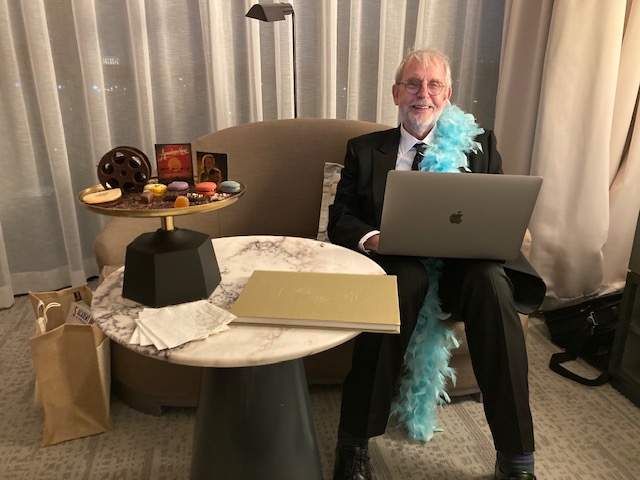
But we were in Hollywood the week before Oscar to celebrate and honor a lifetime of editing work by Walter and the added joy of having the kids – all grown-ups now – along to celebrate their father. And to see them – the other life-time of work – each holding their own and living their lives in the fullness of their times. And young prodigies joined the ranks of old colleagues, those who have been in the trenches of each particular film; from THX 1138, American Graffiti, A Godfather here and there, The Conversation, Apocalypse Now, Return to OZ, Ghost, English Patient, Talented Mr Ripley, Particle Fever, Coup 53 and so many more. A full lifetime of work flashed across the screen turning the photo album pages too quickly – “Wait”, I wanted to say – “let me look a second longer”. And did it end with ‘Her Name was Moviola’? The machine woman who beguiled him away for those long hours, days, nights and all times in-between. She, for that machine is a she, is asleep now, resting in an old horse stall, hidden under a pile of boxes, not yet knowing she will never turn over her wheels again, never clunk down on a sprocket of film to cut. What happens to machine relics? How many get saved for a museum exhibit? Like pencil and paper, envelopes and books, the tools we use are changing, but not the emotion that cinema stirs in us.
Saturday night before the Editors brunch, the Cinema Audio Society held their awards dinner celebration. This guild is only 60 years old, and is not as rich or as powerful as the editors or cinematographers Guilds. But while picture without sound can take over our senses, it is sound that sweetens our awareness of cinema. Voices, sound effects and music blended together are the cradle in which the film can rock.
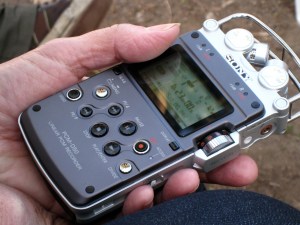
And it is before the cradle that sound comes to us. In 2004 the young voice echoed again, “How do you manage it Mrs ah Murch” when I found myself in Berlin for the Film Festival. Berlin, the first of the years big festivals, is cold, often there is snow, which looks pretty on arrival but soon becomes slushy and grey. I am at a loss, floundering around, and reached for the only tools I had with me: A microphone and tape recorder.
And so I began to record my fluctuating heart beat before moving the mic up over my chest to capture breathing, down my belly for the gurgles that occur with greater frequency when one is nervous. My husband is in the bath, so I kneel beside him, sliding the mic up over his carotid arteries, lub dub, lub dub, lub dub, he doesn’t seem so bothered by Berlin. I walk the hotel hallways where the world’ film makers are hurrying, from one place to another, excited to see the new work and each other.
WSM has taken my Mother’s Symphony and is using it to make a point about our hearing.
I take my recordings back to our room where one track leads into another – blends, fades in and out – but, as in the womb, from four and a half months of gestational life, there is always sound until after we are born – when there is the silence of a solitary crib in a room of one’s own.
Almost 20 years after my Mother’s Symphony was made, played, used in lectures and then put way, film maker Sam Green, found it and then me.
“Could he buy it?” “Certainly not, he could have it.” And so he carefully lifted the symphony tracks from their radio format and slipped it into the opening of his film ’32 Sounds’ where it gently beckons us into the worlds of nature, of make believe and music. On that Hollywood evening, despite strong musical competition, 32 Sounds won for best documentary sound. As the audience rose to its feet It was as if we were all coming home.
And then there was Chocolate
This has been A Letter from A. Broad. Written and read for you by Muriel Murch.




 Muriel Murch