Storm Bert

Written and read for you by Muriel Murch with WSM by my side

It took two weeks for the leaves on the elm tree that bows over the entrance to Kingstown Street to turn from khaki to golden then crimson before falling. Now the branches are bare, showing their stark beauty with the strength that comes from age. The grass below is now covered in a soft mulch of leaves from which will come the renewal of spring in the new year.  Across the street, though, the younger ornamental prunes is in a complete muddle. The first chill of autumn crushed the leaves but then a slight shift brought a warm spell and the buds began to swell. Now there are small pink blossoms peeking through dying yellow leaves. 

The second storm of the season – named Bert – pushed into London from Wales but still on Sunday a walk was called for and, wrapped up against the wind, I ventured out. Turning the corner onto Regent’s Park Road a blast of wind hit me and I buckled, tottering like the old lady I have become, before carefully crossing the road. Though it is the first time I have ever seen this, it is no surprise that there is a notice on the closed park gates: ‘The Park is closed today. All being well it will reopen on Monday. We apologize for any disappointment’. Who chose that word? Disappointment rather than the usual ‘sorry for any inconvenience.’ It almost sounds sincere, a touch of kindness and as I walked past the gate a young family came and paused and they were indeed, disappointed. Storm Bert is the second storm to hit these islands. The first was a snowstorm called Ashley while Conall has yet to arrive. Bert hit Wales, Devon and the South West coasts hard, moving into London and the news and, rough as it is, it is nothing compared to the deluge that overtook Valencia in Spain. It was in 1953 that the World Meteorological Organization in the US began giving women’s names to storms and hurricanes. It wasn’t until 1978 that they began to accept that many of the gods of the sea and winds were male and also lose their temper. In 2014 the UK Met Office began to do the same. So here we are at the tail end of Bert, who, like a flat-capped boozer, is weaving about, losing his way going home across the North Sea.

Storm Bert from The Independent

The budget has caused a stir. Well of course it has. Rachael Reeves is the first woman Chancellor of the Exchequer, presenting the first Labour budget in twelve years, and she has gone after the wealthy. Not so much of a problem but she has included the wealthy who do not pay inheritance tax. Through the years of history business men and women have become land owners choosing to pop their pennies into the soil, growing their wealth now along with too much monoculture and wheat, while avoiding their taxes. These are the farmers for whom the land is the investment. Occasionally they can be seen striding about in their Wellington boots pretending they don’t have a bean to rub together. For the small farmers things are different – making a living from mindful farming and husbandry remains as harsh here as in any country. I don’t understand it all and realize that neither I nor the small farmers are supposed to.

This week Kim Leadbeater, the Labour MP for Spen Valley, that follows the river Spen in the West Riding area of Yorkshire is presenting a bill on Assisted Dying. The arrival of Kim as the northern MP was a welcome and resounding relief after some years with Sarah Wood of Reform UK and Laura Evans  a Conservative before her. Kim has brought forward a new and improved bill on Assisted Dying for debate. There are activists and protesters on both sides of this issue, they are heartfelt and driven by strong emotions of fear and love – and yet – past Prime Minister Sir Gordon Brown is calling for a commission on end-of-life care. At four days of age, Gordon and Sarah’s baby girl had an immense brain hemorrhage and died a week later. In a recent article for the Guardian Gordon Brown wrote –     

Sarah and Gordon Brown after the death of their daughter. From the Daily Mail.

“But those days we spent with her remain among the most precious days of my and Sarah’s lives. The experience of sitting with a fatally ill baby girl did not convince me of the case for assisted dying; it convinced me of the value and imperative of good end-of-life care. We were reassured that she was not in pain.”

At this time, as the National Health Service still struggles from the residue effects of the Covid pandemic and twelve years of Tory government what this debate is showing more than ever there remains a huge difference in health care when defined by your post-code address –  once again playing wealth against poverty.

As autumn dons a winter cloak and storm Bert takes itself out into the North sea, these days have led us into musical adventures. I think of Herman Hesse’s short story, Old Music, where he ventures from his woodland cabin – first on foot, then by tram into the city center to hear a cathedral concert of Bach and what it means to him.

These last ten days have given us similar adventures but the music we have been led to is new to us, not familiar and yet all absorbing reaching me in a new way. This is exciting as with age I’m getting a little iffy I don’t hear music in the same way – and yet from the first concert – the last of the Rolex Arts Initiative series – with jazz vocalists Diana Reeves and Song Yi Jenn from South Korea and the New Dot drummers, my heart and body responded. A complete switch around took us to Abbey Road and a film screening of ‘Standing on the Shoulders of Kitties’ joyfully full of Rock and Roll and country music.

Ticket invitation to the screening 🙂

Gently the week ended at a Musical Salon and an Italian Armenian duet of Viols and Voice from Intesa sharing a musical journey through the stages of love. Each concert was so different yet as the drummers marched onto the stage at the Queen Elizabeth Hall they brought the universal dreams carrying the same searching to be heard and I marvel at the music that speaks to us across the world.

This has been A Letter From A. Broad – Written and Read for you by Muriel Murch 

And as always supported by murchstudio.com

Green is for Grenfell

Written and read for you by Muriel Murch with WSM by my side

One evening last week, four mid-sized yellow ambulances screeched to a halt in the little parking cul-de-sac which serves this side of the Auden Place Council housing apartment blocks. The ambulances were left with engines running and lights flashing as the paramedics carrying their bags, searched to find where they needed to go. They were gone a long time and when later I finally looked out of the window the parking lot was empty. There had been no blue lights flashing or blaring sirens signaling their departure. The next day I learnt that Sylvie had fallen downstairs and had not recovered. Those who knew her went about the day sobered and reflective.

Capitalism lives on in buttons

Last week the second volume of the Grenfell Inquiry report was finally published and made available to the survivors of the tragedy, and today’s government ministers. On the evening’s broadcast, the news-anchor standing in front of the Grenfell Tower, bathed in moonlight and cladding with its green heart wore a bright green coat as she spoke. Green-heart buttons are worn by Prime Minister Sir Keir Starmer and London’s Major Sadiq Khan seen standing on the right side of this event. 

Ministers leave the benches in a hurry

The daily Parliamentary schedule allows that after the morning’s Prime Minister’s questions there is a pause for those who have meetings to attend – to leave. On the morning when the report was to be presented the choking exodus of Members of Parliament was sobering to those who remained seated and disgusting to those survivors watching. Sir Keir turned to face the gallery as he gave his heartfelt apology, acknowledging that on every level – regulatory, council care, business and responsibility – the Government had let them down. The report left no doubt that the 72 deaths from the Grenfell fire of 2017 were avoidable.

The living community that had existed within that tower block, that exists in all housing estates and neighborhoods to a degree, has become one of bereavement for the Grenfell survivors while they remain physically misplaced in temporary housing. ’We want Justice’, read the banners at Grenfell but what is justice, what would it look like? Now the buck of blame is sliding from the place of government regulation, to counselors who did not listen to their citizen’s concerns and onto leaders in businesses. Tracking those responsibile is like following a river to its source, as a hidden stream emerging from the earth that may yet come to rest outside of the garden shed of the Prime Minister of the time, the Rt Hon Lord David Cameron who so eagerly started his ‘bonfires of red tape’ hoping to free businesses of unnecessary regulations. ‘For every new regulation cut three’, was the guideline while each and every one of the construction firms with government contracts took advantage of the burnt red tape. Once all 1,700 pages of the Inquiry documents have been read, surely there will be some firms will be highlighted and named. Sir Keir Starmer calls for the companies involved in the disaster be banned from receiving government contracts, and that the government would support the Metropolitan Police’s investigation into the fire, saying it was “imperative that there is full accountability, including through the criminal justice process, and that this happens as swiftly as possible”. But the Metropolitan Police are stalling, shuffling papers to be read in detail by lawyers – before proceeding with any prosecutions. It will be at least two years before charges are brought against anyone deemed at this time to be responsible.

The report – all of it. Image: Ben Gingell via Dreamstime.com

While the inquiry has been bound together, distributed and read, the criminal courts have been unusually busy for August, as the far-right activists who erupted with violent anti-immigration protests in cities across the country a few weeks ago were rounded up and swiftly brought to trial. It was nasty. Sir Keir – again – expressed his determination to crack down hard on the rioters, and so the courts have been working overtime and in quick succession jail sentences have been handed out like military call-up papers. But there is another problem. England’s jails are reportedly ‘not fit for purpose’. Last week’s count showed only 500 places out of 88,000 were left, 400 being quickly taken up by the far-right rioters, leaving only 100 places, either to be given to more rioters or – possibly saved for those who took advantage of the Tory government’s bonfire of red tape. It is noted but not yet spoken how quickly some prosecutions can occur, while others linger in old manila folders. A jail-house solution is being acted on as I write. 1700 ‘low risk’ prisoners are being released across the country today. We are assured ‘High risk prisoners are not being released’. But that depends on your point of view, who is high risk or low risk, to whom? Prison staff are already struggling with this new check-list of red tape with things to be done to get those lads and lassies out of the prison gates. There is no time to wonder who will receive them, where they can go, who will support them, or will they just find it safer to return to lock-up. Will they leave enough room for the Right Honorable gentlemen and business leaders to maybe one day sit on benches beside them?

This afternoon the government just approved Chancellor Rachael Reeves’s bill to cut the fuel payment allowance given to pensioners last year. Not many people are saying the obvious – that the allowance was a double-hitting ‘take that’ act from the past Prime Minister, Rishi Sunak, first as a sop to mop up any old voters who might have put an x in his box on election day, and secondly to skewer the next government with less money in the kitty and an unpopular choice to make. But Sir Keir and the labour party still have some political support from raising pay for essential workers in the National Health Services and then to the train-drivers, thereby keeping that union at bay – for the moment.  

Sir Keir has not traveled far this summer. He’s been busy reading the manual and fixing the government’s old bike whose chain keeps falling off and brakes need new pads. In Ireland he met the Irish Prime Minister Simon Harris to ‘reset the UK’s relationship with Ireland’. There was also a visit to Paris renewing his friendship with France’s new Prime Minister Michel Barnier. Both are detail-oriented men, and keen to connect rather than disagree. French government being what it is at the moment, Emmanuel Macron’s appointment of Michel Barnier as the new Prime Minister makes England look relatively stable and calm.

And so for excitement – rather than war – we ready ourselves for the upcoming US presidential debate which will have happened by the time this letter airs. It is more nervous-making than any football match with the stakes high for the US and the world. Even those who are not counted will feel the waves of power as they settle in November. 

This has been A. Letter from A Broad. Written and read for you by Muriel Murch.

Supported by https://www.murchstudio.com

We Seek him Here … and then There

Written and Produced by Muriel Murch
Snack time at The Cottage

We seek him here we seek him there and the whereabouts of the Russian General Prigozhin who took a group of mercenary fighters towards Moscow and then back again, is reminiscent of Humpty Dumpty who took a big fall – as I remember – and all the king’s horses and all the king’s men couldn’t put Humpty together again. Prigozhin and his men may or may not be in Belarus. Only five days after the aborted march on Moscow, Prigozhin met with Putin at the Kremlin, and now the location of the mercenary soldiers has got a little murky. Alexander Lukashenko shrugs as he responds to a direct question about Prigozhin during a conversation with a few invited journalists – that reportedly lasted for four hours. “I’ve no idea where General Prigozhin is.” And when asked further about the mercenary soldiers he responded “Every country has them.” Though he may be lying on the first count he is probably right on the second. The newsreels from Belarus show farmland fields filled with rows of army tents flapping gently in the sunshine. Soldiers camping – I remember them on summer exercises in the fields when I was growing up five miles from Aldershot, a military town. But over twenty years ago I also remember crossing a mountain gravel road in Idaho where grown men were taking the lads out “camping” – with bows and arrows and rifles – almost hidden in a mountain-pass meadow. It is so easy – when you feel under threat – to believe you must defend yourself.

While searching for Prigozhin we also look about for Rishi Sunak who does not pop up on the telly quite as often as his two predecessors, Boris Johnson and Lizzy Truss. While the 75th birthday of our pride and joy, the National Health Service, is celebrated with cup-cakes for the working staff, the accompanying discussions on what to do about Britain’s Health care – “charge patients more and pay staff less” seem to be the Government’s only mantra. This is a greasy pole Sunak may fall from. If he isn’t careful and Keir Starmer is careful there could be a change of government in the not-too-distant future. But can such a steady hand with Starmer’s hectoring voice fix all that has been destroyed in the last 12 years? It’s a tall order.

Not my King

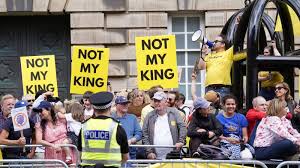
The sun shone as King Charles drove along the Royal Mile from Holyrood House to St. Giles’ Cathedral with his queen and the Prince and Princess of Wales beside him. The crowds came out along the mile, mostly to welcome, wave and shout ‘God Save the King’ but some to show – with large yellow placards – that for them he is ‘Not my King’.

King Charles Touches the Scottish Crown

As a historic rule, Scotland does not care for kings though it’s a little more sympathetic to queens. The King kept it short and accepted the crown with a touch but not wearing it, along with a new sword, and the scepter. The ceremony ended with the familiar fly-pass of the Red Arrow fighter jets – always a crowd-pleaser. For the moment the Royal couple can go on holiday at Berkhall and Balmoral – the homes that his grandmother and mother loved the most. There they can rest a little as they reflect on the legacy he has been given and the job at hand. They may even manage a barbecue in the forests but that might be pushing history and memory a little bit too far. It’s a tough transition. King Charles knows he is a bridge slung between an old Great Britain and a floundering England and not everybody’s King. 

We are in the midst of the summer season with the Wimbledon Lawn Tennis World Championships fortnight. 2018 was the last year that England had any showing at all on the last week of competition. England’s men, Andy Murray, Cameron Norrie, and Liam Broady, and the single woman, Katie Boulter have been knocked out already and the country is embarrassed but maybe not enough. Somehow the play at Wimbledon symbolizes – for me – England’s place – not quite good enough to match the rest of the world. The fixture is of such importance and now with roof lighting – the show must go on – until 11 p.m. The  BBC ten o’clock news is at times pushed aside and the quick brush war between Israel and Palestine barely got two evenings. The Israeli forces did a quick in-and-out three-day attack, killing ten Palestinians in the Jenin refugee camp – job done from the Israeli point of view while the Palestine forces gather once again, vowing not to rest until they have reclaimed their land taken in 1948.

Somewhere in the world a battle is raging, people are being killed while others are trying to escape. Boatloads – some carrying unaccompanied children – are sent off and with luck arrive alive at the English shores in Kent. They are housed in detention centers where Robert Jenrick the Minister of Immigration has ordered the reception area pictures of Micky Mouse and Baloo from The Jungle Book to be painted over, to show something less welcoming. We know by now that we are less welcoming than Germany, Italy, and other European countries but is the painting over of Micky Mouse really helpful? 

Micky waves Hello in Kent

Naturally, the shadow immigration minister, Stephen Kinnock, condemned Mr. Jenrick’s order, saying it was a sign of a “chaotic government in crisis. Labour had a plan to end the dangerous crossings, defeat the criminal smuggler gangs, and end hotel use by clearing the asylum backlog.” Well, good luck with that.

Just as things seem quieter and we prepare to enjoy a week of family celebration, The Headlines of Murdock’s Sun Newspaper breaks another serious scandal coming directly from The BBC. Allegations made against an as yet unnamed TV presenter of – at the least – sexual improprieties are now being reported by the BBC as the mostly women presenters carefully chose their words. We watch to see who is not bringing you the ten o’clock news and like a game of Wordle, fill in the blanks by elimination. The country is hushed with a communal sense of betrayal. Though this week the mood beckons consideration of some serious falling-on-your-sword action by whoever ends up at the bottom row of this puzzle.

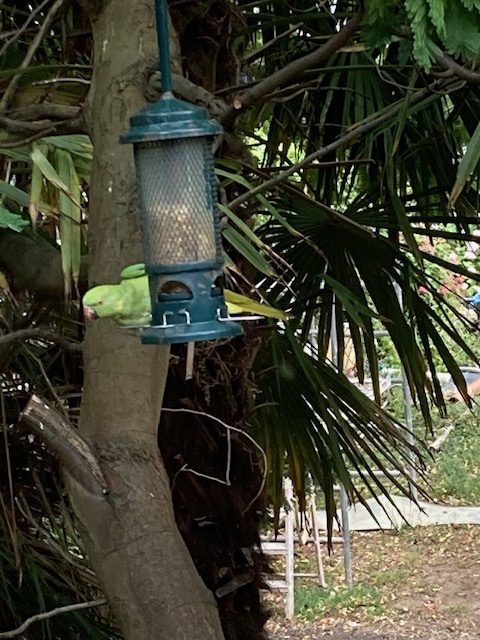
We refill the bird feeder that hangs from the Acacia tree over our little terrace. Along with the familiar families of birds – a small flock of Indian Ring Neck Parrots have found the feeder and have figured out how to work their way through the entire tube of food in a morning. It looks as if they aim to stay with us for a while.

This has been A Letter from A. Broad. Written and read for you by Muriel Murch.

Year’s End

Recorded by WSM Knit together by MAM
From Thanksgiving to Twelfth Night the farm is lit with forty plus year old lights. Wecloming you home and into the New Year. Photo by WSM.

Year’s end.
November rolled like storm-tossed tumbleweed into December and the nights slid earlier into darkness each evening. Now December is ending and even through the storms covering America the light is beginning to return.
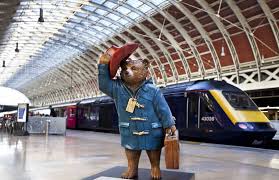
It was already night-time when we landed back from Poland and the Heathrow train stopped at Paddington. The station was closing down for those midnight to five a.m hours. Only the Sainsbury Local stayed lit for the late-night travelers and I dipped in to pick up the milk and bread to be turned to tea and toast in the morning. Outside the vast hollow waiting area which feeds onto the platforms there was no cute, lost Paddington Bear with a suitcase, instead there were a dozen or more old men settling in on the benches – separately – but close enough that each could watch out for another as they came in off of their street-corners to a place of warmth. A plastic shopping bag or a shopping cart contained their travel baggage. I wonder what it is that remains precious to these homeless gentlemen. They each had a blanket that they wrapped around their legs and even their shoulders, if it was big enough. There must be regulars who show up at Paddington, Victoria and Waterloo train stations each night – until they don’t. Do the staff who clean and monitor the stations sweep round the huddled bodies and shopping carts. Is ‘keeping yourself tidy’ a prerequisite to keeping your patch and even bench? What time do you have to ‘move along’ and face the world in the morning? There is a rhythm to this unseen pedalling-in-place, train stations hold these men who watch leavings and loneliness travel alongside of expectation and desire.

Paddington at Paddington

In November Mehram Nasseri died. Nasseri had lived on a bench at the Charles de Gaulle Airport for 18 years and was the inspiration of Steven Spielberg’s film ‘The Terminal.’ Stranded and stateless he perhaps brought a focus to the question of what or where is home. He found a community, and a sense of belonging.

Mehran Karimi Nasseri, or ‘Sir Alfred’, on his home bench at Charles de Gaulle airport. Photograph: Eric Fougere/Corbis/Getty Images

Under Rishi Sunak, the Conservative Government continues with its agenda – to avoid paying Universal European taxes – thank goodness for Brexit – but with no taxes paid by those who could – there is less in the coffers for The National Health Service, the state schools and other community-run organizations. It is now becoming obvious, though it was before if we looked, that the goal is to cripple and disband the NHS, take it away from those who need it most – and the best way to do that is to lock the pay scale of the workers. When I graduated in 1963, satirist Michael Frayn wrote in the Guardian Newspaper: he was looking at reports on wages on what they called ‘the devotional fields’, then primarily nurses. Saying the general principle was to hold the wages as low as possible to keep out ‘undesirable elements wanting to make a fast buck.’ Well they certainly did that, kept the wages as low as possible. Nursing is a devotional field and the wages remain among the lowest of professional workers to this day. On graduation we were encouraged to join the Royal College of Nursing and almost everybody did. But in my youthful idealism I couldn’t ever envision following an order – to go on strike. Now, for the first time nurses are being called on to do that. But they won’t. Instead the ambulance drivers and paramedics will be at the forefront of this battle with the government, and once again the government will win, grudgingly giving out pennies rather than pounds. Nurses will continue to use food banks and be at the mercy of the transport unions who can strike and get the money they are asking for. The Army will get to practice some drills while substituting for the paramedics. And people will die because of it.
From one family to another, we came back home – unsure where that is. We are old nomads – and with a little more infirmity we would be outcasts from the herd but for the moment we are lucky and received by our families wherever we land.
And we landed at the bar in town. With the nudge of a full bladder at 6.30 in the morning we bundled up, and scraping the frosty car windows, to drive downtown and to Smiley’s to watch the World Cup soccer final. The bar was open at 7 in the morning serving its customers what they wanted – a big screen and sports special. And free maté – with honey. It was as fun watching us as it was watching the football, two teams at the very top of their game, with grace, skill and respect as more than once a player in azure blue and white helped another in navy to his feet after a fast clash.
From Sunday to Sunday, turning from the big screen at Smiley’s to the computer screen in the Hayloft and finding the King at Windsor Castle. From here it felt like opening an old blue aerogram letter, with news of home and I watched as keenly as any other ex-pat around the world. There was a light snow on the grounds of Windsor Castle and young girls in the soprano Choristers at the Christmas Carol service in St. Georges Chapel.

The King spoke with no photographs around him to point emotion one way or another. His notes were handy to glance at, maybe showing that the teleprompter was not for him. He spoke in empathy for those families who have lost loved ones this year, of the importance of her faith for his mother – our late Queen, and for him too, and of all faiths. He gave thanks to the hundreds of people who help those in need through the hardships of these times, and very carefully showed those of his family who, by their presence, gratitude and acknowledgment of the work of others, help to sustain us all.


This has been A Letter from A. Broad
written and read for you by Muriel Murch


Tripping About the Countryside

Recorded and Knit together by WSM

They took to the stage on all three major television channels; the BBC, ITV, and Sky. Rishi Sunak trots eagerly up to the podium in his Gucci loafers, though sometimes jacket-less, unsuccessfully portraying a working man. Liz Truss walks carefully in her heels with a smug smile and discreet earrings – one day saying one thing and the next day saying another. She is changing statements, but maybe not her mind which appears to be missing in action at the moment. These are the Conservative leadership rivals to be the next Prime Minister clashing on how they will address: high inflation, the rising cost of living, gas prices, Ukraine’s war with Russia, while sidestepping how both of them are looking to kill the National Health Service. But then the broadcasts stop, the candidates and their lies are just too transparent and boring. Now each gets a news moment as Liz changes her earrings to gold stirrups visiting a farm, and Rishi puts his jacket back on to speak at the Royal St. George’s Golf Club.

Those rural earrings

Like the story of the frog in the hot-tub, the National Health Service is coming to a slow boil. The news has me hold my head with the charts of the numbers of medical staff, doctors, and nurses that have left the Health Service. There are two main reasons for this. Since Brexit, European nurses and doctors are better off regarding pay, hours, and family situations returning home. English-trained nurses and doctors are fleeing abroad to countries that pay more. England is reaching out to poorer countries and importing staff from those that pay even less than England. This migration has gone on since we English, Irish and European nurses flew to America, Canada, and Australia for better living and pay. But nobody talks about Brexit being the cause for this new low, the ridiculous staff-patient ratios, and the non-pay of nurses and doctors. The government counts on the moral inability of nurses and doctors to abandon their patients, and laugh all the way to the locked coffers.

The sky is cloudy and dull, pouting at being left behind in grey England while these two politicians vie for the Conservative leadership. The chambers of the House of Commons sit empty as ministers flee the city, following the example of their old boss Boris Johnson, who took his family off to Greece for the holiday month of August. 

There is no rain. The streets are sticky with the detritus of human and animal food ingested and eliminated. Leaves are falling from trees a month ahead of Autumn. They are dry, crisp, and crackle when kicked about on the pavements. There are no conkers on the chestnut trees in the park and those not-so-old trees are dying.

The second heat wave was well underway, and the scheduled train strikes still a day off when I traveled from Waterloo to Hampshire. The South West trains are all new and all air-conditioned which bought a welcome relief from the rising heat. I am meeting three old friends for lunch at the North Hants Golf Club. The youngest of us is only 75 years old. The tables and umbrellas are set out on the veranda overlooking the first and last holes of the course. Though it is hot we can safely gather in the shade. We sort of look great – in our elderly way. We were children together, almost sisters, and though our paths diverged our roots were seeded in the same soil. My friends stayed close to their rootstock and settled deep in rural Hampshire and Wiltshire, each raising champion horses, sheep, and cattle.

Four for Lunch, Sue, Susan, Ann, and Susette

The North Hants Club is well over 100 years old but was still young when we were. Within that world, there is the sweetnesses to be found in any close-knit organization that becomes a family. Jackie has been a part of the kitchen staff for 43 years and we have known each other with mutual respect and admiration through all that time. The kitchen, where deep frying remains a specialty, is stellar and provided us four Caesar salads that were not on the menu along with teasers from their small tapas plates. It was grand to be together and share our autumnal news. We spoke of our lives, of families, and thought of old friends, remembering that though now we are four, we used to be six. The relentlessness of life continuing after another’s death has a bite to it that is hard to define.

Susan getting Settled

Returning to London the train stops at Weybridge and ‘all change’ is called out – to anyone who can understand the voice through the microphone. There are no leaves on the line, these tracks have not buckled from the heat but there is a fault with the train and so we are directed to a local one waiting on a side platform. ‘Change at Staines for the fast train to Waterloo.’ But I don’t. I stay seeing the names Virginia Water, Staines, Barnes, East and West, Putney, and Chiswick before Clapham and Vauxhall. I realize this so slow train travels alongside the western A30 road laid down over the old Roman Road and follows the historic London to Land’s End coaching route – a popular place for highwaymen. William Davies, known as the Golden Farmer and robber of coaches traveled across Bagshot Heath and was hanged in 1689 at a gallows at the local gibbet hill between Bagshot and Camberley. The Jolly Farmer pub built close by was in remembrance of him.

Sculpture to honour the Windrush Generation of Immigration at Waterloo

The train pulled into Waterloo and the platform exit is beside the newly erected statue tribute to The Windrush Generation immigrants who came from Jamaica and the Caribbean to help England after the Second World War. It is a fine statue, showing hopeful and proud parents and their young daughter. She would grow up to become one among us in nursing school, another sister from another time. Tourists from Africa and America proudly stand beside the statue for their photograph moment.

I was not alone in going out today with a cardigan and umbrella though neither was needed. We, and the earth, are crying for rain – or would be if we could cry. All we can do now is sweat, copiously, as we wait for the bus. An Asian gentleman of about my age is also waiting for the number 274. When it arrives he graciously extends an ‘after you’ gesture to let me board before him. We sit on opposite sides of the bus in the reserved for old people seats. The bus driver is not yet exhausted and the bus almost empty. It is August. Hot, dry, there is no school, and whoever can be – is on holiday. I find myself imagining the cold rainy days of autumn, wishing for them, and having a hard time believing the evidence before me that we are seriously damaging our planet. ‘First, do no Harm’ is the Hippocratic oath and here we are committing murder. The bus goes quickly along its route carrying its few passengers. My gentleman friend gets off at Prince Albert Road. He smiles at me and I at him. It is a moment of grateful recognition but I’m not sure what of.

Now there are hosepipe bans imposed by most of the Water districts, whose own leaks are responsible for almost 30 % of water loss around the country. Then quickly news comes of the other leaks, of sewage from more faulty treatment plants into the local rivers and streams, or to the sea for those low-lying coastal areas. It is too much for the cartoonists who show pictures of Boris Johnson, remember him? the still – but on holiday – Prime Minister, entering the sea somewhere in Greece. Sewage flowing outwards but not yet gone.

This has been a Letter from A. Broad. Written and Read for you by Muriel Murch

+3 = -7

Recorded and Knit together by WSM

Summertime – to spend on holiday or in self-Isolation, depending on which rules and gateways you are following. The news channels are searching for stories that can wake the public out of a lethargy from the recent heatwave and flash floods. 

 Brazil’s Rayssa Leal (silver), Japan’s Momiji Nishiya (gold) 

But in Japan the Tokyo 2020 Olympics are taking place, a year late and bound to be more than a dollar short. But Japan is a proud nation and will hold its head up high no matter what the financial outcome is from these precious days. The empty stands are a grim reminder of what is and is not at stake in the world today and for the 11,000 athletes gathered with their coaches and staff from over 206 countries. Those of us who can, are watching – just a little bit. With the COVID restrictions in place and without the huge crowds roaring, there is a visible difference in the atmosphere. There seems a real focus on the athletes, their sport. Glimpses of the cross-country comradeship between the competitors. Alex Yee, the Asian English Triathlon runner, who came in second is genuinely smiling as he congratulates Kristian Blummenfelt the winner from Norway. The sweet young skateboarders are proud of their countries, yet more deeply excited to be here with each other. An extreme version of summer camp, that, being teenagers, they will take in their stride to adulthood.

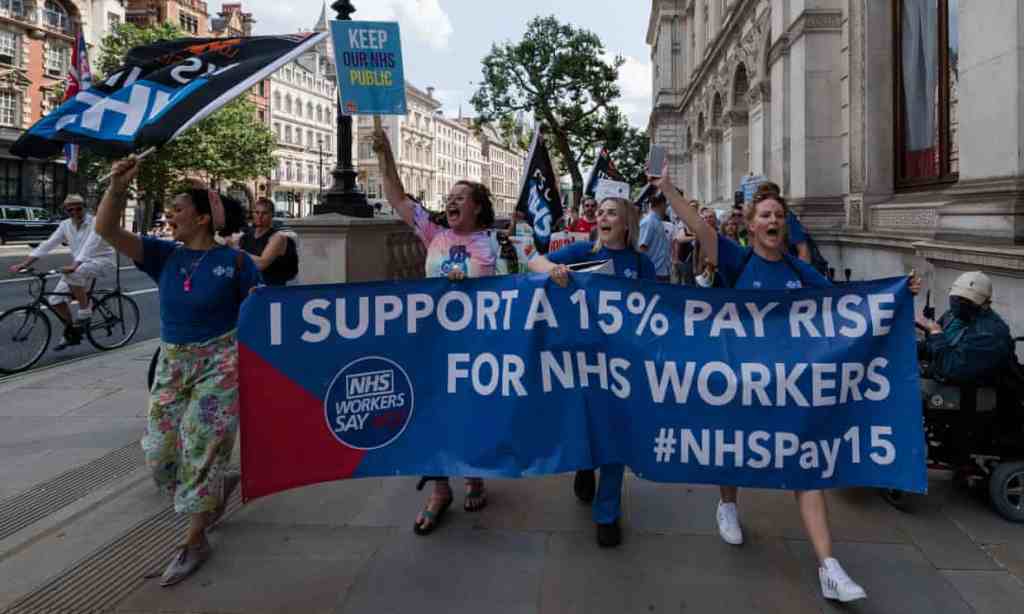
This could be the time for a little news item while everyone is too distracted to notice. The television shows a nurse ironing her home-laundered scrubs. I recognize myself in her, a good woman, a good nurse, trying hard to make ends meet as she works at her chosen profession. The government is to give the National Health medical staff a 3% pay rise. Given, so says the statement “In recognition of the important courageous work done by the medical staff through these last terrible months of the Coronavirus pandemic.” No junior doctors or dentists still in training, most of the medical staff, will receive that rise and the nurses are exhausted. The question remains are the nurses too worn out to consider a some kind of action? 

And so do I

A 3 % raise sounds good – but it equates to a 7.6% decrease in today’s economy for nurses who, more than most public sector workers, have been consistently underpaid. As if tending the body of the sick and oft-time dying is still looked upon as an unclean act. And yet – tending to the body of another is the greatest and first, according to Margaret Mead, sign of a civilized society. All nurses understand it is a privilege, and in a cruel way those who eke out the pounds, shillings and pence also understand that we care for our privilege. But this pay rise remains an insult that is getting harder to ignore. 3% they say, because of all the hard work and dedication you have shown through the pandemic. Hang on, that is what nurses do – all the time. And the police and teachers are to have their pay frozen for at least this year. I can remember being given ten shillings more a week, knowing it would be eaten up in a heartbeat. 

Now that Freedom day has come and we are all following government guidelines that say it is safe to go out – carefully – we cautiously took the train to Oxford. This was for a long overdue visit to friends with whom we had promised to bring a fish pie. And so we packed up a picnic, fish pie, champagne to celebrate a beloved mutual friend’s passing, home-grown and home-made blackcurrant jam, and home-brewed elderflower cordial. 

The Saturday train to Oxford was packed. Every seat was taken and strangers sat beside each other, some carefully, while for others, within the comradeship of youth, conversations began with today’s pickup questions for a new piece of computer software. The train hauled out of Paddington and into the countryside. Buddleia-covered concrete giving way to ragwort and fireweed alongside of un-ripened wheat fields. Our friends live on the outskirts of Oxford and we walked our way from the train station to the bus stop through the town. The river holds, the narrow streets remain the same, the pavements are hard for wheelchairs and the city looks as weary and beaten as any city that is trafficked by students, and where COVID has lain bare the worn cobblestones normally covered by tourists. There are empty store-fronts and as it must be after any war, it is hard to see if they will return fresh and hopeful for the students of the future. It is only when you look up at the massive yellow stone, with its the carved beauty leaning down on you in the narrow streets that you say, “Ah yes, Oxford.”

Photo by WSM

Oxford has been battled over, lost and won again over many centuries. The University was founded 800 years ago and since that time has remained one of the seats of higher education in England. It is the oldest university in the English-speaking world, though, lest we forget, as the English are wont to do, there have been and remain other ancient dynasties throughout the world. In England and at Oxford, church and state were intertwined throughout the centuries, with scholars and politicians emerging from the monasteries and bishops burnt as traitors and martyrs. It was heady stuff. Church and education marched hand in hand and, to enter Oxford, never mind graduate, remains a path to many doors of power. Which brings us to today’s politicians, those who walked the hallowed halls, crossed the sun-shone quads and have too easily assumed the mantle of entitlement that does not become them. But it is these men and women, who hold the purse strings of tax-payers pounds and whose education and political persuasion have led them to justify the equation that plus 3 actually equals minus 7.

This has been A letter from A. Broad

Written and read for you by Muriel Murch

First Aired on Swimming Upstream KWMR.org

Web support by murchstudio.com

Covid, Coup Coo ee

Recorded and Knit together by WSM

To date, over nine million people in the UK have had their first Covid-19 vaccination. Now there is a scurry-hurry as testing is ramped up in flaring spots of the fast-spreading South African variant of the virus. The English like a good hunt and if foxes are off-limits then viruses can be the quarry. As the elderly residents of all UK care homes are now scheduled to receive their first vaccinations, Ireland, Wales and Scotland are also vaccinating the care-home staff but for some untenable reason, England is not.

The Covid virus remains indiscriminate and random in its reach. Age and health play a part but there are no guarantees of safety from the disease. This weekend Captain Sir Tom Moore who walked 100 laps of his garden before his 100th birthday, raising over 32 million pounds for the Nation Health Service, was hospitalized with pneumonia and a positive Covid-19 test, and he died on Tuesday afternoon. He and his family became a symbol of hope and inspiration for the whole country. We hear a lot about how the pandemic affects doctors and nurses on the front line. Today I am thinking about an anesthesiologist’s story of his first two intubations, back to back, for young women bedded in the same unit, both mothers with young families to care for. He writes of the panic in their eyes and in his heart and the moment when he has to switch from compassion to competent – and carry on. 

On Monday came the news of the military coup in Myanmar, formerly Burma, where Aung San Suu Kyi and 400 members of parliament have been detained by the army and remain confined inside their government housing in the capital. Police are inside the complex and soldiers are outside. Somehow a democratic election was held in 2015 and though the military never really gave up control, Aung San Suu Kyi – after spending nearly 15 years in detention – emerged as the country’s leader. Myanmar has never been known as a soft country and her harsh treatment of the Rohingya people has inked her time in the office with the United Nations. But under her leadership, the country has begun to open for the young people who have quickly seen its new possibilities. It is hard to think that they will allow that window to close again.

As hard line coups continue to happen, people throughout the Western world also continue with protests. Alexei Navalny is still in prison but the people of Russia are protesting in their thousands. Was it the video of Putins’ Palace, the gold-plated toilet brushes or Arkady Rotenberg stepping up to claim the palace as his own – Rotenberg, a known construction magnate, judo sparring partner, and close pal to Putin – that has kept the Russian people pouring onto the street to demonstrate? Even those who are not Navalny supporters have joined the protests and this weekend over five thousand were detained by the police. These protests may be as much about questioning the authority of Vladimir Putin as the imprisonment of Navalny. Similar questions as those posed in Belarus. 

Putin’s Black Sea Palace

Military and Police forces are the powerful tools used to protect or take over a government or country and control the media. The Iranian Coup of 1953 used the military and paid mobs to overthrow Prime Minister Mosaddegh and that model has been copied and refined ever since. We can fast-forward to the almost coup 2021 in the United States – which though it appeared unruly, was orchestrated. Photographs of rioters with handcuffs and ropes harks back to a chilling American history. 

NPR reported that nearly 1 in 5 of the American rioters charged has served in the military. This made me think of the Vietnam veterans I met in the mid-1960s while nursing in Hollywood, California when new teams of respiratory therapists marched onto the wards. They were young men, edgy, competent, and clipped and all were returning Vietnam Medic Veterans. They had been fast-tracked, retrained, to treat people after surgery or with cardiac and respiratory disease. 

In 1966 President Johnson read a report “Accidental Death and Disability”, stating accidental deaths as the leading cause of death in young people. And in 1969 came the first standardization of care and emergency training for “rescue squad personnel, policemen, firemen and ambulance attendants.” This program was a life-saver, not only for accident and cardiac victims but for returning medics from the Vietnam War. The program gave their adrenaline the same pump and release that war had given them, but just a little slower, and as they cared for civilian patients many of those medics healed too. So I think about the 1 in 5 rioters who stormed the US capital building being veterans of wars in Iraq and Afghanistan and maybe having no support when they returned to the US, the country they thought they had fought for.

Hello-eee calls out the Royal Society of Protection of Birds, waving for the ‘Big Garden Birdwatch.’ In 1889 Emily Williamson founded The Plumage League to protect birds killed for the decoration of hats. Across England, the last weekend in January is set aside for anyone who wants to count the birds in their garden for an hour. I choose my Sunday morning Andrew Marr breakfast time and, with a cup of tea in one hand, pen poised over notebook in the other, I waited. This weekend the weather was miserable, cold, and foul, and the birds mostly remained shivering in the trees. But eventually, they emerged in the pattern they have long-established. One robbin, followed by two blue tits, two coal tits, one great tit, all knocked off the feeder by a starling. A feral and wood pigeon strut across the terrace while the goldfinches, dunnock, and wren stayed hidden. Then it is a walk up to my friend Lucy’s wilderness garden where we put out more seed. We sit on suitably-spaced garden stools and take our masks off to talk. It doesn’t take long before the robin who lives in this hidden quarter of Primrose Hill comes down to feed with us.

St. George’s Terrace Robbin

This has been A Letter from A. Broad. 

Written and read for you by Muriel Murch 

First aired on Swimming Upstream –KWMR.org

Web support by murchstudio.com

Shutting up Shop

Recorded and Knit together by WSM

Factory workers and university students have now joined the rota of protests in Belarus now working in daily shifts, slowing the country’s economy down hour by hour, adding their voices to the opposition of President Lukashenko.

In Poland too, the women have had enough. The latest change in the abortion laws – stating that even when the fetus is diagnosed with a serious and irreversible defect – abortion is now illegal, is seen as the last tightening knot against democracy, and there is a growing anger at the Church’s complicity in this ruling. The strikes are led by women in the work force, housewives will no longer keep house, and more women than are counted have ‘Shut up Shop’ – completely. 

While Belarus and Poland protest, France mourns and prays as the attacks by ISIS extremists continue. With night-time curfews in France, Spain and Italy no-one knows when to have dinner.

Most of Europe now recognizes that each country’s initial ‘me-first’ reaction to COVID-19 didn’t help countries individually or Europe collectively. Belgium, Germany, France, Italy and Spain are now opening their borders for any needed treatments of COVID-19 patients. While England goes into Lockdown for four weeks. There is an old adage in medicine, “Timing and Dosage” which applies to everything we try to do. Everyone is struggling and, unlike Asia, no European country has succeed thus far in controlling the virus.

Here on Thursday all non-essential businesses will close for another month. Shutting up Shop has never felt so poignant. We tend to look inward and not venture too far afield. While the first wave of COVID caused a lot of closures and adjustments there were also new beginnings. Now there are six pubs within less than five minutes of our front door: The Pembroke, The Queen’s, The Lansdowne, The Princess, The Engineer, and finally The Albert which has reopened after four years. The opening of The Albert took place on Friday. A handful of locals gathered outside and Andrew Marr, of political inclination, declared The Albert open and joked that this was the most important thing he had done all year.  Cheering and clapping on the corner of the street, but it too will close again on Thursday. 

The Albert is ‘Declared Open’ by Andrew Marr. Walter Murch, Phil Cowan, Line Copper are among others present. Photo credit unknown. Thank you.

While walking through the modern complex of shops and high-rise apartments at the Tower complex I thought of our friends Hwai-Min LIN and Hsun CHIANG who had been gifted an apartment there for this summer. They arrived in February, and left in March. “The English are crazy, no masks no distance.” They very sensibly fled to the safety of home in Taiwan.

We had been nervous of going to a theater in these COVID Times. And maybe that is what these times will be known as – These COVID Times. But I snagged the last two seats available for a Saturday afternoon matinee at The Bridge Theatre. We were to see a one hour monologue of David Hare’s “Beat the Devil” performed by Ralph Fiennes.

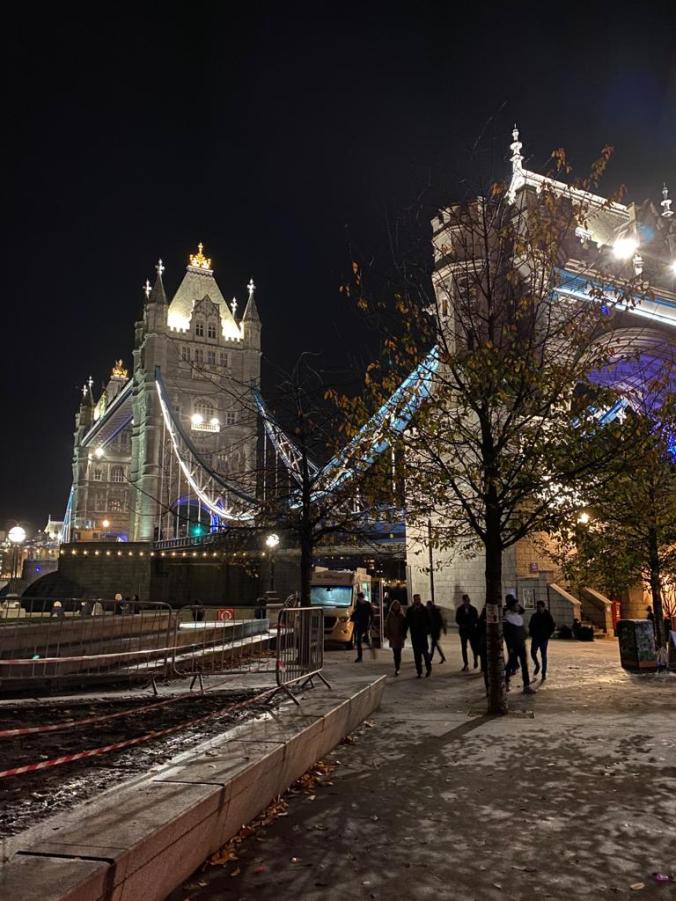
Tower Bridge. Photo by WSM

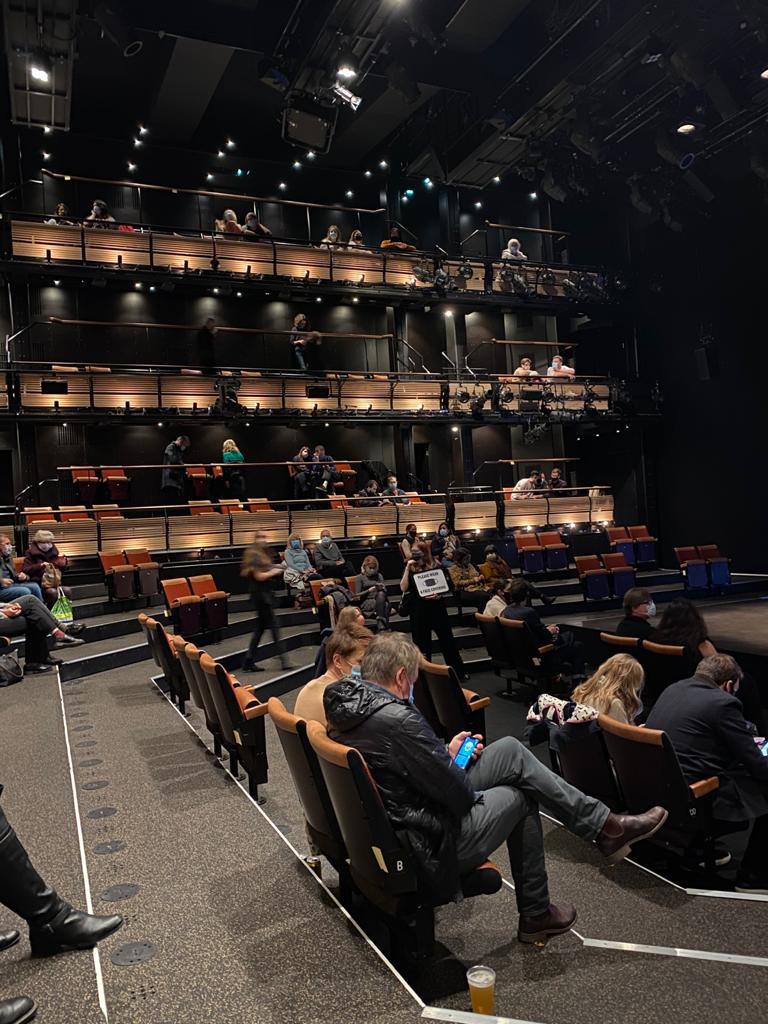
How wonderful it was. And how brave. The Bridge Theater shines as a beacon by the Thames River and is looked down on by Tower Bridge. Across the river stands The Tower of London. Old and New London within a cricket ball toss of each other. The entrance doors of the theater are open, we have a window of time within which to arrive. Masked attendants guide us through the temperature check, check our tickets and show us where to go. The loos are easily accessible. The theater seating looks as if it has been prepared for an orchestra, so many seats are missing and spaced apart.

Getting Settled at the Theatre. Photo by WSM

More staff come by for bar orders, another holds a glowing “Please wear a mask” sign and – if someone leaves their mask down for a chat beyond a sip – gently goes to remind them of their collective responsibility. The mask notice supplanting the ‘please turn off your cell phones’ message. At first I wonder, what on earth is it like to perform to such a sparse house? Does it feel provincial, like stepping out on the boards for the first time, trying to make your way in a flea-bag pit. But this is not that and soon after our ginger-beer drinks arrive the audience buzz begins. It is the same hum of excitement the same music of expectation, as if the audience is indeed in the orchestra pit and tuning up as musicians do. The hum grows, but then – the lights dim – and a hush comes over us all. 

Ralph strides onto the stage and loudly places his props on the table, claiming the table and the props as a supporting cast. He is the magician who will hold us in David Hare’s mind with his fears of the disease, his anger at the government’s handling of it all, and his heart’s rage at the treatment of the NHS nurses. He longs for a gentle ‘Platonic disease’ while later realizes that “The Virus is always with me now.” The septuagenarian is there, twisted in Ralph’s body now sinewy as a maturing cockerel.

Under the London Bridge Photo by WSM

When the play was over, the applause was wondrous and we left the theater uplifted as art moves us, brings us closer to each other. As the audience goes their separate ways, we share that communion and feeling of belonging within this city.

Under the night lights we walk along the river finding our way back to the little enclave of Primrose Hill. It is time to try out the newly opened Albert pub for a half pint of cider and an elegant Ploughman’s supper bowl. It has been too long since I’ve crunched a pickled onion. 

This has been A letter From A. Broad.

Written and read for you by Muriel Murch

Not Fit for Purpose

Recorded and knit together by WSM
Aired on KWMR.org June 17 2020

After three months in lockdown it was time to venture beyond NW1 deeper into the city at West 2. My audiologist was working through his waiting list of patients and my name came up. With two small children at home, he was, frankly, happy to be working.

“The 274 bus will take you to Marble Arch and then it is a five minute walk.” But running late I hailed a taxi. The cabbie kept his windows open and I my mask and gloves on. Late but not too late, I followed Mark into his back room wondering how is this going to work. But the appointments are spaced 15 minute apart to clean the rooms. He took a brief history and looked at my old aides, trying to hide his amazement.
“These are 9 years old.”

Into the box I go and testing begins. The spacing between beeps is far too long. This is not good. Nor is his final verdict, “You might want to tell your children. And these,” he concludes looking again at my old friends, “are no longer Fit for Purpose.”

He sets me up anew and I will read the directions several times to get the best out of my National Health aides. My fingers are crossed and my glasses adjusted hoping that these new friends will ‘See me out.’

Not Fit for Purpose. One thing to say that about an old, but still working, appliance, but a little different for a person.

Though stooped low with osteoporosis, Howard still walks as if about to run. Under his scruffy black cap his sparse, long hair flows behind him. Howard was a fine tennis coach in the small sports center at the north end of Regent’s Park. There were four tennis courts, a golf practice range and cricket nets. But a fresh administration, a clean sweep with a new broom, and the golf and tennis areas were cleared away to increase wilderness for the hedgehogs. A catering hub was built overlooking the newly laid out cricket and football pitches now there was money saved and money earned.

The little tennis club at the other end of the park grew, attracting sweet young things and handsome jocks. And the staff had to fit that look. Howard and his Russian friend did not make the cut and his friend was so devastated he committed suicide. Howard manfully struggles on. Now as his knees and heart age he often stops to rest on his hurried walks back from the village. In this coronavirus loneliness he feels keenly ‘Unfit for Purpose’.

George Floyd’s murder has brought much of the world to attention and the last two weekends in England have been marked with protest marches for ‘Black Lives Matter’ and the BAME communities. And once again the protests have been mucked about by nationalists looking for a good ‘bust up.’ There is no football, no beer and few jobs. Ironically, Nazi Nationalists are seen defending Churchill’s statue while a very buff Patrick Hutchinson tosses an older white skin-head over his shoulder, because, as he said, ’He was separated and needed to get back to his people.’

Patrick Hutchinson rescues a white nationalist Photo credit the Wimbledon Times

When Edward Colston’s statue was pulled from his pinnacle in Bristol, graffitied, today’s version of tarred and feathered – then rolled and tossed into the harbour from whence landed his slave trading fortune, people began to look around. Who else glorified a past built on the enslavement of others for the enrichment of trade? Even Oxford University faced its mixed messages of Cecil Rhodes and Nelson Mandela. “We are going to have to work together now you and I” Mandela said to the statue when he set up the Mandela Rhodes Trust in 2003 to help heal racial divisions.

In London, Winston Churchill’s doomed statue stands on Parliament Square. One weekend graffitied and the next – to protect and possibly buy time – he was boxed up. One couldn’t help smiling – just a little – at the irony of this move. Boris Johnson huffing and puffing that his hero Winston Churchill had to be put in a box and that Sadiq Khan, the son of a London bus driver and now major of London after Boris, was the one to do it. Surely even Boris might have a glimmer of understanding that these statues, even that of his beloved Winston, might now be considered Not Fit for Purpose. This week’s attention is on Clive of India – another dastardly (the word fits) fellow, who is tucked away in Whitehall.

But how do we remember history? How do we teach it, respecting what was good while acknowledging the mostly unrecognized, unspoken atrocities that each and every country inflicts on those who stand in their way or from whom they can benefit?

Typically Johnson has proclaimed ‘A committee will be formed to review race relations’. Some in government will laugh and chuckle, while those in minority communities across the country will weep with resignation at this announcement. Reviews after racial incidents have been happening since race relations began to overtake class inequalities in import. It has been hard to track the snail’s pace of change in this country. But maybe this can be the time, as families from the countries we have plundered march and kneel together, to keep pressure on this government to look again, not only at the statues but in the class-rooms and work to do more for an England that is ‘Fit For Purpose’ in today’s world.

This has been a Letter from A. Broad, Written and read for you by Muriel Murch