A Dog’s Dinner

Written and Produced by Muriel Murch with WSM by my side

The dictionary defines A Dog’s Dinner as ‘A situation, event, or piece of work that is chaotic, badly organized, or very untidy.’ Such as when an unschooled dog gallops into the scullery for his bowl of specially formulated dog food moistened with a little water. It is gulped down in a flash, the bowl knocked about noisily until it hits a wall. But then there is a pause as his tummy swells. A burp is followed by a belch before up comes dinner again, now glistening and sticky with saliva and the first tentacles of stomach acid. The dog looks puzzled wondering what happened but then he spies the food, all over the floor and with excited tail wagging, eats it all up again. Only a mop and a big dose of disinfectant can clear the damage away. 

This is the image that comes to mind after Suella Braverman’s published remarks that homelessness was a lifestyle choice. As Rishi Sunak sent her back to her kennel he had to reshuffle his cabinet once more. Even the newspapers had to print charts with pictures of who has come and gone and where to. We watched – soon to be Lord – David Cameron stride back into Downing Street, knock on the door of number 10 with his tail wagging as he tucks into the mess of Brexit that he created. It looks to be a dog’s dinner all over again.  

On November 14th King Charles celebrated his 75th birthday by popping into a food bank between holding a couple of tea parties for people and organizations that also turned 75 this year. A tea dance was held in Dumfries House and then more tea was served at Highgrove with members of the Caribbean Windrush generation, nurses and midwives from the NHS. This week, The Big Issue, a weekly magazine sold on the streets by homeless vendors, has The King on the cover highlighting his Coronation Food Project, launched on his birthday. The King is quoted – saying that “Food need is as real and urgent a problem as food waste,” …. “If a way could be found to bridge the gap between them, then it would address two problems in one.” It seems to take a football player like young Marcus Rashford of Manchester United and a King like Charles the Third to steer this ship into a clearer lake of fresh water. 

On Tuesday, we left for Poland and the Camerimage International Film Festival in Torun. It takes a full day of travel getting to the festival and we were only traveling from London. Cinematographers, manufacturers, filmmakers from other disciplines with films come from around the world. It is a  jumble of festival and trade faire, a little glamor and a lot of graft for the craft of cinematography. We gather at breakfast, the same as on a film set, such is the comradery of international filmmakers.

The plane landed in Warsaw and the afternoon light stayed for the first hour of the two-and-a-half hours it takes to drive to Torun. Leaving the city there are single-gauge railway tracks that emerge and disappear in and out of the paved road. They are old, disused but along with the tree-covered mounds of larch, silver birch, and pine that cover the detritus of an ancient war, a chilling reminder of the wars past and present. The city names of old wars are now joined with new place markers that move traveling east into Russia and Ukraine, and then south with the eruptions in Jerusalem, Gaza, and Palestine. 

The city disappears giving way to bare winter fields. There is very little green left to harvest, only tall dried-out corn to be cut for livestock. As we pick up speed, the farmhouses appear small, even tiny, most look old and decrepit. There are no lights shining to welcome a farmer home from the plow. As we drive north a storm is crossing Europe and for those moments that we are on the open barrier-less road, the raw wind beats across the motorway making this all-electric German limousine slip and tremble and the windshield wipers pick up speed.

We settle into the hotel with memories that slowly come back to us. Beyond the window the river flows fast, the current pushing and pulling fallen trees into the mud. There is no shipping. The countryside is bleak this far north in November. Even though it maybe earlier in the year than our previous visit winter feels like it is coming sooner. 

Here is Copernicus

Walking into the old medieval town we pay homage to the statue of Copernicus. Torun is not a big city but as Copernicus’s birthplace it is rich in history and over two million people come to visit each year. Some come for astronomy, Copernicus, science, and some for this festival. Walter is here to join Professor of Astronomy, Leszek Blaszkiewicz in a moderated discussion on ‘Copernicus, Dreamers, Inspiration and Science.’ Held in the beautiful old Camerimage Cinema, the audience is primed and happy to hear, think, and discuss such things. After the talk is over they linger and some have already brought with them the beautiful Golden Book on Walter’s Golden Ratio exploration that the festival produced. The days are busy although we don’t get to see one film. 

Mateusz Józefowicz moderates Walter Murch and Leszek Blaszkiewicz in conversation on Art, Inspiration, Science, and Dreams.

On Saturday as we walk over to the main building for the closing ceremony and awards event, dusk has already busied herself with night and the street lights proclaim it is winter. The big theatre has filled up early and fast. The ceremony begins and is almost all in Polish though there are head-sets for translations and it all goes along easily and quickly. The Golden Frog is the symbol for this festival, with tadpoles for the rising stars of cinematography. Each film festival has its symbol, Berlin has the bear, Locarno a Leopard, Venice a Lion, and of course, it’s Oscar for Hollywood. While the Torun festival celebrates the art of Cinematography it is also a huge trade faire. It is overwhelming to see the equipment. The festival also acknowledges the other disciplines and those who – within their fields – carry a particular understanding and integration of cinematography and their own discipline. Walter brought his frog home in 2015 and it sits sweetly and discreetly on a bookcase shelf here in London.

The last award is given and the festival director returned to the stage for his closing remarks before beckoning a line of assistants to file in behind him, and then another line and another, and – as we rose to our feet – he has assembled everyone who made the festival happen on stage. It is the first time we have seen such an acknowledgment from a festival and it seems fitting that it should occur here where the emphasis has always been on the heavy lifting that it takes to be a cinematographer and to make movies. The yellow-vested stage hands arrive carrying three sofas and the recipients of this year’s gold frogs and tadpoles come to sit alongside those who have made this year’s festival possible and still the full audience is on its feet acknowledging that just as Copernicus wrote in his revolutions, we are all like the stars in the heavens and the universe beyond,  elliptically revolving around each other.

Brava and thank you to everyone who made this 31st Camerimage possible.

As we walk back to the hotel we can see our breath and the sky prepares to scatter the first flurries of snow. The final party is going strong but we are too old for that and even in flat shoes my back hurts. At the bar, we sit among those who would rather drink and talk than stand and shout, enjoying a glass of wine and a bowl of Polish soup. The next morning camp is broken and the lobby is full of puffer jackets, wheeled cases, and fond goodbyes. We have barely left the city when a huge owl swoops down across the car, just three feet in front of us, and with wings unfurled for balance, he nails his meal of young bunny on the snow-covered grass beside the road. We drive on past the mistletoe-encrusted trees, the wind turbines emerging from the fog where acres of bare apple and pear fruit trees, red and black currant bushes are already dormant, preparing for the winter ahead. We quietly understand that life in this corner of the world is not easy for those who live here.

This has been A Letter from A. Broad written and read for you by Muriel Murch

Sports Day

While America celebrates its independence on July 4th, here, this year, the not so Great Britain held a day of Thanksgiving to the National Health Service that turns 73 years old this week. And so for the first five years of my life all forms of medical care were paid for out of pockets that were mostly empty after the war. Being a country doctor could have made the difference between the doctor’s family eating well or not. Creating the National Health Service was one of the best things this country every did and for a long time it worked very well. But as science began to overtake the art of medicine, the economic equation became crunched and now the NHS looks like a proverbial cow-pony that has been ‘rode hard and put away wet.’ After these long months of COVID crisis, that are not over yet, many of the medical staff are exhausted and early retirement numbers are high. Johnson’s government will be hard pressed to patch the holes in this beaten war ship. The Queen awarded the King George’s Cross to the entire organization, done so with a handwritten letter, on Windsor Castle note paper, a gesture that is genuinely heartfelt. However a July 4th ‘buns and bangers barbecue’ with Boris in the garden of number 10 for some regional health administrators is an ill-fitting band-aide and will not make up for the 1% pay rise on offer for the staff who remain constantly underpaid and overworked.

The Base Line (Photo by WSM)

The school year here ends in July with sports and speech days and the summer sports season is on us. For a few brief weeks England will not care so much about what happens in the rest of the world but will look instead to the global sport stars. England may no longer have a contender at the Wimbledon World Tennis Championships it hosts, but the international players are thrilling to watch. So when the email came through ‘would we like to go to Wimbledon for a day?’ the answer was quick, ‘Yes Please’. 

As Sam, our driver, talked us through central London on a Monday morning it seems as if the city is slowly, cautiously returning. The Mayor has been busy making bike lanes much to the frustration of our driver. Sam tells me that there is now a shortage of truck drivers, those men who would slide through the tunnels from Europe to the UK and back again have gone home, and produce from the farms of Europe and England are in trouble.

But not the English Strawberries. For it is strawberry season and before the afternoon matches our hosts have a luncheon prepared. There remains a strict COVID protocol in place to follow that we have managed, and are given our COVID certificate wrist bands. This is an interesting table group for us, we are the only members of the arts’ arm of the very large Rolex family. There is a Harry Charles a young showjumper who, with his pal is enjoying a day away from the barn, but on whose shoulders rests England’s Equestrian showjumping dreams. The other men are older, all still at the top of their games. We are in heady company which finishes with the traditional strawberries and cream and good coffee. As we leave the salon we are handed new hats, seat cushions and water and as always, a lovely young masked Rolex guide shows us the way.

Center Court 1/4 finals on Manic Monday (Photo by WSM)

Seated, under cover but in the fresh air, I find that while I am surrounded by Gucci and Botox and more than a handful of Rolex wrists, there is kindness and laugher all waiting for the first match of Manic Monday. As we settle, the ball boys and girls run in and kneel in their navy shorts, line men and women march in, hanging their jackets up and bending over their knees closer to the line, now the umpire sits alone high up on their perch watching, listening and calling as the game begins. The number one player, Novak Djokvic against the Chilean Cristian Garin. The ladies played next with young Coco Gauff from the US putting in a good game with German Angelique Kerber. Then it is time for the Swiss Roger Federer came out with Italian Lorenzo Sonego. The ages of the players, the young pushing on the old add a grip to the excitement. The games unfold quickly and we watched seeing the mistakes that we all have made fast out-numbered by the brilliance we never achieved. Skill, experience, age, temperament and the weather all play their part and I wondered if this would the moment that the old would fall to the young. Thankfully they have held, for at least another year. For tennis is very gladiatorial.

In the summer of 1964 somewhere in Spain we went to a bullfight. It was not a big town, nor a famous fight, the tickets were cheap and we went knowing we might never see this again. It was as fascinating and heartbreaking as I had feared. Six bulls came to fight in the evening’s match. There is protocol, there is blood and death and also in a hard to understand way, honour. The afternoon gave way to the evening, the sunlight gave way to cloud-covered skies and then the rain poured down. The spectators groaned and roared at the skies and then, as quickly as they had come, left the stands but the bulls, the matadors and picadors all remained, and so did we. It seemed the least we could do, to stay, watch and honour the bravery however needlessly it had been shared and spilled.

This has been A letter from A. Broad

Written and read for you by Muriel Murch

First Aired on Swimming Upstream KWMR.org

Web support by murchstudio.com

Coming Home to Roost

A shout out for KWMR.org. This post is going out a day early so that those of you who listen or read have the opportunity to support KWMR.org. Letter from A. Broad is aired every Wednesday at 9.20 a.m Pacific Time. Usually I post the show on this blog, Face Book and Twitter after it has aired on KWMR. But today/this week you have the fantastic opportunity of supporting Community Radio by just clicking the button below. Whatever you decide, thank you for listening and reading and staying tuned. MAM.

Recorded and Knit together by WSM
The bantam rooster Little Richard and his two wives in 2009
Little Richard and his two wives in 2009

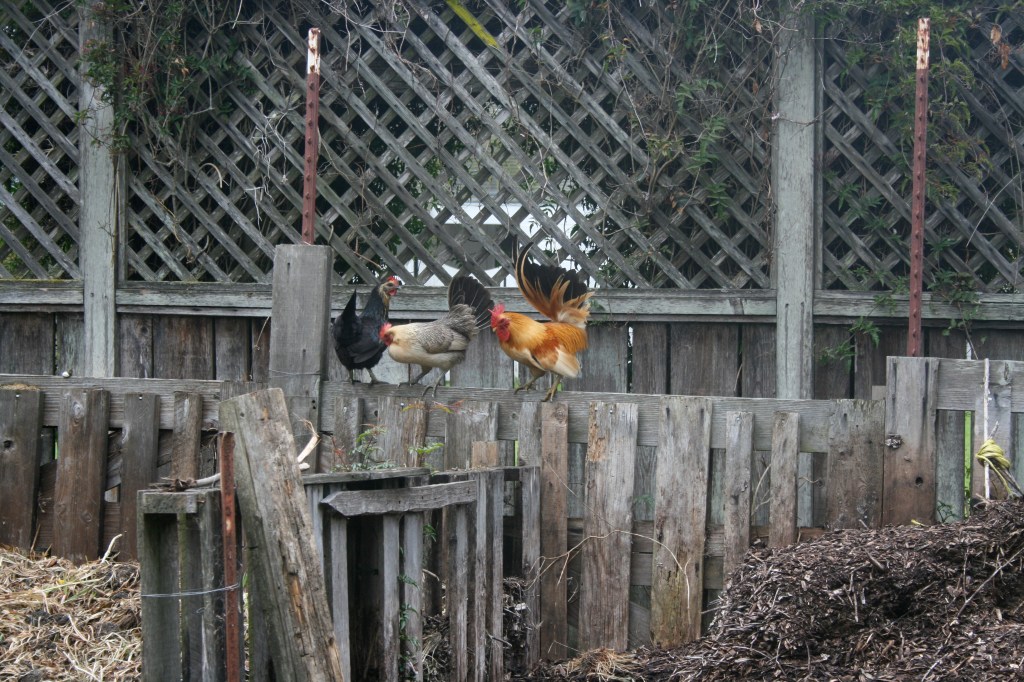
Every rooster who’s lived on the farm had a distinct personality. But none was as independent as Little Richard. He was a small Bantam Rooster gifted, as we do with roosters, by friends – so in a moment of weakness, one Sunday afternoon we drove back down Spring Mountain Road with Richard and two wives. Richard quickly decided that he was not going to live in a chicken coop when the wide world was waiting. Instead, he roosted with his ladies on the high stall walls in the horse barn where, like his namesake, he crowed and sang through the pre-dawn hours of the morning. It was too much, and so I took him up into the hills to fend for himself. After all, he had shown an independent enough spirit to outwit predators at least for a while. During a torrential rain storm two days later, as I was finishing chores in the barn, Little Richard came strutting in – dripping wet, a little battle-weary maybe – but still strutting. He walked with a look of righteous indignation as he came home to roost.

Indignation is what I feel now. For weeks we have been looking outward at the police and military’s clampdowns on protests in eastern Europe, Belarus, Moscow, the Far East in Hong Kong, and Myanmar but now protests are happening in Clapham and Bristol!

A vandalised police van on fire outside Bridewell police station in Bristol. Photograph: Andrew Matthews/PA

I look back in anger or is it despair at how the two bombshells of Brexit and COVID-19 that have hit the UK have been handled by three Conservative Prime Ministers. None of whom liked or respected each other as they handed on the baton of government.

Before we began to really come to grips with what Brexit would mean for England, along came COVID-19 like a low-lying fog that seeped into the walls of our homes, work, and all aspects of our daily lives.

Now fingers are pointed at other countries as new variants naturally arise to name and shame the country of their seeming origin. And – dare we say it – if Brexit had not happened many discussions of travel bans and governments hoarding stashes of vaccines might not be taking place. The British cry, ‘When will we get out of lock-down? When will we be back to Normal? When can we go on holiday?’ as those thinking it is their right to escape the dreariness of an English summer by climbing aboard an EasyJet, emerging into the Spanish sunshine, and oozing out onto the warm beaches. 

But hold on. The great big British rollout of vaccinations is making a real difference on the numbers of COVID-19 infections and serious illnesses. There is breathing space in the Intensive Care Units of the NHS hospitals. While there is tentative talk about the nine most vulnerable groups getting their second vaccinations, there has been a pause on vaccinating those under 50 years old, leaving young men and women, with energy to spare, and often distanced from the immediate pressures of Covid, frustrated with now mounting anger in need of an outlet.

They know that Boris will not listen to them. The Home Secretary, Priti Patel, who has so far successfully clawed her way upstairs, misstep after misstep, apology after apology – only when necessary – has sought to bring greater control for the police force anyway she can. After the events of last weekend when the Metropolitan police crowded in on those women gathering at the Clapham Common band-stand in a vigil for Sarah Everard, she saw another opportunity. Some of the police that night carried a mixture of sympathies; for the protesting women, shame and guilt that the reported perpetrator of the murder was a Metropolitan police officer, and confusion at the messages from Government to the Met. Frequently Priti Patel causes more problems than she solves. Now she is grabbing this time to try and push through a bill that would give the police in England and Wales extended powers to impose heavy fines or prison sentences on non-violent protesters who are considered ‘too noisy’ or are ‘creating a nuisance’. Naturally, this is an alarm bell for those who are vigilant to government behaviors but whose only access is to the police forces acting as a river running against the tide. 

Upstream and downstream swim the fishes, First Minister of Scotland Nicola Sturgeon and her mentor and predecessor, Alex Salmond, as they battle out who said what, who promised what, or didn’t, regarding Salmond’s trial for sexual harassment of nine women. In the redacted report James Hamilton, the independent legal advisor exposed a clear situation when the law gets in the way of the truth. In his cover letter to his report he writes, ‘that the removal of sections of his report by the government would lead to an incomplete and even at times misleading version of what has happened.” Reading between the lines may be the only way to glimpse the truth of this affair. The Scots are good fishermen and good fishermen have a lot of patience. This fish has not yet been reeled in and landed. 

James Hamilton, the independent legal advisor
James Hamilton

In 1697 William Congreve wrote ‘Hell hath no fury like a woman scorned” in his play “Mourning Bride” but the Scottish minister Alex Salmond seems hell-bent on the destruction of his protege Nicola Sturgeon, whom he may feel is under an obligation to him – a situation a smart woman will try at all costs to avoid. For all his shouting and crowing, Alex Salmond may not find his way home to roost.

This has been a Letter from A. Broad. 

Written and read for you by Muriel Murch 
First aired on Swimming Upstream – KWMR.org

Web support by murchstudio.com

Sunday Snow

Recorded and Knit together by WSM

It is almost time to mute Andrew Marr on Sunday mornings. The program is getting upsetting, not so much in the content but in the sharp delivery, so early and with breakfast on the sofa, and it is not good for digestion. When there was art, cinema, and theatre to discuss, Marr’s tone would soften and he would be coy like a schoolboy in a candy shop. But the politicians do not move him in the same way, while now some are figuring out how to defuse him. “Call me by my Name” is a book and a film of love, and to call Andrew by his name somehow takes a touch of the wind out of his sails. Matt Hancock has begun to do it, but it works best with the Shadow Foreign Secretary, Lisa Nandy, or Annelies Dodds, the Shadow Chancellor of the Exchequer, and best of all, with Nicola Sturgeon, First Minister of Scotland. They have also learned that other trick, to keep talking, and not let him interrupt. It takes practice and breath control and would be funny if some of the topics were not so serious and pertinent to our daily lives.

Matt Hancock is still working from his home office and needs to close the kitchen door. But there is a rare smile on Hancock’s face as he recited the rising numbers of those in England who’ve had their first vaccination, including 80% of those over 80 years old. But like the working terrier he is, Andrew has his nose on an important question. Originally the scientists recommended that the two doses of Pfizer/BioNTech and the Oxford University/AstraZeneca vaccines should be given three weeks apart for the maximum benefit. But now politicians and their statisticians, say actually no, the doses can be given up to twelve weeks apart. It seems some serious number-crunching is going on, trying to lower the number of people who would get sick enough to require hospitalization and further burden the National Health Service. But today, as the UK death toll from the Coronavirus tops 100,000, there leaks news of petty behavior from Boris Johnson to João Vale de Almeida the ambassador sent to represent the European Union in England. This rolls back to past behaviors and slights between brief-cased men and women over the last painful years of the Brexit negotiations and now rumbles on into questions of who holds how many doses of which vaccine, manufactured and stored in which country, and who is going to share, what, when.  

Boris Johnson in Trouble
The Independent

This brings back a shadow remembrance of the Ford Pinto number-crunching that went on from the 1970s to 1980s. After the gas tank misdesign was uncovered and Mother Jones published ‘The Pinto Memo’ that said the cost of recalling the cars would have been $121 million, whereas paying off the victims would only have cost Ford $50 million. ‘It’s cheaper to let them burn” in ‘the barbecue that seats four.’  For the moment the UK Government, The European Union, and medical scientists are at odds, as they wrestle with the numbers that may not be, how many lives will be lost, but whose.

The situation with the COVID-19 virus, vaccinations, questions about schools remaining closed, and with no end in this degree of lockdown in sight, have pushed even the American political changes under President Biden onto page two. News of other nation’s pandemics and war deaths are barely covered as if the continents of South America, Africa, and India are too big for us now to comprehend and explain.

Coverage of the protests in Belarus has given way to those in Russia over the arrest of Alexei Navalny. Before Navalny left Germany he made a video film, “Putin’s Palace: The $ Billion Dollar GRIFT” in which, at almost two hours long, Navalny also narrates in staccato bullet-point sentences. It is an amazing piece of work, gathering all of Navalny’s research over the last ten years as well as help from those who also see that things are not as they should be in Mother Russia. By the time Navalny returned to Moscow and was arrested, the film was already available to anyone on YouTube, and, at this point, remains untouchable by Putin. Even as the temperatures are well below freezing in Moscow, St Petersburg, and other Russian cities, the outpouring of demonstrators has filled the city streets and the protesters arrested number in the thousands.

The Russian police look like plated armadillos as they take on the protesters. The chain-mail effect as iron gives way to the sturdy plastic of their interlocking shining plates harks back to Tudor England and copied from the ancient armor held in the museums of Europe.

The harshness and speed of the clamp-down has been so severe that Western countries are ‘considering their next steps,’ as they watch Putin and the Kremlin close the fist of authoritarianism.

Back at the kitchen sink after our morning dose of politics, I look out of the window and the sky stares back at me. “Watch now,” it seems to say, and then slowly, thick drops of moisture begin to fall and, as they gathered in strength and courage they grew bigger, fatter, and fell covering the pavement, the cars, and shrubs outside with a solid blanket of snow. The old words return, none are better: solid blanket, silent night, or, in this case, day, as the snow fell for a sweet two hours, and we smiled with childlike excitement to see it so. Young Charlie fox padded softly by, paused at the window to look in on us before continuing his morning hunting rounds.  

Charlie Passing By Photo by WSM

This has been a Letter from A. Broad. 

Written and read for you by Muriel Murch First aired on Swimming Upstream –KWMR.org

Web support by murchstudio.com

Covid, Cummings and Crying with Clive

Recorded and knit together by WSM. Aired on KWMR.org

Tear it all up and start again, as every night gives a new twist and the morning brings another reality. Thus this letter too may arrive as if receiving the papers on board ship and reading three-month-old news.

A notebook behind my desk opens to a page, ‘Nobody Talks to the Cleaners.’ A friend returning from her hospital stay remarked how she always made a point of saying ‘Hello, how are you?’ to the lady who came to clean the ward. When cleaning and other auxiliary hospital needs were contracted out – separated from the National Health Service – little fissures had a place to enter a smooth team of personnel. This essay was still waiting to be written, when Clive Myrie beat me to it and I am grateful.

Clive Myrie Somewhere.

Born to Jamaican parents Clive is a Lancashire lad. He graduated from The University of Sussex with a Law Degree at the age of twenty. But he chose to enter a BBC graduate program, thus beginning his journalist career. Traveling to over 80 countries, covering far too many war zones, he is now a regular news reporter for the BBC.

I always like to see Clive. Each news reporter has a different persona and how we respond to them may affect how we take in the news they are sharing. Even in his prime John Simmons was always too ‘old school’ for me. Jamaican born Sir Trevor McDonald barely hid his bite and made many folks sit up a bit straighter. Beloved, comfortable Welsh Huw Edwards has an aura of stability that sometimes also carries just the tiniest edge. And the women, well bless Emily Maitlis and her clarity last week. Though she was curbed she was not arrested. But I see compassion in Clive Myrie’s eyes. Scrolling through photographs I am held by one where he is standing with a guard at Guantanamo Bay prison with his fingers on his mouth. What was he thinking? What could he say?

Last week Myrie produced a special assignment closer to home. With permissions from patients, their families, and the staff, Myrie and his team spent a week in the Royal London Hospital of Whitechapel, recording the care, successes and sorrows of the hospital’s Covid virus wards. He sought out and talked with those beyond the front-line student nurses, religious leaders of all faiths, owners of funeral homes and morgues filled to overflowing with the dead of Asian and African communities hit the hardest by the virus, and the cleaners. “We clean to reduce the infection. If I don’t come the infection is going to spread more.”

In his report Myrie said ‘So many of the nurses and doctors and consultants as well as cleaners, the helping hands guiding us through this storm, are Black, Asian and Minority ethnic. Somewhere deep down, my heart skipped a little entering the Royal London’s Corona Wards. Because studies suggest that those from these communities are being affected by the virus disproportionately and almost twice as likely to die from the infection than those who are white.’

Meanwhile up the road in number 10 Downing Street ‘The Dominic Cummings incident’ is being fast swept under the not-so-magic carpet as the bitter pill of betrayal still lies un-swallowed in the mouths of many in this country. The goal of keeping the death rate at under 20,000 is long lost and the number of UK deaths will reach over 40,000 by the end of this week.

In America too those effected by the Corona Virus are disproportionally African-American and working class. Like England, security guards and workers on public transport are at the highest risk for severe infection and death.

The news from the United States brings tears of frustration, anger and deep sadness. For now – again – the senseless death – at police hands of George Floyd. I’m remembering Rodney King, I’m remembering and not calling to mind those who have been killed in the same way before and since that time. Watching the US police forces I think back to when the old ‘cop cars’ were replaced by military SUV’s returning from Iraq. Weapons came with them, bigger and more powerful guns, man-toys. Esquire writer Charles Pierce reminds us “that since 9-11, the federal government has equipped local police with $4.3 billion in military gear and prepared them for an all-out war on terrorists.” And some useful combat techniques. Jim Cessford, who has spent 47 years in law enforcement, says ‘knee to neck’ is not a tactic. “Neck restraints are totally unacceptable and they’re not an approved policy by police.” But on Twitter, the Palestinian Solidarity working group wrote: “US cops train in Israel with Israeli troops on duty in Palestine. The police violence happening in Minneapolis is straight out of the IDF playbook.”

There is anger, tears and despair aplenty among the images across the all the news media formats. There are scenes of peaceful protesters, rioters, more looters, now that the American unemployment rate is 14.7%, alongside groups cleaning up and feeding their communities. New York police wearing ‘I can breathe’ face masks, countered by other New York Police and politicians and even National Guards kneeling with, and reaching out to, protesters. Thus is the divide of the United States of America made visible to the world.

George the Poet, on Newsnight explaining a little about Racisism in the UK

Last weekend in capital cities throughout Europe groups gathered in peaceful protest of this ‘fresh’ killing. In London, marchers gathered in Trafalgar Square and the US fortress Embassy in Wandsworth. Though Social Distancing was out the window, most of the young marchers wore masks. There were only 23 arrests and the London coppers, without a mask between them, clutching only their water bottles in the heat, walked calmly side by side, with the marchers. George the Poet came to Newsnight and spoke in a gentlemanly manner trying to explain to Emily Maitlis the chilling similarities of black men and women killed by Police tactics in the UK and the U.S.

When Martin Luther King was assassinated, The King Assassination Riots, known as The Holy Week Uprising took place in 125 cities across America. America is again bubbling like a cauldron brewed and spread from the swamps of its underbelly. If the ‘Me too Movement’ which Maitlis referred to, was able to bring down Harvey Wienstien is it too much to ask that ‘Black Lives Matter’ maybe the Trump card America needs today.

So I return, retreat maybe, to James Baldwin, watching again his 1965 debate with William Buckley at Cambridge University.
“Has the American Dream been achieved at the expense of the American Negro?”
One could now add, “Among others.”
At night I reach for Baldwin’s ‘Collected Essays’, seeking clarity but not comfort.
In the background Nina Simone is banging on the piano and singing
Mississippi Goddamn – over and over again.

This has been a Letter from A. Broad.
Written and read for you by Muriel Murch.