Decisions

Decisions,

Written and read for you by Muriel Murch with WSM by my side

It started with relentless knee pain that would not go away and it was time to see a doctor. Mr. Mazin Ibrahim took one look at my walking and, with experienced confidence, says. “It’s not your knee. It’s your hip, it’s completely worn away and here are the X-rays to prove it.”

It was a slow dance, back and forth, a cortisone injection to the hip, an appointment with a fantastic physical therapist, another determination to lose weight, and for a month or two the cortisone worked – until it didn’t. The pain returned and with it the realization that it was time for ‘The Decision.’ As I begin the emails, phone calls the explanation of schedule, the booking, the payments and the appointments, I have to accept I am on the other side of the nursing desk. Each time I said “I am a nurse too” I can see my nurse dance partners take a deep breath and guide me to their agenda. As Mibaba, the diminutive Philippine nurse, goes through the detailed admission her voice lifts with a musical “Mam” at the end of each question. Before she is finished, she is asking for a full report from my cardiologist. There is no stone this young woman left unturned. Eventually satisfied, she leads me along the corridor where I see a pair of leather-shod feet which I know, just by the way they are pointed, belong on the end of long legs. Mibaba introduces me to Desmond, from Essex and Uganda. He is tall and, as an orthopedic specialist nurse should be, light on his feet. He has seen it all before and fielding my “I’m a nurse too,” slipping into the nurses’ banter and humor. He is laughingly professional with deep knowledge and warmth and we exchange phone numbers. 

It’s a 7 a.m start as we arrive at the brightly lit entrance to the Princess Grace Hospital. A cheery Scottish receptionist checks me in, all my paperwork and payment is in order. In the reception area we are joined by other couples. One by one, we are picked up by out admitting nurses and taken to our own private rooms to change… Walter helps me settle in, and himself to the waiting ahead.
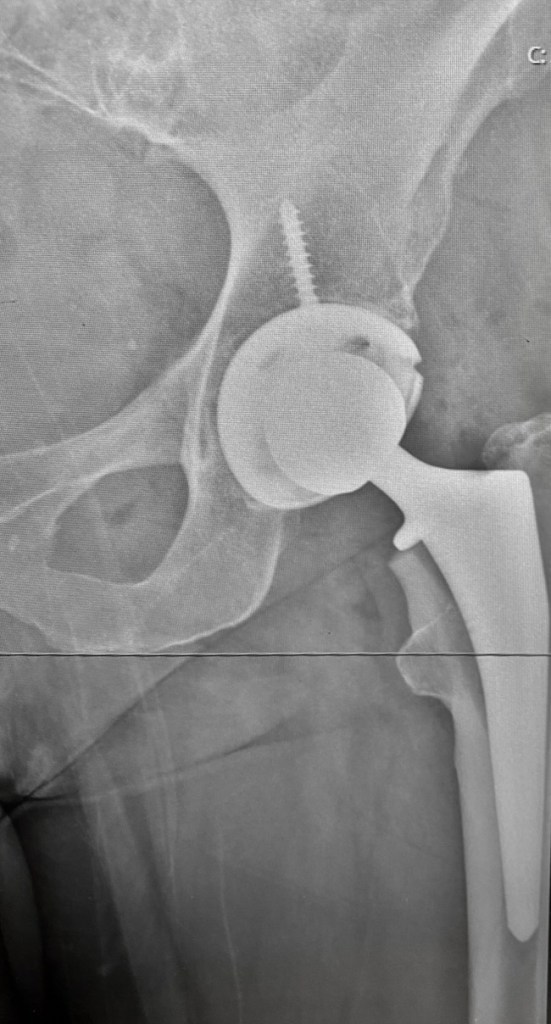
And it is in. That seems to be a real screw in there!

Two attendants come with a gurney and I am slipped onto it. The basement is where the action is, the corridor so narrow that there is only room for one gurney at a time – one in, one out. The door to the surgical suite is open and two men are still mopping the floor as we wheel on past them to a blunt-nosed tiny tool shed. There is just room for the gurney to slide in, with the tool benches all around. “Anesthesiologist” He shouts at me through his mask while pointing to the words on his cap. There are two of them, both Indian, both male, doctor and nurse, a team dancing together as they prepare their next patient for the umpteenth time. Sit up, legs over the edge of the gurney and, cradled in the safe arms of the young nurse who holds me as the anesthesiologist calls out, “Don’t move. Be still”. Now this gurney is wheeled into the newly cleaned and mopped surgical suite. There are fresh big blue containers of sterile equipment, the all-male team also clothed in blue, among them is my surgeon, ready to help hoist me from the gurney onto his table. ‘Wait” I want to say, “I haven’t lost enough weight.” Then an oxygen mask covers my nose and mouth and I’m out.

Back in room 312, Walter is waiting. He sits quietly, watching over us all as I look at my numb legs in my big diaper, “better than a catheter” and I have to agree while watching and participating in the incredible disposable waste that clogs our planet. Day moves to night and back to day. Walter walks across the park from home to hospital and back again. Nurses and therapists, their voices blending in a symphony of all those who make up the serving faces of England today, come and go. Dawn is late while, carefully watched, I get up to the bathroom and wash before a reasonable pot of tea shows up at 7.30 with breakfast. My bladder is working unaided – for which I am truly grateful. As a liquid laxative is washed down with an oral suspension of Morphine I am dimly aware that they might not be the best of dance partners. It is not until the next day when Saturday’s supper returns with a vengeance that everyone gets serious about those absent bowel sounds and my discharge is postponed.

The beginning.

The physical therapist pops in to tackle up and down stairs, and so we go up and down the stairs with no problem until the last dose of morphine kicks in and I slide into a chair. Well if this is a way to change this dimension for the next – it’s fine with me.  

Then home, bags of drugs, wise unheeded words from the nurses ‘Don’t let the pain get ahead of you’. And I leave the safety of their care. The world of nurses, these are the voices I want to hear. Melodious, musical and on the brink of laughter if you are someone who would let that in.

Back at home there is warmth by the fire, a kind and willing helper for all things, those exercises to be done and the pain iced away. Walter is ever-vigilant as friends come bearing meals. With such care it takes only a few days to accept that this was the right decision and I am going to get better.

October chilled into November and there are distractions. November 4th was an election day in North America. There were celebrations from New York as Zohran Mamdani is voted to be the new Mayor, redistricting passes in California, and governorships going to Democrats Abigail Spanberger in Virginia, and Mikie Sherrill in New Jersey. All this on the night before we sit together watching the fireworks from the remembrance of Guy Fawkes who tried to blow up the Houses of Parliament in 1605. The King and Crown also chose this time to banish Andrew Mountbatten-Windsor, to the dark forest of Norfolk. From the depth of next January he will call a corner of the 20,000 acre Sandringham Estate home. It is time to start sorting books from bookshelves and suits from his wardrobe. 

While I write, the United States President has risen up from 20,000 leagues under the sea and murky waters of the Eastern Seaboard. Not content to wave his tentacles across the American media, crushing those who displease him he has, in a circular sweep with his pal Benjamin, now focused on the BBC. Searching for a hook which which to snare this big fish they have found a questionable editorial choice from an October 28th Panorama Program last year about the US President.

The hook is tightly embedded, heads have rolled, and the mighty organization is left rudderless with no captain or first-mate to hold the ship steady. Another decision is to be made, apologize or stand firm, or even let the Government make this decision for them. Pontus Pilate did not have it any easier. 

This has been A Letter From. A Broad Written and read for you by Muriel Murch with WSM by my side and as always supported by Beatrice from MurchStudio

Feet in the Fridge

Writtten and read for you by Muriel Murch with WSM by my side.

Sally came back from across the street, “Granny Turriff has pulled up a chair and has her feet in the fridge.” 

“Well that seems sensible. It is hot today.” replied her mother summing up the family consensus from their kitchen on the small street in the village where I grew up. The temperature must have reached the mid 70s at that time in the early 1950s. Granny Turriff was not my Granny, but she was one of the grannies who lived all around, in the house, or across the street at a time when families stayed close and watched out for each other. There was no air-conditioning then – maybe a breeze from an open back door would rise – stirring the still air – and putting your feet in the fridge was a pretty reasonable way for an elderly lady living alone to stay cool.

London Temperatures for Saturday June 28th

This last week with the heat wave now official – three days of temperatures above 30 degrees celsius, the mid-80s Fahrenheit – I’m remembering Granny Turriff  as I open our fridge door to reach for the freshly made jug of iced tea and the cool air swirls out towards me. The temperature rests in the mid 80s and is 10 degrees hotter that when Granny Turriff put her feet in the fridge. Low level fridges are long gone so no one will see this piece of eccentricity – when practical might be considered just beyond sensible – and such actions could be judged as inappropriate behavior. There are warnings of the ‘extra’ deaths that this heatwave will bring to the vulnerable; the very young, the elderly and the infirm. The news details the pressures this will put on the already stressed health service and we, the very young, the elderly and the infirm, are advised to stay at home, rest and drink plenty of water. It is almost our duty to do so. We will keep the curtains and blinds drawn down to keep out the sun. We will water our plants in the evening time and we will rest. 

The heat wave crosses Europe and given these times an almost manageable concern – what is it that puts global warming into manageable while Palestinian families are bombed, Ukraine battles on struggling to reclaim land stolen by Russia and now the mad man in American makes Dr. Strangelove look sane? 

War, once again there is war. War for The United States of America is almost as big an industry as the entire US agricultural section. With these blasts, like aggressive bowel evacuations, of another attack on a sovereign country – whether one likes the regime or not – I look around searching for a place of reason. There are the “No Kings” demonstrations around the United States and even in Europe and other countries. The leaders of Canada, Mark Carney and Mexico, Claudia Sheinbaum cradle us in hope while the American Democratic party sits about pinging their phones and deleting emails. The American barrel of sanity looks pretty empty.

But this week, in a small organization, I found a firm steadfast remembrance of the horror of war. 

Nurses, old, ofttimes retired are joined by young ones as they group together, state by state to form Nurses Honor Guards. The NHG now has over 300 chapters in all 50 states and continues to grow. Jeanie Bryner is a nurse, a friend, a poet and a power-house member of the Nurses Honor Guard of Eastern Ohio. When asked, the honor guards gathers to perform Nightingale Tribute services for nurses. Like in the military, it consists of the Final Call to Duty. The Nightingale Lamp is lit in the nurse’s honor and when a triangle is rung the nurse’s name is called out three times as a request to report to duty. With the last silence, after her name is called, the nurse is announced as retired and the lamp’s flame is extinguished. She is relieved from Duty. 

Relieved from Duty Display from an Honor Guard.

Last week three chapters of the Nurses Honor Guard from Ohio took buses to Washington D.C. where they had been invited to place a wreath on the Tomb of the Unknown Soldier. And that makes some kind of sense. The little I know, but something, from the strength of the grass-rooted down to earth poetry of Jeanie Bryner – the poetry of rural people, the patients, the nurses who care for them from the heartland of America – these are people who know the loss of war. It is probable that at least half of those women nurses have suffered some deep loss from the wars fought within their lifetimes – never mind their fathers before them. I found the video of the wreath laying ceremony on line – of course I did – and like so many at that ceremony there were tears in my eyes watching these nurses, there for their fellow fallen sisters and brothers, lovers and fathers.

Ohio Chapter of the Nurses Honor Guard at Arlington Washington D.C.

In 1995 Ohio State University published the first of a series of Anthologies on Nursing. ‘Between the Heartbeats Poetry and Prose by Nurses’ was edited by Judy Schaefer and Cortney Davis. As many of us as could traveled to Washington DC. where The American Nurses association was holding its annual meeting. But the ANA refused us permission to present or read at the convention. Instead we found a bookstore that took us in. I don’t remember how many other people came to that reading but we were an enthusiastic and proud group of nurse writers. As we gathered after the reading, mostly meeting each other for the first time, there was one nurse I particularly remember. Above her slacks she wore a brown, checked, gingham, short sleeved shirt. She had read her poem about Vietnam. We asked her if she had visited the new Vietnam Memorial wall. “Oh no.” She replied. “It is too soon.” In our silence we understood we would never know the horror she had witnessed. While the Ohio nurses gathered at the tomb of the unknown solder we all hold the world closer, praying for peace and the seeming unceasing wars to end.

This has been A Letter from A. Broad. written and read for you by Muriel Murch.

Always supported by https://murchstudio.com

+3 = -7

Recorded and Knit together by WSM

Summertime – to spend on holiday or in self-Isolation, depending on which rules and gateways you are following. The news channels are searching for stories that can wake the public out of a lethargy from the recent heatwave and flash floods. 

 Brazil’s Rayssa Leal (silver), Japan’s Momiji Nishiya (gold) 

But in Japan the Tokyo 2020 Olympics are taking place, a year late and bound to be more than a dollar short. But Japan is a proud nation and will hold its head up high no matter what the financial outcome is from these precious days. The empty stands are a grim reminder of what is and is not at stake in the world today and for the 11,000 athletes gathered with their coaches and staff from over 206 countries. Those of us who can, are watching – just a little bit. With the COVID restrictions in place and without the huge crowds roaring, there is a visible difference in the atmosphere. There seems a real focus on the athletes, their sport. Glimpses of the cross-country comradeship between the competitors. Alex Yee, the Asian English Triathlon runner, who came in second is genuinely smiling as he congratulates Kristian Blummenfelt the winner from Norway. The sweet young skateboarders are proud of their countries, yet more deeply excited to be here with each other. An extreme version of summer camp, that, being teenagers, they will take in their stride to adulthood.

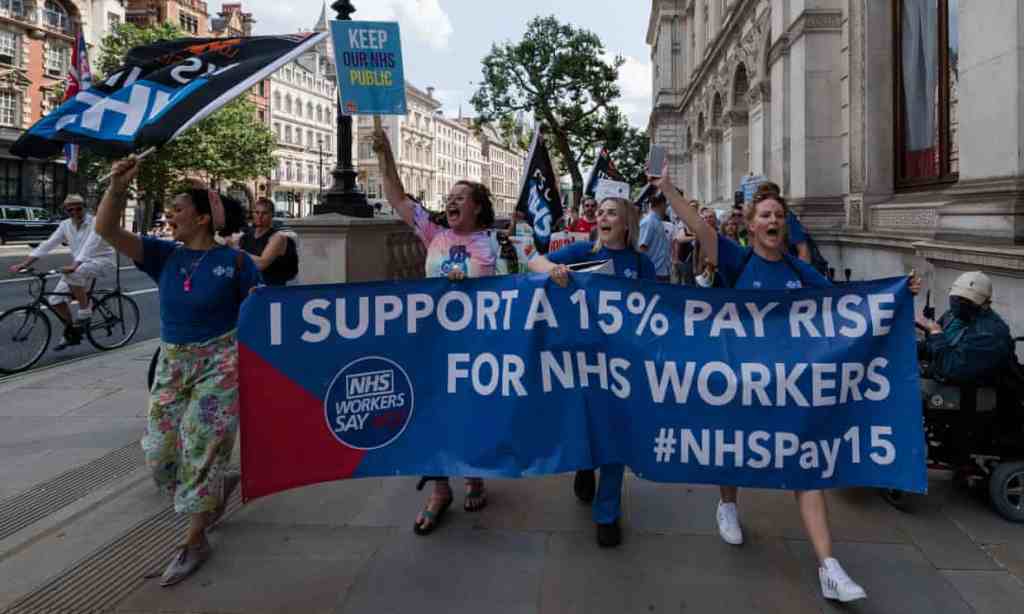
This could be the time for a little news item while everyone is too distracted to notice. The television shows a nurse ironing her home-laundered scrubs. I recognize myself in her, a good woman, a good nurse, trying hard to make ends meet as she works at her chosen profession. The government is to give the National Health medical staff a 3% pay rise. Given, so says the statement “In recognition of the important courageous work done by the medical staff through these last terrible months of the Coronavirus pandemic.” No junior doctors or dentists still in training, most of the medical staff, will receive that rise and the nurses are exhausted. The question remains are the nurses too worn out to consider a some kind of action? 

And so do I

A 3 % raise sounds good – but it equates to a 7.6% decrease in today’s economy for nurses who, more than most public sector workers, have been consistently underpaid. As if tending the body of the sick and oft-time dying is still looked upon as an unclean act. And yet – tending to the body of another is the greatest and first, according to Margaret Mead, sign of a civilized society. All nurses understand it is a privilege, and in a cruel way those who eke out the pounds, shillings and pence also understand that we care for our privilege. But this pay rise remains an insult that is getting harder to ignore. 3% they say, because of all the hard work and dedication you have shown through the pandemic. Hang on, that is what nurses do – all the time. And the police and teachers are to have their pay frozen for at least this year. I can remember being given ten shillings more a week, knowing it would be eaten up in a heartbeat. 

Now that Freedom day has come and we are all following government guidelines that say it is safe to go out – carefully – we cautiously took the train to Oxford. This was for a long overdue visit to friends with whom we had promised to bring a fish pie. And so we packed up a picnic, fish pie, champagne to celebrate a beloved mutual friend’s passing, home-grown and home-made blackcurrant jam, and home-brewed elderflower cordial. 

The Saturday train to Oxford was packed. Every seat was taken and strangers sat beside each other, some carefully, while for others, within the comradeship of youth, conversations began with today’s pickup questions for a new piece of computer software. The train hauled out of Paddington and into the countryside. Buddleia-covered concrete giving way to ragwort and fireweed alongside of un-ripened wheat fields. Our friends live on the outskirts of Oxford and we walked our way from the train station to the bus stop through the town. The river holds, the narrow streets remain the same, the pavements are hard for wheelchairs and the city looks as weary and beaten as any city that is trafficked by students, and where COVID has lain bare the worn cobblestones normally covered by tourists. There are empty store-fronts and as it must be after any war, it is hard to see if they will return fresh and hopeful for the students of the future. It is only when you look up at the massive yellow stone, with its the carved beauty leaning down on you in the narrow streets that you say, “Ah yes, Oxford.”

Photo by WSM

Oxford has been battled over, lost and won again over many centuries. The University was founded 800 years ago and since that time has remained one of the seats of higher education in England. It is the oldest university in the English-speaking world, though, lest we forget, as the English are wont to do, there have been and remain other ancient dynasties throughout the world. In England and at Oxford, church and state were intertwined throughout the centuries, with scholars and politicians emerging from the monasteries and bishops burnt as traitors and martyrs. It was heady stuff. Church and education marched hand in hand and, to enter Oxford, never mind graduate, remains a path to many doors of power. Which brings us to today’s politicians, those who walked the hallowed halls, crossed the sun-shone quads and have too easily assumed the mantle of entitlement that does not become them. But it is these men and women, who hold the purse strings of tax-payers pounds and whose education and political persuasion have led them to justify the equation that plus 3 actually equals minus 7.

This has been A letter from A. Broad

Written and read for you by Muriel Murch

First Aired on Swimming Upstream KWMR.org

Web support by murchstudio.com

An Intersting weekend

Recorded and Knit together by WSM.
(Photo by FAYEZ NURELDINE/AFP via Getty Images)

Saudi Arabia’s Crown Prince Salman bin Abdulaziz gave the welcoming address as all the members of the G 20 summit were made visible on the big Zoom Screen. The summit was hosted by Saudi Arabia but without the lush, welcome goody bags that must have been missed. Here were twenty nations coming together, to talk, or in this instance, to listen, trying to come up with a positive action in this COVID year that has affected every nation. President Putin looked suitably serious, President Merkel was as clear and concise as ever. Prime Minister Johnson huffed and puffed his way forward, while ‘you know who’ got up after the first photo shoot and went golfing. The consensus that emerged was that COVID-19 vaccines should be made available world-wide, and equally accessible to poorer countries.

There were no cozy tete-a-tete in the tea rooms or bars of the hotels where so much, for better or worse, can be discussed, suggested or mooted. So it was no surprise that the U.S. Secretary of State, Michael Pompeo, slipped off touring the Arab states and ‘had a word’ with the Israeli Prime Minister Netanyahu and Crown Prince Mohammed Bin Salman, M.B.S. undoubtedly picking scabs in Irainian politics with Pompeo saying “It’ll be our policy until our time is complete.” One wonders what the ‘it’ is, beyond giving President-elect Joe Biden a headache on entering the White House in January.

In England, beyond Brexit, beyond COVID, beyond a Prime Minister in isolation again, the UK government has another little problem. Sir Alex Allan, as adviser on ministerial standards, clearly decided that the Home Secretary, Priti Patel, had breached the ministerial code through yelling profanities and bullying. For whatever reasons Johnson sat on the report for months, though now it is clear that Patel’s role as dark haired handmaiden to the blond bumble may be in jeopardy. While Sir Alex Allan resigned, a few ministers came forward uttering variations of:

“I’ve never seen her behave badly,” The business has left another bad taste in the mouth of the public that is barely being rinsed away by the news of COVID Vaccines soon becoming available, or the promise of the national lock-down being lifted and Christmas having some element of normality.

European and international news is buried deep in back page paragraphs. In Belarus the 16 weeks of protest continue though the weekends arrests were down to 200. Three young Hong Kong activists including Joshua Wong, have been charged with activism and each face three years imprisonment. Exhaustion and the COVID Virus have caused many demonstrations to fade, though the women of Poland are still visible, struggling for the last vestiges of control of their bodies.

Seeing all this harsh political power-playing behavior, being isolated in COVID quarantine, and feeling powerless has been countered by the human kindness we met this week.

By Friday night, after a little biopsy on Thursday, my body had taken offense and raised my blood pressure to the extent it needed to let off steam, or blood, and, as there already was a wound available, it did. After doing all the right things it became clear this wasn’t going to stop without help. We had been instructed, “Dial 111 if you bleed for longer that fifteen minutes.” And I felt nothing but relief when two slender men in green uniforms strode into our cottage and joined me, sitting, and dripping, in the bathroom. Mike and John had been a paramedic team for over 20 years. Though both were now retired they had responded to this spring’s outreach call and came back into part time service for COVID.

After a bathroom sit and a chat it was clear that it was time to return to University College Hospital where a hand-off, such as I recognized, took place. Two young nurses tucked me up, watched my not good blood pressure and gently cleaned what they could of the continual stream of blood that was flowing into unmentionable creases. We were well connected before a very jolly God’s-gift-to-whoever doctor bounced in.

“We’re giving you some medicine for your blood pressure and now if you just hold this here with a little more pressure. And why did you have a biopsy?”

“Well it wasn’t for fun.” brought laughter to the little cubicle in which he had the grace to join in. I was wheeled off to a holding pen ward to wait, while continuing to drip, for the facial surgeon.

“And you are?”

“The Doctor.” A beloved young Asian Muslim knelt by my bed to talk at my level. I held out my hand and he took it, receiving me into his care. His soft brown eyes held my old bloodshot ones as he gently explained what he was going to do. He had done the first healing with acceptance and tenderness and now with his skill and experience he cleaned up the mess. I was beyond grateful.

While he went off to write up his notes, completing this minor event for him, I wondered if he realized that his healing had begun when he knelt by my side to look me in the eye. At one time he too must have had to overcome the fear of ‘the first time’ that was still carried by the young doctor who had performed the first, maybe her first, biopsy. We have all been there, learning the procedures, by the time honoured, “see one, do one”, been an assistant who lets their hand be squeezed so tightly as to bruise, before becoming the experienced practitioner who has the assurance to heal.

This has been A Letter from A. Broad.
Written and read for you by Muriel Murch. First aired on Swimming Upstream – KWMR.org. Web support by murchstudio.com