It’s Only Going to Get Worse

Written and read for you by Muriel Murch with WSM by my side

“The next time you do this lady, you’re going downtown.” He was big, beefy and, even from behind his counter desk, threatening, as he leaned forward into my space. Was it my space? The flight back to San Francisco had been full and fraught. Wearing my very nice Irish tweed suit (How I wish I could fit into it now) and my pearls, was usually enough to let me sail through customs and immigration when returning to the United States. Since 2000, I had been commuting back and forth to England taking care of my mother as best I could as Congestive Heart Failure quietly worked its way, taking its toll, through her body. She never complained about the distresses and frustrations and even fear it caused her through the three plus years of her illness. But this was 2003, two years after 9/11 and the ante had been upped. I was shaken as he slapped my green card and English passport down on the counter and passed them back to me. I hurried away from this glowering man in his booth before he had beckoned the next person standing in line forward for his scrutiny.

Soon after, I was safely back on the farm a close neighbor stopped by. I was still so shaken I told him, I was telling everyone, what had happened. And he replied,

“Bill’s sister works in Washington. Would you like me to ask him to ask her what is going on?” 

“Yes please,” I replied. He left shortly and it was only two hours later that he phoned me back. The advice from Washington was: 

“Have her do her paperwork now. It is only going to get worse”. I heeded her advice reluctantly and over the next two years finished the required paperwork and took my tests, before finally stepping into the Hall of Justice in San Fransisco to stand and swear. It was a sobering moment, not only for me and hundreds of others, but watching those young people in military uniforms finally reaping the rewards of their service.

NAS SIGONELLA (July 20, 2010) – Candidates for American citizenship representing eight countries, raise their right hand and recite the Oath of Allegiance during a citizenship ceremony held here July 20. Eleven candidates participated in the ceremony to become U.S. Citizens. (U.S. Navy photo by Mass Communication Specialist 1st Class Erica R. Gardner/RELEASED).

Our daughter Beatrice took her work break to meet me and, over a sort of celebratory lunch, helped me fill in my voter registration papers. Now I could vote, and, as importantly, protest the death penalty outside of prisons without fear of deportation. I can count myself among the lucky ones, and privileged to be so. 22 years later ‘it’ has indeed proved to be so much worse than we could ever have imagined and those not so lucky, not so privileged, are living in fear while some are paying a terrible price with the regime in power as they make their bids for a better life and freedom for their families. 

We have to dig deep into the news to follow the paths of the American government’s lawlessness, and when we do it is sickening beyond belief. We don’t really know where to turn. The world is boiling over with the gastric disturbances of climate change amid the constant eruptions of war and destruction.

A not so small incident happened this week as Ursula Von der Leyen’s plane to Bulgaria was left circling for an hour while the satellite navigation system system was jammed. “Nothing  to do with us,’ said the Kremlin spokesperson, Dmitry Peskov, “Your information is incorrect.” While Mark Rutte, Nato’s secretary general, said they are working night and day to make sure this does’t happen again, I’m not putting money on their being successful.

President Zelensky and Europe

And so the wars’ effects spread, across  continents, each one oozing out to the other, Europe, The Middle East, and beyond. When the American President isn’t pouting that he has not been invited to China, he is busy plotting what he is going to do with Gaza when it finally becomes available. But what is it? Gaza, The West Bank, Palestine? Well that rather depends who you are talking with. President Macron calls it all Palestine, other European leaders are set to agree while BiBi Netanyahu calls it Gaza and The West Bank trying to keep Palestine even more separate.The American President calls it Beach Site property.

Israel continues to bomb Gaza, targeting hospitals and journalists.

The Committee to protect journalists says that to date at least 189 journalists and media workers have been killed in Gaza in the most deadly conflict for journalists ever recorded. As we watch the nightly news, the lead anchor for that evening repeats, “Israel does not allow foreign media to film in Gaza and so this footage comes from, dot, dot, dot. “ Whoever can record it” Bolex cameras have given way to smart phones and the footage is shared across the world aired by which ever country chooses to show it. 

Dusk on the street – Auntie (The BBC) is tucked safely behind the church

On Tuesday we found ourselves at the entrance to the BBC headquarters in London. It has been twenty years since I first popped in to watch an interview. Yellow-jacketed security personnell man the paths winding between the barriers which go up and down and are moved around as rumours cross the courtyards to other waiting press and protesters who are always present. We have an appointment and are let in, then directed to more security. It’s a tight ship or a giant warhorse depending on your focus for the day. Eventually wearing our guest passes – clearly visible please – we pass through more guarded glass doors and look down on the huge buzzing news room below. Though brightly lit, it is somewhat spooky, the below aspect of it, as if a design relic of old wartime bunkers. Now instead of long tables with maps there are rows of computer hubs catching news from around the world, some of it coming from those phones that are held up in Gaza, in Kiev, in Afghanistan, but rarely the Sudan or even Haiti. No photographs are allowed here either and the security remains visible as we make our way through the warren of lifts and corridors and messy drink alcoves that look like they belong on a train until we reach a recording suite. There is enough gear to make a community-radio head swoon except that I understand that though they have the equipment, the personnel and money, community radio has a greater freedom.

Two guests, one host, one producer, one engeneer. Be still my lustful heart.

It’s a straight forward forty-five minutes of book talk for Walter, another guest and the host before heading to the bar for drinks. Fully back from the Covid year, the space is loud, raucous and liquid and the cider is not bad. The men and women crews gathered here are grateful to do the good work that they can.
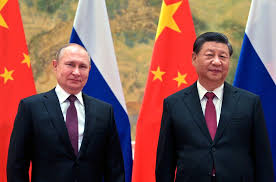
Vladimir Putin and Xi Jinping stand together

I watch the evening news with a slightly different take, looking for what is chosen and what is not. Russia keeps on bombing Ukraine. There are no talks of peace in any of these war zones. A new world order gathers for a military parade in Beijing as Xi Jinping hosts China’s largest-ever military parade, with Vladimir Putin and Kim Jong-un, standing and almost smiling in a show of defiance to the West. The American President and other Western and European leaders were not in attendance. 

Though notably absent from our newscasts for the last few days, the American president immediately posted a petulant response, an embarrassment to even some of his supporters. As speculation abounds a diagnosis of Chronic Venous Insufficiency has been given. Similar in presentation and outcome as varicose veins, he may find them as useful today as a little bone spur was 60 years ago.

This has been A. Letter From A. Broad. written and read for you by Muriel Murch.

As always supported by https://www.murchstudio.com

Dress to Impress

Written and read for you by Muriel Murch with WSM by my side

Dress to impress and dress for success, sometimes we try – but what does that mean – and for whom and for when are we dressing? This week I dressed for an appointment with a new doctor because I wanted him to see and receive me, and not to toss me off as another white 82 year old female with knee pain. So my fingernails were a playful bright green.

Green Nails by Esra Afşar on Unsplash

I may not be a spring chicken but I’m not ready to shuffle off with a walker just yet. I’m praying for a physical exam and an x-ray and a picture that would tell me what is going on with my knee and how can we fix it. It is 15 years since that knee was replaced and I’m aiming for at least another five. It looks like the green nail varnish worked and slipped this fast-talking professional fellow out of total keep-it-together efficiency to ask ‘So how tall are you’? and we laughed – before getting serious again and him telling me what the x-ray pictures showed. ‘Your knee is fine – your hip is worn out.’ Seems like another case of ‘rode hard and put away wet’. But I know to be beyond grateful. I am fortunate to have options in front of me and live a life where such care is accessible.   

Gaza: Doctors Under Attack

In countries that are at war, with themselves and each other, this is not so. The old, the infirm, the young and sick, are all vulnerable and frequently dying for and from the wars that ravage around them. Within the jungles of Myanmar, the city streets of Belarus and the open fields and villages of Ukraine, we are not privy to the unseen hardships played out in those lands. This week we watched ‘Gaza: Doctors Under Attack’ a documentary that was first commissioned by the BBC. Then, according to Stuart Heritage writing for The Guardian, “dropped due to the risk that it created “a perception of partiality”. Luckily Channel 4 picked it up and it is also now available on YouTube. Channel 4’s Louisa Compton warned that Doctors Under Attack would “make people angry, whichever side they take.” She is right. This is the sort of television that will never leave you. Maybe it can provoke an international reaction and we owe it to the people and the countries to not look away. And I don’t, instead finding images remain front and center in my mind making me think deeper about what is happening and how it is happening.

A doctor, who has just lost members of his own family, kneels beside a bed shared by two staving children and asks the older boy fed with a gastric tube “What do you want, What would you like?” The boy whispers, “Mango, mango and grapes”. “And the doctor laughs gently with him, “Mangos and Grapes. You shall have them” while in his heart he knows that joy may have to wait for another life time. As he pats the boy, feigning reassurance he steadies himself against the weeping that is in his soul. And maybe we too must at the least bear witness to the horrors that are happening just around our global corner, as a less than five hours flight from London to Israel has become. 

Some of the doctors followed in this film are still alive and working. Some are not. Almost all have been imprisoned, tortured and lost family members. The film follows a trajectory of sorts. It begins as hospitals are warned to evacuate – but there is nowhere for patients or staff to go. Then an air strike happens, causing more chaos and casualties among the patients and staff who remained. There is a final follow-through as the doctors homes and families are bombed before the attacks move onto the next hospital and repeat the format. Hospital buildings can be rebuilt – though it is doubtful that is the agenda here – but the taking out by imprisonment, torture and death of top medical personal leaves a hole in the knowledge of medicine that will take more than one decade to repair. 

‘No water, no electricity’ … surgeons at work in Gaza: Doctors Under Attack. Photograph: Basement Films

Since the film was made last year, medical officials of all areas in Gaza are facing mass casualties and deaths of Palestinians wounded by Israeli fire as they scramble and fight for food. Relief aid distribution is now almost solely in the hands of The Gaza Humanitarian Foundation, a US and Israel-backed organization, formed in February 2025, and now helmed by Johnnie Moore Jr of Delaware, an evangelical leader and businessman – which seems awfully close to Washington DC. In May the GHF took over from any organization sanctioned by the United Nations. I am not alone in feeling that this organization is disguising target practice as aid. 

But we see very little of this on our daily evening news. Summer sports keep us happy, the heat waves keep us worrying, and we sigh at the incredible slowness of the government body inquiries into biggest miscarriage of Justice –  the Post Office scandals – between 1999 and 2015 – finally come to a conclusion, exonerating those 900 sub-postmasters who were wrongly accused of masses of thefts, – the Horizon computers did it. 13 sub-postmasters committed suicide, many died of old age. The inquiry’s chair has begun to release the reports. Judge Sir Wyn Williams is a singing Welshman, president of Pendyrus Male Choir, which somehow makes one feel that he is a sensible fellow able to lead this committee walking through the dutiful steps to bring the officials to account, saying what needs to be said. It has taken a singing Welshman to steer this inquiry into publication

After the relief of seeing this debortle coming to an end, we watched French President Macron toss the prickly ball of illegal immigration back and forth with Prime Minister Starmer in the House of Commons before they both enjoyed the perks of a State visit. President and Madame Macron’s State visit to Britain is the first of France, or indeed Europe, to England since Brexit. The final banquet, hosted by the King and Queen at Windsor Castle, brought out all the medals and sashes one could find, a tiara or two, good will and good manners to all, with proper speeches and – we hope – good French wine. A little brightness to end the day. 

Sashes, medals and a Tiara but no green nail varnish

As censorship continues pulsing in with the tide of fear we must watch for rogue waves while the ripples over the sand show us where the truth is hiding, like clams under the sand sending up spouts of sea water, cleaning its breathing and screaming for life. But in England, coming down firmly in favour of censorship, protesting and supporting the pro-Palestinian, anti-Israeli activist group Palestine Action, has washed in another ruling under anti-terrorist laws as the government hurries to  project its own agenda. There are spouts of truths in all the theaters of war and governments and while those in authority try so hard to hide them they continue to wash up on the shores of our consciousness.

This has been A Letter from A. Broad. Written and read for you by Muriel Murch 

Grateful to be supported by murchstudio.com/

666 Days and Counting

Written and Read for you by Muriel Murch with WSM by my side.
Stinson Beach from the Airplane, photo by WSM

Bump bump bump goes the United Airlines plane as we fly across the mid-west and over the Rockies, it is as if the plane is no longer sure what is United, and as for ‘flying the friendly skies’ that went the way of all bombers. We bumped until we didn’t – descending like a glider over the Point Reyes Peninsula, seeing our home stretch of California before heading back to land. 

As we were a week later than planned, there was no time to slowly unpack and settle in before the appointments all lined up. Day one, Doctor in the city, check. Day two, doctor in the country, check. Day three, The Department of Motor Vehicles, check, an Xray here, a medication pick up there and we are check, checked again – now hungry and exhausted. But it is barely late afternoon and as we are a little ways north we gratefully pull up at the Rancho Nicasio Bar and Restaurant which quietly stays open for those like us, coming home too tired and hungry to cook. It’s a small row, really all one building, and looking at it, it is always strange to think that this was going to be the center seat of Marin County. How would the county have emerged if that had happened instead of San Rafael? The bar restaurant is the biggest holding here, tucked beside it is the grocery store that was out of milk, and almost hidden by an overhanging oak tree in the corner is the post office. As we pull up and the boys walk towards the bar door, another car pulls in and smiling through her window is a dear friend that I haven’t seen for a year. She is here to get her mail – at the post office. And I too have letters to post. Another gentleman, whose name I can’t remember, also smiles hello to me, and I am reminded that this is what the postoffice does – weaving a vital thread through the community as folks come and go checking for their mail and on each other, even more than community libraries, they are places of and for community.

Our town, Bolinas – there, said it out-loud – has been without its post office for 666 days and counting. And we are counting, and marking it down, writing letters, going to meetings, in public and in private and hustling, trying to right this wrong. This town, and others around the country like us, little ones, with not too many people, may not be considered worth the time and effort needed to put things right. After all – how many votes are we? Though adding up a few thousand here and a few thousand there could make a difference. Meanwhile our long-suffering nearby neighbors make room for us at their post offices, where we take up space, make the queues longer at their counters, and mingle with their friends. 

The famous Bolinas 2 Miles road sign memorialised as an ornament.

As we drive home at dusk through the soft falling rain we can stop rushing. I can take in the twisted limbs, fallen trunks and greening pastures, the trees are shiny with their sparse autumnal beauty. The mud in these fields is not so dense and thick as that of small farms in England. The weather is not so raw, and the cattle are calving well on their own. The roads are glistening as streams cross them in a hurry, there are clusters of mushrooms sitting brazenly on the verges, tempting one to stop and venture into the woodlands. But we carry on home, grateful to have finished our day and be able to light a fire for warmth.

It is in the gratitude of sitting by the fireside that I think of those I have left behind in England for these months of relative comfort. The wars still being waged, erupting like bubbling volcanos, The Ukraine, Gaza – is there anything left of Gaza? and now the rock pulled away from the oppression by the Assad regime in Syria uncovering more cruelty than we know how to absorb. How can it go on? So many of us ‘of a certain age’ turn away in depressed horror and despair. A reader had asked Johnathan Freedland of the Guardian “How do we live in this terrible world?” and he tries – at quite a few column inches – to answer. But it is not easy – It is hard to put your faith in the goodness of our fellow human beings when we read of the horror of cruelty and the greed of those in power.

Catching up on old copies of ‘The Week’ I found a quote from President Barack Obama which seems to help. “At the end of the day, we’re part of a long running story. We just try to get our paragraph right.”

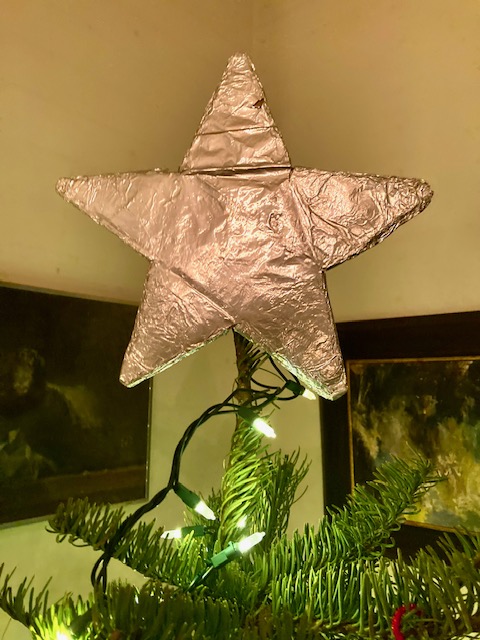
Our family Christmas tree star, going on 40+ years now

So with my paragraph I am sending out a prayer of gratitude for all the good people and things I know are here in our world.

Thank you for those who are trying to bring back our local post office. Thank you to those who are growing our food, caring for each other, those who are helping the sick, the family and friends who are suffering with illness and loss. Thank you to artist friends we know who  have risked so much to bring truth through story into our lives. Thank you.  

This has been A. Letter From A. Broad written and read for you by Muriel Murch

And supported by murchstudio.com
Behind Closed Doors

Written and read for you by Muriel Murch with WSM by my side

The Piazza Santissima Annunziata is almost empty with only a few tourists bearing the late afternoon summer heat while seeking refuge in the churches and museums. Idanna drives straight into the empty Piazza and parks the car. We get out and look around. In the center sits The Grand Duke Ferdinand (from 1608) astride his horse. The horse is facing the little telescope alleyway that leads directly to the Duomo, but the Duke’s eyes, if you look carefully, seem to glance up to two windows, three stories high, on a red building. The shutters remain open so that through the centuries he can look to, and be seen by, his mistress behind them. His arm is raised in salutation to the Pope of the day, or to her – it is left to the onlooker to imagine. On another side is the hospital of the Innocents, an orphanage and museum still run by the nuns from the Sisters di Maria. A small grilled window sits facing the square where – at night time – a mother could – between 1660 and 1875 – raise the grill and lay her new-born babe on the rota where friars, on their night-time shift, sat waiting for a delivery, not as midwives for a wanted child, but as caretakers receiving the fruits of enslaved and then abandoned love. These are the buildings and stories we take in as we make our way to the side door of the Church of Santissima Annunziata, for our friends, Idanna Pucci and Terence Ward have something to show us.

The Key to the door.

“It is a surprise,” says Idanna after we had stopped at the Palazzo Pucci to pick up the ancient key that would have weighted heavy on the twisted cord belt of a monk’s cassock. Again, her face lights with that impossible grin she has when holding a happy secret. The door is thickly double paneled, over eight meters tall, and the strong wood is sun-cracked. Terry takes the key from his pocket and places it in the single lock.

In the bright late afternoon sunlight the key is reluctant to turn and it takes several wiggles before it catches and the door is opened. We enter the tall cool space of this chapel dedicated to St. Sebastian and now lovingly restored by Giannozzo and Idanna Pucci with the help of World Wide Friends of Florence.

WSM and Terence Ward look up to St. Sebastian.

Terry gathers the three red velvet chairs placed in the chancel for musicians together and we gather around as Idanna tells the story. Her lilting voice takes us back to 1082 when a little house of prayer was dedicated to St. Sebastian, then leads us down the path of history through the Middle Ages, the building of this church of the most Holy Annunciation and this chapel, to the paintings commissioned, sold (by one of the unscrupulous relatives) and now lovingly replicated through the guiding hand of her brother Giannozzo. Her voice sings with the joy of the story, coming to when the chapel was reopened and rededicated in May of this year. Idanna is grinning with the happiness of sharing their gift to the city with us. They then lead us around the three major paintings of Saint Sebastian hanging above the alter sanctuary while underneath there are sculpted reliefs of Pucci ancestors, the good and the maybe not so good. Finally we look up at the breathtaking cupola. As we lingered in the beautiful sanctuary a guide from the main church brought in two more visitors to see this sidebar of history. Taking our leave, we walk over the moveable stones that cover the crypt holding Puccis and maybe even a Medici or two. “Have you been down there?” I ask Terry, and he firmly shakes his head. “I have looked. It is a jumble of bones all tossed about, from the flood’. In 1966 the Arno river flooded and swamped Florence ravaging much of the art and bibliotic heritage of the city. The Pucci crypt would be one among many holding places of the dead to be tumbled into confusion and dust. Leaving, Terry turns the key once more in the lock. Walking to the car in the still almost-empty Piazza, I silently said goodbye to the orphanage museum, the Convent of the Sorelle di Maria and the old Duke with his arm raised in salutation.

The Hospital of the Innocents – Orphanage and Museum – Photo by WSM

With our time in Italy we missed the final run up to the UK general election and returned only in time to watch Ukrainian Prime Minister General Zelensky meet his Hungarian counter part, Victor Orbán. Orban, who for six months more is head of the European Union, then went on to chat with his pal Vladimir Putin.

Orbán and Zelensky meet

The countries that make up the EU cried ‘Foul, He is not speaking for us,’ but Orbán merely shrugged, figuratively speaking, saying he was just going to listen and hear what each side has to say. He may be dreaming to broker a peace deal – always a good thing to have noted – but his hand is more eager to grasp Putins’ than Zelensky’s. As each Eastern European leader swims across the tides of history pulling and pushing the boundaries of their country it is within our memory to recall Hungarian refugees arriving in England while fleeing their own county’s oppression.

As July 4th – the UK polling day ended – TV screens lit up like a game show as presenters pointed out which constituencies were turning from blue to red with touches of amber for the Liberal Democrats and green for – well – the Green party. But it is the red of a Labour takeover of the country that has prevailed. As Dishy Rishi drove off to hand his resignation to the King, the movers were quickly packing up the Sunaks’ plates and cutlery, curtains and bed linens to take out of the back door. An hour – or is it two –  later, steady Sir Keir Starmer was off to Buck House, asking the King’s permission to form another government. The handover has to be quick so the country is not left to its own devices. The moving vans are as quick in and out which is rather lovely, for #10 Downing Street is just an old run-down city house in constant need of repair. The inconvenience of any refurbishments only heightens the impermanence of the position, as power comes and goes and hopefully, while you have it, you can do more than change the curtains.

Sir Keir Starmer has not been idle. The smell of Pledge furniture polish was barely cleared from the cabinet room before he gathered his new team around the oval table and gave them each their work orders for the weekend. There was not an old Etonian among them and there would be no potting shed moments. For some, their bags were already packed to fly out, meet and greet, and start work. The weekend saw Keir begin his trip around the British Isles meeting the other UK government leaders. While with the First Minister of Scotland, Sir John Prescott, the chants from protest marchers could be heard through the ministerial walls before Sir Keir was whisked away past the waving Pro-Palestinian flags to meet the First Ministers of Wales and Northern Ireland. On Monday, he arrived in Washington DC, attending the two day Nato conference, filling his movable dance card with more meetings of world leaders, some who are uncertain about their political future. As Sir Keir enters the stage, others are exiting, stage left or right or hovering in the center holding an unenviable heavy portfolio. While Zelensky can be assured of continued support from the UK, the State of Israel, Gaza and the Palestinians remains out of balance. The elections in France have handed Macron a mixed plate but there is relief that, for the moment, the Far Right parties of Farage in England and La Pen in France, though now more visible than ever, have been contained – but only just.

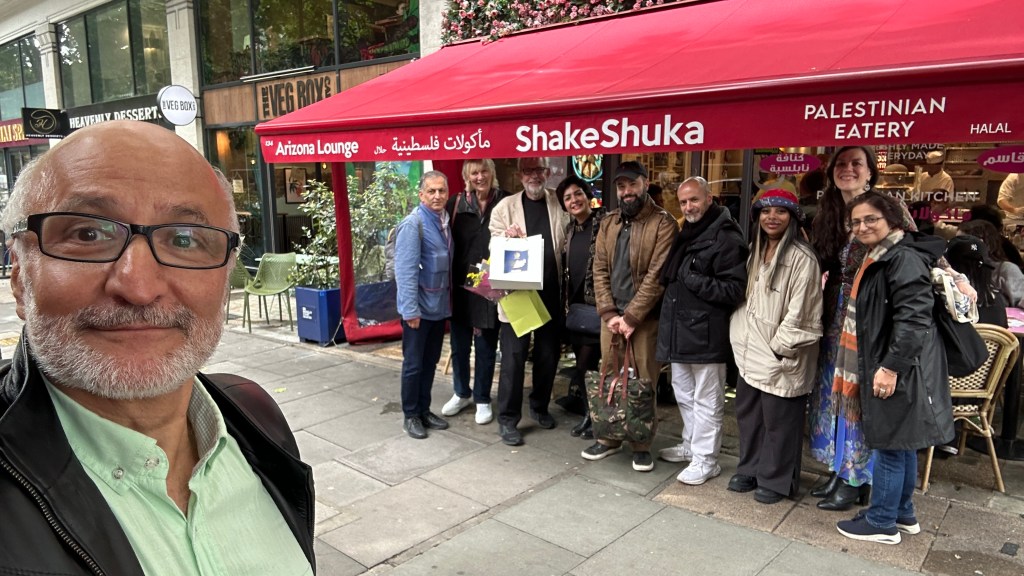
When thirteen of us gathered together at a Palestinian restaurant on the Marylebone Road, for a Coup 53 reunion and an early celebration of Walter’s 81st Birthday, I looked around the table counting our birth-countries: Sweden, The Caribbean, Finland, Iran, North America, Ireland, and England, and am grateful to break bread in a place of such multiplicity.

Taghi Amirani and team. Photo by Taghi

By the closed door of the ladies, I stood with a tall, young, beautiful Palestinian woman just back from the day’s march. “How was it?” “Really good, we were over 100,000 strong.” Smiling together we know that however dissimilar we appear our women’s hearts beat in one accord. 

And always supported by Beatrice @ murchstudio.com

Fading Flags

Written and produced by Muriel Murch with WSM by my side.

Driving out along the lagoon, over the mountain, and down the twisting road through the Redwoods into another town, the large Ukrainian flags are faded and torn but still fluttering under the trees.

They look weary like the soldiers themselves must be. That war, between Russia and Ukraine, is into its second year and is now being jostled out of the headlines and overtaken by the three way shootout that is occurring between Gaza, Israel and Palestine. The weariness that is shown by the torn Ukrainian flags is but a reflection of the faces of both the Ukrainian and Russian soldiers. Satellite pictures of Russian graveyards show their expansion and a rough estimate is over 50,000 Russian and 31,000 Ukrainian troops killed from this war so far. Mothers do not like to hear such numbers and know that their sons are among the fallen.

Daily, more young, untrained Russian boys and old men are sent into battle to wear down the Ukrainian military. In 2022 the Russian Wagner leader Yevgeny Prigozhin began recruiting prisoners for his private army – until that all went pear shaped and ‘angry words were spoken’. Shortly after that Prigozhin was killed in a plane crash. But – to no one’s surprise – the Russian defense minister has continued with the same policy, containing the stipulation that enlisted prisoners must fight until they die or the war is over – whichever comes first. Prison recruits remain crucial to the success of the Meat Grinder… The modern term for Cannon Fodder.

Nobody really knows how many Russian and Ukrainian solders or civilians are dying. But all Russians steeped in their history know, from Tolstoy’s War and Peace to Maylis De Kerangal’s Eastbound, war in Russia is carried genetically through ancestral bloodlines. For the Ukraine it is not a lot different – maybe the war dead figures are more honest – it is hard to tell. President Zelensky is anxious and impatient calling for the military aid package just passed by the US Congress over the weekend to be delivered now – not in six months time.

Back in London, though there are no more welcome signs for refugees from any country, this war is still on the page. The prancing dance that is happening with Putin, the West, China and the East is keeping at least some journalists on their toes.

London welcomes me back into a land of brown people and I am grateful. There is kindness all around me. I push my trolly-load of luggage towards the parked taxi driver at the airport, who, when we reach the cottage, brings my suitcases inside and lifts them onto the spare bed.

But our UK Government remains as tight, shortsighted and corrupt as ever. Another Tory minister resigns here, mud is slung at Angela Rayner the labour Deputy Prime Minister there, and, goodness me, Peter Murrell, the husband of the last Scottish First Minister, Nicola Sturgeon, is under arrest again.  Released of course – the only polite thing to do – and to be investigated further – in due course. Well maybe. This is beyond sad, another betrayal as most people whatever they felt about an independent Scotland admired and even liked Nicola Sturgeon as she brought Scotland through the Covid crisis. Lifting its head slightly out from underneath these stained seats of government we find other unbelievable act of fly swatting. 

Through The European Commission president, Ursula von der Leyen, the EU have proposed free moment for young European Union citizens and Britons across the borders, allowing young people from the EU to stay in the UK to work or study for reciprocal periods of time. As Ursula said, this would have been where there could be “closer collaboration. The topic of youth mobility is in both our interests, because the more we have youth mobility being on both sides of the Channel, the more we increase the probability we will be on good terms because the next generation knows each other very well.” But Rishi doesn’t seem to want to get to know anyone outside of his home-county set and has rejected that, the government saying that ‘Brexit had ended free movement and it had no desire to reopen that conversation, even with strict conditions on length of stay.’ God help this country. 

As I began to write, the question of shipping undocumented immigrants to Rwanda was being batted back and forth across the aisles of Parliament for maybe the fourth time. There is no doubt that if the bill passes, those held in ‘safe housing’ will disappear into the urban ghettos of this country. Some will die, many will be extorted, while only a very few will reunite with their families or move on to make some kind of a life for themselves. Sunak will merely have transported the jungles of Calais to the cities of Liverpool and London. After a night of back and forth from the green seats of the Commons to the tattered red ones of the Lords the bill was passed – at the cost of 1.8 Million pounds per person – before it was time for an early morning cup of tea. It goes to the King on Tuesday evening and goodness knows how he is going to keep his mouth shut and sign it. 

A Getty Image of Rhishi trying.

It is hard to think about this as I sit on the sofa at dusk watching the evening light soften and glow, as if to say, ‘That was an ok day wasn’t it? The plants in my pots on my small terrace garden must have bloomed for our guests: volunteer Bluebells coming out of home-made compost, yellow Cowslips raised and bowed down. The geraniums and fuchsias are not quite ready to come out of hibernation while the unpruned rose buds are reaching for any weak spring sunshine. The pigeons and squirrels scurry around though the bird feeder needs replenishing and rehanging before the smaller birds will return. But it is dusk and Lucy the fox is back. Her coat is full and healthy while her udder glistens from the recent suckling of her kits. She too has sensed the movement behind the glass, the lights flickering on and off, and has come to check my egg supply. I go to the fridge and get one for her. Sliding open the terrace door I place it just inside the cottage. Tentatively, checking my smell and my seat on the sofa, she steps froward and takes the egg in her mouth, turns and neatly hops off between my pots to trot along the wall and disappear.

Lucy comes for her first egg of the evening Photo by WSM.

She returns ten minutes later for a second egg. How many kits does she have this year? A famous Italian designer has a trophy home just across the wall and with his garden unused for the winter months this could be where Lucy and her family live. The park – with its tall grasses and hedgerows – is just across the road and the canal with its river-rat filled verges is only a quarter of a mile away. Can Lucy and her family live peacefully in that garden or will they too be evicted out of their found safety to wander to find a new place to call home.

This has been A Letter From A. Broad. Written and Read for you by Muriel Murch.  

And always overseen by – beatrice @ murchstudio.com

Serving Safety

Written and Recorded by Muriel Murch with WSM by my side

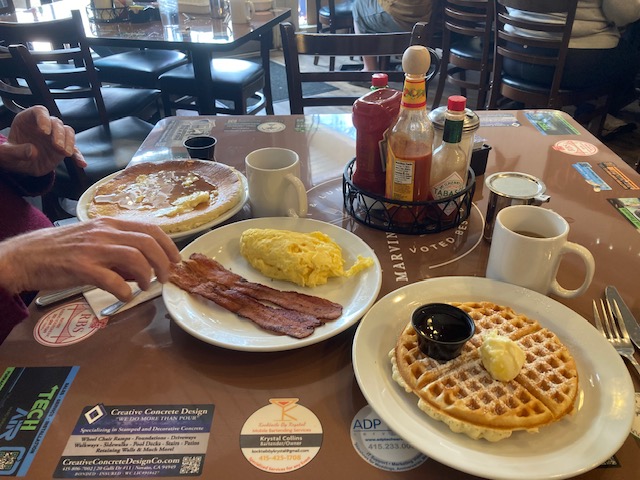
When you want a ‘good old American Breakfast’ you need a ‘good old American restaurant’ to go to. There are a couple still thriving on the main street of Novato, in California. We go to Marvin’s. The tables are crammed together, the outside dining that came in with Covid, remains – and for those new to Novato, with small fluffy dogs as accessories, those tables are fine. But for us, not locals but oldies, inside is better. The coffee comes quicker, the menu is there and you only get water if you ask for it. The restaurant is crammed and with a fluidity of a well-honed team the kitchen, and wait-staff dance between us all and even have time to smile and say hello. The clientele inside is mostly old, local, male and large. Which makes placing cardboard on the  floor of the tiny bathroom a more than sensible idea. So do the signs posted on the walls, ‘ For goodness sake clean up after yourself’, ‘Anything is possible if you have the courage to make it happen,’ ‘You never know what you have until it’s gone. Toilet paper for instance.’  Returning to our table, my second cup of coffee is ready for me and I am beginning to feel better. And that is the gift that a restaurant, worthy of the name, gives to its patrons.  

One of Marvin’s ‘All American’ breakfasts.

For over 50 years Cupertino-based Chefs of Compassion Cooking for a Cause has held an annual fundraiser dinner. A gala evening event of food, giving the attendees a feast fit for their dollars as they support the West Valley Community Services – serving those in need from the cratered and neglected pockets Santa Clara County. It is one of thousands of not-for-profit organizations throughout the country and the world that help those struggling with food, and to get by with things that many of us take for granted.

Steve Simmons with Chefs of Compassion

I stumbled across The Chefs of Compassion when reading of the sudden death of a beloved friend, Chef Steve Simmons. Steve and I first met when he was cajoled onto the board of Full Circle Programs. Barely out of apprenticeship he was far too young to enjoy sitting at meetings. He was busy claiming his place alongside other rising chefs in the Bay Area, such as Ogden Bradley. But he was game and eager to help with my first ever fund-raising event: a screening of The English Patient for the Full Circle Programs in 1997. I didn’t have a clue what I was doing but Steve had everything under control and – if I remember correctly – gracefully served up oysters and champagne. The event was a modest success and we made money for the program. Steve soon became a renowned and sought-after Bay Area Chef in his own right before opening his own success story, Bubbas’ Diner in San Anselmo. Bubba’s was perfect for meetings, family gatherings and just plain, ‘let me sit-down for a moment and gather myself before the next whatever hits me’. With constant affection, our lives crossed paths for over thirty years. Steve’s sudden death from a heart attack brings a personal sadness as it does to all his friends, colleagues and family. He leaves three children to still scramble through school. But Steve’s work carried a constant in that, as well as being a fine chef, his desire to help those less fortunate was a hallmark of his work and is seen so often in other chefs, serving from small roadside kitchens or in world-renowned restaurants. Serving and sharing food is a passion that reaches out from our own kitchen table, to our communities and beyond. 

Chef José Andrés and his carrots

Meet Jose Andrés Group

There are chefs who are known not only for their cooking, books, fame and fortunes but for their humanitarian work feeding the world. Such a chef is the Spanish American José Ramón Andrés who, with a matador’s flair naturally rose to the challenges ahead of him in the 1990’s when he arrived in New York. Success quickly followed success and took him to Washington DC where, dinning in his restaurants, meetings over a meal, discord could become accord. In 2010  Andrés founded the World Central Kitchen beginning by focusing on feeding communities hit with natural disasters but too quickly found itself operating – like Doctor’s without Borders – in areas of conflict – as wars marched side by side with climate change as the cause for famine and disease. While many chefs are artists in the kitchen and business men behind the till, Andrés is also a deeply caring man. Like an army General he quickly strode across the global stage with his humanitarian work.

Wherever war has brought hunger, the World Kitchen has been there, serving the food of the people to the people. The World Central Kitchen has grown to be enormous, serving food and people’s worldwide. Currently it is operating in Haiti, Ukraine, Poland, Israel and Gaza. In Ukraine, chefs and restauranteurs jockey with each other to feed the best borscht to their people, in the Middle East to honour Ramadan and other religions, and now the World Central Kitchen serves in Israel and Gaza, bringing the food of comfort to both Israelis and Palestinians. Though more at home behind a roaring grill or unloading the flatbed of a truck, Andrés fingers are now busy working the computer and phones as he looks to use any influence he has to halt the war in Gaza. Andrés is outspoken in his criticism of anyone who cannot see the need for humanitarian aid and his work is such that nobody wants to be seen not being compassionate. Both Republican and Democrat Senators are known to nod sagely when he speaks. Even in Israel, where the World Central Kitchen immediately gathered forces to feed those affected from the Hamas attack in October, Andrés can speak. But now – as that assault became a full blown war – and Netanyahu seized the excuse to attack Gaza, squeezing Palestinians into tighter corrals with less and less resources, things became personal for Andrés. A pier was built by the U.S. Military where food, water and relief could be unloaded safely and delivered to the Palestinians still trapped on the Gaza Strip. With the precision of a Military General Andrés already had supply workers lined up in a convoy. One, two and three, the vehicles were picked off by Israeli soldiers and all seven of the international volunteer workers were killed. Quickly Andrés took pen to paper and wrote op-ed pieces both in the New York Times and in Israel’s largest newspaper, plus tweets and all forms of media. He wrote “Israel is better than the way this war is being waged,” For the moment that supply route is closed. 

Andrés’ stride across the world stage is large like the Ukrainian president Volodymyr Zelenskyy, who is also untrained in the school of politics. Andrés’ schooling in the kitchen as Zelenskyy’s on the stage has given both men the skills of hustle, the art of seduction, both slicing and seasoning each connection to fit and join with another. Is it possible that it is these artists that can chip away at the gates of death, calm the storms of war, and bring a peace at the table. 

This has been A Letter from A. Broad. Written and read for you by Muriel Murch.

And always overseen by – beatrice @ murchstudio.com

A Dog’s Dinner

Written and Produced by Muriel Murch with WSM by my side

The dictionary defines A Dog’s Dinner as ‘A situation, event, or piece of work that is chaotic, badly organized, or very untidy.’ Such as when an unschooled dog gallops into the scullery for his bowl of specially formulated dog food moistened with a little water. It is gulped down in a flash, the bowl knocked about noisily until it hits a wall. But then there is a pause as his tummy swells. A burp is followed by a belch before up comes dinner again, now glistening and sticky with saliva and the first tentacles of stomach acid. The dog looks puzzled wondering what happened but then he spies the food, all over the floor and with excited tail wagging, eats it all up again. Only a mop and a big dose of disinfectant can clear the damage away. 

This is the image that comes to mind after Suella Braverman’s published remarks that homelessness was a lifestyle choice. As Rishi Sunak sent her back to her kennel he had to reshuffle his cabinet once more. Even the newspapers had to print charts with pictures of who has come and gone and where to. We watched – soon to be Lord – David Cameron stride back into Downing Street, knock on the door of number 10 with his tail wagging as he tucks into the mess of Brexit that he created. It looks to be a dog’s dinner all over again.  

On November 14th King Charles celebrated his 75th birthday by popping into a food bank between holding a couple of tea parties for people and organizations that also turned 75 this year. A tea dance was held in Dumfries House and then more tea was served at Highgrove with members of the Caribbean Windrush generation, nurses and midwives from the NHS. This week, The Big Issue, a weekly magazine sold on the streets by homeless vendors, has The King on the cover highlighting his Coronation Food Project, launched on his birthday. The King is quoted – saying that “Food need is as real and urgent a problem as food waste,” …. “If a way could be found to bridge the gap between them, then it would address two problems in one.” It seems to take a football player like young Marcus Rashford of Manchester United and a King like Charles the Third to steer this ship into a clearer lake of fresh water. 

On Tuesday, we left for Poland and the Camerimage International Film Festival in Torun. It takes a full day of travel getting to the festival and we were only traveling from London. Cinematographers, manufacturers, filmmakers from other disciplines with films come from around the world. It is a  jumble of festival and trade faire, a little glamor and a lot of graft for the craft of cinematography. We gather at breakfast, the same as on a film set, such is the comradery of international filmmakers.

The plane landed in Warsaw and the afternoon light stayed for the first hour of the two-and-a-half hours it takes to drive to Torun. Leaving the city there are single-gauge railway tracks that emerge and disappear in and out of the paved road. They are old, disused but along with the tree-covered mounds of larch, silver birch, and pine that cover the detritus of an ancient war, a chilling reminder of the wars past and present. The city names of old wars are now joined with new place markers that move traveling east into Russia and Ukraine, and then south with the eruptions in Jerusalem, Gaza, and Palestine. 

The city disappears giving way to bare winter fields. There is very little green left to harvest, only tall dried-out corn to be cut for livestock. As we pick up speed, the farmhouses appear small, even tiny, most look old and decrepit. There are no lights shining to welcome a farmer home from the plow. As we drive north a storm is crossing Europe and for those moments that we are on the open barrier-less road, the raw wind beats across the motorway making this all-electric German limousine slip and tremble and the windshield wipers pick up speed.

We settle into the hotel with memories that slowly come back to us. Beyond the window the river flows fast, the current pushing and pulling fallen trees into the mud. There is no shipping. The countryside is bleak this far north in November. Even though it maybe earlier in the year than our previous visit winter feels like it is coming sooner. 

Here is Copernicus

Walking into the old medieval town we pay homage to the statue of Copernicus. Torun is not a big city but as Copernicus’s birthplace it is rich in history and over two million people come to visit each year. Some come for astronomy, Copernicus, science, and some for this festival. Walter is here to join Professor of Astronomy, Leszek Blaszkiewicz in a moderated discussion on ‘Copernicus, Dreamers, Inspiration and Science.’ Held in the beautiful old Camerimage Cinema, the audience is primed and happy to hear, think, and discuss such things. After the talk is over they linger and some have already brought with them the beautiful Golden Book on Walter’s Golden Ratio exploration that the festival produced. The days are busy although we don’t get to see one film. 

Mateusz Józefowicz moderates Walter Murch and Leszek Blaszkiewicz in conversation on Art, Inspiration, Science, and Dreams.

On Saturday as we walk over to the main building for the closing ceremony and awards event, dusk has already busied herself with night and the street lights proclaim it is winter. The big theatre has filled up early and fast. The ceremony begins and is almost all in Polish though there are head-sets for translations and it all goes along easily and quickly. The Golden Frog is the symbol for this festival, with tadpoles for the rising stars of cinematography. Each film festival has its symbol, Berlin has the bear, Locarno a Leopard, Venice a Lion, and of course, it’s Oscar for Hollywood. While the Torun festival celebrates the art of Cinematography it is also a huge trade faire. It is overwhelming to see the equipment. The festival also acknowledges the other disciplines and those who – within their fields – carry a particular understanding and integration of cinematography and their own discipline. Walter brought his frog home in 2015 and it sits sweetly and discreetly on a bookcase shelf here in London.

The last award is given and the festival director returned to the stage for his closing remarks before beckoning a line of assistants to file in behind him, and then another line and another, and – as we rose to our feet – he has assembled everyone who made the festival happen on stage. It is the first time we have seen such an acknowledgment from a festival and it seems fitting that it should occur here where the emphasis has always been on the heavy lifting that it takes to be a cinematographer and to make movies. The yellow-vested stage hands arrive carrying three sofas and the recipients of this year’s gold frogs and tadpoles come to sit alongside those who have made this year’s festival possible and still the full audience is on its feet acknowledging that just as Copernicus wrote in his revolutions, we are all like the stars in the heavens and the universe beyond,  elliptically revolving around each other.

Brava and thank you to everyone who made this 31st Camerimage possible.

As we walk back to the hotel we can see our breath and the sky prepares to scatter the first flurries of snow. The final party is going strong but we are too old for that and even in flat shoes my back hurts. At the bar, we sit among those who would rather drink and talk than stand and shout, enjoying a glass of wine and a bowl of Polish soup. The next morning camp is broken and the lobby is full of puffer jackets, wheeled cases, and fond goodbyes. We have barely left the city when a huge owl swoops down across the car, just three feet in front of us, and with wings unfurled for balance, he nails his meal of young bunny on the snow-covered grass beside the road. We drive on past the mistletoe-encrusted trees, the wind turbines emerging from the fog where acres of bare apple and pear fruit trees, red and black currant bushes are already dormant, preparing for the winter ahead. We quietly understand that life in this corner of the world is not easy for those who live here.

This has been A Letter from A. Broad written and read for you by Muriel Murch

Rain Stops Play

Recorded and Knit together by WSM

The third week in May – and it is still raining steadily. Umbrella in hand, it was time to take the 274 bus into town. The bus was already half full, so I sat upstairs to look down over the London streets and see a group of young Asian men, carrying their hefty bags full of cricket gear on their way to the park. One is already dressed in his Cricket whites. Do they dream of one day playing in the holy of holies, Lord’s Cricket Grounds close by in St. John’s Wood? Founded in 1788 by Thomas Lord, the grounds were moved at least three times before settling into this corner of Marylebone. Noted historical progressions through the years included that in 1864 the purchase of a lawn mower removed the need to keep sheep. Those young men I saw from my bus would have been in the grounds where my father was a member for all of his adult life.   

I arrived at the edge of the city to where, even with the soft rain falling, the pubs’ and restaurants’ outdoor tables are full. Most shops have been opened again on the Marylebone High Street, but with some noticeable gaps where high-end English brands used to sit proudly on their corner lots. They were always just out of my price range and I am not as sympathetic as I could be. 

On Monday, more lockdown restrictions were eased but we are going slowly, being sensible, as the health Minister Matt Hancock urges us all to be. But maybe there will be some lightening of the infection load that will bring this, and other countries, safely out of hibernation.

Every country is looking at what their government could have done better, safer, faster to save more lives. Doors, gateways, air pathways and sea-channels have been opened and closed with speeds that relate to the economy as much as infection rates. All governments have behaved badly to various degrees. There have been profiteers and deals of equipment, and devious deals of no equipment. Last week the head of a pharmaceutical firm in India fled to London after failing to provide more affordable vaccines to his own country. The blame? Already shifted to Narendra Modi, India’s Prime Minister for not booking ahead and placing his order. The high numbers of infection rates and still low numbers of vaccines are struggling to meet on a world-wide level. 

Over this year and half, the COVID-19 virus has been named and shamed as the Chinese, the Kent and now the Indian variant and – as it was named – so it fled to greener pastures. It must have been obvious to any epidemiologist that the Virus would change and mutate as the opportunity arose. That’s what viruses do. They are as opportunistic as all living beings. The Times newspaper estimated that at least 20,000 passengers from India were allowed to enter the UK because there was a trade deal in the works and a little hop to India would have got Boris out of his wallpaper dilemma . The Daily Mirror called Boris Johnson’s delay on closing travel from India another unforgivable ‘Own Goal’. 

Covid Memorial wall in London

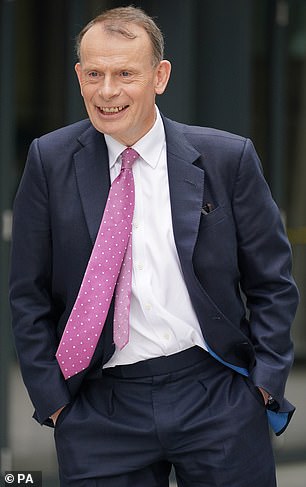
Another news item broke this week, one that many of us have been looking for. Andrew Marr, the BBC political broadcaster, whom we regularly watch with a Sunday Sofa breakfast, said he may leave the corporation so he can share his true views on politics. Speaking in Glasgow with the Scottish journalist Ruth Wishart, he said, ‘At some point, I want to get out and use my own voice again. How and when, I have no idea …. There are many privileges of working at the BBC, including the size of the audience and all of that, but the biggest single frustration by far is losing your own voice, not being able to speak in your own voice.’ Constraints such as this are a knife edge that all paid journalists must traverse, admitting the constraints is another.

Andrew Marr – smiling

For eight days and counting we have watched Israeli airstrikes and Hamas rocket barrages that have killed over 200 hundred people, the vast majority of them Palestinian women and children. Hospital buildings, schools and media centers have been bombed to rubble with Palestinians running, searching for their dead children. The heavy metal disparities are impossible to ignore. Prime Minister Benjamin Netanyahu gave no justification for targeting the 12-story press building in Gaza, though later claimed that Hamas had an intelligence unit inside. No news organization using the building had seen evidence of Hamas presence. He went on, “Israel’s military operation against Palestinian Hamas militants in Gaza will continue with full force. We are acting now, for as long as necessary, to restore calm… It will take time,” Mr Netanyahu warned. Time, to right which wrong?

Vanessa Redgrave in Julia

1978 was the awards season for the film Julia, directed by Fred Zinneman and staring Vanessa Redgrave, Jane Fonda and Jason Robards. Julia was up for eight nominations including for best editor and so we were there that night. Sitting aways away, (Walter’s chances of winning were not considered high) Vanessa looked very young, and alone as she scampered up onto the stage to be greeted by an even bouncier John Travolta. Graciously she accepted her Oscar and then spoke: quietly, politely but with great purpose, her memorable speech denounced what she saw as the Zionist disturbers of that time. That speech cost her a full blown career in Hollywood, thus allowing all of the richness of her work in the cinematic and theatre arts to flow through different channels. Listening again to that speech from 1978 while looking to the now scant news screens, tragically darkened by this new wave of Israeli and Palestinian bombing of the land that is Gaza and Holy – I wonder when will the world be able to bow our heads in prayer – together again.

This has been a Letter from A. Broad. 
Written and read for you by Muriel Murch 
First aired on Swimming Upstream – KWMR.org.
Web support by murchstudio.com

Colours of Conscience

Recorded and Knit together by WSM

The hedgerows bow down with cowslip’s white lace to welcome us walking along the canal towpath. There is the faint smell of spring in the air which will coax summer into being as the bees find the blossoms of cowslip, hawthorne and elderflower. I am searching for the elderflower but because of the continuing cold weather she is shy to blossom. Not so the dog roses, peeking cheekily along the back pathways surrounding Primrose Hill. I must wait a week, two at the most, for my harvest to make elderflower cordial. In the city and the countryside the seasons are following one after the other, the way the Earth intended.

White spring on the hill

The countryside is one thing but the country is another. On Thursday, looking for renewal or some new life to emerge, the United Kingdom went to the polls for a by-election. This is when the local councils and townships vote for their councilors and mayors, the boots on the ground, who have to balance the ever-decreasing government budget hand-outs with the needs of their constituencies that those in Westminster’s Parliament are too busy to discuss.

The results trickled in over the weekend. Ballot counting was slow –apparently due to Covid – while both paid staff and volunteers worked hard, counting by hand as they always have. There was ‘some problems’ with the London mail-in votes as 30,000 were rejected as not being filled out correctly. I hope mine was not one of them. ‘Things will change,’ said the defeated Conservative Mayoral candidate, Shaun Bailey. Maybe.

But Sadiq Khan is back for another four years of hard grind and I am glad to see him. Though past Labour leaders such as Gordon Brown and Ed Miliband have seen and used Khan’s worth, the Conservative team will have little time for a working class Sunni Muslim son of a bus driver from Tooting. Growing up, Khan always worked while at school and university. Taking jobs from builders yards to the Peter Jones Department store in Sloane Square, Khan learnt early how England’s different worlds would treat him. The Westminster Conservatives will not give him an easy ride while he walks and works to his own conscience. On reelection he said, 

“I will always be a mayor for all Londoners, working to improve the lives of every single person in this city…The scars of Brexit have yet to heal. A crude culture war is pushing us further apart.”  

Sadiq Kahn
Prime Minister Boris Johnson and Mayor of London Sadiq Khan photo by P.A. Wire

Khan’s words are true not just for London but for the United Kingdom which look more frayed than ever before. Wales returned a strong Red rosette Labour party across the board. Scotland with Nicola Sturgeon came back with a daffodil yellow Scottish Independence party win, while England turned blue with the cold of a crushing Conservative paint job.

What happened to Labour that the nice Sir Kier Starmer lost so much ground? Maybe it was similar to Hillary Clinton’s error of not going to the people who were hurting and most afraid. For change is coming – for the English laborer who cares not to toil the fields or work the railroads. Now the work is for new technologies and inventive ways of producing and harnessing clean energy. With their belief that green policies embrace social justice, environmentalism and nonviolence and are inherently related to one another, the Green party is now nipping at the heels of the Big Two.

When Labour’s Andy Burnham was reelected as the mayor of Greater Manchester with a landslide victory, he shone a shining light on the North of England’s place in the country. Promising to adopt a “place-first not a party-first” policy he is, in his own way, echoing Sadiq Khan’s call for London with a reminder that England remains, or has become, more divided than ever before. It is not just North and South, rural and urban, English or British but a sewer-stuck mixture of all of these things in a country closing in on itself. Now more than ever the waters of the channel to Europe and beyond are looking like choppy seas.  

The Queen’s Speech is today. This ceremonial occasion is where the Queen reads out the government’s new policies. As we watch her age with years and life’s burdens, the robes and weight of the office seem to smother her. She sits on her throne, reading words written by her government and on this occasion, like other times before, one holds the secret hope that she will stand and say. “This is not good enough. It is ridiculous, cruel, or incomplete.”  We, the public, naturally have been leaked what is to be said. There is little of merit in the speech. The promise to help the United Kingdom recover from the effects of the Covid Pandemic carry, as Labour politicians point out, no meat or potatoes in those words.  But one item seemly taken from one orange man and used by a yellow one, relates to voting reforms. Britons will have to show Photo IDs to vote in future General elections, and it is combined with a strange item that limits the number of postal votes that can be handed in on behalf of others. Ministers say this will reduce the risk of electoral fraud. While the Electoral Commission is quietly shaking its collective head, for in 2019 there was just one conviction and one police caution for impersonating another voter.

Looking beyond our shores, the fires of distress spark flames of unrest and fear across the world. This week sees Israel and Palestine hurl bombs and bullets at each other fighting for their homelands as they see it. The loss of children’s lives crossed all religions while those who can see, cry out “Enough already”.  

This has been a Letter from A. Broad. 

Written and read for you by Muriel Murch 

First aired on Swimming Upstream – KWMR.org

Web support by murchstudio.com