Bees are Buzzing

Written and read for you by Muriel Murch with WSM by my side

The orange one and his grubby companions are causing horrendous chaos in Washington and the world, but one thing they cannot stop is this morning’s spring sunshine. Even in the worst of times, which for so many people in the world this is, the spring sunshine is bringing warmth and a moment of peace within the despair of their lives. How can it be otherwise when the world is churning upside down, as if a mammoth is rising up from the depth of the ocean and has begun a tidal wave of tsunami proportions? We do not know when this will be stopped for surely as America and the world come to their senses, the end of their road and rope will be reached. 

Last week an early swam of bees arrived. First they circled the redwood trees, then the wood pile below, before settling deep into the as yet unpruned Cécile Brunner rose. They presented a knotty problem, this is not really a safe place for them while being a very tricky spot for any bee keeper to reach. But these were the gentlest bees I can remember ever working with. They slid into the skip and were happily transferred to an already swept out and refreshed hive body waiting for them. It was a big swarm and has settled in nicely and I am a little bit gleeful, for we may – eventually – profit from their upgraded housing. You can live here – and we will harvest – tithing you – later in the year. Sounds a little like a mafia move to me. 
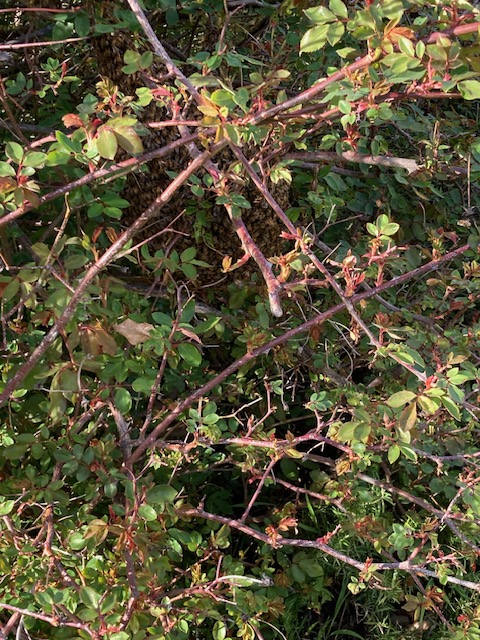
They are very hard to see but – trust me – they are there.

But then a little swarm returned to the rose bush, hiding, I suspect, a young and tender queen who was having none of it and could not be persuaded to move. A few days later I tried to add them to their sisters in the big hive but no – back to their rose bush they flew and by the following morning were clustered, a smidgen smaller, but still holding onto their rose bush branch. She, their young queen, and they know better than to trust me and, if they had time, could become strong enough to find ‘just the right’  log or tree, and they would move on again. But there isn’t time. We are wanting to host a small party in the back garden later this week and not everyone is comfortable with worker bees out and about. There could be panic among the humans, panic among the bees as the workers die off in the efforts to save their little queen, who may die before they find a suitable home and build up a colony that will survive and grow. I look at the bees, some acquiescing to our manipulation and others holding out for what they believe in. It feels a little like some of the behavior in North America right now. So this morning, while the dew was still on the ground, and the sun had not reached this cluster holding tight for warmth, I came to them again. Sweeping them softly into a box, closing it quickly and then taking it to a smaller hive that I had again prepared. This time they went in and by the time this letter is finished for you they will be busy setting up house and drawing out comb ready to take care of their community once more.
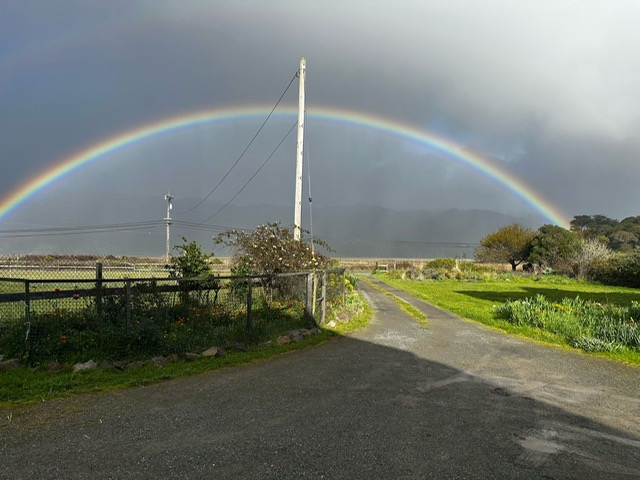
After the storm, a rainbow for the farm. Photo by Greg Watson.

This has been a Letter from A. Broad. Written and read for you by Muriel Murch.

Supported by https://www.murchstudio.com

Morning Moments

Written and read for you by Muriel Murch with WSM by my side.

Across the high street from the general merchants, Wainwrights and Sons  – when general merchants sold everything from coal, lumber and rabbit food – was a small glass-fronted, with green trim, coffee and pastry shop. It was run by Madame Max and painted above the door, in curly blue writing ‘Mrs Max’s Café’. She must have been a refugee from the war and somehow had landed in our small town in Fleet in Hampshire. I like to think there may have been a story from a returning army officer giving her a helping hand to start her life once more. There are stories we never know. Lady Pechell was a daily customer, riding her bicycle from the two miles from the rhododendron shrouded Denorban Avenue into the village. Lady Pechell was older than the young mothers making do with their ration books, trading eggs and butter from small holdings for gin from goodness knows where. On shopping days during the week they came to Mrs Max’s Café, to be together for an hour. To commiserate about all and everything, trying to put their lives together as the war continued, while Lady Pechall quietly fed me lumps of sugar. She pocketed more lumps of sugar for her ponies. Though sugar was also rationed and because she was a little eccentric and her husband had fought in two world wars, nobody minded. A mystery surrounded her, her husband Sir Paul, that maybe included Madame Max and her café. 

Hampshire countryside then and now

I’m thinking of those times after reading Emma Beddington in the Guardian last week. Her article was about Starbucks, now getting people out of their U.S. coffee shops with a new “Coffeehouse Code of Conduct,” making people buy something or leave. Someone has been scratching their corporate head wondering how, in the words from ‘The Loved one’ “To get those stiffs off of my property.”

This attitude has caused quite a stir-up in the brew that makes up coffee house culture in the U.S. and Europe. It’s a big thing in all cultures and wouldn’t you know it it is America that can’t quite handle the slow soothing pace of sipping. There are all sorts of reasons, the economy being the main thrust driving Starbucks which, really isn’t failing but has always seemed to be on overdrive. I’m remembering European workmen, standing at coffee bars in Rome and Paris, taking an expresso hit before their day started and women pausing for a refresher mid-morning to get them through the day. I’m thinking of Bianca, who I met 30 years ago in the Piazza San Lorenzo, our dogs yapping at each other leading to a conversation, a visit with homemade raspberry sorbet and a postcard from Puccini. 

KHARKIV OBLAST, UKRAINE – NOVEMBER 20 2023.
(Photo by Diego Herrera Carcedo/Anadolu via Getty Images)

Soldiers stand about – taking their coffee before heading back out on patrol. How is it now for the Russian and Ukrainian solders in Northern Europe slogging on in February where the war between them has wearied both the soldiers, the politicans and those of us who are watching from thousands of miles away. They have no comfort, barely some companionship that may or may not be with them at the end of the day. February for foot soldiers in war is the month of mud, spring and relief seems far away. Russian troops are killing more Ukrainian war prisoners and The new US President is doing his ‘gimme gimme’ routine with Ukraine, asking for ‘Rare Earth’ in exchange for weapons. Rare Earth that would be better used for rebuilding a war torn country when all of that stops. 

And as for the old fella’s tariffs on Canada and Mexico, well they may have slid backwards or even backfired. The Mexican President Claudia Sheinbaum said she reached an agreement with the US president to pause tariffs for a month as Mexico sends 10,000 troops to the border to stop migrants crossing into the US and address drug smuggling. And after talks with the Canadian prime minister, Justin Trudeau, there is a month’s pause going north as well. Both these agreements were apparently all in place before they were ‘renegotiated’. But it is too late for the Kentucky Bourbon now being pulled off of the Canadian Liquor store shelves. Meanwhile China responds in its own way.

In Europe Sir Keir Starmer has been to Brussels and managed to say pretty much nothing as he walked the gymnastic balance beam in front of the whole European school. He made it to the end – without falling off – but only just. A journalist from the BBC no less – called out that surely these were not ordinary times in the political arena. That the Orange one is rather upsetting the apple cart. Standing beside Sir Keir Starmer in a joint conference, Mark Rutte the former prime minister of the Netherlands and now the Secretary General of NATO said that “I am absolutely convinced that we can deal with these issues, and there are always issues between allies, … sometimes bigger, sometimes smaller. But I’m absolutely convinced that will not get in the way of our collective determination to keep our deterrence strong.” They looked very alone standing in their joint conviction of collective peace in our time. 

Sir Keir Starmmer and Mark Rutte standing together in Brussels

Tariffs tossed out across borders, gutting of American government bodies is keeping the president busy and he will get hand cramp if he is not careful signing away the country in a Coup. This weekend sees BB Netanyahu sitting in DC having photos taken, and a chat about Gaza – or what to do with the rubble that is left of the state. It is doubtful that they will talk about the people. But there will be a statement about something ‘definitely happening’.  But as we doubt those ‘definitely happening’ statements we worry and need to share those thoughts; the effects of this new global bickering and power plays that is costing lives, along with worries about our communities as the trickle-down effect of this new reality takes hold, our friends getting older and our families. 

It is seriously raining outside but our need for companionship in another place, neither work nor home, calls us out. And so we come together, meeting in town for an hour to sit at Toby’s with our cups of coffee. Chris Giacomini is moving the chairs back into the feed barn so that we are dry. He understands more than most that the need for companionship – sharing our worries and the world’s troubles with a friend are served best – in that other place – slowly sipping a cup of coffee.

This has been A Letter From A. Broad. Written and read for you by Muriel Murch.

As always supported by murchstudio.com
Wolf Moon

Written and recorded by Muriel Murch with WSM by my side

Last week the Wolf Moon rose over the whole world. Shining brightly through clouds and fog, it blazed through the night and our windows while the coyotes howled for mates on the lowlands along with their wolf brethren deep in the forests. It’s a strong moon for the middle of winter that harbors renewal as seal and sea lion birth occurs on the seashores around us, but the ground is still cold and – tempting as the sun can be – it is too soon to start planting a garden.

Coyote looking about the farm. Photo by Walter out West

The predators that come through the farm change through the years and we would do well to take note. For the moment there are no raccoons or foxes tiptoeing up the stairs to our little terrace. They are deeper in the woods, also hiding from the coyotes and the bobcats that are also happy with the local takeaway of pet-fur as chicken feathers. The coyotes are hungry and so are the hawks. Both eye our chickens. From time to time they get lucky and there are raids that end in death cries and feathers to tell the tale. The predators know this small holding lies on the edge of farming country and that we are not always as vigilant as we could be. The hawks fly in silently and the coyote is quiet as he trots up the back driveway, looking here and there for an easy catch or any human activity that precludes it before carrying on through the barn and out, down the front driveway. He is scrawny, this coyote who comes through, hungry and skinny beyond just the needs of winter.

But there are others – in human form – who are searching, looking for some nurturing of the soul. He is young, dark with weathered skin and hair that covers his head and face as if he is risen from the sea, a messenger from Poseidon, and now finding himself on land, is not too sure what to do next. He wandered in, up the back driveway like the coyote, and stood behind the barn looking about him for a while. 

Ever the galant host, our son approached the stranger to ask if he is all right? Slowly coming to earth he responds, “This is so authentic man. Your jacket too. It looks like the real thing.” And covetously eyes it. Walter replies, “It is the real thing. I need it. You can’t have my jacket.” They stand in the driveway, as the stranger ponders his situation. He looks again at the farmer before he slowly backs away – like an animal who has stumbled into another bear’s territory. 

But the stranger was looking for something, and maybe found it in the grounded feel of this little farm that sits on the knotty edge of what used to be farming country and is now braced between National Park Land and a vacation paradise. It’s a tricky triangle, played out in this tiny corner of West Marin. But enlarge that geography and the mindsets that cherish agriculture, parkland and vacations, and a storm in a teacup doesn’t even begin to cover it. This week – things came to a head and we have seen and heard the outpouring of frustration and grief at the closure of the ranches within the Point Reyes Parks. It’s a pretty brutal execution and one that could have been so avoided a long time ago with bringing all parties to the table for counsel, consideration, and cooperation. In our local paper – the Point Reyes Light – January 16th issue – there are articles beyond articles of the damage these closures will cause to all the Parklands the environmentalists, the tourists, the ranchers, and the ranch workers whose family members also work in the communities.  Dewey Livingston added a column, “Point Reyes in Time” laying out the history of Point Reyes since ‘we’ took it over.  Sober and sad as it is, it is also a reminder that we are all a part of history. In ‘The Temper of our Time’ Eric Hoffer wrote “Every great cause begins as a movement, becomes a business, and eventually degenerates into a racket.” Putting some of the environmental and conservation organizations into that equation and you might find a good fit.

On the day that I write this letter another historical change is occurring in America. As one administration bows out another is striding in and the world is trembling in happy or fearful anticipation. In a preemptive move, not something the Democratic party do often, outgoing President Joe Biden has pardoned many public servants to prevent false prosecution by the incoming government. The list is too long for this writing but the democratic Chairman Bennie Thompson, and Republican Vice Chair Liz Cheney, leaders of the House Select January 6 committee said on behalf of the committee they were grateful for the pardons. I choke up thinking that Dr Fauci is in need of protection from such harassment. Immediately on taking office the incoming president puts his cards on the table – playing a full flush of pardons for 1,600 people associated with the January 6th riots storming the Capitol. He went on, signing this and signing that and the ‘to do’ list laid out for his administration –  the heads of whom – don’t seem to have yet learned how to lay the table – is long.

Meanwhile – after it is over – I study the news, culling from this publication and that TV station. European leaders, some past, some still sitting at their desks, and some not quite there yet I’m seeing a motley crew with their hair and hats and ties as they took their places behind the second generation American Tech leaders of the moment. 

Past Presidents Bill Clinton, George W. Bush and Barak Obama with Hilary Clinton and Laura Bush

Then I look particularly at the women who – like our late Queen – know the subtle messages of the clothes they wear and the actions they take. Michelle Obama is absent. Hillary Clinton standing beside her very trim husband is wearing a Peace on Earth broach.  Laura Bush has a single strand of good pearls over her dress as she accompanied her husband George.

A universal image probably from Getty or The Guardian.

Melania is wearing a hat – that fits – her mood, and possibly her need to be hidden as she walks back onto the world stage. And as she controls the gloved touches she exchanges with her husband, she does not let his flesh reach hers. Melania’s hide may not be as thick as she likes us to believe. Only time will tell if the oil of parenthood has softened her skin to embrace the world she comes from and is about to enter once more.

This has been A Letter from A. Broad. Written and read for you by Muriel Murch. 

As always supported by murchstudio.com

666 Days and Counting

Written and Read for you by Muriel Murch with WSM by my side.
Stinson Beach from the Airplane, photo by WSM

Bump bump bump goes the United Airlines plane as we fly across the mid-west and over the Rockies, it is as if the plane is no longer sure what is United, and as for ‘flying the friendly skies’ that went the way of all bombers. We bumped until we didn’t – descending like a glider over the Point Reyes Peninsula, seeing our home stretch of California before heading back to land. 

As we were a week later than planned, there was no time to slowly unpack and settle in before the appointments all lined up. Day one, Doctor in the city, check. Day two, doctor in the country, check. Day three, The Department of Motor Vehicles, check, an Xray here, a medication pick up there and we are check, checked again – now hungry and exhausted. But it is barely late afternoon and as we are a little ways north we gratefully pull up at the Rancho Nicasio Bar and Restaurant which quietly stays open for those like us, coming home too tired and hungry to cook. It’s a small row, really all one building, and looking at it, it is always strange to think that this was going to be the center seat of Marin County. How would the county have emerged if that had happened instead of San Rafael? The bar restaurant is the biggest holding here, tucked beside it is the grocery store that was out of milk, and almost hidden by an overhanging oak tree in the corner is the post office. As we pull up and the boys walk towards the bar door, another car pulls in and smiling through her window is a dear friend that I haven’t seen for a year. She is here to get her mail – at the post office. And I too have letters to post. Another gentleman, whose name I can’t remember, also smiles hello to me, and I am reminded that this is what the postoffice does – weaving a vital thread through the community as folks come and go checking for their mail and on each other, even more than community libraries, they are places of and for community.

Our town, Bolinas – there, said it out-loud – has been without its post office for 666 days and counting. And we are counting, and marking it down, writing letters, going to meetings, in public and in private and hustling, trying to right this wrong. This town, and others around the country like us, little ones, with not too many people, may not be considered worth the time and effort needed to put things right. After all – how many votes are we? Though adding up a few thousand here and a few thousand there could make a difference. Meanwhile our long-suffering nearby neighbors make room for us at their post offices, where we take up space, make the queues longer at their counters, and mingle with their friends. 

The famous Bolinas 2 Miles road sign memorialised as an ornament.

As we drive home at dusk through the soft falling rain we can stop rushing. I can take in the twisted limbs, fallen trunks and greening pastures, the trees are shiny with their sparse autumnal beauty. The mud in these fields is not so dense and thick as that of small farms in England. The weather is not so raw, and the cattle are calving well on their own. The roads are glistening as streams cross them in a hurry, there are clusters of mushrooms sitting brazenly on the verges, tempting one to stop and venture into the woodlands. But we carry on home, grateful to have finished our day and be able to light a fire for warmth.

It is in the gratitude of sitting by the fireside that I think of those I have left behind in England for these months of relative comfort. The wars still being waged, erupting like bubbling volcanos, The Ukraine, Gaza – is there anything left of Gaza? and now the rock pulled away from the oppression by the Assad regime in Syria uncovering more cruelty than we know how to absorb. How can it go on? So many of us ‘of a certain age’ turn away in depressed horror and despair. A reader had asked Johnathan Freedland of the Guardian “How do we live in this terrible world?” and he tries – at quite a few column inches – to answer. But it is not easy – It is hard to put your faith in the goodness of our fellow human beings when we read of the horror of cruelty and the greed of those in power.

Catching up on old copies of ‘The Week’ I found a quote from President Barack Obama which seems to help. “At the end of the day, we’re part of a long running story. We just try to get our paragraph right.”

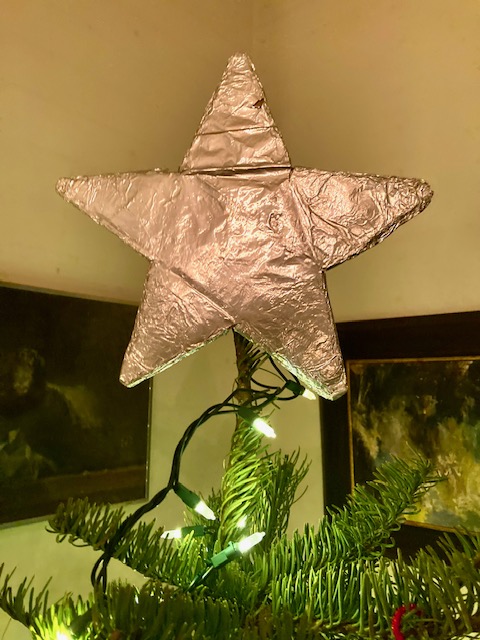
Our family Christmas tree star, going on 40+ years now

So with my paragraph I am sending out a prayer of gratitude for all the good people and things I know are here in our world.

Thank you for those who are trying to bring back our local post office. Thank you to those who are growing our food, caring for each other, those who are helping the sick, the family and friends who are suffering with illness and loss. Thank you to artist friends we know who  have risked so much to bring truth through story into our lives. Thank you.  

This has been A. Letter From A. Broad written and read for you by Muriel Murch

And supported by murchstudio.com

A Week Ago

A week ago on Wednesday.

Written and produced by Muriel Murch with WSM by my side

There was a stillness in the air – The cloud-shielded sky was hiding its sorrow that the world it was covering could well now begin to die. Conversations at the corner cafe were subdued and somber. Nobody was smiling, not even in greetings. Our American friend and neighbor and I sat together nursing our long overdue coffee moment. As we took time to catch up, he spoke of waiting for his Lithuanian passport. What in the world has changed that he is looking forward to a Lithuanian passport? 

Image by Urszula from Pixabay

A lumbering beast has come into the room, lurching forward, knocking against the chessboard where a game is forever in progress. The King has been moved and there is a new guard surrounding him. As the board shudders to a halt, the pawns in the front row of defense are jostling about, each seeking a square of safety. But there is little to be found. Even those soldiers who surround the new King will be knocked off the board before this game is over. 

Prime ministers and presidents across the world pick up their phones and press numbers stored on speed-dial. Who will they phone first, the incoming King or the outgoing President? They will make more than one call, many to be denied later in the press, for there are many corners of the board to be covered. For those – like the Taliban – who don’t have phone access, they can always post a tweet on the public notice board marked X.  Photographic coverage of war leaders shows a smiling Netanyahu and a serious Zelensky. Putin can’t keep the sly smugness out of his eyes while communication with President Zelensky is paused as support is reconsidered. The UK’s chief of defense staff said approximately 1,500 Russian troops were being killed or injured every day, while the 10,000 soldiers sent from North Korea are already suffering casualties. Now the United Kingdom is looking at its options. Possibly how to honor its word with support while changing what that support could mean. A bribe perhaps? Money rather than weapons – but there is no time for funds to become weapons.

In Gaza there are collapsed corridors of rubble where streets and buildings once stood, leaving families to scrape with their bare hands to retrieve the bodies of their loved ones. While the ‘surrender or starve’ policy has been denied by Israel, earlier this week a military official told BBC reports it had “no intention” of allowing Palestinians to return to their homes in Northern Gaza. There will be no cease-fire in Gaza. Israel will continue with its annihilation of that country.

That was the week that was – or was not – depending on your frame of reference. The English news media continue writing and scurrying around words and projecting policies while the politicians, in England and all over Europe, are shifting their papers and policies as fast as they can. The moral high ground seems to be sinking. 

I spent Wednesday and Thursday gnawing on my nails, shredding them to jagged uneven tops. Turning to the drinks cupboard, it was an easy finish of the almost empty sherry, whiskey, and gin bottles. There was not much in them to start with, but upending all three bottles of their dregs was telling. We look around and can only console ourselves with caring for each other.

Neal’s Yard Cheese shop in London by Frank Fujimoto

While politics plays out on the world stage, England continues to play out a mix of lorry-like thievery and home-grown purity. The world famous cheese market of Neal’s Yard Dairy was cleanly relieved of 22 tons of cheese in 950 wheels of cheddar valued at £300,000. While the police seriously consider deliveries to Russia or the Middle East, chef Jamie Oliver was more down to earth tweeting, “There has been a great cheese robbery. Some of the best cheddar cheese in the world has been stolen,” and added “If anyone hears anything about posh cheese going for cheap, it’s probably some wrong’uns.” 

Ah yes, Some of those wrong’uns for sure. But then there are the 5 % good ‘uns such as Paul Horton, the owner of Apidae Honey in Lincolnshire. Paul sells ‘proper honey’. Not like 90% of the honey tested from retailers selling to supermarkets – all considered suspicious by the British branch of the Honey Authenticity Network.

King Charles III at the Remembrance day Service. The Princess Royal next to him.

This weekend is Remembrance Day Weekend. For the first time in a  week the sun is shining. Whenever the date falls, the weekend Friday brings a ‘Festival of Remembrance’ at the Royal Albert Hall with the senior royals all in attendance. The service, filled with traditional music, ends with the first of the two minute silences as paper poppy petals fall on the audience of armed forces and civilians all standing to attention. On Saturday morning the Family comes out once more, leading the nation in remembering those who fought and died in the continued wars we fight. While we follow this remembrance here in England, it is played out in all corners of the British Isles and in Europe.

Sir Keir Starmer joined President Emanuel Macron for the Armistice Day Remembrance in Paris

For the first time since 1944, when Churchill was in Paris, Sir Keir Starmer joined the French President Emanuel Macron for the Armistice Day Remembrance in Paris. They stood together, Sir Keir with his red poppies, Emmanuel with his Blue cornflowers, both symbols of their country’s losses during the wars beyond the first. And in summer, in the cornfields of France and England, those two flowers, the red poppy and blue cornflower grow together, side by side amidst the wheat which is cut down in the harvest of bread and blood. The two minute silence was repeated in at 2 minutes to 11 on the 11th day of the 11th month.

This has been a Letter from A. Broad. Written and Read for you by Muriel Murch 

And as always supported by murchstudio.com

Somber June

Written and Produced for you by Muriel Murch with WSM by my side.

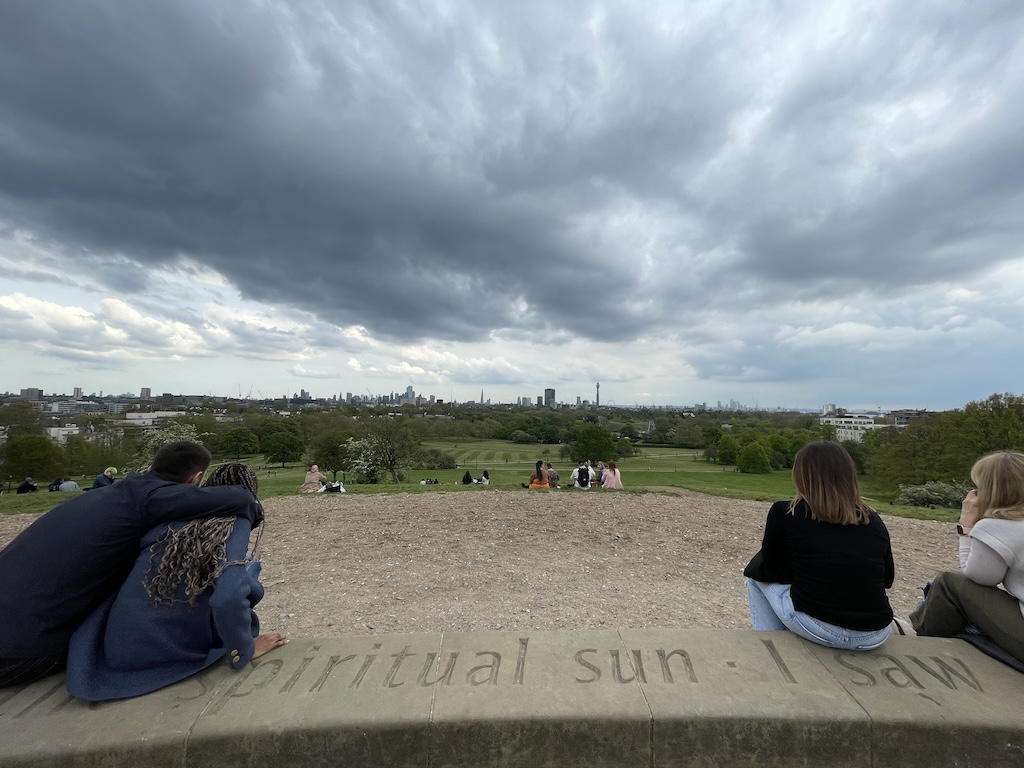
Grey skies and the London skyline over Primrose Hill by Beatrice Murch

The grey sky is pouting – there is no sun – just a half-hearted threat of rain. The London season is muted; the Chelsea Flower Show and Royal Ascot Race week do not shine as brightly in splashing colour across the weekly magazines. Even Queen Mary’s Rose garden in Regent’s Park – that in June is usually overwhelming with the attar of roses and a wild palette of colour – is subdued, while beds of favourite roses have been grubbed up and new adolescent bushes planted in their stead. On our little terrace the roses and geraniums that should be bursting with cheerful reds and yellows remain shy and closed, while the potted tomato plants stand nakedly to attention, seemingly condemned to a fruitless life. It is sobering. 

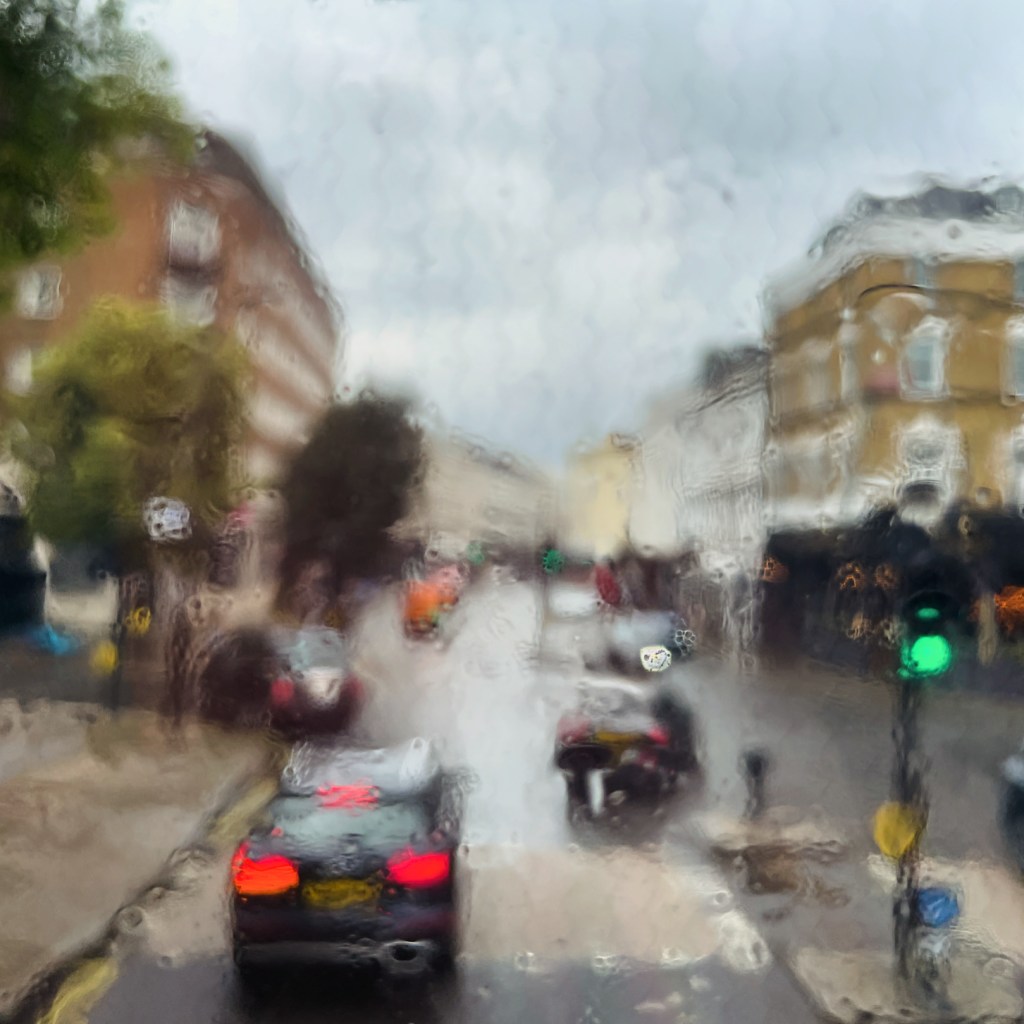
Rainy London from the top of a double decker red London bus by Beatrice Murch

At the bus stop on Thursday morning I join a small crowd waiting to catch the 31 that has gone missing from the Chalk Farm stop, “Not stopping here mate, you have to go back into Camden”. But I walked forward to Swiss Cottage – on past the road works overlooking the railway line that have been in progress for at least a year’s duration – and settled in to wait – looking as one does – for the big bright red bus to come around the corner. But it was hearing a sound I had not heard for years that had me turn my head. Sharp, fast hoofbeats and the King’s Household Cavalry came trotting smartly down the road from Primrose Hill on their way through North London to Hampstead. The traffic was stopped in all directions as the horses took over the streets – trotting in tandem, one rider with two horses. Keeping the Household Cavalry horses fit and quiet is only a part of the weeks of preparation that comes before next Saturday’s Trooping of the Colours which marks the Sovereign’s official birthday as it has for over 260 years. In April there was an ‘incident’ in London when a construction site’s sudden dumping of rubble down a roadside shaft spooked the horses and several bolted and soldiers were unceremoniously dumped on the road. It must have been quite a ruckus, as five horses  were injured along with three soldiers. Camera phones were clicking as the horses took off – galloping along the streets with blood streaming down their bodies. The incident was admirably ‘contained’ and progress information – first the horses and then the soldiers –  was metered out in the best British understated tradition.

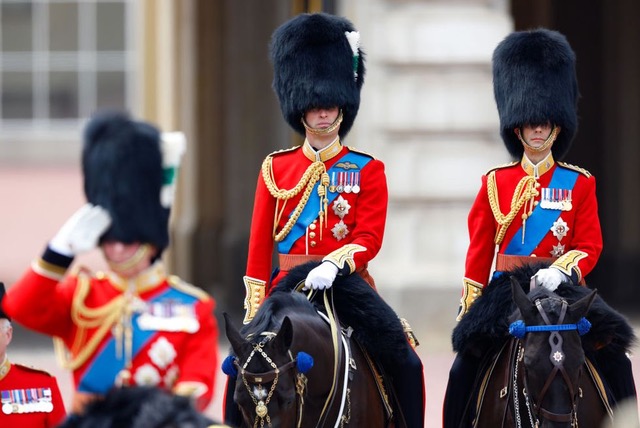
Prince William in procession photo by Getty

And so, on this upcoming Saturday the King will take the colours – not on horseback as he did last year – his first year as Monarch – but in a carriage befitting his health and doctor’s advice. And Princess Kate, the Duchess of Cornwall and the Colonel in Chief of the Irish Guards, whose honour it is this year to lead the trooping, was missing from this past week’s dress rehearsal. In a heartfelt letter to the regiment, she apologised and wished them all well and luck. As the nation does her. The silence around the princess’s illness is more sobering than the intermittent news of her father-in-law’s health, and underlines the rest of the news the country has to hear.

Not least is the snap election on July 4th called by Rishi Sunak. Standing at his podium outside of #10 Downing Street in a downpour of rain and unsuitable suit, the question of whether to raise an umbrella or not must have been a snap one, and as Sunak turned to retreat back inside – water dripping from his coat tail, he did truly look like a drowning rat, and one could not but help feeling just a little bit sorry for him. This week he was followed by the French President Emmanuel Macron dissolving the French parliament and calling for a snap election to be held within the next 30 days. The French president said the decision was a “serious and heavy” one, but that he could not resign himself to the fact that “far-right parties … are progressing everywhere on the continent”. He described it as “an act of confidence”, saying he had faith in France’s voters and “in the capacity of the French people to make the best choice for themselves and for future generations”. This is confusing to both the French people and the governing European bodies based in Brussels. How will it play out? Is it truly a bid for gathering up and solidifying a democracy that is crumbling over much of Europe and the world.

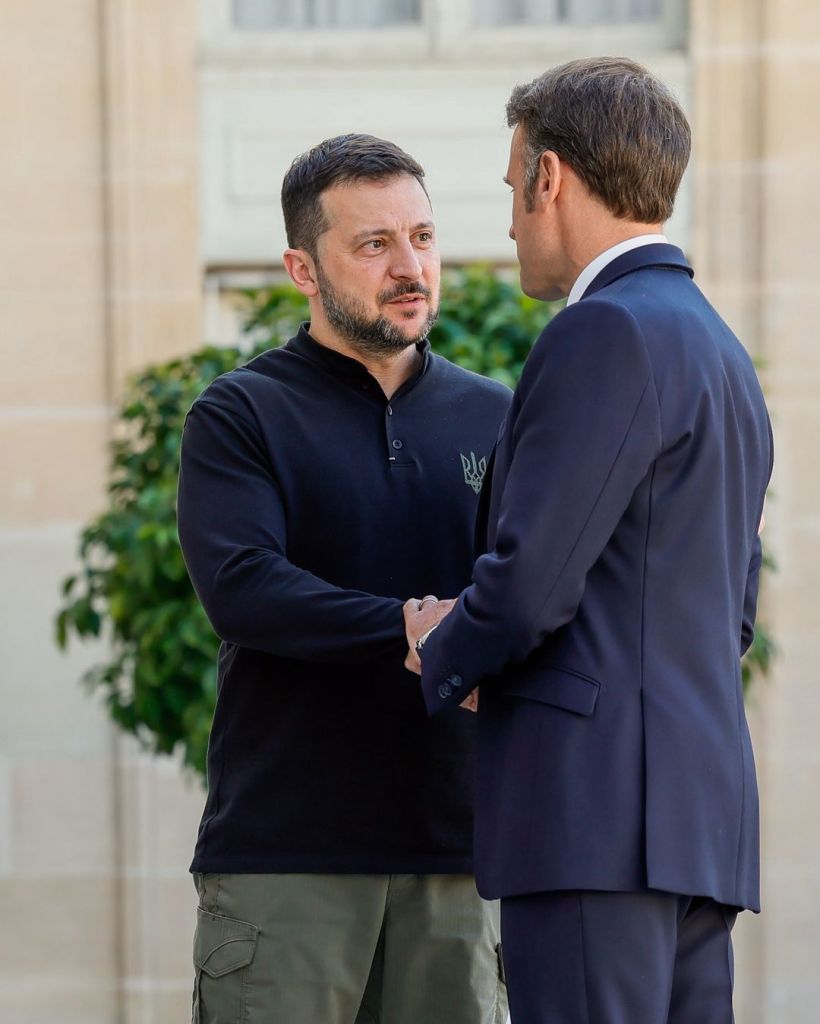
Presidents Zelensky & Macron in France June 2024 – photo courtesy of Macron Instagram

But before Macron called for his snap election – along with the leaders of the allied nations – among the Canadian, British and US, he attended the D-Day commemorations on Omaha Beach. This 80th remembrance brought together for maybe the last time, the mostly 100-year-old Veterans from all the Allied countries. A heavy dose of British royalties were also present to pay homage and show gratitude. This was also a time when the Ukrainian President Zelensky could say thank you while meeting and greeting and hopefully gathering more support for his country’s war. The Soviet Union lost more than 25 million lives in World War II and – though there have been Russian officials attending those ceremonies in the past – there were no invitations sent – or representatives present – in France this year. These wartime commemorations always bring a special pause in all countries – there are a lot of them and they do go on a bit, as they need to, because there is much that can happen there, in front of a camera or behind a closed door. President Zelensky has a lot of hustle to get through gathering the spoken, moral and physical support that he needs for Ukraine. Like chess pieces moved by an unseen magnet under the board, the world leaders who are present pick and choose which meetings and photo calls to attend. They circle each other, and the wars that they are fighting or funding. It is ironic that this commemoration, ending this war, is taking place as another war is embedded in the land that was to hold and heal the displaced people from 80 years ago. Each day – while Ukraine fights on – there is more news from the Middle East. After the carnage that killed 270 Palestinians to release four Israeli hostages, there is another US backed peace offering on the table endorsed by the UN security council – between Hamas and Israel. But there is little word of the others – refugees – otherwise known as Palestinians.

This has been A letter from A. Broad. written and read for you by Muriel Murch with support by WSM and as always overseen by – beatrice @ murchstudio.com 

Easter Weekend 2020

Easter Weekend in London brings news and time for reflection.

Some days swirl by in a non-specific haze, leading to a confusion of thought, and a seeming inability to get anything done, so that the by day’s end one wonders what did actually happen. Like older relatives and parents who cut out articles from the newspapers and mailed them to us, we now swap internet links and stories. “I thought you might be interested in …” and we often are.

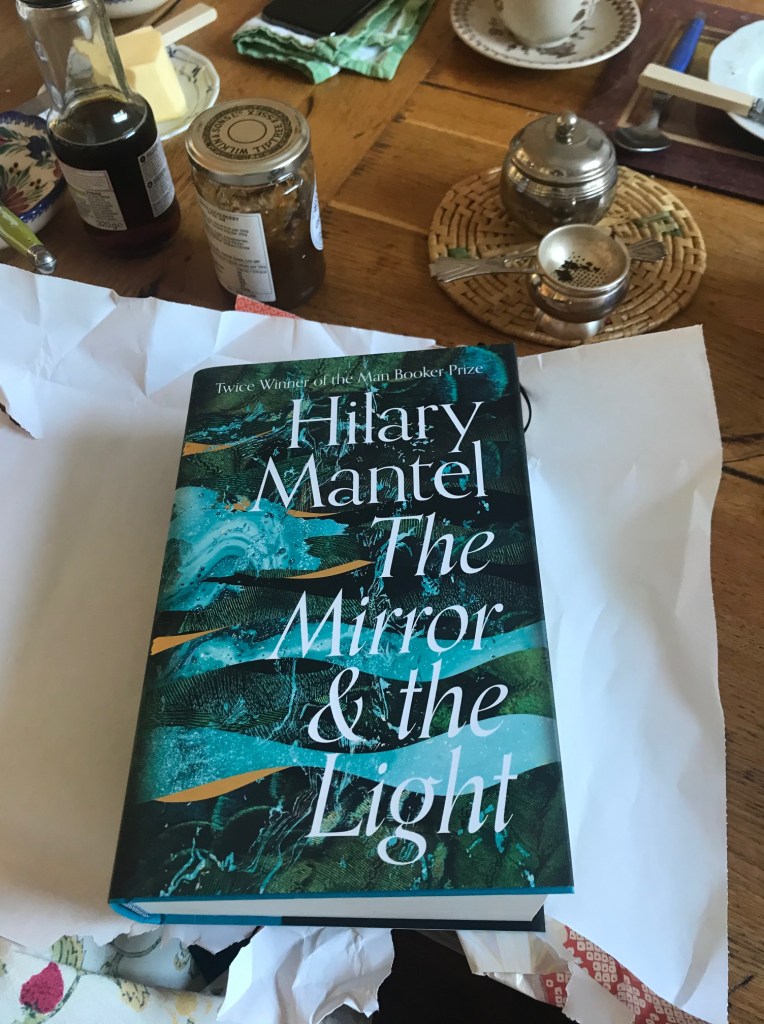
Thomas arrived for my birthday. He had been hinted at, noted, ordered from our local book shop and was wrapped up to serve beside a pot of coffee for breakfast.

Thomas at Breakfast

Hilary Mantel’s “The Mirror and the Light” brings Thomas Cromwell’s life to an end. For three days and nights I managed to resist him, continuing to read an evening chapter from “Jock of the Bushveld” an old favorite book of my mother’s.

But before even a week was over, I had picked up the hefty tome of 880 pages. I said (to myself) “I’ll just take a peek”, as if “I’ll just go for a drink with him. It’s nothing. I can get up and leave whenever I want.” But now Jock is laid aside, and Thomas has my heart and mind. I love him, more than a little bit, and am infinitely in awe of and grateful to Hilary Mantel. I am not alone. Others I know read him in this gifted time of solitude. We will go with him to his end and close the book with sadness.

When Susan Sontag published ‘The Volcano Lover’ in 1992, she went on her book tour. I was fascinated with the history and had lots of questions prepared for speaking with her at KPFA, Pacifica. But as the conversation relaxed and drew to a close, I asked about living alone in New York City. “Are you ever lonely?” “How could I be,” she responded. “I have two thousand years of history in my library.”

Here in London we both have small libraries crammed full of books that we cherish. We are both re-readers, I returning to history while he explores science. Though I’m a one-at-a-time gal there are at least seven books piled behind “The Mirror and the Light”.

My father would have been in his 70’s when I was first old enough to become conscious of his reading habit. And for him, too, this age was a time of re-reading books that he welcomed back into his life as long lost friends.

Saturday morning began in the new quiet, but by noon a helicopter began to circle overhead. There is no Prince traveling from one palace to another, and the air ambulance is hardly needed now that the London streets are almost empty of traffic. This is the police, boys with their toys, circling Primrose Hill and Regent’s Park looking for those, oh no, sunbathers and loiterers. Later, when we take our walk a police patrol car is cruising The Broad Walk. They are not walking to give a face to their presence, nor even on horseback when I might get lucky with a bag full of droppings for the compost pile.

The evening news program brings the government representatives out to the podiums with their daily bulletins. Mathew Hancock, Minister for Health, speaks his coverup nonsense “Maybe the NHS are hoarding gowns and masks which is why there is a shortage.” Priti Patel, the Home Secretary says, as one does when knowing there is a need for an apology but not ready to give ground, “I’m sorry the situation makes you feel that way.” As of this writing 8 national health doctors – all of them UK immigrants – have died. The number of nurses to have died is unknown. Today at over 11,000 deaths, England is set to overtake Italy in the number of Covid-19 deaths.

On Easter Sunday morning, the Prime Minister Boris Johnson was discharged from St. Thomas’s Hospital and driven to Chequers, the country seat of the current Prime Minister. Whatever one feels about this Prime Minister we are grateful that one more life has been saved. And so is he, giving public thanks to the nurses who cared for him; particularly Ward Sister Jenny McGee, from New Zealand and Staff Nurse Luis Pitarma from Portugal – again – immigrants.

Easter Sunday is when some look for a miracle. Not necessarily the one of a life returned, but possibly of the recognition in this moment of gratitude by the Prime Minister, for the nurses, doctors and all staff working in the health service. Doctors may cure but it is the nurses and hospital staff that keep us alive.

Old into New – again

A strange part of all of this is trying to accept that my job is to be out of the way, not on the ‘front line’ – not helping. But what to do? what is next? The table napkins are next, the first one already torn and sewn to make a face mask. I take up a needle and mother’s cotton threads while listening to history unfold itself again.

I bow my head over the work as a gentlewoman would in the Tudor time of King Henry and his Lord Privy Seal, Sir Thomas Cromwell.

This has been A Letter from A. Broad. Written and read for you by Muriel Murch.

1967

Sometimes when I get mad or sad beyond the normal ups and downs of day to day living, I recover by writing poetry which – naturally – makes much of the work unpublishable.

But the political arena of the last weeks in the USA has led me to more sorrow and anger than I have felt for a long time. It is deeply profound with a collective grief that has become personal. Private and public in the same way the wars, famine, floods, fires, shootings and political shenanigans are to any of us thinking and feeling in the world today. Maybe it is that I not only feel these assaults on women as a woman but also as a nurse. Assuredly an old one, but still active in heart and mind and even on occasion in the physical world.

Heartbeat bills in the USA as of May 2019

The governmental legislation occurring in Alabama, Georgia, Ohio, Mississippi, and beyond, leaning hard to the political far right, and the gamesmanship of these politicians, is chilling and terrifying, and reminiscent of a time when …

In 1967 I was working the afternoon 3-11 p.m. shifts in a major Hollywood hospital in Los Angeles County, California. One busy afternoon, shortly after we had come on duty, after the day nurses had left, we were making rounds and checking on our medical patients and the post-surgical patients returning from the recovery room when a phone call came to the nurses’ station. We were to take an emergency admission who would be scheduled for surgery later that evening. Hardly had I put the phone down when a gurney, carrying a young woman, came out of the lift and was hurriedly pushed onto our floor. The orderlies wheeled the gurney into a double room close to the nurses’ station and tipped the patient onto the empty bed. A clipboard with doctor’s order lay over her body.

“Start IV of Dextrose and Saline and insert a nasogastric tube STAT.” was scrawled on it, with a signature. I hardly looked to whom her admitting doctor was, just focused on the fact that she came from the Emergency Unit. Once unstrapped from the gurney and on the bed, she (I want to call her Helen) began thrashing, screaming, and writhing with abdominal pain, while gagging, trying to release whatever was inside her. Doris, my aide, hurried to get the nasogastric set-up and we called for the IV nurse to come to the floor, Stat.

The other team, of one nurse and an aide, were caught up caring for the remaining patients on the floor and there was no-one else around. Helen was beyond hearing me as I tried to explain what I had to do, for and with, her. She was obviously terrified and aside from her not able to hear me she continued to thrash in the bed. We could not hold her steady. So I slapped her. Not hard but I did slap her and I remember it to my shame to this day. But, still terrified, Helen focused on me for the first time, and our eyes remained locked together from then on.

“I need your help. You have to stay with me and let me do this for you.” Having a nasogastric tube inserted is always unpleasant and there are risks attached to the procedure, making sure the tube enters the esophagus and not the trachea and goes to the stomach and not the lungs. As Doris stood by her (and my) side she stroked Helen’s arm giving her calm comfort. I managed to insert her tube correctly and immediately a torrent of brown fluid came up. The IV nurse arrived and started the intravenous fluids into Helen’s veins.

Soon Dr. L., a gynecologist, arrived. He was quick and brisk but also quiet and reassuring as he spoke. Helen was prepped and soon taken to surgery. Later that evening she returned to us. Dr. L. was tight lipped when he too came back to the floor to write up his notes.

We didn’t talk much at the nurses’ station. I was young and naive enough to only begin to understand what had happened to Helen. Who was with her? She had come to us alone but someone, a friend or family member, had got her to Dr. L. and he had managed to save her life if not her uterus. It was clear this was not the first time he had taken such care of a women. His tired face showed that he feared that it would not be the last. Helen recovered, walking the hall carrying her IV pole, catheter and shame. She discarded the IV and the catheter over the next few days, but maybe she took the shame with her when she was finally discharged.

That was 1967, within so many of our life times. Those of us fortunate enough to have lived within relative control of our bodies need to remember to be grateful. Women around the world today still carry unwelcome and dangerous pregnancies. The thought that so many young people within once enlightened societies could again face such a situation is beyond chilling and beyond poetry.

Humpty Dumpty

Humpty Dumpty sat on a wall,
Humpty Dumpty had a great fall.
All the king’s horses and all the king’s men
couldn’t put Humpty together again.

And it went on. Now, after almost three weeks of tumbling down I’m still so sad and angry, watching as the English politicians made such a cock-up of their dear referendum. Yes I’m going to say that. Though in a global view this is small blip. America is churning and bleeding to death and Africans are dying in the Sahara desert, the Libyan jails and finally the Mediterranean ocean as they struggle to escape a certain death for a less certain life. But still, I’m so sad and mad. I don’t know when I have struggled so to write. If this was a yellow pad, which it was earlier, I would be back at the stationary shop buying another one. But the emotions that have been going around and around in my (and a lot of other people’s ) head, as the television and newspapers reports changed, history being eloquently rewritten every day and Great Britain as it was is no more.

That morning, the one when we all woke up to the Brexit decision was sobering and most of the country, even those who voted out, to show ‘them’ a lesson were stunned and grieving as the realization of what could come to pass began to sink in.

The eye watches London

The eye watches London

So I’ve read, and read and read, mostly coming back to The Guardian editorials which are the ones that make the most sense – to me. I’m suspicious even of my beloved Telegraph, seeing hidden agendas in each opinion column and page. But there are good articles. Lighthearted and accurate from Buzz-feed and somber and intellectual in The Guardian. Maybe there will be a breather today as the politicians wait for Her Majesty to return to London. The Queen is not going to break off other engagements just because these boys have all behaved so shockingly badly.

The weekend after the vote we took a train to Shropshire to visit with a beloved old friend who lives deep in sheep country. That evening he took us and another couple who were staying in Wales, (with more sheep), for dinner. The long evening light was still with us as we climbed out of the taxi (no drinking and driving with this crowd, who can still drink as if they were twenty). Our driver, a young lad, was built like a Sumo wrestler. Overflowing from the van’s upright driving seat he yet held a gentle hand on the wheel and had a sure knowledge of the small country lanes and the farmers heading towards us.

Deah heading the roses

Deah heading the roses

Summer roses

Summer roses

The following day it became clear that ‘a spot of lunch’ was actually a full blown ‘Luncheon for 30 plus’ and I was going to be vastly under-dressed and under-blinged. While the most amazing meal was being prepared in the garage, I was set to deadheading the roses, which with all the rain and very little sun, were glorious.

At noon the guests began to arrive. It was time to change from jeans to a not quite dressy enough skirt and join the friends who had come to share this day. As we sat down to lunch I took the opportunity to really find out a little more what people were thinking, and how they voted. I became impolite, asking those questions one never discussed in public (politics and taxes). Here were the land owners of Shropshire. The charming gentleman on my left was happy to tell me why he had voted Brexit, “We don’t like being told what to do,” And by “we” he did mean all of us, the Sumo wrestler driver, the milk-man, the chicken farmer as well as the Lords of the Manor (most of Shropshire’s around the table) were of one mind.

“We don’t like to be told by Angela Merkel. We don’t like to be told by George Osborne. And we don’t like to be told by Your Barack Obama.” And so out of sheer bloody mindedness they, to a man and woman, voted out.

“To show those politicians what we think.” The rifts that have erupted within families are startling and have taken this grey haired and somewhat still with it generation by surprise.

By the time the cigars and snuff were coming around I was being sleepily interrogated by Algie, (Algernon Heber-Percy Esq.) Shropshire’s very own lord-lieutenant. As the Queen’s representative in the county he could not venture his opinion. But by the languid body language he displayed as he placed his pinch of snuff surely on the back of his hand, he showed that he too was with the aforementioned gentleman on my left, his shepherds and arable farmers.

Today the Queen will return from her morning of duties and have time for a light lunch before meeting with David Cameron (let’s hope he doesn’t whistle a happy tune on his way out of the palace). Then maybe she will have time for a soothing cup of tea before she summons Theresa May to formally ask her,

“Can you command a majority in the House of Commons?” May will say ‘Yes Ma’am I can.”  May might add a curtsey and there you have it. While those two politicians are trotting in and out of the palace moving vans will have been in and out of three houses and on Thursday morning Great Britain will wake up to a new Prime-minister.

Grey skies over Westminster

Grey skies over Westminster

Meanwhile Humpty Dumpty will join his nursery rhyme pals, other eggs who have fallen, and lie broken on the ground, below the wall and under the benches in the House of Commons. They will pretend to care. Some will be swept up and discarded. Others might return to their seats, now knowing how precarious their hold and seat is on the wall. Who knows, one or two may even reach out for a drink with Tony Blair, also bruised if not bowed. The Chilcot Report has been released and the film ‘We are Many‘ is being shown in theaters again and again.