An Inquiry

Written and produced for you by Muriel Murch with WSM by my side.

โ€˜Yes Ministerโ€™ first aired on The BBC television in 1980 until it ended in 1988, possibly due to the fact that it was becoming harder to distinguish the comedy series from the nightly newscasts that followed. Among the many quotes attributed to the Cabinet Secretary Sir Humphrey is โ€œMinister there is going to be an Inquiryโ€ to which the reply from The Prime Minister Jim Hacker is โ€œOh good, then nothing will happen.โ€ Well yes and here we are again –ย 

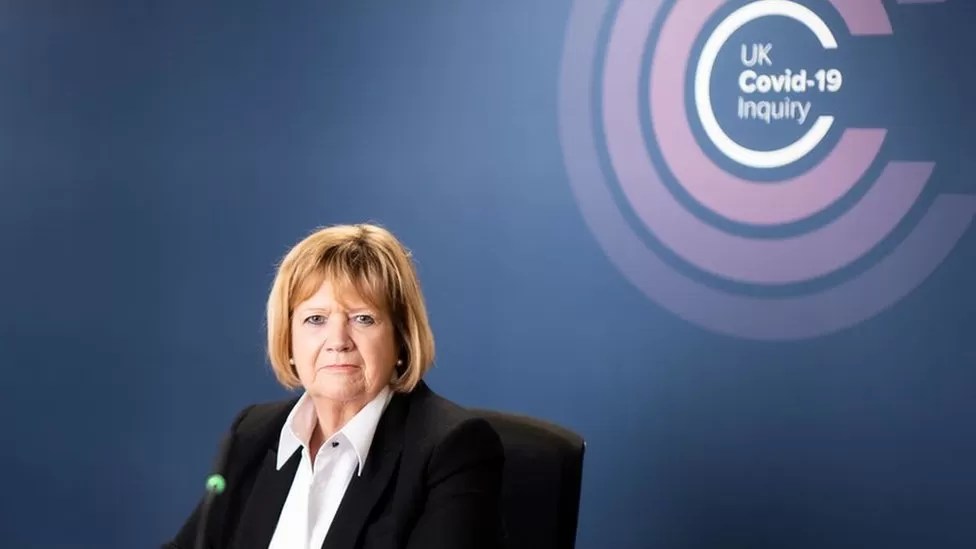
Baroness Hallett promises the inquiry would be ‘thorough and fair’. Photo from Piranha Photography.

Last week saw the beginning of “Britainโ€™s Public Inquiry” to understand the Conservative Governmentโ€™s responses and handling of the Covid pandemic. But for the life of me, I canโ€™t find out who is in charge of “Britiainโ€™s Public Inquiry” and what – after the facts have hopefully been gathered – will happen? Will lessons have been learnt? Will those deemed responsible be held responsible? Will there be any retribution? Will anyone be called before a court of law or those pages of documents produced be filed away rather than read. Last week when Dominic Cummings gave his testimony he asked that the inquiry also focus on the broader failures of the system. Reading – for I canโ€™t listen to them talking – it is clear that as blame is shuffled about like pearls under walnuts, the prize goes to the then Prime Minister Boris Johnson. Dominic Cummings likened working with Boris Johnson to driving a shopping cart with a wonky wheel.ย 

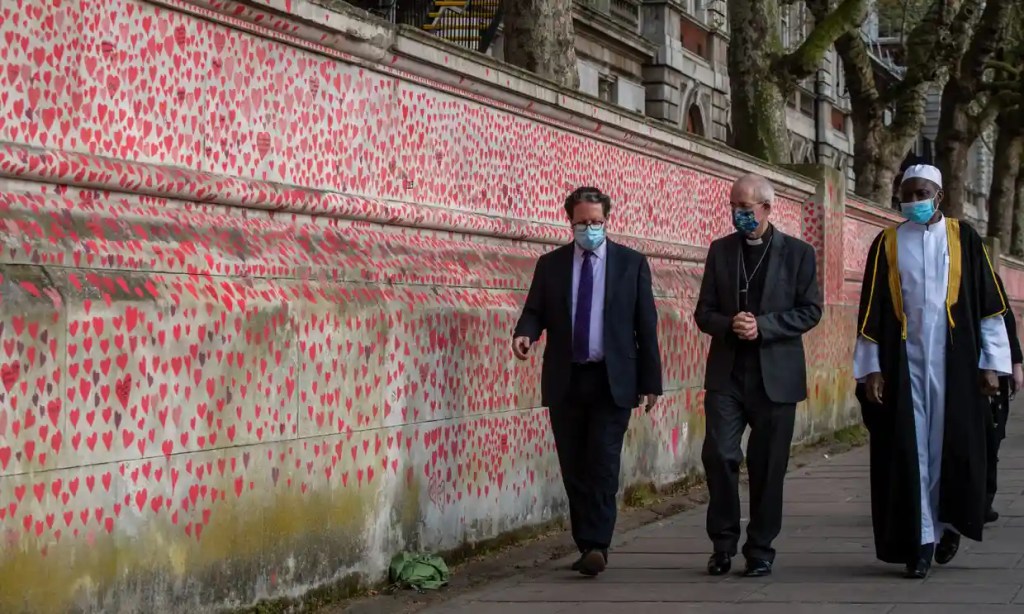
It is not without irony that the inquiry is taking place at Whitehall just across the river from the Covid Memorial Wall that was created and painted in 2021by people who had lost loved ones, or worked in the NHS, coming together with the good guidance of the group โ€˜Led By Donkeysโ€™. Over 240,000 painted hearts cover more than a third of a mile alongside the Thames River outside of St. Thomasโ€™s Hospital. During this time the public were afraid and looked in vain for leaders in the government where all the common sense had been bred and educated out of almost anyone in Westminster not yet of pensionable age. It was like putting drones in charge of the beehive to collect pollen and care for their queen, when all they could think about was kingship and sexual obsession.ย 

From left: Rabbi Daniel Epstein, the archbishop of Canterbury, Justin Welby, and Imam Kareem Farai visiting the wall in April. Photograph: Chris J Ratcliffe For Covid-19 Bereaved Families For Justice/Getty Images

People are booking their theater seats. We follow the inquiry like a serialized Charles Dickens story in the magazines of the day. Up to testify next are the past Prime Minister Boris Johnson, his hovering henchman Matt Hancock, and the holder of the chair at the moment, Rishi Sunak. But it is the failings of one particular individual, Boris Johnson, who was ultimately responsible for directing the government, which will continue to be scrutinized in the months ahead. Johnsonโ€™s successor-but-one as prime minister, Rishi Sunak โ€” who was U.K. Chancellor during the pandemic โ€” also has questions to answer. All three men โ€” Johnson, Sunak, and Hancock โ€” are to appear before the inquiry in the same week at the end of November.ย 

Photo Credit to Art Center Wikipedia

Sunak has thrown his dead cat into the ring – by hosting an international AI conference on safety issues that was held at Bletchley Park. The conference produced some back-patting for, and from, the UK, US, and European leaders who attended while getting a nod of approval from the United Nations. Elon Musk arrived to give a speech and chat with Rishi at Downing Street. Both men in their uniforms, Elon remains rumpled and a little unshaved while Rishi rolls up his pristine white shirt sleeves possibly looking for his next job opportunity after this gig is over. So will anything happen from this inquiry apart from “Lessons have been learnt”? The Infected Blood Inquiry – the Stephen Lawrence Inquiry – and the Greenfield Tower Inquiry – have each chipped away at this UK government, but not a lot has changed. Could this inquiry be the one showing that Britainโ€™s democracy has really gone up in flames? Iโ€™m writing on Guy Fawkes night – our night of fireworks – celebrating the failure of the 1605 attempt to blow up the Houses of Parliament. We may be holding our breath and will it happen this time? I cannot watch the inquiries – it is too painful – so instead I read.

in an interview, the American thinking and writer, James Baldwin, said “You must realize that if I am starving you are in dangerโ€. And in this simple truth, buried deeply, lies some of the reasons the wars are being fought all around us. Johnathan Freelander writes eloquently and with great heart in this weekendโ€™s Guardian Newspaper, that no side of the Israeli, Gaza, and Jordan triangle conflict are searching for a peaceful conclusion – at this time. In Pulse “Stories from the Heart of Medicine,” I read a translated account from Hadar Sadeh, an Israeli youth psychiatrist working at a Medical Center, about twenty-five miles from the Gaza Strip. Then I open an email from our Palestinian friend and filmmaker, Annemarie Jacir. Each woman weeps at the death of children and physical destruction that they see around them. Each letter could have been written the other.

And see how the war in Ukraine gets roughly pushed to one side even as we know it continues? Old statesmen take planes from one capital city for talks then board another, exchanging their suit jackets for a flack vest as they land in a war zone to encourage young men to face death bravely for their country. Ukrainian President Zelensky rightly worries that this other war is distracting from support to his war – defending Ukraine from Russiaโ€™s invasion. How much can we carry in our hearts? And tucked away even further is the news that Russiaโ€™s President Putinโ€™s arch-opponent Alexei Navalnyโ€™s three lawyers have been detailed. They are facing trial for participating in the so-called extremist group, Navalnyโ€™s Anti-Corruption Foundation. If they end up in jail then all contact to the outside world will be lost for Navalny. Each of these eruptions is bleeding like an aspirin-fed wound and all the pressure that is applied will not staunch or stop it any time soon. ย 

This has been A Letter From A. Broad written and read for you by Muriel Murch.
From Wards to Words and Back Again

It was 1995 when Between the Heartbeats Poetry and Prose for Nurses was first published by the University of Iowa State Press. Conceived and edited by Cortney Davis and Judy Schaefer, this was the first Anthology of Creative Writing by Nurses, gathered from around the world.

Heartbeats at Chapters Bookstore DC

Between the Heartbeats writers at Chapters Book Store, Washington DC, 1995

ย For many nurses it was the first time our medical writing had been accepted for publication. That summer as many of us who could, maybe twenty out of fifty contributors, came to Chapters Book Store in Washington DC for our first ever reading. This coincided – not unintentionally – with the annual general convention of the American Nurses Association. The evening was exciting, scary and thrilling. Scary because we were reading our own work and thrilling because we were hearing the words and work of other nurses. All of us facing the same direction, our voices so different and yet so deeply in tune with each another. There was an audience, listening, applauding and asking questions. One man spoke up,ย โ€œWow, this is amazing. Canโ€™t wait for when you present this to the ANAโ€. We were all silent before Cortney, in her calmest most diplomatic way, (her speciality) replied,ย โ€œActually we wonโ€™t be at the convention. They donโ€™t want us and wonโ€™t let us present the book there.โ€ Among the audience were nurses who would be at the convention. We were all stunned, silenced and sobered that those nurses for whom we wrote did not deem our words necessary or supportive of their work.

As nurse writers we came together for that weekend forming a tight union of sorts, loosely knit, tendrils of thought, vision, each of us seeing and transforming through words, our patients in the wards, clinics and communities we serve. Since those early years we have continued to write, sending each other our books, reviewing and commenting for each other, hosting nurses writers on the radio and spoke of our work to audiences wherever we could.

Coming together was always a chancy affair but we get our moments. Two years ago The Medical University of North Carolina held its first โ€œNarrative Bridge Conferenceโ€. Five of us, Jeanne Bryner, Cortney Davis, Veneta Masson, Judy Schaefer and myself, made it there for the long weekend;. We were billed as “The Nurse Poets” and that is what we have become. Through the years more books of poetry, prose, creative non-fiction and novels have been written and published and within the โ€˜about the authorโ€™ description the word โ€œNurseโ€ always leads. This is who we are, this is where we speak from, whenever and wherever we can.

It was Lisa Kerr from the MUSC school of nursing who again called us together this year. Lisa wrote asking if we could come, not only to speak to the faculty and students of the nursing school but that there could be an opportunity to perform as The Nurse Poets in the annual Piccolo Spoleto Arts Festival at the Dock Street Theatre. New books had been published, among them, Jeanne Brynerโ€™s poetry Smoke, Cortney Davisโ€™ When the Nurse Becomes a Patient, which won an American Journal of Nursing Book Award for 2015 and my 2016 The Bell Lap Stories for Compassionate Nursing Care were all hot off the press and we were eager to share our work. I was ending a roll-out with The Bell Lap, coming down from New York and a launch at the National Arts Club with the great cartoonist, and tonight – host – Roz Chast whose book about the final years of her parentโ€™s lives Canโ€™t we Talk about Something More Pleasant, remains a best seller.

A little help with the night before prep.

A little help with the night before prep.

It was – is – fun to be on the other side of the microphone. This was a first for Roz who is more used to being questioned about her work, and almost a first for me, being more used to asking those questions. With her questions and comments, memories surprised me and in the quickness of the moment words did not always take the long route – through my brain – as they rushed from my heart to my mouth. Maybe it was not the smartest thing to recall โ€˜my first leg,โ€™ after Rozโ€™s question about my failed operating room experiences. And so we learn. Beloved friends were there and I was more than grateful to see nurses in the audience, plus a doctor or two. Paul Gross and Dianne Guernsey who co-edit Pulse Magazine “Voices from the Heart of Medicine” came in on the train, Cousin Tom rode the bus from Cap Cod and nurse colleague Gerry Colburn traveled in from New Hampshire.

Tony and Peter and MAM

A Hug from Tony and Peter After it is all over.

It was a great evening and gave me the needed boost and courage to fly down to Charleston and join the band – not yet a rock band – The Nurse Poets.

Four of us had made it and it was grand to be together. Jeanne had driven for two days from Ohio. Cortney flew from Connecticut, Veneta from Washington DC and I from London, via New York. At breakfast we celebrated with coffee and grits. We quickly shared our stories, families, the agonies of book promotions and knowing as all women of a certain age do, that we will continue to balance these lives until illness, infirmity or death claim us.

At noon, under Lisaโ€™s guidance, we spoke at MUSC nursing school for more faculty than students but how eager they all were, how they knew the importance of story, the lives led before and beyond the illness of the patient. Then an afternoon break before being driven past the Emanuel Church where flowers are still laid out daily in remembrance of last years tragedy to an early supper of fine southern food. (Where oh where do I get the real recipe for Green Fried Tomatoes?)

Then we walked to the Dock Street Theater where the audience was already gathering for our evening performance. The theatre is nestled in a small courtyard, intimate and perfect for poetry readings. The seats filled quickly and chairs were added along-side the cloisters until there was standing room only. We sat, warm but not hot, under the evening sky. Our time was tight, and so were we. Introductions by Barbara, the organizer of the festival. then Lisa, organizer of us and then, following each other in alphabetical order, we were on. Each of us brought our full-to-overflowing hearts to the mics and poured out our words. Jeanne watching family, Cortney and Veneta their clinics, and I from the wards and communities before returning to nursing school with an excerpt from The Bell Lap.

Veneta Masson, Cortney Davis, Muriel Murch, Jeanne Bryner

Veneta Masson, Cortney Davis, Muriel Murch, Jeanne Bryner

The audience rose to applaud these words that came from our hearts and our memories. Why did they love us so? We were good ๐Ÿ™‚ yes but was it just the words, or was it the knowledge that with these words they know we have seen them, as people before patients. We have marked and held them in our hearts and returned them to themselves, thus received and healed, if not cured. Giving this audience an understanding that as these words have come from the wards to them they may also return to the new young nurses of today.

Jeanne, Miriam from L.A., Venetta and Muriel

Jeanne, Miriam (The next generation), Veneta and Muriel enjoy the reception for The Nurse Poets.