Behind Closed Doors

Written and read for you by Muriel Murch with WSM by my side

The Piazza Santissima Annunziata is almost empty with only a few tourists bearing the late afternoon summer heat while seeking refuge in the churches and museums. Idanna drives straight into the empty Piazza and parks the car. We get out and look around. In the center sits The Grand Duke Ferdinand (from 1608) astride his horse. The horse is facing the little telescope alleyway that leads directly to the Duomo, but the Duke’s eyes, if you look carefully, seem to glance up to two windows, three stories high, on a red building. The shutters remain open so that through the centuries he can look to, and be seen by, his mistress behind them. His arm is raised in salutation to the Pope of the day, or to her – it is left to the onlooker to imagine. On another side is the hospital of the Innocents, an orphanage and museum still run by the nuns from the Sisters di Maria. A small grilled window sits facing the square where – at night time – a mother could – between 1660 and 1875 – raise the grill and lay her new-born babe on the rota where friars, on their night-time shift, sat waiting for a delivery, not as midwives for a wanted child, but as caretakers receiving the fruits of enslaved and then abandoned love. These are the buildings and stories we take in as we make our way to the side door of the Church of Santissima Annunziata, for our friends, Idanna Pucci and Terence Ward have something to show us.

The Key to the door.

“It is a surprise,” says Idanna after we had stopped at the Palazzo Pucci to pick up the ancient key that would have weighted heavy on the twisted cord belt of a monk’s cassock. Again, her face lights with that impossible grin she has when holding a happy secret. The door is thickly double paneled, over eight meters tall, and the strong wood is sun-cracked. Terry takes the key from his pocket and places it in the single lock.

In the bright late afternoon sunlight the key is reluctant to turn and it takes several wiggles before it catches and the door is opened. We enter the tall cool space of this chapel dedicated to St. Sebastian and now lovingly restored by Giannozzo and Idanna Pucci with the help of World Wide Friends of Florence.

WSM and Terence Ward look up to St. Sebastian.

Terry gathers the three red velvet chairs placed in the chancel for musicians together and we gather around as Idanna tells the story. Her lilting voice takes us back to 1082 when a little house of prayer was dedicated to St. Sebastian, then leads us down the path of history through the Middle Ages, the building of this church of the most Holy Annunciation and this chapel, to the paintings commissioned, sold (by one of the unscrupulous relatives) and now lovingly replicated through the guiding hand of her brother Giannozzo. Her voice sings with the joy of the story, coming to when the chapel was reopened and rededicated in May of this year. Idanna is grinning with the happiness of sharing their gift to the city with us. They then lead us around the three major paintings of Saint Sebastian hanging above the alter sanctuary while underneath there are sculpted reliefs of Pucci ancestors, the good and the maybe not so good. Finally we look up at the breathtaking cupola. As we lingered in the beautiful sanctuary a guide from the main church brought in two more visitors to see this sidebar of history. Taking our leave, we walk over the moveable stones that cover the crypt holding Puccis and maybe even a Medici or two. “Have you been down there?” I ask Terry, and he firmly shakes his head. “I have looked. It is a jumble of bones all tossed about, from the flood’. In 1966 the Arno river flooded and swamped Florence ravaging much of the art and bibliotic heritage of the city. The Pucci crypt would be one among many holding places of the dead to be tumbled into confusion and dust. Leaving, Terry turns the key once more in the lock. Walking to the car in the still almost-empty Piazza, I silently said goodbye to the orphanage museum, the Convent of the Sorelle di Maria and the old Duke with his arm raised in salutation.

The Hospital of the Innocents – Orphanage and Museum – Photo by WSM

With our time in Italy we missed the final run up to the UK general election and returned only in time to watch Ukrainian Prime Minister General Zelensky meet his Hungarian counter part, Victor Orbán. Orban, who for six months more is head of the European Union, then went on to chat with his pal Vladimir Putin.

Orbán and Zelensky meet

The countries that make up the EU cried ‘Foul, He is not speaking for us,’ but Orbán merely shrugged, figuratively speaking, saying he was just going to listen and hear what each side has to say. He may be dreaming to broker a peace deal – always a good thing to have noted – but his hand is more eager to grasp Putins’ than Zelensky’s. As each Eastern European leader swims across the tides of history pulling and pushing the boundaries of their country it is within our memory to recall Hungarian refugees arriving in England while fleeing their own county’s oppression.

As July 4th – the UK polling day ended – TV screens lit up like a game show as presenters pointed out which constituencies were turning from blue to red with touches of amber for the Liberal Democrats and green for – well – the Green party. But it is the red of a Labour takeover of the country that has prevailed. As Dishy Rishi drove off to hand his resignation to the King, the movers were quickly packing up the Sunaks’ plates and cutlery, curtains and bed linens to take out of the back door. An hour – or is it two –  later, steady Sir Keir Starmer was off to Buck House, asking the King’s permission to form another government. The handover has to be quick so the country is not left to its own devices. The moving vans are as quick in and out which is rather lovely, for #10 Downing Street is just an old run-down city house in constant need of repair. The inconvenience of any refurbishments only heightens the impermanence of the position, as power comes and goes and hopefully, while you have it, you can do more than change the curtains.

Sir Keir Starmer has not been idle. The smell of Pledge furniture polish was barely cleared from the cabinet room before he gathered his new team around the oval table and gave them each their work orders for the weekend. There was not an old Etonian among them and there would be no potting shed moments. For some, their bags were already packed to fly out, meet and greet, and start work. The weekend saw Keir begin his trip around the British Isles meeting the other UK government leaders. While with the First Minister of Scotland, Sir John Prescott, the chants from protest marchers could be heard through the ministerial walls before Sir Keir was whisked away past the waving Pro-Palestinian flags to meet the First Ministers of Wales and Northern Ireland. On Monday, he arrived in Washington DC, attending the two day Nato conference, filling his movable dance card with more meetings of world leaders, some who are uncertain about their political future. As Sir Keir enters the stage, others are exiting, stage left or right or hovering in the center holding an unenviable heavy portfolio. While Zelensky can be assured of continued support from the UK, the State of Israel, Gaza and the Palestinians remains out of balance. The elections in France have handed Macron a mixed plate but there is relief that, for the moment, the Far Right parties of Farage in England and La Pen in France, though now more visible than ever, have been contained – but only just.

When thirteen of us gathered together at a Palestinian restaurant on the Marylebone Road, for a Coup 53 reunion and an early celebration of Walter’s 81st Birthday, I looked around the table counting our birth-countries: Sweden, The Caribbean, Finland, Iran, North America, Ireland, and England, and am grateful to break bread in a place of such multiplicity.
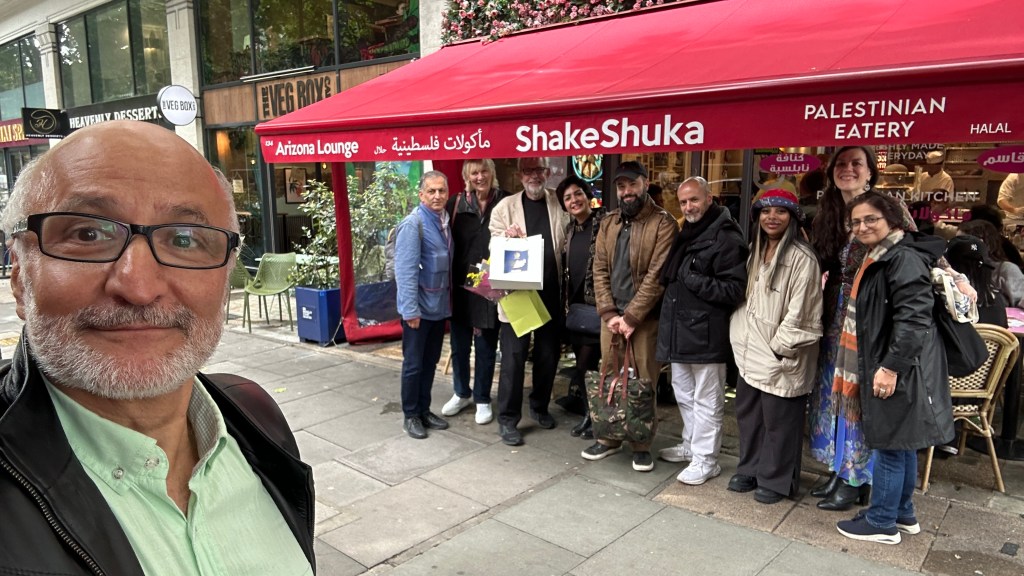
Taghi Amirani and team. Photo by Taghi

By the closed door of the ladies, I stood with a tall, young, beautiful Palestinian woman just back from the day’s march. “How was it?” “Really good, we were over 100,000 strong.” Smiling together we know that however dissimilar we appear our women’s hearts beat in one accord. 

And always supported by Beatrice @ murchstudio.com

The Sky is Crying

Written and Produced for you by Muriel Murch with WSM by my side.

“Look Granny, The sky is crying,” David says as he peeks out from underneath our umbrella. And we laugh because the rain is soft and light and warm and we know that it is just a little late May-time cry from the sky. And of course it is raining because the cottage windows have just been washed.

The park Elderflowers are bowed down with the rain

First I see his ladder, it wobbles as he perches it up against the study windowsill before ringing the door bell.

“ello Aggie – I saw you was back.”

“Perfect Chris – I have been thinking about you wondering when we would catch up. How have you been?”

“All right – middling you know.” And together we laugh as old friends do. Chris drives up from Sussex and parks his van somewhere in Camden. His tools are simpler now, an old wooden six-foot ladder that is wrapped in cloth and duct tape to protect the windows, a black plastic bucket, spray bottle of dish soap, window wiper, and cloth. He has a route of regulars through Camden, up Parkway and Regent’s Park Road before curling down through Primrose Hill until he has had enough for the day and can circle back to Camden, load up his van and drive home before the commute traffic gets too full. 

“You’re limping more,” I say to Chris, Such is our familiarity over close to 20 years that I can say such things. 

“it’s uh cyst on my muscle,” he replies. “Never heard of such a thing.” And he limps up and down the stairs. Chris is a London lad who, with his move to Sussex, has dipped his toes into semi-country living. He is old school and while he will go to the doctor he will not voluntarily step foot in a hospital. With Dickinsonian knowledge he knows well that you can die in there. As Chris does less for us – I pay him more. No longer able to hoist a big expandable ladder, nor not steady enough to carry our flimsy one upstairs, he no longer clears out the junk and leaves from our gutters. There was a time when he could reach the outside of the upstairs kitchen window and then help me replant out that lonely flower box. But no more. He can’t get up on the ladder and I can’t get onto the kitchen window ledge. About an hour in it is time to ask. 

“ Would you like a cup of tea now Chris?”

“Oh, wouldn’t mind at all.” And so I make the tea. Chris is close to finishing up but the tea must come as tea break – not the end of the job. With milk, no sugar, and two biscuits. Chris needs the break and I sit down beside him. It is time to talk over matters most serious. But before we start Walter comes up to say hello and goodbye.  Chris doesn’t quite stand up but returns Walter greeting.

“Morning Sir, you are keeping her well then I see.” While my husband chuckles his response I feel like an elderly dairy cow – still producing. But this again is our familiarity. Now it is time to get comfortable with our conversation.

Chris tells me of his sister in France – doing well with her family. And then it is on to politics. 

John Swinney is sworn in as First Minister of Scotland – Photo from Hollyrood

The Scottish National Party is doing the Highland Reel with their changing of the presidential guard – for a moment longer – the leading Scottish governmental party with the First Mister of Scotland, and have just chucked out their leader Humza Yousaf as First Minister. He seemed to go quietly – almost too quietly – some saying he fell on his own sword with his dismissal of a collaboration with the Green Party and then begging them back to no avail. Sir John Swinney steps up to the helm, saying he will continue Yousaf’s independence strategy. A brown man steps down for a white one – who – admittedly is apparently untarnished – unlike Nicola’s Sturgeon’s husband Peter Murrell or her mentor Alex Salmond, neither one as yet in jail for any financial slipping and sliding and who both look like 19th century Moreland farmers still eating beef in quantities over and above the necessary calories for sitting around in government houses. Stepping up to the microphone as the new first minister, Sir John Swinney is trimmer. At first this looks like a right old stitch up, but maybe he is a guiding tugboat bringing this limping ship of the Scottish National party into safe waters. It remains to be seen.

Prime Minister Boris Johnson with his dog Dilyn after voting at a polling station in London in 2022. (Photo: AP/Matt Dunham)

Meanwhile Chris and I continue, curling our lips in mock horror at the buffoonery of Boris Johnson showing up to vote in the English by-elections without any ID – a law brought in by his government under his watch – and his – “you’ve seen me with my terrier dog on a lead” – just does’t cut it. We shake our heads in mutual disdain. Now the tea is finished, and it is time for Chris to carry on along his rounds and we say goodbye until he comes knocking on our door again in a few month’s time. I will see him through the summer, with his little ladder propped up against the window of a rock and roll bar on Parkway.

As the by-election results come in we watch the Tory party begin to implode. Rishi Sunak holds a tight grin as he speaks and congratulates the few Tories who have held onto their seats. A photo-op occurs in an Indian Restaurant where he is filmed chopping carrots with such inefficiency that the by-standing chefs are biting their lips and holding a tight smile as if watching a child with a knife for the first time.  The Labour Party Leader, Sir Keir Starmer tries to look hard-working and casual as he goes about the country congratulating those who have worked hard on winning their labour seats. Poor man – someone should tell him that a white tee shirt under a jumper doesn’t suit every male figure. And all this hopping about the country for these by-elections puts the real business of government aside. The Conservatives are in the process of taking a whipping at the polls and government ministers are shuffling from one foot to another, not yet quite sure where to land and where to speak. 

But Foreign Secretary Sir David Cameron has stayed busy, and along with the French President Emmanuel Macron, committed money and arms to Ukraine while still trying to broker any kind of peace in the Middle East. Russia’s President Putin has plenty to say about that.

The student protests with Pro-Palestinian sympathies about the bombing of Gaza are growing around the world, each country’s universities going about their demonstrations in their own cultural way. On the campuses here in England, because so far there are no overt clashes between the students, the administration and police, they are not covered by the evening news. While the young students and some professors already know the cost of speaking out, they are prepared to do so. When asked by the Guardian columnist Nesrine Malik about the cost – of their education, their reputation – a student replied, “The students in Gaza don’t have schools to protest in; they don’t have medical care to be taken away from them. This is nothing compared to what they’re experiencing.” Could it be that this time it is the young of the world who can silence the guns of war.   

This has been A Letter from A. Broad. Written and produced for you by Muriel Murch

And always overseen by – beatrice @ murchstudio.com 
Fading Flags

Written and produced by Muriel Murch with WSM by my side.

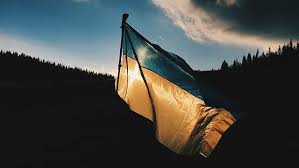
Driving out along the lagoon, over the mountain, and down the twisting road through the Redwoods into another town, the large Ukrainian flags are faded and torn but still fluttering under the trees.

They look weary like the soldiers themselves must be. That war, between Russia and Ukraine, is into its second year and is now being jostled out of the headlines and overtaken by the three way shootout that is occurring between Gaza, Israel and Palestine. The weariness that is shown by the torn Ukrainian flags is but a reflection of the faces of both the Ukrainian and Russian soldiers. Satellite pictures of Russian graveyards show their expansion and a rough estimate is over 50,000 Russian and 31,000 Ukrainian troops killed from this war so far. Mothers do not like to hear such numbers and know that their sons are among the fallen.

Daily, more young, untrained Russian boys and old men are sent into battle to wear down the Ukrainian military. In 2022 the Russian Wagner leader Yevgeny Prigozhin began recruiting prisoners for his private army – until that all went pear shaped and ‘angry words were spoken’. Shortly after that Prigozhin was killed in a plane crash. But – to no one’s surprise – the Russian defense minister has continued with the same policy, containing the stipulation that enlisted prisoners must fight until they die or the war is over – whichever comes first. Prison recruits remain crucial to the success of the Meat Grinder… The modern term for Cannon Fodder.

Nobody really knows how many Russian and Ukrainian solders or civilians are dying. But all Russians steeped in their history know, from Tolstoy’s War and Peace to Maylis De Kerangal’s Eastbound, war in Russia is carried genetically through ancestral bloodlines. For the Ukraine it is not a lot different – maybe the war dead figures are more honest – it is hard to tell. President Zelensky is anxious and impatient calling for the military aid package just passed by the US Congress over the weekend to be delivered now – not in six months time.

Back in London, though there are no more welcome signs for refugees from any country, this war is still on the page. The prancing dance that is happening with Putin, the West, China and the East is keeping at least some journalists on their toes.

London welcomes me back into a land of brown people and I am grateful. There is kindness all around me. I push my trolly-load of luggage towards the parked taxi driver at the airport, who, when we reach the cottage, brings my suitcases inside and lifts them onto the spare bed.

But our UK Government remains as tight, shortsighted and corrupt as ever. Another Tory minister resigns here, mud is slung at Angela Rayner the labour Deputy Prime Minister there, and, goodness me, Peter Murrell, the husband of the last Scottish First Minister, Nicola Sturgeon, is under arrest again.  Released of course – the only polite thing to do – and to be investigated further – in due course. Well maybe. This is beyond sad, another betrayal as most people whatever they felt about an independent Scotland admired and even liked Nicola Sturgeon as she brought Scotland through the Covid crisis. Lifting its head slightly out from underneath these stained seats of government we find other unbelievable act of fly swatting. 

Through The European Commission president, Ursula von der Leyen, the EU have proposed free moment for young European Union citizens and Britons across the borders, allowing young people from the EU to stay in the UK to work or study for reciprocal periods of time. As Ursula said, this would have been where there could be “closer collaboration. The topic of youth mobility is in both our interests, because the more we have youth mobility being on both sides of the Channel, the more we increase the probability we will be on good terms because the next generation knows each other very well.” But Rishi doesn’t seem to want to get to know anyone outside of his home-county set and has rejected that, the government saying that ‘Brexit had ended free movement and it had no desire to reopen that conversation, even with strict conditions on length of stay.’ God help this country. 

As I began to write, the question of shipping undocumented immigrants to Rwanda was being batted back and forth across the aisles of Parliament for maybe the fourth time. There is no doubt that if the bill passes, those held in ‘safe housing’ will disappear into the urban ghettos of this country. Some will die, many will be extorted, while only a very few will reunite with their families or move on to make some kind of a life for themselves. Sunak will merely have transported the jungles of Calais to the cities of Liverpool and London. After a night of back and forth from the green seats of the Commons to the tattered red ones of the Lords the bill was passed – at the cost of 1.8 Million pounds per person – before it was time for an early morning cup of tea. It goes to the King on Tuesday evening and goodness knows how he is going to keep his mouth shut and sign it. 

A Getty Image of Rhishi trying.

It is hard to think about this as I sit on the sofa at dusk watching the evening light soften and glow, as if to say, ‘That was an ok day wasn’t it? The plants in my pots on my small terrace garden must have bloomed for our guests: volunteer Bluebells coming out of home-made compost, yellow Cowslips raised and bowed down. The geraniums and fuchsias are not quite ready to come out of hibernation while the unpruned rose buds are reaching for any weak spring sunshine. The pigeons and squirrels scurry around though the bird feeder needs replenishing and rehanging before the smaller birds will return. But it is dusk and Lucy the fox is back. Her coat is full and healthy while her udder glistens from the recent suckling of her kits. She too has sensed the movement behind the glass, the lights flickering on and off, and has come to check my egg supply. I go to the fridge and get one for her. Sliding open the terrace door I place it just inside the cottage. Tentatively, checking my smell and my seat on the sofa, she steps froward and takes the egg in her mouth, turns and neatly hops off between my pots to trot along the wall and disappear.

Lucy comes for her first egg of the evening Photo by WSM.

She returns ten minutes later for a second egg. How many kits does she have this year? A famous Italian designer has a trophy home just across the wall and with his garden unused for the winter months this could be where Lucy and her family live. The park – with its tall grasses and hedgerows – is just across the road and the canal with its river-rat filled verges is only a quarter of a mile away. Can Lucy and her family live peacefully in that garden or will they too be evicted out of their found safety to wander to find a new place to call home.

This has been A Letter From A. Broad. Written and Read for you by Muriel Murch.  

And always overseen by – beatrice @ murchstudio.com

Navalny

Written and Produced for you by Muriel Murch with WSM by my side

The news of Alexei Navalny’s death is confirmed. First offered with a shrug from the Kremlin, for ‘what did you expect? That we would let him live forever?’

This single death takes over my consciousness as I think I can imagine it – while the multiple slaughters are that are occurring in Gaza and on the West Bank leaves me sifting through pictures of rubble, hospitals and carnage, not really knowing who or what I am looking for, or at. Navalny’s death has me remembering the South African Activist Steve Biko. While Wikipedia maintains that his Political Legacy remains ‘a matter of contention’ there is no doubt that he was a forceful presence against apartheid. Wikipedia also tells us that Biko was the twenty-first person to die in a South African prison in twelve months, and the forty-sixth political detainee to die during interrogation since in 1963 the South African government introduced laws permitting imprisonment without trial. Biko and Navalny were both men of their time and place, both political prisoners killed with the direction or approval of the state. It is not uncommon, this singling out of one man whose presence has become more than annoying, but is still only a potential threat to those currently in power.

The English Royal Courts of Justice are wrestling with another moral question ‘Which is the more serious crime: extrajudicial killings, routine torture of prisoners and illegal renditions carried out by a state. Or exposing those actions by publishing illegally leaked details of how, and where, and when and by whom they were committed?’ Now, after ten years, Julian Assange is having his day in court though he is not present. He is reportedly too unwell to even watch his appeal via a video link. Assange has been asking to be able to appeal against the decision to extradite him to the US to face trial under its Espionage Act for his publication of documents, via WikiLeaks. The documents – handed to him by the former US soldier Chelsea Manning – detailed illegal US actions in Afghanistan, Iraq, Guantanamo Bay and elsewhere. While still not having been convicted of any crime he is in his fifth year in high security in Belmash prison. The memory of Daniel Ellsberg who in 1973, was hauled into the legal system for exposing the US government and military activities in Vietnam hovers over this hearing. No-one knows yet what will happen  – except that you can bet someone is looking at film rights… 

Across the river, the Houses of Parliament are turned upside down with Sir Lindsay Hoyle the Speaker of the House of Commons loosing his cool and his gavel as he tries to control both sides of the aisle. The clamoring from the Labour, Conservative and all parties in between that they want a stop to the bombing and fighting  – turns into an uproar for two days – fussing over a breach in protocol that happened due to the rising threats of retaliations to Members of Parliament. It sounds silly – but – we remember the Labour MP, Jo Cox, killed by a Neo-Nazi supremacist in 2016 followed by the conservative MP, Sir David Amess, in 2021 by a Jihadist. Both of these instances occurred during Sir Lindsay’s time in government. Since 1812 only six members of parliament have been killed while in office but the pace of assassination seems to be stepping up in the 21st century. Maybe Sir Lindsay is being super-aware and damning the little rules and regulations – there could be an inquiry – but probability not. Apart from some tut-tutting over the tea cups this will blow over and the government will move onto more important issues as the UK tries again to be relevant and meaningful on the world stage.  

But can it? Will the United Kingdom ever accept that, since Brexit, and our disengagement from Europe, nobody is really listening. Last week Zelensky welcomed the leaders of Italy, Canada and Belgium along with the European Commission president Ursula von der Leyen who all stood beside him as he spoke at Kyiv. The US president Joe Biden tuned in by video. Boris Johnson popped over with a few delegates – of what I’m not sure – to wave his tattered flag and tell whoever he was speaking to – that he was sure that Ukraine could beat the Russian forces. But quietly – and maybe not so quietly – much of the rest of the world is not so sure. 

Meanwhile Sir David Cameron – how handy is that prefix of Sir – in his role of Foreign Secretary is being a little more serious on the world stage as he speaks up for a two state solution to the war in the Middle East. Just like the Jewish people displaced from Europe in the last two World Wars, he insists Palestinians must have a homeland to call their own. 

But Rishi Sunak flew into Wales, so sidestepping the rising concerns of racial bigotry brewing in London. He has hardly rapped Suella Braverman’s knuckles for her racially inflammatory writing and shrugs off Lee Anderson’s remarks about Sadiq Khan, the mayor of London, ‘giving London to his mates’. It’s getting scary – again. Instead Rishi is in Wales standing side-by-side with net zero and climate conspiracy groups of Welsh farmers as he tries to bolster his rural vote. The Welsh Labour government is proposing a new payment scheme in which farmers will have to prove 10% of their land is woodland and 10% of it is quality habitat for wildlife. That’s not so much and in Wales, so full of hills and dales where the sheep roam and get lost all the time.

Rishi Sunak speaking with farmers after he delivered a speech at the Welsh Conservatives conference 2024. Photograph by Peter Byrne

As I write, the home team of Pacific Slope Tree Company is working on my Gertrude Jekyll corner. Jekyll always wrote that we should leave a portion of our gardens to the wilderness and I have stayed true to that. Many years ago – in my naiveté – I planted at least 40 pine trees to provide a windshield and wilderness habitat. The trees grew tall providing a deep shade and soon brambles covering the forest floor. They did create a habitat while over the years the blue jays buried their oak acorns and forgot them. As the pines grew taller and weaker they were harvested for fire wood. Now some of the young oaks are straight and strong, others a little weaker but with more light and air they too could flourish. The last pines will come down now and let the young oaks emerge as a new wilderness.

This has been A Letter from A Broad written and read for you by Muriel Murch.

And always overseen by – beatrice@murchstudio.com
A Dog’s Dinner

Written and Produced by Muriel Murch with WSM by my side

The dictionary defines A Dog’s Dinner as ‘A situation, event, or piece of work that is chaotic, badly organized, or very untidy.’ Such as when an unschooled dog gallops into the scullery for his bowl of specially formulated dog food moistened with a little water. It is gulped down in a flash, the bowl knocked about noisily until it hits a wall. But then there is a pause as his tummy swells. A burp is followed by a belch before up comes dinner again, now glistening and sticky with saliva and the first tentacles of stomach acid. The dog looks puzzled wondering what happened but then he spies the food, all over the floor and with excited tail wagging, eats it all up again. Only a mop and a big dose of disinfectant can clear the damage away. 

This is the image that comes to mind after Suella Braverman’s published remarks that homelessness was a lifestyle choice. As Rishi Sunak sent her back to her kennel he had to reshuffle his cabinet once more. Even the newspapers had to print charts with pictures of who has come and gone and where to. We watched – soon to be Lord – David Cameron stride back into Downing Street, knock on the door of number 10 with his tail wagging as he tucks into the mess of Brexit that he created. It looks to be a dog’s dinner all over again.  

On November 14th King Charles celebrated his 75th birthday by popping into a food bank between holding a couple of tea parties for people and organizations that also turned 75 this year. A tea dance was held in Dumfries House and then more tea was served at Highgrove with members of the Caribbean Windrush generation, nurses and midwives from the NHS. This week, The Big Issue, a weekly magazine sold on the streets by homeless vendors, has The King on the cover highlighting his Coronation Food Project, launched on his birthday. The King is quoted – saying that “Food need is as real and urgent a problem as food waste,” …. “If a way could be found to bridge the gap between them, then it would address two problems in one.” It seems to take a football player like young Marcus Rashford of Manchester United and a King like Charles the Third to steer this ship into a clearer lake of fresh water. 

On Tuesday, we left for Poland and the Camerimage International Film Festival in Torun. It takes a full day of travel getting to the festival and we were only traveling from London. Cinematographers, manufacturers, filmmakers from other disciplines with films come from around the world. It is a  jumble of festival and trade faire, a little glamor and a lot of graft for the craft of cinematography. We gather at breakfast, the same as on a film set, such is the comradery of international filmmakers.

The plane landed in Warsaw and the afternoon light stayed for the first hour of the two-and-a-half hours it takes to drive to Torun. Leaving the city there are single-gauge railway tracks that emerge and disappear in and out of the paved road. They are old, disused but along with the tree-covered mounds of larch, silver birch, and pine that cover the detritus of an ancient war, a chilling reminder of the wars past and present. The city names of old wars are now joined with new place markers that move traveling east into Russia and Ukraine, and then south with the eruptions in Jerusalem, Gaza, and Palestine. 

The city disappears giving way to bare winter fields. There is very little green left to harvest, only tall dried-out corn to be cut for livestock. As we pick up speed, the farmhouses appear small, even tiny, most look old and decrepit. There are no lights shining to welcome a farmer home from the plow. As we drive north a storm is crossing Europe and for those moments that we are on the open barrier-less road, the raw wind beats across the motorway making this all-electric German limousine slip and tremble and the windshield wipers pick up speed.

We settle into the hotel with memories that slowly come back to us. Beyond the window the river flows fast, the current pushing and pulling fallen trees into the mud. There is no shipping. The countryside is bleak this far north in November. Even though it maybe earlier in the year than our previous visit winter feels like it is coming sooner. 

Here is Copernicus

Walking into the old medieval town we pay homage to the statue of Copernicus. Torun is not a big city but as Copernicus’s birthplace it is rich in history and over two million people come to visit each year. Some come for astronomy, Copernicus, science, and some for this festival. Walter is here to join Professor of Astronomy, Leszek Blaszkiewicz in a moderated discussion on ‘Copernicus, Dreamers, Inspiration and Science.’ Held in the beautiful old Camerimage Cinema, the audience is primed and happy to hear, think, and discuss such things. After the talk is over they linger and some have already brought with them the beautiful Golden Book on Walter’s Golden Ratio exploration that the festival produced. The days are busy although we don’t get to see one film. 

Mateusz Józefowicz moderates Walter Murch and Leszek Blaszkiewicz in conversation on Art, Inspiration, Science, and Dreams.

On Saturday as we walk over to the main building for the closing ceremony and awards event, dusk has already busied herself with night and the street lights proclaim it is winter. The big theatre has filled up early and fast. The ceremony begins and is almost all in Polish though there are head-sets for translations and it all goes along easily and quickly. The Golden Frog is the symbol for this festival, with tadpoles for the rising stars of cinematography. Each film festival has its symbol, Berlin has the bear, Locarno a Leopard, Venice a Lion, and of course, it’s Oscar for Hollywood. While the Torun festival celebrates the art of Cinematography it is also a huge trade faire. It is overwhelming to see the equipment. The festival also acknowledges the other disciplines and those who – within their fields – carry a particular understanding and integration of cinematography and their own discipline. Walter brought his frog home in 2015 and it sits sweetly and discreetly on a bookcase shelf here in London.

The last award is given and the festival director returned to the stage for his closing remarks before beckoning a line of assistants to file in behind him, and then another line and another, and – as we rose to our feet – he has assembled everyone who made the festival happen on stage. It is the first time we have seen such an acknowledgment from a festival and it seems fitting that it should occur here where the emphasis has always been on the heavy lifting that it takes to be a cinematographer and to make movies. The yellow-vested stage hands arrive carrying three sofas and the recipients of this year’s gold frogs and tadpoles come to sit alongside those who have made this year’s festival possible and still the full audience is on its feet acknowledging that just as Copernicus wrote in his revolutions, we are all like the stars in the heavens and the universe beyond,  elliptically revolving around each other.

Brava and thank you to everyone who made this 31st Camerimage possible.

As we walk back to the hotel we can see our breath and the sky prepares to scatter the first flurries of snow. The final party is going strong but we are too old for that and even in flat shoes my back hurts. At the bar, we sit among those who would rather drink and talk than stand and shout, enjoying a glass of wine and a bowl of Polish soup. The next morning camp is broken and the lobby is full of puffer jackets, wheeled cases, and fond goodbyes. We have barely left the city when a huge owl swoops down across the car, just three feet in front of us, and with wings unfurled for balance, he nails his meal of young bunny on the snow-covered grass beside the road. We drive on past the mistletoe-encrusted trees, the wind turbines emerging from the fog where acres of bare apple and pear fruit trees, red and black currant bushes are already dormant, preparing for the winter ahead. We quietly understand that life in this corner of the world is not easy for those who live here.

This has been A Letter from A. Broad written and read for you by Muriel Murch

An Inquiry

Written and produced for you by Muriel Murch with WSM by my side.

‘Yes Minister’ first aired on The BBC television in 1980 until it ended in 1988, possibly due to the fact that it was becoming harder to distinguish the comedy series from the nightly newscasts that followed. Among the many quotes attributed to the Cabinet Secretary Sir Humphrey is “Minister there is going to be an Inquiry” to which the reply from The Prime Minister Jim Hacker is “Oh good, then nothing will happen.” Well yes and here we are again – 

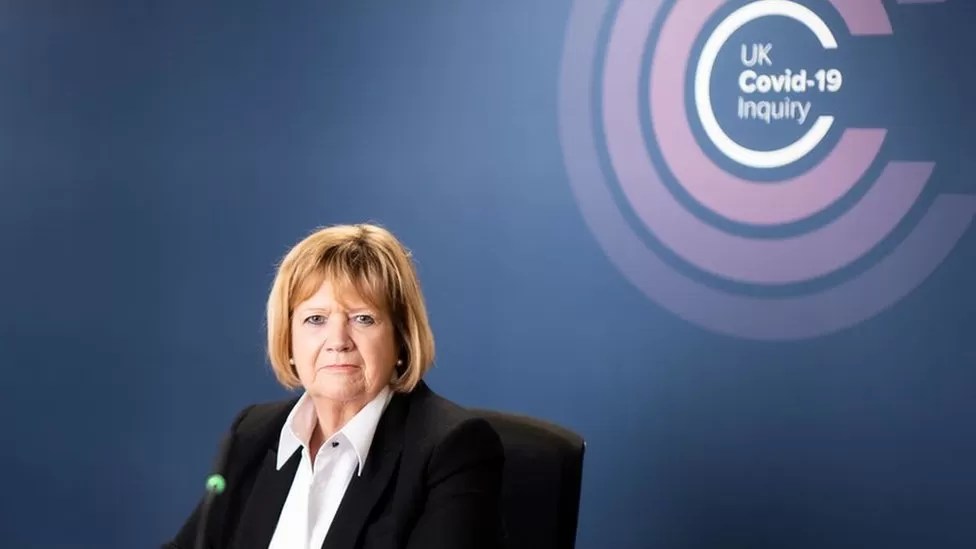
Baroness Hallett promises the inquiry would be ‘thorough and fair’. Photo from Piranha Photography.

Last week saw the beginning of “Britain’s Public Inquiry” to understand the Conservative Government’s responses and handling of the Covid pandemic. But for the life of me, I can’t find out who is in charge of “Britiain’s Public Inquiry” and what – after the facts have hopefully been gathered – will happen? Will lessons have been learnt? Will those deemed responsible be held responsible? Will there be any retribution? Will anyone be called before a court of law or those pages of documents produced be filed away rather than read. Last week when Dominic Cummings gave his testimony he asked that the inquiry also focus on the broader failures of the system. Reading – for I can’t listen to them talking – it is clear that as blame is shuffled about like pearls under walnuts, the prize goes to the then Prime Minister Boris Johnson. Dominic Cummings likened working with Boris Johnson to driving a shopping cart with a wonky wheel. 

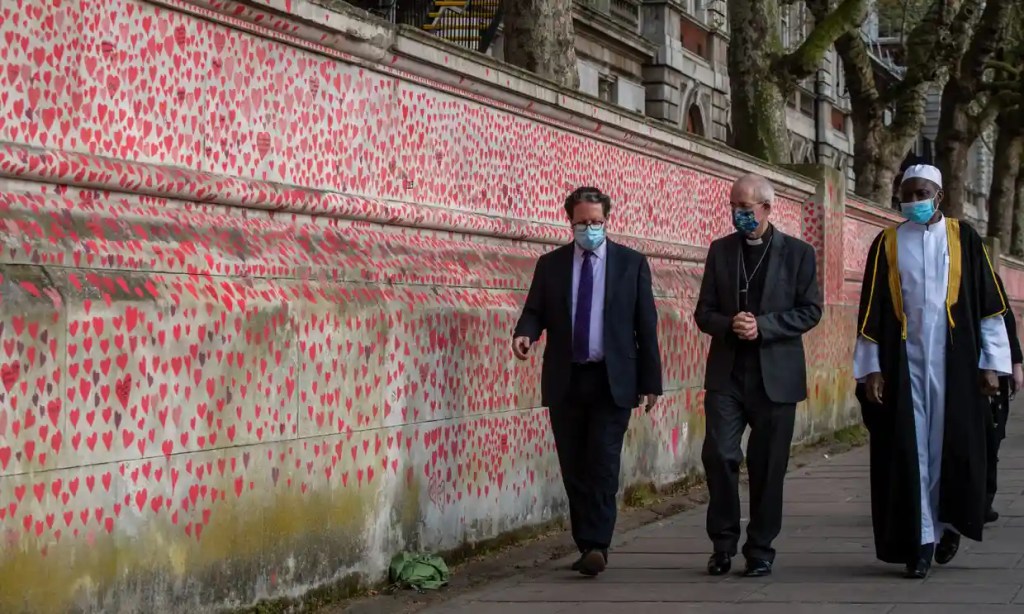
It is not without irony that the inquiry is taking place at Whitehall just across the river from the Covid Memorial Wall that was created and painted in 2021by people who had lost loved ones, or worked in the NHS, coming together with the good guidance of the group ‘Led By Donkeys’. Over 240,000 painted hearts cover more than a third of a mile alongside the Thames River outside of St. Thomas’s Hospital. During this time the public were afraid and looked in vain for leaders in the government where all the common sense had been bred and educated out of almost anyone in Westminster not yet of pensionable age. It was like putting drones in charge of the beehive to collect pollen and care for their queen, when all they could think about was kingship and sexual obsession. 

From left: Rabbi Daniel Epstein, the archbishop of Canterbury, Justin Welby, and Imam Kareem Farai visiting the wall in April. Photograph: Chris J Ratcliffe For Covid-19 Bereaved Families For Justice/Getty Images

People are booking their theater seats. We follow the inquiry like a serialized Charles Dickens story in the magazines of the day. Up to testify next are the past Prime Minister Boris Johnson, his hovering henchman Matt Hancock, and the holder of the chair at the moment, Rishi Sunak. But it is the failings of one particular individual, Boris Johnson, who was ultimately responsible for directing the government, which will continue to be scrutinized in the months ahead. Johnson’s successor-but-one as prime minister, Rishi Sunak — who was U.K. Chancellor during the pandemic — also has questions to answer. All three men — Johnson, Sunak, and Hancock — are to appear before the inquiry in the same week at the end of November. 

Photo Credit to Art Center Wikipedia

Sunak has thrown his dead cat into the ring – by hosting an international AI conference on safety issues that was held at Bletchley Park. The conference produced some back-patting for, and from, the UK, US, and European leaders who attended while getting a nod of approval from the United Nations. Elon Musk arrived to give a speech and chat with Rishi at Downing Street. Both men in their uniforms, Elon remains rumpled and a little unshaved while Rishi rolls up his pristine white shirt sleeves possibly looking for his next job opportunity after this gig is over. So will anything happen from this inquiry apart from “Lessons have been learnt”? The Infected Blood Inquiry – the Stephen Lawrence Inquiry – and the Greenfield Tower Inquiry – have each chipped away at this UK government, but not a lot has changed. Could this inquiry be the one showing that Britain’s democracy has really gone up in flames? I’m writing on Guy Fawkes night – our night of fireworks – celebrating the failure of the 1605 attempt to blow up the Houses of Parliament. We may be holding our breath and will it happen this time? I cannot watch the inquiries – it is too painful – so instead I read.

in an interview, the American thinking and writer, James Baldwin, said “You must realize that if I am starving you are in danger”. And in this simple truth, buried deeply, lies some of the reasons the wars are being fought all around us. Johnathan Freelander writes eloquently and with great heart in this weekend’s Guardian Newspaper, that no side of the Israeli, Gaza, and Jordan triangle conflict are searching for a peaceful conclusion – at this time. In Pulse “Stories from the Heart of Medicine,” I read a translated account from Hadar Sadeh, an Israeli youth psychiatrist working at a Medical Center, about twenty-five miles from the Gaza Strip. Then I open an email from our Palestinian friend and filmmaker, Annemarie Jacir. Each woman weeps at the death of children and physical destruction that they see around them. Each letter could have been written the other.

And see how the war in Ukraine gets roughly pushed to one side even as we know it continues? Old statesmen take planes from one capital city for talks then board another, exchanging their suit jackets for a flack vest as they land in a war zone to encourage young men to face death bravely for their country. Ukrainian President Zelensky rightly worries that this other war is distracting from support to his war – defending Ukraine from Russia’s invasion. How much can we carry in our hearts? And tucked away even further is the news that Russia’s President Putin’s arch-opponent Alexei Navalny’s three lawyers have been detailed. They are facing trial for participating in the so-called extremist group, Navalny’s Anti-Corruption Foundation. If they end up in jail then all contact to the outside world will be lost for Navalny. Each of these eruptions is bleeding like an aspirin-fed wound and all the pressure that is applied will not staunch or stop it any time soon.  

This has been A Letter From A. Broad written and read for you by Muriel Murch.

Bobbies on the Beat

Written and produced by Muriel Murch with WSM by

It is a sunny autumn morning when I sit outside of Le Tea Cosy cafe, sipping a flat white and chatting with a friend when first two, then three, followed by two more police men and women saunter by. I laugh to them, “Seven of you”. And the slightly older – but still so young – as policemen have been for years – smiles back “Yes, young recruits on training exercises.” He could have been talking about trotting out young cavalry horses in Hyde Park, but no, this is rookies on the beat walking around Primrose Hill and into the village on a sunny mid-week midday, and is a very different scene from what they could encounter on a Saturday night down by the locks in Camden Town. Their young faces look sweet, both hopeful and nervous of what lies ahead for them all.

Chris Kaba – photo courtesy of his family

For by now they know that the news is full of the charge of murder by an armed police officer with a single gunshot to the head of Chris Kaba last September in South East London. Chris was a construction worker and a rapper under the name of Madix with the group called 67. Reportedly he was not a man without flaws but with his impending fatherhood that could have been about to change.

The firearm officer charged with Chris’s murder is only named as NX121. Rallies led by Chris’ mother and family were held asking for an investigation. Here we go again and we hope that Steven Lawrence’s parents are helping her. Home Secretary Minister Suella Braverman – she of the floating barges and Rwanda deportation plans for immigrants – assures the police that they have her full backing. But what does that mean? Now – for a moment – there is a pause. Close to one hundred bobbies-on-the-beat, a little older than those rookies walking the pavements of Primly Hill, are handing in their guns. Reflecting on what they think ‘could have happened on that street in Streatham Hill’ and want no part of it. They don’t trust Suella Braverman to have their backs and maybe – for a solitary moment – they don’t trust themselves and want no part of killing another man – when – on a Saturday night off they might be dancing to the music of 67. Further assurances are made by Braverman, and the Met Police force floats the idea of bringing in the army to do a Policeman’s work, leaving these young officers churning again in confusion and mistrust.

Chris’s family, along with the police, are not alone in their mistrust of the government. This next weekend the Conservatives are holding their Annual Party Conference in Manchester. Which is a bit rude – to put it mildly – where the main item on the agenda is the closing down of the continued construction of the High-speed Rail link that travels from London to Birmingham and is scheduled to go on to Manchester. The South/North divide is strong in England, and Andy Burnham the major of Greater Manchester sees this move for what it is. Like a true northerner he is able to speak his mind.

Andy Burnham Getty Images

Come to think of it that maybe the most characteristic difference between the north and south in England. Northerners don’t mess around, calling a spade a spade while southerners can relish moving words and phrases around as if playing the ‘follow the ace’ card game again and again. For Sunak, to make the decision to scrap this link is pretty abrasive. Grant Shapps who was transport secretary until last month and who moves through Cabinet secretary positions with the lighting speed of those fast trains he wants to halt, says it would be “crazy” not to reassess whether the full HS2 rail project remains viable. One of the far reaching goals for High Speed rail – such as exists in Europe and Japan – let’s not speak of Europe – was that it would enable business men and women from the north to travel to London or even – steady on – to Paris, Brussels and Amsterdam – for face-to-face meetings thereby giving the North of England a better shot of doing business within Europe. But ministers in Westminster are determined to keep the power close to the south and this train vasectomy would do that. With a change of government this little snip could be reversed but that is no certainty. 

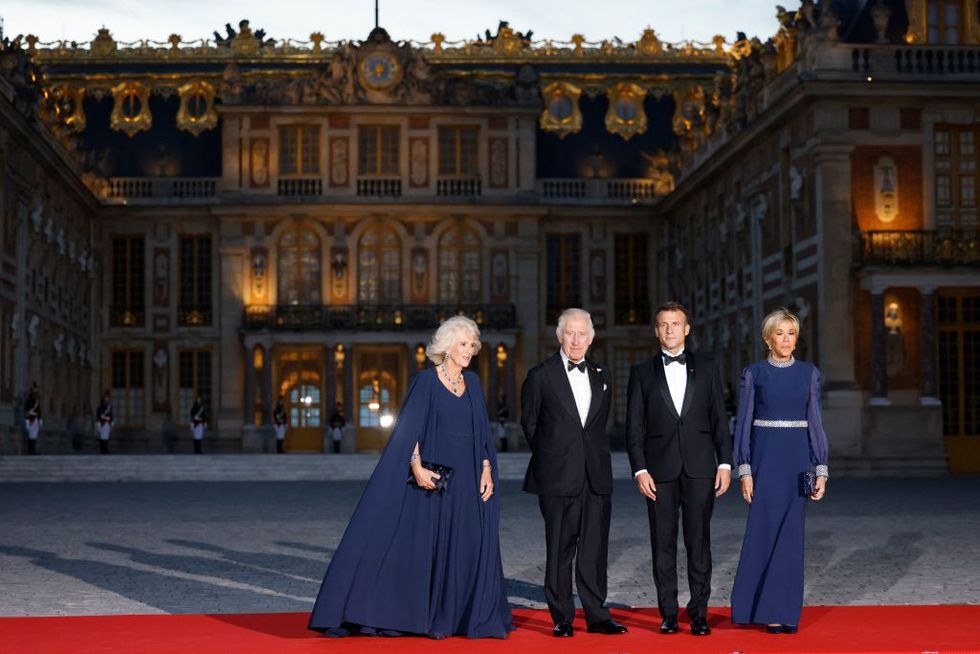
Meanwhile – thinking forward in fellowship – King Charles and Queen Camilla were invited to Paris for a three-day state visit complete with dinner for 150 guests in the Hall of Mirrors at the Palace of Versailles. When invited to dinner some people bring wine, flowers or chocolate. But the King and Queen brought Sir Mick Jagger and England’s still favorite handsome man, Hugh Grant. The guest list was drawn from French and English men and women who continually contribute to good relations between the two countries, so often found easily within the arts and sports. The fact that both French and English cheeses were on the menu says a great deal for the warmth that was brought to the table. One wonders who sat next to whom and we can only hope that everyone remembered their table manners and used their silverware from the outside in. Fellowship was ever present and as the wind ushered their entrance to the palace Mme Macron helped the Queen with her cloak. Of course there were speeches – the President and the King both speaking in each other’s language. During the three-day visit there was the obligatory tree planting, remembrances of past Royal visits to Paris, then the wives played a little table tennis at a sports center, both showing their need for more practice and a first – as King Charles spoke in French to the French senate. It was a good visit with gentle words and gracious kindness on both sides. 

Queen Camila, King Charles, President and Madam Marcon before dinner

As the equinox came and went the evenings were closing in. The green tomatoes were harvested from the library garden and our little terrace and there was just enough to make the starter layer of chutney. I look to see what we have and what should I add? In the local greengrocers there are fresh onions and the first Bramley apples, while on the counter is a box of no longer sellable fruit. Ladies of a certain age know not to waste and so half a dozen soft and wrinkly, old lady peaches went into my bag and then the chutney. Delia Smith has two recipes in her book but chutney is not for recipes, it is for bountiful harvests, leftovers and sweetness so I jumble the recipes up – remembering a little of this instead of that works – and there it cooked happily on the stove. Now it is in jars to wait – if it can – for the flavors to lie together and emerge anew.

Labeled and Photgraphed by WSM:)

This has been A Letter From A Broad Written and read for you by Muriel Murch 

Summer’s End

Written and recorded by Muriel Murch with WSM by my side.

The summer blasted out with a heatwave that left those of us of a certain age floating in a sea of lethargic sweat. This morning there is a lift in the breeze as brown leaves fall and swirl, crackling underfoot, telling us that autumn has arrived. Children are returning to school, politicians to their chambers, and nobody really knows what is happening in Ukraine. The huge earthquake and toll of over 2,500 deaths in Morocco has blasted the Ukrainian war off the front pages but not completely out of the news. 

Widowed 26-year-old Margo sits at her desk inside a small brick mortuary close to the front line in Donetsk. Unknown soldiers are brought for her to check and record what she can about each body. And where she says – she speaks to the dead. “It may sound weird… but I’m the one who wants to apologize for their deaths. I want to thank them somehow. It’s as if they can hear, but they can’t respond.” Ukraine gives no numbers of its war dead – but Margo knows the losses are huge. US officials, quoted by the New York Times, recently put the number at 70,000 dead and as many as 120,000 injured. This from an armed force estimated at only half a million strong.

A mother looks for her son

Crime Watch Live was a BBC weekly program in which the public were asked to help the police solve a crime that has been reported yet remains unsolved. Britain loves this work, it plays into the ancient forest hunter. In Crime Watch the police would put up a situation, giving as much detail as they could and a phone number to call. And sometimes it worked, while the show was still going on ‘a suspect was apprehended and brought in for questioning’. The TV public loved it and so the escape of the ex-army soldier and terror suspect Daniel Khalifa from Wandsworth Prison on Wednesday brought the public out hunting again alongside the police. Daniel is only 21 years old, with an Asian name and light coffee coloring. Dressed as a chef he managed to escape the prison strapped onto the undercarriage of a food delivery truck as it left the prison. I was not the only person with a smile on my face. An ex-prisoner interviewed by the BBC, could not stop grinning as he said. “He’s off out of here now.” But it was not to be. 75 hours after dangling under the truck out of Wandsworth Prison he was pushed off of his bike by an undercover police officer while cycling the towpath by the Union Canal in Chiswick. While Daniel faces the law on Monday it is time to point a finger of blame at someone. The finger circulates around and comes to rest on the conservative government as the country pays the price for another slice of the Austerity measures put in place by George Osbourne and David Cameron. On BBC radio, Secretary of State for Foreign and Commonwealth affairs James Cleverly, previously secretary for Education – so it’s not clear how much he really knows – claimed there was no evidence that cuts imposed by his government were to blame because, “the number of escapes had decreased dramatically, while “4,000 extra prison officers” had been recruited. To which the Prison Officers Association national chair, Mark Fairhurst, rebutted that the Prison Service was “now unable to retain the staff we recruit. That tells you everything about the working conditions in our prisons.” And blamed the escape on “The link goes back to 2010, when the Tory government came into power and hit us all with austerity measures.” 

But this little bit of amusement is only one part of the austerity chickens coming home to roost.

As children put on their uniforms, several schools will be closed due to those chickens roosting. Construction codes were loosened in the 1980s and 90s and buildings built during those years are now crumbling apart from the light-weight, porous, cheaper, easier concrete. Classrooms are getting soaked through in the rains and even clumps of ceilings are falling down in classrooms. The hold-your-breath not-said-yet page-turner are those other buildings – hospitals, apartment blocks, offices – built during that boom – and is going to be a very big problem once someone puts the question to the government. Which is maybe why the Prime Minster nipped off to India for the G20 summit. Better to be shunned and dissed by world leaders than hounded in parliament. It’s tricky for Rishi and he really has no way out. There is no one else to blame for the state of the nation but the Conservative government and everybody knows it. And Rishi will have to show up in parliament soon. 

The King and Queen must also come down from the highlands and back to London. The King managed a few weeks away in his beloved Scotland, to take the time to honour his mother and reflect on the first year of his reign as he moves forward. Where now can he now shine a careful light without poking his finger into politics? It is rumored that his first big personal project is a national initiative to tackle food waste. The Evening Standard newspaper – which reports a surprising amount of truth – writes that 2.9 million tons of good-to-eat farm produce, enough to provide the equivalent of seven billion meals, is being dumped in landfills each year. And you can be sure that more than one someone is making a profit from that.

This caption quote is from ‘Left Foot Forward’
The campaign to hand out EU flags at the Last Night of the Proms was spearheaded by the Thank EU for the Music group, which said that “tens of thousands of music lovers have taken our free European flags into the Royal Albert Hall for each Last Night of the Proms in solidarity with musicians who feel (like countless others) the destructive impact of Britain’s recent isolation from Europe.”
The group also posted a letter it had sent to the BBC’s Director General Tim Davie on its Facebook Page, where it added: “Our flags represent the hope that the Last Night of the Proms musically celebrates “Britannia ruling the airwaves”, hopefully transforming the problematic post-colonial anthems into something more, shall we say, enlightened and collaborative?”

The Promenade Concerts from the Royal Albert Hall ended this weekend. The last night of the Proms usually concludes with a roar of British national fever but this year it was pitched a little differently and though ending with the usual Rule Britannia – sounding a little tired – the National Anthem – God Save the King and For Auld Lang Syne while people stood swaying together singing along in harmony. But there were as many European Union flags and berets in the audience as there were Union Jacks. Members of the Government are asking for another investigation by the BBC but it could be – that just like the late Queen before them – with her clear message hat, the people are speaking calling for a greater self than just this treasured Isle.

`The Late Queen at the opening of Parliament 2017

September 8th marks a year since the late Queen died. An evening program set out the timeline of the day leading up to her death. Little nooks and crannies of tit-bit information came to light as we watched and remembered that day and our Queen. While the Queen’s condition became more grave, the then Prince of Wales took himself off for a solitary walk in the forest as he began to prepare himself for what lay ahead. This program was a moment for the nation to reflect on the passing of a beloved monarch and mother, a person who affected all of our lives, like remembrance prayers for all of our dearly departed. Years ago coming to All Hallows Eve, St.Michaelmas – of the daisy and the dead – an old friend wrote to ask if I would like my mother’s name included in the prayers for the dead at St. Paul’s Cathedral. It was an unexpected act of kindness and a remembrance of all things past. And we do remember them, those we knew, those we loved, and those who taught us life lessons. We will remember them until we become among those who are remembered. 

This has been A Letter from A. Broad.

Written and read for you by Muriel Murch

Poaching in the Park

Written and Produced by Muriel Murch with WSM by my side.
Blackberry-bramble Harvest 2023

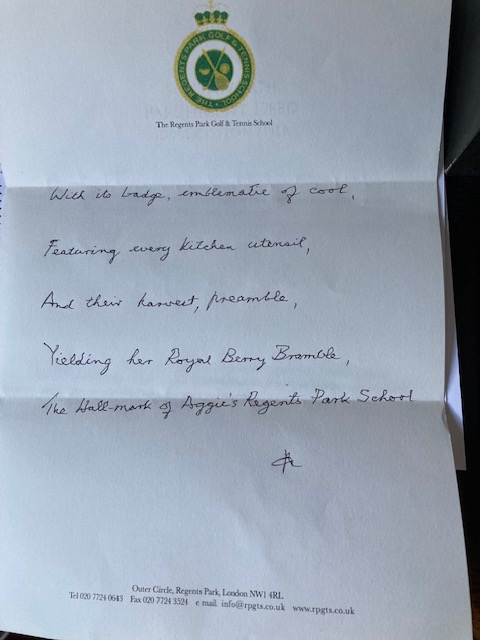
August slipped into autumn not bothering to wait for September while most of London went on holiday, leaving the city almost as subdued as Paris. Along the canal, three teenage ducklings are swimming alone as if their parents have regretted their final feathered fling in the water and are just too tired to raise one more brood this year. The ducklings look lost, paddling from one clump of weeds to another in the mindless way of adolescence. It is blackberry season and we are late for our semi-annual ‘Poaching in the Park’ moment. We go in the middle of the week – with less chance of being caught – though this little corner of Regent’s Park is now sorely neglected. There used to be a thriving small sports school here, a place to practice your tennis, golf, or cricket. But now the cricket practice nets have moved close to a central concrete hub with a cafe, overlooking the big open pitches that serve both cricket and football in often overlapping seasons. There is a small tennis club close to Queen Mary’s Rose Garden but the golf nets were removed altogether. Now the wilderness has taken over – as it should – and the blackberry brambles climb the Hawthorne shrubs and surround the adolescent oak trees. The King is in Scotland striding out on the moors for a good bit of fresh air, while the Prime Minister is back home in Yorkshire, maybe looking to see if the Green Peace ‘Stop Oil’ Delegation have left him any more notes on how to run the country. So we can pick and gather our bramble harvest which quickly became eight pots of jam. Six are stored away. One goes straight into our fridge and the other to Howard who – in years gone by – was one of the tennis coaches on the courts now covered with brambles. Howard lives close by and while closing into the other side of his eighties we often stop and chat. Howard is fond of the written word and from time to time pops a poem through our letter box. 

This week’s poem from Howard

The nightly news can barely be bothered with the wars that do not stop in the Sudan and Yemen. The Human Rights Watch write that Saudi border guards have been reported killing hundreds of Ethiopians trying to cross into Saudi Arabia from Yemen. And the war in Ukraine is not ending soon. The maps showing – in red, purple, and white – whose troops hold which cities and coastlines in Ukraine – are confusing and seem at odds with the reporting. If all that land – in red – is occupied by the Russians, how is Ukraine ‘making ground’? We see villages and cities bombed – and the long, low trenches slicing through fields and countryside appear no different than those dug for World War One – where Ukrainian soldiers crouch and fire, fire and smoke, and slog on. Summertime is wearing for soldiers and politicians alike. But there is a useful police mess-up from Manchester and a horrific tale of infanticide to keep us distracted from the wars and the Government debortle with the Biddy Stockholm barge. A few asylum seekers were being marched onto the barge two by two – when it was discovered – at least a week before reporting – and the marching on – that the barge water supply contained traces of the legionella disease bacteria long known to cause severe pneumonia and death. Time to pack their bags and march those foot-weary seekers of asylum and hope off again. 

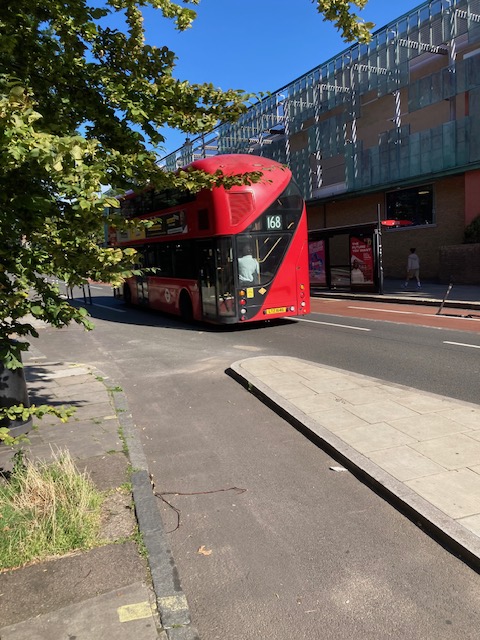
The 168 bus leaving Chalk Farm.

Sometimes I miss the small thud when the paper lady pops the Camden New Journal through the letterbox every Thursday morning. I glance through it, knowing there will not be not much I care to read but that sometimes, something will catch my eye. Last week – another August moment – there was no home delivery – so this week I made sure to read it. And there it was: a small column slipped into the side of a page. ‘RIP 168 – the bus stops here’. This route will be closed in September. ‘Oh No.’ How could they – who the heck is ‘they’ – let it happen. ‘They’ turns out to be Transport For London (TFL for short) and to whom we pay our bus and rail fares. They did a survey – even reporting that of three hundred respondents, only 18 agreed with the scheme to scrap the 168 bus route. And still, they went ahead. It is this kind of lock-jaw response that drives us all crazy. The government does it with their ‘there will be an inquiry’. It is – to put it mildly – upsetting.

Upsetting and inconvenient for people like me perhaps but downright devastating for people like Jim. Jim and I have been friends for twenty years and know much – and yet little – about each other. Jim is Jamaican, his wife was German and I often wondered what brought them together – if in those early years of their courtship, they both felt the chill of English disapproval. Jim was a Camden Garbage truck driver until he retired. His route brought the truck onto our street and he lives just two blocks away in a council flat. He had a Yorkshire Terrier dog, small, black and brown, and always keen, pulling Jim along as she raced up our street galloping towards the hill. Even at 17 – a serious senior for a little terrier – she was always ahead of Jim – until she wasn’t – and one day Jim quietly took her to the vet to say goodbye. Now he is alone, and as he gets older doesn’t go out and about so much. But we meet from time to time. ‘Ello darlin’ He calls to me, having long forgotten my name and it being too old a friendship to ask to be reminded. And we chat, about this, that, the other, and loneliness. A kiss is always welcome. The last time I saw Jim he was walking slowly with his cane, going to the bus stop for the aforementioned 168 bus on his way to The Royal Free Hospital in South End Green where the bus stops right outside of the hospital – in both directions. What will happen to Jim and so many others if TFL takes this moment of independence away? Each little cost-saving denial from them leads to a retreat and loss for us all. 

This has been A Letter From A. Broad written and read for you by Muriel Murch.

On the Moor

Written and produced by Muriel Murch with WSM by my side
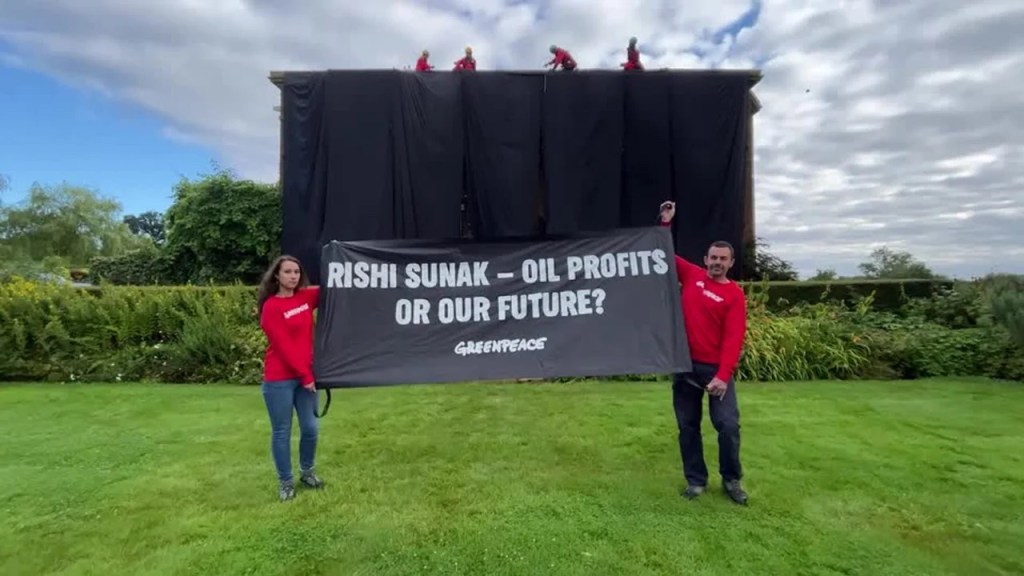
Pictures posted online by Greenpeace UK on Thursday showed the protesters on top of the property while a banner read “RISHI SUNAK – OIL PROFITS OR OUR FUTURE?”

Rishi Sunak and his family have all gone on holiday leaving England and the remainder of the United Kingdom in tatters. So it was no surprise that when the five Greenpeace ‘Stop Oil’ activists knocked on the door of Sunak’s country home in North Yorkshire and nobody opened the door, they felt free to climb onto the rooftop of the grade II-listed manor house and drape oil-black fabric over it before posing with their ‘Stop Oil’ Banner in front of the house – protesting against the government’s decision to expand North Sea oil drilling. There is – naturally – to be an inquiry – as to how and why the Prime Minister’s house was left so unattended. Surely there was some surveillance in place. But as Sunak has begun to show his real colors – under the tiniest bit of pressure on a radio program (listeners take note) we have seen his business management underbelly and once more our hopes – why do we even have them? – are dashed. What is Rishi doing looking to lift the 20 mph speed limits in some small residential neighborhoods while issuing new licenses for North Sea Oil drilling? I’m remembering – not that long ago – when the new King very pointedly invited the new Prime Minister to speak at a reception the King was giving for world leaders gathering before a conference on climate change. Rishi popped over to the conference in a private jet to smile and show up. But now he reminds us that ‘you can take a horse to water but you can’t make him drink’. 

So it is with renewed respect we watch the Mayor of London Sadiq Khan, with his bushy eyebrows, sticking to his guns with the expansion of London’s low emission zone, saying tackling the climate emergency and air pollution are “bigger than party politics”. While those in parliament waffle and wave according to their party’s policies, Khan is staying true to his course. He is winning some and losing others. Hundreds of doctors have urged politicians to stand firm on initiatives to tackle air pollution, warning that they see its “devastating health consequences” in patients on a daily basis. Air pollution is the single largest environmental risk to public health, linked to between 28,000 and 36,000 UK deaths a year. Air pollution affects every one of us from before we are born into old age. I remember in 1966 looking into the chest of a young Mexican 16-year-old boy who had only been in the city for six weeks. His lungs were already pinpointed with black city pollution.

As I write, the Bibby Stockholm barge is receiving its first asylum seekers – refugees – today. There was a small stall – was this going to be a fire trap? But though Amnesty International calls the barge and its use a ‘Ministerial cruelty’, food will be served in the canteen tonight.

A combination of our 58th wedding anniversary, a small window of time, with the excuse to see a beloved old friend, and the long-anticipated search for Murches – dead more than alive – takes us to Devon and the northern end of Dartmoor.

The two-carriage train runs on old tracks – clickety clack, clickety clack – from Exeter-St. David to Okehampton, slowly rolling past the rows of not-yet-old oak trees marking the hedgerows separating pastures as some far-thinking farmers return to the old ways. The hedgerows are made of stone with some post and rail. There is little wire to be seen. The clouds are hanging low as if chasing the fields into the sea. There is no taxi stand at the Okehampton train station, but drivers swing in and out around train arrival times to see if they can hook a passenger and soon we are caught. But our man has only lived in these ‘ere parts for six years, “A second marriage,” he says, and driven for two which may explain the very long route that brought us through cow pastures – where he had to be reminded to close the gates – with a herd of fine healthy Devonshire cows, and the rubbish dumpster bins, to the back of the hotel for 27 pounds thank you very much. This one is not yet a local.

We are staying at the most elegant and expensive of hotels at Gidleigh Park which carries just the slightest breath of Fawlty Towers to remind us we are in England. After we check-in, there is time for a walk to the hamlet of Murchington. From the hotel, we dip into the woodlands of an ancient forest of Oak and Beech trees where the River Teign runs freely alongside of the path. This is the wilderness of fairies and Robin Hood.  We leave the forest for the lanes that are as narrow as I remember them and the bracken is mid-summer high allowing the brambles to twine over and around the long fronds while wild white yarrow and pale orange columbine wave gently where they can. The couch grass remains stubbornly growing and uneaten by the cattle or sheep in the pastures. It’s a good climb up the hill before going down into the dale and finding the old sign of Murchington where Beatrice posed forty years ago. The few cars that pass are careful enough to let us squeeze into the bracken and it isn’t until we crest the hill – before the final dale – that we meet another traveler on the road. She is short and quite round, walking in country clothes with a fine leather hat, and two poles. She is moving slowly and when we first pass her taking a talking break with a motorist  “Are we far from Murchington?” I ask, “Just down there. I live in Upper Murchington.” so we carry on. Murchington is now a hamlet having only a few houses with the church being decommissioned in 1975 and there is no central place of worship or community. Sometimes a hamlet is a small group of Kinsmen, no larger than an extended family or clan, though there are no Murches living in Murchington, nor could we find trace of any. On our return – there is not a lot to see in Murchington – our fellow traveler is now polling on the other side of the hill and we pause together. “I like your hat,” says Walter, and that is all it takes to learn about her two children, in Texas and Portugal, far away from this widowed mother who has just had double knee surgery and is walking alone along a country lane. 

Back at the hotel and we change for dinner. To dine here is an event and joining us are my oldest friend from Nursing school 60 years ago, Sally, and her daughter Emma who is a leading conservationist with her Dartmoor’s Daughter tours of Dartmoor. There are screams of delight and so much laughter when we see each other and the tears of joy would fall but that we are both – even at 80 – mindful of mascara. When dinner is served it behooves us to pay attention for the care, flavor, and presentation is exquisite, though a far cry from the gnawing on bones by the forest fire that could have been here mere centuries ago. 

Hand-tinted postcard of Murchington, c. 1910 showing Woodlands Farm and the Anglican chapel (with railings)

The next day is for searching for those long-dead Murches that we are pretty sure are lying about in the Church graveyard. But first, there is morning coffee – at a small cafe where the local artists gather- in the town of Chagford. The four tables that have been put together for us take up almost half of the cafe space. We are late – Richard – our taxi driver – knows his way about, but then there are cattle and ponies on the road and hellos to be shared. Immediately when we arrive fresh coffee is served and we split up – the conversation rushes deeply into the arts at one end of the table and conservation and humanity at the other. It’s a wonderful way to spend a Saturday morning – with people who care – reinforcing each other – encouraging by just showing up – before we wave our goodbyes and slip away into the day.

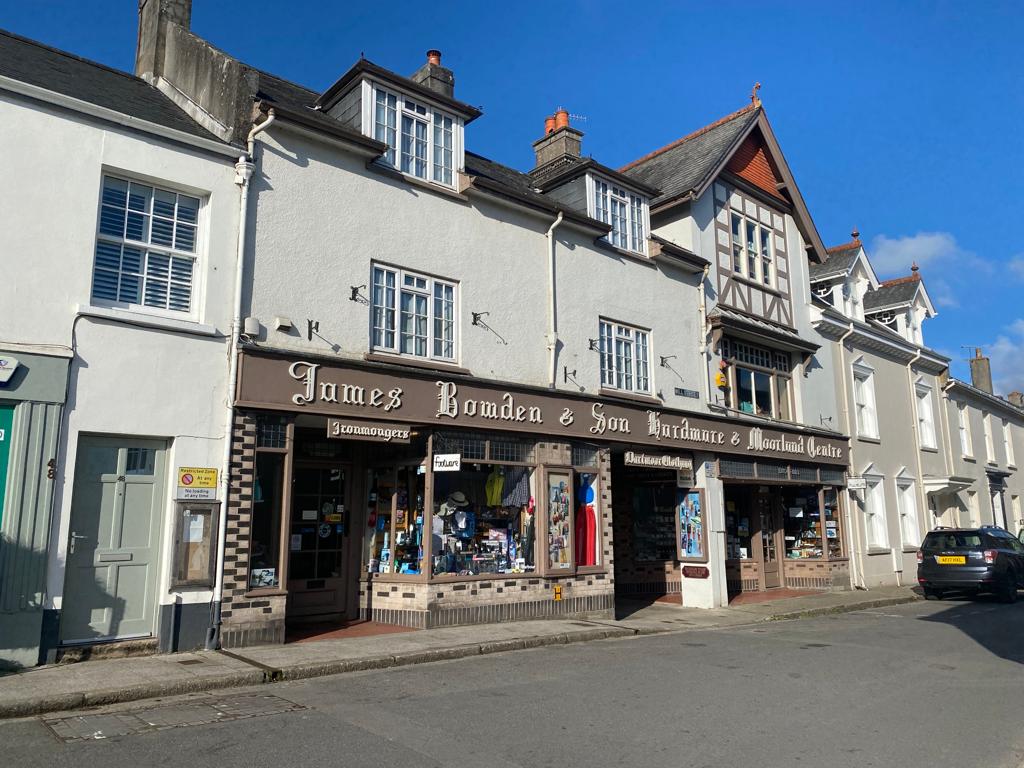
James Bowden & Son Hardware & Moorland Centre

It is beginning to rain – a soft rain – as Sally guides us to the hardware shop that sells everything you need at home and more enticingly has a museum room in the back. It is here that we find the first evidence of George Murch, wheelwright, who sold this shop to James Bowden in 1862. The little room that sells the boots would have been his first shop room. It is comforting to know that we both come from working stock a wheelwright and Slater, such names carry the trades of our forefathers. And more than one Murch married into the Perryman family from Stancombe, giving me full license to go ahead with cider making. As the soft rain gets stronger Sally leaves us at the Chagford churchyard of St Michael the Archangel where someone did what we all mean to do with our boxes of old photographs – gone through the graveyard and mapped out as to whom is buried where – it doesn’t take any time at all to find one of George’s sons, William but not George. William’s gravestone is still upright but leaning a bit as most in the ‘old’ graveyard are. We stand in the rain and think about those lives. The ones that came before us – not so very long ago – was William the one who stayed behind so that James could leave? Or was James always restless – the one who would venture out no matter what? He never named a son of his after his father. These are stories we may not know but only imagine.

On Sunday morning there is a knock on the door and our morning tea, toast, and flaking-everywhere croissant arrives. We are rested and ready to leave with Emma at 8.15 a.m. for a 9.30 start on our guided Wool Walk. After picking up Sally and a friend, Emma sets off at a roaring pace along those single-lane roads and we are soon out on the moor which stretches before us with heart-holding beauty. The sheep are grazing and resting beside the road along with small herds of cows and ponies. Low patches of late gorse hold tightly to the beginning blooms of heather. 

The walk is led by – I quote – qualified Hill and Moorland Leader, Emma Cunis aka Dartmoor’s Daughter, and Kristy Turner, Curator of the Dyeing on Dartmoor exhibition at the Museum of Dartmoor Life. Emma and Kristy give us a little introductory talk and we share our names and reasons for walking this Sunday morning. The walk is billed as ‘Easy’ and as we set off Emma acknowledges that we will be of different walking abilities: some fast, some in the middle, and some – a little slower. It doesn’t take long for me to realize I am among the latter- more than a little slower – and this sobers me as I miss the woman I used to be.

Old Friends and old Oaks photo by WSM

This morning Sally wrote “It came to me last night, we are a bit like ancient oak trees, a bit bent and gnarled, but the inner strength keeps us going. So from one Oak tree to another, take care of your roots and branches but wave your leaves merrily into the air whenever you get the chance.” This is friendship and sounds like good advice for us all.

This has been A Letter from A. Broad, written and read for you by Muriel Murch.