August Bank Holiday W/E

August Bank Holiday,

Written and read for you by Muriel Murch with WSM by my side.

‘Out of the Office’, automatic replies come bouncing in to anyone foolish enough to write a business letter in the month of August. Occasionally there is a head’s up – a note saying “I will be away on holiday until the ‘something’ in August. If this is urgent please contact – whoever the poor soul is who has been left to ward off intrusive calls.” Lawyers, bankers, publishers, doctors, stylists, and politicians all go away, usually taking a plane to Spain or even as far as Turkey, leaving delivery drivers and grocery clerks to carry on. Pete from the Primrose Hill market farm stand has taken his wife to visit her family in Croatia.  

Chugging along under Tower Bridge Photo by WSM

Over the weekend, the river is choppy as the wind battles with the sun to give the tourists a boat-ride to remember while cruising up and down the Thames to Greenwich where the Cutty Sark, along with the maritime museums and colleges waits patiently for them.

Returning to the city from their seafaring adventures the tourists pour into the street, across Westminster Bridge circling around the Palace of Westminster, the House of Parliament and Big Ben, now free of three years of scaffolding, and whose clock-face shines over the river.

But across the bridge from the Houses of Parliament is the wall that encircles St. Thomas’s Hospital and lines the walkway along the river.

Painting of St. Thomas’s Hospital at the Welcome Trust Museum

The Hospital was named after Saint Thomas Becket and first built in Southwark, possibly as early as 1173. The reformation of the monasteries caused its closure but in 1551- the young king – Edward VI – allowed the hospital to move up-river a bit while being rededicated to another Thomas – the Apostle. St. Thomas’s Hospital was first dedicated to serving the poor, the destitute and homeless and though it has become a world renowned teaching hospital it has remained open ever since. It is seeming and appropriate that the wall that cradles the hospital close to the Thames and faces the Houses of Parliament is still decorated with painted hearts and messages commemorating the thousands who died in the Covid epidemic that began in January of  2020. 

Within the Houses of Parliament, the green benches in the house of Commons and the red benches from the House of Lords are mostly bare. If Sir Keir Starmer, during his term as Prime Minister, finally has his way then those red benches, so bloated by gift peerages from previous governments – both Labour and Conservative – will become even more sparsely filled and those gifts of ermine robes in very short supply. Though most of the politicians have popped off on holiday the Prime Minister has cancelled his two weeks of family time in Europe and stayed at home. Sir Keir knows that there are things to attend to and if he is lucky he can get some serious work done – for he is a methodical and serious fellow – and have a look at the bookkeeping left by the previous government. What exactly is the state of the economy and the country and how much money is available in the kitty for all those reforms that he promised? Not a lot it seems. Like a new contractor coming in for your house repairs, there is some teeth sucking as he looks at the job before him. And like any English builder – there is fault to find with those who came before him. Instead of “They used the wrong paint love,” Sir Keir’s line is already “Things will get worse before they get better.” A version of Lord David Cameron’s “Hard times are ahead we are going to have to tighten our belts.” And we all remember how that went down. The £600 fuel allowance that was so freely given out last year has already been cut for the upcoming winter. There will hardly be a city and country household who will choose not to heat their entire house – however small it is.

Like many of us – not on holiday – in England – Sir Keir has been watching the wars as they continue to unfold. The Ukrainian army has popped a missile over into the Russian territory of Kursk, and captured a few Russian soldiers that it promptly swapped for 115 men of its own. Our screens light up with the flames from the Israeli and Hezbollah strikes at each other. Is it a game of fire and fury, a warning or wake up move? All is paused as each side ponders and watches the other.

Then there was the Democratic Convention held in Chicago last week, orchestrated into a fine piece of rousing theatre. Only the most cynical among us could not be flickered into a moment of hope that the homegrown terrorist among the American people could be held at bay. The concept of a  woman – a comfortable and pleasing shade of brown – with a steady coach beside her, may – with much luck and hard work – keep America safe for a few more years, is enough to make one giddy with hope. One could see this as a sea change of colour that comes with autumn, the maturing of the fruits of this season.

At the market the colours are changing too. Bright red berries are giving way to the blush of young apples, the green cream of pears and the dark purple of Victoria plums, while the deep black of hedgerow berries glisten with a shimmering autumnal hue.

With constant support by murchstudio.com
An Inquiry

Written and produced for you by Muriel Murch with WSM by my side.

‘Yes Minister’ first aired on The BBC television in 1980 until it ended in 1988, possibly due to the fact that it was becoming harder to distinguish the comedy series from the nightly newscasts that followed. Among the many quotes attributed to the Cabinet Secretary Sir Humphrey is “Minister there is going to be an Inquiry” to which the reply from The Prime Minister Jim Hacker is “Oh good, then nothing will happen.” Well yes and here we are again – 

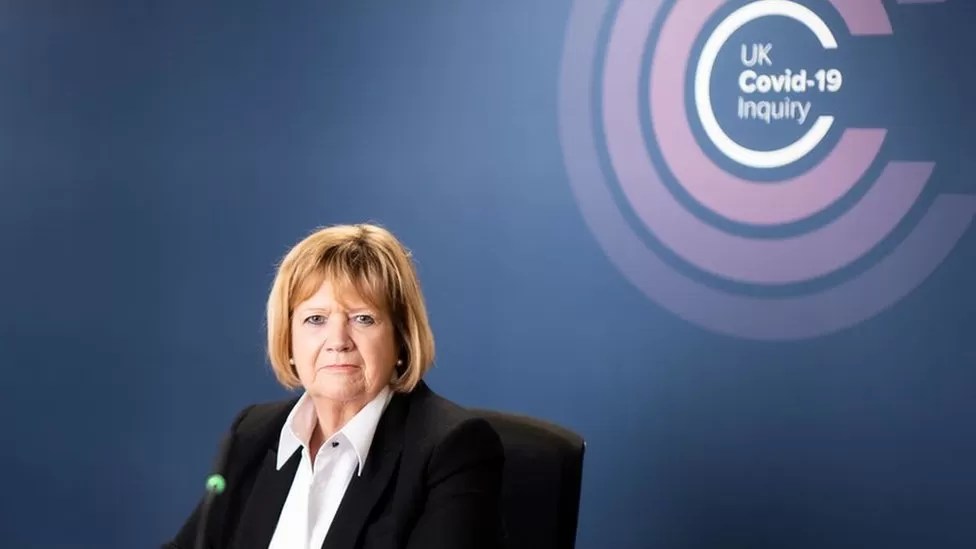
Baroness Hallett promises the inquiry would be ‘thorough and fair’. Photo from Piranha Photography.

Last week saw the beginning of “Britain’s Public Inquiry” to understand the Conservative Government’s responses and handling of the Covid pandemic. But for the life of me, I can’t find out who is in charge of “Britiain’s Public Inquiry” and what – after the facts have hopefully been gathered – will happen? Will lessons have been learnt? Will those deemed responsible be held responsible? Will there be any retribution? Will anyone be called before a court of law or those pages of documents produced be filed away rather than read. Last week when Dominic Cummings gave his testimony he asked that the inquiry also focus on the broader failures of the system. Reading – for I can’t listen to them talking – it is clear that as blame is shuffled about like pearls under walnuts, the prize goes to the then Prime Minister Boris Johnson. Dominic Cummings likened working with Boris Johnson to driving a shopping cart with a wonky wheel. 

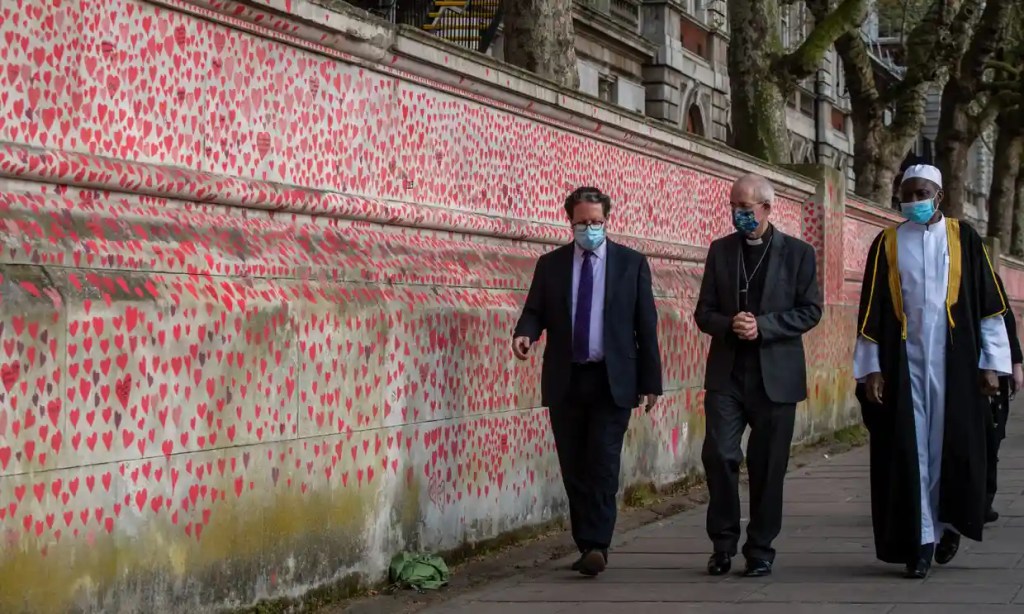
It is not without irony that the inquiry is taking place at Whitehall just across the river from the Covid Memorial Wall that was created and painted in 2021by people who had lost loved ones, or worked in the NHS, coming together with the good guidance of the group ‘Led By Donkeys’. Over 240,000 painted hearts cover more than a third of a mile alongside the Thames River outside of St. Thomas’s Hospital. During this time the public were afraid and looked in vain for leaders in the government where all the common sense had been bred and educated out of almost anyone in Westminster not yet of pensionable age. It was like putting drones in charge of the beehive to collect pollen and care for their queen, when all they could think about was kingship and sexual obsession. 

From left: Rabbi Daniel Epstein, the archbishop of Canterbury, Justin Welby, and Imam Kareem Farai visiting the wall in April. Photograph: Chris J Ratcliffe For Covid-19 Bereaved Families For Justice/Getty Images

People are booking their theater seats. We follow the inquiry like a serialized Charles Dickens story in the magazines of the day. Up to testify next are the past Prime Minister Boris Johnson, his hovering henchman Matt Hancock, and the holder of the chair at the moment, Rishi Sunak. But it is the failings of one particular individual, Boris Johnson, who was ultimately responsible for directing the government, which will continue to be scrutinized in the months ahead. Johnson’s successor-but-one as prime minister, Rishi Sunak — who was U.K. Chancellor during the pandemic — also has questions to answer. All three men — Johnson, Sunak, and Hancock — are to appear before the inquiry in the same week at the end of November. 

Photo Credit to Art Center Wikipedia

Sunak has thrown his dead cat into the ring – by hosting an international AI conference on safety issues that was held at Bletchley Park. The conference produced some back-patting for, and from, the UK, US, and European leaders who attended while getting a nod of approval from the United Nations. Elon Musk arrived to give a speech and chat with Rishi at Downing Street. Both men in their uniforms, Elon remains rumpled and a little unshaved while Rishi rolls up his pristine white shirt sleeves possibly looking for his next job opportunity after this gig is over. So will anything happen from this inquiry apart from “Lessons have been learnt”? The Infected Blood Inquiry – the Stephen Lawrence Inquiry – and the Greenfield Tower Inquiry – have each chipped away at this UK government, but not a lot has changed. Could this inquiry be the one showing that Britain’s democracy has really gone up in flames? I’m writing on Guy Fawkes night – our night of fireworks – celebrating the failure of the 1605 attempt to blow up the Houses of Parliament. We may be holding our breath and will it happen this time? I cannot watch the inquiries – it is too painful – so instead I read.

in an interview, the American thinking and writer, James Baldwin, said “You must realize that if I am starving you are in danger”. And in this simple truth, buried deeply, lies some of the reasons the wars are being fought all around us. Johnathan Freelander writes eloquently and with great heart in this weekend’s Guardian Newspaper, that no side of the Israeli, Gaza, and Jordan triangle conflict are searching for a peaceful conclusion – at this time. In Pulse “Stories from the Heart of Medicine,” I read a translated account from Hadar Sadeh, an Israeli youth psychiatrist working at a Medical Center, about twenty-five miles from the Gaza Strip. Then I open an email from our Palestinian friend and filmmaker, Annemarie Jacir. Each woman weeps at the death of children and physical destruction that they see around them. Each letter could have been written the other.

And see how the war in Ukraine gets roughly pushed to one side even as we know it continues? Old statesmen take planes from one capital city for talks then board another, exchanging their suit jackets for a flack vest as they land in a war zone to encourage young men to face death bravely for their country. Ukrainian President Zelensky rightly worries that this other war is distracting from support to his war – defending Ukraine from Russia’s invasion. How much can we carry in our hearts? And tucked away even further is the news that Russia’s President Putin’s arch-opponent Alexei Navalny’s three lawyers have been detailed. They are facing trial for participating in the so-called extremist group, Navalny’s Anti-Corruption Foundation. If they end up in jail then all contact to the outside world will be lost for Navalny. Each of these eruptions is bleeding like an aspirin-fed wound and all the pressure that is applied will not staunch or stop it any time soon.  

This has been A Letter From A. Broad written and read for you by Muriel Murch.

Step Right This Way

Step right this way – 

Recorded and Knit together by WSM

And we are back in Belarus. On Sunday when the journalist Roman Protasevich boarded a plane in Greece, he was already nervous, texting back to colleagues that he believed someone was following him. The plane was under an hour away from Vilnius in Lithuania when the announcement came, “This is your captain speaking. We have received information of a possible bomb on board and are to be diverted to Minsk”. As a Soviet-era MiG-29 fighter jet, ordered by President Lukashenko, came alongside to escort the Ryanair plane to Minsk, Roman and his girlfriend must have really felt fear. Passengers were taken off the plane, claiming their luggage laid out across the tarmac as the charade continued. But it was Roman Protasevich who was the luggage to be collected by the two Belarusian secret service men also on board the plane. Protasevich was detained, with his girlfriend, accused of organizing last year’s protests against Alexander Lukashenko’s regime. Ryanair said that the situation had been “out of its hands”. The plane was over Belarusian airspace when it was diverted to Minsk though it was closer to the Lithuanian capital, Vilnius. 

Here Dominic Raab, the UK foreign secretary, can tut-tut away, grateful that, for this moment at least, we are not a part of the European Union. The US has also joined the tut-tut brigade and most of the responsibility will fall to the slight but firm shoulders of Ursula von der Leyen and the Polish prime minister Mateusz Morawiecki who accused Lukashenko of a “reprehensible act of state terrorism”. As of today European flights are no longer flying over Belarusian airspace and Belarusian planes can no longer fly through Europe. That will be a lot of detours. The incident is alternately described as a hijack and/or a criminal offense, (I’m not sure of the difference) but Alexander Lukashenko doesn’t care. He has got his man and thumbed his nose at Europe and the western world at the same time. This must call for a phone call chuckle and a drink with his chum Vladimir Putin. 

There is an English saying, ‘Ash before the oak, in for a soak, oak before the ash, in for a splash’. And so it is proving this May where the Ash tree leaves are already a mature green while the oaks remain delicate and pale. But umbrella raised above the wind and rain we strode out on Sunday, taking the 168 bus down to the the south bank of the river where the wind blew even as the rain stopped. Stepping down to the river from the Waterloo bridge we walked – among people – many still masked – along the banks of Old Father Thames. The river-water was mud-brown with tide hurried wavelets shaking like a dog coming in from a run. The cafes were open, the open-air bookstall up and running outside of the British Film Institute and clean public toilets close by. ‘Spending a Penny’ now costs a pound – no change given. At the bright orange carousel a young man fishes deep into his pockets giving me change for my two pound coin. Someone is making a pretty penny with these necessary facilities.

We walked past the London Eye, looking so huge from the ground, and then under the Westminster Bridge through to the “Wall of Hearts.” Painted on the wall that surrounds St. Thomas’s Hospital it faces the river and the Houses of Parliament. Organized by Matt Fowler, whose father died from the virus, each heart is for another death. To date over 128,000 lives have been lost in the United Kingdom. The 150,000 hearts already painted will be used up soon enough as family members continue to come and write, commemorating the names of their beloveds in all the languages that make up this country.

The Covid Memorial Wall

The wall covers the length of the two old prestigious hospitals Guy’s and St. Thomas’s, now merged as one. Looking high above the wall, there are still old stone arches crumbled and moss-laden leading from the hospital’s beginnings in history through to the buildings of today. May holds Nurses’ Day and I am thinking of Dame Cicely Saunders, who trained here, first as a nurse then as medical social worker and finally as a physician. It was here she pioneered her palliative care treatments before founding St. Christophers Hospice in 1967, expanding to community home care in 1969.

Nurse Saunders and Dame Cicely Saunders

The wall ends bringing us to the Lambeth Bridge and the Lambeth Garden Museum which must wait for another day.

“The BBC is in a dangerous place at the moment, and people like me have a special duty to be careful about what they say,” said Andrew Marr last week. And I can’t even remember what scandal that was about, for now an old chestnut has come back to haunt them. 

After 25 years an inquiry has finally been completed into the Martin Bashir 1995 panorama interview with Princess Diana. And this week Prince William spoke publicly. His comments almost bypassing Bashir, going straight to the jugular of the BBC. He called for them to never air the program again and blasted the BBC top brass for presiding over a “cover-up”, rather than lay the blame squarely with rogue reporter Martin Bashir who used fake bank statements to falsely claim Diana’s inner circle were selling information on her to the press. Heads have already begun to roll with resignations here and there. No doubt this will lead to another inquiry, but it will have to wait in line as there are many files already stacked in the constipated bowels of Westminster.

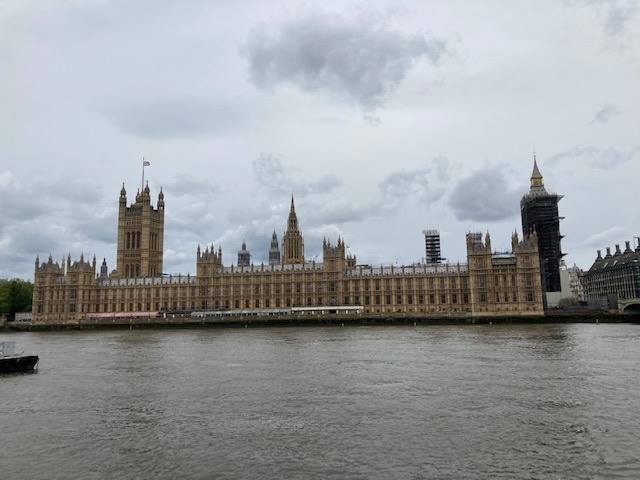
Palace of Westminster UK Parliment from across the river

This has been a Letter from A. Broad. 

Written and read for you by Muriel Murch 

First aired on Swimming Upstream – KWMR.org

Web support by murchstudio.com