Remembering the First Time
It was 1948 and I was 5 years old when, with my mother and Brett, my nanny, I stood on the side of The Devil’s Punch Bowl. As each horse came to the crest of the gully, they paused, taking in the drop, collecting three strides down, before a leap over the solid tree-trunk above the deep ditch then galloping up the other side and away onto the rest of the course. As a big grey horse thundered past, my mother and Brett let out a cheer for the Swedish rider. Brett was from Sweden and this was the first Olympics after the Second World War. The equestrian events at the 1948 London Olympic Games were all held close to home at the Tweseldown Racecourse by Aldershot – a military town and at a very early age we were taught, “Never talk to the soldiers”. The American team won the eventing, the Swedish team placed second, with Mexico taking the Bronze medal. The changes in the political geography of countries can often be seen at the Olympics. In those days Mexico and Argentina sent successful equestrian teams all over the world. I never got over the thrill of seeming that grey horse leap into and over the Devils Punch Bowl.

I was hooked and it would be less than ten years before Taffy and I were galloping through those same forests and over any obstacle I found in the secret freedoms that lay on those moorlands.
We remember those first times, and now as this year’s Olympics play out in Paris we watch the athletes perform, many for the first time for their country.
Sir Keir is a serious man and treating his new premiership with appropriate gravitas, and while the Labour Government was seriously going about getting settled in, they too felt they could breathe gently and watch our athletes in Paris giving their very British best. But if he had hoped for a longer honeymoon period it was soon cut short as we watched the riots break out in a fire storm over the killing of three little girl children finishing a dance class in Southport. An unnamed seventeen year old boy – incorrectly rumored at first to be a Muslim refugee – is being held in custody. Rumours – spreading as fast as the wildfires of Canada and California, have sparked violence in cities across the country. Far-Right nationalists fuelled by the disinformation from social media, are following a pattern discernible in North America, Israel and Hungary, among other eruptions around the world. Gray headed grannies holding signs for ‘Nans not Nazis’ are in danger of being knocked to the ground by the boys in thier street that they may have helped raise.
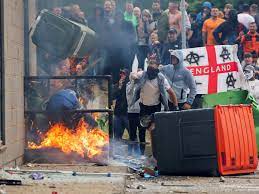
From Southport in the north to Aldershot in the south, towns up and down the country that hold deep pockets of poverty and unemployment are fuelled with anger and rioting in an all-too-familiar manner. Sir Keir Starmer is facing his first time as Prime Minister with this storm battle and our country’s worst elements. Nigel Farage barely makes an effort to keep a neutral face while he sits in Parliament and no one can believe that he is not chalking one up for the far-right team. The Police have been given ‘extra powers’, more prosecuting lawyers have been called in, though from where and where to it is hard to tell. ‘The rioters will feel the full force of the law,’ promises Sir Keir, but some of us wonder if those said rioters will care, and what the law stands for – for them and for us all. It just took one incident – no matter that misinformation was spread – lines are drawn across the streets of neighbors, with those leaving flowers for the children and their families, and those rioting for an England they never knew, each side is screaming to be heard.
Certainly other government leaders are not concerned about the internal laws of their own country or the international laws that loosely hold the global community together. The recent swap of Political prisoners, brokered by Germany, Norway, Slovenia, Poland, North America, and Russia that took place in Turkey was the largest game of checkers since the Cold War. 16 Russian dissidents, Germans and US prisoners were returned for 8 Russian undercover spies and agents. But there are still hundreds of political prisoners left behind in Russian prisons, and who knows how many Russian prisoners are also still in European and American jails. When the talks first started, Navalny’s name was among those put forward for release, ‘Sure, no problem,’ said Putin in the Russian political way. During the months that the final arrangements fell into place and the talks continued the ‘Sure no problem’ line was repeated, but Navalny died in prison on February 16th. Bait and switch. Check mate. Putin never intended for Navalny to go free.
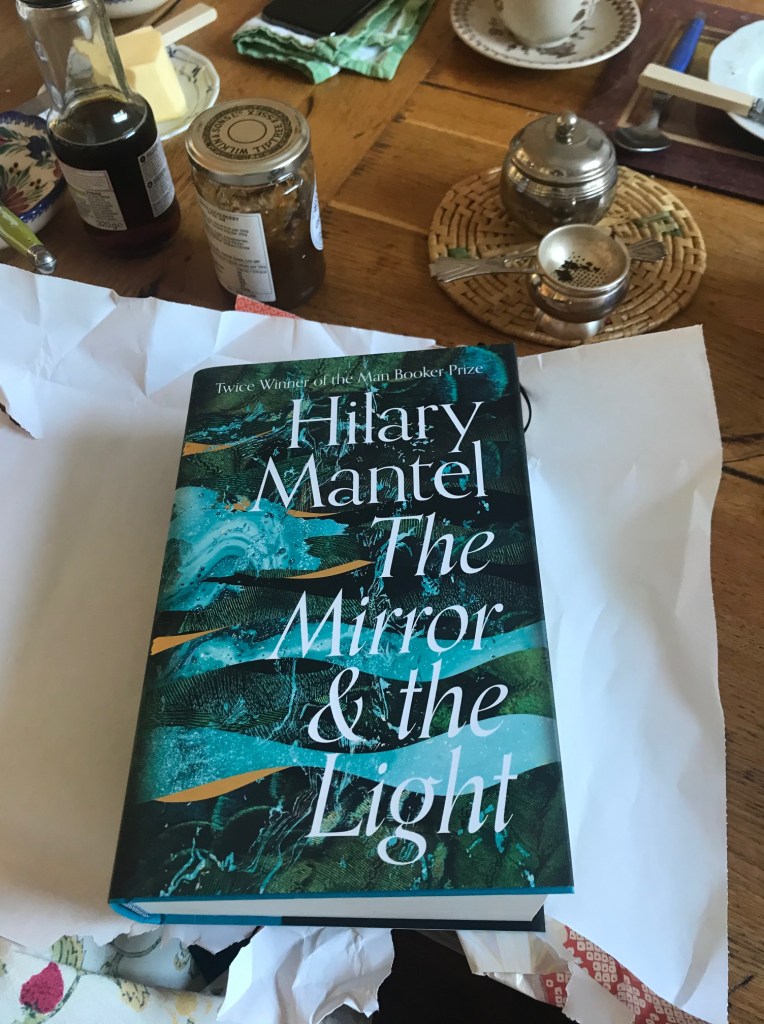
It was 1992 when at KPFA Pacifica, I was handed ‘Time and Tide’ a new book by Edna O’Brien who was coming to California for an extensive book tour. This was to be my first book interview. As I picked up the book and turned it in my hand, the portrait of a sensual and defiant Edna stared out at me from the back cover. Edna was a woman who – if she took to your husband at a dinner party might – or might not – return him for breakfast. This I knew to be true. ‘Time and Tide’ was not an easy book, even if you were a follower of Edna’s writing. But I understood Nell, her heroine, even as I cringed at all the troubles that beset her through the pages.

Edna arrived at the radio station in a fuss. Her plane has been delayed and her luggage was lost. She was as tiny and Irish as I was tall and English but quickly I saw that we were both nervous. Edna upset at the loss of her luggage and the fact that her silver pendant had rubbed a stain on her white jumper. I was terrified of her intellect and sexuality. But as we sat down, locked together in the recording booth, and began to talk, she relaxed, answering my questions with eagerness and generosity and the conversation began to roam as she remarked “Well, Ulysses is difficult isn’t it?” Then we slipped into film as both of us had been knocked sideways with ‘Raise the Red Lantern.’ by Zhang Yimou. It was clear we shared a mutual concern for the plight of young women and that, as well as my thorough preparation, softened Edna and she recommend me for the publishers next author, Susan Sontag. Now Edna has died at the age of 93 after a long illness and I wonder what was the illness that took her away from this world at the beginning of this late summer time. Edna was my first Author Interview and I will never forget her.
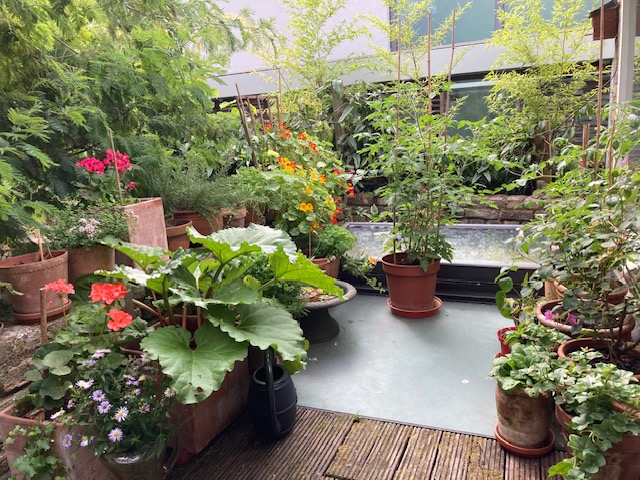
Apart from the riots and the Olympics there are the perennial editorial concerns about the decline of wildlife and insects. Our little terrace is less than 150 square feet and is now full of summertime beauty. We get excited when we see the honey, bumble and mason bees, and then a cabbage white butterfly, an orange tiger moth, and a blue dragonfly also come by. Their first arrivals let us know we are doing the right thing on our tiny patch of heaven.
This has been a Letter from A. Broad. Written and read for you by Muriel Murch, and supported by murchstudio.com
A correction from the audio to the text. In the audio I say Stockport when it should be Southport.

 Muriel Murch