Behind Closed Doors

Written and read for you by Muriel Murch with WSM by my side

The Piazza Santissima Annunziata is almost empty with only a few tourists bearing the late afternoon summer heat while seeking refuge in the churches and museums. Idanna drives straight into the empty Piazza and parks the car. We get out and look around. In the center sits The Grand Duke Ferdinand (from 1608) astride his horse. The horse is facing the little telescope alleyway that leads directly to the Duomo, but the Duke’s eyes, if you look carefully, seem to glance up to two windows, three stories high, on a red building. The shutters remain open so that through the centuries he can look to, and be seen by, his mistress behind them. His arm is raised in salutation to the Pope of the day, or to her – it is left to the onlooker to imagine. On another side is the hospital of the Innocents, an orphanage and museum still run by the nuns from the Sisters di Maria. A small grilled window sits facing the square where – at night time – a mother could – between 1660 and 1875 – raise the grill and lay her new-born babe on the rota where friars, on their night-time shift, sat waiting for a delivery, not as midwives for a wanted child, but as caretakers receiving the fruits of enslaved and then abandoned love. These are the buildings and stories we take in as we make our way to the side door of the Church of Santissima Annunziata, for our friends, Idanna Pucci and Terence Ward have something to show us.

The Key to the door.

“It is a surprise,” says Idanna after we had stopped at the Palazzo Pucci to pick up the ancient key that would have weighted heavy on the twisted cord belt of a monk’s cassock. Again, her face lights with that impossible grin she has when holding a happy secret. The door is thickly double paneled, over eight meters tall, and the strong wood is sun-cracked. Terry takes the key from his pocket and places it in the single lock.

In the bright late afternoon sunlight the key is reluctant to turn and it takes several wiggles before it catches and the door is opened. We enter the tall cool space of this chapel dedicated to St. Sebastian and now lovingly restored by Giannozzo and Idanna Pucci with the help of World Wide Friends of Florence.

WSM and Terence Ward look up to St. Sebastian.

Terry gathers the three red velvet chairs placed in the chancel for musicians together and we gather around as Idanna tells the story. Her lilting voice takes us back to 1082 when a little house of prayer was dedicated to St. Sebastian, then leads us down the path of history through the Middle Ages, the building of this church of the most Holy Annunciation and this chapel, to the paintings commissioned, sold (by one of the unscrupulous relatives) and now lovingly replicated through the guiding hand of her brother Giannozzo. Her voice sings with the joy of the story, coming to when the chapel was reopened and rededicated in May of this year. Idanna is grinning with the happiness of sharing their gift to the city with us. They then lead us around the three major paintings of Saint Sebastian hanging above the alter sanctuary while underneath there are sculpted reliefs of Pucci ancestors, the good and the maybe not so good. Finally we look up at the breathtaking cupola. As we lingered in the beautiful sanctuary a guide from the main church brought in two more visitors to see this sidebar of history. Taking our leave, we walk over the moveable stones that cover the crypt holding Puccis and maybe even a Medici or two. “Have you been down there?” I ask Terry, and he firmly shakes his head. “I have looked. It is a jumble of bones all tossed about, from the flood’. In 1966 the Arno river flooded and swamped Florence ravaging much of the art and bibliotic heritage of the city. The Pucci crypt would be one among many holding places of the dead to be tumbled into confusion and dust. Leaving, Terry turns the key once more in the lock. Walking to the car in the still almost-empty Piazza, I silently said goodbye to the orphanage museum, the Convent of the Sorelle di Maria and the old Duke with his arm raised in salutation.

The Hospital of the Innocents – Orphanage and Museum – Photo by WSM

With our time in Italy we missed the final run up to the UK general election and returned only in time to watch Ukrainian Prime Minister General Zelensky meet his Hungarian counter part, Victor Orbán. Orban, who for six months more is head of the European Union, then went on to chat with his pal Vladimir Putin.

Orbán and Zelensky meet

The countries that make up the EU cried ‘Foul, He is not speaking for us,’ but Orbán merely shrugged, figuratively speaking, saying he was just going to listen and hear what each side has to say. He may be dreaming to broker a peace deal – always a good thing to have noted – but his hand is more eager to grasp Putins’ than Zelensky’s. As each Eastern European leader swims across the tides of history pulling and pushing the boundaries of their country it is within our memory to recall Hungarian refugees arriving in England while fleeing their own county’s oppression.

As July 4th – the UK polling day ended – TV screens lit up like a game show as presenters pointed out which constituencies were turning from blue to red with touches of amber for the Liberal Democrats and green for – well – the Green party. But it is the red of a Labour takeover of the country that has prevailed. As Dishy Rishi drove off to hand his resignation to the King, the movers were quickly packing up the Sunaks’ plates and cutlery, curtains and bed linens to take out of the back door. An hour – or is it two –  later, steady Sir Keir Starmer was off to Buck House, asking the King’s permission to form another government. The handover has to be quick so the country is not left to its own devices. The moving vans are as quick in and out which is rather lovely, for #10 Downing Street is just an old run-down city house in constant need of repair. The inconvenience of any refurbishments only heightens the impermanence of the position, as power comes and goes and hopefully, while you have it, you can do more than change the curtains.

Sir Keir Starmer has not been idle. The smell of Pledge furniture polish was barely cleared from the cabinet room before he gathered his new team around the oval table and gave them each their work orders for the weekend. There was not an old Etonian among them and there would be no potting shed moments. For some, their bags were already packed to fly out, meet and greet, and start work. The weekend saw Keir begin his trip around the British Isles meeting the other UK government leaders. While with the First Minister of Scotland, Sir John Prescott, the chants from protest marchers could be heard through the ministerial walls before Sir Keir was whisked away past the waving Pro-Palestinian flags to meet the First Ministers of Wales and Northern Ireland. On Monday, he arrived in Washington DC, attending the two day Nato conference, filling his movable dance card with more meetings of world leaders, some who are uncertain about their political future. As Sir Keir enters the stage, others are exiting, stage left or right or hovering in the center holding an unenviable heavy portfolio. While Zelensky can be assured of continued support from the UK, the State of Israel, Gaza and the Palestinians remains out of balance. The elections in France have handed Macron a mixed plate but there is relief that, for the moment, the Far Right parties of Farage in England and La Pen in France, though now more visible than ever, have been contained – but only just.

When thirteen of us gathered together at a Palestinian restaurant on the Marylebone Road, for a Coup 53 reunion and an early celebration of Walter’s 81st Birthday, I looked around the table counting our birth-countries: Sweden, The Caribbean, Finland, Iran, North America, Ireland, and England, and am grateful to break bread in a place of such multiplicity.
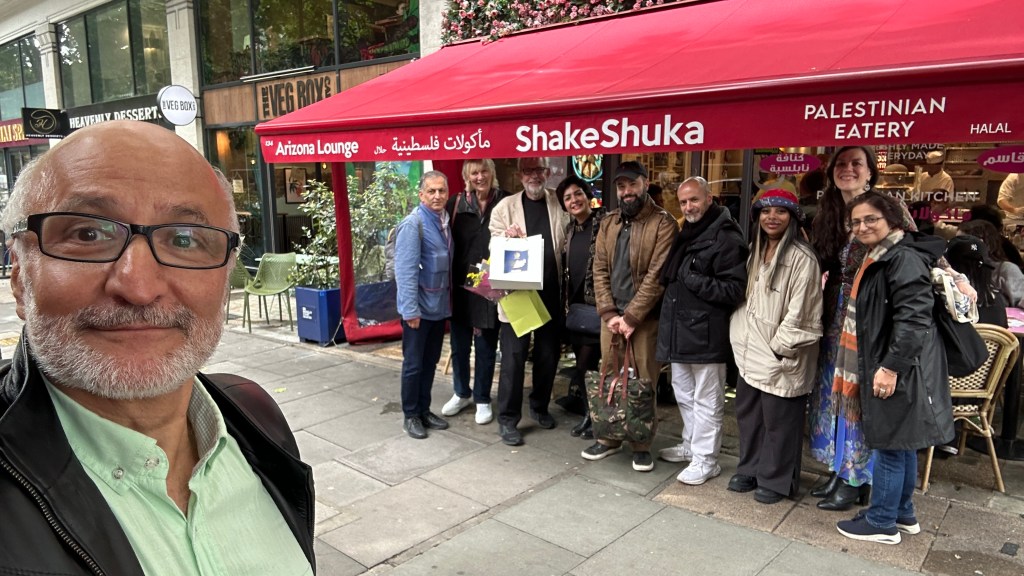
Taghi Amirani and team. Photo by Taghi

By the closed door of the ladies, I stood with a tall, young, beautiful Palestinian woman just back from the day’s march. “How was it?” “Really good, we were over 100,000 strong.” Smiling together we know that however dissimilar we appear our women’s hearts beat in one accord. 

And always supported by Beatrice @ murchstudio.com

Truth Bombers

Recorded and Produced by Muriel Murch

I’m remembering a Chinese restaurant – probably in Manhattan – it was loud with cooking and cleaning noises from the kitchen and impatient traffic from the street and even then – when we were half our present age – we had to raise our voices to hear each other. 

“What we need are Truth Bombers,” said our friend and immediately Walter and George began to expand on the idea. All that was needed were people whose reputations are so strong, so respected, that everyone would listen, believe them, and would act accordingly – doing – as Spike Lee said – The Right Thing. ‘Well that’s all sorted’ we thought as it came time to crack open the fortune cookies. How on earth could we have been so naive?

Now as governments become stronger in their authoritarian rules, there have always been truth bombers who are shot down before they can clip the sharp manicured nails of those iron fists. Truth Bombers come from all walks of life, particularly among artists and their offspring – celebrities, and activists – with politicians far down the list of those who follow this path.

Somehow this has all bubbled up in my mind from another British boil-over – you can’t be serious – the country says – when Boris Johnson, past Prime Minister of bumbling, put his father forward for a seat in the House of Lords where he had already booted his brother Leo to safety. 

On 7 March, Gary Lineker spoke out – well, tweeted actually – which now amounts to the same thing – that the language being used around asylum seekers was “Not dissimilar to that used by Germany in the 30s” and that put the government’s knickers in a twist and Lineker off the air. When he first joined the BBC, Lineker had clearly stated that “there are two things that I’ll continue to talk about, the refugee crisis and climate change.” When Lineker was reinstated to Match of the Day the following weekend, the director-general, Mr. Davie, said he had taken “proportionate action”. Adding “We believe we did the right thing. I think I did the right thing.” The row over Lineker’s tweet led to fresh calls for BBC chairman Richard Sharp to resign. After things quieted down, Lineker added: “What they have to think about first and foremost – the government of the day whether it is Tory or Labour – cannot decide who the chairman of the BBC is, or have any kind of influence on who they put in the director of news or anything else – though it looks like another ermine robe could be floating down the BBC’s back staircase.” 

Photo by Mike Egerton A.P

The ten-hour flight from San Francisco was as smooth as those things can be. Dear Taghi Amirani met us at Heathrow – driving us into five minutes of sunshine before the grey clouds of England covered the sky over the old A4 road into London. It is a scruffy road, airport hotels sit bossily beside old fields that have been given up and over to scrub and travelers of all kinds. A few plum trees are in blossom and new emerald-green leaves are appearing on the roadside trees. When the sunlight strikes them my spirits lift at this harbinger of spring. Even the houses in Hounslow, that sit directly under the flight paths of so many planes, look fresh and optimistic. Tulips have been planted to follow the daffodils along grass verges. As we come into the city, blackened tree trunks and branches are leafing out saying yes to this season. 

Slowly we begin to settle in – unpacking this – rediscovering that and wondering where on earth is the other thing. And we look at the shift in the news items of today. The main themes of course remain the same, corruption by public political figures. Boris and his Papa now receding into the back pages while two Scottish figures from the Scottish National Party were arrested and then released on bail. Last month it was the former chief executive Peter Murrell – husband of Nicola Sturgeon – the recently resigned First Minister of Scotland – and this week the Scottish National Party treasurer Colin Beattie. Then there is the little matter of Rishi Sunak’s wife’s investments in childcare firms not being mentioned on some disclosure forms. Instead, we get to see Rishi and his wife – who wears the taut skin of a supremely rich woman – on the floor – smiling as they appropriate jumbo Lego blocks from nervous children. 

Meanwhile, inflation in England is at over 10%, the highest in Western Europe – Brexit – Thank you again. Junior doctors are out on strike for more than their £14 an hour – the supposed living wage in England. The nurses are once more teetering on striking while surgeries and other procedures are being canceled. The National Health System appears to be falling apart which may be the no-longer-hidden goal of this government that put forward a Prime Minister of color as the fall guy. 

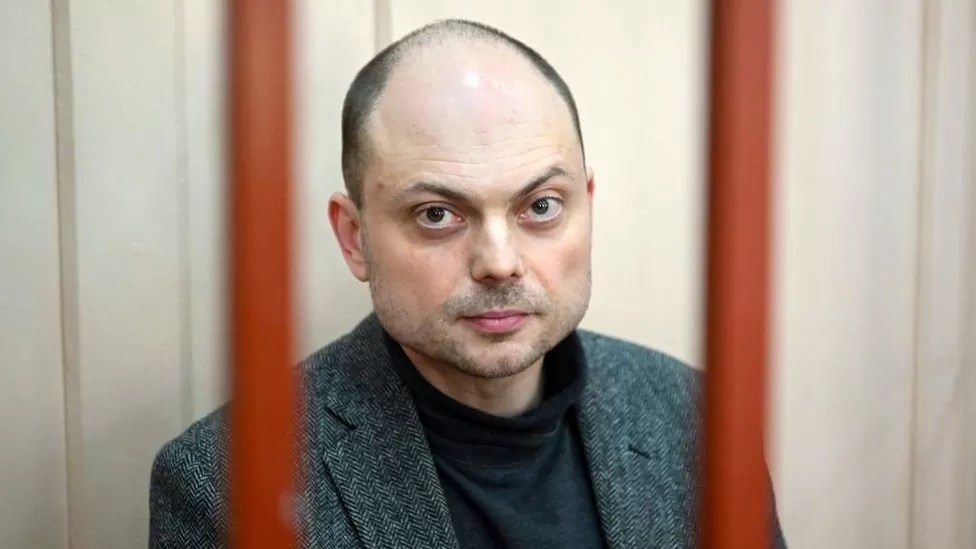
It is time for the ten o’clock news and though the Scottish indecent party politics lead, followed by a smiling Rishi on the floor with a toddler’s Lego, the main item is the recent trial of the Russian activist and journalist Vladimir Kara-Murza. Murza is Russian and came to England as a teenager, later attending Cambridge University. He worked in journalism before becoming an adviser to Boris Nemtsov, another Russian political opposition leader who was shot and killed in 2015. Murza now lived in the United States with his wife and family. Then later, he wrote from his cell, “We all understand the risk of opposition activity in Russia. But I couldn’t stay silent in the face of what is happening, because silence is a form of complicity”. He has survived two alleged poisoning attempts but at the onset of this war knew that he had to return to Russia where he was immediately arrested and now found guilty of criticizing the war in the Ukraine, spreading “false” information about the Russian army and being affiliated with an “undesirable organization”. all equating treason. He has been sentenced to 25 years in jail, the harshest sentence yet for political dissidents. Along with Russian Alexei Navalny, Belarusian Alex Bialiatski, and others, Vladimir Kara-Murza is a Truth Bomber.

BBC News

Which brings us to Sir David Attenborough, another truth bomber – Still flying missions – Sir David Attenborough’s new flagship series, Wild Isles, looks at the beauty of nature in the British Isles. Five episodes are currently airing in primetime slots on BBC One. But the sixth episode – a stark look at the losses of nature in the UK and what has caused those declines will only be available on the BBC iPlayer. It is understood to include examples of rewilding, a controversial concept in some deep rightwing circles. Once again the Government’s knickers are in a twist – and all of a sudden it doesn’t seem so far a stretch between rapping Gary Lineker’s knuckles, clipping Sir David’s prime-time wings, and jailing Vladimir Kara-Murza. 

Photo BBC

This has been A Letter From A. Broad written and produced for you by Muriel Murch.

An Eton Mess

Recorded and Knit together by WSM

Despite being arrested and badly beaten, protesters are not giving up and protests in Belarus continue. Over 200,000 people took to the streets in Minsk over the weekend while TV Journalists are refusing to work in the state-sanctioned stations. Europe and much of the world are watching, appalled at the police and army violence used to control the protesters. Beleaguered President Alexander Lukashenko is feeling the heat and has turned to Vladimir Putin asking for help, which may – or may not – be forthcoming. Is this a world-warning to the U.S. if, in November, the U.S. presidential elections appear to be overtly tampered with?

A real Eton Mess by Helen Hall

An Eton Mess, as described in Wikipedia – the now go-to in depth Encyclopedia Britannica – is a traditional English dessert of strawberries, meringue, and whipped cream. As the name suggests the Eton Mess originated at Eton College and began life when served at the annual cricket match between the Eton and Harrow Schools at Lords Cricket Grounds in London.

In the summer time of the early 1960’s, as young student nurses, with our end of the month brown envelopes, we would walk up the hill to The Corona Cafe on the Guildford High Street. Crowded tightly into our little booth we would each order, not an Eton Mess, which was not yet on every restaurant’s menu, but a Knickerbocker Glory, which was.

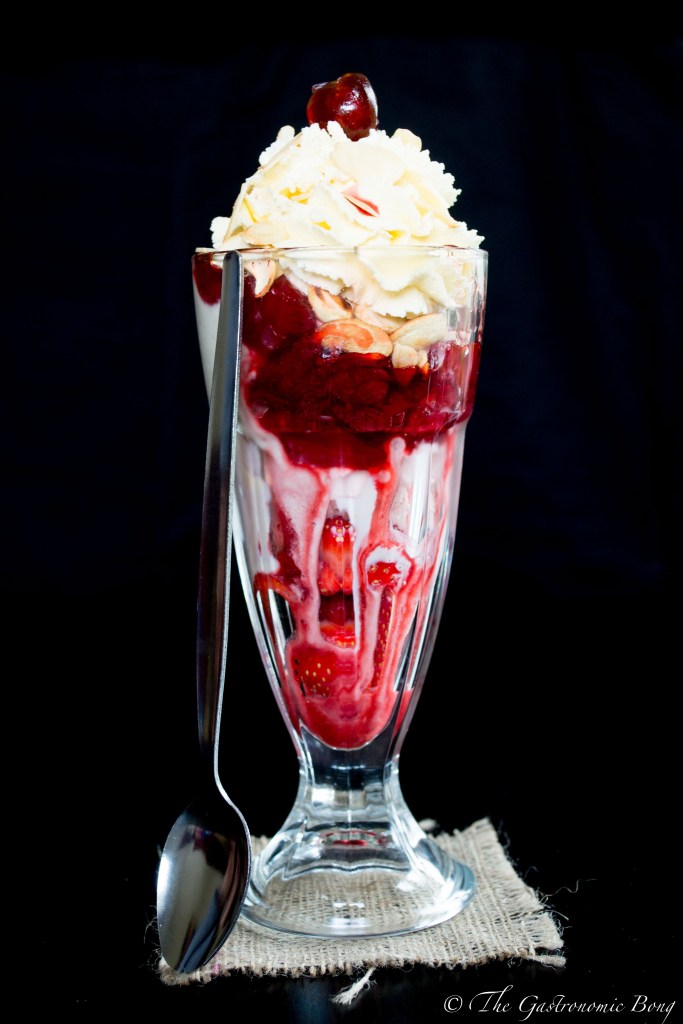
A Real Knickerbocker Glory from Gastronomic Bong

Before the European Market, and a global economy, soft fruit was truly seasonal and ripe only in June and July. The berries then faded, giving way to August’s blushing peaches and plums.

But here we are in August, with strawberries and raspberries still in the markets and so, if we choose, we can make up our own versions of an Eton Mess; mashing merengue, ice-cream and fruit all together, or we can be more creative, putting together an elegant Knickerbocker Glory.

Now in this mid-summer moment, Boris Johnson’s Government has produced its own Eton Mess within the education system, taking all the good things of a last school year and, with a hairy fist and no thought for the consequences, crushed them into the industrial blender of the Ofqual algorithm. Whether it is G.C.S.E.’s or A levels, leaving school exam results are hugely important to the students, teachers and their schools. I can remember fearfully waiting during exam result’s week for the brown envelope containing my O Level results to come though the letter box. This year, because of the Corona Virus, there have been no A level exams. They are vital indicators for a student’s way forward to a university – or not – and if so which university can they attend. The government’s first choice was to wiggle through two paths. In Private (called Public) schools, the teachers were allowed to give their assessments of a student’s grades. In State schools the government implemented an algorithm from the exams watchdog, Ofqual, based on previous results from these schools. This appeared dependent on post codes for schools and students alike and did not address the hard work of the schools and teachers struggling to improve and equalize the opportunities for students throughout the country. The gap between rich and poor has been broadened and deepened more that ever.

The Scottish Prime Minister, Nicola Sturgeon, was the first to think ‘Rubbish, off with that computer’s head, we are going to listen to the teachers,’ though she put it more politely saying:
“We’ve got this wrong and apologize to both students and teachers. We are going to do whatever we can to put this right.” Northern Ireland and Wales followed suit. Quickly, old Etonian Boris Johnson, and the Education Secretary, Gavin Williamson, far from an Old Etonian, but maybe with such aspirations, were left watching their Eton Mess collapse into a proper Dog’s dinner. And now the students have voices; quickly they formed protests around the country and posted their stories on Social Media. Those whose post-codes down-graded their results are not going anywhere quietly. This maybe the first time that Domonic Cummings’ computer and puppet-strings for Gavin Williamson have tangled and crashed. The government has been forced to abandon their algorithm from Ofqual and now slides into a U-Turn. Like a cur that has regurgitated its Eton mess, it has turned tail, eaten its own words as a dog’s dinner and retreated.

But this week we are preparing for the Virtual launch of COUP 53 on Wednesday August 19th. That is this evening if you are listing on KWMR.org, one of the over 90 venue hosts in four countries, for COUP 53. Yes, I’m putting in a plug for the film and our own beloved radio station, where you can get tickets for Wednesday night and thereafter as long as the venues keep the link on their website. If your tickets are for the Wednesday opening you also get to see the on-line Q & A moderated by Johnathan Snow and featuring the writer/director Taghi Amirani, the writer/editor Walter Murch and actor, Ralph Fiennes. Ticket sales are split between the host venue and the film.

Everyone involved in the making of COUP 53 at times wondered what rabbit-hole we were falling into as these historic events from 67 years ago played out in more than unusual footage and film. The Press coverage has been amazing and maybe is in part due to the guts and determination it has taken to not only make the film but now to release it in these Covid-19 times. I’ve seen COUP 53 many times but truth be told, I’m looking forward to switching on and watching it again on Wednesday night.

This has been A. Letter from A. Broad.Written and read for you by Muriel Murch

Taghi Amirani and Walter Murch – Almost Done

Zooming Along

Recorded and Knit together by WSM. Aired on Swimming Upstream KWMR.org

Tom Peck writes in the Independent, “The message is go back to work. The guidance is stay at home. So that is clear then.” On Sunday morning’s Andrew Marr Show, Michael Gove, the Minister of the Cabinet, was speaking, and I couldn’t stop imagining him dusting and polishing the table while making sure the water glasses were clean and sparkling on their coasters, as he clearly said, “I don’t think wearing face masks should be compulsory, but it is the polite and sensible thing to do”. For the first time in weeks I was nodding along with him, at the word – polite.

Monday morning Boris Johnson, the Prime Minister you remember, urged the public to wear face-masks in shops. “I think in shops it is very important to wear a face covering. Whether we make it mandatory or not, we’ll be saying a bit more in the next few days.” By Monday evening it is compulsory. One for Cummings behind Boris, nil for Gove.

Sunday was also a Big Birthday as the other member of this household of two turned 77. Upside down 77 could look like two deck chairs sitting out in the sunshine but we know not to sit still for too long. The day brought a first in four months: lunch at a restaurant with two other couples. The restaurant garden with outdoor seating was full at this Sunday lunch-time. But it is strange to know that though we may walk beside each other we cannot hug. This small curb checks us back to when we were children with parents who didn’t do hugging. Lunch is lovely and after our goodbyes leads to a long afternoon nap.

But on a birthday, a big birthday as the years, not us, get older, it is fun to find a reason to gather and celebrate. Brane Zivkovic from New York University first comes up with the idea for his students. Then he reaches out to Randy Thom from Skywalker and Taghi Amirani with the Coup53 team. And suddenly there is a surprise Zoom party and I have stage directions to follow! They zoom like fishing, dropping a line into the river of our lives, hooking those bites and making connections with long ago colleagues and friends. There are folks in party hats and with balloons, the number 77 in case we forget what birthday this is. There are chuckles bringing forth deep and long-ago memories to share. Our children and grandchildren are enjoying the moments, too. It is filled with rememberings, gosh did that really happen? Yes it did. And laughter, more laughter. We are all hungry to connect while holding in our hearts a longing for the physicality of each other that is still a long way off. With a tilt of a camera here a half-closed eye for focus and imagination, we could even all be at the farm, with people flowing from one room or screen to another. After the final click goodbye we sit back, grateful for this time we live in, while remembering those who are torn apart from families and friends throughout the world.

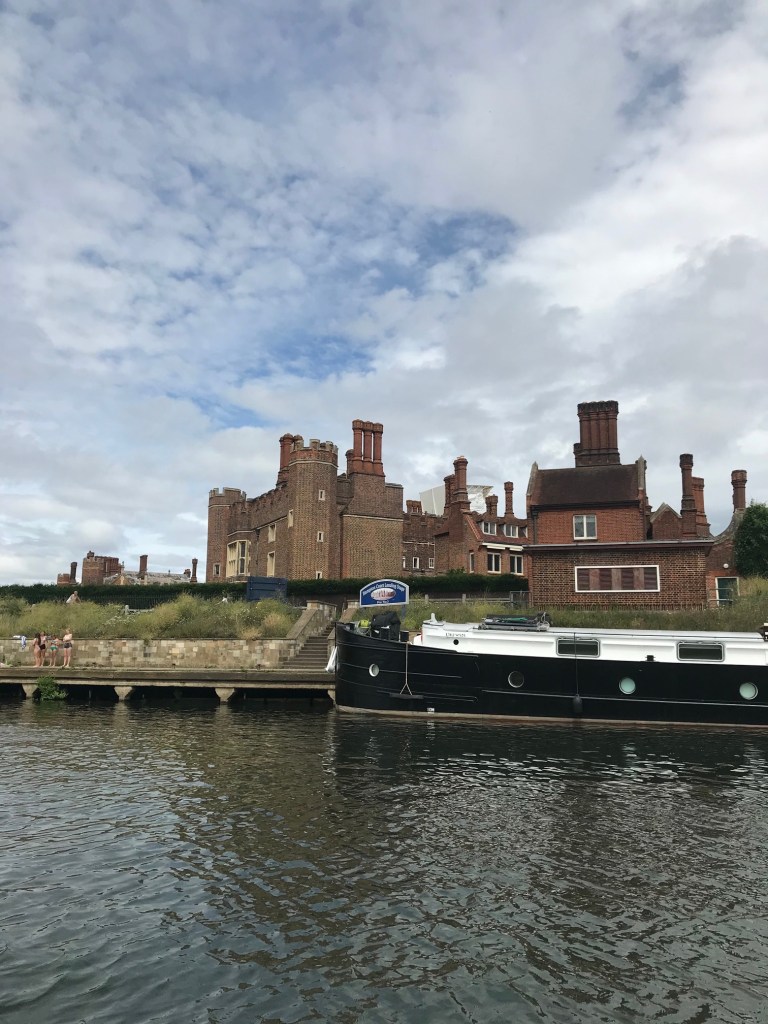
And for Monday, what about a nice little picnic on the river? It seemed like a good idea and we sensibly took off to Kingston in an Uber. It was strange to be out in the ‘real world.’ And truthfully we were a little intimidated by it. There are facilities to find, instructions to heed before we finally are in a tiny little GoBoat and heading out onto the Thames river. The boat is small and slow. The river is big, but we are alone and can take off our masks and spread out a picnic on the table. Steering to river rules, we begin to see what semi-suburban England is looking like and going through. There are swans, geese, ducks and a few grebes on the water circling us, more curious than hungry for the chips we toss to them. The blackberry vines dip into the water and their lush berries are already ripening. Looking back towards Westminster I thought of Henry and Thomas in Tudor times and wondered how long it took to row up river from Westminster to Hampton Court when you were summoned to the King in residence.

Hampton Palace comes into view Photo by WSM

Today there is no hurry. People are wiling away their time, lingering on the river banks. There are groups of children gathered together, unmasked, as they play in and around the water. Boys teasing girls, boys showing off for girls, boys daring each other to climb and jump higher than before from this or that branch into the river. A few out-of-work young men are fishing – that occupation of doing something and nothing.

The smug and comfortable detached houses, with gardens and moorings are sad, rejected for this year at least, left like old lovers to fend for themselves. There are no renters to prepare for, no holiday makers to the river. The lawns are uncut, Buddleja grabs hold in borders waiting for the butterflies to find their blossoms. Even the few potted begonias fail to convince anyone that this year is not over before it began.

Boats in waiting


The house boats are tied up in rows, barely bobbing with the river’s ebb and flow. The spring chores of painting and polishing have hardly begun as we enter mid-summer. Maybe I am wrong, maybe it is just Monday on the river, but it feels like the river, the community, and thus the country is in retreat.

As are we, now we are safely back home. A deeper acceptance of this moment in history has set in and we are mindful of what is before us.

This has been A Letter from A. Broad written and read for you by Muriel Murch.