August in LA

Written and read for you by Muriel Murch with WSM by my side

August is a hard month for California. The sun sears down on the land that slides out from underneath the mountain ranges towards the sea. Only the water cascading down from the mountains and channeled into the fertile fields below brings relief and wealth, and the sense that all is as it should be. But looking closely, cracks are beginning to emerge. The eruptions of wealth, from early settler gold diggers in the Northern Hills, to the tech innovators in Silicon Valley playing their chips, surge and wane while those other essential and lucrative industries of agriculture and cinematic art are holding on, even as they feel the the claws of federal predators stretch and contract, preparing to strike at this strength and wealth while waiting until other, bigger fish for the moment, are fried.

The plane from London touches down at LA International. Not sure what to expect we are amazed at the ease of facing a camera before the gates are opened into the United States. Collecting our bags, we too are collected by our driver. We are exhausted but Bruno, an Angeleno, born and bred, with his own faded dreams has a lot to tell us and we listen as best we can. Depending on the time of day and day of the week each driver has their preferred route. Today we are driven to Beverly Hills on Sepulveda Avenue. The Avenue is large, even by old Los Angeles standards, dusty, dry and worn, laid down before the freeways had been dug out and around snaking through this city ever hungry for more traffic with seven lanes each way, at times barely able to contain the flow of cars.

Best burger at The Apple Pan

Entering The Four Seasons Hotel, the bright lights of the chandeliers beam down on the vast urns of gladioli denying the suffering outside. The following night we leave for the Apple Pan – open from 11 to 11 – on West Pico Boulevard, serving the same menu since 1947. It’s interesting to see Uber drivers from different cities, how they adapt to their city, get a job a gig and somehow make it all work – for a while. For we are all aware, both passengers and drivers how precarious is the American world today. We have paid homage to The Apple Pan since the 1960s, growing older along with Manny on the left wing, and Gordi on the right, of the big horseshoe-shaped counter that surrounds the deep friers and fronts the cavernous kitchen behind. Manny and Gordi began as young counter-boys about the time we first motorcycled into Los Angeles in 1965. They have both retired, but we continue to come, showing our children this tradition whenever we are in Los Angles together. Three kinds of burgers and four sandwiches make up the main menu with a generous helping of french fries. Flipping the menu over to deserts, only the Fresh Apple and Pecan pies are not cream pies – the rest are cholesterol heaven. You want Ice Cream? That will be double Dutch Vanilla.

Entering The Apple Pan is like entering a cave. For awhile, the beat and heat of the outside world is left behind. Even if your truck-driving is more limousine laden than diesel loaded, this is trucker heaven. We come to decompress, to speak and be spoken to kindly, it is almost holy. In years gone by West Pico was bright with shining mall lights, the intersection humming with life but now the outside street is dark and bare. Swaths of real estate have been shuttered, the lights turned off, only the blinking of a few cars and hissing busses pass by. It has taken me two days to find the right word for this Los Angles – it is – desolate. America does not seem so great again.
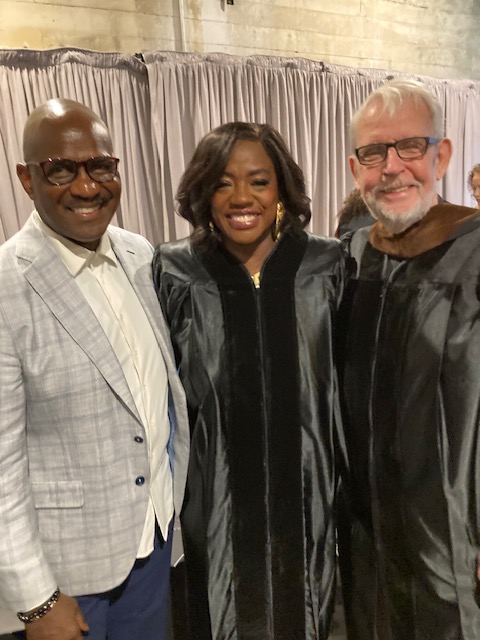
Julius Tennon, Viola Davis, Walter Murch

The week ahead holds a busy schedule. Along with Viola Davis, Walter received an Honorary Doctorate from the American Film Institute. Each of them, a power-house within their spheres, spoke passionately from within their disciplines and I wonder what the graduates made of them both.

For a morning, because it is a graduation with new beginnings for young artists, there is hope and relief in the air. And laughter as when we stop in at the post-event brunch and the faculty head of editorial asked me, 

“Are you?”

“Yes.”

and laughter

“You’re famous in Hollywood. You must have the patience of a saint.”

And there is more laughter. 

A little nervous beside Marylin

We connect with the friends that we can. There are friends too sick to visit, there are friends who have put their homes back together after the Palasades fires, and friends who are only just beginning. These are the precious moments. 

And then the work. ‘Suddenly Something Clicked’ is clicking along. The buzz around its publication is moving quickly through the Los Angles Post Production community and at the same time ‘Harvesting History’ is having its own quieter moment.

Randal Kleiser and WSM are listening – along with a standing room only audience.

Randal Kleiser led us both through our books at Chevalier’s Book Store in Larchmont before Lawrence Weschler puppeteered Murch at The Hammer Museum and the following night Murch just carried on determined to expose as many minds as possible – in another packed house at the Pasadena College of Art and Design – to his exploration of the Golden Ratio of the human face and its relation to cinema. He’s almost come up with an answer, but an absolute answer that might hold truth in logic would perhaps disperse the magic. And what is the magic of these days for these film makers? Maybe the fact that someone is thinking about and able to articulate what they hardly know goes on in their own minds. “Oh that is what I am doing, that is what is happening.” There is hope and validation and even a good dose of courage to be gained by listening.

We are lacking the stamina that is needed for such a full adventure and were felled with summer colds that descended like thick fog and hovered on the brink of bronchitis. Walter was downed early, checked out and prescribed a broad antibiotic by the brisk 60 year young hotel house doctor. I fall at the end, somehow packing and flying until we reach the safety of our London cottage. I wail that I want Doctor Joe, with his gentle chuckling care and beloved Mo with her Chicken soup.

The saving grace of illness is that it was two nights before we are able to manage the world news, Gazas rubble and carnage taking third billing to the immigration rows and the slow bizarre meeting of The American President with Vladimir Putin in Alaska followed by the European Leaders ‘Coalition of the Willing’ in Washington DC. There is the news, and the the body language, and maybe some fake AI unfurling as this madness of the about turns of this play out in unreal time. Sifting through the lies and the truths, the temptings and concessions, the breath-holding is reminiscent of a mother feeding a toddler with a buzzing airplane spoonful of spinach maybe to be spat out in a rage or grasped and swallowed looking for the prize of peace.

This has been A Letter From A. Broad written and read for you by Muriel Murch 

As always supported by murchstudio.com

Hove Actually.

Written and Read for you by Muriel Murch with WSM by my side.

Last week we took the train from London’s Victoria Station to Hove. Brighton and Hove that is, Hove tagging along beside its more famous big sister Brighton, never quite able to keep up. Which is why we were to spend the night in a cheaper seaside hotel in Hove rather than Brighton, and though the hotel boasted of a five-star breakfast, it remained Hove as the shingle beach stretches all along the Essex county coast line. It’s been a bitter marriage. Hove remains the smaller sister, its houses on the roads to the seaside crammed side by side with no breathing room between them. 

After the last war, every few houses became a boarding house, helping widows and poor relations hold onto their homes. Such was the lot of my Uncle Geoff and Aunt Gertrude, Geoff having retired as a Canadian Mountie and failed as a real estate developer returning from Canada. There was possibly not a lot of interest in development for the wilds of Alberta in the early 1950’s. I was sent to stay with Uncle Geoff and Aunt Gertrude in what I now see as an attempt to revert the family estate back to me, the only offspring of six children. I failed at that, but learnt to swim in the King Alfred seawater baths at Hove.  I also learnt about hunger for the first time in my life, Geoff and Gertrude’s Canadian life style didn’t include three meals a day. Another spinster aunt, Edith, lived close by, and her house was even more dismal than Geoff and Gertrude’s. Looking back I realize that my father was the only one of those six children to make it out of Canterbury and into a more successful life. No wonder Geoff and Gertrude were not going to hand back the small-as-it-was Slater Estate.

The Peace Statue that marks the entrance to Brighton

We taxied to the hotel, that looked no different from the houses along the road, and were greeted by a sweet young European woman who looked no different from all the European hotel staff who arrived at Victoria Station in the 1950’s, looking to better their lives and those of their families back home. The outline of the old house is still visible as we climbed the stairs to the top floor. All done over and with the necessary wifi connections. A quick change, back downstairs, to the next taxi and through the rush hour traffic along the coastal roadside, passing the Peace Statue into Brighton. A supper moment meeting the co-guests of this event, Victor and Wendy Armstrong – fellow film makers, English – who made their home and livelihood in Los Angeles. Victor being the world’s most prolific stunt double. His career is as legendary as Walter’s and this evening’s event is an interesting twinning of production action and post production manipulation of that action.

But supper has to be quick, we are on location with a gig after all and we walk our way from the restaurant to Horatio’s Bar and ‘The Space’ on Brighton Palace Pier. Dusk has arrived and day trippers were leaving the pier as film buffs are arriving, bustling in, ordering a drink or two and settling into the chairs arched around The Space. It is late by the time the last fans leave and we walk back along the pier, with the waves lapping underneath drowning out the sound of the cars heading back to ‘Hove Actually’.

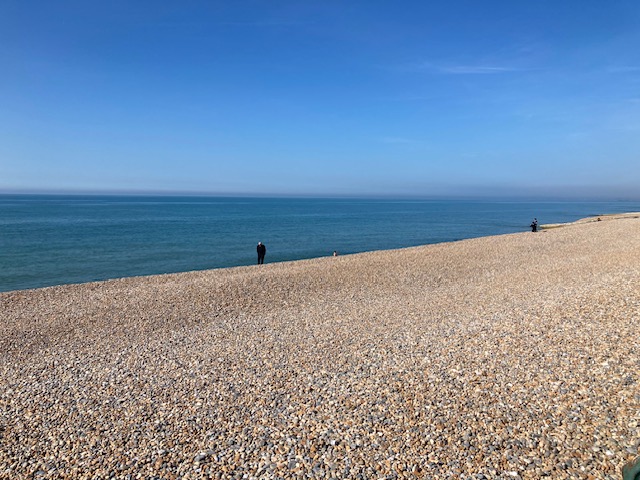
Shingles by the sea.

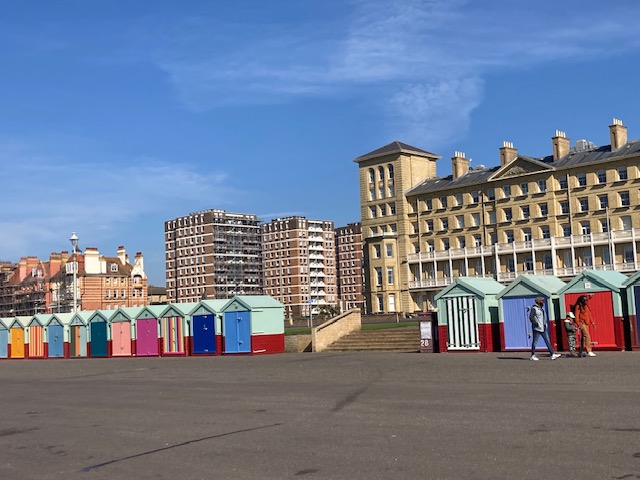
The morning gets us down to the 5 star breakfast which was probably the most appalling breakfast I have ever been faced with. And it must have been appalling for those poor European girls to prepare, never mind serve. Even the coffee – we won’t discuss the coffee. So we walked to the beach, the shingle stones as large and unforgiving as they were to my 10-year-old feet. The sun was shining, the beach huts all still closed up and only a few brave souls were at the water’s edge. The cold and the currents take no prisoners here in Sussex. 

We took the train back to London, where the cottage was waiting for us, and the pigeons were impatient for feeding. Fred, I think it is Fred, has been doing a dance, turning in circles in one of the flower pots to attract Freda, who is not that impressed with this swirling dervish courtier. The parrots are having better luck, a pair cozying up to the feeder together. They give us pleasure, these birds as we watch their antics in relief to those we see having in the United fractured States of America.  But are cracks slowly beginning to be visible as the axes of untrained gardeners slash into the undergrowth of Government? There are checks occurring, the latest being that while the Pope honored King Charles and Queen Camila with an audience, he guided JC Vance into the learned hands of Cardinal Pietro Parolin and the foreign minister, Archbishop Paul Gallagher. “There was an exchange of opinions on the international situation, especially regarding countries affected by war, political tensions and difficult humanitarian situations, with particular attention to migrants, refugees, and prisoners,” said the statement reported in The Guardian. Whereas the parameters of Islam follow the concentric expansion of interests that little by little extends to other persons and groups. The Christian one – as in this Easter Message – read for the Pope –

“I appeal to all those in positions of political responsibility in our world not to yield to the logic of fear which only leads to isolation from others, but rather to use the resources available to help the needy, to fight hunger and to encourage initiatives that promote development. These are the ‘weapons’ of peace: weapons that build the future, instead of sowing seeds of death!”

No matter which religion one follows, none include the concept of ‘Proizvol’ a Russian word that means the arbitrary abuse of power, the effect of which is a feeling that anything can happen to anyone at any time and that there is no accountability. Russia has this word for it, I wonder, do we?

Vance has to go to India, fast on the heels of China’s president Xi Jinping, who manages with a smile and charm to show Beijing having a steady hand on the tiller of commerce. But the Indian farmers, who outnumber any of those in North America, could rumble into Mumbai powering their concern and displeasure at Usha Vance bringing this American husband to her homeland. They are not convinced that he has come in the spirit of cooperation.

Vice President JD Vance has been tripping about and often tripping on unforeseen obstacles such as other countries opinions of his ‘America First’ Foreign Policy. It just doesn’t occur to him, or other members of this US government that going around the world shouting “America First” is – to put it politely – very rude. It’s also not polite to so brashly criticize your hosts defense spending or saying, while in Greenland, “We have to have Greenland.” Over this Easter Weekend it was touch and go if the ailing Pontiff would in fact grant Vance and audience, but finally – as it would – kindness and good manners prevailed and JD and his wife were allowed into the presence of the Pope. It was brief, Vance’s Motorcade idled in the Vatican grounds for a mere 17 minutes as JD nipped in and out it, appearing to listen, before patting the ailing Pope on the arm. They were give chocolate for the children and sent on their way.

As Vance boards his plane flying into India he will have heard of the Pope’s death. Will he, can he, reflect on his ‘America First’ attitude maybe being one more endurance that the Pope shouldered before putting down his burden ?  

This has been A letter from A. Broad, written and read for you by Muriel Murch.

As always supported by murchstudio.com
Monday Nights at the Movies with Mark

Written and read for you by Muriel Murch with WSM by my side

It’s a Monday evening for goodness sake, with an early opening of 6.30 pm. People have to rush from work, and – this being a youngish crowd – they do. The British Film Institute is hosting its 92nd MK3D monthly – Monday night at the Movies with Mark  – Kermode that is – and the theatre is packed with a live audience of hundreds of film fanatics. Which is what they must be because Mark and his team never announce who his guests will be. For the past few months the BFI has been going through some serious renovations – we hear the new bar is not senior friendly – and this live event is the 4th to take place at the IMAX theatre in Waterloo – between the railway station and the bridge across the Thames River. Unless you really know where you are going it is very easy to get lost. Our driver had to be chased down by a runner, to turn around and take a dive under the river before we were led on foot through a labyrinth of latrine smelling tunnels. But we made it in time and were gathered up by Mark’s team of very efficient and kind women. And this may be one of the keys to his success. Mark surrounds himself with good people and because he is good, and passionate about cinema and its history good people want to be on his show, want to hear his show and want to work for him. This night Walter was to be one of the guests and as we all assembled in a discrete roped-off corner of the bar, gentle weavings of admiration stretched across the guests who gratefully sipped their beverages of choice but as elders, we were happy to refrain, before being locked into an auditorium. 

After Mark’s news he introduced his first guest, Robbie Ryan, the director of Photography on ‘Poor Things’. Robbie was followed by Rachael Ramsay co-director of the documentary ‘Copa 71’ on the very successful Women’s Football World Cup that was erased from sporting history – until now. Then came Johnny Burn the sound designer on ‘The Zone of Interest,’ before the senior fellow, Walter gave a shout-out for the 50-year release of ‘The Conversation’ and his latest film ‘Her Name Was Moviola’ directed by Howard Berry.

Mark Kermode, WSM and Robbie Burn photo by MAM

Mark is deft in drawing out the information he wants from his guests and dropping in, like sweet strawberries, clips from the films they are talking about, for after all it is film that Mark and his audience are here for. But like all good hosts he also turns the questions a little more inward onto the guests. On a Literature program I might have asked a guest ‘What book is beside your bedside? Rose Grey, owner and chef of the River Cafe, asks her guests on the Podcast ‘Ruthies’ Table 4’ ‘what is the comfort food of your life’?  Mark’s question is ‘What are the films that have influenced you?’ and then showed chosen clips.

Robbie Ryan picked ‘The Elephant Man’, and ‘Women in Love’. Rachael Ramsey a lesser-known work, ‘Bring It On’, Johnny Burn chose ‘Apocalypse Now’ and Walter picked the final scene of ‘2001’. The breadth of these films, the evolution of their styles and subjects left me – again – in awe of the art of Cinema. 

Burlington Arcade Beadles outfitted by Joshua Kane

On Saturday – when London is given over completely to tourists – I am making my way down to Piccadilly for the last-minute errands before a real vacation, and I hurry as best I can through the streets. From New Bond Street I weave my way into the Burlington Arcade, now almost completely overtaken by boutiques with the bling of today. I see two old shops that remain – their windows filled with diamond brooches and rings laid out on black velvet, looking like small spinsters trying not to seem bold. Two young Beadles were stationed – one at each end of the arcade – but neither was wearing their beautiful Joshua Kane outfits, merely a routine heavy black with white piping livery coat and top-hat. Coming to the Piccadilly end of the arcade I slip into a gentleman’s summer sports shop and – because it is French – I buy my husband an elegant, and very expense pair of shorts. He will be furious but look great – he has good legs – and I’m smiling because he will – eventually – wear them. 

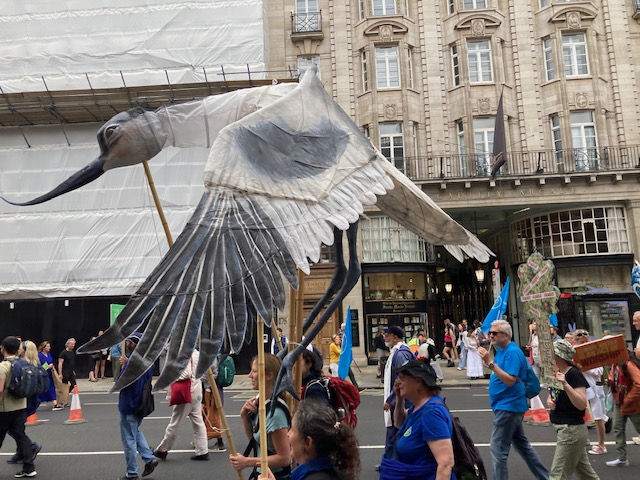
Earthday March with Bird on Piccadilly. Photo by MAM

On Piccadilly, a long march is going past and I think for a moment: it is for Palestine or Ukraine? But no, the colours are too soft and the energy too high. No one is silently angry, this is a peaceful Earth Day Summer Solstice parade march. There are human butterflies and bees and birds and placards and the spirits lifted. Their music makes me happy. I walk between them, all smiling and waving and slip into the last shops I need to go to.

For a moment I am able to forget the horrible wars that continue and the utter utter stupidity of the English Political General election that is happening next week. Now a row has erupted and – like a festering boil – causing swelling in all the body politic. Apparently a ‘few’, shall we say five, politicians have gone to the races – this being Ascot week after all – and as they say, ‘Put on a bob or two’ betting on the date and maybe the outcome of the General election. And in classic English fashion the security policeman who joined in this gamble has been arrested. The politicians have yet to have their knuckles rapped. This has taken over any talk about National Health patients waiting lists, education, or crime, or anything that the country really needs to think about.

I stick with the Earth Day marchers and pop into the teashop and the bookshop for more gifts and memories. Bookshops will do that.

A week earlier at a dinner party, Gabriel Garcia Marquez’s name had come up and Walter mentioned that when we had visited Cuba in 1989 and while strolling awhile after a long latin luncheon, Gabriel and I had made a connection. The dinner guests were eager to hear what that was and I quietly said that after we had spent some time together Gabriel had asked me to write to him.

“And did you?” was the breathless question. “Oh No. I was afraid of being collected.” and I could tell they were disappointed at the possibilities I had rejected.

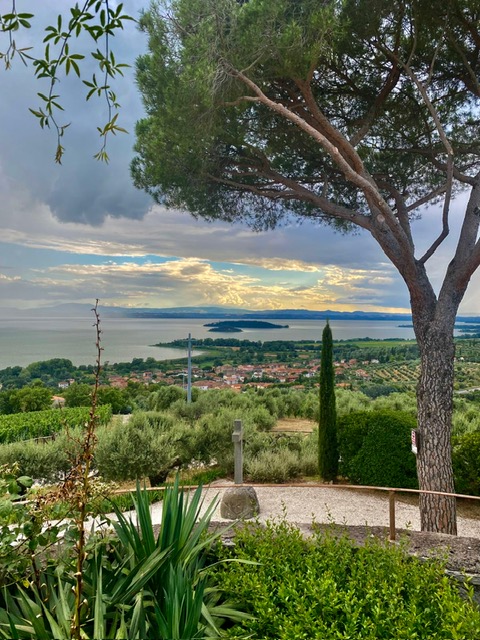
Back at home as I pack up the gifts, I think again about Gabriel Marquez and all his books that I had not got around to reading. During one of those ’It’s 2 am and I’m still awake’ moments I find ‘One Hundred Years of Solitude’ on our study bookshelf and put it by my bedside. But it is at the local library that I find the one book I have read. ‘Love in the Time of Cholera’ published in 1985. An old friend and lover – of literature – and I had read it at the same time. Our friend died earlier this month and sitting under ancient olive trees overlooking hills and lakes of this corner of Italy this seems the right book, the right time to turn those pages and say farewell to over 60 years of friendship.

Overlooking the lake at evening time.

And always supported by Beatrice @ murchstudio.com

The Guilds

Written and read for you by Muriel Murch with WSM by my side

‘How do you manage it Mrs a-Murch?” ‘Manage what?” I asked looking down to the sweet young Indian film student in Pune?” “Holly wood” she replied using two words with her beautiful sing-song voice – speaking the English that has been imposed on her country. I laughed and said that I didn’t manage it – Hollywood – we had long ago escaped to Northern California. She breathed a sigh of wonderment rather than relief and the three – there were only three – female film students in the country’s film school over the next few days took me firmly under their wings as we exchanged the stories that women can share.

Good morning – every morning

But this last weekend I had to mange it – Hollywood – because it was ‘that time of year again’. Oscar was coming. But there is foreplay in the form of the British BAFTA awards appearing in London a month beforehand, like a butler announcing ‘Dinner is served.’ And then in Los Angeles the weekend before the Oscars, the Industry Guilds all give out their awards. It’s a busy time and Hollywood, Beverly Hills and the tentacles of Los Angeles are gratefully twitching and alive with business. But is it enough to reboot the industry after the screen-writers and actors strike that shut down the town for five months last year? Whether you fly, drive or take an Amtrak train into Los Angeles, it is the industry that envelops you. Like the coal mines of Yorkshire, or General Motors of Detroit, the unions here hold power over the industry bosses, which in the film business are the studio heads – whose heads roll with each change in profit margins. It’s a rough game.

The players are divided into teams – called guilds – and they – for better or worse are divided again – into above and below the line. That is – recognizable and exploitable names with star qualities above and those who keep the engines moving throughout production below. At this time of year our mail box is crammed full of glossy Hollywood extra magazines, all promoting this film, that craft, and for a while they are fun to read in the bath, as one would under the hair dryer in years gone by. But some carry dire warnings of another strike as more below-the-line guilds enter union negotiations to protect their health and pension benefits. The Screen Actors and Writers had known names walking the picket lines, but this strike, by the crews that keep the cameras rolling, the boom mic high enough out of the shots, the wardrobe departments sewing and ironing, the stylists and makeup artists gently applying their brushes, followed by the post-production teams of sound and picture editors pushing their faders, clicking their mice, tightening and kneading the films into its best self does not. The teamsters union boss, Lindsay Doughery says “We will strike if we have to”. These crews have been out of work for months as the industry ground to a halt in Hollywood. Actors and writers mostly have enough to get by but many below the line have been pinched and squeezed into bread lines over these last months.

Which maybe was why with the new – almost all improved – Oscar ceremony last Sunday the show opened with teamsters, truckers, caterers and drivers brought on stage for a round of applause. Was this a genuine gesture of appreciation, or a preemptive move to beg them not to strike and bring the industry to a halt again. 

But we were in Hollywood the week before Oscar to celebrate and honor a lifetime of editing work by Walter and the added joy of having the kids – all grown-ups now – along to celebrate their father. And to see them – the other life-time of work – each holding their own and living their lives in the fullness of their times. And young prodigies joined the ranks of old colleagues, those who have been in the trenches of each particular film; from THX 1138, American Graffiti, A Godfather here and there, The Conversation, Apocalypse Now, Return to OZ, Ghost, English Patient, Talented Mr Ripley, Particle Fever, Coup 53 and so many more. A full lifetime of work flashed across the screen turning the photo album pages too quickly – “Wait”, I wanted to say – “let me look a second longer”. And did it end with ‘Her Name was Moviola’? The machine woman who beguiled him away for those long hours, days, nights and all times in-between. She, for that machine is a she, is asleep now, resting in an old horse stall, hidden under a pile of boxes, not yet knowing she will never turn over her wheels again, never clunk down on a sprocket of film to cut. What happens to machine relics? How many get saved for a museum exhibit? Like pencil and paper, envelopes and books, the tools we use are changing, but not the emotion that cinema stirs in us. 

Saturday night before the Editors brunch, the Cinema Audio Society held their awards dinner celebration. This guild is only 60 years old, and is not as rich or as powerful as the editors or cinematographers Guilds. But while picture without sound can take over our senses, it is sound that sweetens our awareness of cinema. Voices, sound effects and music blended together are the cradle in which the film can rock. 

And it is before the cradle that sound comes to us. In 2004 the young voice echoed again, “How do you manage it Mrs ah Murch” when I found myself in Berlin for the Film Festival. Berlin, the first of the years big festivals, is cold, often there is snow, which looks pretty on arrival but soon becomes slushy and grey. I am at a loss, floundering around, and reached for the only tools I had with me: A microphone and tape recorder.

And so I began to record my fluctuating heart beat before moving the mic up over my chest to capture breathing, down my belly for the gurgles that occur with greater frequency when one is nervous. My husband is in the bath, so I kneel beside him, sliding the mic up over his carotid arteries, lub dub, lub dub, lub dub, he doesn’t seem so bothered by Berlin. I walk the hotel hallways where the world’ film makers are hurrying, from one place to another, excited to see the new work and each other.

WSM has taken my Mother’s Symphony and is using it to make a point about our hearing.

I take my recordings back to our room where one track leads into another – blends, fades in and out – but, as in the womb, from four and a half months of gestational life, there is always sound until after we are born – when there is the silence of a solitary crib in a room of one’s own.

Almost 20 years after my Mother’s Symphony was made, played, used in lectures and then put way, film maker Sam Green, found it and then me.  

“Could he buy it?” “Certainly not, he could have it.” And so he carefully lifted the symphony tracks from their radio format and slipped it into the opening of his film ’32 Sounds’ where it gently beckons us into the worlds of nature, of make believe and music. On that Hollywood evening, despite strong musical competition, 32 Sounds won for best documentary sound. As the audience rose to its feet It was as if we were all coming home. 

And then there was Chocolate

This has been A Letter from A. Broad. Written and read for you by Muriel Murch.

And always overseen by – beatrice@murchstudio.com

Remembering Oscar

Written and Produced for you with WSM by my side.

In 1978 the film Julia was nominated for 10 Academy Awards. Directed by Fred Zinnemann, the film starred Vanessa Redgrave, Jane Fonda, Jason Robards, and – Meryl Streep in her first film. Walter was among the nominees for the editing. Of the ten, Julia won in three categories; Jason for Best Supporting Actor, Vanessa for Best Supporting Actress, and Alvin Sargent for Adapted Screenplay. A few weeks earlier, the BAFTA awards in London had yielded a slightly different crop of awards from its ten nominations with Jane Fonda winning for Best Actress, Dougie Slocombe for Cinematography, Joan Bridge for Costume Design, and Producer Richard Roth for Best Picture. My mother and her pals, whom we had invited to the BAFTA awards dinner with us that year, also scored. With postwar frugality, she and her friends refused to leave opened bottles of wine on the table and so – to my total embarrassment – six bottles were deftly pocketed into Gabardine macintoshes and mink coats.

Hraybould, via Wikimedia Commons

My mother had decided we were being far too serious about the whole awards business and wanted to liven the evening up a bit. “Why it’s just like a school prize giving”. And – as she often was – she was right. But looking back that year on Julia, spent in England having all four children with us, was for me the best of those film adventures that we shared. And when Julia came to an end and was received with critical and box office approval, we kept Fred company going to a few of those awards dinners, bolstering him in the disappointments and learning a thing or two about how the awards machines are oiled and work. At the Directors Guild Awards dinner, Fred quietly whispered why he believed he would not win, while we could see that he did ‘oh so want to’ – just one more time. Woody Allen won for Anne Hall, beating out George Lucas for Star Wars, Steven Spielberg for Close Encounters of the Third Kind, Herbert Ross for The Turning Point, and Fred with Julia. I’m sure I wore the same outfit – a long pale green dress with no particular flair, more discreet than outstanding, but a dress I felt safe in. By Oscar night, because there had been so much political publicity, we were all nervous. Fred nervous from his long-standing knowledge of Hollywood and its people had a saying, “I met him in 1938.” Meaning I know that type and that style. Our nervousness was because we didn’t know our way around this particular Hollywood. Vanessa Redgrave’s nomination for Best Supporting Actress was already causing a stir but she didn’t show any nervousness. The Jewish Defense League had openly objected to her nomination and were picketing that year’s Oscar Ceremony. Vanessa had narrated a film, ‘The Palestinian’ which was critical of Israel’s role in the conflict between Palestine and Israel – then – in 1977. Vanessa’s acceptance speech did not disappoint. There were boos among the applause and Vanessa never returned to work in Hollywood again.

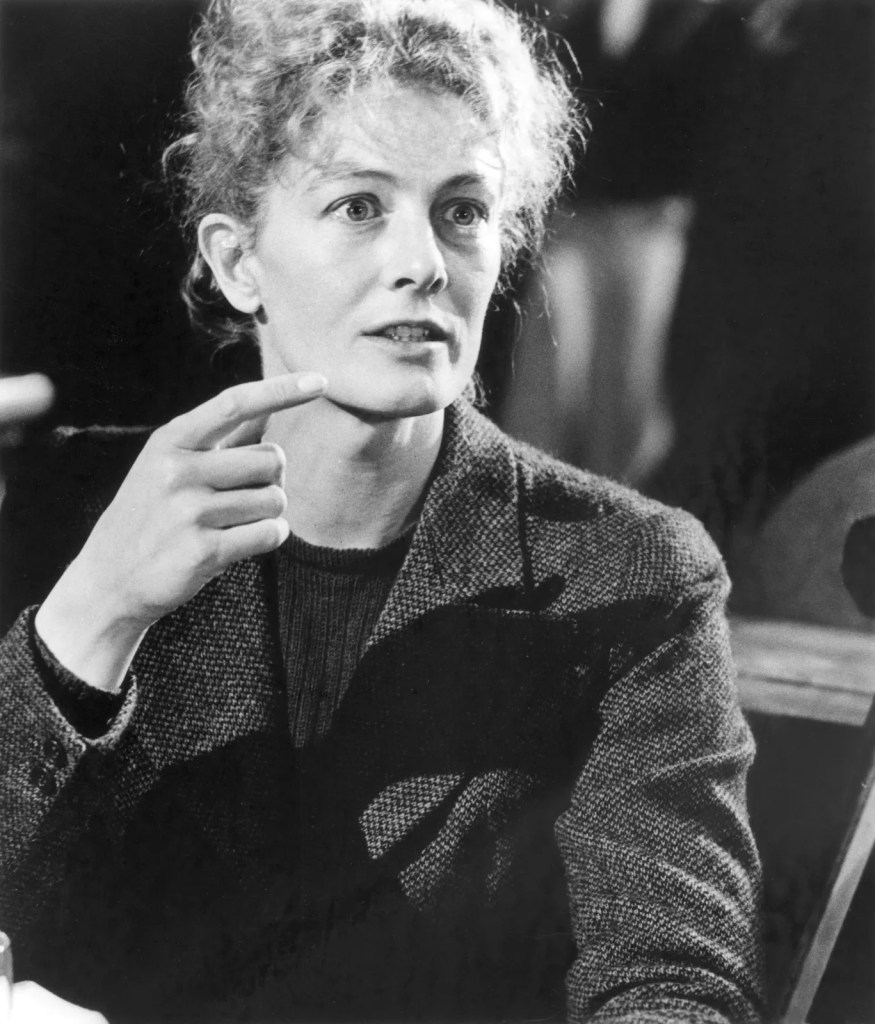
Vanessa Redgrave as Julia in the film of the same name. Directed by Fred Zinnemann 1977

Looking back on that year, and the politics that were uppermost in so many minds, it is hard to accept where we are now. Everything seems more – nothing seems less – and it is frightening for all of those paying attention. 86-year-old Vanessa, and others who have hit that 80-year date, still struggle and sometimes succeed to put the political and artistic work in a perspective that encourages those who follow. Looking back at that seemingly innocent time – but that was not – we are grateful for the work opportunities we had, and the friendships that grew and formed from mutual respect and bound us together. The friendship between Fred and Walter lasted up to and through Fred’s death. On an April spring afternoon in his office, Fred said, “I’m feeling a little tired. I will rest on the sofa.” On his own terms, it was a wonderfully discreet way to leave.

It seems like it has been raining on and off for weeks. Huge clusters of ladybugs have come inside in record numbers, finding their own warm spots, close to light bulbs and on my desk. The farm is saturated to sogginess. Overflowing water scurries down from the Mesa and bounces out from shallow ditches to collect in the fields, puddling in the low spots until it finds its way to another ditch flowing back to the road and beyond. It is as if the farm cradles the water, rocking it from one roadside to the other. The small roadside streams along the road into town are thick with mud pulled from the hillsides and I can’t even see the watercress that was just beginning to be ready for harvest. Now the Wolf Moon has arrived – gentle and mild while as bright and strong as the headlights from the harvesting trucks crossing the fields at three in the morning. The trucks bounce along, with their headlights shining into the hayloft waking me to watch them. I think of them, the drivers and the pickers, rolling out of bed at 2 am to gather the harvest and drive it to its destination by lunchtime. 

Jan 2024 Wolf Moon over Marin by Clint Graves

“Aggie’s breeding frogs.” says one friend to another when we meet in Point Reyes. His friend smiles, and she is not too sure what we are talking about. It is the night-time chorus from our hopelessly disused pond. Somehow – for all of my neglect, water gathers and holds within the reeds, rushes, and Irises and the little green and red-legged frogs settle down to call out to each other. It is at a particular moment in the rainstorms – as if the moonlight on water truly beckons them to sing and mate. There are more, bigger bodies of water up on the Mesa of our town, and for those living close by, the chorus is deafening. Recorder in hand we walk quietly along the driveway but still they hear us. Slowly, then suddenly, all is quiet again as they wait us out. We must leave before they start their singing again. 

Even as we slosh about in our boots outside in the dark this song of the frogs brings a smile to all our faces, begging relief from the horror of the wars’ continuum. Here in a failing pond, is a place of renewal and a sign of hope. 

This has been A Letter From A. Broad. Written and read for you by Muriel Murch 

A Dog’s Dinner

Written and Produced by Muriel Murch with WSM by my side

The dictionary defines A Dog’s Dinner as ‘A situation, event, or piece of work that is chaotic, badly organized, or very untidy.’ Such as when an unschooled dog gallops into the scullery for his bowl of specially formulated dog food moistened with a little water. It is gulped down in a flash, the bowl knocked about noisily until it hits a wall. But then there is a pause as his tummy swells. A burp is followed by a belch before up comes dinner again, now glistening and sticky with saliva and the first tentacles of stomach acid. The dog looks puzzled wondering what happened but then he spies the food, all over the floor and with excited tail wagging, eats it all up again. Only a mop and a big dose of disinfectant can clear the damage away. 

This is the image that comes to mind after Suella Braverman’s published remarks that homelessness was a lifestyle choice. As Rishi Sunak sent her back to her kennel he had to reshuffle his cabinet once more. Even the newspapers had to print charts with pictures of who has come and gone and where to. We watched – soon to be Lord – David Cameron stride back into Downing Street, knock on the door of number 10 with his tail wagging as he tucks into the mess of Brexit that he created. It looks to be a dog’s dinner all over again.  

On November 14th King Charles celebrated his 75th birthday by popping into a food bank between holding a couple of tea parties for people and organizations that also turned 75 this year. A tea dance was held in Dumfries House and then more tea was served at Highgrove with members of the Caribbean Windrush generation, nurses and midwives from the NHS. This week, The Big Issue, a weekly magazine sold on the streets by homeless vendors, has The King on the cover highlighting his Coronation Food Project, launched on his birthday. The King is quoted – saying that “Food need is as real and urgent a problem as food waste,” …. “If a way could be found to bridge the gap between them, then it would address two problems in one.” It seems to take a football player like young Marcus Rashford of Manchester United and a King like Charles the Third to steer this ship into a clearer lake of fresh water. 

On Tuesday, we left for Poland and the Camerimage International Film Festival in Torun. It takes a full day of travel getting to the festival and we were only traveling from London. Cinematographers, manufacturers, filmmakers from other disciplines with films come from around the world. It is a  jumble of festival and trade faire, a little glamor and a lot of graft for the craft of cinematography. We gather at breakfast, the same as on a film set, such is the comradery of international filmmakers.

The plane landed in Warsaw and the afternoon light stayed for the first hour of the two-and-a-half hours it takes to drive to Torun. Leaving the city there are single-gauge railway tracks that emerge and disappear in and out of the paved road. They are old, disused but along with the tree-covered mounds of larch, silver birch, and pine that cover the detritus of an ancient war, a chilling reminder of the wars past and present. The city names of old wars are now joined with new place markers that move traveling east into Russia and Ukraine, and then south with the eruptions in Jerusalem, Gaza, and Palestine. 

The city disappears giving way to bare winter fields. There is very little green left to harvest, only tall dried-out corn to be cut for livestock. As we pick up speed, the farmhouses appear small, even tiny, most look old and decrepit. There are no lights shining to welcome a farmer home from the plow. As we drive north a storm is crossing Europe and for those moments that we are on the open barrier-less road, the raw wind beats across the motorway making this all-electric German limousine slip and tremble and the windshield wipers pick up speed.

We settle into the hotel with memories that slowly come back to us. Beyond the window the river flows fast, the current pushing and pulling fallen trees into the mud. There is no shipping. The countryside is bleak this far north in November. Even though it maybe earlier in the year than our previous visit winter feels like it is coming sooner. 

Here is Copernicus

Walking into the old medieval town we pay homage to the statue of Copernicus. Torun is not a big city but as Copernicus’s birthplace it is rich in history and over two million people come to visit each year. Some come for astronomy, Copernicus, science, and some for this festival. Walter is here to join Professor of Astronomy, Leszek Blaszkiewicz in a moderated discussion on ‘Copernicus, Dreamers, Inspiration and Science.’ Held in the beautiful old Camerimage Cinema, the audience is primed and happy to hear, think, and discuss such things. After the talk is over they linger and some have already brought with them the beautiful Golden Book on Walter’s Golden Ratio exploration that the festival produced. The days are busy although we don’t get to see one film. 

Mateusz Józefowicz moderates Walter Murch and Leszek Blaszkiewicz in conversation on Art, Inspiration, Science, and Dreams.

On Saturday as we walk over to the main building for the closing ceremony and awards event, dusk has already busied herself with night and the street lights proclaim it is winter. The big theatre has filled up early and fast. The ceremony begins and is almost all in Polish though there are head-sets for translations and it all goes along easily and quickly. The Golden Frog is the symbol for this festival, with tadpoles for the rising stars of cinematography. Each film festival has its symbol, Berlin has the bear, Locarno a Leopard, Venice a Lion, and of course, it’s Oscar for Hollywood. While the Torun festival celebrates the art of Cinematography it is also a huge trade faire. It is overwhelming to see the equipment. The festival also acknowledges the other disciplines and those who – within their fields – carry a particular understanding and integration of cinematography and their own discipline. Walter brought his frog home in 2015 and it sits sweetly and discreetly on a bookcase shelf here in London.

The last award is given and the festival director returned to the stage for his closing remarks before beckoning a line of assistants to file in behind him, and then another line and another, and – as we rose to our feet – he has assembled everyone who made the festival happen on stage. It is the first time we have seen such an acknowledgment from a festival and it seems fitting that it should occur here where the emphasis has always been on the heavy lifting that it takes to be a cinematographer and to make movies. The yellow-vested stage hands arrive carrying three sofas and the recipients of this year’s gold frogs and tadpoles come to sit alongside those who have made this year’s festival possible and still the full audience is on its feet acknowledging that just as Copernicus wrote in his revolutions, we are all like the stars in the heavens and the universe beyond,  elliptically revolving around each other.

Brava and thank you to everyone who made this 31st Camerimage possible.

As we walk back to the hotel we can see our breath and the sky prepares to scatter the first flurries of snow. The final party is going strong but we are too old for that and even in flat shoes my back hurts. At the bar, we sit among those who would rather drink and talk than stand and shout, enjoying a glass of wine and a bowl of Polish soup. The next morning camp is broken and the lobby is full of puffer jackets, wheeled cases, and fond goodbyes. We have barely left the city when a huge owl swoops down across the car, just three feet in front of us, and with wings unfurled for balance, he nails his meal of young bunny on the snow-covered grass beside the road. We drive on past the mistletoe-encrusted trees, the wind turbines emerging from the fog where acres of bare apple and pear fruit trees, red and black currant bushes are already dormant, preparing for the winter ahead. We quietly understand that life in this corner of the world is not easy for those who live here.

This has been A Letter from A. Broad written and read for you by Muriel Murch

The Rain in Spain

The Rain in Spain

Written and produced by Muriel Murch with WSM by my side
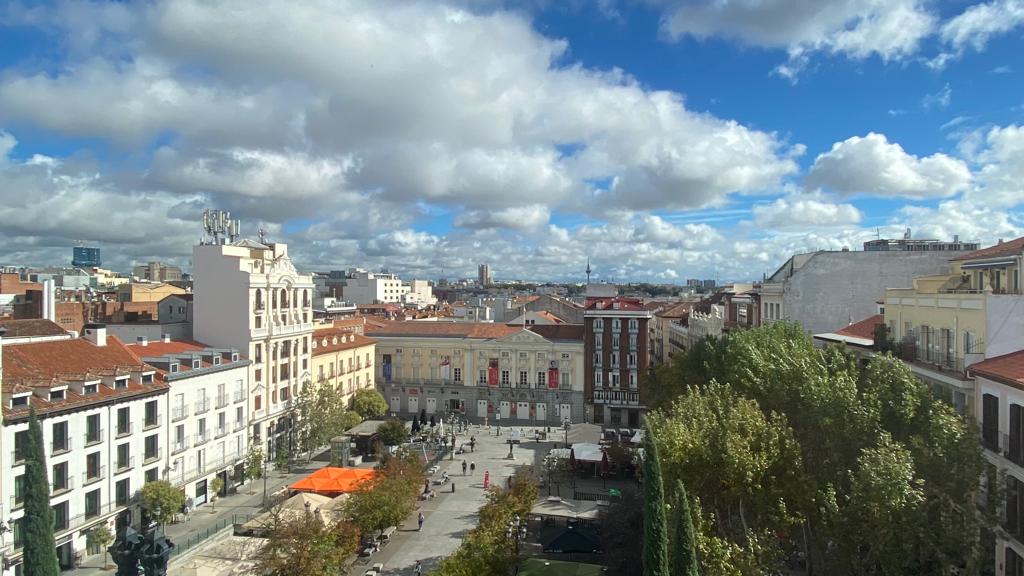
View from the Victoria Hotel over the Santa Ana Square in Madrid by WSM

Falls mainly in the plain. And we saw that as we sat in the plane, in the rain, for three hours at the Madrid airport waiting for it to ease off enough that a Spanish pilot – who must be used to such things – was cleared for take off. It was a bumpy ride but we got from A – Madrid to B – London and home. Only three days earlier – as we drove to the city center we passed the dry dusty outskirts, the soil a pail ochre yellow that looked like sand and made one wonder how anything could grow there. But it does. Between the houses – jostling for a patch – olive trees claim their space clinging and begging to be allowed to stay, offering their untended fruit as payment for the soil. As the motorways slice through the land the trees give way to factories and then block housing before entering the old city center.  

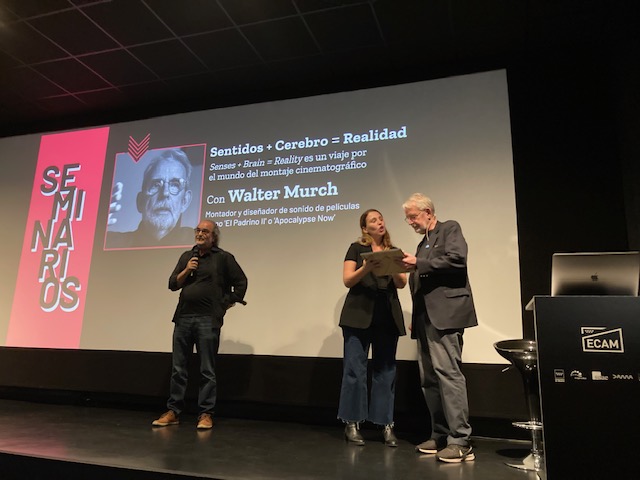
It has been six years since we were last in Madrid and at this film school. Beloved faculty who were young men then are – like us – just a little bit older while our young minders all seemed very much younger. It was a fully packed two days as Walter gave four lectures on Senses + Brain = Reality, as seen in the editing of Motion Pictures. A bit of a mouthful for a title but the four talks were all swallowed, hungrily by most – and cautiously by a few – in the full-house audience for both days as the students and old professionals bravely went along with him. Such is their affection for and trust in the man. These talks are where Walter can give encouragement to them and try out new ways or show what is right in front of – and in our faces – or noses – on this occasion taking a very deep dive into the concept of the Golden Ratio as it applies to the human face.

WSM is made an honorary professor of the University. Photo by MAM

We arrived in the middle of the third week in October and as the wars slide from one continent to another, the new war of the season is well underway. The conflict in the Sudan never reaches the papers, the Ukrainian war remains but is now a side column as the bombing, threats of more bombing, retaliations, and death on all sides of this Middle Eastern mess unravel before us. Hostages had been taken and at that time none released. Politicians began lining up their positions while planning out their strategies, looking for who are their friends, who owns what, and what trades and compromises are available. Each day the war moves forward and it is not a pretty picture. Walter speaks of this at the beginning of both talks reminding us that this is the world we live in, and we are fortunate to be speaking and thinking about art and ideas for this short period of time. 

A new translation of ‘Blink’ in Spanish needs signing. Photo by MAM

While waiting and watching Walter sign a new edition of his old ‘Blink’ book I am gently surrounded by the young people who are there for us. They hover like bees finding a new flower but instead, it is I who take from them, as each has a story, and war, government policies, and economic hardships feature in everyone. 

The purple-haired bright-smiling young assistant from the film school is from Puerto Rico. While her family are scattered and separated in California, she has turned East and has found her way to Madrid, and this film school. Deeply conscious of the neglect of the various North American government administrations, her dream is to return to Puerto Rico and help the country with the film and radio skills she is learning. 

Peter, the photographer, was born in Ukraine. He is young, with a mop of blond hair, and is slipping from gangly youth into adulthood. His parents – maybe seeing the future with fear – emigrated to Spain while they could. Peter speaks modest English though better Spanish and now his mother forbids the family to speak Russian – their native tongue – in their home. He doesn’t talk much about Ukraine but his mother worries. Peter’s grandmother is still there, not in the thick of the war zone but close enough, choosing to stay in her home and her mind until she dies. 

Argentines Queuing to Vote in the Hague. Photo by Agustina Izurieta

Cecelia, our main minder, is a young and beautiful Argentine. As Argentina crumbles and falls – with the Argentine peso now at 1000 to 1 US dollar and rising – she too has left her home searching for a new life, a safer place to live and has come to Spain. This weekend our son-in-law took the train from Utrecht to the Hague to vote in Argentina’s first round of elections. Throughout Europe, the lines around the Argentine Embassies were hours long as those who had fled rallied to send the crazed Javier Milei out of the ballot box. 

Coming home we reach out to Lika, another young friend who last year managed to leave Russia for Israel and then bring her mother with her. 

She writes from her point of view in Tel Aviv, “Me and mom are ok. We have a bomb-shelter in the apartment and it’s the best you can get in this situation. North doesn’t get as many rockets as in the South up to Tel Aviv, but from day 1 we have constant shootings from Lebanon and even Syria. I have a panoramic view of the whole bay and I already saw and heard explosions, rockets being caught by the iron shield, and sirens from the border areas. It’s intense. To be honest I still can’t fully comprehend that it’s the second war in my life and at the same moment. We’re very much invested in the war in Ukraine and now this. And the ugliest thing is that the terrorists here are all in one bed – Russia, Hamas, Iran… and Israel and Ukraine have one thing left – to defend themselves. We have many Ukrainian friends here who were evacuated from the bombs and they are incredible to watch – very brave.”

The wars are pushing Britain’s local government squabbles off the front pages. Slipping the two conservative safe seats bi-elections – that they lost – well out of the spotlight. The wars, in the Ukraine, and now in Gaza and Israel are rolling over our consciousness like the winter storms hurtling through forests and along rivers in eastern Scotland. Yet they are not random acts of nature but preplanned with maps and political strategies that are embraced with little thought nor care for the collateral destruction and deaths that follow. It is as if a giant combine harvester is scraping the fields of our planet Earth, leaving stubble where there was wheat, stones, and dust where there used to be rich soil. We cry out but can do little more than weep.  

This has been a Letter from A. Broad. Written and read for you by Muriel Murch. Note an error correction – in the recording I say the pesos to dollar is 350 to 1. It is 1000 to 1 and falling.

Back to Work

Written and read for you by MAM with WSM by my side

The coronation is over, the King and Queen have had their little rest and are now back working; the King shaking hands with ministers and world leaders, and reading those dispatch papers that keep him informed as to who is doing what- and where – while the Queen goes out and about visiting and spreading good cheer as she continues to learn who is doing what in this country. The flags are still flying over the London streets teasing the tourists out to take another picture or two.

King Charles III. Photo by Victoria Jones /PA

The roses are only just beginning to bloom and have not yet pushed spring into summer. The bluebells are fading and the air in London is rich with the attar of cowslips growing in the hedges around the parks and along the canals and rivers. Last week while, walking up alongside of Primrose Hill I saw two vans parked on the same side of the street – back to back with their boot hatches open facing one another. The two men – from street-savvy habit – look up, always conscious of who might be watching, and we catch each other’s eyes. I’m smiling at them and – like fourteen-year-old boys caught smoking at school – they sheepishly grin back. There is an exchange going on. The slightly younger man is holding a plastic fitting, something that could be used in plumbing or electrical works. He seems to have at least a box of them and is proudly showing them to the slightly older man. Both are in their forties and when they were babes such things would appear on the lot of the film studio at Elstree, ‘It fell off of a lorry’ was the phrase for such items. Here in town, lorries are too conspicuous in the city streets and an unmarked white van can disappear quickly into the traffic. The men know that I know – and that I remember such mischief – and am too old to do anything but go on my way. And with another grin exchanged that is what I do.

The newspapers are quieter, looking as they can for other news. Well, there are always wars, and though we have a hard time keeping up with the Ukrainian president as he moves from the front lines of his country’s war to diplomatic meetings and back again, he does keep visible and keep the world informed. Is he luckier – in a sickening sense of that phrase – than the people of Syria with their multi-sided civil war or the Sudan where civilians are killed on a daily basis. Wars continue in what could be called the B column. In the C column, news of the treatments of refugees from Somalia and Ethiopia by the Greek authorities are not even reaching the English papers. The refugees fleeing these wars have made their way from Turkey to Greece only to be captured – by whom – and pushed into vans – driven to launches – taken out to sea and transferred to the Greek coast guard vessels before being set adrift in rubber dinghies. Is this bounty hunting as in ‘I’ll give you so much for an adult, so much for a child’? We are horrified and sickened as we catch glimpses of such cruelty – and yet – it is hard to think of a time or place in ‘civilized history’ where and when this has not been true. 

But at home – in England – the Prime Minister is missing. Rishi Sunak and his wife have gone to Japan for the G7 conference where everyone has a chat and so politely says ’After you’ as in ‘if you give Ukraine bombers we will too. If you shake China’s hand – we will too’. All are consumed with the war in Ukraine. Well, almost all, India and the Arab States are keeping a distance from that chat while Volodymyr Zelensky strides about this world stage, clad in his army fatigues moving and talking to anyone and everyone he can. What deals can he cut? A little pilot training here, a couple of fighter jets there. It may not be much but he wouldn’t get any of it without showing up and giving a photo opportunity for the supposed great and good.

While Rishi is away, the little problem of Suella Braverman’s speeding ticket has blown up across the papers. It is almost good for a laugh. Those pesky cameras are everywhere and even with the warnings, ‘speed camera ahead’ one can get careless, and click, click there is your license plate picture in a civil service office and the next thing you know a paper notice comes through the letter box. Then what do you do? Well if you are the Archbishop of Canterbury and you get nicked popping in and out of London you may try to resolve it out of court but accept that, “No your worship – you was speeding – a hot 25 in a 20 mph zone.” He may have muttered some words about the press getting ahold of this one but paid up and accepted the points on his license. But a politician is different and good – not so old – Suella Braverman tried to wiggle out of taking her speeding awareness course within a class. The media spotlight swung quickly onto her – again – and she looks more and more like the most recent hole in the Tory bucket shining light into the murky interior of her political party.

And with Rishi still in Japan, Boris popped back into the news announcing that he and Carrie are expecting another child, bringing this family up to three children trotting along beside the other known five he has begat. What a lovely old word begat is.

But some words are not so lovely – they are hard to pronounce and to say. Nigel and Farage are two such words heard again as he showed up on the news once more to finally admit – ‘Brexit is not working.’  He goes on – that of course it is not Brexit’s fault, but the bureaucratic administration that has got it all wrong. The communist party said the same thing but no one remembers that. What is so terribly sad is how this country cannot yet see itself as a minor player on the world stage, and behave accordingly. Europe has no need of England, but England has great need of Europe and European business, industry, and people.

On Monday evening our plane touched down in Athens Airport, 59 years after we left – not knowing if we would ever see each other again. The drive to the city dips in and out of old memories. Small towns and old olive groves spread out in age, showing dreams made, broken, and reset as the trees are realigned to the country’s fortunes. The scattered sage and scrub are muted in the decaying dusk before we enter the city center where there is not a refugee to be seen. The limousine pulls up beside the hotel, and we are welcomed to Athena. For 24 hours we can disappear into an old marble suite, deep hot baths, and room service before reemerging to work in the world once more.

Yorgos Mavropsaridis and Walter Murch in conversation with Orestis Andreadakis at the Astor Cinema for the Rolex Arts Festival. Photo Credit – in Greek!

This has been A Letter From A. Broad. written and produced for you by Muriel Murch.