Let’s Talk About It.

Written and Read for you by Muriel Murch with WSM by my side

Several elephants go around and around a circus ring, trunk to tail, holding onto each other, scared to let go and be separated from the herd. But the elephant trainer cracks his whip calling one to the center and perform a special trick. Lets call this elephant Charlie. Charlie is a good elephant, mature, smart, and expressive as he performs his trick and is well rewarded. Until one day something bad happens to Charlie and the show is disrupted.

We, the audience, take in this pause, viewing it all around, from one side of the arena to the other. There are few clues in the circus program notes to see what will happen next. We all find different truths for what has happened and we talk to each other following a clip, with no date, on the internet showing Charlie Kirk, answering questions from a woman, “What are you doing, what is the point?” is met by “ … When people stop talking, that’s when you get violence…” And we don’t want to see the elephants stampede. But there is little footage of him engaging with students. He tosses out unsupported statements in his strong, intimidating voice, cowering students not versed in the skills of debate. I sadly find such old-world prejudices that it is hard to believe an educated young man could hold them such as this comment on race from his show on January 23 rd 2024

“If I see a Black pilot, I’m going to be like, boy, I hope he’s qualified.”

In the 1990’s, while exploring books and authors for radio broadcast, I slipped into a rabbit hole of the writing of Saint Exupéry. At the same time a new friend, George Nixon, came into our lives. George was among the very first African-American Pilots on a commercial airline, and a captain for United Airlines. He was being recruited onto the board of directors for the Full Circle Program. George was definitely feeling like a duck out of water and knew that the board was eager for him to join as the token black man. George was back-peddling until we got taking and he realized that like Heather, his wife, I was English, and could see I was as itchy at board meetings as he was. George had also become the United Airlines poster boy encouraging us to ‘Fly the Friendly Skies of United.’ When he told Heather he was going to try out for the video she immediately replied, “Oh don’t be so silly George, you are far too black.” But George, with his ‘I don’t give a damn’ attitude went for it. And got it. His blue-black face was seen up and down the freeways in and out of San Fransisco with his smile grinning down to the commuters as he dared other young African Americans to reach for their dreams. 
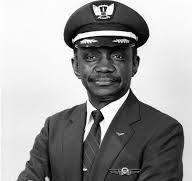
Captain George Nixon

Now with my rabbit hole search into aviation, and the writings of Saint Exupéry, I also had a pilot pal with which to explore the friendly skies. Once I flew on a night flight with George from San Fransisco to Boston with a plane load of flatulent first class fellows. I was excited and awake all through the night watching America unfold underneath the plane, until that moment that she didn’t. The hum of the engine was constant as I looked out of the window to see no lights below but only the stars ahead, not even really above us, just there in the night sky. Later, when we sat down together and I turned on the tape recorder we talked about his yearning to fly, I asked about the night sky that I had seen, talking about how Saint Exupéry flew by the stars.

“The stars,” said George, “The stars are my friends.” It is over thirty years since we had that conversation. I wonder how many pilots today still know where they are in the world by following the stars in the night sky. George retired in 1995 and with Heather moved to Tasmania at ‘Blackman’s Cove’ “Only you George, could do that,” laughed Heather and I in chorus. He stayed close to the edge, facing the ocean as he wondered what ahead for him.

It’s well into September now and there are storms coming in from the Atlantic ocean and tumbling over the Welsh hillsides on into the home countries. The winds are squally and the rain spits like a disgruntled snake. This is not a good day for landing a plane at Stanstead as the American President arrives for his second state visit which has been planned out very carefully to suit his tastes. As we work, the US President’s helicopters have just left the US residence in Regent’s Park, flying on their way to Windsor Castle. There will be soldiers standing with a guard of honor on the lawns before a carriage ride around the grounds, and inside in the evening a gold-plated meal – all within the safety of the castle keep. Hopefully the King will be wrapped up warmly and not catch cold.

The King gives his speech after the State banquet. From the Independent news paper

On Thursday the US President will leave Windsor for Chequers where the prime minister will have another guard of Honor – this time a band of bag pipers. There are Churchill’s archives to view, if not read, before getting down to the business of deal-making with the leaders of GSK, Microsoft and Rolls-Royce. Meanwhile Melania will linger with the queen viewing the Windsor Royal Library along with Queen Mary’s Doll’s House. By the time the President and his wife leave they will have seen very little of the people’s displeasure at their feet on our soil.

Friends on the Castle Tower from UTube and The Guardian.
The Trump Baby blimp rises over London’s Parliament Square (in 2018) by Michael Reeve

On Saturday over a 150,000 people came to London joining a far-right street-protest. Billed as a festival of Free speech, Tommy Robinson then eased his people through into racial conspiracies and Anti – Muslim hate speech.  Having Elon Musk dialed in on the big screen was not that attractive as he railed against the “woke mind virus” and told the crowd that “violence is coming” and that “you either fight back or you die”. It didn’t sound much like Charlie Kirk’s suggestion to talk about it.

This morning the recycle truck came roaring down the street. The four lads jumped out, and jogging to the pavement, rolled the carts up to the lorry to chuck-in the recycling. The men are quick, laughing, shouting and getting on with it. I stand at our door with my bucket of compost, “Am I too late,” “No Aggie you’re fine, give it ‘ere.” And Nick takes my little bucket of compost and tosses it into the truck’s container. “How’ve you ‘bin Aggie?” “All right, and you?” “I’m retiring in two years Aggie.” “NO. You’re too young.” “I’m 64.” “No, you can’t be.” “I’m 82.” “No, Not a day over 42.” And he gives me an appraising look, as I stand there on the door step in my PJs and not a bit of uplift underneath.  Back in the house after this early morning banter, I’m smiling. If Nick and I were having a pub-time drink we would undoubtedly be sharing very different views about the worlds we live in. But we would talk and laugh together and buy just one more round.

This has been A Letter From A Broad. Written and read for you by Muriel Murch 

And as always supported by https://www.murchstudio.com

Dress to Impress

Written and read for you by Muriel Murch with WSM by my side

Dress to impress and dress for success, sometimes we try – but what does that mean – and for whom and for when are we dressing? This week I dressed for an appointment with a new doctor because I wanted him to see and receive me, and not to toss me off as another white 82 year old female with knee pain. So my fingernails were a playful bright green.

Green Nails by Esra Afşar on Unsplash

I may not be a spring chicken but I’m not ready to shuffle off with a walker just yet. I’m praying for a physical exam and an x-ray and a picture that would tell me what is going on with my knee and how can we fix it. It is 15 years since that knee was replaced and I’m aiming for at least another five. It looks like the green nail varnish worked and slipped this fast-talking professional fellow out of total keep-it-together efficiency to ask ‘So how tall are you’? and we laughed – before getting serious again and him telling me what the x-ray pictures showed. ‘Your knee is fine – your hip is worn out.’ Seems like another case of ‘rode hard and put away wet’. But I know to be beyond grateful. I am fortunate to have options in front of me and live a life where such care is accessible.   

Gaza: Doctors Under Attack

In countries that are at war, with themselves and each other, this is not so. The old, the infirm, the young and sick, are all vulnerable and frequently dying for and from the wars that ravage around them. Within the jungles of Myanmar, the city streets of Belarus and the open fields and villages of Ukraine, we are not privy to the unseen hardships played out in those lands. This week we watched ‘Gaza: Doctors Under Attack’ a documentary that was first commissioned by the BBC. Then, according to Stuart Heritage writing for The Guardian, “dropped due to the risk that it created “a perception of partiality”. Luckily Channel 4 picked it up and it is also now available on YouTube. Channel 4’s Louisa Compton warned that Doctors Under Attack would “make people angry, whichever side they take.” She is right. This is the sort of television that will never leave you. Maybe it can provoke an international reaction and we owe it to the people and the countries to not look away. And I don’t, instead finding images remain front and center in my mind making me think deeper about what is happening and how it is happening.

A doctor, who has just lost members of his own family, kneels beside a bed shared by two staving children and asks the older boy fed with a gastric tube “What do you want, What would you like?” The boy whispers, “Mango, mango and grapes”. “And the doctor laughs gently with him, “Mangos and Grapes. You shall have them” while in his heart he knows that joy may have to wait for another life time. As he pats the boy, feigning reassurance he steadies himself against the weeping that is in his soul. And maybe we too must at the least bear witness to the horrors that are happening just around our global corner, as a less than five hours flight from London to Israel has become. 

Some of the doctors followed in this film are still alive and working. Some are not. Almost all have been imprisoned, tortured and lost family members. The film follows a trajectory of sorts. It begins as hospitals are warned to evacuate – but there is nowhere for patients or staff to go. Then an air strike happens, causing more chaos and casualties among the patients and staff who remained. There is a final follow-through as the doctors homes and families are bombed before the attacks move onto the next hospital and repeat the format. Hospital buildings can be rebuilt – though it is doubtful that is the agenda here – but the taking out by imprisonment, torture and death of top medical personal leaves a hole in the knowledge of medicine that will take more than one decade to repair. 

‘No water, no electricity’ … surgeons at work in Gaza: Doctors Under Attack. Photograph: Basement Films

Since the film was made last year, medical officials of all areas in Gaza are facing mass casualties and deaths of Palestinians wounded by Israeli fire as they scramble and fight for food. Relief aid distribution is now almost solely in the hands of The Gaza Humanitarian Foundation, a US and Israel-backed organization, formed in February 2025, and now helmed by Johnnie Moore Jr of Delaware, an evangelical leader and businessman – which seems awfully close to Washington DC. In May the GHF took over from any organization sanctioned by the United Nations. I am not alone in feeling that this organization is disguising target practice as aid. 

But we see very little of this on our daily evening news. Summer sports keep us happy, the heat waves keep us worrying, and we sigh at the incredible slowness of the government body inquiries into biggest miscarriage of Justice –  the Post Office scandals – between 1999 and 2015 – finally come to a conclusion, exonerating those 900 sub-postmasters who were wrongly accused of masses of thefts, – the Horizon computers did it. 13 sub-postmasters committed suicide, many died of old age. The inquiry’s chair has begun to release the reports. Judge Sir Wyn Williams is a singing Welshman, president of Pendyrus Male Choir, which somehow makes one feel that he is a sensible fellow able to lead this committee walking through the dutiful steps to bring the officials to account, saying what needs to be said. It has taken a singing Welshman to steer this inquiry into publication

After the relief of seeing this debortle coming to an end, we watched French President Macron toss the prickly ball of illegal immigration back and forth with Prime Minister Starmer in the House of Commons before they both enjoyed the perks of a State visit. President and Madame Macron’s State visit to Britain is the first of France, or indeed Europe, to England since Brexit. The final banquet, hosted by the King and Queen at Windsor Castle, brought out all the medals and sashes one could find, a tiara or two, good will and good manners to all, with proper speeches and – we hope – good French wine. A little brightness to end the day. 

Sashes, medals and a Tiara but no green nail varnish

As censorship continues pulsing in with the tide of fear we must watch for rogue waves while the ripples over the sand show us where the truth is hiding, like clams under the sand sending up spouts of sea water, cleaning its breathing and screaming for life. But in England, coming down firmly in favour of censorship, protesting and supporting the pro-Palestinian, anti-Israeli activist group Palestine Action, has washed in another ruling under anti-terrorist laws as the government hurries to  project its own agenda. There are spouts of truths in all the theaters of war and governments and while those in authority try so hard to hide them they continue to wash up on the shores of our consciousness.

This has been A Letter from A. Broad. Written and read for you by Muriel Murch 

Grateful to be supported by murchstudio.com/

Year’s End

Recorded by WSM Knit together by MAM
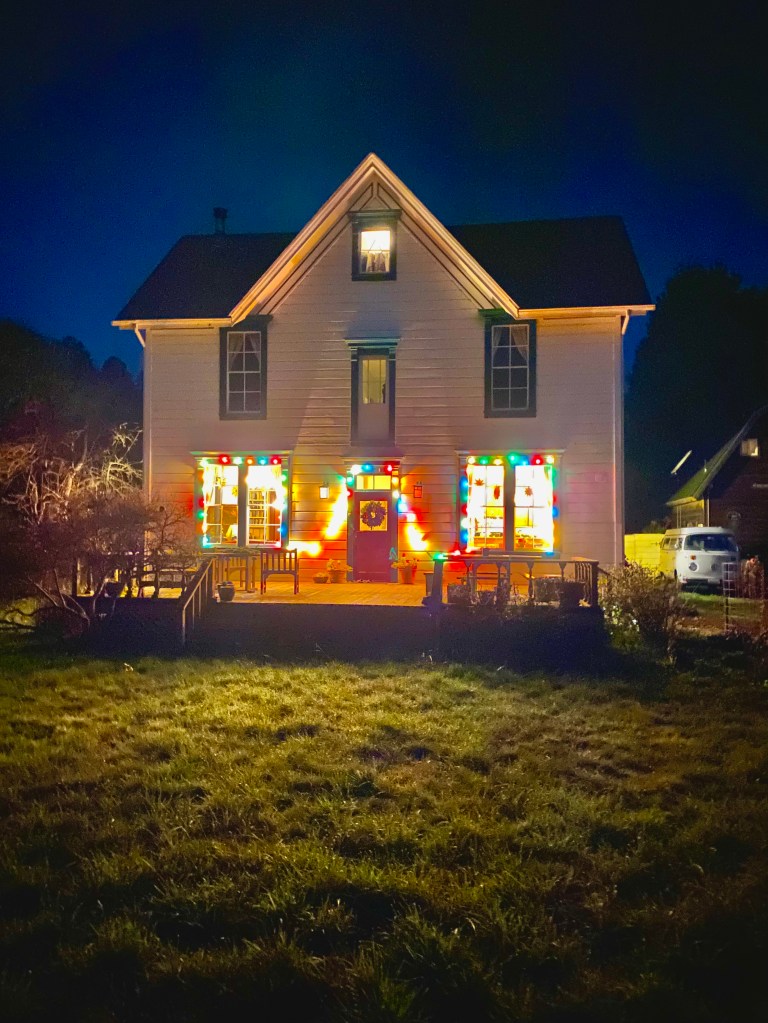
From Thanksgiving to Twelfth Night the farm is lit with forty plus year old lights. Wecloming you home and into the New Year. Photo by WSM.

Year’s end.
November rolled like storm-tossed tumbleweed into December and the nights slid earlier into darkness each evening. Now December is ending and even through the storms covering America the light is beginning to return.
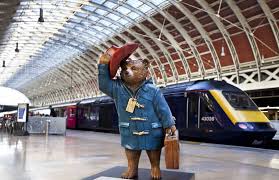
It was already night-time when we landed back from Poland and the Heathrow train stopped at Paddington. The station was closing down for those midnight to five a.m hours. Only the Sainsbury Local stayed lit for the late-night travelers and I dipped in to pick up the milk and bread to be turned to tea and toast in the morning. Outside the vast hollow waiting area which feeds onto the platforms there was no cute, lost Paddington Bear with a suitcase, instead there were a dozen or more old men settling in on the benches – separately – but close enough that each could watch out for another as they came in off of their street-corners to a place of warmth. A plastic shopping bag or a shopping cart contained their travel baggage. I wonder what it is that remains precious to these homeless gentlemen. They each had a blanket that they wrapped around their legs and even their shoulders, if it was big enough. There must be regulars who show up at Paddington, Victoria and Waterloo train stations each night – until they don’t. Do the staff who clean and monitor the stations sweep round the huddled bodies and shopping carts. Is ‘keeping yourself tidy’ a prerequisite to keeping your patch and even bench? What time do you have to ‘move along’ and face the world in the morning? There is a rhythm to this unseen pedalling-in-place, train stations hold these men who watch leavings and loneliness travel alongside of expectation and desire.

Paddington at Paddington

In November Mehram Nasseri died. Nasseri had lived on a bench at the Charles de Gaulle Airport for 18 years and was the inspiration of Steven Spielberg’s film ‘The Terminal.’ Stranded and stateless he perhaps brought a focus to the question of what or where is home. He found a community, and a sense of belonging.

Mehran Karimi Nasseri, or ‘Sir Alfred’, on his home bench at Charles de Gaulle airport. Photograph: Eric Fougere/Corbis/Getty Images

Under Rishi Sunak, the Conservative Government continues with its agenda – to avoid paying Universal European taxes – thank goodness for Brexit – but with no taxes paid by those who could – there is less in the coffers for The National Health Service, the state schools and other community-run organizations. It is now becoming obvious, though it was before if we looked, that the goal is to cripple and disband the NHS, take it away from those who need it most – and the best way to do that is to lock the pay scale of the workers. When I graduated in 1963, satirist Michael Frayn wrote in the Guardian Newspaper: he was looking at reports on wages on what they called ‘the devotional fields’, then primarily nurses. Saying the general principle was to hold the wages as low as possible to keep out ‘undesirable elements wanting to make a fast buck.’ Well they certainly did that, kept the wages as low as possible. Nursing is a devotional field and the wages remain among the lowest of professional workers to this day. On graduation we were encouraged to join the Royal College of Nursing and almost everybody did. But in my youthful idealism I couldn’t ever envision following an order – to go on strike. Now, for the first time nurses are being called on to do that. But they won’t. Instead the ambulance drivers and paramedics will be at the forefront of this battle with the government, and once again the government will win, grudgingly giving out pennies rather than pounds. Nurses will continue to use food banks and be at the mercy of the transport unions who can strike and get the money they are asking for. The Army will get to practice some drills while substituting for the paramedics. And people will die because of it.
From one family to another, we came back home – unsure where that is. We are old nomads – and with a little more infirmity we would be outcasts from the herd but for the moment we are lucky and received by our families wherever we land.
And we landed at the bar in town. With the nudge of a full bladder at 6.30 in the morning we bundled up, and scraping the frosty car windows, to drive downtown and to Smiley’s to watch the World Cup soccer final. The bar was open at 7 in the morning serving its customers what they wanted – a big screen and sports special. And free maté – with honey. It was as fun watching us as it was watching the football, two teams at the very top of their game, with grace, skill and respect as more than once a player in azure blue and white helped another in navy to his feet after a fast clash.
From Sunday to Sunday, turning from the big screen at Smiley’s to the computer screen in the Hayloft and finding the King at Windsor Castle. From here it felt like opening an old blue aerogram letter, with news of home and I watched as keenly as any other ex-pat around the world. There was a light snow on the grounds of Windsor Castle and young girls in the soprano Choristers at the Christmas Carol service in St. Georges Chapel.

The King spoke with no photographs around him to point emotion one way or another. His notes were handy to glance at, maybe showing that the teleprompter was not for him. He spoke in empathy for those families who have lost loved ones this year, of the importance of her faith for his mother – our late Queen, and for him too, and of all faiths. He gave thanks to the hundreds of people who help those in need through the hardships of these times, and very carefully showed those of his family who, by their presence, gratitude and acknowledgment of the work of others, help to sustain us all.


This has been A Letter from A. Broad
written and read for you by Muriel Murch


The Queen

Recorded by WSM Written, read and knit together by MAM
Waiting for the next Prime Minister photo by Jane Barlow

It has barely been three weeks since September 6th, when a rumpled Prime Minister Johnson arrived at the Balmoral Castle gates to hand in his card at 11 a.m. In quick succession, he was followed by the tight-skirted Truss. It was a long morning for our Queen, and for those watching with concern – seeing the Queen holding onto a stick with one hand while smiling and extending the other used and bruised hand, to Liz Truss. The Queen’s head looking large on her diminished frame, her nose pinched – straining for air – while no amount of lipstick covered the cyanosis of her lips. Tuesday was a brave day. Barely 48 hours later the Queen died as she had lived, in service to her nation. The heavens opened, pouring down their tears and we are still grieving.

Accompanied by The Princess Royal and her husband Admiral Sir Tim Laurence, the Queen’s coffin slowly made its way south to London to lie in state at Westminster Hall where over two hundred and fifty thousand people from all walks of life filed past to pay their respects and say ‘Thank you Ma’am for your service’. Did she cover all the bases? One could, if one chose, fault her for some family issues, but not on duty to her country as she saw it; honoring and hosting state and national moments or those small engagements around the country. The late Queen Mary was paraphrased as saying ‘We are the Royal Family and we love Infrastructure.’ We all feel a little stronger and stand a little straighter, when someone else shows interest and gratitude for what we do.

Her Majesty The Queen opens Parliament 2017 wearing – a hat –

The Saturday after the Queen’s death I wove my way behind Piccadilly through the lines of police vans parked all around St. James’ Square, then down the stairs behind that Palace to enter The Mall that felt like the nave of a giant cathedral. There was a quietness in this crowd, many carrying flowers and leading children, that was to last for days all across the country. People walked along the pavements to Buckingham Palace, sometimes with a pause as King Charles III and the Queen Consort were driven in and out of those palaces, Buckingham and St. James’. They were back and forth all afternoon and one hoped that they got at least 15 minutes for a sit-down cup of tea. The Autumn skies tossed grey and white clouds over the park trees, but the rain stayed hidden behind them.

What does it mean for a young girl to take a vow to follow a life that was chosen for her rather than she chose? It happens in all walks of life, people are lucky if they get to live their dreams. It takes an effort and strong will to turn your given path into your chosen one. The Queen embraced her role until she could relish it and turn it to her desiring. 

There are fewer of us alive now who remember Queen Elizabeth’s coronation than who will remember her death and funeral. John Galsworthy wrote in the Forsythe Saga at the death of Queen Victoria. “We shan’t see the like of her again”. But now we have this Elizabeth was our Queen for 70 years. Even in death, the Queen managed something that the government could not – as the Transport Unions and the Royal Mail held off their strikes until next month. 

At the announcement of the Queen’s death, all the television stations began airing their programs that they had been building for this moment. Planning for the Queen’s funeral had begun when she turned 79. All the news Broadcasters wore black. Huw Edwards, the senior news anchor man at the BBC – and he a Welshman – allowed himself to show some emotion. Those who wished to see the films, the footage, forever repeated could do so. It was like a huge family album of our family, our Queen, for as she vowed to give her life, be it long or short, to our service, she did – and we claimed her and the family as our own, rejoicing in the good times and fussing at the bad. The television stations played ten full days of coverage, back and forth with all the joys and the horrors replayed over and over again, probing into a life lived in the spotlight of her public, her people. The new King’s state and public greetings and meetings were followed in flashy detail. The pageantry and processions built like gentle love-making to the climax as the coffin was carried from Westminster Hall to Westminster Abbey. Giving his address from the pulpit of the Abbey – Justin Welby, the Archbishop of Canterbury – looked down across the nave at the congregation seated below. He spoke of our collective grief, the Queen’s abiding Christian faith, and service to duty, and then let out his zinger: “People of loving service are rare in any walk of life. Leaders of loving service are still rarer.” 

The service over, it was on to Wellington Arch where the coffin was transferred to the royal Hearse then driven slowly on through Hyde Park to join the A 30 road to Windsor. Just as she had begun her journey from Balmoral through the countryside of Scotland now she returned to the farms and lanes of Berkshire.

The Queen’s Corgi Dogs return from Balmoral Castle

The flags at all the royal residences flew at half-mast until the day after the State Funeral when the official period of public mourning ended. The Royal family and some of us will continue as long as we need.

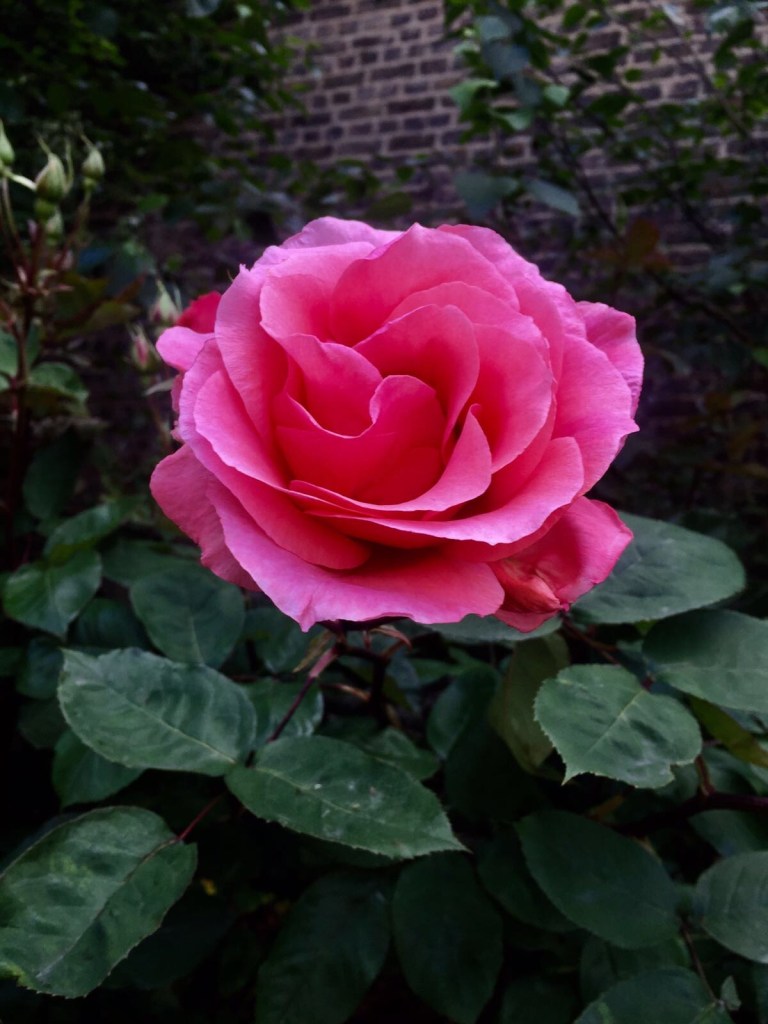
In our little London garden is a David Austin Queen Elizabeth rose – still blooming in autumn. My mother bought it after my father died when she had to start a new life in her new home. Now it is with us. The same rose was among the flowers on the Queen’s coffin – in remembrance of things past but not forgotten.

Queen Elizabeth Rose by David Austin.

This has been A Letter from A. Broad, written and read for you by Muriel Murch.