Wolf Moon

Written and recorded by Muriel Murch with WSM by my side

Last week the Wolf Moon rose over the whole world. Shining brightly through clouds and fog, it blazed through the night and our windows while the coyotes howled for mates on the lowlands along with their wolf brethren deep in the forests. It’s a strong moon for the middle of winter that harbors renewal as seal and sea lion birth occurs on the seashores around us, but the ground is still cold and – tempting as the sun can be – it is too soon to start planting a garden.

Coyote looking about the farm. Photo by Walter out West

The predators that come through the farm change through the years and we would do well to take note. For the moment there are no raccoons or foxes tiptoeing up the stairs to our little terrace. They are deeper in the woods, also hiding from the coyotes and the bobcats that are also happy with the local takeaway of pet-fur as chicken feathers. The coyotes are hungry and so are the hawks. Both eye our chickens. From time to time they get lucky and there are raids that end in death cries and feathers to tell the tale. The predators know this small holding lies on the edge of farming country and that we are not always as vigilant as we could be. The hawks fly in silently and the coyote is quiet as he trots up the back driveway, looking here and there for an easy catch or any human activity that precludes it before carrying on through the barn and out, down the front driveway. He is scrawny, this coyote who comes through, hungry and skinny beyond just the needs of winter.

But there are others – in human form – who are searching, looking for some nurturing of the soul. He is young, dark with weathered skin and hair that covers his head and face as if he is risen from the sea, a messenger from Poseidon, and now finding himself on land, is not too sure what to do next. He wandered in, up the back driveway like the coyote, and stood behind the barn looking about him for a while. 

Ever the galant host, our son approached the stranger to ask if he is all right? Slowly coming to earth he responds, “This is so authentic man. Your jacket too. It looks like the real thing.” And covetously eyes it. Walter replies, “It is the real thing. I need it. You can’t have my jacket.” They stand in the driveway, as the stranger ponders his situation. He looks again at the farmer before he slowly backs away – like an animal who has stumbled into another bear’s territory. 

But the stranger was looking for something, and maybe found it in the grounded feel of this little farm that sits on the knotty edge of what used to be farming country and is now braced between National Park Land and a vacation paradise. It’s a tricky triangle, played out in this tiny corner of West Marin. But enlarge that geography and the mindsets that cherish agriculture, parkland and vacations, and a storm in a teacup doesn’t even begin to cover it. This week – things came to a head and we have seen and heard the outpouring of frustration and grief at the closure of the ranches within the Point Reyes Parks. It’s a pretty brutal execution and one that could have been so avoided a long time ago with bringing all parties to the table for counsel, consideration, and cooperation. In our local paper – the Point Reyes Light – January 16th issue – there are articles beyond articles of the damage these closures will cause to all the Parklands the environmentalists, the tourists, the ranchers, and the ranch workers whose family members also work in the communities.  Dewey Livingston added a column, “Point Reyes in Time” laying out the history of Point Reyes since ‘we’ took it over.  Sober and sad as it is, it is also a reminder that we are all a part of history. In ‘The Temper of our Time’ Eric Hoffer wrote “Every great cause begins as a movement, becomes a business, and eventually degenerates into a racket.” Putting some of the environmental and conservation organizations into that equation and you might find a good fit.

On the day that I write this letter another historical change is occurring in America. As one administration bows out another is striding in and the world is trembling in happy or fearful anticipation. In a preemptive move, not something the Democratic party do often, outgoing President Joe Biden has pardoned many public servants to prevent false prosecution by the incoming government. The list is too long for this writing but the democratic Chairman Bennie Thompson, and Republican Vice Chair Liz Cheney, leaders of the House Select January 6 committee said on behalf of the committee they were grateful for the pardons. I choke up thinking that Dr Fauci is in need of protection from such harassment. Immediately on taking office the incoming president puts his cards on the table – playing a full flush of pardons for 1,600 people associated with the January 6th riots storming the Capitol. He went on, signing this and signing that and the ‘to do’ list laid out for his administration –  the heads of whom – don’t seem to have yet learned how to lay the table – is long.

Meanwhile – after it is over – I study the news, culling from this publication and that TV station. European leaders, some past, some still sitting at their desks, and some not quite there yet I’m seeing a motley crew with their hair and hats and ties as they took their places behind the second generation American Tech leaders of the moment. 

Past Presidents Bill Clinton, George W. Bush and Barak Obama with Hilary Clinton and Laura Bush

Then I look particularly at the women who – like our late Queen – know the subtle messages of the clothes they wear and the actions they take. Michelle Obama is absent. Hillary Clinton standing beside her very trim husband is wearing a Peace on Earth broach.  Laura Bush has a single strand of good pearls over her dress as she accompanied her husband George.

A universal image probably from Getty or The Guardian.

Melania is wearing a hat – that fits – her mood, and possibly her need to be hidden as she walks back onto the world stage. And as she controls the gloved touches she exchanges with her husband, she does not let his flesh reach hers. Melania’s hide may not be as thick as she likes us to believe. Only time will tell if the oil of parenthood has softened her skin to embrace the world she comes from and is about to enter once more.

This has been A Letter from A. Broad. Written and read for you by Muriel Murch. 

As always supported by murchstudio.com

Remembering Oscar

Written and Produced for you with WSM by my side.

In 1978 the film Julia was nominated for 10 Academy Awards. Directed by Fred Zinnemann, the film starred Vanessa Redgrave, Jane Fonda, Jason Robards, and – Meryl Streep in her first film. Walter was among the nominees for the editing. Of the ten, Julia won in three categories; Jason for Best Supporting Actor, Vanessa for Best Supporting Actress, and Alvin Sargent for Adapted Screenplay. A few weeks earlier, the BAFTA awards in London had yielded a slightly different crop of awards from its ten nominations with Jane Fonda winning for Best Actress, Dougie Slocombe for Cinematography, Joan Bridge for Costume Design, and Producer Richard Roth for Best Picture. My mother and her pals, whom we had invited to the BAFTA awards dinner with us that year, also scored. With postwar frugality, she and her friends refused to leave opened bottles of wine on the table and so – to my total embarrassment – six bottles were deftly pocketed into Gabardine macintoshes and mink coats.

Hraybould, via Wikimedia Commons

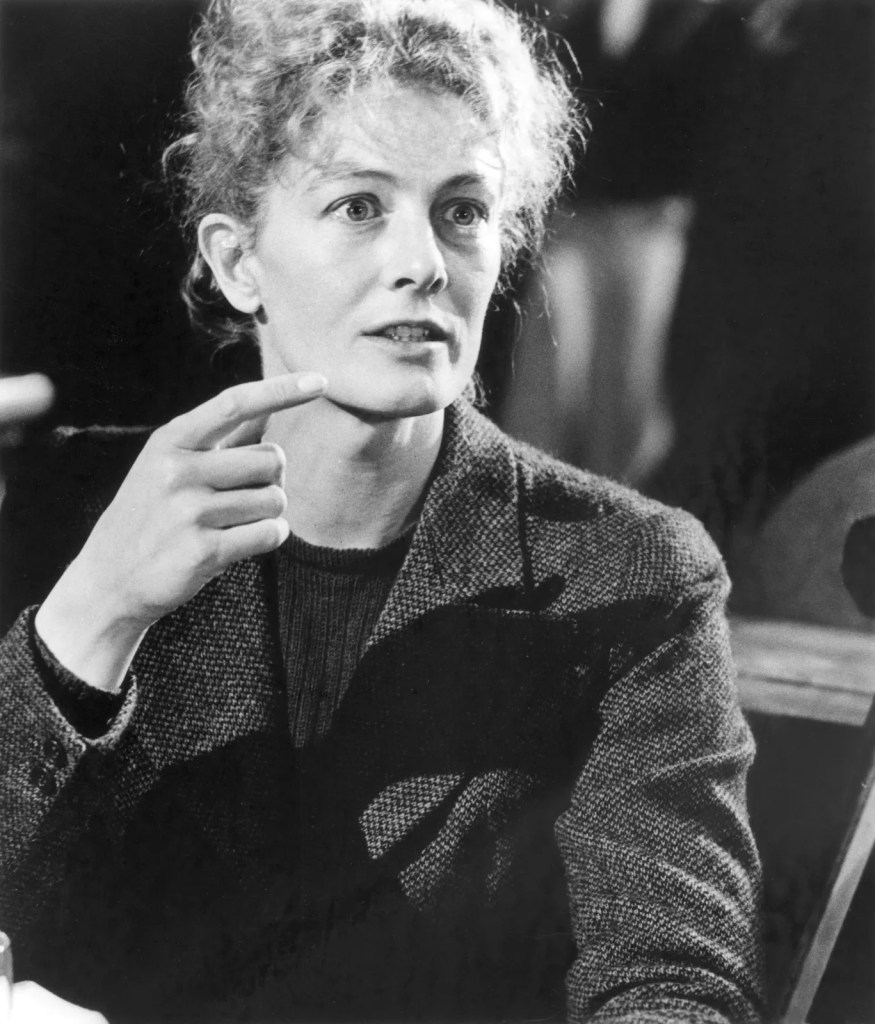
My mother had decided we were being far too serious about the whole awards business and wanted to liven the evening up a bit. “Why it’s just like a school prize giving”. And – as she often was – she was right. But looking back that year on Julia, spent in England having all four children with us, was for me the best of those film adventures that we shared. And when Julia came to an end and was received with critical and box office approval, we kept Fred company going to a few of those awards dinners, bolstering him in the disappointments and learning a thing or two about how the awards machines are oiled and work. At the Directors Guild Awards dinner, Fred quietly whispered why he believed he would not win, while we could see that he did ‘oh so want to’ – just one more time. Woody Allen won for Anne Hall, beating out George Lucas for Star Wars, Steven Spielberg for Close Encounters of the Third Kind, Herbert Ross for The Turning Point, and Fred with Julia. I’m sure I wore the same outfit – a long pale green dress with no particular flair, more discreet than outstanding, but a dress I felt safe in. By Oscar night, because there had been so much political publicity, we were all nervous. Fred nervous from his long-standing knowledge of Hollywood and its people had a saying, “I met him in 1938.” Meaning I know that type and that style. Our nervousness was because we didn’t know our way around this particular Hollywood. Vanessa Redgrave’s nomination for Best Supporting Actress was already causing a stir but she didn’t show any nervousness. The Jewish Defense League had openly objected to her nomination and were picketing that year’s Oscar Ceremony. Vanessa had narrated a film, ‘The Palestinian’ which was critical of Israel’s role in the conflict between Palestine and Israel – then – in 1977. Vanessa’s acceptance speech did not disappoint. There were boos among the applause and Vanessa never returned to work in Hollywood again.

Vanessa Redgrave as Julia in the film of the same name. Directed by Fred Zinnemann 1977

Looking back on that year, and the politics that were uppermost in so many minds, it is hard to accept where we are now. Everything seems more – nothing seems less – and it is frightening for all of those paying attention. 86-year-old Vanessa, and others who have hit that 80-year date, still struggle and sometimes succeed to put the political and artistic work in a perspective that encourages those who follow. Looking back at that seemingly innocent time – but that was not – we are grateful for the work opportunities we had, and the friendships that grew and formed from mutual respect and bound us together. The friendship between Fred and Walter lasted up to and through Fred’s death. On an April spring afternoon in his office, Fred said, “I’m feeling a little tired. I will rest on the sofa.” On his own terms, it was a wonderfully discreet way to leave.

It seems like it has been raining on and off for weeks. Huge clusters of ladybugs have come inside in record numbers, finding their own warm spots, close to light bulbs and on my desk. The farm is saturated to sogginess. Overflowing water scurries down from the Mesa and bounces out from shallow ditches to collect in the fields, puddling in the low spots until it finds its way to another ditch flowing back to the road and beyond. It is as if the farm cradles the water, rocking it from one roadside to the other. The small roadside streams along the road into town are thick with mud pulled from the hillsides and I can’t even see the watercress that was just beginning to be ready for harvest. Now the Wolf Moon has arrived – gentle and mild while as bright and strong as the headlights from the harvesting trucks crossing the fields at three in the morning. The trucks bounce along, with their headlights shining into the hayloft waking me to watch them. I think of them, the drivers and the pickers, rolling out of bed at 2 am to gather the harvest and drive it to its destination by lunchtime. 

Jan 2024 Wolf Moon over Marin by Clint Graves

“Aggie’s breeding frogs.” says one friend to another when we meet in Point Reyes. His friend smiles, and she is not too sure what we are talking about. It is the night-time chorus from our hopelessly disused pond. Somehow – for all of my neglect, water gathers and holds within the reeds, rushes, and Irises and the little green and red-legged frogs settle down to call out to each other. It is at a particular moment in the rainstorms – as if the moonlight on water truly beckons them to sing and mate. There are more, bigger bodies of water up on the Mesa of our town, and for those living close by, the chorus is deafening. Recorder in hand we walk quietly along the driveway but still they hear us. Slowly, then suddenly, all is quiet again as they wait us out. We must leave before they start their singing again. 

Even as we slosh about in our boots outside in the dark this song of the frogs brings a smile to all our faces, begging relief from the horror of the wars’ continuum. Here in a failing pond, is a place of renewal and a sign of hope. 

This has been A Letter From A. Broad. Written and read for you by Muriel Murch