Behind Closed Doors

Written and read for you by Muriel Murch with WSM by my side

The Piazza Santissima Annunziata is almost empty with only a few tourists bearing the late afternoon summer heat while seeking refuge in the churches and museums. Idanna drives straight into the empty Piazza and parks the car. We get out and look around. In the center sits The Grand Duke Ferdinand (from 1608) astride his horse. The horse is facing the little telescope alleyway that leads directly to the Duomo, but the Duke’s eyes, if you look carefully, seem to glance up to two windows, three stories high, on a red building. The shutters remain open so that through the centuries he can look to, and be seen by, his mistress behind them. His arm is raised in salutation to the Pope of the day, or to her – it is left to the onlooker to imagine. On another side is the hospital of the Innocents, an orphanage and museum still run by the nuns from the Sisters di Maria. A small grilled window sits facing the square where – at night time – a mother could – between 1660 and 1875 – raise the grill and lay her new-born babe on the rota where friars, on their night-time shift, sat waiting for a delivery, not as midwives for a wanted child, but as caretakers receiving the fruits of enslaved and then abandoned love. These are the buildings and stories we take in as we make our way to the side door of the Church of Santissima Annunziata, for our friends, Idanna Pucci and Terence Ward have something to show us.

The Key to the door.

“It is a surprise,” says Idanna after we had stopped at the Palazzo Pucci to pick up the ancient key that would have weighted heavy on the twisted cord belt of a monk’s cassock. Again, her face lights with that impossible grin she has when holding a happy secret. The door is thickly double paneled, over eight meters tall, and the strong wood is sun-cracked. Terry takes the key from his pocket and places it in the single lock.

In the bright late afternoon sunlight the key is reluctant to turn and it takes several wiggles before it catches and the door is opened. We enter the tall cool space of this chapel dedicated to St. Sebastian and now lovingly restored by Giannozzo and Idanna Pucci with the help of World Wide Friends of Florence.

WSM and Terence Ward look up to St. Sebastian.

Terry gathers the three red velvet chairs placed in the chancel for musicians together and we gather around as Idanna tells the story. Her lilting voice takes us back to 1082 when a little house of prayer was dedicated to St. Sebastian, then leads us down the path of history through the Middle Ages, the building of this church of the most Holy Annunciation and this chapel, to the paintings commissioned, sold (by one of the unscrupulous relatives) and now lovingly replicated through the guiding hand of her brother Giannozzo. Her voice sings with the joy of the story, coming to when the chapel was reopened and rededicated in May of this year. Idanna is grinning with the happiness of sharing their gift to the city with us. They then lead us around the three major paintings of Saint Sebastian hanging above the alter sanctuary while underneath there are sculpted reliefs of Pucci ancestors, the good and the maybe not so good. Finally we look up at the breathtaking cupola. As we lingered in the beautiful sanctuary a guide from the main church brought in two more visitors to see this sidebar of history. Taking our leave, we walk over the moveable stones that cover the crypt holding Puccis and maybe even a Medici or two. “Have you been down there?” I ask Terry, and he firmly shakes his head. “I have looked. It is a jumble of bones all tossed about, from the flood’. In 1966 the Arno river flooded and swamped Florence ravaging much of the art and bibliotic heritage of the city. The Pucci crypt would be one among many holding places of the dead to be tumbled into confusion and dust. Leaving, Terry turns the key once more in the lock. Walking to the car in the still almost-empty Piazza, I silently said goodbye to the orphanage museum, the Convent of the Sorelle di Maria and the old Duke with his arm raised in salutation.

The Hospital of the Innocents – Orphanage and Museum – Photo by WSM

With our time in Italy we missed the final run up to the UK general election and returned only in time to watch Ukrainian Prime Minister General Zelensky meet his Hungarian counter part, Victor Orbán. Orban, who for six months more is head of the European Union, then went on to chat with his pal Vladimir Putin.

Orbán and Zelensky meet

The countries that make up the EU cried ‘Foul, He is not speaking for us,’ but Orbán merely shrugged, figuratively speaking, saying he was just going to listen and hear what each side has to say. He may be dreaming to broker a peace deal – always a good thing to have noted – but his hand is more eager to grasp Putins’ than Zelensky’s. As each Eastern European leader swims across the tides of history pulling and pushing the boundaries of their country it is within our memory to recall Hungarian refugees arriving in England while fleeing their own county’s oppression.

As July 4th – the UK polling day ended – TV screens lit up like a game show as presenters pointed out which constituencies were turning from blue to red with touches of amber for the Liberal Democrats and green for – well – the Green party. But it is the red of a Labour takeover of the country that has prevailed. As Dishy Rishi drove off to hand his resignation to the King, the movers were quickly packing up the Sunaks’ plates and cutlery, curtains and bed linens to take out of the back door. An hour – or is it two –  later, steady Sir Keir Starmer was off to Buck House, asking the King’s permission to form another government. The handover has to be quick so the country is not left to its own devices. The moving vans are as quick in and out which is rather lovely, for #10 Downing Street is just an old run-down city house in constant need of repair. The inconvenience of any refurbishments only heightens the impermanence of the position, as power comes and goes and hopefully, while you have it, you can do more than change the curtains.

Sir Keir Starmer has not been idle. The smell of Pledge furniture polish was barely cleared from the cabinet room before he gathered his new team around the oval table and gave them each their work orders for the weekend. There was not an old Etonian among them and there would be no potting shed moments. For some, their bags were already packed to fly out, meet and greet, and start work. The weekend saw Keir begin his trip around the British Isles meeting the other UK government leaders. While with the First Minister of Scotland, Sir John Prescott, the chants from protest marchers could be heard through the ministerial walls before Sir Keir was whisked away past the waving Pro-Palestinian flags to meet the First Ministers of Wales and Northern Ireland. On Monday, he arrived in Washington DC, attending the two day Nato conference, filling his movable dance card with more meetings of world leaders, some who are uncertain about their political future. As Sir Keir enters the stage, others are exiting, stage left or right or hovering in the center holding an unenviable heavy portfolio. While Zelensky can be assured of continued support from the UK, the State of Israel, Gaza and the Palestinians remains out of balance. The elections in France have handed Macron a mixed plate but there is relief that, for the moment, the Far Right parties of Farage in England and La Pen in France, though now more visible than ever, have been contained – but only just.

When thirteen of us gathered together at a Palestinian restaurant on the Marylebone Road, for a Coup 53 reunion and an early celebration of Walter’s 81st Birthday, I looked around the table counting our birth-countries: Sweden, The Caribbean, Finland, Iran, North America, Ireland, and England, and am grateful to break bread in a place of such multiplicity.
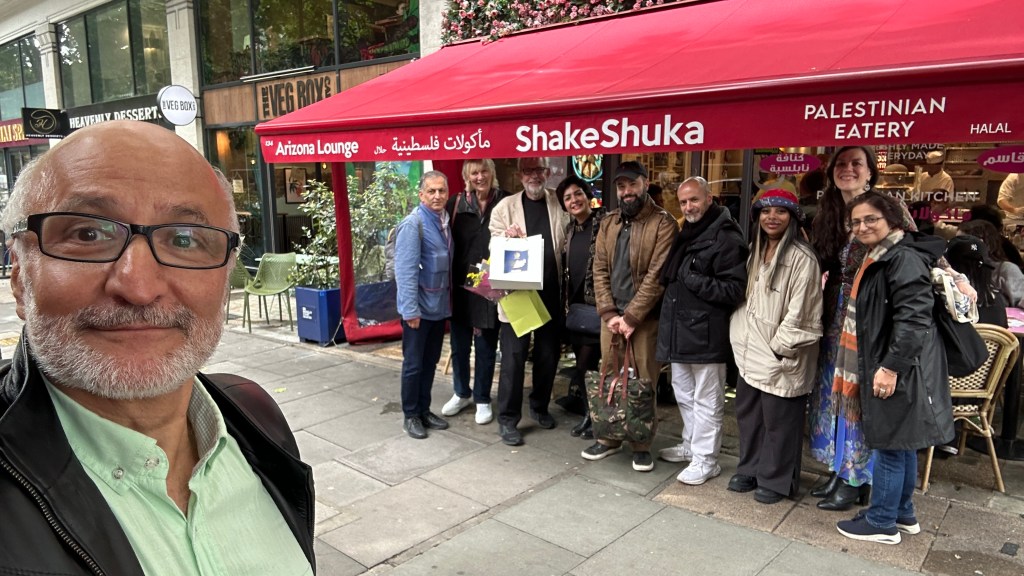
Taghi Amirani and team. Photo by Taghi

By the closed door of the ladies, I stood with a tall, young, beautiful Palestinian woman just back from the day’s march. “How was it?” “Really good, we were over 100,000 strong.” Smiling together we know that however dissimilar we appear our women’s hearts beat in one accord. 

And always supported by Beatrice @ murchstudio.com

The Sky is Crying

Written and Produced for you by Muriel Murch with WSM by my side.

“Look Granny, The sky is crying,” David says as he peeks out from underneath our umbrella. And we laugh because the rain is soft and light and warm and we know that it is just a little late May-time cry from the sky. And of course it is raining because the cottage windows have just been washed.

The park Elderflowers are bowed down with the rain

First I see his ladder, it wobbles as he perches it up against the study windowsill before ringing the door bell.

“ello Aggie – I saw you was back.”

“Perfect Chris – I have been thinking about you wondering when we would catch up. How have you been?”

“All right – middling you know.” And together we laugh as old friends do. Chris drives up from Sussex and parks his van somewhere in Camden. His tools are simpler now, an old wooden six-foot ladder that is wrapped in cloth and duct tape to protect the windows, a black plastic bucket, spray bottle of dish soap, window wiper, and cloth. He has a route of regulars through Camden, up Parkway and Regent’s Park Road before curling down through Primrose Hill until he has had enough for the day and can circle back to Camden, load up his van and drive home before the commute traffic gets too full. 

“You’re limping more,” I say to Chris, Such is our familiarity over close to 20 years that I can say such things. 

“it’s uh cyst on my muscle,” he replies. “Never heard of such a thing.” And he limps up and down the stairs. Chris is a London lad who, with his move to Sussex, has dipped his toes into semi-country living. He is old school and while he will go to the doctor he will not voluntarily step foot in a hospital. With Dickinsonian knowledge he knows well that you can die in there. As Chris does less for us – I pay him more. No longer able to hoist a big expandable ladder, nor not steady enough to carry our flimsy one upstairs, he no longer clears out the junk and leaves from our gutters. There was a time when he could reach the outside of the upstairs kitchen window and then help me replant out that lonely flower box. But no more. He can’t get up on the ladder and I can’t get onto the kitchen window ledge. About an hour in it is time to ask. 

“ Would you like a cup of tea now Chris?”

“Oh, wouldn’t mind at all.” And so I make the tea. Chris is close to finishing up but the tea must come as tea break – not the end of the job. With milk, no sugar, and two biscuits. Chris needs the break and I sit down beside him. It is time to talk over matters most serious. But before we start Walter comes up to say hello and goodbye.  Chris doesn’t quite stand up but returns Walter greeting.

“Morning Sir, you are keeping her well then I see.” While my husband chuckles his response I feel like an elderly dairy cow – still producing. But this again is our familiarity. Now it is time to get comfortable with our conversation.

Chris tells me of his sister in France – doing well with her family. And then it is on to politics. 

John Swinney is sworn in as First Minister of Scotland – Photo from Hollyrood

The Scottish National Party is doing the Highland Reel with their changing of the presidential guard – for a moment longer – the leading Scottish governmental party with the First Mister of Scotland, and have just chucked out their leader Humza Yousaf as First Minister. He seemed to go quietly – almost too quietly – some saying he fell on his own sword with his dismissal of a collaboration with the Green Party and then begging them back to no avail. Sir John Swinney steps up to the helm, saying he will continue Yousaf’s independence strategy. A brown man steps down for a white one – who – admittedly is apparently untarnished – unlike Nicola’s Sturgeon’s husband Peter Murrell or her mentor Alex Salmond, neither one as yet in jail for any financial slipping and sliding and who both look like 19th century Moreland farmers still eating beef in quantities over and above the necessary calories for sitting around in government houses. Stepping up to the microphone as the new first minister, Sir John Swinney is trimmer. At first this looks like a right old stitch up, but maybe he is a guiding tugboat bringing this limping ship of the Scottish National party into safe waters. It remains to be seen.

Prime Minister Boris Johnson with his dog Dilyn after voting at a polling station in London in 2022. (Photo: AP/Matt Dunham)

Meanwhile Chris and I continue, curling our lips in mock horror at the buffoonery of Boris Johnson showing up to vote in the English by-elections without any ID – a law brought in by his government under his watch – and his – “you’ve seen me with my terrier dog on a lead” – just does’t cut it. We shake our heads in mutual disdain. Now the tea is finished, and it is time for Chris to carry on along his rounds and we say goodbye until he comes knocking on our door again in a few month’s time. I will see him through the summer, with his little ladder propped up against the window of a rock and roll bar on Parkway.

As the by-election results come in we watch the Tory party begin to implode. Rishi Sunak holds a tight grin as he speaks and congratulates the few Tories who have held onto their seats. A photo-op occurs in an Indian Restaurant where he is filmed chopping carrots with such inefficiency that the by-standing chefs are biting their lips and holding a tight smile as if watching a child with a knife for the first time.  The Labour Party Leader, Sir Keir Starmer tries to look hard-working and casual as he goes about the country congratulating those who have worked hard on winning their labour seats. Poor man – someone should tell him that a white tee shirt under a jumper doesn’t suit every male figure. And all this hopping about the country for these by-elections puts the real business of government aside. The Conservatives are in the process of taking a whipping at the polls and government ministers are shuffling from one foot to another, not yet quite sure where to land and where to speak. 

But Foreign Secretary Sir David Cameron has stayed busy, and along with the French President Emmanuel Macron, committed money and arms to Ukraine while still trying to broker any kind of peace in the Middle East. Russia’s President Putin has plenty to say about that.

The student protests with Pro-Palestinian sympathies about the bombing of Gaza are growing around the world, each country’s universities going about their demonstrations in their own cultural way. On the campuses here in England, because so far there are no overt clashes between the students, the administration and police, they are not covered by the evening news. While the young students and some professors already know the cost of speaking out, they are prepared to do so. When asked by the Guardian columnist Nesrine Malik about the cost – of their education, their reputation – a student replied, “The students in Gaza don’t have schools to protest in; they don’t have medical care to be taken away from them. This is nothing compared to what they’re experiencing.” Could it be that this time it is the young of the world who can silence the guns of war.   

This has been A Letter from A. Broad. Written and produced for you by Muriel Murch

And always overseen by – beatrice @ murchstudio.com 

Sunshine and Storms

Written and Read for you by Muriel Murch with WSM by my side.

This Letter was written last weekend just as the storms were breaking in Israel, Gaza and Palestine. Since then events are unfolding at a fearful pace and I have not gone back to update this blog. There are better places to find out what is happening as we try to keep all people in our hearts. This program is always first aired on KWMR.org on ‘The Lowdown show’. KWMR.ORG is in the middle of its fall Pledge drive. If you feel you can support the little station that could and can and does make a difference, we are all grateful – especially in these difficult times. Thank you. https://kwmr.org

On this bright Saturday October morning, The Primrose Hill Farmer’s Market is bustling. The stalls are overflowing and there seem to be more shoppers, children and dogs than I have seen all year long. Like squirrels, we are stocking up for the winter ahead. I buy olive oil and artichoke hearts from the Olive Bar, then see Ron, who now walks with a cane, with his Horizon collection of honey and I choose a jar of freshly harvested heather honey. From Pete, of Brambletyne Farm, I gather eggs, small windfall apples, some of the last Negro Kale and fresh mushrooms. Spelt bread from Olivers and the French baker who always gives me a sweet grin and his ‘best’ loaf. Alex of Five-Way Fruit is doing a brisk trade with perfect pears and the last of his berries grown in plastic greenhouses. Here is lovely Angelina, who comes at harvest time with their family wine and olive oil from Italy. Onto the back of the market and Varley and Crouch for Parmesan and a slice of three-month-old sheep cheese plus 100 grams of Parma ham for tonight’s supper, with Matthew’s Eden Farm Organics baked potatoes. Mathew also has the last of the fresh carrots – they are getting large, but with their tops on, are still fresh. I remember to buy unpasteurized milk and butter from Steve Hooks’ farm stall. But no meat today, either from Hooks or Picks or even one of Rafik’s chickens. I pass by fresh pasta, smoked salmon, empanadas, fresh broth and tempting macaroons. On my way out I take a loop through Ted’s Veg and there is the prize of the morning. Bert, of Ted’s Veg, has a basket of fresh walnuts. They are still moist, and the shells green with damp mould. They lie cool in my hand as if they have been plucked from a woodland floor. I scoop two handfuls into a bag and hope that Bert will have more next week. Only when I get home do I realize I have forgotten onions and garlic. The day is full: a noon-time haircut followed by a Film Festival screening. When finally we come home, I am exhausted. Flat out on the sofa, rehydrated with Russet apple juice, I can face the small plate that Walter prepares for me. One of Alex’s moist pears, sliced alongside of thin cuts of the sheep cheese and now those precious walnuts are crushed, the meat glistening and as fragrant as an evening fog-laden autumn walk. Like the squirrels on the hill, I have come home with gifts of the forest.

The walnuts are fresh and moist.

Away from home, wars join natural disasters to fill our newspapers and TV screens. The war in Ukraine remains in the news as much for the war as for the political ramifications, and manoeuvres that are played out on the world stage. Zelensky still strides about in Army fatigues but now they are pressed and clean for he is as often at conferences as he is on the ground with his troops as they enter their third winter in the fields of battle. This is getting messy and does not look to end any time soon. The stakes are too high for both sides.

Nature skips her stones across the deserts and into the lake scolding us for our unwanted cheap behaviour. Storm Daniel flooded and crushed the dams around the city of Derna and swept villages away in Libya, while earthquakes shook villages free from the hillsides of Morocco and Afghanistan.

Coming home from the market, and thinking about what to write for this weekend letter – focusing on the Labour and Conservative Party Conferences that take place in September and October – but while I was plucking carrots, choosing cheese and walnuts – another war exploded. Israel was attacked from The Gaza Strip by Hamas in the biggest attack for fifty years. Among the targets was a music festival held close to the border between the two territories. Israel’s Zika rescue service have so far removed 260 bodies. Images of the festival audience running for their cars also showed the Israeli hostages taken. Many are young, beautiful in their youth, as well as children and grandparents. This was a family day out. There is no pause now, with the Israeli Prime Minister saying the country is embarking on a “long and difficult war”. Hamas claims to have struck Israeli cities while Israel clamps a siege on Gaza. Iran’s officials say “not me gov” and the politicians here are sobered, clambering to position themselves to the right or the left of their own moral consciousness. 

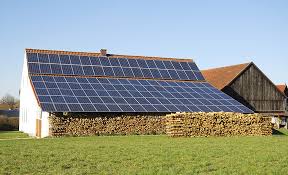
Solar Panels from GreenBiz

The politicians have returned to work beginning with the Conservative and Labour Party conferences. The Conservative party held theirs at the end of September in Manchester, rudely giving the High-speed rail 2 – leading from London to Manchester – the chop. Despite the fact that this was probably not planned out well by their conservative cronies all those years ago – let’s change things for change’s sake – such as the rail tracks width so that no trains running on it could actually link up with other trains across the country or – hold it – going on into Europe. And taking additional slices of the country pie by cutting back on solar panels incentives for farmers. There are a lot of big Conservative farmers who don’t like this new form of harvest, seeing solar panels in their fields as a blight on ‘this green and pleasant land’ preferring their huge combines to scoop out the earth’s resources rather than receive the sun’s bounty.

Now in October, it is the turn of the Labour Party – and even though this brand new war has caused a moment of reflection – the Labour leader Sir Keir Starmer is doing his thing and so is the Shadow Deputy Prime Minister Angela Rayner, she of flaming red hair and a true Council-house background. Now she is ready to roll and she does. Can she and Sir Keir deliver on housing, the cost of living, the NHS backlog, interest rates, immigration and God knows whatever else. There are some serious messes to clean up. They are an unlikely team but that in itself may help to make them work in harness. During these months and years ‘in opposition’ they have learnt ‘when to hold ‘em and when to fold them’ with each other’s style. If they can both keep focused on the country and not themselves, then there is a chance for The United Kingdom to righten the ship of state.

A little Glitter for Sir Keir at the Labour Party Conference

An interesting development is the addition to the Labour team of Marina Wheeler KC – ex-wife of ex-Prime Minister Boris Johnson as Labour’s new “whistleblowing tsar”, offering advice on proposed protections for women against workplace harassment, helping the party strengthen the employment rights of women. After the mandatory six-month break between roles, Sue Grey the former Civil Servant, whose report on the parties at Downing Street during the Covid lock-down helped bring the aforementioned Boris and his boys to the dudgeon – is now Labour’s Chief of Staff. Sir Keir Starmer has more than welcomed these women – formally from the Conservative party – to join him, he has plucked the cream of the crop.

Volunteering at our Community Library has its perks beyond meeting and greeting people from our community. There are books to be borrowed and relished and – tempted by politics – and the writers I do. However the inner truth of ‘Johnson at 10’, by Anthony Seldon and Raymond Newell – documenting the chaos and downfall of the Johnson premiership – is too unbearable to read. But I dive into the muddled waters of ‘Politics on the Edge: A Memoir from Within’ by Rory Stewart with the heartbreaking truths of its pages showing me a Conservative party system rotten to the core and it makes me deeply afraid as I face my naiveté.

This has been a Letter from A. Broad written and read for you by Muriel Murch.

November Light

Written and produced by Muriel Murch. Recorded by Walter Murch

November has closed in and daylight already slips away before tea time leading into the long evenings. For amusement, we watched our new prime minister and cabinet ministers dance a Scottish highland eight-some reel as partners were swung about, changed, and reunited as fast as the fiddler could play. But a Prince who has become the King rehearsed more than dancing in his beloved Scotland. When the past Prime Minister, Liz Truss ‘recommended’ that the King not go to the COP 27 Climate summit in Egypt he bowed to her will and – as the dance partners changed once more, the New Prime Minister, Rishi Sunak, appeared too busy to go. So King Charles drew up an invitation to a reception, more commonly known as a ‘drinks party’ for world leaders to drop in at Buckingham Palace on their way to Egypt where our new prime minister would address them, before packing his bags, and joining the caravan to Egypt. It was a masterstroke of Diplomacy. It might have helped if Rishi did not look like a happy puppy seeing his master come home, but he showed that – at least on the face of it – his government has one eye on climate change. Rishi did not stay long and the conference ended late, finally promising some financial help to those countries worst hit by climate change. This is not enough and there was no real resolution on curbing Co2 emissions. We remain in danger.

King Charles greats Prime Minister Sunak

Struggling to remain relevant, Sir Keir Starmer announced that if he became Prime Minister he would abolish the House of Lords to ‘restore trust in politics’. With so many Tory ministers in the House of Commons having a spot of bother with the press, this may not be that effective. And he may be too late as Peers from the House of Lords have joined members of the House of Commons all hedging their bets. In 2016 only 47 MPs held an Irish passport. By the end of 2022, there are 321 of them. Our ruling class seems to be keen to remain in Europe. 

We watched the American Mid-term elections with trepidation and the physical attack on Paul Pelosi at home in San Francisco holds only two degrees of separation for us. But Mark Kelly won in Arizona and what we feared would become a miscarriage turned into – as one young friend called it – a little mid-monthly-term spotting. But as we see money amassed to be traded for power and the children who hold it become so willful and petulant, it is a warning that this American child called Democracy is as fragile as in any other country.

Mid-November saw us in Poland where Walter gave the first outing of his presentation on the Golden Ratio in the Cinematic Frame to an international conference of Cinematographers. And they took it well. Toruñ is an old city, a two-and-a-half-hour drive North-west from Warsaw and only a hundred miles from the borders of Russia, Belarus, and Ukraine. I was sobered at them all breathing the same cold air as Poland. The Polish men, young and middle-aged, are stoic and handsome – not yet fat with excess – they look as if they could be artists or soldiers – preparing for another war.  

The first afternoon I left the hotel for a mid-afternoon stroll and at 2 p.m. the grey day was already receding. Walking along the towpath by the River Vistula, little white pieces of flotsam kept pace with me, bobbing in and out of the whirlpool eddies. The river is fat, wide, and brown as if grumbling from the mud below. The bridges that span across it are sturdy and utilitarian. There has been no money to spend on beauty. Under the bridge, back up into a small park, rests an old war-lookout bunker with its slotted windows. There is graffiti on the bricks and a homeless man had parked his belongings beside it in the long grass.

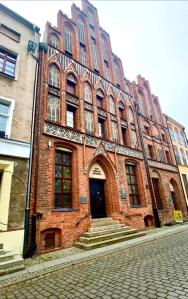
Copernicus’ house in Poland

The final morning was free and we set out walking to Copernicus’ house – as one does – which is now a museum to the study of the stars, mathematics, and medieval life complete with a hand spindle for spinning wool. Along the small cobbled street, we were approached by a young mother and her not-yet-teenage daughter. With her broken English, she showed us the map on her cellphone written in Ukrainian. She was anxious, and lost, not wanting to be late for a job interview. She is a refugee here as the old enemies of Poland and Ukraine unite, sharing the same fears and foes – of Russia. After touring Copernicus’s medieval mathematics we came back onto the cobblestone street and drifted over to the beautiful, small chocolate shop. An old van was parked outside with its doors propped open. Tree branches, wire, and tools were strewn on the pavement as two well-wrapped-up gentlemen began to dress the shop window for Christmas and winter. The shop owner was holding their ladder steady, and, no doubt sharing her directions. On such a dark afternoon this promise of light, which will stay until spring, is comforting.

The train traveled fast through the French Countryside and for Thanksgiving, we go home to where the heart is joining our daughter’s young family in Utrecht. Though we were concerned as that day Argentina had lost to Saudi Arabia 2 to 1 in the World Soccer Tournament being played in Qatar. But a world goal was scored by the team from Iran, everybody’s favorite football to kick around. Iran lost to England 6 to 2 that night but won in respect as they stood silently in solidarity with their country’s women while their national anthem was played. Knowing what could await them and what already might be happening with their families, no one can doubt the raw courage of these young players asking for a freer more democratic country. It is early days yet in the month-long tournament and who knows how far that ball will be kicked down the field. 

Our last afternoon in Utrecht we all walked to the Magic Circus pitched up in the park beside the school. In the late afternoon, we queued outside the small striped tent and single mobile kiosk selling popcorn. The rough benches inside were arranged in a semicircle and it looked like there had been a new expenditure on fifty black plastic chairs. For two hours seven performers from Europe and Argentina, doubled up as spinners of candy floss and flippers of dutch pancakes in the intermission, brought magic to the families in this international city and we carried our smiles with us as we walked home in the dark. Our last evening – hamburgers for supper and then Argentina played Mexico in a game as football should be played. Argentina won 2 – 0.  

Our son-in-law Santi on stage with and then carried off by the Argentine circus performer
Cotton candy tastes just the same ‘says Granny’ and doesn’t stand a chance with this kid.

This has been A Letter From A. Broad. Written and Read for you by Muriel Murch. 

January is Gathering Speed

Recorded and Knit together by WSM

What will this week bring for American politics, for England’s Covid vaccination news, and for all of us living in these times?

With Brexit a done deal, opposition leader Sir Keir Starmer is washing his hands of any Brexit redux, leaving the freedom of travel for Europeans and Britons in the hands of the European Union. Sad as it is maybe he is right to let the English people grumble and suffer on with Boris Johnson’s non-deal.

Meanwhile the Covid Vaccine timetable is being rolled out. Health workers are getting vaccinated, the Queen and Prince Philip have been vaccinated, and white-haired seniors can been seen shuffling along in the cold, queuing outside of drafty tents. Minister of the Cabinet, Michael Gove, does admit “Transport for seniors may present a bit of an issue.” All I can think of is bladder control.

The First BioNTech-Pfizer Vaccine given to ninety-year-old grandmother Margaret Keenan. Photo by Jacob King

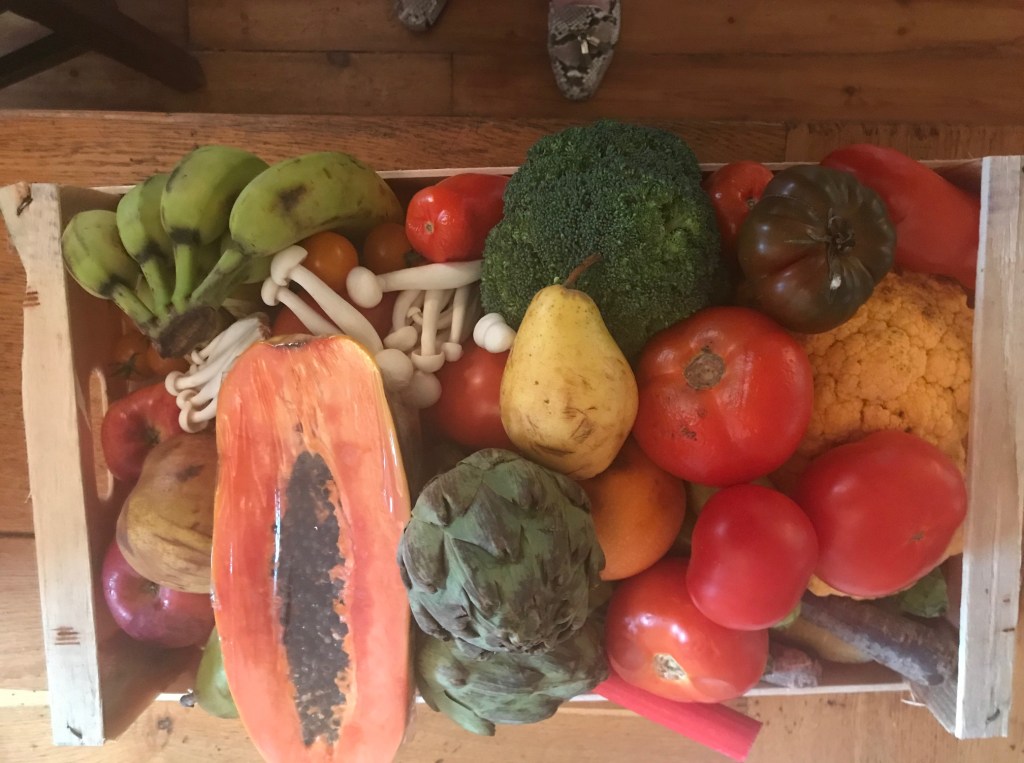
The stillness is beginning to get oppressive. Though there are still clusters of young people milling around the High Street coffee shops, not yet able to give up on the social connection or the metabolic addiction of their cup of Joe. Once again, I write out a grocery list and send it along to Parkway Greens. Later in the day, there is a rat-a-tat-tat on the door, and an overflowing box of fruit and vegetables is laid on the steps.

£ 5 left over special

In Hampshire, where I grew up, the statistics are set out in graphs so color-coordinated I can’t follow them. But next door, Surrey, the homiest of home counties, has begun to build temporary morgues on discrete army grounds. While making room for 800 bodies, the County Council are still concerned that this will not be enough. The small hamlets and villages that surrounded my childhood are dotted with Covid virus cases and death. Old names – Ash Vale, Frimley, Bagshot, Camberley, Farnham, Elstead, Tongham, and Guildford, all a part of my childhood – are now saddened with a startled grief. The home counties suburbs are struggling in their perceived privilege with its lack of discipline as much as the industrial working north is with making a lively-hood.

A friend in London admits to now watching afternoon television. Something she would never have considered even six months ago. We are not there yet except for the momentous events of last Wednesday in Washington DC. But the death this autumn of Dame Barbara Windsor, star of the long-running TV drama East Enders reminded us of the hunger to escape into a fantasy world. And, often I do switch on my Roberts radio, tuned to BBC Radio 4, and catch the fifteen minutes of ‘The Archers’ which this year turned 70. First subtitled ‘The Every Day Story of Country Folk’ with a five-part pilot in 1950, it was created in an effort to educate farmers and improve agricultural production in the early post-war years and had a heavy government influence in the scripting until the 1970s. I can remember it playing on the wireless in my nursery where I would be having supper and someone would be ironing. Our generation listened to it for years, it was as ingrained in our minds as a Catholic catechism. School term times came and went, and whenever we returned ‘The Archers’ would be playing in their 6.45. p.m. slot. You could dip in and out of the village story, for it never lost its charm or its relevance to rural living. Even when television came nipping at radio audiences with their soap operas of Coronation Street and The East Enders that focused on working lives in London and the north of England, The Archers carried on.

Over this summer, the episodes of The Archers continued with a story of three British-born young men kept as slaves in a secret location on the outskirts of Ambridge, each one having a learning or mental health disability. This is the appalling reality that The Archers’ editor, Jeremy Howe, chose to confront as well as to challenge. According to the Global Slavery Index, it is thought there are up to 136,000 victims of modern slavery in the United Kingdom.

“It’s not simply a problem involving immigrant labour,” explains Howe. “It can be a British problem involving British slaves and British gang-masters.”

Reading the Saturday Financial Times paper on Sunday, I found a small article tucked in a lower corner. The South Korean Government knocking on Japan’s door once more for recompense for the Korean Comfort Women kept for the Japanese soldiers during WWII. The Japanese are, naturally, dismissing any further claims of compensation for the now very few women left alive. I first came to this story with Nora Okja Keller’s book “Comfort Woman” published in 1998 when for KPFA and KWMR we had a conversation about her book which was loosely told from her grandmother’s remembrances.

Three hungry young men

Slavery, and enforced indenture-hood, in today’s world, is nothing new, but something we don’t always look to find on our doorstep. Simple dramas like The Archers can do that for us. And so can the three young men of undetermined Slavik European lineage who “worked” for what we now call our Irish Rogue Roofers in 2016. We were taken for a right royal ride and I can only shake my head at our stupidity. And I remember those young men who devoured all the food I fed them and spent the longest time relishing hot water as they cleaned up at the end of the day in our bathroom. Photographs and recordings given to the police yielded nothing more than a night-time stop-over in a local police station for the family patriarch. In the silence of these restricted and cold winter months, with no work available, I pray that those young men are somewhere safe today.

This has been a Letter from A. Broad. 

Written and read for you by Muriel Murch

First aired on Swimming Upstream – KWMR.org.

Web support by murchstudio.com