I ain’t’ done nothink

Written and recorded by Muriel Murch with WSM by my side
Eurostar from Rotterdam Station – photo by Beatrice Murch

Though paused along the track, the Eurostar train to St. Pancras arrived on time and we disembark. It seems to have been a full long weekend away in Amsterdam for musicians and young families. We had joined the train at Rotterdam after our grandson David’s 9th birthday and the best Dutch birthday cake ever, homemade by David and his mother. On the platform, those of us who are older, the grand-parent tribe, and the wandering poets are quickly passed by the young musicians and even the families struggling with all their stuff to gather and bundle up. By the time we reach the last turn into the exit there is hardly anyone with us as we pass the four customs officers standing together. They seem to be hanging out, just chatting, but as I look at them – and they don’t meet my eyes – I realize they have been looking at us all. First I wonder what on earth do they think we are carrying, and then I realize they are also looking at whom we might be carrying.

Slavery – indentured servitude – is still alive and well in Britain and Europe. The German far right politician Jörg Dornau employs political prisoners from the uprising against Aleksandr Lukashenko’s political re election in 2020. Dornau owns an onion farm in Belarus where around 30 prisoners work, many of whom, like Nicole who told the story, had been jailed on political grounds and for “liking” old social media posts from 2021. The prisoners sorted onions for roughly £4 a day on what Nicole described as a strictly voluntary basis. And the onions tasted good. They are the lucky ones. But the customs officers waiting to see the passengers leave the Eurostar train were watching for those not so lucky.

Emerging into the station proper we pick up breakfast essentials before heading to the taxi rank. This evening the queue is not too long and we shuffle forward at a steady pace. Naturally everyone is tired, looking at their phones and not speaking. But suddenly there are quick soft running footsteps, and a child’s voice shouting “I ain’t’ done nothink.” More running footsteps, a longer stride and a uniformed youth catches up with the child, who is clutching a brown paper shopping bag and still yelling. “Let me go, I ain’t’ done nothing.” Faces lift from the phones and those in the taxi queue look as the young officer catches the barely clothed child wearing shorts and a very oversized t-shirt. Now there are more footsteps, heavier as in regulation police boots, and six uniformed security policemen, all under the age of thirty catch up with their young partner who is barely holding onto the child still crying out, “Let me go I ain’t done nothing.” Then suddenly the air goes silent and it is over. Taxis come to the curb, the line moves forward, and as we wait three patrol cars with lights flashing and sirens ringing come to a screeching halt beside us. I marvel at all the adrenaline rushing through at least nine men holding one child. And the silencing of the voice that echoes Oliver Twist in 1837 – led on by The Artful Dodger, used and abandoned by Fagin.  What really has changed in almost 200 years? Not so much. Hardship finds us along many paths.

Flying high over the carnival – photo by Beatrice Murch

On the autumn Sunday afternoon in Utrecht we visit a carnival. It has popped up outside of a Jumbo shopping center and is an easy distraction for small children, and some who are no longer so little. We’re cruising, grandson David passes the candy floss as he leads me to this fishing hall, that shooting range, all the time with his eye out for the bungee jumping trampoline that looks terrifying – to a Granny. Suddenly there is his best friend from down their street. The boys are thrilled to see each other, the bungee jump forgotten for the moment while the mothers chat together. The afternoon ends with a closing-time visit to the big public library which is institutional but welcoming and impressive. I am – as Grannies do – sitting, resting and waiting outside when the mother of David’s friend approaches me. Bea has sent her over.  “Mum’s a nurse, ask her.” “May I ask you something?” “Yes of course.”

She is from Ukraine and has three children, two boys and one girl. Her husband has left her and they are now divorcing. The afternoon carnival is a cheap distraction for them together. Her long hair is matted, her clothes look to have come off of the floor and her sneakers are – for want of a better word – inadequate. The children are hovering, watchful, a little distant, protecting her as best they can. They are nervous of her speaking with a strange woman, even from their friend’s family. The mother had a little accident on her bike and her thumb hurts. Is it broken? Should she go to the hospital? But that means a four hour wait in the emergency room and she has three small children. In her state the slightest upset blows into a potential disaster. Softly I ask if I can touch her hand and she nods. I take her hand in mine and begin to gently feel here and there, bend the hand and fingers this way and that. Quickly I know that it is not broken. There is a little warmth suggesting the thumb is strained. I continue to hold her hand, for with the act of touching and receiving her, she begins to calm. I tell her about arnica gel. Seeing their mother relaxing, the children creep closer to us as we retrace our steps to the pharmacy. Which is – naturally – at 5.30 on a Sunday afternoon – now closed. But the young mother is looking better, more purposeful and with a little smile. The children cluster closer still around her as we said goodbye. The eldest boy shakes my hand, the two little ones smile and wave. They are grateful that someone had listened and received their mother. This little Ukrainian family have been in the Netherlands since before the war began.  Maybe they knew what was coming or maybe they just got lucky. Now it makes no difference. They are adrift and broken in a foreign country. Hardship finds us along many paths.

The conflict – pick any red dot on the map – in the Middle East – has pushed the Ukrainian War off of the page and the screen. Cold mud and snipers are not as photogenic as nighttime rockets and buildings ablaze. Rubble and body bags are more prolific in any of the states at war in the Middle East than in the Ukrainian villages on fire. This war has a published start date of October 7 but that cannot have been the beginning. Israeli solders are schooled that attack is the best form of defense, but all of those red dots – in Gaza, in Lebanon and beyond – do not appear as the work of a country defending itself. Back, back we go into history, Europeans and their pens, pencils and rulers, drawing lines across the desert, pointing fingers and saying ‘That will do.’ 

This has been A Letter From A. Broad. Written and read for you by Muriel Murch  

And always supported by murchstudio.com

Dear oh Dear

Recorded by WSM edited by MAM
King Charles III greets Prime Minister Sunak

“Dear, oh dear” muttered the new King, Charles III, as he greeted Liz Truss at Buckingham Palace only two weeks ago. The double doors were swung open by a liveried equerry announcing “Prime Minister – Your Majesty”. Ms. Truss bobbed forward to shake hands with the King, and said, ”Your Majesty, great to see you again,” the King smiled as he replied “Back again?” – “Well come along then,” he may have continued – but we missed that bit as, like a patient headmaster, he led the not quite settled in new Prime Minister into another room. Last week – as I began to unpack in Rome – she was back. “Oh dear oh dear.” The King may have said – again.

So Liz Truss was out, holding the seat warm for whoever wanted her place. There were only three takers for the open seating plan at Number Ten Downing Street, and they were not sitting in the stalls. Boris Johnson immediately flew back from his holiday in the Caribbean – reportedly booed as he got on the plane. Rishi Sunak got busy on his phone, emails, or in the tea rooms. Only Penny Mordaunt was seen in the halls of Westminster, looking strong, sensible, and even a little tough. She made me wonder what a woman like her could do if the men in Parliament really backed her. But these men are not the backing kind. 

The country was in an uproar as the disaster of Truss’s short-stay-to-let was seen but not averted. Clusters of shoppers were shown tut-tutting at the country markets – always the prettiest picture – as parliamentary plotting – all perfectly legal – continued. A candidate had to have at least 100 Conservative votes to make the ballot for the role of Prime Minister and by the deadline of 2 p.m. on Monday Rishi had 182. Penny conceded at 1.58 p.m. Boris, like a cornered bear, threw in his towel, and lumbered away on Sunday night, declaring ‘this is not the right time’. Let us hope history is remembered and it never becomes his right time again. Sunak was educated at Winchester College, not Eton, and like Avis, it can be hoped that he will ‘try harder’. 

The autumn temperature drops day by day and the leaves fall from the London trees only just faster than the Conservative cabinet ministers gathering their pens and papers as they scuttle out of their seats.

In our corner of London the cool morning air smells of sweet ripe apples, from a box of them set out by a neighbor when she returns from her country retreat. I make apple sauce that is as perfect as Bramley apples give before we go to Europe: first to Utrecht with family and an end-of-summer outdoor birthday party, then onto Paris to be with friends. Paris sparkles with the first crispness of autumn sunlight and delight, the streets and buildings shine as they brush off the stale air of summer and the lingerings of Covid. People are cautious and sensible as they move through the streets, mindful of the effects of the Ukrainian war on fuel supplies and costs. The city seems hopeful, bordering on contentment. A restaurant owner brings out a jar of truffles he has just acquired and we laugh in happy expectation of his fine omelets. We are here in the autumn of our lives, cherishing it, for we know our winter is near.

Fresh Truffles in Paris

And then it is onto Rome for their Film Festival, showing William Kentridge’s ‘Self Portrait as a Coffee Pot’. We are driven from the airport through the back streets into bulging traffic leading to the Tiber River and the city beyond looking weary, beaten down by the effects of the Covid pandemic. A bad garbage strike after the summer’s heat has left the big street bins battered and tainted with pigeon residue. Finally, we reach The Eden Hotel and from our terraced window we look down on a Rome that doesn’t seem so bruised. Lying in the marble bath at dusk I watch the bats wake up and zoom out from under the tile roof just above me to the park below.

Old and new friends in Roma; Noah, Linda, Aggie, Franca, Walter, Conrad, Laura

It takes a day – and we only had two – to breathe in the air of this city which I had come to terms with 24 years ago when I joined Walter on location. On our last evening, walking with friends after dinner we passed by an alleyway I remembered. Then, in a store window, three or four prepubescent girls sat cross-legged under a single light bulb. Old Persian rugs hung behind the girls, and their heads were bent low over their hands which were busy, stitching, weaving threads through old worn carpets. 

The day we leave, our driver is a woman and I am grateful to see this small step forward for equality in Rome. The road she took out of the city twists and turns and we crossed the river three times. The small riverside shrubs of 24 years ago have grown to trees but still the Tiber moves fast. They say a body tossed into the river is never found.  As we left the ancients – looking worn in the grey light – we drove up through the graffiti-clad outskirts of the city. The colors were dusty as they lay scrawled over the lower apartments of these almost middle-class neighborhoods, pulling them down as if in anger that the slums cannot rise but only spread. 

The flight to London was full and it was not until we landed and were ready to go through UK passport control that I stopped to use the facilities. There was a poster on the stall door; a young man’s face peering out from a confusion – of a woman’s hand, a car window, and lights, with the words ’Can you see me?’ ‘Slavery Still Exists’. On the way home, amidst catching the stealth movements of our politicians, I thought of those young girls sitting in the shop window and wondered what became of them in the ancient world that is Rome. 

This has been A Letter From A. Broad. Written and read for you by Muriel Murch.

January is Gathering Speed

Recorded and Knit together by WSM

What will this week bring for American politics, for England’s Covid vaccination news, and for all of us living in these times?

With Brexit a done deal, opposition leader Sir Keir Starmer is washing his hands of any Brexit redux, leaving the freedom of travel for Europeans and Britons in the hands of the European Union. Sad as it is maybe he is right to let the English people grumble and suffer on with Boris Johnson’s non-deal.

Meanwhile the Covid Vaccine timetable is being rolled out. Health workers are getting vaccinated, the Queen and Prince Philip have been vaccinated, and white-haired seniors can been seen shuffling along in the cold, queuing outside of drafty tents. Minister of the Cabinet, Michael Gove, does admit “Transport for seniors may present a bit of an issue.” All I can think of is bladder control.

The First BioNTech-Pfizer Vaccine given to ninety-year-old grandmother Margaret Keenan. Photo by Jacob King

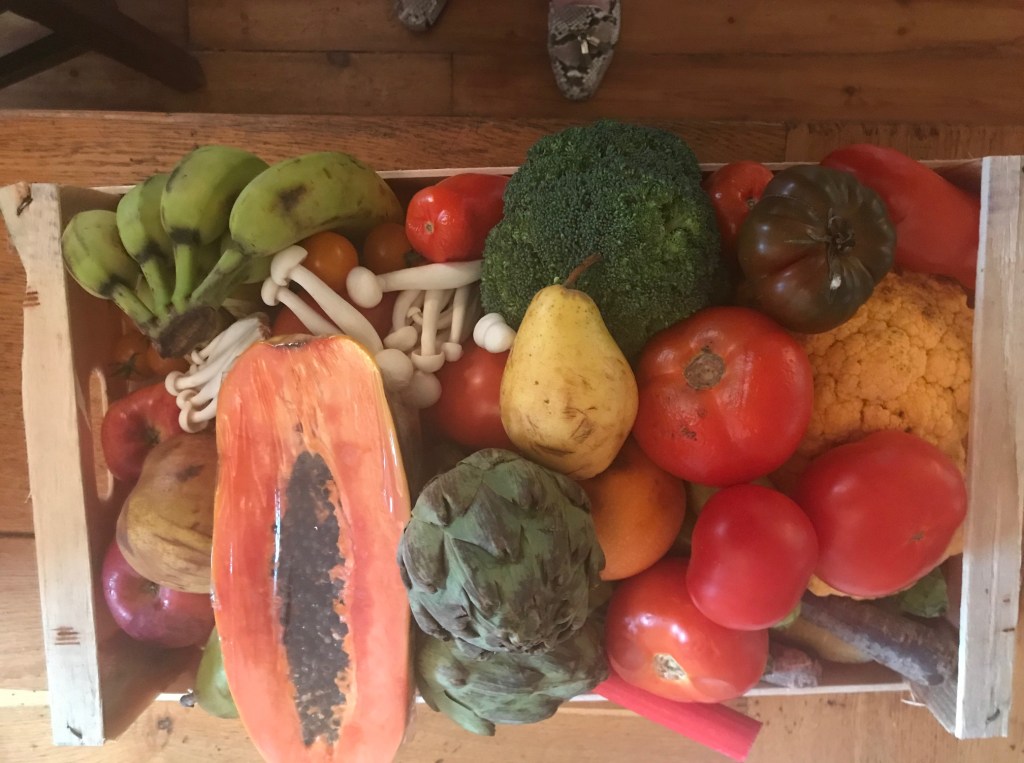
The stillness is beginning to get oppressive. Though there are still clusters of young people milling around the High Street coffee shops, not yet able to give up on the social connection or the metabolic addiction of their cup of Joe. Once again, I write out a grocery list and send it along to Parkway Greens. Later in the day, there is a rat-a-tat-tat on the door, and an overflowing box of fruit and vegetables is laid on the steps.

£ 5 left over special

In Hampshire, where I grew up, the statistics are set out in graphs so color-coordinated I can’t follow them. But next door, Surrey, the homiest of home counties, has begun to build temporary morgues on discrete army grounds. While making room for 800 bodies, the County Council are still concerned that this will not be enough. The small hamlets and villages that surrounded my childhood are dotted with Covid virus cases and death. Old names – Ash Vale, Frimley, Bagshot, Camberley, Farnham, Elstead, Tongham, and Guildford, all a part of my childhood – are now saddened with a startled grief. The home counties suburbs are struggling in their perceived privilege with its lack of discipline as much as the industrial working north is with making a lively-hood.

A friend in London admits to now watching afternoon television. Something she would never have considered even six months ago. We are not there yet except for the momentous events of last Wednesday in Washington DC. But the death this autumn of Dame Barbara Windsor, star of the long-running TV drama East Enders reminded us of the hunger to escape into a fantasy world. And, often I do switch on my Roberts radio, tuned to BBC Radio 4, and catch the fifteen minutes of ‘The Archers’ which this year turned 70. First subtitled ‘The Every Day Story of Country Folk’ with a five-part pilot in 1950, it was created in an effort to educate farmers and improve agricultural production in the early post-war years and had a heavy government influence in the scripting until the 1970s. I can remember it playing on the wireless in my nursery where I would be having supper and someone would be ironing. Our generation listened to it for years, it was as ingrained in our minds as a Catholic catechism. School term times came and went, and whenever we returned ‘The Archers’ would be playing in their 6.45. p.m. slot. You could dip in and out of the village story, for it never lost its charm or its relevance to rural living. Even when television came nipping at radio audiences with their soap operas of Coronation Street and The East Enders that focused on working lives in London and the north of England, The Archers carried on.

Over this summer, the episodes of The Archers continued with a story of three British-born young men kept as slaves in a secret location on the outskirts of Ambridge, each one having a learning or mental health disability. This is the appalling reality that The Archers’ editor, Jeremy Howe, chose to confront as well as to challenge. According to the Global Slavery Index, it is thought there are up to 136,000 victims of modern slavery in the United Kingdom.

“It’s not simply a problem involving immigrant labour,” explains Howe. “It can be a British problem involving British slaves and British gang-masters.”

Reading the Saturday Financial Times paper on Sunday, I found a small article tucked in a lower corner. The South Korean Government knocking on Japan’s door once more for recompense for the Korean Comfort Women kept for the Japanese soldiers during WWII. The Japanese are, naturally, dismissing any further claims of compensation for the now very few women left alive. I first came to this story with Nora Okja Keller’s book “Comfort Woman” published in 1998 when for KPFA and KWMR we had a conversation about her book which was loosely told from her grandmother’s remembrances.

Three hungry young men

Slavery, and enforced indenture-hood, in today’s world, is nothing new, but something we don’t always look to find on our doorstep. Simple dramas like The Archers can do that for us. And so can the three young men of undetermined Slavik European lineage who “worked” for what we now call our Irish Rogue Roofers in 2016. We were taken for a right royal ride and I can only shake my head at our stupidity. And I remember those young men who devoured all the food I fed them and spent the longest time relishing hot water as they cleaned up at the end of the day in our bathroom. Photographs and recordings given to the police yielded nothing more than a night-time stop-over in a local police station for the family patriarch. In the silence of these restricted and cold winter months, with no work available, I pray that those young men are somewhere safe today.

This has been a Letter from A. Broad. 

Written and read for you by Muriel Murch

First aired on Swimming Upstream – KWMR.org.

Web support by murchstudio.com