Filling out Farm Forms

Boot bench

Boot bench

It must have been around 1976, a few years after we had settled into The Old Dairy. We had been checked out, evaluated and in town long enough and been seen to be trying to do right by the land and thus we were assigned our place in the community.

The pantry shelves had not yet become cupboards but the old kitchen sink was installed in the tack room. A bench and a picnic table were nestled into that kitchen space now turned into a ‘nook’.

The bench and table wood was new and shiny and must have been purchased in a rebellious extravagant moment. The benches are long removed, one has disappeared all together while the other has become the ‘back-door-boot-bench’.

The table remains, now taking center stage in a proper sized farm kitchen. Here we break bread and ponder the woes and joys of our family and community lives. But then, in the second half of the 1970’s, these ruminations all took place in the nook.

Jess must have waited and thought about it for awhile. Maybe it was while mulling over his predicament with a cup of coffee and his know-everybody-and-their-business sister-in-law Lydia that she suggested, ‘Try Aggie, down at the Peter’s place.’ For it was still too early to be known as Blackberry Farm, the name we had given The Old Dairy when we arrived. Jess, like many old ranchers of Sonoma and Marin had a little side line in horses. Working ranch quarter horses were mostly home bred but sometimes one could get lucky and dabble in a little thoroughbred breeding for the track. Heck, it didn’t cost much and was a little more fun than raising the steers for market. But the young colts and fillies had to be registered before they were yearling.

This could pose a problem for the old cowboys of Santa Rosa and ranchers of Marin and Sonoma. Most of them had dipped into grade school but many had slipped out when fathers with ranch chores needed help. It may have been thus for Jess. Then, as now, the extent of one’s book learning ever needs to be kept a secret from ones increasingly educated children. Parents then were frustrated and resented, as much as we do now, having to admit our failings with the written word and computer technology.

It was mid-afternoon when the old green chevy truck pulled up in the driveway. At first I didn’t recognize Jess, mostly because he was rarely seen off the ranch or out of his truck. He knocked, as we all do, on the back door.

What did he say in greeting? I don’t remember, the usual, ‘Howdy,’ I expect before we sat down at the table in the nook. Jess reached into the inside pocket of his worn, thick Levi jacket and produced the crumbled forms he needed to fill out in order to register the yearlings. The forms were easy for me, simple and straightforward like a birth certificate should be. Jess had chosen names for the yearlings that we wrote down. The job was soon done and I handed the forms back to Jess. He nodded his thanks and we took a little longer, lingering over a cup of coffee, to talk of breeding, the weather and crops before he rose to leave. I didn’t see him again until 1995 at Mary Magdalene Church when he tolled the tower bell calling Lydia home to rest.

Since that time forms have become a growing crop for farmers.As organic farming becomes a business there are organizations to monitor and check up on us, our fields and our crops.
Must be here somewhere

Like most busy country people my forms get shuffled about and sometimes misplaced so that due dates come rushing towards me.

Now I’ve opened the envelope to another one. The due date, May 7th is past. But I still don’t know or understand what the form is for, why it is necessary or what they want from me. Where to, and where not to, fill it out?

I’ve been thinking about it for too many days now. Maybe it is time for me to get on my bike, ride down the road, and check in with the young farmer by the creek. He seems to know what he is doing.

Farm deliveries

Time to get on my bike to the young farmer down the road.


Permission to Touch: ¿Permiso?

We laugh when AARP first shows up in our mail box on our fiftieth birthday. But over the years we come to read more articles until devouring the magazine from cover to cover. This April’s bulletin issue features Jessica Migala’s article High-Tech Ways to Stay Healthy which looks at the new world of medical app options for both patients and doctors.

In Stuck in the Past: Why are Doctors still using the Stethoscope and Manila Folder? Michael R. Splinter, Executive Chairman, Applied Materials, Inc., asks ‘Why Physicians haven’t adopted more modern Technology?’ He suggests that physicians should get rid of the Stethoscope and the Manila Folder. But I would ask him, along with Medscape Editor, Dr. Eric Topol and others, in the interest of good physicianship, for want of a better word, to hold steady and reconsider, first the sturdy stethoscope with all its uses and then, memory.

Mike Newall’s 2007 film Love in the Time of Cholera opens in the year 1880. Early in the film, Fermine Urbino, having rejected her suitor Florentino Ariza, suddenly, mysteriously falls sick. Her anguished father calls for the young doctor, Juvenal Urbino, who hurries to the bedside of his friend’s daughter. A lady’s maid hovers nervously in the background. Approaching the bed Dr. Urbino takes in Fermine’s glistening, feverish forehead. His hand reaches down to check her pulse. Then, bending low over the bed, and in haste for a rapid diagnosis (and screen drama), rips open Ferimine’s bodice to reveal her breasts, which rise, quivering under such an assault. Putting his ear close to her heart he leans low to hear its rapid, beating pulse while struggling to contain his emotions. But we all know what is going on and – because the film is a little slow and predictable, and most viewers have read the book – what will happen.

We may miss these dramatic bodice ripping moments but it is an undeniable fact that the invention of the stethoscope in the early 1800s made diagnosis of certain illnesses better, and faster.

In 1816, while studying medicine in Paris under Dupuytren and Jean-Nicholas Corvisart-Desmarets, René Laennec began to experiment with ways in which to hear the body better. His first instrument was a plain wooden monaural tube.

This early stethoscope belonged to Laennec (Science Museum, London).

This early stethoscope belonged to Laennec (Science Museum, London).

By 1851 it had evolved to a binaural instrument with flexible tubing. He named his instrument the stethoscope from the Greek words Stethos (chest) and Skopos (examination). Laennecs’ new invention was far more accurate in hearing heart and lung sounds than the old method demonstrated in Love in the Time of Cholera. But it had its detractors. Christopher McManus writes in his Right Hand, Left Hand, that Thomas Watson MD, was known for not only using his new stethoscope but sitting and watching the patient and saying he found the stethoscope ‘more of a hindrance than a help and that although he could not do without it, he did without it as much as he could.’

A young Scottish physician, John Forbes, moved to London in 1840 while his old friend James Clark was the young Queen Victoria’s physician. Queen Victoria loved all things Scottish and was fascinated with modern medicine. So it was not surprising that in 1841 she chose this studious doctor for her family and the Royal Household. Scottish physician or not, Forbes brought with him the new French instrument, the stethoscope.

Not until almost a hundred years later, in the 1940s, did Rappaport and Spraugue design the stethoscope with two sides, one for the respiratory system and the other for the cardiovascular system which remains the basic design used today.

The most basic work horse stethoscope used today.

The most basic work horse stethoscope used today.

What the Stethoscope does now, beyond listening to the regular or irregular trills and lub-dubs of the heart, and searching through the dull silence or fretful peristalsis of the abdomen for the calm gurglings of a bubbling stream, is to permit the physician to bend low, in homage to the body. His other hand may search to feel for a pulse away from the apex beat, ‘the Watson Pulse,’ of the heart’s aortic pounding, catching the dance of the two partnered beats. Maybe his fingers brush the abdomen before he takes courage and palpates the flesh, quadrant by quadrant.

In Argentina it is customary to ask permission, ¿Permiso? before crossing the threshold and entering a home. Today the physician needs an excuse to touch the body and the stethoscope gives that permission and allows the patient to accept this touch. Then he can slip the scope into his pocket and bending closer again percuss the lungs, tapping and listening over and around each lobe that embraces the heart.

As nurses we have permission to touch the patient, and time to be intimate. Washing, turning and tending the body are among our arts. They hold their place as skills alongside checking monitors and charting observations. Touch can comfort and bring safety, relaxation, even healing, and healing can pave the way to curing. Maybe nurses used touch more when we moved from bed to bed in the large open wards of long ago where patients saw and connected with the suffering of one another and were helped by that sharing. In our efforts to incorporate ‘individuality’ and privatization into every aspect of our lives, illness has become shuttered away in lonely single and semi-private rooms, where patients lie secreted and alone.

In Buenos Aires, I have had occasion to see a few physicians over the years I have visited. Nothing big, just mindful checking in and up. The office of Doctor Garavaglia, the General Practitioner, is typical of them all. His big desk faces out from the back wall and the two chairs sitting comfortably in front of it are inviting rather than intimidating. There are two bookcases holding literature as well as medical texts and a screen in the corner to give privacy for undressing and the examination couch if the patient should need it.

In each office, the visits begin with conversation, discussion about our mutual families, for that is but courtesy. Before Doctor Garavaglia asks what brought me to him, what he can do for me, he pulls out a card – no bigger than the old Kardex cards we once used. My name is written on the top, my passport and phone numbers also. And there, in cryptic hand, go a few notes. But then he puts down his pen, and listens as I talk, occasionally nudging me this way or that. For as he listens and watches me, how I talk is as meaningful to him as what I say. I speak of our daughter and he reaches into a drawer, pulls out her card and glances at it. In a moment he has her relevant history in his recall, which he – naturally – shares with me. When, a year later, I return he pulls my card from the same drawer. ‘Ah yes, I remember’ updates are made on the card, then it is put aside. ‘¿Cómo estás? Estas bien, verdad?’ He means it. It is good to see you. And we talk once more.

————————-

You’ve Got Mail

Screen Shot 2015-04-05 at 10.28.40 AM Earlier this year a report came out of Brigham Young University stating that ‘Loneliness and social isolation are just as much a threat to longevity as obesity.’ Republished in Science Daily it was then picked up by The Week on April 3. Thus is university research trickled into public consciousness. This ancient universal truth helps account for the modern obsession that we hold to e-mail, Facebook, Twitter and Instagram. These are all ways of staying connected within a real or virtual community that sometimes feels far way and out of reach.

In the days of long hospital stays, back in the early 1960’s, before rehabilitation centers and convalescent homes were big business, patients stayed in hospital until they were deemed ‘All right to go home.’ The tasks of daily living, such as being able eat, toilet, and digest alone and finally, in the last few days of ambulation, prepare and serve from the drinks trolley through the ward. In those years visiting hours were quite restricted. Patients and families could see each other only as the hospital hours, the family work schedules and public transportation allowed. It was often difficult to be at the bedside of a loved one through the days of a long illness. Cards and letters from the outside were very important.

Like other hospitals up and down the country, the post was delivered twice a day to The Royal Surrey County Hospital. It arrived at the front desk and was handed to the hospital porter on duty. Our head porter was named Frank and each morning Frank took the post and sort it into departments; Patients, Clinics, Matron and finally Nurses. Frank would put the different piles in his bag and, leaving the front desk in the hands of the lady telephone operator, set out on his rounds.

I suspect that this walk-about for Frank was as important to him as Matron’s morning rounds were to her, and, in their way, an essential part of the hospital running smoothly. Everyone looked forward to Frank’s arrival, a signal that maybe ‘you’ve got mail.’ Frank’s cheery face would be welcomed with a reciprocal smile everywhere he went. Frank went from Matron’s office to the Bursar’s, the departments, the nurses’ dining room, and then to each of the wards in turn, bearing cards and letters for the patients. In the wards, Frank would hand the post over to the Ward Sister who, depending on how busy she was, would begin to sort and give them out as soon as she could.

But Frank also had a fatherly interest in us nurses and, once we were no longer students but black-belted, silver-buckled Staff Nurses, he watched the patterns that formed in the letters we received. He seemed to know which letters bore serious intent, what passion was in the strong hand writing on the envelope. We would watch him too when he came to the wards. Sometimes he would pretend not to see us but he noticed weight loss and dark, hungry eyes. After he had handed over the patients’ letters to Sister on Victoria Ward he would look for me. If I was with a patient, he found a reason to wait. If I was by the morning coffee trolley he could come to me.

“Good Morning Frank. How are you today?”
“Well. Thank you Staff.”

My eyes would ask the question and his eyes would twinkle a response as, almost every day, he would pull his right hand slowly from his overall pocket and hand me a square white envelope, covered in airmail stamps. He never left these letters in the dinning room for other nurses to find and tease me with. The Royal Mail was then as fast as our young heart beats.

A Letter from abroad “Thank you Frank.” Did I blush? Maybe so, as I took the envelope from his hand into my deep uniform pocket. It rested patiently, beside scissors and tape, until I found a quiet moment to read alone.
I should have known then it was hopeless. I was supposed to be booking a flight to Malaya to work in the Leprosy Hospital of my friend Bushba’s uncle. Instead I was looking into Flights to North America.

Five months later I joined nurses from all over Ireland, England, Scotland and Scandinavia. We were that generation’s import of cheap labour. The next wave of immigrants from the old world to the new. That was fifty years ago.
This pattern of writing has stood us in good stead. Often we have been apart and whenever that happens we write to each other every day. Over the years The Royal Mail gave way to faxes and eventually to e-mails. There are bundles of letters in old boxes in the barn, files of faxes in trunks in the attic and years of emails stored on computer drives.

This week he flew away again as I stay behind to do what needs to be done. God willing I can join him before summer settles in. But until then we will take time to give and receive each other’s hearts and minds, sharing words together.

Sorrel Soup

Sorrel growing in the garden.

Sorrel growing in the garden.

Sorrel is an early, easy leafy green vegetable to plant in the perennial vegetable garden.

Garden sorrel or Rumex Acetosa and French Sorrel Rumex Scutatus both have a tangy lemon flavour. I’m not sure which one I am growing but it may be the French because of its pointed leaves. Sorrel looks like its weedy first cousin wild Dock but is a brighter, springier green. They all look a bit scruffy but are equally useful. Sorrel for soup and salad and Dock (with a bit of spit) to calm a stinging nettle rash when you are out walking.

This recipe is adapted from one given to me by my friend Creta Pullen. Creta, her husband Bill, and their two very enthusiastic dogs run Ocean Song Retreat Bed and Breakfast.  Creta is an outrageous cook and always concocting something new. It was Creta who gave me my Sorrel starts.

Sorrel 3

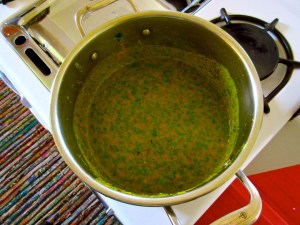
Blended sorrel soup on the stove.

  • Cut a bunch/handful of Sorrel.
  • Wash and sort it and set it in a jar until you are ready to use it.
  • Sauté a chopped onion or leek or shallot in olive oil.
  • Today I added a little fresh chopped ginger and some turmeric and 4 bay leaves.
  • Stir to colour and soften while dicing up a Russet potato and
    chopping 2 carrots.
  • Now add these to the onions and stir some more.
  • Any white wine in the fridge? A glug or two can go in now.
  • After the wine is absorbed add your home made chicken or vegetable stock.

(There will be more on making stock later).

Sorrel 4

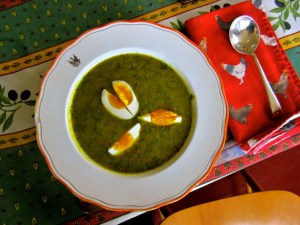
Ready to serve sorrel soup with a hard boiled egg.

  • Let it all cook up gently until the carrots and potatoes are tender.
  • Strip the sorrel leaves from their stems and roughly cut up the leaves.
  • While the stock cools do something else (lay the table, boil an egg or two).
  • Fish out the bay leaves and put them in the compost.
  • Now with whatever blender technique you use, blend the soup and sorrel leaves together. Return to the pot and adjust the seasoning. I add a little pepper here but no salt.
  • Now it is time to add your own favorites. A little milk or cream or butter will soften the flavor. Tonight I made soft boiled eggs.
  • Some warm French bread, a glass of wine and supper is yours and goes down a treat.

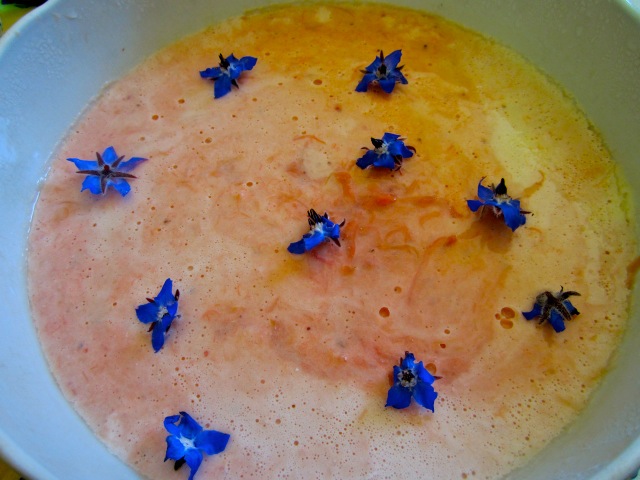
Rhubarb-Strawberry Mousse

Rhubarb-Strawberry Mousse

Rhubarb-Strawberry Mousse

This recipe first appeared in The Times in an article by Olwen Woodier in 1989 I think. Sometime later it was adapted from Mallards Restaurant at Arrowwood in Rye Brook, N.Y.

When I found it again about 2010 I changed it a little – as you will too.
1 1/4 pounds rhubarb, finely diced
1 cup sliced strawberries
1/2 cup sugar
2 tablespoons kirsch
1 tablespoon unflavored gelatin
1 cups heavy cream
  1. Combine the rhubarb, strawberries and sugar in a heavy 2-quart saucepan and simmer for 20 minutes, until the rhubarb is soft.
  2. Pour 2/3 of the mixture into a blender with the kirsch; purée and set aside.
  3. Pour 4 tablespoons cold water into a small saucepan and sprinkle the gelatin over the top. Allow to soften for 10 minutes. Heat gently until the gelatin has completely dissolved. Stir into the rhubarb purée.
  4. Combine the purée with the remaining cooked rhubarb mixture.
  5. Whip the heavy cream until stiff and fold into the rhubarb mixture. Chill for several hours. Serves 8 to 10.
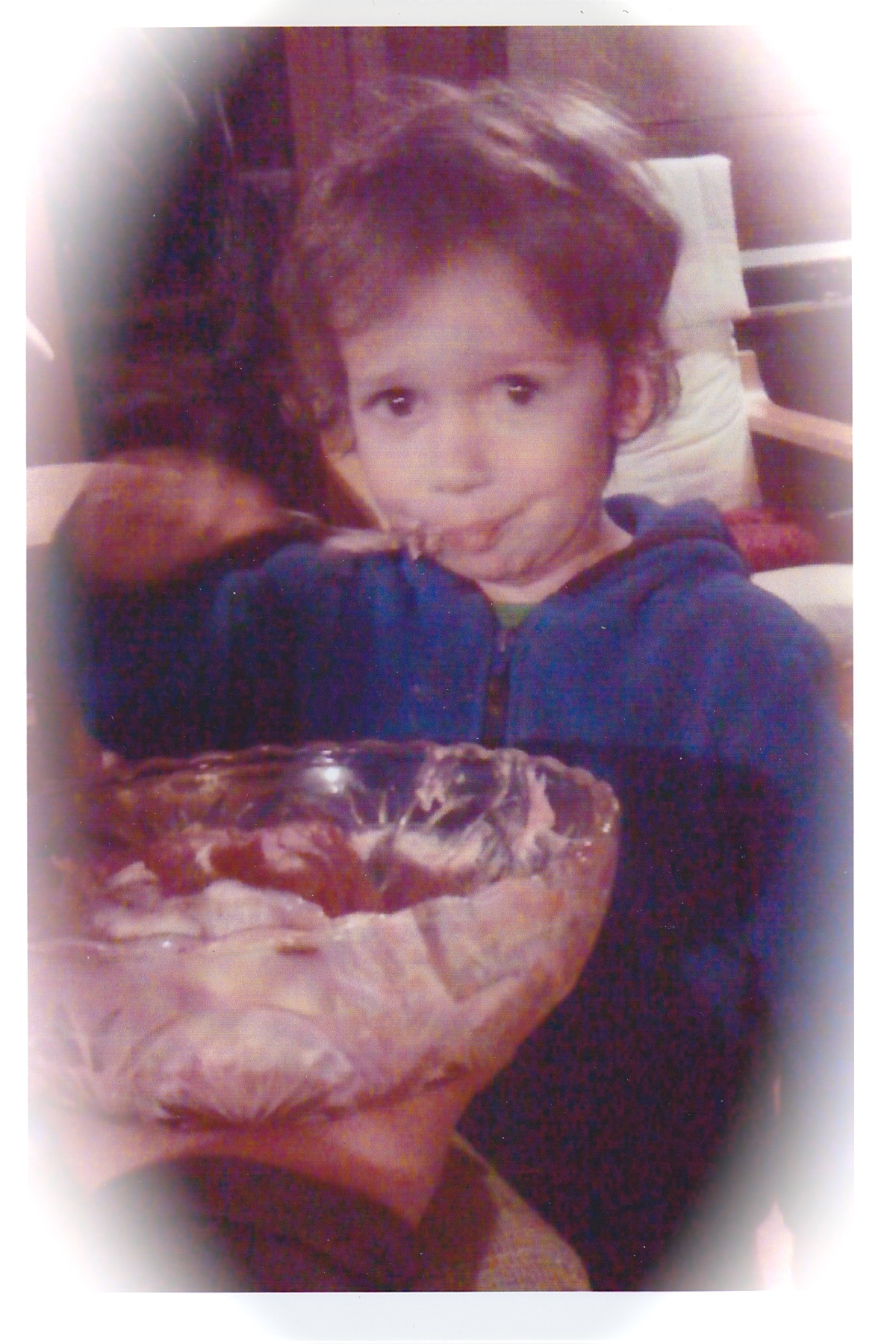
There is no sense in leftovers

There is no sense in leftovers